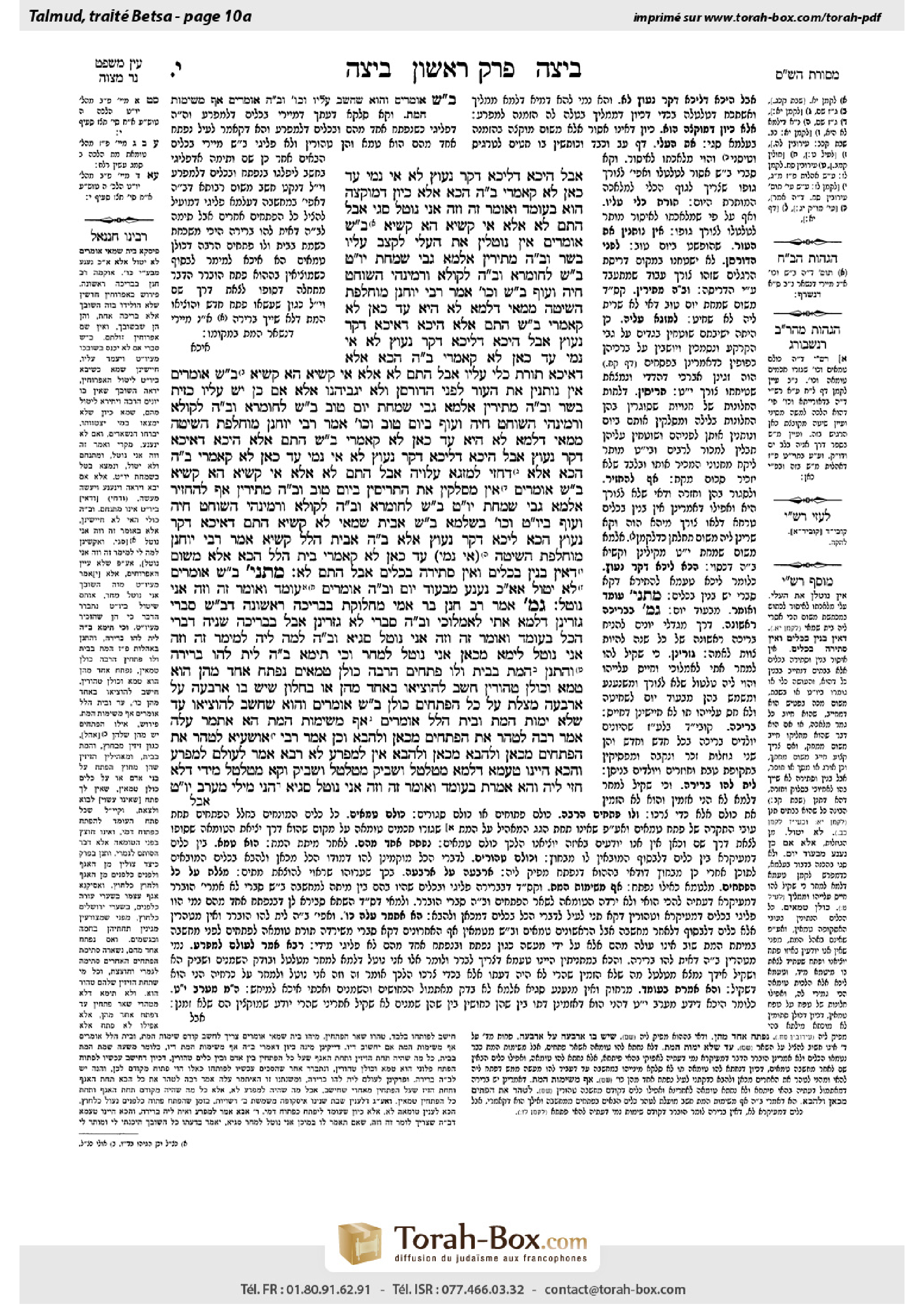
Beitzah 10a: Talmud study for Daf Yomi
Study the Talmud for Daf Yomi with scanned pages, Hebrew text, English translations from Sefaria and AI-generated French translations.
Passage selection and English or AI-generated French translation are available where the scan has annotations. Daf Study is independent of Torah-Box and Sefaria.
Browse Beitzah · ביצה · All tractatesBeitzah 10a text and translations
This page of Beitzah includes the Aramaic text, an English translation and an AI-generated French translation, alongside the scan above.
ביצה י׳ א · Aramaic and Hebrew text
אֲבָל הֵיכָא דְּלֵיכָּא דָּקָר נָעוּץ — לָא. אִי נָמֵי: עַד כָּאן לָא קָאָמְרִי בֵּית הִלֵּל הָכָא, אֶלָּא כֵּיוָן דְּמוּקְצֶה הוּא, בְּעוֹמֵד וְאוֹמֵר זֶה וְזֶה אֲנִי נוֹטֵל סַגִּי. אֲבָל הָתָם — לָא.
אֶלָּא, אִי קַשְׁיָא — הָא קַשְׁיָא: בֵּית שַׁמַּאי אוֹמְרִים: אֵין נוֹטְלִין אֶת הָעֱלִי, לְקַצֵּב עָלָיו בָּשָׂר, וּבֵית הִלֵּל מַתִּירִין. אַלְמָא גַּבֵּי שִׂמְחַת יוֹם טוֹב בֵּית שַׁמַּאי לְחוּמְרָא וּבֵית הִלֵּל לְקוּלָּא, וּרְמִינְהִי הַשּׁוֹחֵט חַיָּה וָעוֹף, בֵּית שַׁמַּאי וְכוּ׳! אָמַר רַבִּי יוֹחָנָן: מוּחְלֶפֶת הַשִּׁיטָה.
מִמַּאי? דִּלְמָא לָא הִיא: עַד כָּאן לָא קָאָמְרִי בֵּית שַׁמַּאי הָתָם אֶלָּא הֵיכָא דְּאִיכָּא דָּקָר נָעוּץ, אֲבָל הֵיכָא דְּלֵיכָּא דָּקָר נָעוּץ — לָא, אִי נָמֵי: עַד כָּאן לָא קָאָמְרִי בֵּית הִלֵּל הָכָא אֶלָּא, דְּאִיכָּא תּוֹרַת כְּלִי עָלָיו, אֲבָל הָתָם לָא.
אֶלָּא, אִי קַשְׁיָא — הָא קַשְׁיָא: בֵּית שַׁמַּאי אוֹמְרִים: אֵין נוֹתְנִין אֶת הָעוֹר לִפְנֵי הַדּוֹרְסָן, וְלֹא יַגְבִּיהֶנּוּ אֶלָּא אִם כֵּן יֵשׁ עָלָיו כְּזַיִת בָּשָׂר. וּבֵית הִלֵּל מַתִּירִין.
אַלְמָא, גַּבֵּי שִׂמְחַת יוֹם טוֹב בֵּית שַׁמַּאי לְחוּמְרָא וּבֵית הִלֵּל לְקוּלָּא, וּרְמִינְהִי: הַשּׁוֹחֵט חַיָּה וְעוֹף בְּיוֹם טוֹב וְכוּ׳, אָמַר רַבִּי יוֹחָנָן: מוּחְלֶפֶת הַשִּׁיטָה.
מִמַּאי? דִּלְמָא לָא הִיא: עַד כָּאן לָא קָאָמְרִי בֵּית שַׁמַּאי הָתָם אֶלָּא הֵיכָא דְּאִיכָּא דָּקָר נָעוּץ, אֲבָל הֵיכָא דְּלֵיכָּא דָּקָר נָעוּץ — לָא. אִי נָמֵי: עַד כָּאן לָא קָאָמְרִי בֵּית הִלֵּל הָכָא, אֶלָּא דַּחֲזֵי לְמִזְגֵּא עִלָּוֵיהּ, אֲבָל הָתָם לָא.
אֶלָּא, אִי קַשְׁיָא — הָא קַשְׁיָא: בֵּית שַׁמַּאי אוֹמְרִים: אֵין מְסַלְּקִין אֶת הַתְּרִיסִין בְּיוֹם טוֹב, וּבֵית הִלֵּל מַתִּירִין אַף לְהַחְזִיר. אַלְמָא, גַּבֵּי שִׂמְחַת יוֹם טוֹב בֵּית שַׁמַּאי לְחוּמְרָא וּבֵית הִלֵּל לְקוּלָּא, וּרְמִינְהִי: הַשּׁוֹחֵט חַיָּה וְעוֹף בְּיוֹם טוֹב וְכוּ׳.
בִּשְׁלָמָא בֵּית שַׁמַּאי אַבֵּית שַׁמַּאי לָא קַשְׁיָא: הָתָם דְּאִיכָּא דָּקָר נָעוּץ, הָכָא לֵיכָּא דָּקָר נָעוּץ. אֶלָּא בֵּית הִלֵּל אַבֵּית הִלֵּל קַשְׁיָא!
אָמַר רַבִּי יוֹחָנָן: מוּחְלֶפֶת הַשִּׁיטָה. (אִי נָמֵי:) עַד כָּאן לָא קָאָמְרִי בֵּית הִלֵּל הָכָא, אֶלָּא מִשּׁוּם דְּאֵין בִּנְיָן בְּכֵלִים וְאֵין סְתִירָה בְּכֵלִים. אֲבָל הָתָם — לָא.
מַתְנִי׳ בֵּית שַׁמַּאי אוֹמְרִים: לֹא יִטּוֹל אֶלָּא אִם כֵּן נִעְנַע מִבְּעוֹד יוֹם. וּבֵית הִלֵּל אוֹמְרִים: עוֹמֵד וְאוֹמֵר ״זֶה וָזֶה אֲנִי נוֹטֵל״.
גְּמָ׳ אָמַר רַב חָנָן בַּר אַמֵּי: מַחְלוֹקֶת בִּבְרִיכָה רִאשׁוֹנָה, דְּבֵית שַׁמַּאי סָבְרִי: גָּזְרִינַן דִּלְמָא אָתֵי לְאִמְּלוֹכֵי.
וּבֵית הִלֵּל סָבְרִי: לָא גָּזְרִינַן. אֲבָל בִּבְרִיכָה שְׁנִיָּה — דִּבְרֵי הַכֹּל בְּעוֹמֵד וְאוֹמֵר ״זֶה וָזֶה אֲנִי נוֹטֵל״ סַגִּיא.
וּבֵית הִלֵּל — לְמָה לֵיהּ לְמֵימַר ״זֶה וָזֶה אֲנִי נוֹטֵל״? לֵימָא: ״מִכָּאן אֲנִי נוֹטֵל לְמָחָר״?
וְכִי תֵּימָא בֵּית הִלֵּל לֵית לְהוּ בְּרֵירָה, וְהָתְנַן: הַמֵּת בַּבַּיִת וְלוֹ פְּתָחִים הַרְבֵּה — כּוּלָּן טְמֵאִים.
נִפְתַּח אֶחָד מֵהֶן, הוּא טָמֵא, וְכוּלָּן טְהוֹרִין. חִשֵּׁב לְהוֹצִיאוֹ בְּאֶחָד מֵהֶן, אוֹ בְּחַלּוֹן שֶׁיֵּשׁ בּוֹ אַרְבָּעָה עַל אַרְבָּעָה — מַצֶּלֶת עַל כׇּל הַפְּתָחִים כּוּלָּן.
בֵּית שַׁמַּאי אוֹמְרִים: וְהוּא שֶׁחִשֵּׁב לְהוֹצִיאוֹ עַד שֶׁלֹּא יָמוּת הַמֵּת, וּבֵית הִלֵּל אוֹמְרִים: אַף מִשֶּׁיָּמוּת הַמֵּת.
הָא אִתְּמַר עֲלַהּ, אָמַר רַבָּה: לְטַהֵר אֶת הַפְּתָחִים מִכָּאן וּלְהַבָּא. וְכֵן אָמַר רַבִּי אוֹשַׁעְיָא: לְטַהֵר אֶת הַפְּתָחִים מִכָּאן וּלְהַבָּא. מִכָּאן וּלְהַבָּא — אִין, לְמַפְרֵעַ — לָא.
רָבָא אָמַר: לְעוֹלָם לְמַפְרֵעַ, וְהָכָא הַיְינוּ טַעְמָא: דִּלְמָא מְטַלְטֵל וְשָׁבֵיק, מְטַלְטֵל וְשָׁבֵיק, וְקָא מְטַלְטֵל מִידֵּי דְּלָא חֲזֵי לֵיהּ.
וְהָא אָמְרַתְּ — בְּעוֹמֵד וְאוֹמֵר ״זֶה וָזֶה אֲנִי נוֹטֵל״ סַגִּיא! הָנֵי מִילֵּי מֵעֶרֶב יוֹם טוֹב,
Beitzah 10a · English translation
However, where there is no embedded shovel, even Beit Shammai did not permit it. Alternatively, it is possible that Beit Hillel say their opinion only here, since a dove is muktze, which is prohibited by rabbinic law, and therefore when he stands and says: I will take this and that, it is enough. However there, where the prohibition applies by Torah law, they did not say so.
Rather, if there is a difficulty involving a contradiction, this is the difficulty, from a different mishna (11a): Beit Shammai say: One may not take a large pestle from a mortar, which is normally used for crushing wheat in the preparation of porridge, for any other purpose on a Festival, e.g., to cut meat on it; and Beit Hillel permit it. Apparently, with regard to rejoicing on the Festival, the opinion of Beit Shammai is stringent, and that of Beit Hillel is lenient. And the Gemara raises a contradiction: With regard to one who slaughters an undomesticated animal or a fowl on a Festival, Beit Shammai say: He may dig earth with a shovel and cover the blood, and Beit Hillel say: He may not slaughter an undomesticated animal or a fowl, unless he had earth prepared for that purpose while it was still day. It was in this regard that Rabbi Yoḥanan said: The attribution of the opinions is reversed.
The Gemara rejects this: From where do you know this? Perhaps it is not so. Rather, Beit Shammai say their opinion only there, where there is a shovel embedded and prepared the day before, but where there is no embedded shovel, they did not rule leniently. Alternatively, one can say that Beit Hillel say their opinion only here, with regard to a pestle, which at least has the status of a vessel, and therefore it is not completely muktze. However, there, in the case of slaughtering, Beit Hillel did not issue a lenient ruling.
Rather, if there is a difficulty, this is the difficulty: It is taught in a mishna (11a): Beit Shammai say: One may not place an unprocessed hide before those who will tread on it, as this is an instance of the prohibited labor of tanning on a Festival. And one may not lift the hide from its spot, as it is considered muktze, unless there is an olive-bulk of meat on it, in which case it may be carried on account of its meat. And Beit Hillel permit one to place a hide before those who will tread upon it.
Once again the Gemara states: Apparently, with regard to rejoicing on the Festival, the opinion of Beit Shammai is stringent, and that of Beit Hillel is lenient. And the Gemara raises a contradiction: With regard to one who slaughters an undomesticated animal or a fowl on a Festival, Beit Shammai say, etc. Concerning this case, Rabbi Yoḥanan said: The attribution of the opinions is reversed.
Here too, the Gemara rejects this: From where do you know this? Perhaps that is not so. Rather, Beit Shammai say their opinion only there, where there is a shovel embedded and prepared the day before, but where there is no embedded shovel, they did not rule leniently. Alternatively, Beit Hillel say their opinion only here, with regard to a hide, which is suitable for people to recline upon, and therefore it is not completely muktze. However, there, in the case of slaughtering, they were not lenient.
Rather, if there is a difficulty, this is the difficulty, as it is taught (11a): Beit Shammai say: One may not remove the shutters of a store on a Festival, to open the store by raising them, due to the prohibition against building and demolishing on a Festival; and Beit Hillel permit not only to open the shutters, but even to replace them. Apparently, with regard to rejoicing on the Festival, the opinion of Beit Shammai is stringent, and that of Beit Hillel is lenient. And the Gemara raises a contradiction: With regard to one who slaughters an undomesticated animal or a fowl on a Festival, Beit Shammai say, etc.
Granted, the contradiction between one statement of Beit Shammai and the other statement of Beit Shammai is not difficult, as it can be explained as follows: There, in the slaughtering case, it is referring to a situation where there is a shovel embedded and prepared the day before; here, there is no embedded shovel, and therefore Beit Shammai are stringent. However, the contradiction between one statement of Beit Hillel and the other statement of Beit Hillel is difficult.
It is with regard to this contradiction that Rabbi Yoḥanan said: The attribution of the opinions is reversed. The Gemara comments: Alternatively, one can suggest a different answer without reversing the opinions: Beit Hillel say their lenient opinion only here, in the case of the shutters, because they maintain that there is no prohibition against building with regard to vessels and there is no prohibition against dismantling with regard to vessels, which means that no Torah prohibition is violated in removing the shutters. However, there, in the case of slaughtering, where there are no extenuating circumstances, Beit Hillel did not permit it. Consequently, there is no contradiction that necessitates a reversal of the opinions.
MISHNA: Beit Shammai say: One may not take fledgling doves from a dovecote on a Festival, unless he shook the ones he wished to take while it was still day, thereby preparing them. And Beit Hillel say: It is not necessary to shake; rather, it is sufficient if one stands the day before and says: I will take this fledgling and that one.
GEMARA: Rav Ḥanan bar Ami said: The dispute between Beit Shammai and Beit Hillel applies to the first brood, the first pair of fledglings hatched in the first month of the year from a pair of doves. Those fledglings are usually left in the nest and are not used for food. As Beit Shammai hold: We issue a decree prohibiting taking them, as perhaps on the Festival he will come to reconsider after handling them and decide to leave them in their place, in which case he has moved them unnecessarily. However, once he has already shaken them, there is no further concern that he might change his mind on the Festival itself.
And Beit Hillel hold: We do not issue a decree, as there is no concern that one might change his mind, and therefore a verbal commitment is sufficient. However, with regard to the second brood, the fledglings born on the second cycle in the following month, everyone agrees that it is enough for one to stand and say: I will take this one and that one.
The Gemara asks: And according to the opinion of Beit Hillel, why does one need to say: I will take this one and that one? Let him say: From here, this dovecote, I will take tomorrow. Why does one have to specify exactly which fledglings he plans to remove from the dovecote?
And if you say that Beit Hillel do not accept the principle of retroactive designation, i.e., they reject the idea that a person’s original intention can be clarified retroactively, and therefore it cannot be said that the fledglings one takes on the Festival were the ones he had in mind beforehand, but didn’t we learn in a mishna (Ohalot 7:3): If a corpse is located in a house, and the house has many entrances, whether they are open or closed, not only is the inside of the house ritually impure as a tent of the dead, but all the entrances are likewise ritually impure and impart impurity to the vessels they contain? The reason is that the corpse might be removed via any of the entrances, and therefore they all contract impurity.
If only one of the entrances was open after the person died, that entrance alone is ritually impure, as the corpse will certainly be removed through it, and all the other entrances remain ritually pure. The same applies if one decided from the outset to remove the corpse through one of the entrances, or to carry it out through a window that is four by four handbreadths in size, which is large enough for a corpse. This intention spares all the other entrances from ritual impurity, as it is clear that the corpse will not be removed through them.
With regard to this case, Beit Shammai say: This halakha applies only if one had decided to remove the corpse by a particular entrance before the person died, so that the entrance through which the body would be removed was already determined at the time of death. And Beit Hillel say: This halakha applies even after the person died, as the principle of retroactive designation is invoked, which means that the entrance through which the deceased will be removed is retroactively designated. This indicates that Beit Hillel do accept the principle of retroactive designation.
The Gemara refutes this proof: Wasn’t it stated by amora’im with regard to this mishna that Rabba said: In this case, Beit Hillel referred only to purifying the entrances from that point forward. In other words, after one has decided on an entrance that he will use to remove the dead, any vessels in the space of the other entrances do not become ritually impure. However, vessels that were located inside the space of the other entrances before the decision was made remain impure. According to these amora’im, Beit Hillel do not accept the principle of retroactive designation. And, so too, Rav Oshaya said: This halakha is referring to purifying the entrances from that point forward, which indicates: From here onward, yes, the entrances are ritually pure; retroactively, no, they are not considered pure.
Rava said that there is a different way to resolve the conflicting rulings of Beit Hillel: Actually, in the case of ritual impurity, Beit Hillel maintain that all the entrances are ritually pure retroactively. And here, with regard to fledglings, this is the reason why Beit Hillel insist that one designate which particular fledglings one plans to take on the Festival: Perhaps one will move fledglings, and put them down, and again move them, and put them down until he finds the pair he wants, thereby moving an object that is not suitable for him, i.e., which is muktze.
The Gemara raises an objection: But if this is indeed the concern, didn’t you say that it is enough if one stands and says: I will take this one and that one. In this case, too, he does not touch them. It is therefore possible that he may reconsider his choice of fledglings on the Festival after he handles them. The Gemara answers: This applies only when one made his choice on the eve of the Festival. Since he knows that he may not alter his decision on the Festival itself even if he does not like the ones he chose, he definitively decides to take those fledglings and will not handle others.
Beitzah 10a · Traduction française (IA)
Cependant, là où il n'y a pas de pelle intégrée, même Beit Shammai n'a pas permis cela. Alternativement, il est possible que Beit Hillel disent que leur opinion n'est valable que dans ce cas précis, car un pigeon est muktze, interdit par la loi rabbinique, et donc lorsqu'il se tient et dit : Je prendrai celui-ci et celui-là, cela suffit. Cependant, là où l'interdiction s'applique selon la loi de la Torah, ils n'ont pas dit cela.
Au contraire, si c'est une difficulté liée à une contradiction, c'est cette difficulté, tirée d'une autre mitsva (11a) : Beit Shammai disent : On ne peut pas prendre un pilon grand de mortier, utilisé normalement pour écraser le blé dans la préparation de la semoule, à d'autres fins pendant un festival, par exemple pour couper la viande ; et Beit Hillel permettent cela. Apparemment, concernant la joie du festival, l'opinion de Beit Shammai est stricte, et celle de Beit Hillel est clémente. Et la Guemara soulève une contradiction : Concernant celui qui sacrifie un animal sauvage ou un oiseau pendant un festival, Beit Shammai disent : Il peut creuser le sol avec une pelle et couvrir le sang, et Beit Hillel disent : Il ne peut pas sacrifier un animal sauvage ou un oiseau, sauf s'il avait préparé du sol à cet effet pendant la journée. C'est à ce sujet que Rabbi Yoḥanan a dit : L'attribution des opinions est inversée.
La Guemara rejette cela : D'où savez-vous cela ? Peut-être ce n'est pas ainsi. Plutôt, Beit Shammai disent leur opinion uniquement là où il y a une pelle intégrée et préparée la veille, mais là où il n'y a pas de pelle intégrée, ils n'ont pas rendu un avis clémente. Alternativement, on peut dire que Beit Hillel disent leur opinion uniquement ici, concernant un pilon, qui au moins a le statut d'un récipient, et donc n'est pas totalement muktze. Cependant, là, dans le cas du sacrifice, Beit Hillel n'a pas rendu un avis clémente.
Au contraire, si c'est une difficulté, c'est cette difficulté : Il est enseigné dans une mitsva (11a) : Beit Shammai disent : On ne peut pas placer une peau non traitée devant ceux qui la marcheront, car cela constitue un exemple du travail interdit de tannage pendant un festival. Et on ne peut pas soulever la peau de son lieu, car elle est considérée comme muktze, sauf s'il y a une quantité d'olive de viande dessus, dans ce cas on peut la porter à cause de la viande. Et Beit Hillel permettent de placer une peau devant ceux qui la marcheront.
Encore une fois, la Guemara dit : Apparemment, concernant la joie du festival, l'opinion de Beit Shammai est stricte, et celle de Beit Hillel est clémente. Et la Guemara soulève une contradiction : Concernant celui qui sacrifie un animal sauvage ou un oiseau pendant un festival, Beit Shammai disent, etc. Concernant ce cas, Rabbi Yoḥanan a dit : L'attribution des opinions est inversée.
Ici aussi, la Guemara rejette cela : D'où savez-vous cela ? Peut-être ce n'est pas ainsi. Plutôt, Beit Shammai disent leur opinion uniquement là où il y a une pelle intégrée et préparée la veille, mais là où il n'y a pas de pelle intégrée, ils n'ont pas rendu un avis clémente. Alternativement, Beit Hillel disent leur opinion uniquement ici, concernant une peau, qui est adaptée pour que les gens s'y allongent, et donc n'est pas totalement muktze. Cependant, là, dans le cas du sacrifice, ils n'ont pas rendu un avis clémente.
Au contraire, si c'est une difficulté, c'est cette difficulté, car il est enseigné (11a) : Beit Shammai disent : On ne peut pas retirer les rideaux d'une boutique pendant un festival, pour ouvrir la boutique en les levant, en raison de l'interdiction de construire et de démolir pendant un festival ; et Beit Hillel permettent non seulement d'ouvrir les rideaux, mais même de les remplacer. Apparemment, concernant la joie du festival, l'opinion de Beit Shammai est stricte, et celle de Beit Hillel est clémente. Et la Guemara soulève une contradiction : Concernant celui qui sacrifie un animal sauvage ou un oiseau pendant un festival, Beit Shammai disent, etc.
D'accord, la contradiction entre une déclaration de Beit Shammai et une autre déclaration de Beit Shammai n'est pas difficile, car elle peut être expliquée ainsi : Là, dans le cas du sacrifice, il s'agit d'une situation où il y a une pelle intégrée et préparée la veille ; ici, il n'y a pas de pelle intégrée, et donc Beit Shammai sont stricte. Cependant, la contradiction entre une déclaration de Beit Hillel et une autre déclaration de Beit Hillel est difficile.
C'est à propos de cette contradiction que Rabbi Yoḥanan a dit : L'attribution des opinions est inversée. La Guemara commente : Alternativement, on peut proposer une autre réponse sans inverser les opinions : Beit Hillel disent leur opinion clémente uniquement ici, dans le cas des rideaux, car ils maintiennent qu'il n'y a pas d'interdiction de construire concernant les récipients et qu'il n'y a pas d'interdiction de démolir concernant les récipients, ce qui signifie qu'aucun interdit de la Torah n'est violé en retirant les rideaux. Cependant, là, dans le cas du sacrifice, où il n'y a pas de circonstances atténuantes, Beit Hillel n'a pas permis cela. Ainsi, il n'y a pas de contradiction nécessitant l'inversion des opinions.
MITSVA : Beit Shammai disent : On ne peut pas prendre des petits pigeons d'un colombier pendant un festival, sauf s'il a secoué ceux qu'il voulait prendre pendant la journée, ce qui les prépare. Et Beit Hillel disent : Il n'est pas nécessaire de secouer ; plutôt, il suffit de se tenir la veille et de dire : Je prendrai ce petit pigeon et celui-là.
GUEMARA : Rav Ḥanan bar Ami a dit : Le débat entre Beit Shammai et Beit Hillel s'applique aux premiers petits, les premiers couples de petits pigeons éclos dans le premier mois de l'année d'un couple de pigeons. Ces petits sont généralement laissés dans le nid et ne sont pas utilisés en alimentation. Comme Beit Shammai maintiennent : Nous édictons un interdit pour ne pas les prendre, car peut-être il reviendra à la pensée après les avoir manipulés et décidera de les laisser dans leur lieu, dans ce cas il les a déplacés inutilement. Cependant, une fois qu'il a déjà secoué les petits, il n'y a plus de crainte qu'il change d'avis pendant le festival lui-même.
Et Beit Hillel affirment : Nous ne donnons pas un décret, car il n'y a pas de crainte qu'une personne change d'avis, et donc une promesse verbale suffit. Cependant, concernant la seconde génération, les poussins nés dans le deuxième cycle du mois suivant, tout le monde convient que suffit à une personne de se tenir et de dire : Je prendrai celui-ci et celui-là.
La Guemara demande : Et selon l'opinion de Beit Hillel, pourquoi a-t-on besoin de dire : Je prendrai celui-ci et celui-là ? Laissez-le dire : De là, ce colombier, je prendrai demain. Pourquoi a-t-on besoin de spécifier exactement quels poussins il prévoit de retirer du colombier ?
Et si vous dites que Beit Hillel ne reconnaissent pas le principe de désignation rétrospective, c'est-à-dire qu'ils rejettent l'idée qu'une intention originale d'une personne puisse être clarifiée rétrospectivement, et donc il ne peut pas être dit que les poussins qu'on prend pendant la fête étaient ceux qu'il avait en tête avant, mais n'a pas encore exécuté, ne nous n'avons-nous pas appris dans une mitsva (Ohalot 7:3) : Si un cadavre est situé dans une maison, et que la maison a plusieurs entrées, qu'elles soient ouvertes ou fermées, non seulement l'intérieur de la maison est impur rituellement comme une tente du mort, mais toutes les entrées sont également impures rituellement et transmettent l'impureté aux objets qu'elles contiennent ? La raison est que le cadavre pourrait être retiré par n'importe quelle entrée, et donc toutes contractent l'impureté.
Si seulement une des entrées était ouverte après la mort de la personne, cette entrée seule est impure rituellement, car le cadavre sera certainement retiré par là, et toutes les autres entrées restent pures rituellement. De même, si l'on avait décidé dès le départ de retirer le cadavre par une des entrées, ou de le porter par une fenêtre de quatre par quatre tefachim, qui est assez grande pour un cadavre, cette intention épargne toutes les autres entrées de l'impureté rituelle, car il est clair que le cadavre ne sera pas retiré par elles.
Concernant ce cas, Beit Shammai disent : Cette halakha s'applique uniquement si l'on avait décidé de retirer le cadavre par une entrée particulière avant la mort de la personne, de sorte que l'entrée par laquelle le corps serait retiré était déjà déterminée au moment de la mort. Et Beit Hillel disent : Cette halakha s'applique même après la mort de la personne, car le principe de désignation rétrospective est invoqué, ce qui signifie que l'entrée par laquelle le défunt sera retiré est désignée rétrospectivement. Cela indique que Beit Hillel acceptent effectivement le principe de désignation rétrospective.
La Guemara réfute cette preuve : N'avait-on pas dit par les amoraïm concernant cette mitsna que Rabba a dit : Dans ce cas, Beit Hillel faisaient référence uniquement à la purification des entrées à partir de ce moment. En d'autres termes, après qu'une personne ait décidé d'utiliser une entrée pour retirer le mort, tout objet dans l'espace des autres entrées ne devient pas impur rituellement. Cependant, les objets qui étaient situés dans l'espace des autres entrées avant la décision restent impurs. Selon ces amoraïm, Beit Hillel ne reconnaissent pas le principe de désignation rétrospective. Et de même, Rav Oshaya a dit : Cette halakha fait référence à la purification des entrées à partir de ce moment, ce qui indique : À partir de maintenant, oui, les entrées sont pures rituellement ; rétrospectivement, non, elles ne sont pas considérées comme pures.
Rava a dit qu'il existe une autre manière de résoudre les divergences des décisions de Beit Hillel : En réalité, concernant l'impureté rituelle, Beit Hillel affirment que toutes les entrées sont pures rituellement rétrospectivement. Et ici, concernant les poussins, c'est la raison pour laquelle Beit Hillel insistent sur le fait de désigner quels poussins précisément l'on prévoit de prendre pendant la fête : Peut-être l'on déplacera des poussins, les posera, et à nouveau les déplacera, et les posera jusqu'à ce qu'on trouve la paire souhaitée, en déplaçant un objet qui n'est pas adapté, c'est-à-dire qui est muktze.
La Guemara soulève une objection : Mais si cette crainte est effectivement présente, n'avez-vous pas dit que suffit que l'on se tienne debout et dise : Je prendrai celui-ci et celui-là. Dans ce cas également, il ne touche pas à eux. Il est donc possible qu'il puisse réévaluer son choix de poussins pendant la fête après avoir manipulé ceux-ci. La Guemara répond : Cela s'applique uniquement lorsque l'on a fait son choix la veille de la fête. Sachant qu'il ne peut pas modifier son décision pendant la fête même s'il n'aime pas ceux qu'il a choisis, il décide définitivement de prendre ces poussins et ne manipulera pas d'autres.
Traduction française générée par IA à partir de l’édition anglaise de Sefaria. Vérifie toujours un passage avec le texte source.
Text from Sefaria: William Davidson Edition - Vocalized Aramaic (CC BY NC); William Davidson Edition - English (CC BY NC).