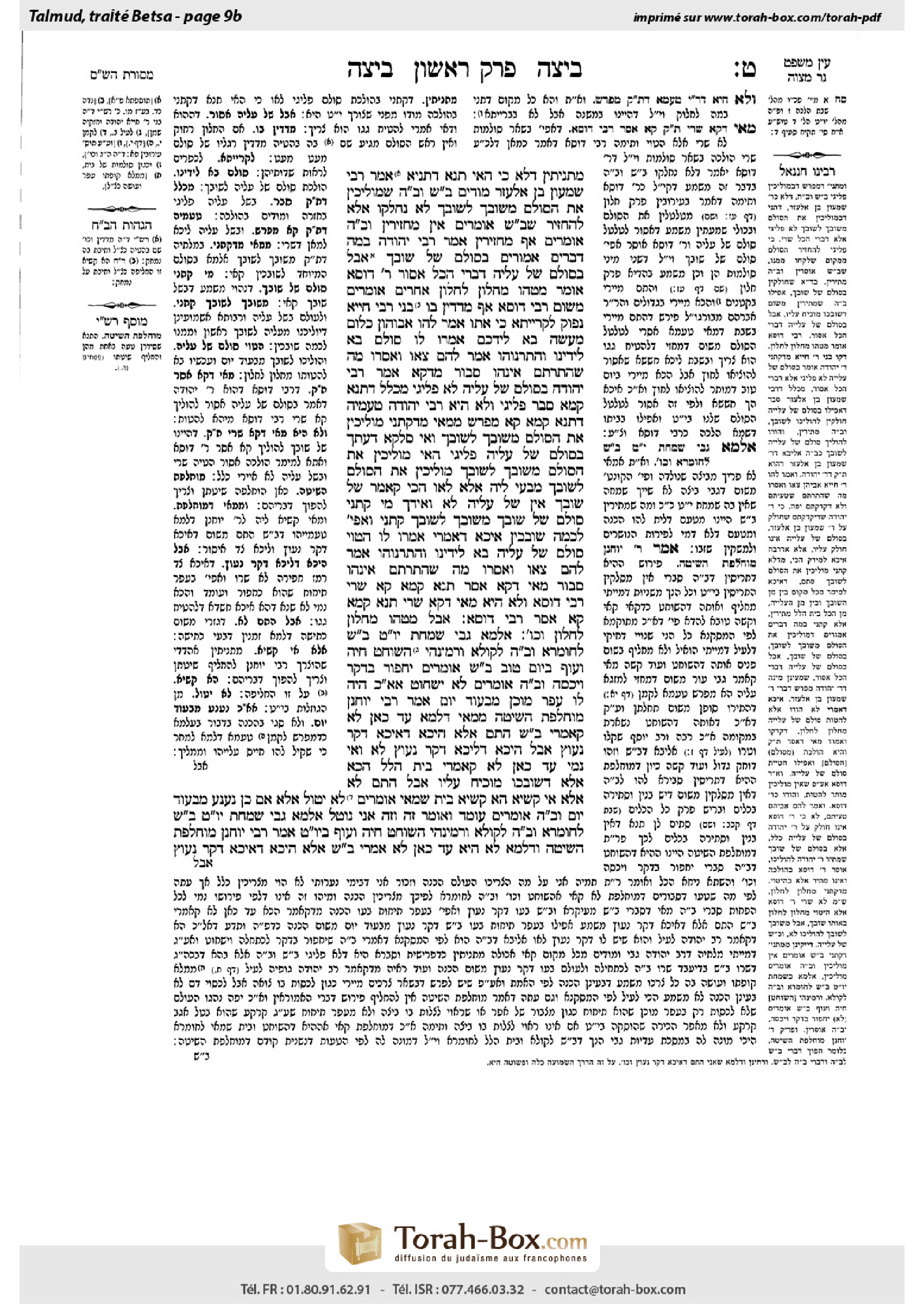
Beitzah 9b: Talmud study for Daf Yomi
Study the Talmud for Daf Yomi with scanned pages, Hebrew text, English translations from Sefaria and AI-generated French translations.
Passage selection and English or AI-generated French translation are available where the scan has annotations. Daf Study is independent of Torah-Box and Sefaria.
Browse Beitzah · ביצה · All tractatesBeitzah 9b text and translations
This page of Beitzah includes the Aramaic text, an English translation and an AI-generated French translation, alongside the scan above.
ביצה ט׳ ב · Aramaic and Hebrew text
מַתְנִיתִין דְּלָא כִּי הַאי תַּנָּא, דְּתַנְיָא, אָמַר רַבִּי שִׁמְעוֹן בֶּן אֶלְעָזָר: מוֹדִים בֵּית שַׁמַּאי וּבֵית הִלֵּל שֶׁמּוֹלִיכִין אֶת הַסּוּלָּם מִשּׁוֹבָךְ לְשׁוֹבָךְ. לֹא נֶחְלְקוּ אֶלָּא לְהַחְזִיר, שֶׁבֵּית שַׁמַּאי אוֹמְרִים: אֵין מַחְזִירִין, וּבֵית הִלֵּל אוֹמְרִים: אַף מַחְזִירִין.
אָמַר רַבִּי יְהוּדָה: בַּמֶּה דְּבָרִים אֲמוּרִים — בְּסוּלָּם שֶׁל שׁוֹבָךְ, אֲבָל בְּסוּלָּם שֶׁל עֲלִיָּה — דִּבְרֵי הַכֹּל אָסוּר. רַבִּי דּוֹסָא אוֹמֵר: מַטֵּהוּ מֵחַלּוֹן לְחַלּוֹן. אֲחֵרִים אוֹמְרִים מִשּׁוּם רַבִּי דּוֹסָא: אַף מְדַדִּין בּוֹ.
בְּנֵי רַבִּי חִיָּיא נְפוּק לְקִרְיָיתָא. כִּי אֲתוֹ, אֲמַר לְהוּ אֲבוּהוֹן: כְּלוּם מַעֲשֶׂה בָּא לְיֶדְכֶם? אָמְרוּ לוֹ: סוּלָּם בָּא לְיָדֵינוּ, וְהִתַּרְנוּהוּ. אָמַר לָהֶם: צְאוּ וְאִסְרוּ מַה שֶּׁהִתַּרְתֶּם.
אִינְהוּ סְבוּר: מִדְּקָא אָמַר רַבִּי יְהוּדָה בְּסוּלָּם שֶׁל עֲלִיָּה לָא פְּלִיגִי, מִכְּלָל דְּתַנָּא קַמָּא סָבַר פְּלִיגִי. וְלָא הִיא, רַבִּי יְהוּדָה טַעְמֵיהּ דְּתַנָּא קַמָּא קָא מְפָרֵשׁ.
מִמַּאי, מִדְּקָתָנֵי: מוֹלִיכִין אֶת הַסּוּלָּם מִשּׁוֹבָךְ לְשׁוֹבָךְ, וְאִי סָלְקָא דַעְתָּךְ בְּסוּלָּם שֶׁל עֲלִיָּה פְּלִיגִי, הַאי ״מוֹלִיכִין אֶת הַסּוּלָּם מִשּׁוֹבָךְ לְשׁוֹבָךְ״, ״מוֹלִיכִין אֶת הַסּוּלָּם לְשׁוֹבָךְ״ מִבְּעֵי לֵיהּ. אֶלָּא לָאו הָכִי קָאָמַר: שֶׁל שׁוֹבָךְ — אִין, שֶׁל עֲלִיָּה — לָא.
וְאִידַּךְ: מִי קָתָנֵי ״סוּלָּם שֶׁל שׁוֹבָךְ״? ״מִשּׁוֹבָךְ לְשׁוֹבָךְ״ קָתָנֵי, וַאֲפִילּוּ לְכַמָּה שׁוֹבָכִין.
אִיכָּא דְאָמְרִי, אָמְרוּ לוֹ: הִטּוּי סוּלָּם שֶׁל עֲלִיָּה בָּא לְיָדֵינוּ וְהִתַּרְנוּהוּ. אָמַר לָהֶם: צְאוּ וְאִסְרוּ מַה שֶּׁהִתַּרְתֶּם. אִינְהוּ סְבוּר: מַאי דְּקָא אָסַר תַּנָּא קַמָּא, קָא שָׁרֵי רַבִּי דּוֹסָא. וְלָא הִיא, מַאי דְּקָא שָׁרֵי תַּנָּא קַמָּא, קָא אָסַר רַבִּי דּוֹסָא.
אֲבָל מַטֵּהוּ מֵחַלּוֹן לְחַלּוֹן וְכוּ׳. אַלְמָא, גַּבֵּי שִׂמְחַת יוֹם טוֹב בֵּית שַׁמַּאי לְחוּמְרָא וּבֵית הִלֵּל לְקוּלָּא.
וּרְמִינְהִי: הַשּׁוֹחֵט חַיָּה וָעוֹף בְּיוֹם טוֹב, בֵּית שַׁמַּאי אוֹמְרִים: יַחְפּוֹר בַּדָּקָר וִיכַסֶּה, וּבֵית הִלֵּל אוֹמְרִים: לֹא יִשְׁחוֹט אֶלָּא אִם כֵּן הָיָה לוֹ עָפָר מוּכָן מִבְּעוֹד יוֹם.
אָמַר רַבִּי יוֹחָנָן: מוּחְלֶפֶת הַשִּׁיטָה. מִמַּאי: דִּלְמָא עַד כָּאן לָא קָאָמְרִי בֵּית שַׁמַּאי הָתָם, אֶלָּא הֵיכָא דְּאִיכָּא דָּקָר נָעוּץ, אֲבָל הֵיכָא דְּלֵיכָּא דָּקָר נָעוּץ — לָא.
וְאִי נָמֵי: עַד כָּאן לָא קָאָמְרִי בֵּית הִלֵּל הָכָא, אֶלָּא דְּשׁוֹבָכוֹ מוֹכִיחַ עָלָיו, אֲבָל הָתָם — לָא.
אֶלָּא, אִי קַשְׁיָא — הָא קַשְׁיָא: בֵּית שַׁמַּאי אוֹמְרִים: לֹא יִטּוֹל אֶלָּא אִם כֵּן נִעְנַע מִבְּעוֹד יוֹם, וּבֵית הִלֵּל אוֹמְרִים: עוֹמֵד וְאוֹמֵר זֶה וְזֶה אֲנִי נוֹטֵל.
אַלְמָא, גַּבֵּי שִׂמְחַת יוֹם טוֹב בֵּית שַׁמַּאי לְחוּמְרָא וּבֵית הִלֵּל לְקוּלָּא, וּרְמִינְהִי: הַשּׁוֹחֵט חַיָּה וָעוֹף בְּיוֹם טוֹב, אָמַר רַבִּי יוֹחָנָן: מוּחְלֶפֶת הַשִּׁיטָה.
וְדִלְמָא לָא הִיא: עַד כָּאן לָא אָמְרִי בֵּית שַׁמַּאי, אֶלָּא הֵיכָא דְּאִיכָּא דָּקָר נָעוּץ
Beitzah 9b · English translation
§ With regard to the mishna itself, the Gemara comments: The mishna is not in accordance with the opinion of this tanna, as it is taught in a baraita: Rabbi Shimon ben Elazar said that Beit Shammai and Beit Hillel agree that one may carry a ladder from one dovecote to another to take doves; they disagree only after one has finished at the second dovecote, whether it is permitted to replace the ladder to its original spot at the first dovecote, as Beit Shammai say: One may not replace the ladder, and Beit Hillel say: One may even replace it.
Rabbi Yehuda said: In what case is this statement said? With regard to a dovecote ladder, which clearly serves the purpose of taking doves. However, in the case of an attic ladder, which has a variety of uses, everyone agrees that it is prohibited, as this will raise suspicions. Rabbi Dosa says: One may tilt it from one window to another in the same dovecote. Aḥerim say in the name of Rabbi Dosa: One may even shift the ladder from one place to another by shuffling its legs.
The Gemara relates: The sons of Rabbi Ḥiyya went out to the villages to attend to their business. When they came back, their father said to them: Did any incident requiring a ruling of halakha come to your notice? They said to him: The issue of carrying an attic ladder to a dovecote came to our notice, and we permitted it. Rabbi Ḥiyya said to them: Go out and prohibit that which you permitted.
The Gemara explains: Rabbi Ḥiyya’s sons thought that from the fact that Rabbi Yehuda said that Beit Shammai and Beit Hillel do not disagree with regard to an attic ladder, this proves by inference that the first tanna holds that they do disagree. Consequently, Rabbi Ḥiyya’s sons thought that according to the first tanna, Beit Hillel permit even the use of a loft ladder, and they ruled in accordance with this opinion. But that is not so, as Rabbi Yehuda does not disagree with him, but rather he explains the reason of the first tanna.
From where can this be inferred? From the fact that the first tanna teaches: One may carry a ladder from one dovecote to another. And if it enters your mind to say that Beit Shammai and Beit Hillel disagree with regard to an attic ladder, if so, this phrase: One may carry a ladder from one dovecote to another, is inexact, as he should have said: One may carry a ladder to a dovecote. Rather, isn’t this what the tanna said: With regard to a dovecote ladder, yes, it is permitted to move it; however, in the case of an attic ladder, no, one may not use it.
The Gemara asks: And the others, Rabbi Ḥiyya’s sons, what is their reasoning? The Gemara answers that they would reply: Is it taught in the baraita: A dovecote ladder? It teaches: From one dovecote to another, and this simply means that it is permitted to do so even with regard to several dovecotes.
Some say a slightly different version of this incident. Rabbi Ḥiyya’s sons said to him: The tilting of an attic ladder came to our notice, and we permitted it. We were asked whether an attic ladder positioned near a dovecote before the Festival may be moved from one window to another in the same dovecote, and we allowed it. Rabbi Ḥiyya said to them: Go out and prohibit that which you permitted. The Gemara explains that they thought: That which the first tanna prohibits, i.e., moving an attic ladder, Rabbi Dosa permits, i.e. Rabbi Dosa is more lenient than the first tanna and permits moving even an attic ladder from one window to another. And that is not so. Rather, that which the first tanna permits, moving a dovecote ladder, Rabbi Dosa prohibits. He is more stringent and maintains that even a dovecote ladder may be moved only by tilting rather than in the usual manner.
§ The mishna taught: However, everyone agrees that one may tilt a dovecote ladder from one window to another in the same dovecote. The Gemara infers: Apparently, with regard to rejoicing on the Festival, the opinion of Beit Shammai is stringent, and that of Beit Hillel is lenient.
And the Gemara raises a contradiction from the first mishna of the tractate (2a): With regard to one who slaughters an undomesticated animal or a fowl on a Festival, Beit Shammai say: He may dig earth with a shovel and cover the blood, and Beit Hillel say: He may not slaughter an undomesticated animal or a fowl, unless he had earth prepared for that purpose while it was still day. This indicates that it is Beit Shammai who are concerned for the honor and joy of the Festival, and they are therefore lenient with regard to covering the blood; whereas Beit Hillel do not share the same concern and are stringent about covering the blood, despite the fact that their ruling might adversely affect the joy of the Festival.
Rabbi Yoḥanan said: The attribution of the opinions of the tanna’im is reversed. The opinion attributed to Beit Hillel is actually that of Beit Shammai, and vice versa. The Gemara rejects Rabbi Yoḥanan’s answer: From where do you infer that this extreme conclusion is necessarily the case? A different explanation is possible: Perhaps Beit Shammai say their opinion, that it is permitted to cover the blood, only there, where there is already a shovel embedded in the earth ready for this purpose, and therefore there are grounds for a lenient ruling. However, where there is no embedded shovel, they did not permit it.
Alternatively, it is possible to say that Beit Hillel say their opinion, that an act is permitted for the sake of the joy of the Festival, only here, where his dovecote, the place where he ultimately positions the ladder, proves with regard to him that he intended to use his ladder for a permitted purpose; but there, where there is no equivalent proof, they were not lenient. This shows that there is no clear contradiction between the rulings in the two cases.
Rather, the Gemara retracts the previous version and suggests that Rabbi Yoḥanan issued his statement with regard to a different issue: If the dispute between Beit Shammai and Beit Hillel is difficult, this is what is difficult: It was taught in a different mishna (10a): Beit Shammai say: One may not take fledgling doves on a Festival unless he shook them, as an act of preparation, while it was still day. And Beit Hillel say: It is indeed necessary to perform some act of preparation to permit the taking of fledglings on a Festival, but this does not have to be done by shaking them. Rather, it is enough if one stands the day before and says: I will take this dove and that one.
Apparently, with regard to rejoicing on the Festival, the opinion of Beit Shammai is stringent and that of Beit Hillel is lenient. And the Gemara raises a contradiction as above: With regard to one who slaughters an undomesticated animal or a fowl on a Festival, Beit Shammai are lenient and allow one to dig with a shovel to cover the blood, due to the joy of the Festival, whereas Beit Hillel do not permit one to slaughter at all, unless there was a shovel ready from the day before. It was with regard to this contradiction that Rabbi Yoḥanan said: The attribution of the opinions is reversed.
The Gemara challenges this explanation: But perhaps that is not so, as a different explanation is possible: Beit Shammai only state their lenient opinion, that it is permitted to cover the blood, where there is an embedded shovel.
Beitzah 9b · Traduction française (IA)
§ En ce qui concerne la Michna elle-même, le Guemara commente : La Michna ne correspond pas à l'opinion de ce tanna, car il est enseigné dans une baraïta : Rabbi Shimon ben Elazar disait que Beit Shammai et Beit Hillel s'accordent sur le fait qu'on peut porter une échelle d'un colombier à un autre pour prendre des colombes ; ils ne s'entendent que sur la question de savoir si l'on peut remettre l'échelle à son point d'origine dans le premier colombier après avoir fini dans le second colombier, Beit Shammai disent qu'on ne peut pas le faire, et Beit Hillel disent qu'on peut même le faire.
Rabbi Yehuda dit : Dans quel cas cette déclaration est-elle faite ? En ce qui concerne une échelle de colombier, qui sert clairement à prendre des colombes. Cependant, dans le cas d'une échelle de grenier, qui a divers usages, tout le monde convient qu'elle est interdite, car cela pourrait susciter des soupçons. Rabbi Dosa dit : On peut la pencher d'une fenêtre à l'autre dans le même colombier. D'autres disent en nom de Rabbi Dosa : On peut même déplacer l'échelle d'un endroit à un autre en déplaçant ses jambes.
Le Guemara rapporte : Les fils de Rabbi Ḥiyya sont allés aux villages pour s'occuper de leurs affaires. Lorsqu'ils sont revenus, leur père leur dit : Avez-vous remarqué un incident nécessitant une décision de halakha ? Ils lui dirent : L'affaire du transport d'une échelle de grenier à un colombier nous a été signalée, et nous l'avons permis. Rabbi Ḥiyya leur dit : Allez dehors et interdisez ce que vous avez permis.
Le Guemara explique : Les fils de Rabbi Ḥiyya pensaient que, du fait que Rabbi Yehuda disait que Beit Shammai et Beit Hillel ne s'entendent pas sur une échelle de grenier, cela prouve par déduction que le premier tanna considère qu'ils s'entendent. Ainsi, les fils de Rabbi Ḥiyya pensaient que, selon le premier tanna, Beit Hillel permettent même l'utilisation d'une échelle de grenier, et ils ont rendu un jugement en conformité avec cette opinion. Mais cela n'est pas vrai, car Rabbi Yehuda ne s'oppose pas à lui, mais il explique la raison du premier tanna.
D'où peut-on en déduire cela ? De ce fait que le premier tanna enseigne : On peut porter une échelle d'un colombier à un autre. Et si cela vous vient à l'esprit de dire que Beit Shammai et Beit Hillel s'entendent sur une échelle de grenier, si c'est le cas, cette phrase : On peut porter une échelle d'un colombier à un autre, est imprecise, car il aurait dû dire : On peut porter une échelle à un colombier. Plutôt, n'est-ce pas ce que le tanna a dit : En ce qui concerne une échelle de colombier, oui, on peut la déplacer ; cependant, en ce qui concerne une échelle de grenier, non, on ne peut pas l'utiliser.
Le Guemara pose la question : Et les autres, les fils de Rabbi Ḥiyya, quelle est leur raisonnement ? Le Guemara répond qu'ils répondraient : Est-ce que cela est enseigné dans la baraïta : Une échelle de colombier ? Il enseigne : D'un colombier à un autre, et cela signifie simplement qu'il est permis de le faire même en ce qui concerne plusieurs colombiers.
Certains racontent une version légèrement différente de cet incident. Les fils de Rabbi Ḥiyya dirent à lui : Le penchage d'une échelle de grenier nous a été signalé, et nous l'avons permis. Nous avons été interrogés sur le fait si une échelle de grenier placée près d'un colombier avant la fête pouvait être déplacée d'une fenêtre à l'autre dans le même colombier, et nous l'avons autorisé. Rabbi Ḥiyya leur dit : Allez dehors et interdisez ce que vous avez permis. Le Guemara explique qu'ils pensaient : Ce que le premier tanna interdit, c'est-à-dire le déplacement d'une échelle de grenier, Rabbi Dosa permet, c'est-à-dire que Rabbi Dosa est plus clément que le premier tanna et permet même le déplacement d'une échelle de grenier d'une fenêtre à l'autre. Et cela n'est pas vrai. Plutôt, ce que le premier tanna permet, c'est le déplacement d'une échelle de colombier, Rabbi Dosa l'interdit. Il est plus strict et maintient que même une échelle de colombier ne peut être déplacée qu'en la penchant plutôt qu'en la manipulant de la manière habituelle.
§ La mitsva a enseigné : Cependant, tout le monde convient qu'on peut pencher une échelle de colombier d'une fenêtre à l'autre dans le même colombier. Le Guemara déduit : Apparemment, en ce qui concerne la joie de la fête, l'opinion de Beit Shammai est stricte, et celle de Beit Hillel est clémente.
Et le Guemara soulève une contradiction à partir de la première mitsva du traité (2a) : En ce qui concerne celui qui sacrifie un animal sauvage ou un oiseau de basse-cour lors d'une fête, Beit Shammai disent : Il peut creuser le sol avec une pelle et couvrir le sang, et Beit Hillel disent : Il ne peut pas sacrifier un animal sauvage ou un oiseau de basse-cour, sauf s'il avait préparé du sol pour cela pendant la journée. Cela indique que c'est Beit Shammai qui sont préoccupés par l'honneur et la joie de la fête, et qu'ils sont donc cléments en ce qui concerne la couverture du sang ; tandis que Beit Hillel n'ont pas la même préoccupation et sont stricts sur la couverture du sang, malgré le fait que leur décision pourrait nuire à la joie de la fête.
Rabbi Yoḥanan dit : L'attribution des opinions des tannaïm est inversée. L'opinion attribuée à Beit Hillel est en réalité celle de Beit Shammai, et vice versa. La Guemara rejette la réponse de Rabbi Yoḥanan : D'où infères-tu que cette conclusion extrême est nécessaire ? Une autre explication est possible : Peut-être Beit Shammai disent qu'ils permettent la couverture du sang uniquement là où il y a déjà une pelle enfoncée dans le sol, prêt à cette fin, et donc il y a des raisons pour une décision clémente. Cependant, là où il n'y a pas de pelle enfoncée, ils n'ont pas permis cela.
Une autre possibilité est de dire que Beit Hillel disent que leur opinion, qui permet l'acte pour la joie de la fête, est permise uniquement ici, où son colombier, l'endroit où il finit par placer l'échelle, prouve envers lui qu'il avait l'intention d'utiliser son échelle à un but permis ; mais là, où il n'y a pas de preuve équivalente, ils n'étaient pas cléments. Cela montre qu'il n'y a pas de contradiction claire entre les décisions dans les deux cas.
Au contraire, la Guemara retire la version précédente et suggère que Rabbi Yoḥanan a formulé son opinion concernant une question différente : Si le débat entre Beit Shammai et Beit Hillel est difficile, voici ce qui est difficile : Il a été enseigné dans une autre mitsva (10a) : Beit Shammai disent : On ne peut pas prendre des petits moineaux pendant un festival, sauf si l'on les secoue, comme acte de préparation, pendant la journée. Et Beit Hillel disent : Il est effectivement nécessaire d'accomplir un acte de préparation pour permettre de prendre les petits moineaux pendant un festival, mais cela ne doit pas se faire en les secouant. Il suffit que l'on se tienne la veille et dise : Je prendrai ce moineau et celui-là.
Apparemment, concernant la joie du festival, l'opinion de Beit Shammai est stricte et celle de Beit Hillel est clémente. Et la Guemara soulève une contradiction comme ci-dessus : Concernant celui qui sacrifie un animal sauvage ou un oiseau pendant un festival, Beit Shammai sont cléments et permettent de couvrir le sang avec une pelle, en raison de la joie du festival, tandis que Beit Hillel ne permettent pas de sacrifier du tout, sauf s'il y avait une pelle prête la veille. C'est à propos de cette contradiction que Rabbi Yoḥanan a dit : L'attribution des opinions est inversée.
La Guemara conteste cette explication : Mais peut-être que ce n'est pas ainsi, car une autre explication est possible : Beit Shammai n'expriment que leur opinion clémente, à savoir qu'il est permis de couvrir le sang, à condition qu'il y ait une pelle intégrée.
Traduction française générée par IA à partir de l’édition anglaise de Sefaria. Vérifie toujours un passage avec le texte source.
Text from Sefaria: William Davidson Edition - Vocalized Aramaic (CC BY NC); William Davidson Edition - English (CC BY NC).