Beitzah 10b: Talmud study for Daf Yomi
Study the Talmud for Daf Yomi with scanned pages, Hebrew text, English translations from Sefaria and AI-generated French translations.
Passage selection and English or AI-generated French translation are available where the scan has annotations. Daf Study is independent of Torah-Box and Sefaria.
Browse Beitzah · ביצה · All tractatesBeitzah 10b text and translations
This page of Beitzah includes the Aramaic text, an English translation and an AI-generated French translation, alongside the scan above.
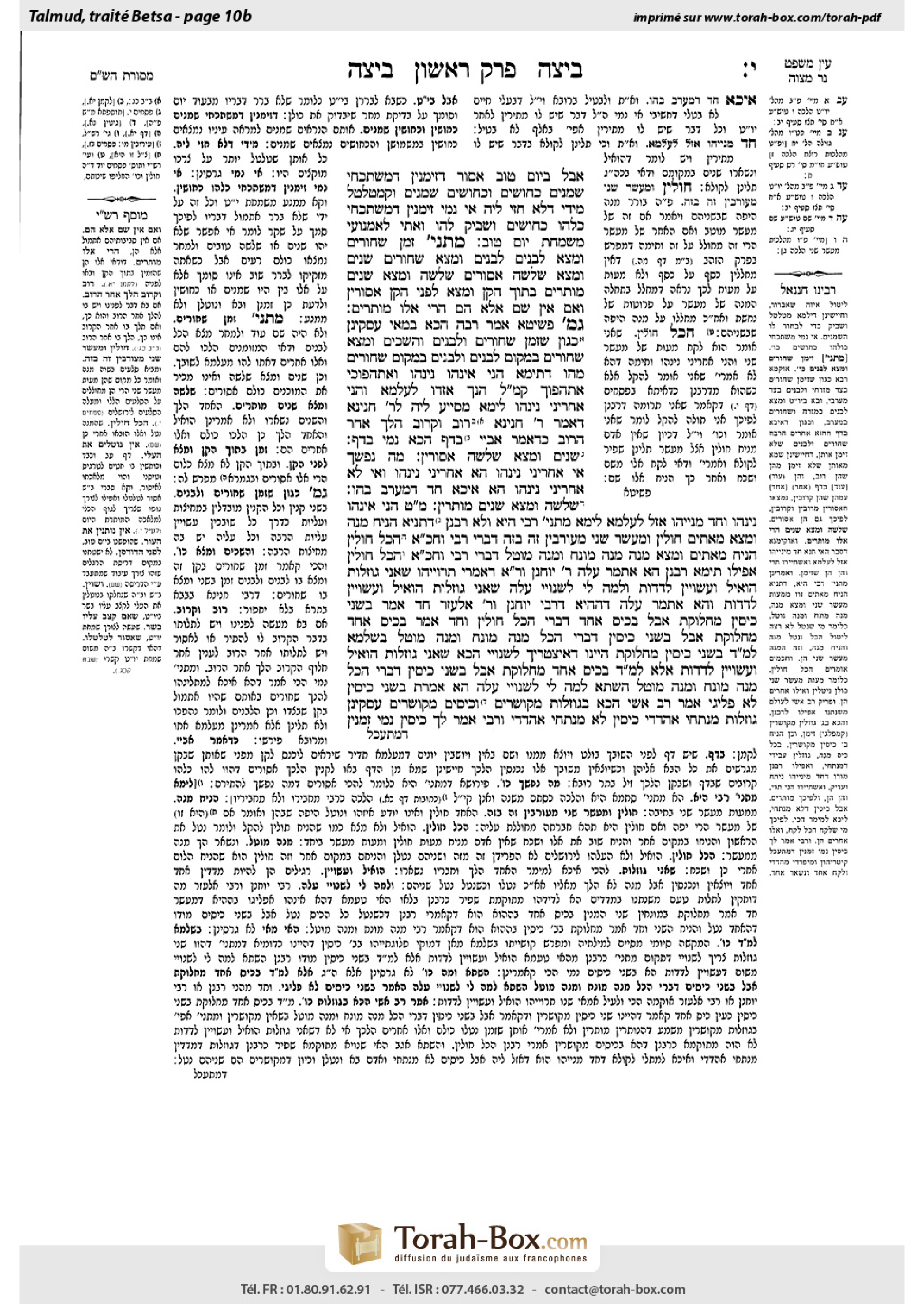
ביצה י׳ ב · Aramaic and Hebrew text
אֲבָל בְּיוֹם טוֹב אָסוּר, דְּזִימְנִין דְּמִשְׁתַּכְחִי שְׁמֵנִים כְּחוּשִׁים וּכְחוּשִׁים שְׁמֵנִים, וְקָמְטַלְטֵל מִידֵּי דְּלָא חֲזֵי לֵיהּ. אִי נָמֵי זִימְנִין דְּמִשְׁתַּכְחִי כֻּלְּהוּ כְּחוּשִׁים וְשָׁבֵיק לְהוּ, וְאָתֵי לְאִמְּנוֹעֵי מִשִּׂמְחַת יוֹם טוֹב.
מַתְנִי׳ זִמֵּן שְׁחוֹרִים וּמָצָא לְבָנִים, לְבָנִים וּמָצָא שְׁחוֹרִים, שְׁנַיִם וּמָצָא שְׁלֹשָׁה — אֲסוּרִים. שְׁלֹשָׁה וּמָצָא שְׁנַיִם — מוּתָּרִים.
בְּתוֹךְ הַקֵּן וּמָצָא לִפְנֵי הַקֵּן — אֲסוּרִין, וְאִם אֵין שָׁם אֶלָּא הֵם — הֲרֵי אֵלּוּ מוּתָּרִים.
גְּמָ׳ פְּשִׁיטָא! אָמַר רַבָּה: הָכָא בְּמַאי עָסְקִינַן, כְּגוֹן שֶׁזִּמֵּן שְׁחוֹרִים וּלְבָנִים, וְהִשְׁכִּים וּמָצָא שְׁחוֹרִים בִּמְקוֹם לְבָנִים וּלְבָנִים בִּמְקוֹם שְׁחוֹרִים. מַהוּ דְּתֵימָא: הָנֵי אִינְהוּ נִינְהוּ וְאִתְהֲפוֹכֵי אִתְהֲפוּךְ, קָא מַשְׁמַע לַן: הָנָךְ אֲזַדוּ לְעָלְמָא, וְהָנֵי אַחֲרִינֵי נִינְהוּ.
לֵימָא מְסַיַּיע לֵיהּ לְרַבִּי חֲנִינָא. דְּאָמַר רַבִּי חֲנִינָא: רוֹב וְקָרוֹב — הַלֵּךְ אַחַר הָרוֹב!
כִּדְאָמַר אַבָּיֵי — בְּדַף, הָכָא נָמֵי — בְּדַף.
שְׁנַיִם וּמָצָא שְׁלֹשָׁה — אֲסוּרִין. מָה נַפְשָׁךְ: אִי אַחֲרִינֵי נִינְהוּ — הָא אַחֲרִינֵי נִינְהוּ, וְאִי לָא אַחֲרִינֵי נִינְהוּ — הָא אִיכָּא חַד דִּמְעָרַב בְּהוּ.
שְׁלֹשָׁה וּמָצָא שְׁנַיִם מוּתָּרִין. מַאי טַעְמָא? הָנֵי אִינְהוּ נִינְהוּ, וְחַד מִנַּיְיהוּ אֲזַל לְעָלְמָא.
לֵימָא מַתְנִיתִין רַבִּי הִיא וְלָא רַבָּנַן, דְּתַנְיָא: הִנִּיחַ מָנֶה וּמָצָא מָאתַיִם — חוּלִּין וּמַעֲשֵׂר שֵׁנִי מְעוֹרָבִין זֶה בָּזֶה, דִּבְרֵי רַבִּי. וַחֲכָמִים אוֹמְרִים: הַכֹּל חוּלִּין.
הִנִּיחַ מָאתַיִם וּמָצָא מָנֶה, מָנֶה מוּנָּח וּמָנֶה מוּטָל, דִּבְרֵי רַבִּי. וַחֲכָמִים אוֹמְרִים: הַכֹּל חוּלִּין!
אֲפִילּוּ תֵּימָא רַבָּנַן, הָא אִתְּמַר עֲלַהּ: רַבִּי יוֹחָנָן וְרַבִּי אֶלְעָזָר דְאָמְרִי תַּרְוַיְיהוּ: שָׁאנֵי גּוֹזָלוֹת, הוֹאִיל וַעֲשׂוּיִין לְדַדּוֹת.
וּלְמָה לִי לְשַׁנּוֹיֵי עֲלַהּ שָׁאנֵי גּוֹזָלוֹת הוֹאִיל וַעֲשׂוּיִין לְדַדּוֹת? וְהָא אִתְּמַר עֲלַהּ דְּהַהִיא, דְּרַבִּי יוֹחָנָן וְרַבִּי אֶלְעָזָר, חַד אָמַר: בִּשְׁנֵי כִיסִין מַחְלוֹקֶת, אֲבָל בְּכִיס אֶחָד — דִּבְרֵי הַכֹּל חוּלִּין. וְחַד אָמַר: בְּכִיס אֶחָד מַחְלוֹקֶת, אֲבָל בִּשְׁנֵי כִיסִין — דִּבְרֵי הַכֹּל מָנֶה מוּנָּח וּמָנֶה מוּטָל.
בִּשְׁלָמָא לְמַאן דְּאָמַר בִּשְׁנֵי כִיסִין מַחְלוֹקֶת, הַיְינוּ דְּאִיצְטְרִיךְ לְשַׁנּוֹיֵי הָכָא שָׁאנֵי גּוֹזָלוֹת הוֹאִיל וַעֲשׂוּיִין לְדַדּוֹת. אֶלָּא לְמַאן דְּאָמַר בְּכִיס אֶחָד מַחְלוֹקֶת, אֲבָל בִּשְׁנֵי כִיסִין דִּבְרֵי הַכֹּל מָנֶה מוּנָּח וּמָנֶה מוּטָל — הַשְׁתָּא לְמָה לִי לְשַׁנּוֹיֵי עֲלַהּ? הָא אָמְרַתְּ בִּשְׁנֵי כִיסִין לָא פְּלִיגִי!
אָמַר רַב אָשֵׁי: הָכָא בְּגוֹזָלוֹת מְקוּשָּׁרִים וְכִיסִים מְקוּשָּׁרִים עָסְקִינַן. גּוֹזָלוֹת — מְנַתְּחִי אַהֲדָדֵי, כִּיסִין — לָא מְנַתְּחִי אַהֲדָדֵי.
וְרַבִּי אָמַר לָךְ: כִּיסִין נָמֵי, זִמְנִין
Beitzah 10b · English translation
However, on the Festival it is prohibited, as sometimes those that seemed to him to be fat ones will be found to be thin, and thin ones will be found to be fat, and he will move an object that is not suitable for him, thereby transgressing the prohibition against moving muktze objects. Alternatively, sometimes they will all be found to be thin, and he will leave them all, and he will come to neglect the rejoicing of the Festival. If, however, one announces the day before: I will take this one and that one, he will indeed take only those fledglings, thereby enhancing his Festival joy.
MISHNA: If, on the eve of a Festival, one designated black fledglings to be slaughtered, and on the following day found white ones in the dovecote, rather than the birds he had designated, or if one designated white ones to be slaughtered and found black ones, or if one designated two fledglings to be slaughtered and found three, they are prohibited, as these are not the same fledglings he had designated earlier. If, however, one designated three to be slaughtered and found only two, they are permitted, as it is presumed that one of the fledglings escaped.
If one designated them inside the nest and the next day he cannot find them there, and he found fledglings before the nest, they are prohibited, as they might be fledglings other than the ones he designated and left inside the nest. But if there are only those fledglings in the immediate vicinity, they are permitted, as it can be assumed that these are the ones he designated inside the nest.
GEMARA: The Gemara asks: But it is obvious that if one designated black ones to be slaughtered and found white ones, they are not the same birds. Rabba said: With what are we dealing here? The mishna is referring to a case where one designated both black and white ones to be slaughtered, and he arose and found black ones in the place where the white ones had been, and white ones in the place of the black ones. Lest you say: These are those same fledglings and they simply exchanged places, the mishna teaches us that this claim is not accepted. Instead, it is assumed that these ones that he designated have gone to the outside world, and these ones that he found are others that have come from elsewhere.
The Gemara suggests: Let us say that this mishna supports Rabbi Ḥanina, as Rabbi Ḥanina said: When resolving an uncertainty with regard to the identity of an item, if the majority indicates one ruling but the item in question is proximate to a source that indicates otherwise, one follows the majority. In this case, the majority of fledglings are prohibited, as they were not designated for use on the Festival. Consequently, the found fledglings are prohibited, despite the fact that the nearest fledglings are the designated ones.
The Gemara refutes this suggestion: Perhaps it is as Abaye said with regard to a different issue: We are dealing with fledglings located on a ledge, a flat piece of wood protruding from the dovecote, around which many doves congregate. Here too, the mishna is referring to a ledge. Since other doves are regularly found there, the principle that one follows the majority rather than the proximate source does not apply, as both the majority of doves and the proximate source of doves are not the original ones, and therefore all the fledglings are prohibited.
The mishna taught that if one designated two and found three, they are prohibited. The Gemara explains: Whichever way you look at this matter, the fledglings are prohibited. If these are others, they are others that have not been designated. And if they are not others, i.e., two of the fledglings that one designated are still there, nevertheless there is one that he certainly did not designate and that is mingled with them, which renders the others prohibited as well.
§ The mishna taught that if one designated three and found two, they are permitted. The Gemara asks: What is the reason for this? The Gemara explains: These are the same ones, and one of them has gone to the outside world, leaving two behind.
The Gemara suggests: Let us say that the mishna is in accordance with the opinion of Rabbi Yehuda HaNasi, and not that of the Rabbis, as it is taught in a baraita: If one placed one hundred dinars of tithe money in a safe place and found two hundred there, it is assumed that this is non-sacred money and second-tithe money mingled together. Someone must have come and added another hundred to his tithe money. Therefore, he separates one dinar from the total and states: Whatever part of this is the tithe, is fine; whatever part of it is non-tithe money, let it be used to redeem the tithe money, and this should be sanctified as tithe money in its place. This is the statement of Rabbi Yehuda HaNasi. And the Rabbis say: It is all non-sacred money. Since the money is not as he left it, the assumption is that someone took the original one hundred dinars; and he, or someone else, replaced it with two hundred dinars of regular money.
Conversely, if one placed two hundred dinars and found one hundred dinars, it is presumed that one hundred dinars has been left in its place and is tithe money, and one hundred dinars was removed. This is the statement of Rabbi Yehuda HaNasi. And the Rabbis say: It is all non-sacred money. It is assumed that someone removed all the money, and the one hundred dinars he found must have been placed there by someone else, and is not connected to the money he left. The halakha with regard to the case of fledglings apparently follows Rabbi Yehuda HaNasi’s opinion in the case of second-tithe money.
The Gemara refutes this claim: Even if you say that the mishna is in accordance with the opinion of the Rabbis, it can be explained, as it was stated with regard to this mishna that Rabbi Yoḥanan and Rabbi Elazar both say: Fledglings are different, since they typically hop from place to place. Therefore, it is possible that one of them escaped. By contrast, a money pouch cannot move of its own accord and must have been taken by someone.
The Gemara asks: And why do I need to answer with regard to it: Fledglings are different, since they typically hop? But wasn’t it stated with regard to that mishna, which deals with a money pouch, that Rabbi Yoḥanan and Rabbi Elazar disagree over it: One of them said: The dispute applies only to a case of two pouches, with one hundred dinars in each pouch. However, if all of the money was in a single pouch, everyone agrees that it is non-sacred money, as it is unlikely that only half of the money was removed while the other half was left in its place. And the other one of them said: The dispute applies only to one pouch, but with regard to two pouches, everyone agrees that one hundred dinars of tithe is left and one hundred dinars has been removed.
The Gemara explains: Granted, according to the one who said that the dispute deals with a case of two pouches, this is why it was necessary to answer here: Fledglings are different, since they typically hop. However, according to the one who says that the dispute involves a case of one pouch, but with regard to two pouches everyone agrees that one hundred dinars of tithe is left and one hundred dinars has been removed, now consider: Why do I need to answer, with regard to it, that there is a difference between that halakha and the case of fledglings? You said that they do not disagree even with regard to two separate pouches, and therefore they certainly do not disagree in the case of fledglings.
Rav Ashi said: Here we are dealing with fledglings tied together and with money pouches tied together. In other words, when it is stated that the dispute applies to one pouch, this refers to two pouches that are tied together, as well. Rabbi Yehuda HaNasi and the rabbis agree only with regard to two pouches that are entirely separate. Consequently, it is necessary to explain that there is a difference between pouches tied together and fledglings tied together: Fledglings can release themselves from each other, and therefore it is possible that only one of them escaped, whereas pouches cannot release themselves from each other. Therefore, it is evident that someone must have taken them. Since they were tied together, he certainly took both of them.
The Gemara asks: But if that is indeed the case, and it is obvious that someone came and took the money, what is Rabbi Yehuda HaNasi’s reasoning? The Gemara explains: And Rabbi Yehuda HaNasi could have said to you: Pouches, too, sometimes
Beitzah 10b · Traduction française (IA)
Cependant, pendant le festival, cela est interdit, car parfois ceux qui semblaient être des oiseaux gras se révèlent être maigres, et ceux qui semblaient maigres se révèlent être gras, et il déplace un objet qui n'est pas adapté à lui, en transgressant ainsi l'interdiction de déplacer des objets muktze. Alternativement, parfois tous se révèlent être maigres, et il les laisse tous, et il arrive à négliger la joie du festival. Cependant, si l'on annonce la veille : Je prendrai celui-ci et celui-là, il prendra effectivement seulement ces petits oiseaux, ce qui accroît sa joie du festival.
MICHNA : Si, la veille d'un festival, l'on a désigné des petits oiseaux noirs à être sacrifiés, et le lendemain l'on trouve des blancs dans le colombier, plutôt que les oiseaux désignés, ou si l'on a désigné des blancs à être sacrifiés et l'on trouve des noirs, ou si l'on a désigné deux petits oiseaux à être sacrifiés et l'on trouve trois, ils sont interdits, car ce ne sont pas les mêmes petits oiseaux que ceux désignés précédemment. Cependant, si l'on a désigné trois à être sacrifiés et l'on trouve seulement deux, ils sont permis, car on suppose qu'un des petits oiseaux a fui.
Si l'on a désigné les petits oiseaux à l'intérieur du nid et le lendemain il ne peut pas les trouver là, et il trouve des petits oiseaux avant le nid, ils sont interdits, car ils pourraient être d'autres petits oiseaux que ceux désignés et laissés dans le nid. Cependant, si seuls ces petits oiseaux sont dans les environs, ils sont permis, car on peut supposer qu'ils sont ceux désignés à l'intérieur du nid.
GUEMARA : La Guemara pose la question : Mais c'est évident que si l'on a désigné des oiseaux noirs à être sacrifiés et l'on trouve des oiseaux blancs, ce ne sont pas les mêmes oiseaux. Rabba dit : De quoi sommes-nous en train de parler ? La Michna fait référence à un cas où l'on a désigné à la fois des oiseaux noirs et des oiseaux blancs à être sacrifiés, et l'on se lève et l'on trouve des oiseaux noirs là où les oiseaux blancs étaient, et des oiseaux blancs là où les oiseaux noirs étaient. Pour éviter que l'on dise : Ce sont les mêmes petits oiseaux qui ont simplement échangé de place, la Michna nous apprend que cette affirmation n'est pas acceptée. Au contraire, on suppose que ceux que l'on a désignés sont partis vers l'extérieur, et ceux que l'on a trouvés sont d'autres qui sont venus d'ailleurs.
La Guemara suggère : Disons que cette Michna soutient Rabbi Ḥanina, car Rabbi Ḥanina a dit : Lors de la résolution d'une incertitude concernant l'identité d'un objet, si la majorité indique une décision mais que l'objet en question est proche d'une source indiquant autre chose, on suit la majorité. Dans ce cas, la majorité des petits oiseaux est interdite, car ils n'étaient pas désignés pour être utilisés pendant le festival. Par conséquent, les petits oiseaux trouvés sont interdits, malgré le fait que les petits oiseaux les plus proches sont ceux désignés.
La Guemara réfute cette suggestion : Peut-être est-ce comme Abaye a dit concernant un autre sujet : Nous sommes en présence de petits oiseaux sur une corniche, une planche plate qui saillit du colombier, autour de laquelle beaucoup de moineaux se rassemblent. Ici aussi, la Michna fait référence à une corniche. Puisque d'autres moineaux y sont régulièrement trouvés, le principe selon lequel on suit la majorité plutôt que la source la plus proche ne s'applique pas, car à la fois la majorité des moineaux et la source la plus proche des moineaux ne sont pas les originaux, et donc tous les petits oiseaux sont interdits.
La Michna a enseigné que si l'on a désigné deux et l'on a trouvé trois, ils sont interdits. La Guemara explique : Quel que soit le point de vue, les petits oiseaux sont interdits. Si ce sont d'autres, ce sont d'autres qui n'ont pas été désignés. Et si ce ne sont pas d'autres, c'est-à-dire que deux des petits oiseaux que l'on a désignés sont encore là, néanmoins il y a un qui a certainement été désigné et qui est mêlé à eux, ce qui rend les autres interdits également.
§ La Michna a enseigné que si l'on a désigné trois et l'on a trouvé deux, ils sont permis. La Guemara pose la question : Quel est le motif de cela ? La Guemara explique : Ce sont les mêmes, et l'un d'eux est parti vers l'extérieur, laissant deux derrière.
La Guemara suggère : Disons que la Michna suit l'opinion de Rabbi Yehuda HaNasi et non celle des Rabbins, car il est enseigné dans une baraïta : Si l'on a mis un cent dinares de terouma dans un lieu sûr et l'on trouve deux cents là, on suppose que c'est de l'argent non sacré et des titres secondaires mêlés ensemble. Quelqu'un doit avoir entré et ajouté un autre cent à son argent sacré. Par conséquent, il sépare un dinaire du total et déclare : Tout ce qui est terouma dans cela est bien ; tout ce qui n'est pas terouma, qu'il soit utilisé pour racheter l'argent sacré, et cela doit être sanctifié comme terouma à sa place. C'est l'opinion de Rabbi Yehuda HaNasi. Et les Rabbins disent : C'est tout de l'argent non sacré. Puisque l'argent n'est pas comme il l'avait laissé, on suppose que quelqu'un a pris le cent dinares originels ; et lui, ou quelqu'un d'autre, l'a remplacé par deux cents d'argent ordinaire.
Inversement, si l'on a mis deux cents dinares et l'on a trouvé un cent, on suppose que cent dinares ont été laissés en place et constituent des dîmes, et cent dinares ont été enlevés. C'est l'opinion de Rabbi Yehuda HaNasi. Et les Rabbins disent : C'est tout de l'argent non sacré. On suppose que quelqu'un a enlevé tout l'argent, et le cent dinares trouvé est celui que quelqu'un d'autre a mis là, et n'est pas lié à l'argent laissé. La halakha concernant le cas des petits oiseaux suit apparemment l'opinion de Rabbi Yehuda HaNasi dans le cas des dîmes secondaires.
La Guemara réfute cette affirmation : Même si vous dites que la Michna suit l'opinion des Rabbins, on peut l'expliquer, car il a été dit concernant cette Michna que Rabbi Yoḥanan et Rabbi Elazar disent tous les deux : Les petits oiseaux sont différents, car ils sautent généralement d'un endroit à un autre. Il est donc possible qu'un d'entre eux ait fui. À l'inverse, un sac d'argent ne peut pas se déplacer tout seul et doit avoir été pris par quelqu'un.
La Guemara pose la question : Et pourquoi ai-je besoin de répondre à ce sujet : les petits oiseaux sont différents, car ils sautent généralement ? Mais n’a-t-il pas été dit concernant cette mitsva, qui traite d’un sac de monnaie, que Rabbi Yoḥanan et Rabbi Elazar s’opposent sur ce point : l’un d’eux disait : le désaccord s’applique uniquement à un cas de deux sacs, chacun contenant cent dinars. Cependant, si toutes les monnaies étaient dans un seul sac, tout le monde convient qu’il s’agit de monnaie non sacrée, car il est peu probable que seulement la moitié des monnaies ait été retirée tandis que l’autre moitié restait en place. L’autre disait : le désaccord s’applique uniquement à un seul sac, mais concernant deux sacs, tout le monde convient qu’un cent dinars de terouma est resté et un cent dinars a été retiré.
La Guemara explique : C’est évident, selon celui qui disait que le désaccord concerne un cas de deux sacs, c’est pourquoi il était nécessaire de répondre ici : les petits oiseaux sont différents, car ils sautent généralement. Cependant, selon celui qui dit que le désaccord concerne un seul sac, mais concernant deux sacs tout le monde convient qu’un cent dinars de terouma est resté et un cent dinars a été retiré, considérons maintenant : pourquoi ai-je besoin de répondre à ce sujet que la halakha diffère du cas des petits oiseaux ? Tu as dit qu’ils ne s’opposent pas même concernant deux sacs séparés, et donc ils ne s’opposent certainement pas dans le cas des petits oiseaux.
Rav Ashi dit : Ici, nous parlons de petits oiseaux liés ensemble et de sacs de monnaie liés ensemble. En d’autres termes, lorsque cela est dit que le désaccord s’applique à un seul sac, cela fait référence à deux sacs liés ensemble. Rabbi Yehuda HaNasi et les sages s’entendent uniquement concernant deux sacs entièrement séparés. Par conséquent, il est nécessaire d’expliquer qu’il y a une différence entre les sacs liés ensemble et les petits oiseaux liés ensemble : les petits oiseaux peuvent se libérer les uns des autres, et donc il est possible que seul l’un d’eux ait fui, tandis que les sacs ne peuvent pas se libérer les uns des autres. Ainsi, il est évident que quelqu’un a dû les prendre. Puisque les sacs étaient liés ensemble, il a certainement pris les deux.
La Guemara pose la question : Mais si c’est effectivement le cas, et que c’est évident que quelqu’un est venu prendre la monnaie, quelle est la raison de Rabbi Yehuda HaNasi ? La Guemara explique : Et Rabbi Yehuda HaNasi aurait pu dire à toi : les sacs aussi, parfois, peuvent se libérer les uns des autres.
Traduction française générée par IA à partir de l’édition anglaise de Sefaria. Vérifie toujours un passage avec le texte source.
Text from Sefaria: William Davidson Edition - Vocalized Aramaic (CC BY NC); William Davidson Edition - English (CC BY NC).