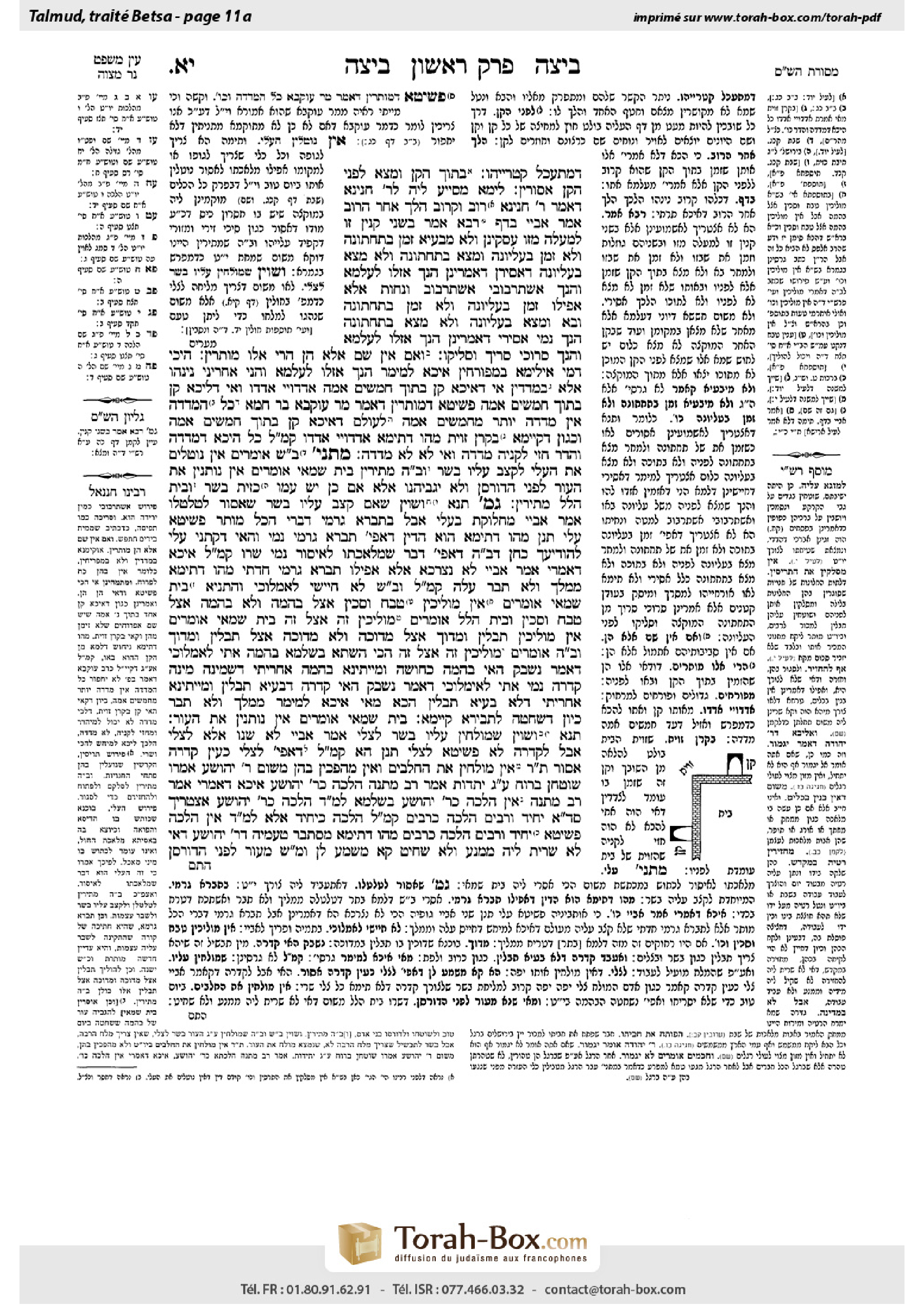
Beitzah 11a: Talmud study for Daf Yomi
Study the Talmud for Daf Yomi with scanned pages, Hebrew text, English translations from Sefaria and AI-generated French translations.
Passage selection and English or AI-generated French translation are available where the scan has annotations. Daf Study is independent of Torah-Box and Sefaria.
Browse Beitzah · ביצה · All tractatesBeitzah 11a text and translations
This page of Beitzah includes the Aramaic text, an English translation and an AI-generated French translation, alongside the scan above.
ביצה י״א א · Aramaic and Hebrew text
דְּמִתְעַכַּל קִטְרַיְיהוּ.
בְּתוֹךְ הַקֵּן וּמָצָא לִפְנֵי הַקֵּן — אֲסוּרִין. לֵימָא מְסַיַּיע לֵיהּ לְרַבִּי חֲנִינָא, דְּאָמַר רַבִּי חֲנִינָא: רוֹב וְקָרוֹב — הַלֵּךְ אַחַר הָרוֹב!
אָמַר אַבָּיֵי: בְּדַף. רָבָא אָמַר: בִּשְׁנֵי קִנִּין זוֹ לְמַעְלָה מִזּוֹ עָסְקִינַן. וְלָא מִבַּעְיָא זִמֵּן בַּתַּחְתּוֹנָה וְלֹא זִמֵּן בָּעֶלְיוֹנָה, וּמָצָא בַּתַּחְתּוֹנָה וְלֹא מָצָא בָּעֶלְיוֹנָה — דַּאֲסִירָן, דְּאָמְרִינַן: הָנָךְ אֲזַלוּ לְעָלְמָא, וְהָנָךְ אִשְׁתְּרַבּוֹבֵי אִשְׁתַּרְבּוּב וּנְחוּת.
אֶלָּא אֲפִילּוּ זִמֵּן בָּעֶלְיוֹנָה וְלֹא זִמֵּן בַּתַּחְתּוֹנָה, וּבָא וּמָצָא בָּעֶלְיוֹנָה וְלֹא מָצָא בַּתַּחְתּוֹנָה — הָנָךְ נָמֵי אֲסִירִי, דְּאָמְרִינַן: הָנָךְ אֲזַלוּ לְעָלְמָא, וְהָנָךְ סָרוֹכֵי סָרוּךְ וּסְלִיקוּ.
וְאִם אֵין שָׁם אֶלָּא הֵן — הֲרֵי אֵלּוּ מוּתָּרִין. הֵיכִי דָמֵי? אִילֵּימָא בִּמְפוֹרָחִין, אִיכָּא לְמֵימַר: הָנָךְ אֲזַלוּ לְעָלְמָא, וְהָנֵי אַחֲרִינֵי נִינְהוּ.
אֶלָּא בְּמִדַּדִּין. אִי דְּאִיכָּא קֵן בְּתוֹךְ חֲמִשִּׁים אַמָּה — אִדַּדּוֹיֵי אִדַּדּוֹ, וְאִי דְּלֵיכָּא קֵן בְּתוֹךְ חֲמִשִּׁים אַמָּה — פְּשִׁיטָא דְּמוּתָּרִין, דְּאָמַר מָר עוּקְבָא בַּר חָמָא: כׇּל הַמְדַדֶּה — אֵין מְדַדֶּה יוֹתֵר מֵחֲמִשִּׁים אַמָּה.
לְעוֹלָם דְּאִיכָּא קֵן בְּתוֹךְ חֲמִשִּׁים אַמָּה, וּכְגוֹן דְּקָיְימָא בְּקֶרֶן זָוִית. מַהוּ דְּתֵימָא: אִדַּדּוֹיֵי אִדַּדּוֹ, קָא מַשְׁמַע לַן כׇּל הֵיכָא דְּמִדַּדֵּה וַהֲדַר חָזֵי לְקִנֵּיהּ — מִדַּדֵּה, וְאִי לָא — לָא מִדַּדֵּה.
מַתְנִי׳ בֵּית שַׁמַּאי אוֹמְרִים: אֵין נוֹטְלִים אֶת הָעֱלִי לְקַצֵּב עָלָיו בָּשָׂר, וּבֵית הִלֵּל מַתִּירִין. בֵּית שַׁמַּאי אוֹמְרִים: אֵין נוֹתְנִין אֶת הָעוֹר לִפְנֵי הַדּוֹרְסָן. וְלֹא יַגְבִּיהֶנּוּ, אֶלָּא אִם כֵּן יֵשׁ עִמּוֹ כְּזַיִת בָּשָׂר, וּבֵית הִלֵּל מַתִּירִין.
גְּמָ׳ תָּנָא: וְשָׁוִין שֶׁאִם קִצֵּב עָלָיו בָּשָׂר — שֶׁאָסוּר לְטַלְטְלוֹ.
אָמַר אַבָּיֵי: מַחֲלוֹקֶת בֶּעֱלִי, אֲבָל בְּתָבְרָא גַּרְמֵי — דִּבְרֵי הַכֹּל מוּתָּר. פְּשִׁיטָא, עֱלִי תְּנַן!
מַהוּ דְּתֵימָא: הוּא הַדִּין דַּאֲפִילּוּ תָּבְרָא גַּרְמֵי נָמֵי. וְהַאי דְּקָתָנֵי עֱלִי, לְהוֹדִיעֲךָ כֹּחָן דְּבֵית הִלֵּל, דַּאֲפִילּוּ דָּבָר שֶׁמְּלַאכְתּוֹ לֶאֱסוֹר נָמֵי שָׁרוּ — קָא מַשְׁמַע לַן.
אִיכָּא דְּאָמְרִי, אָמַר אַבָּיֵי: לֹא נִצְרְכָא אֶלָּא אֲפִילּוּ תָּבְרָא גַּרְמֵי חַדְתִּי, מַהוּ דְּתֵימָא: מִמְּלֵךְ וְלָא תָּבַר עֲלַהּ — קָא מַשְׁמַע לַן.
וּבֵית שַׁמַּאי לָא חָיְישִׁי לְאִמְּלוֹכֵי? וְהָתַנְיָא, בֵּית שַׁמַּאי אוֹמְרִים: אֵין מוֹלִיכִין טַבָּח וְסַכִּין אֵצֶל בְּהֵמָה, וְלֹא בְּהֵמָה אֵצֶל טַבָּח וְסַכִּין. וּבֵית הִלֵּל אוֹמְרִים: מוֹלִיכִין זֶה אֵצֶל זֶה.
בֵּית שַׁמַּאי אוֹמְרִים: אֵין מוֹלִיכִין תַּבְלִין וּמָדוֹךְ אֵצֶל מְדוֹכָה, וְלֹא מְדוֹכָה אֵצֶל תַּבְלִין וּמָדוֹךְ. וּבֵית הִלֵּל אוֹמְרִים: מוֹלִיכִין זֶה אֵצֶל זֶה!
הָכִי הַשְׁתָּא?! בִּשְׁלָמָא בְּהֵמָה אָתֵי לְאִמְּלוֹכֵי, דְּאָמַר: נִשְׁבֹּק הַאי בְּהֵמָה כְּחוּשָׁה, וּמַיְיתֵינָא בְּהֵמָה אַחֲרִיתִי דְּשַׁמִּינָה מִינַּהּ. קְדֵרָה נָמֵי אָתֵי לְאִימְּלוֹכֵי, דְּאָמַר: נִשְׁבֹּק הַאי קְדֵרָה דְּבָעֲיָא תַּבְלִין, וּמַיְיתֵינָא אַחֲרִיתִי דְּלָא בָּעֲיָא תַּבְלִין. הָכָא מַאי אִיכָּא לְמֵימַר? מִמְּלֵךְ וְלָא תָּבַר? כֵּיוָן דְּשַׁחְטַהּ — לִתְבִירָא קָיְימָא.
בֵּית שַׁמַּאי אוֹמְרִים: אֵין נוֹתְנִין אֶת הָעוֹר. תָּנָא: וְשָׁוִין שֶׁמּוֹלְחִין עָלָיו בָּשָׂר לְצָלִי. אָמַר אַבָּיֵי: לֹא שָׁנוּ אֶלָּא לְצָלִי, אֲבָל לִקְדֵרָה — לֹא.
פְּשִׁיטָא — לְצָלִי תְּנַן! הָא קָא מַשְׁמַע לַן דַּאֲפִילּוּ לְצָלִי, כְּעֵין קְדֵרָה — אָסוּר.
תָּנוּ רַבָּנַן: אֵין מוֹלְחִין אֶת הַחֲלָבִים וְאֵין מְהַפְּכִין בָּהֶן. מִשּׁוּם רַבִּי יְהוֹשֻׁעַ אֲמַרוּ: שׁוֹטְחָן בָּרוּחַ עַל גַּבֵּי יְתֵדוֹת.
אָמַר רַב מַתְנָה: הֲלָכָה כְּרַבִּי יְהוֹשֻׁעַ. אִיכָּא דְּאָמְרִי, אָמַר רַב מַתְנָה: אֵין הֲלָכָה כְּרַבִּי יְהוֹשֻׁעַ. בִּשְׁלָמָא לְמַאן דְּאָמַר הֲלָכָה כְּרַבִּי יְהוֹשֻׁעַ — אִצְטְרִיךְ, סָלְקָא דַּעְתָּךְ אָמֵינָא יָחִיד וְרַבִּים הֲלָכָה כְּרַבִּים, קָא מַשְׁמַע לַן הֲלָכָה כְּיָחִיד.
אֶלָּא לְמַאן דְּאָמַר אֵין הֲלָכָה — פְּשִׁיטָא, יָחִיד וְרַבִּים הֲלָכָה כְּרַבִּים! מַהוּ דְּתֵימָא: מִסְתַּבַּר טַעְמֵיהּ דְּרַבִּי יְהוֹשֻׁעַ דְּאִי לָא שָׁרֵית לֵיהּ מִמְּנַע וְלָא שָׁחֵיט, קָא מַשְׁמַע לַן.
וּמַאי שְׁנָא מֵעוֹר לִפְנֵי הַדּוֹרְסָן?
Beitzah 11a · English translation
their knot becomes worn and untied. Consequently, it is possible that someone took only one of the two pouches.
§ The mishna taught that if one designated fledglings inside the nest and found them before the nest, they are prohibited. The Gemara comments: Let us say that this supports the opinion of Rabbi Ḥanina, as Rabbi Ḥanina said: In a case involving a majority and an item that is near, one follows the majority. Since doves from the outside world are more numerous than those that one designated, the assumption is that these fledglings are from the majority, and therefore they are prohibited.
Abaye said, in refutation of this claim: Here we are dealing with a ledge affixed to the front of the nest, where all the doves gather. Therefore, the principle pertaining to a majority and an item that is near does not apply to this case. Rava said: Here we are dealing with two nests, one above the other, i.e., adjacent nests rather than any two nests. And it is not necessary to state that in the case of one who designated the fledglings in the lower nest and did not designate those in the upper one, and he found fledglings in the lower one and he did not find fledglings in the upper one, that the fledglings are all prohibited. The reason is that we say: These that were in the lower nest went to the outside world, while these still present have dragged themselves and come down.
Rather, even if one designated fledglings in the upper nest and did not designate fledglings in the lower one, and he came and found fledglings in the upper one and did not find fledglings in the lower one, those in the upper nest are also prohibited, as we say: Those that he originally designated went to the outside world, and those in the lower nest have clutched and climbed. Therefore, there is cause for concern in both of these cases.
The mishna states that if there are no others there apart from them, they are permitted. The Gemara asks: What are the circumstances? If we say that the mishna is dealing with fledglings that are already able to fly, it is possible to say that those that he designated went to the outside world, and the ones that are present are other ones.
Rather, the mishna must be referring to fledglings that can only hop from one place to another. However, if it deals with a case where there is another dove nest within fifty cubits, the fledglings might have jumped and come from that nest; and if there is no nest within fifty cubits, it is obvious that they are permitted, for from where could they have come? As Mar Ukva bar Ḥama said: With regard to any creature that hops, it does not hop more than fifty cubits.
The Gemara answers: Actually, it is referring to a case where there is another nest within fifty cubits, and it deals with a situation where the additional nest is situated around a corner from the first nest, rather than in a straight line from it. Lest you say: The fledglings jumped from one nest to the other, the mishna therefore teaches us that anywhere that a fledgling hops and turns and sees its nest, it will continue to hop. But if it can no longer see its original nest, it will not hop any farther.
MISHNA: Beit Shammai say: One may not take a large pestle from a mortar, which is normally used for crushing wheat in the preparation of porridge, for any other purpose on a Festival, e.g., to cut meat on it; and Beit Hillel permit it. Likewise, Beit Shammai say: One may not place an unprocessed hide before those who will tread on it, as this constitutes the prohibited labor of tanning on a Festival. And one may not lift the hide from its place, as it is considered muktze, unless there is an olive-bulk of meat on it, in which case it may be carried on account of its meat; and Beit Hillel permit it in both cases.
GEMARA: The Sage taught in a baraita: And Beit Shammai and Beit Hillel agree that if one already cut the meat he needs for the Festival on the pestle, it is prohibited to move the pestle farther on the Festival. The reason is that the vessel is muktze as a utensil whose primary function is a prohibited use, and therefore it is permitted to handle it only when one requires it.
Abaye said: This dispute applies specifically in the case of a pestle; however, in the case of a wooden anvil used for breaking bones, everyone agrees that it is permitted. The Gemara asks: This is obvious; we learned in the mishna: A pestle. Why would one think that an object not even mentioned in the mishna is prohibited?
The Gemara answers: Abaye’s statement is necessary, lest you say: The same is true, i.e., Beit Shammai and Beit Hillel disagree, even with regard to a wooden anvil used for breaking bones; and that which the mishna specifically teaches: A pestle, is to convey the far-reaching nature of the opinion of Beit Hillel, that they permitted moving even an object whose primary function is for a prohibited use. Abaye therefore teaches us that Beit Shammai and Beit Hillel did not disagree with regard to a wooden anvil used for breaking bones.
Some say a different version of the previous discussion. Abaye said: It is necessary to say only: Even a new wooden anvil used for breaking bones is also permitted. Lest you say: Perhaps one will reconsider and not break bones on it, but rather set it aside for a different purpose, Abaye therefore teaches us that this is not a concern.
The Gemara asks: And is that so? Are Beit Shammai not concerned about the possibility that one might reconsider? But isn’t it taught (Tosefta, Beitza 1:13): Beit Shammai say: On a Festival, one may not lead a butcher with a knife in hand to an animal located far from him, so that he can slaughter it; nor may one lead an animal to a butcher with a knife, lest he reconsider, in which case he will have handled the knife unnecessarily, which is prohibited; and Beit Hillel say: One may lead them from one to the other, as they are not concerned about unnecessary use of the knife.
By the same reasoning, Beit Shammai say: One may not bring spices or a pestle to a mortar, nor a mortar to spices and a pestle, as he might change his mind and will have handled these utensils on the Festival for no purpose. And Beit Hillel say: One may bring one to the other, as there is no concern that he may reconsider. This shows that Beit Shammai are, in general, concerned that one might reconsider, as they prohibit one to handle items for this reason.
The Gemara refutes this: How can these cases be compared? Granted, in the case of an animal, one is liable to come to reconsider, as he might say: Let us leave aside this animal, as it is thin, and we will bring a different animal, fatter than it. With regard to a pot, too, one is liable to come to reconsider, as he might say: Let us leave aside this pot of cooked food, as it requires spices and would take great effort to prepare, and I will bring a different one that does not require spices and can be cooked as it is. However, here, with regard to a wooden anvil used for breaking bones, what is there to say? Will one reconsider and not break the bones? Since he has slaughtered an animal, it stands ready for its bones to be broken, as it cannot be eaten in any other way.
§ It was taught in the mishna that Beit Shammai say: One may not place an unprocessed hide before the one who will tread on it. The Sage taught (Tosefta, Beitza 1:13): And Beit Shammai and Beit Hillel agree that one may salt meat for roasting on this hide, and there is no concern that some of the salt will fall on the hide, which would be similar to tanning the hide by salting. Abaye said: They taught that one may salt meat only for roasting, in which case it is not salted a great deal. However, in the case of meat for a pot, i.e., for cooking, the Sages did not say that one may salt it on the hide, as meat must be well-salted on all sides before cooking, and a large amount of salt will inevitably spill onto the hide.
The Gemara asks: It is obvious the one may not salt meat for cooking in a pot, as we explicitly learned in the Tosefta just cited: For roasting, and not for cooking. The Gemara answers: This comes to teach us that even the permission to salt meat for roasting applies only if one does so in the usual manner. However, if one salts it in a manner of meat salted to be cooked in a pot, which requires more salt than is necessary for roasting, it is prohibited.
The Sages taught: On a Festival, one may not salt the fats of an animal, which is done so that they will not decompose and emit a foul odor. This is true even if the animal was slaughtered on the Festival. And one may not turn them over. The fats are unfit for use on the Festival, and therefore they are muktze. They said in the name of Rabbi Yehoshua: One may spread the fats out in the wind on pegs to prevent them from decaying.
Rav Mattana said: The halakha is in accordance with the opinion of Rabbi Yehoshua. Some say that Rav Mattana said: The halakha is not in accordance with the opinion of Rabbi Yehoshua. The Gemara asks: Granted, according to the one who said that the halakha is in accordance with the opinion of Rabbi Yehoshua, this statement is necessary. Otherwise, it might enter your mind to say that since this is a dispute between an individual and the many, one should apply the principal that the halakha is in accordance with the opinion of the many. Rav Mattana therefore teaches us that, in this case, the halakha is in accordance with the opinion of the individual.
However, according to the one who said that the halakha is not in accordance with the opinion of Rabbi Yehoshua, this is obvious. In a case involving an individual and the many, the halakha is in accordance with the many. The Gemara answers: This ruling is nevertheless necessary, lest you say: Rabbi Yehoshua’s opinion is more reasonable, for if you do not permit him to air out the fats, he will refrain and not slaughter an animal at all. Rav Mattana therefore teaches us that this factor is not taken into consideration.
The Gemara asks: And in what way is this case different from placing a hide before those who will tread on it, which Beit Hillel, whose ruling is accepted as halakha, permit for the very reason that, if one is not allowed to do so, he will refrain from slaughtering animals?
Beitzah 11a · Traduction française (IA)
leur nœud devient usé et dénoué. Il est donc possible que quelqu'un ait pris seulement l'un des deux sacs.
§ La Michna enseigne que si l'on a désigné des poussins dans le nid et qu'on les trouve avant le nid, ils sont interdits. La Guemara commente : Disons que cela soutient l'opinion de Rabbi Ḥanina, car Rabbi Ḥanina a dit : Dans un cas impliquant une majorité et un objet proche, on suit la majorité. Puisque les moineaux du monde extérieur sont plus nombreux que ceux que l'on a désignés, on suppose que ces poussins proviennent de la majorité, et par conséquent, ils sont interdits.
Abaye a dit, en réfutant cette affirmation : Ici, nous sommes en présence d'une corniche fixée devant le nid, où tous les moineaux se réunissent. Par conséquent, le principe relatif à la majorité et à un objet proche ne s'applique pas à ce cas. Rava a dit : Ici, nous sommes en présence de deux nids, l'un au-dessus de l'autre, c'est-à-dire des nids adjacents plutôt que n'importe quels nids. Et il n'est pas nécessaire de préciser que dans le cas où l'on a désigné les poussins dans le nid inférieur et non ceux du nid supérieur, et qu'on a trouvé des poussins dans le nid inférieur sans en trouver dans le supérieur, ces poussins sont tous interdits. La raison est que nous disons : ceux qui étaient dans le nid inférieur sont partis vers le monde extérieur, tandis que ceux qui sont encore présents se sont déplacés et sont descendus.
Au contraire, même si l'on a désigné des poussins dans le nid supérieur et non ceux du nid inférieur, et qu'on a trouvé des poussins dans le supérieur sans en trouver dans l'inférieur, ceux du supérieur sont également interdits, car nous disons : ceux que l'on a initialement désignés sont partis vers le monde extérieur, et ceux du nid inférieur se sont accrochés et sont montés. Il y a donc lieu de s'inquiéter dans les deux cas.
La Michna stipule que si personne d'autre n'est présent à part eux, ils sont permis. La Guemara pose la question : Quelles sont les circonstances ? Si nous disons que la Michna traite de des poussins déjà capables de voler, il est possible de dire que ceux que l'on a désignés sont partis vers le monde extérieur, et ceux présents sont d'autres poussins.
Au contraire, la Michna doit se référer à des poussins qui ne peuvent que sauter d'un endroit à un autre. Cependant, si le cas concerne un nid de moineaux à cinquante cubits, les poussins pourraient avoir sauté et être venus de ce nid ; et si aucun nid n'est à cinquante cubits, il est évident qu'ils sont permis, car d'où pourraient-ils venir ? Comme Mar Ukva bar Ḥama a dit : Concernant tout être qui saute, il ne saute pas plus de cinquante cubits.
La Guemara répond : En réalité, il s'agit d'un cas où il y a un autre nid à cinquante cubits, et il s'agit d'une situation où le nid supplémentaire est situé autour d'un coin par rapport au premier nid, plutôt que sur une ligne droite. Lorsque vous dites : les poussins ont sauté d'un nid à l'autre, la Michna nous enseigne donc que partout où un poussin saute, tourne et voit son nid, il continuera à sauter. Mais si il ne peut plus voir son nid d'origine, il ne sautera plus loin.
MICHNA : Beit Shammai disent : On ne peut pas prendre un mortier de grande taille utilisé normalement pour écraser le blé dans la préparation de la pâte, pour un autre usage pendant un festival, par exemple pour couper la viande ; et Beit Hillel permettent cela. De même, Beit Shammai disent : On ne peut pas placer une peau non traitée devant ceux qui la foulent, car cela constituerait le travail interdit de tannage pendant un festival. Et on ne peut pas soulever la peau de son lieu, car elle est considérée comme muktze, sauf s'il y a une quantité d'olive de viande dessus, dans ce cas on peut la porter en raison de la viande ; et Beit Hillel permettent cela dans les deux cas.
GUEMARA : Le Sage a enseigné dans une baraïta : Et Beit Shammai et Beit Hillel s'accordent sur le fait que si l'on a déjà coupé la viande nécessaire pour le festival sur le mortier, il est interdit de déplacer le mortier davantage pendant le festival. La raison est que le récipient est muktze comme un ustensile dont la fonction principale est un usage interdit, et par conséquent, il est permis de le manipuler uniquement lorsqu'on en a besoin.
Abaye a dit : Cette dispute s'applique spécifiquement au cas d'un mortier ; cependant, dans le cas d'une enclume en bois utilisée pour briser les os, tout le monde s'accorde sur le fait qu'elle est permise. La Guemara pose la question : Cela est évident ; nous avons appris dans la Michna : un mortier. Pourquoi penserait-on que l'objet non mentionné dans la Michna est interdit ?
La Guemara répond : L'affirmation d'Abaye est nécessaire, afin que vous ne disiez pas : la même chose est vraie, c'est-à-dire Beit Shammai et Beit Hillel sont en désaccord, même concernant une enclume en bois utilisée pour briser les os ; et que la Michna enseigne spécifiquement : un mortier, est pour faire comprendre la portée de l'opinion de Beit Hillel, qui permettent de déplacer même un objet dont la fonction principale est un usage interdit. Abaye enseigne donc que Beit Shammai et Beit Hillel n'ont pas de désaccord concernant une enclume en bois utilisée pour briser les os.
Certains donnent une version différente de la discussion précédente. Abaye a dit : Il faut dire seulement : même une enclume en bois neuve utilisée pour briser les os est permise. Lorsque vous dites : peut-être l'on réfléchira et ne brisera pas les os dessus, mais plutôt l'abandonnera à un autre usage, Abaye enseigne donc que cela n'est pas un problème.
La Guemara pose la question : Et c'est ainsi ? Beit Shammai ne sont-ils pas préoccupés par la possibilité que l'on réfléchisse ? Mais n'est-il pas enseigné (Tosefta, Beitza 1:13) : Beit Shammai disent : Pendant un festival, on ne doit pas conduire un boucher avec un couteau à un animal situé loin de lui, afin qu'il le sacrifie ; ni ne doit-on conduire un animal vers un boucher avec un couteau, de peur qu'il réfléchisse, dans ce cas il aura manipulé inutilement le couteau, ce qui est interdit ; et Beit Hillel disent : On peut les conduire l'un à l'autre, car ils ne sont pas préoccupés par l'utilisation inutile du couteau.
Par le même raisonnement, Beit Shammai disent : On ne peut pas apporter des épices ou un pilon à un mortier, ni un mortier aux épices et au pilon, car l'homme pourrait changer d'avis et avoir manipulé ces ustensiles pendant la fête sans raison. Et Beit Hillel disent : On peut apporter l'un à l'autre, car il n'y a pas de crainte qu'il change d'avis. Cela montre que Beit Shammai, en général, sont préoccupés par le fait qu'on puisse changer d'avis, car ils interdisent de manipuler des objets pour cette raison.
La Guemara réfute cela : Comment ces cas peuvent-ils être comparés ? En effet, dans le cas d'un animal, on est en danger de changer d'avis, car l'homme pourrait dire : Laissons cet animal, il est maigre, et nous apporterons un autre animal plus gras. En ce qui concerne une marmite, on est également en danger de changer d'avis, car l'homme pourrait dire : Laissons cette marmite de plat, car elle nécessite des épices et il faudrait beaucoup de travail pour la préparer, et nous apporterons un autre plat qui n'a pas besoin d'épices et peut être cuisiné tel quel. Cependant, ici, concernant un anvil en bois utilisé pour casser les os, qu'y a-t-il à dire ? L'homme pourrait-il changer d'avis et ne pas casser les os ? Puisqu'il a sacrifié un animal, il est prêt à ce que ses os soient cassés, car il ne peut être mangé d'une autre manière.
§ Il a été enseigné dans la mitsna que Beit Shammai disent : On ne peut pas placer une peau non traitée devant celui qui la marchera. Le Sage enseigna (Tosefta, Beitza 1:13) : Et Beit Shammai et Beit Hillel s'accordent sur le fait qu'on peut saler la viande pour la cuisson sur cette peau, et il n'y a pas de crainte que certaines particules de sel tombent sur la peau, ce qui serait similaire à tanner la peau par le sel. Abaye dit : Ils enseignent qu'on peut saler la viande uniquement pour la cuisson, dans ce cas, on ne la salerait pas beaucoup. Cependant, dans le cas de la viande pour une marmite, c'est-à-dire pour la cuisson, les Sages n'ont pas dit qu'on puisse la saler sur la peau, car la viande doit être bien salée de tous les côtés avant la cuisson, et une grande quantité de sel tomberait inévitablement sur la peau.
La Guemara demande : C'est évident qu'on ne peut pas saler la viande pour la cuisson dans une marmite, car nous avons appris explicitement dans la Tosefta citée précédemment : Pour la cuisson, et non pour la cuisson. La Guemara répond : Cela vient enseigner que même la permission de saler la viande pour la cuisson s'applique uniquement si l'on le fait de la manière habituelle. Cependant, si l'on la salait de la manière de la viande salée pour la cuisson dans une marmite, qui nécessite plus de sel que nécessaire pour la cuisson, cela est interdit.
Les Sages enseignèrent : Pendant un festival, on ne peut pas saler les graisses d'un animal, ce qui est fait afin qu'elles ne se décomposent pas et n'émettent pas une odeur nauséabonde. Cela est vrai même si l'animal a été sacrifié pendant le festival. Et on ne peut pas les retourner. Les graisses sont inutilisables pendant le festival, et par conséquent, elles sont muktze. Ils dirent en nom de Rabbi Yehoshua : On peut étaler les graisses dans le vent sur des clous pour les empêcher de se dégrader.
Rav Mattana dit : La halakha suit l'opinion de Rabbi Yehoshua. Certains disent que Rav Mattana dit : La halakha ne suit pas l'opinion de Rabbi Yehoshua. La Guemara demande : En effet, selon celui qui a dit que la halakha suit l'opinion de Rabbi Yehoshua, cette déclaration est nécessaire. Sinon, cela pourrait entrer en vous l'idée de dire que, puisque c'est un désaccord entre un individu et la majorité, on devrait appliquer le principe que la halakha suit l'opinion de la majorité. Rav Mattana enseigne donc que, dans ce cas, la halakha suit l'opinion de l'individu.
Cependant, selon celui qui a dit que la halakha ne suit pas l'opinion de Rabbi Yehoshua, cela est évident. Dans un cas impliquant un individu et la majorité, la halakha suit la majorité. La Guemara répond : Ce jugement est toutefois nécessaire, afin que vous ne disiez pas que l'opinion de Rabbi Yehoshua est plus rationnelle, car si vous ne permettez pas à l'homme de faire sécher les graisses, il se abstiendra de sacrifier un animal. Rav Mattana enseigne donc que ce facteur n'est pas pris en compte.
La Guemara demande : Et dans quelle mesure ce cas diffère-t-il de celui de la mise d'une peau devant ceux qui la marcheront, qui est permis par Beit Hillel, dont le jugement est accepté comme halakha, précisément parce que, si l'on ne permet pas cela, l'homme se abstiendra de sacrifier des animaux ?
Traduction française générée par IA à partir de l’édition anglaise de Sefaria. Vérifie toujours un passage avec le texte source.
Text from Sefaria: William Davidson Edition - Vocalized Aramaic (CC BY NC); William Davidson Edition - English (CC BY NC).