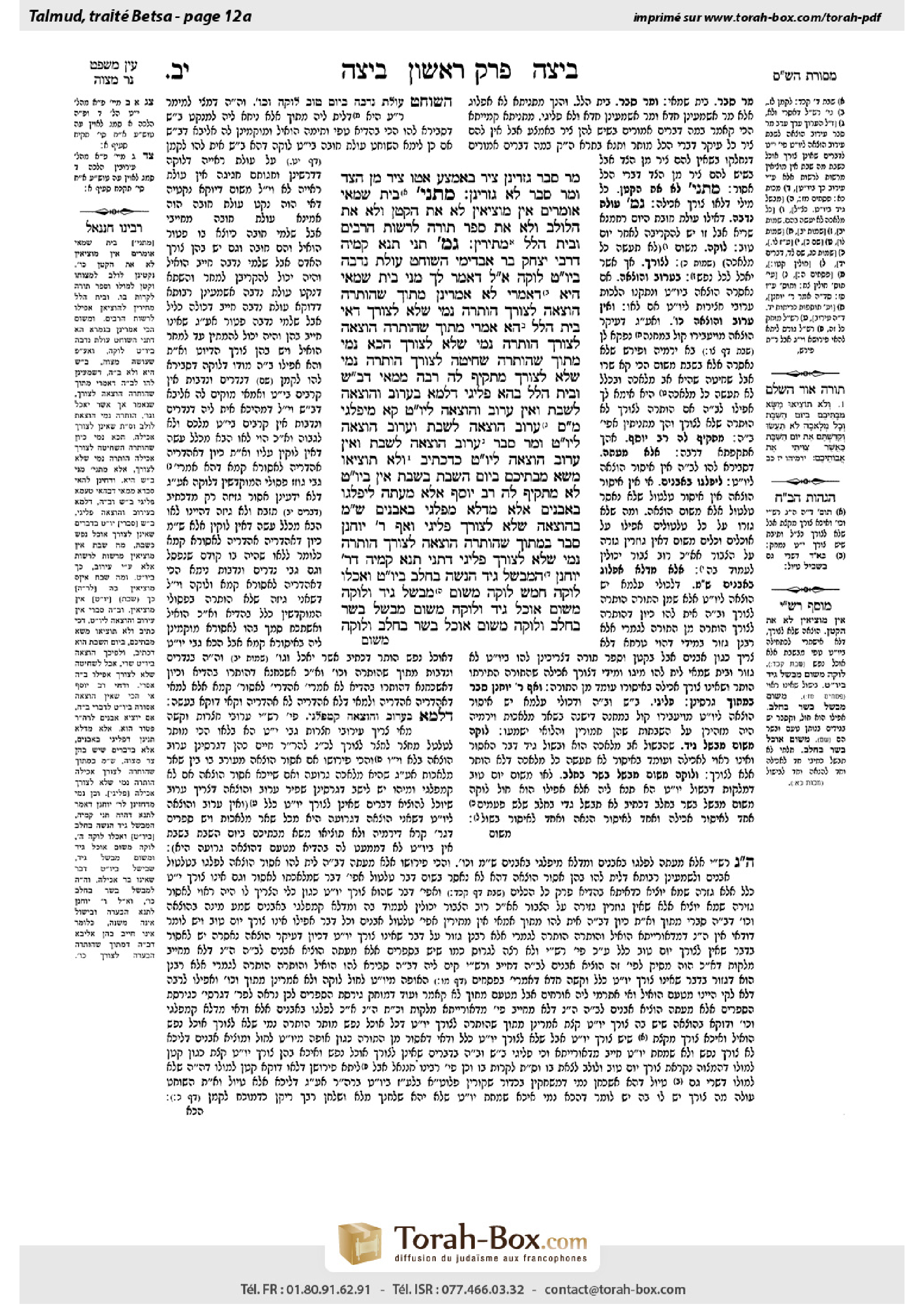
Beitzah 12a: Talmud study for Daf Yomi
Study the Talmud for Daf Yomi with scanned pages, Hebrew text, English translations from Sefaria and AI-generated French translations.
Passage selection and English or AI-generated French translation are available where the scan has annotations. Daf Study is independent of Torah-Box and Sefaria.
Browse Beitzah · ביצה · All tractatesBeitzah 12a text and translations
This page of Beitzah includes the Aramaic text, an English translation and an AI-generated French translation, alongside the scan above.
ביצה י״ב א · Aramaic and Hebrew text
מָר סָבַר: גָּזְרִינַן צִיר בָּאֶמְצַע אַטּוּ צִיר מִן הַצַּד, וּמָר סָבַר: לָא גָּזְרִינַן.
מַתְנִי׳ בֵּית שַׁמַּאי אוֹמְרִים: אֵין מוֹצִיאִין לֹא אֶת הַקָּטָן, וְלֹא אֶת הַלּוּלָב, וְלֹא אֶת סֵפֶר תּוֹרָה לִרְשׁוּת הָרַבִּים, וּבֵית הִלֵּל מַתִּירִין.
גְּמָ׳ תָּנֵי תַּנָּא קַמֵּיהּ דְּרַבִּי יִצְחָק בַּר אַבְדִּימִי: הַשּׁוֹחֵט עוֹלַת נְדָבָה בְּיוֹם טוֹב — לוֹקֶה.
אֲמַר לֵיהּ: דַּאֲמַר לָךְ מַנִּי — בֵּית שַׁמַּאי הִיא, דְּאָמְרִי: לָא אָמְרִינַן מִתּוֹךְ שֶׁהוּתְּרָה הוֹצָאָה לְצוֹרֶךְ — הוּתְּרָה נָמֵי שֶׁלֹּא לְצוֹרֶךְ. דְּאִי בֵּית הִלֵּל, הָא אָמְרִי: מִתּוֹךְ שֶׁהוּתְּרָה הוֹצָאָה לְצוֹרֶךְ — הוּתְּרָה נָמֵי שֶׁלֹּא לְצוֹרֶךְ. הָכָא נָמֵי, מִתּוֹךְ שֶׁהוּתְּרָה שְׁחִיטָה לְצוֹרֶךְ — הוּתְּרָה נָמֵי שֶׁלֹּא לְצוֹרֶךְ.
מַתְקֵיף לַהּ רַבָּה: מִמַּאי דְּבֵית שַׁמַּאי וּבֵית הִלֵּל בְּהָא פְּלִיגִי? דִּלְמָא בְּעֵרוּב וְהוֹצָאָה לְשַׁבָּת וְאֵין עֵרוּב וְהוֹצָאָה לְיוֹם טוֹב קָא מִיפַּלְגִי.
מָר סָבַר: עֵרוּב הוֹצָאָה לְשַׁבָּת, וְעֵרוּב הוֹצָאָה לְיוֹם טוֹב.
וּמַר סָבַר: עֵרוּב הוֹצָאָה לְשַׁבָּת, וְאֵין עֵרוּב הוֹצָאָה לְיוֹם טוֹב, כְּדִכְתִיב: ״וְלֹא תוֹצִיאוּ מַשָּׂא מִבָּתֵּיכֶם בְּיוֹם הַשַּׁבָּת״. בְּשַׁבָּת — אִין, בְּיוֹם טוֹב — לָא.
מַתְקֵיף לַהּ רַב יוֹסֵף: אֶלָּא מֵעַתָּה, לִיפַּלְגוּ בַּאֲבָנִים! אֶלָּא מִדְּלָא מִפַּלְגִי בַּאֲבָנִים, שְׁמַע מִינַּהּ,
בְּהוֹצָאָה שֶׁלֹּא לְצוֹרֶךְ פְּלִיגִי.
וְאַף רַבִּי יוֹחָנָן סָבַר: בְּמִתּוֹךְ שֶׁהוּתְּרָה הוֹצָאָה לְצוֹרֶךְ הוּתְּרָה נָמֵי שֶׁלֹּא לְצוֹרֶךְ פְּלִיגִי. דְּתָנֵי תַּנָּא קַמֵּיהּ דְּרַבִּי יוֹחָנָן: הַמְבַשֵּׁל גִּיד הַנָּשֶׁה בְּחָלָב בְּיוֹם טוֹב וַאֲכָלוֹ — לוֹקֶה חָמֵשׁ.
לוֹקֶה מִשּׁוּם מְבַשֵּׁל גִּיד, וְלוֹקֶה מִשּׁוּם אוֹכֵל גִּיד, וְלוֹקֶה מִשּׁוּם מְבַשֵּׁל בָּשָׂר בְּחָלָב, וְלוֹקֶה מִשּׁוּם אוֹכֵל בָּשָׂר בְּחָלָב, וְלוֹקֶה
Beitzah 12a · English translation
One Sage, Beit Shammai, holds that we issue a decree and prohibit a hinge in the middle due to a hinge on the side; and one Sage, Beit Hillel, holds that we do not issue this decree. Since placing a hinge of this type does not constitute the prohibited labor of building, it is permitted.
MISHNA: Beit Shammai say: One may carry out on a Festival neither a minor child, nor a lulav, nor a Torah Scroll into the public domain, as none of these are required for the preparation of food; and Beit Hillel permit it.
GEMARA: The tanna who reviews mishnayot teaches a baraita before Rav Yitzḥak bar Avdimi: One who slaughters a gift offering on a Festival is flogged for transgressing the prohibition: “No manner of work shall be done on them” (Exodus 12:16). Since this slaughtering was not performed for the purpose of eating, the action constitutes a prohibited labor on a Festival.
Rav Yitzḥak bar Avdimi said to that tanna: Who could have said this baraita to you? It is evidently in accordance with the opinion of Beit Shammai, who say that we do not say: Since carrying out was permitted on a Festival for the purpose of food preparation, it was also permitted not for that purpose. For if you say the baraita is accordance with the opinion of Beit Hillel, they say: Since carrying out was permitted for the requirements of food preparation, it was also permitted not for these requirements. Here, too, with regard to the prohibited labor of slaughtering, since slaughter was permitted for the requirements of food preparation, it was also permitted not for these requirements. It was permitted for any purpose that benefits people, whether directly or indirectly.
Rabba strongly objects to this reasoning: From where do you infer that Beit Shammai and Beit Hillel disagree over this issue? Perhaps they disagree about the following: The halakhot of eiruv and the prohibition against carrying out apply to Shabbat, but there are no halakhot of eiruv nor a prohibition against carrying out on a Festival.
The Gemara clarifies the dispute according to this explanation: One Sage, Beit Shammai, holds that the halakhot of eiruv and the prohibition against carrying out apply to Shabbat, and similarly the halakhot of eiruv and carrying out apply to a Festival. The only difference is that, on a Festival, carrying, like other types of prohibited labor, is permitted for the sake of food preparation.
And one Sage, Beit Hillel, holds that the halakhot of eiruv and the prohibition against carrying out apply to Shabbat, but there are no halakhot of eiruv nor a prohibition against carrying out on a Festival, as it is written: “Neither carry forth a burden out of your houses on the Shabbat day” (Jeremiah 17:22), from which Beit Hillel inferred: On Shabbat, yes, carrying from one domain to another is indeed prohibited; on a Festival, no, it is not prohibited. According to this explanation, Beit Shammai and Beit Hillel did not disagree about whether a prohibited labor that is permitted for the purpose of food preparation on a Festival is also permitted when it does not serve that purpose.
Rav Yosef strongly objects to this explanation of Rabba: However, if that is so, that the dispute is whether the prohibition against carrying out applies on a Festival, Beit Hillel should permit one to move muktze objects, as the prohibition of handling muktze is an extension of the prohibition against carrying out. Consequently, let them differ with regard to whether or not it is permitted to carry out stones on a Festival. Rather, from the fact that Beit Shammai and Beit Hillel do not disagree with regard to stones but concerning objects that serve some sort of purpose, conclude from this: Everyone agrees that carrying out is prohibited on a Festival, and the Torah permitted it only when it is necessary for sustenance.
Instead, Beit Shammai and Beit Hillel disagree with regard to carrying out that is not for the purpose of food preparation. According to the opinion of Beit Hillel, since carrying out is permitted for the sake of sustenance, it is entirely permitted. According to Beit Shammai, the Sages permitted only labor that serves the purpose of food preparation.
The Gemara comments: And Rabbi Yoḥanan also holds that Beit Shammai and Beit Hillel disagree with regard to the principle: Since carrying out is permitted on a Festival for the purpose of food preparation, it was also permitted not for this purpose, as the tanna teaches a baraita before Rabbi Yoḥanan: One who cooks the sciatic nerve in milk on a Festival and eats it is flogged for violating five distinct prohibitions.
How so? (1) He is flogged due to the prohibition of cooking the sciatic nerve, which is prohibited because the sciatic nerve is unfit for consumption; (2) and he is flogged due to the prohibition of eating the sciatic nerve, which is explicitly prohibited by the Torah; (3) and he is flogged due to the prohibition of cooking meat in milk; (4) and he is flogged due to the prohibition of eating meat cooked in milk; (5) and lastly, he is flogged
Beitzah 12a · Traduction française (IA)
Un sage, Beit Shammai, affirme que nous édictons un décret et interdisons un axe au milieu en raison d'un axe sur le côté ; et un autre sage, Beit Hillel, affirme que nous ne nous édictons pas ce décret. Placer un axe de ce type ne constitue pas le travail interdit de la construction, donc cela est permis.
MICHNA : Beit Shammai disent : On ne peut pas transporter un enfant mineur, un lulav ou un rouleau de Torah dans le domaine public pendant un festival, car aucun de ces objets n'est nécessaire à la préparation des aliments ; et Beit Hillel permet cela.
GUEMARA : Le tanna qui révise les mishnayot enseigne une baraïta avant Rav Yitzḥak bar Avdimi : Celui qui sacrifie un holocauste pendant un festival est battu pour avoir transgressé l'interdiction : « Aucun travail ne doit être fait sur eux » (Exode 12:16). Puisque ce sacrifice n'a pas été effectué à des fins de consommation, l'action constitue un travail interdit pendant un festival.
Rav Yitzḥak bar Avdimi dit à ce tanna : Qui aurait pu dire cette baraïta à vous ? Il est évident qu'elle s'inscrit dans l'opinion de Beit Shammai, qui affirment que nous ne disons pas : Puisque le transport était permis pendant un festival à des fins de préparation alimentaire, il était également permis sans cette raison. Puisque vous dites que la baraïta s'inscrit dans l'opinion de Beit Hillel, ils affirment : Puisque le transport était permis à des fins de préparation alimentaire, il était également permis sans ces raisons. Ici aussi, concernant le travail interdit de bétail, puisque le bétail était permis à des fins de préparation alimentaire, il était également permis sans ces raisons. Il était permis pour toute raison qui bénéficie aux gens, que ce soit directement ou indirectement.
Rabba s'oppose fermement à cette raisonnement : D'où infères-tu que Beit Shammai et Beit Hillel divergent sur ce point ? Peut-être divergent-ils sur le suivant : Les halakhot de l'eiruv et l'interdiction de transport s'appliquent à la Shabbat, mais il n'y a pas de halakhot de l'eiruv ni d'interdiction de transport pendant un festival.
La Guemara clarifie le débat selon cette explication : Un sage, Beit Shammai, affirme que les halakhot de l'eiruv et l'interdiction de transport s'appliquent à la Shabbat, et de même les halakhot de l'eiruv et du transport s'appliquent à un festival. La seule différence est que, pendant un festival, le transport, comme d'autres types de travail interdit, est permis à des fins de préparation alimentaire.
Et un sage, Beit Hillel, affirme que les halakhot de l'eiruv et l'interdiction de transport s'appliquent à la Shabbat, mais il n'y a pas de halakhot de l'eiruv ni d'interdiction de transport pendant un festival, car il est écrit : « Ne portez pas de fardeau de vos maisons le jour de la Shabbat » (Jérémie 17:22), d'où Beit Hillel infère : La Shabbat, oui, le transport d'un domaine à un autre est effectivement interdit ; le festival, non, il n'est pas interdit. Selon cette explication, Beit Shammai et Beit Hillel n'ont pas divergé sur le fait que le travail interdit qui est permis à des fins de préparation alimentaire pendant un festival est également permis sans cette raison.
Rav Yosef s'oppose fermement à cette explication de Rabba : Cependant, si c'est ainsi, que le débat porte sur l'application de l'interdiction de transport pendant un festival, Beit Hillel devrait permettre de déplacer les objets muktze, car l'interdiction de manipuler les objets muktze est une extension de l'interdiction de transport. Ainsi, laissons-les diverger sur le fait de savoir si le transport des pierres est permis pendant un festival. Au contraire, du fait que Beit Shammai et Beit Hillel ne divergent pas sur les pierres mais sur les objets ayant une certaine utilité, concluons-en : Tout le monde convient que le transport est interdit pendant un festival, et la Torah a permis cela uniquement lorsqu'il est nécessaire pour la subsistance.
Au contraire, Beit Shammai et Beit Hillel divergent concernant le transport qui n'a pas pour but la préparation alimentaire. Selon l'opinion de Beit Hillel, puisque le transport est permis à des fins de subsistance, il est entièrement permis. Selon Beit Shammai, les Sages ont permis uniquement le travail servant à la préparation alimentaire.
La Guemara commente : Rabbi Yoḥanan affirme également que Beit Shammai et Beit Hillel divergent concernant le principe : puisque le transport est permis pendant un festival à des fins de préparation alimentaire, il était également permis sans cette raison, comme le tanna enseigne une baraïta avant Rabbi Yoḥanan : celui qui cuisine le nerf sciatique dans le lait pendant un festival et le mange est battu pour avoir violé cinq prohibitions distinctes.
Comment cela ? (1) Il est battu en raison de la prohibition de cuisson du nerf sciatique, qui est interdite car le nerf sciatique n'est pas comestible ; (2) et il est battu en raison de la prohibition de manger le nerf sciatique, qui est explicitement interdit par la Torah ; (3) et il est battu en raison de la prohibition de cuisson de viande dans le lait ; (4) et il est battu en raison de la prohibition de manger de la viande cuite dans le lait ; (5) et enfin, il est battu.
Traduction française générée par IA à partir de l’édition anglaise de Sefaria. Vérifie toujours un passage avec le texte source.
Text from Sefaria: William Davidson Edition - Vocalized Aramaic (CC BY NC); William Davidson Edition - English (CC BY NC).