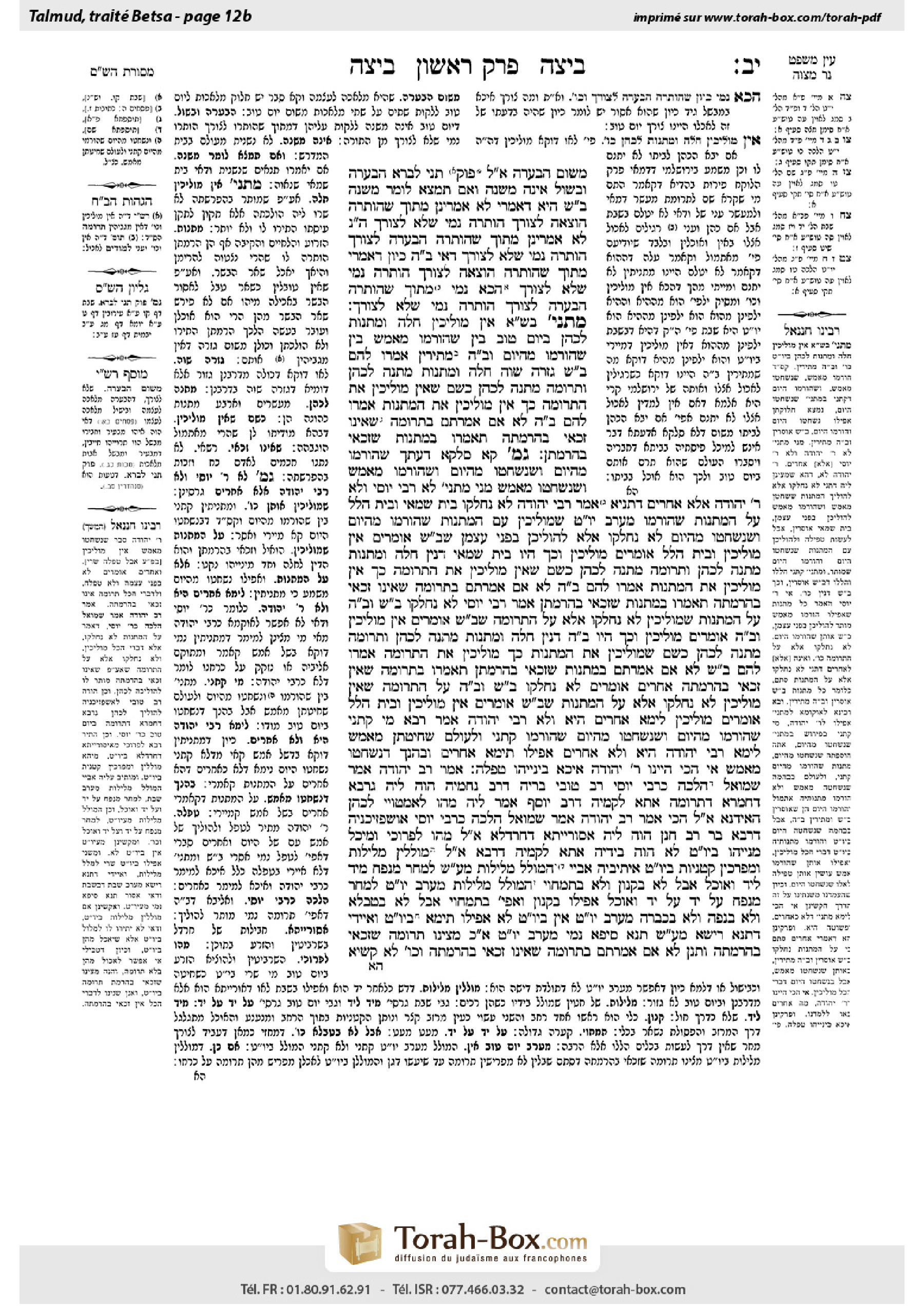
Beitzah 12b: Talmud study for Daf Yomi
Study the Talmud for Daf Yomi with scanned pages, Hebrew text, English translations from Sefaria and AI-generated French translations.
Passage selection and English or AI-generated French translation are available where the scan has annotations. Daf Study is independent of Torah-Box and Sefaria.
Browse Beitzah · ביצה · All tractatesBeitzah 12b text and translations
This page of Beitzah includes the Aramaic text, an English translation and an AI-generated French translation, alongside the scan above.
ביצה י״ב ב · Aramaic and Hebrew text
מִשּׁוּם הַבְעָרָה.
אֲמַר לֵיהּ: פּוֹק תְּנִי לְבָרָא, הַבְעָרָה וּבִשּׁוּל אֵינָהּ מִשְׁנָה. וְאִם תִּמְצָא לוֹמַר מִשְׁנָה — בֵּית שַׁמַּאי הִיא, דְּאָמְרִי: לָא אָמְרִינַן מִתּוֹךְ שֶׁהוּתְּרָה הוֹצָאָה לְצוֹרֶךְ הוּתְּרָה נָמֵי שֶׁלֹּא לְצוֹרֶךְ. הָכָא נָמֵי, לָא אָמְרִינַן: מִתּוֹךְ שֶׁהוּתְּרָה הַבְעָרָה לְצוֹרֶךְ, הוּתְּרָה נָמֵי שֶׁלֹּא לְצוֹרֶךְ.
דְּאִי בֵּית הִלֵּל — כֵּיוָן דְּאָמְרִי מִתּוֹךְ שֶׁהוּתְּרָה הוֹצָאָה לְצוֹרֶךְ הוּתְּרָה נָמֵי שֶׁלֹּא לְצוֹרֶךְ, הָכָא נָמֵי: מִתּוֹךְ שֶׁהוּתְּרָה הַבְעָרָה לְצוֹרֶךְ — הוּתְּרָה נָמֵי שֶׁלֹּא לְצוֹרֶךְ.
מַתְנִי׳ בֵּית שַׁמַּאי אוֹמְרִים: אֵין מוֹלִיכִין חַלָּה וּמַתָּנוֹת לַכֹּהֵן בְּיוֹם טוֹב, בֵּין שֶׁהוּרְמוּ מֵאֶמֶשׁ, בֵּין שֶׁהוּרְמוּ מֵהַיּוֹם. וּבֵית הִלֵּל מַתִּירִין.
אָמְרוּ לָהֶם בֵּית שַׁמַּאי, גְּזֵרָה שָׁוָה: חַלָּה וּמַתָּנוֹת — מַתָּנָה לַכֹּהֵן, וּתְרוּמָה — מַתָּנָה לַכֹּהֵן. כְּשֵׁם שֶׁאֵין מוֹלִיכִין אֶת הַתְּרוּמָה — כָּךְ אֵין מוֹלִיכִין אֶת הַמַּתָּנוֹת.
אָמְרוּ לָהֶם בֵּית הִלֵּל: לֹא, אִם אֲמַרְתֶּם בִּתְרוּמָה — שֶׁאֵינוֹ זַכַּאי בַּהֲרָמָתָהּ, תֹּאמְרוּ בְּמַתָּנוֹת — שֶׁזַּכַּאי בַּהֲרָמָתָן.
גְּמָ׳ קָא סָלְקָא דַּעְתָּךְ שֶׁהוּרְמוּ מֵהַיּוֹם וְשֶׁנִּשְׁחֲטוּ מֵהַיּוֹם, וְשֶׁהוּרְמוּ מֵאֶמֶשׁ וְשֶׁנִּשְׁחֲטוּ מֵאֶמֶשׁ. מַנִּי מַתְנִיתִין? לָא רַבִּי יוֹסֵי וְלָא רַבִּי יְהוּדָה, אֶלָּא אֲחֵרִים. דְּתַנְיָא, אָמַר רַבִּי יְהוּדָה: לֹא נֶחְלְקוּ בֵּית שַׁמַּאי וּבֵית הִלֵּל עַל הַמַּתָּנוֹת שֶׁהוּרְמוּ מֵעֶרֶב יוֹם טוֹב שֶׁמּוֹלִיכִין עִם הַמַּתָּנוֹת שֶׁהוּרְמוּ מֵהַיּוֹם וְשֶׁנִּשְׁחֲטוּ מֵהַיּוֹם. לֹא נֶחְלְקוּ אֶלָּא לְהוֹלִיכָן בִּפְנֵי עַצְמָן, שֶׁבֵּית שַׁמַּאי אוֹמְרִים: אֵין מוֹלִיכִין, וּבֵית הִלֵּל אוֹמְרִים: מוֹלִיכִין.
וְכָךְ הָיוּ בֵּית שַׁמַּאי דָּנִין: חַלָּה וּמַתָּנוֹת — מַתָּנָה לַכֹּהֵן, וּתְרוּמָה — מַתָּנָה לַכֹּהֵן. כְּשֵׁם שֶׁאֵין מוֹלִיכִין אֶת הַתְּרוּמָה — כָּךְ אֵין מוֹלִיכִין אֶת הַמַּתָּנוֹת. אָמְרוּ לָהֶם בֵּית הִלֵּל: לֹא, אִם אֲמַרְתֶּם בִּתְרוּמָה — שֶׁאֵינוֹ זַכַּאי בַּהֲרָמָתָהּ, תֹּאמְרוּ בְּמַתָּנוֹת — שֶׁזַּכַּאי בַּהֲרָמָתָן.
אָמַר רַבִּי יוֹסֵי: לֹא נֶחְלְקוּ בֵּית שַׁמַּאי וּבֵית הִלֵּל עַל הַמַּתָּנוֹת שֶׁמּוֹלִיכִין, לֹא נֶחְלְקוּ אֶלָּא עַל הַתְּרוּמָה, שֶׁבֵּית שַׁמַּאי אוֹמְרִים: אֵין מוֹלִיכִין, וּבֵית הִלֵּל אוֹמְרִים: מוֹלִיכִין. וְכָךְ הָיוּ בֵּית הִלֵּל דָּנִין: חַלָּה וּמַתָּנוֹת — מַתָּנָה לַכֹּהֵן, וּתְרוּמָה — מַתָּנָה לַכֹּהֵן, כְּשֵׁם שֶׁמּוֹלִיכִין אֶת הַמַּתָּנוֹת, כָּךְ מוֹלִיכִין אֶת הַתְּרוּמָה. אָמְרוּ לָהֶם בֵּית שַׁמַּאי: לֹא, אִם אֲמַרְתֶּם בְּמַתָּנוֹת שֶׁזַּכַּאי בַּהֲרָמָתָן — תֹּאמְרוּ בִּתְרוּמָה שֶׁאֵין זַכַּאי בַּהֲרָמָתָהּ!
אֲחֵרִים אוֹמְרִים: לֹא נֶחְלְקוּ בֵּית שַׁמַּאי וּבֵית הִלֵּל עַל הַתְּרוּמָה שֶׁאֵין מוֹלִיכִין, לֹא נֶחְלְקוּ אֶלָּא עַל הַמַּתָּנוֹת, שֶׁבֵּית שַׁמַּאי אוֹמְרִים אֵין מוֹלִיכִין, וּבֵית הִלֵּל אוֹמְרִים מוֹלִיכִין. לֵימָא אֲחֵרִים הִיא וְלָא רַבִּי יְהוּדָה?
אָמַר רָבָא: מִי קָתָנֵי שֶׁהוּרְמוּ מֵהַיּוֹם וְשֶׁנִּשְׁחֲטוּ מֵהַיּוֹם? שֶׁהוּרְמוּ קָתָנֵי, וּלְעוֹלָם: שְׁחִיטָתָן מֵאֶמֶשׁ. לֵימָא רַבִּי יְהוּדָה הִיא וְלֹא אֲחֵרִים! אֲפִילּוּ תֵּימָא אֲחֵרִים, וּבְהָנָךְ דְּנִשְׁחֲטוּ מֵאֶמֶשׁ.
אִי הָכִי הַיְינוּ רַבִּי יְהוּדָה? אִיכָּא בֵּינַיְיהוּ טְפֵלָה.
אָמַר רַב יְהוּדָה אָמַר שְׁמוּאֵל: הֲלָכָה כְּרַבִּי יוֹסֵי. רַב טוֹבִי בְּרֵיהּ דְּרַב נְחֶמְיָה הֲוָה לֵיהּ גַּרְבָּא דְחַמְרָא דִּתְרוּמָה, אֲתָא לְקַמֵּיהּ דְּרַב יוֹסֵף, אֲמַר לֵיהּ: מַהוּ לְאַמְטוֹיֵי לְכֹהֵן הָאִידָּנָא? אֲמַר לֵיהּ: הָכִי אָמַר רַב יְהוּדָה אָמַר שְׁמוּאֵל: הֲלָכָה כְּרַבִּי יוֹסֵי.
אוּשְׁפִּיזְכָנֵיהּ דְּרָבָא בַּר רַב חָנָן הֲוָה לֵיהּ אִסּוּרְיָיתָא דְחַרְדְּלָא, אֲמַר לֵיהּ: מַהוּ לְפָרוֹכֵי וּמֵיכַל מִנַּיְיהוּ בְּיוֹם טוֹב? לָא הֲוָה בִּידֵיהּ, אֲתָא לְקַמֵּיהּ דְּרָבָא. אֲמַר לֵיהּ: מוֹלְלִין מְלִילוֹת וּמְפָרְכִין קִטְנִיּוֹת בְּיוֹם טוֹב.
אֵיתִיבֵיהּ אַבָּיֵי: הַמּוֹלֵל מְלִילוֹת מֵעֶרֶב שַׁבָּת, לְמָחָר מְנַפֵּחַ מִיָּד לְיָד, וְאוֹכֵל. אֲבָל לֹא בַּקָּנוֹן, וְלֹא בַּתַּמְחוּי.
הַמּוֹלֵל מְלִילוֹת מֵעֶרֶב יוֹם טוֹב, לְמָחָר מְנַפֵּחַ עַל יָד עַל יָד, וְאוֹכֵל אֲפִילּוּ בַּקָּנוֹן וַאֲפִילּוּ בַּתַּמְחוּי, אֲבָל לֹא בַּטַּבְלָא וְלֹא בַּנָּפָה וְלֹא בַּכְּבָרָה. מֵעֶרֶב יוֹם טוֹב — אִין, בְּיוֹם טוֹב — לָא!
אֲפִילּוּ תֵּימָא בְּיוֹם טוֹב, וְאַיְּידֵי דִּתְנָא רֵישָׁא ״מֵעֶרֶב שַׁבָּת״, תְּנָא סֵיפָא נָמֵי ״מֵעֶרֶב יוֹם טוֹב״.
אִם כֵּן מָצִינוּ תְּרוּמָה שֶׁזַּכַּאי בַּהֲרָמָתָהּ, וּתְנַן: לֹא, אִם אֲמַרְתֶּם בִּתְרוּמָה שֶׁאֵינוֹ זַכַּאי בַּהֲרָמָתָהּ וְכוּ׳!
לָא קַשְׁיָא,
Beitzah 12b · English translation
due to the prohibition of kindling a fire on a Festival.
Rabbi Yoḥanan said to that tanna: Leave and teach it outside, i.e., this baraita is not fit for discussion in the study hall. The opinion that there is a prohibition against kindling and cooking on a Festival is not a mishna worthy of serious consideration. And if you say that it is a mishna rather than an error, this statement is still not in accordance with the halakha, as it is following the opinion of Beit Shammai, who say: We do not say: Since carrying out was permitted on a Festival for the purposes of food preparation, it was also permitted when performed not for these purposes. Here, too, we do not say: Since kindling was permitted on a Festival for the purposes of food preparation, it was also permitted when performed not for these purposes.
The Gemara explains why the baraita cannot be attributed to Beit Hillel. If one were to suggest that this baraita follows the opinion of Beit Hillel, this cannot be the case, as they say: Since carrying out was permitted for the purposes of food preparation, it was also permitted when performed not for these purposes. Here, too, since kindling was permitted for the purposes of food preparation, it was also permitted when performed not for these purposes. Therefore, according to the opinion of Beit Hillel, kindling cannot be included amongst those prohibitions for which one is liable on a Festival.
MISHNA: The separation of ḥalla is permitted on a Festival, as one is permitted to prepare dough and bake it on a Festival, and bread may not be eaten without first separating ḥalla. Beit Shammai say: One may not bring separated ḥalla or any of the other priestly gifts, i.e., the foreleg, the jaw, and the maw of a slaughtered animal, to a priest on a Festival, though it is permitted to separate them from an animal slaughtered on a Festival. This is prohibited regardless of whether they were separated last evening, i.e., before the Festival, or whether they were separated today. And Beit Hillel permit it.
Beit Shammai said to Beit Hillel: This halakha can be derived by an analogy: Ḥalla and the other gifts are both considered a gift to the priest, and likewise teruma separated from produce is also a gift to the priest. Just as you agree that one may not bring teruma to a priest on a Festival, so too, one may not bring the other gifts.
Beit Hillel said to them: No, this analogy is incorrect. If you said that you derive the halakha from teruma, where its separation is not allowed on the Festival, how will you say the same with regard to the gifts from an animal or ḥalla, concerning which their separation is allowed on the Festival? Since it is not prohibited to separate these gifts, they may likewise be brought to a priest.
GEMARA: It enters your mind to explain that when the mishna states: They were separated today, it means: From animals slaughtered today. And the phrase: They were separated last evening, is referring to animals slaughtered last evening. The Gemara asks: If so, whose opinion is expressed in the mishna? It is not Rabbi Yosei nor Rabbi Yehuda, but the opinion of Aḥerim, as it is taught in the Tosefta that Rabbi Yehuda said: Beit Shammai and Beit Hillel did not dispute with regard to gifts separated on the eve of a Festival, that one may bring them to a priest on a Festival day itself along with gifts separated that day and from those animals slaughtered that day. They disputed only the halakha of bringing gifts separated the day before by themselves, as Beit Shammai say: One may not bring these gifts by themselves, and Beit Hillel say: One may bring them.
And Beit Shammai would reason as follows: Ḥalla and gifts from a slaughtered animal are a gift to the priest, and teruma is a gift to the priest. Just as one may not bring teruma to a priest on a Festival, so too, one may not bring the other gifts. Beit Hillel said to them: No, granted, if you said so with regard to teruma, the reason is that separation is not allowed on a Festival, but how will you say the same with regard to the other gifts, concerning which separation is allowed on the Festival? It is therefore permitted to bring these gifts to a priest as well. This is Rabbi Yehuda’s interpretation of the dispute between Beit Shammai and Beit Hillel, according to which Beit Shammai prohibit bringing even gifts separated on the Festival itself.
Rabbi Yosei said: That is not the correct record of the dispute, as Beit Shammai and Beit Hillel did not dispute about the fact that one may bring the gifts from an animal to a priest on a Festival. They disputed only with regard to teruma, as Beit Shammai say: One may not bring it, and Beit Hillel say: One may even bring teruma. And Beit Hillel would reason as follows: Ḥalla and gifts are a gift to the priest, and teruma is a gift to the priest. Just as one may bring the other gifts on a Festival, so too, one may bring teruma. Beit Shammai said to them: No; if you said so with regard to the other gifts, concerning which their separation is allowed on the Festival, will you say the same with regard to teruma, whose separation is not allowed?
Aḥerim say that the dispute was as follows: Beit Shammai and Beit Hillel did not dispute with regard to teruma, that one may not bring it to a priest on a Festival. They disputed only the case of the other gifts, as Beit Shammai say: One may not bring the other gifts, and Beit Hillel say: One may bring them. The Gemara proposes: Let us say that the mishna is only in accordance with the opinion of Aḥerim, and not in accordance with the opinion of Rabbi Yehuda. The Gemara does not even suggest that the mishna might be in accordance with the opinion of Rabbi Yosei, as it is clear that it cannot be reconciled with his explanation.
Rava said: Is it taught in the mishna: They were separated that day and were slaughtered that day? No; it teaches: They were separated, and actually the mishna should be explained as follows: They were slaughtered last evening and separated today, which is exactly what Rabbi Yehuda said. The Gemara asks: If so, let us say that the mishna is in accordance with the opinion of Rabbi Yehuda and not in accordance with the opinion of Aḥerim? The Gemara rejects this: Even if you say that the mishna is in accordance with the opinion of Aḥerim, it can still be claimed that, in their opinion, Beit Shammai and Beit Hillel disputed the case of these animals that were slaughtered last evening, not those slaughtered on the Festival.
The Gemara asks: If so, this is the same opinion as that of Rabbi Yehuda. What, then, is the difference between the opinions of Rabbi Yehuda and Aḥerim? The Gemara answers: The practical difference between them is with regard to secondary gifts. If one has gifts separated before a Festival, is he permitted to join them as secondary gifts along with others separated on the Festival and transport them together to a priest? Rabbi Yehuda maintains that secondary gifts may be brought to a priest, according to the opinion of Beit Hillel, whereas Aḥerim prohibit it.
With regard to the dispute cited in the Tosefta, Rav Yehuda said that Shmuel said: The halakha is in accordance with the opinion of Rabbi Yosei. The Gemara relates: Rav Tovi, son of Rabbi Neḥemya, had a bottle of teruma wine. He came before Rav Yosef and said to him: What is the halakha with regard to bringing this wine to a priest now, on a Festival? Rav Yosef said to him: That is what Rav Yehuda said that Shmuel said: The halakha is in accordance with the opinion of Rabbi Yosei, who maintains that Beit Hillel permit one to bring teruma to a priest on a Festival, and the halakha is in accordance with their opinion.
§ The Gemara relates: The host of Rava, son of Rav Ḥanan, had bundles of unprocessed mustard, whose seeds remained in their stems. He said to his guest, the Sage: What is the halakha with regard to crushing these mustard stalks and eating from them on a Festival? Rava, son of Rav Ḥanan, did not have an answer readily available, so he came before Rava to ask his opinion. Rava said to him that it was taught: One may husk kernels by rubbing them between one’s fingers, and one may likewise crush legumes on a Festival. This statement indicates that it is permitted to crush mustard stalks.
Abaye raised an objection to Rava from a baraita: In the case of one who husks kernels of grain on Shabbat eve, on the following day, on Shabbat itself, he may winnow the chaff in an irregular manner by passing the kernels from hand to hand and then eat them. However, one may not do so, neither by means of a basket [kanon] that is occasionally used for sorting and separating the chaff nor with a large vessel.
With regard to one who husks kernels of grain on a Festival eve, on the following day, he may winnow a little grain at a time and eat, even with a tray or a large vessel. However, he may not do so with a tablet, nor with a winnow, nor with a sieve. Since these vessels are designed for winnowing, they are used only for large quantities, and therefore it will appear as though he were preparing for after the Festival, which is certainly prohibited. In any case, the wording of the baraita indicates: On a Festival eve, yes, one may husk or crush legumes; on the Festival itself, no, it is prohibited to do so.
The Gemara refutes this: Even if you say that it is permitted on a Festival, the baraita can be understood. The reason is as follows: Since he taught in the first clause of the baraita: On Shabbat eve, as husking grain may not be performed on Shabbat itself, for it might lead to a prohibited labor on Shabbat, he also taught in the latter clause: On a Festival eve. However, this does not mean that rubbing or crushing legumes is prohibited on the Festival itself.
Abaye raises a difficulty against the opinion of Rava from a different angle: If you say so, we have thereby found a case of teruma for which separation is allowed on a Festival. Before being rubbed, the grains of wheat were certainly not fit to be eaten, and therefore there was no obligation to separate teruma from them. Now that one has prepared them as food by rubbing them, he is obligated to separate teruma from them, and if one is permitted to eat them, he must be permitted to separate teruma from them first. And we learned explicitly in the mishna: No, if you said that you derive the halakha from teruma, where its separation is not allowed on the Festival. This statement indicates that even Beit Hillel agree that one may not separate teruma of any kind on a Festival.
The Gemara refutes this challenge: This is not difficult.
Beitzah 12b · Traduction française (IA)
en raison de l'interdiction de faire du feu pendant un festival.
Rabbi Yoḥanan dit à ce tanna : Retourne et enseigne cela à l'extérieur, c'est-à-dire que ce baraïta n'est pas adapté à la discussion dans la salle de study. L'opinion selon laquelle il y a une interdiction de faire du feu et de cuisiner pendant un festival n'est pas une mitsva méritant une considération sérieuse. Et si tu dis qu'il s'agit d'une mitsva plutôt qu'une erreur, cette déclaration est encore incohérente avec la halakha, car elle suit l'opinion de Beit Shammai, qui disent : Nous ne disons pas : Puisque le transport était permis pendant un festival pour la préparation des aliments, il était également permis lorsqu'il était effectué sans ces raisons. Ici aussi, nous ne disons pas : Puisque le feu était permis pendant un festival pour la préparation des aliments, il était également permis lorsqu'il était effectué sans ces raisons.
Le Guemara explique pourquoi ce baraïta ne peut être attribué à Beit Hillel. Si l'on suggère que ce baraïta suit l'opinion de Beit Hillel, cela ne peut pas être le cas, car ils disent : Puisque le transport était permis pour la préparation des aliments, il était également permis lorsqu'il était effectué sans ces raisons. Ici aussi, puisque le feu était permis pour la préparation des aliments, il était également permis lorsqu'il était effectué sans ces raisons. Par conséquent, selon l'opinion de Beit Hillel, le feu ne peut pas être inclus parmi les prohibitions pour lesquelles on est puni pendant un festival.
MICHNA : La séparation de la ḥalla est permise pendant un festival, car on est autorisé à préparer la pâte et à la cuire pendant un festival, et le pain ne peut être mangé sans avoir d'abord séparé la ḥalla. Beit Shammai disent : On ne peut pas apporter la ḥalla séparée ou tout autre don sacré, c'est-à-dire la cuisse, la mâchoire et la gueule d'un animal sacrifié, à un prêtre pendant un festival, bien qu'il soit permis de séparer ces dons d'un animal sacrifié pendant un festival. Cela est interdit qu'importe si ces dons ont été séparés la veille, c'est-à-dire avant le festival, ou s'ils ont été séparés aujourd'hui. Et Beit Hillel permettent cela.
Beit Shammai dit à Beit Hillel : Cette halakha peut être dérivée par analogie : La ḥalla et les autres dons sont tous des dons au prêtre, et de même la terouma séparée des produits est aussi un don au prêtre. Aussi longtemps que vous convenez que l'on ne peut pas apporter la terouma à un prêtre pendant un festival, de même on ne peut pas apporter les autres dons.
Beit Hillel dit à eux : Non, cette analogie est incorrecte. Si vous disiez que vous dérivez la halakha de la terouma, où la séparation n'est pas autorisée pendant le festival, comment dire la même chose concernant les dons d'un animal ou la ḥalla, concernant lesquels leur séparation est autorisée pendant le festival ? Puisque la séparation de ces dons n'est pas interdite, ils peuvent également être apportés au prêtre.
GUEMARA : Il entre dans votre esprit d'expliquer que lorsque la mitsna dit : Ils ont été séparés aujourd'hui, cela signifie : D'animaux sacrifiés aujourd'hui. Et la phrase : Ils ont été séparés la veille, fait référence aux animaux sacrifiés la veille. Le Guemara demande : Si c'est ainsi, quel est l'opinion exprimée dans la mitsna ? Ce n'est pas celle de Rabbi Yosei ni de Rabbi Yehuda, mais celle d'Aḥerim, car il est enseigné dans la Tosefta que Rabbi Yehuda a dit : Beit Shammai et Beit Hillel n'ont pas disputé concernant les dons séparés à la veille d'un festival, que l'on peut apporter à un prêtre pendant la journée du festival avec les dons séparés de la même journée et les animaux sacrifiés de la même journée. Ils ont disputé uniquement la halakha d'apporter les dons séparés la veille par eux-mêmes, car Beit Shammai disent : On ne peut pas apporter ces dons par eux-mêmes, et Beit Hillel disent : On peut apporter ces dons.
Et Beit Shammai raisonnait ainsi : La ḥalla et les dons d'un animal sacrifié sont un don au prêtre, et la terouma est un don au prêtre. Aussi longtemps qu'on ne peut pas apporter la terouma à un prêtre pendant un festival, de même on ne peut pas apporter les autres dons. Beit Hillel dit à eux : Non, si vous dites cela concernant la terouma, la raison est que la séparation n'est pas autorisée pendant un festival, mais comment dire la même chose concernant les autres dons, concernant lesquels la séparation est autorisée pendant un festival ? Il est donc permis d'apporter ces dons au prêtre. C'est l'interprétation de Rabbi Yehuda concernant la dispute entre Beit Shammai et Beit Hillel, selon laquelle Beit Shammai interdisent d'apporter même les dons séparés pendant le festival lui-même.
Rabbi Yosei dit : Ce n'est pas la bonne description de la dispute, car Beit Shammai et Beit Hillel n'ont pas disputé sur le fait qu'on puisse apporter les dons d'un animal à un prêtre pendant un festival. Ils ont disputé uniquement concernant la terouma, car Beit Shammai disent : On ne peut pas l'apporter, et Beit Hillel disent : On peut même apporter la terouma. Et Beit Hillel raisonnait ainsi : La ḥalla et les dons sont un don au prêtre, et la terouma est un don au prêtre. Aussi longtemps qu'on peut apporter les autres dons pendant un festival, de même on peut apporter la terouma. Beit Shammai dit à eux : Non ; si vous dites cela concernant les autres dons, concernant lesquels leur séparation est autorisée pendant le festival, direz-vous la même chose concernant la terouma, dont la séparation n'est pas autorisée ?
D'autres disent que la dispute était comme suit : Beit Shammai et Beit Hillel n'ont pas disputé concernant la terouma, que l'on ne peut pas apporter à un prêtre pendant un festival. Ils ont disputé uniquement le cas des autres dons, car Beit Shammai disent : On ne peut pas apporter les autres dons, et Beit Hillel disent : On peut apporter les autres dons. Le Guemara propose : Disons que la mitsna est uniquement en conformité avec l'opinion d'Aḥerim, et non avec celle de Rabbi Yehuda. Le Guemara ne suggère même pas que la mitsna pourrait être en conformité avec l'opinion de Rabbi Yosei, car il est clair qu'elle ne peut pas être conciliée avec son explication.
Rava a dit : La Michna enseigne-t-elle : Ils ont été séparés ce jour-là et sacrifiés ce jour-là ? Non ; elle enseigne : Ils ont été séparés, et en réalité la Michna doit être interprétée ainsi : Ils ont été sacrifiés la veille et séparés aujourd'hui, ce qui est exactement ce que Rabbi Yehuda a dit. La Guemara pose la question : Si c'est ainsi, disons que la Michna suit l'opinion de Rabbi Yehuda et non celle des autres ? La Guemara rejette cette idée : Même si vous dites que la Michna suit l'opinion des autres, on peut toujours affirmer que, selon leur opinion, Beit Shammai et Beit Hillel ont disputé le cas de ces animaux sacrifiés la veille, pas ceux sacrifiés pendant le festival.
La Guemara pose la question : Si c'est ainsi, c'est la même opinion que celle de Rabbi Yehuda. Alors, quelle est la différence entre l'opinion de Rabbi Yehuda et celle des autres ? La Guemara répond : La différence pratique entre eux concerne les offrandes secondaires. Si l'on a des offrandes séparées avant un festival, est-on autorisé à les joindre comme offrandes secondaires avec d'autres séparés pendant le festival et à les transporter ensemble vers un prêtre ? Rabbi Yehuda maintient que les offrandes secondaires peuvent être apportées à un prêtre, selon l'opinion de Beit Hillel, tandis que les autres les interdisent.
Concernant la dispute mentionnée dans la Tosefta, Rav Yehuda a dit que Shmuel a dit : La halakha suit l'opinion de Rabbi Yosei. La Guemara rapporte : Rav Tovi, fils de Rabbi Néchemyah, avait une bouteille de vin de terouma. Il est venu devant Rav Yosef et lui a dit : Quelle est la halakha concernant l'apport de ce vin à un prêtre maintenant, pendant un festival ? Rav Yosef lui a répondu : C'est ce que Rav Yehuda a dit que Shmuel a dit : La halakha suit l'opinion de Rabbi Yosei, qui maintient que Beit Hillel autorisent l'apport de terouma à un prêtre pendant un festival, et la halakha suit leur opinion.
§ La Guemara rapporte : L'hôte de Rava, fils de Rav Ḥanan, avait des bouquets de moutarde non traitée, dont les graines restaient dans leurs tiges. Il a dit à son invité, le Sage : Quelle est la halakha concernant le broyage de ces tiges de moutarde et leur consommation pendant un festival ? Rava, fils de Rav Ḥanan, n'avait pas de réponse immédiate, donc il est allé demander l'avis de Rava. Rava a dit qu'il avait été enseigné : On peut éplucher des grains en les frottant entre ses doigts, et on peut également broyer des légumineuses pendant un festival. Cette déclaration indique qu'il est permis de broyer les tiges de moutarde.
Abaye a soulevé un obstacle contre Rava à partir d'une baraïta : Dans le cas d'une personne qui épluche des grains de céréale le soir du sabbat, le lendemain, le sabbat lui-même, il peut éliminer la paille de manière irrégulière en passant les grains d'une main à l'autre et ensuite les manger. Cependant, on ne peut pas le faire, ni avec un panier [kanon] utilisé occasionnellement pour trier et séparer la paille, ni avec un grand récipient.
Concernant une personne qui épluche des grains de céréale le soir du festival, le lendemain, il peut éliminer une petite quantité de céréale à la fois et la manger, même avec une plaque ou un grand récipient. Cependant, il ne peut pas le faire avec une tablette, ni avec un éplucheur, ni avec un tamis. Ces récipients étant conçus pour l'épluchage, ils sont utilisés uniquement pour de grandes quantités, et donc cela pourrait paraître comme s'il préparait pour après le festival, ce qui est certainement interdit. En tout cas, le texte de la baraïta indique : Le soir du festival, oui, on peut éplucher ou broyer des légumineuses ; pendant le festival lui-même, non, cela est interdit.
La Guemara réfute cela : Même si vous dites qu'il est permis pendant le festival, la baraïta peut être interprétée. La raison est la suivante : Puisqu'il a enseigné dans la première partie de la baraïta : Le soir du sabbat, l'épluchage des grains ne peut pas être fait le sabbat lui-même, car cela pourrait entraîner un travail interdit le sabbat, il a aussi enseigné dans la seconde partie : Le soir du festival. Cependant, cela ne signifie pas que le frottement ou le broyage des légumineuses est interdit pendant le festival lui-même.
Abaye soulève une difficulté contre l'opinion de Rava d'un autre point de vue : Si vous dites cela, nous avons ainsi trouvé un cas de terouma pour lequel la séparation est autorisée pendant un festival. Avant d'être frotté, les grains de blé étaient certainement inedibles, et donc il n'y avait pas d'obligation de séparer la terouma d'eux. Maintenant que l'on a préparé ces grains en les frottant pour les rendre comestibles, on est tenu de séparer la terouma d'eux, et si l'on est autorisé à les manger, on doit être autorisé à séparer la terouma d'eux d'abord. Et nous avons appris explicitement dans la Michna : Non, si vous dites que vous dérivez la halakha de la terouma, où sa séparation n'est pas autorisée pendant le festival. Cette déclaration indique que même Beit Hillel s'accordent sur le fait qu'il est interdit de séparer toute sorte de terouma pendant un festival.
La Guemara réfute ce défi : Cela n'est pas difficile.
Traduction française générée par IA à partir de l’édition anglaise de Sefaria. Vérifie toujours un passage avec le texte source.
Text from Sefaria: William Davidson Edition - Vocalized Aramaic (CC BY NC); William Davidson Edition - English (CC BY NC).