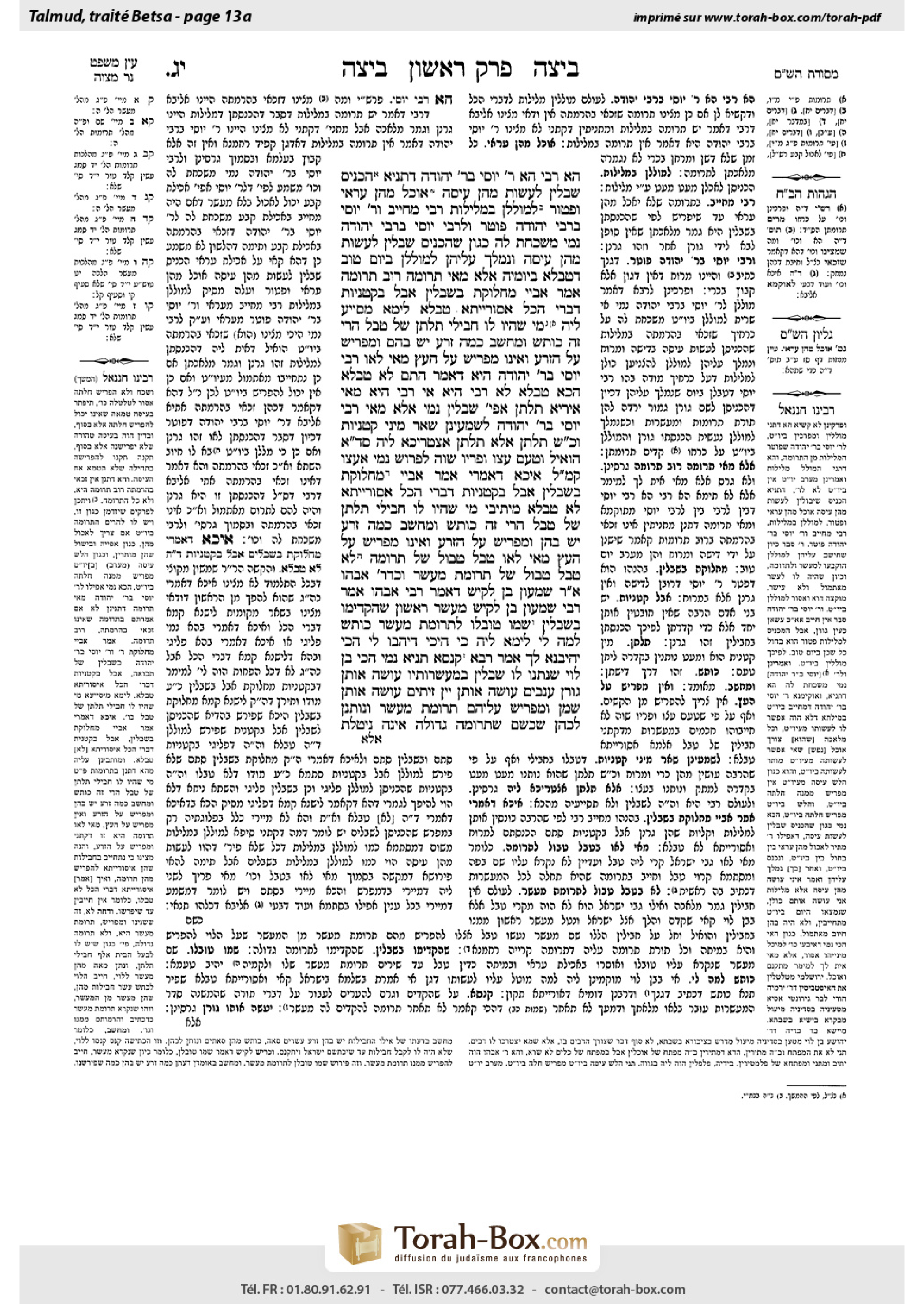
Beitzah 13a: Talmud study for Daf Yomi
Study the Talmud for Daf Yomi with scanned pages, Hebrew text, English translations from Sefaria and AI-generated French translations.
Passage selection and English or AI-generated French translation are available where the scan has annotations. Daf Study is independent of Torah-Box and Sefaria.
Browse Beitzah · ביצה · All tractatesBeitzah 13a text and translations
This page of Beitzah includes the Aramaic text, an English translation and an AI-generated French translation, alongside the scan above.
ביצה י״ג א · Aramaic and Hebrew text
הָא רַבִּי, הָא רַבִּי יוֹסֵי בְּרַבִּי יְהוּדָה. דְּתַנְיָא: הִכְנִיס שִׁבֳּלִין לַעֲשׂוֹת מֵהֶן עִיסָּה — אוֹכֵל מֵהֶן עֲרַאי, וּפָטוּר.
לְמוֹלְלָן בִּמְלִילוֹת — רַבִּי מְחַיֵּיב וְרַבִּי יוֹסֵי בְּרַבִּי יְהוּדָה פּוֹטֵר.
וּלְרַבִּי יוֹסֵי בְּרַבִּי יְהוּדָה נָמֵי מַשְׁכַּחַתְּ לַהּ — כְּגוֹן שֶׁהִכְנִיס שִׁבֳּלִין לַעֲשׂוֹת מֵהֶן עִיסָּה, וְנִמְלַךְ עֲלֵיהֶן לְמוֹלְלָן בְּיוֹם טוֹב, דְּטָבְלָא בְּיוֹמֵיהּ!
אֶלָּא: מַאי תְּרוּמָה — רוֹב תְּרוּמָה.
אָמַר אַבָּיֵי: מַחְלוֹקֶת בְּשִׁבֳּלִין. אֲבָל בְּקִטְנִיּוֹת — דִּבְרֵי הַכֹּל אִסּוּרְיָיתָא טָבְלָא.
לֵימָא מְסַיַּיע לֵיהּ: מִי שֶׁהָיוּ לוֹ חֲבִילֵי תִלְתָּן שֶׁל טֶבֶל — הֲרֵי זֶה כּוֹתֵשׁ, וּמְחַשֵּׁב כַּמָּה זֶרַע יֵשׁ בָּהֶם, וּמַפְרִישׁ עַל הַזֶּרַע וְאֵינוֹ מַפְרִישׁ עַל הָעֵץ. מַאי לָאו — רַבִּי יוֹסֵי בְּרַבִּי יְהוּדָה הִיא, דְּאָמַר: הָתָם לָא טָבְלָא הָכָא טָבְלָא!
לָא, רַבִּי הִיא. אִי רַבִּי הִיא, מַאי אִירְיָא תִּלְתָּן, אֲפִילּוּ שִׁבֳּלִין נָמֵי?
אֶלָּא מַאי, רַבִּי יוֹסֵי בְּרַבִּי יְהוּדָה — לַשְׁמְעִינַן שְׁאָר מִינֵי קִטְנִיּוֹת, וְכׇל שֶׁכֵּן תִּלְתָּן.
אֶלָּא תִּלְתָּן אִצְטְרִיכָא לֵיהּ. סָלְקָא דַּעְתָּךְ אָמֵינָא: הוֹאִיל וְטַעַם עֵצוֹ וּפִרְיוֹ שָׁוֶה, לִפְרוֹשׁ נָמֵי אַעֵצוֹ, קָא מַשְׁמַע לַן.
אִיכָּא דְּאָמְרִי, אָמַר אַבָּיֵי: מַחְלוֹקֶת בְּשִׁבֳּלִין, אֲבָל בְּקִטְנִיּוֹת דִּבְרֵי הַכֹּל אִסּוּרְיָיתָא לָא טָבְלָא. מֵיתִיבִי: מִי שֶׁהָיוּ לוֹ חֲבִילֵי תִלְתָּן שֶׁל טֶבֶל הֲרֵי זֶה כּוֹתֵשׁ, וּמְחַשֵּׁב כַּמָּה זֶרַע יֵשׁ בָּהֶן, וּמַפְרִישׁ עַל הַזֶּרַע וְאֵינוֹ מַפְרִישׁ עַל הָעֵץ. מַאי לָאו, טֶבֶל טָבוּל שֶׁל תְּרוּמָה!
לָא, טֶבֶל טָבוּל שֶׁל תְּרוּמַת מַעֲשֵׂר.
וְכִדְרַבִּי אֲבָהוּ אָמַר רַבִּי שִׁמְעוֹן בֶּן לָקִישׁ. דְּאָמַר רַבִּי אֲבָהוּ אָמַר רַבִּי שִׁמְעוֹן בֶּן לָקִישׁ: מַעֲשֵׂר רִאשׁוֹן שֶׁהִקְדִּימוֹ בְּשִׁבֳּלִין,
שְׁמוֹ טוֹבְלוֹ לִתְרוּמַת מַעֲשֵׂר.
כּוֹתֵשׁ לְמָה לִי? לֵימָא לֵיהּ: כִּי הֵיכִי דִּיהַבוּ לִי, הָכִי יָהֵיבְנָא לָךְ! אֲמַר רָבָא: קְנָסָא.
תַּנְיָא נָמֵי הָכִי: בֶּן לֵוִי שֶׁנָּתְנוּ לוֹ שִׁבֳּלִין בְּמַעַשְׂרוֹתָיו — עוֹשֶׂה אוֹתָן גּוֹרֶן, עֲנָבִים — עוֹשֶׂה אוֹתָן יַיִן, זֵיתִים — עוֹשֶׂה אוֹתָן שֶׁמֶן, וּמַפְרִישׁ עֲלֵיהֶם תְּרוּמַת מַעֲשֵׂר, וְנוֹתְנָן לַכֹּהֵן. שֶׁכְּשֵׁם שֶׁתְּרוּמָה גְּדוֹלָה אֵינָהּ נִיטֶּלֶת
Beitzah 13a · English translation
This source, the baraita, is in accordance with the opinion of Rabbi Yehuda HaNasi, who holds that one must separate teruma from kernels of grain on the stalk, and one may separate terumot on a Festival. That source, the mishna, is in accordance with the opinion of Rabbi Yosei, son of Rabbi Yehuda, who maintains that there is no need to separate teruma from kernels of grain on the stalk, as it is taught in a baraita: If one brought inside his house stalks of grain in order to grind them into flour and to make dough from them, he may eat from them, as a snack, before they are ground, and he is exempt from teruma. Provided that the grain has not yet been fully processed, the obligation to separate teruma does not apply. The Sages decreed that such produce may only be consumed casually and not as part of a regular meal.
However, if from the outset one brought in the stalks of grain not to grind them but to husk the kernels and eat them a little at a time, Rabbi Yehuda HaNasi obligates him to separate teruma from them and prohibits him from partaking of the grain until he has done so. And Rabbi Yosei, son of Rabbi Yehuda, exempts him from the obligation of teruma. He maintains that not even this intention renders one obligated to separate teruma, as the obligation for teruma applies only to fully processed grain.
The Gemara challenges this: And according to the opinion of Rabbi Yosei, son of Rabbi Yehuda, you can also find a case when one must separate teruma from grain that has not been fully processed. How so? For example, if one brought inside his house stalks of grain to make dough from them, thereby rendering himself obligated to separate teruma from them, and he reconsidered and decided to husk them in order to eat the kernels on a Festival. In that case, the prohibition of untithed produce takes effect on that day and one is obligated to separate teruma, only afterward is he permitted to eat the kernels.
Rather, one must say: What is the teruma that Beit Shammai and Beit Hillel agree may not be separated on a Festival? It is referring to most teruma, e.g., grain that has been threshed and gathered into piles on the eve of the Festival. They do, however, admit that there are exceptional cases in which one may separate teruma on a Festival.
Abaye said: This dispute, concerning when the obligation to separate teruma and the prohibition of untithed produce takes effect, is referring only to stalks of grain, which are typically brought into a granary, where they are processed in a standard manner. Until that point, the grain is not prohibited as untithed produce. However, with regard to legumes, everyone agrees that the bundles are already regarded as untithed produce, and teruma must be separated from them at that stage.
The Gemara suggests: Let us say that the following mishna supports him (Terumot 10:6): With regard to one who had bundles of fenugreek, a type of legume, of untithed produce, he may pound these bundles to remove the seeds from them. And he calculates how many seeds the bundles contain and separates teruma based on the quantity of seeds, but he does not calculate and separate teruma based on the quantity of stalks. Although the stalks and leaves are also used for cooking, it is not necessary to separate teruma from them. What, is it not the case that this halakha is in accordance with the opinion of Rabbi Yosei, son of Rabbi Yehuda, who said: There, with regard to stalks of grain, it is not yet ready to be tithed, and therefore not prohibited as untithed produce, whereas here, i.e., with regard to the bundles of fenugreek, it is ready to be tithed and therefore prohibited as untithed produce?
The Gemara rejects this contention: No, this is no proof, as it can be claimed that the mishna dealing with fenugreek is in accordance with the opinion of Rabbi Yehuda HaNasi, who obligates one to separate teruma in the case of stalks of grain. The Gemara challenges this: If it is in accordance with the opinion of Rabbi Yehuda HaNasi, what novel element does the mishna provide? Why specifically discuss fenugreek? According to Rabbi Yehuda HaNasi, the same halakha applies even to stalks of grain as well.
The Gemara rejects this: Rather, what then? Is the mishna in accordance with the opinion of Rabbi Yosei, son of Rabbi Yehuda? If so, let him teach us this halakha with regard to other types of legumes, i.e., that they have the status of untithed produce when placed in bundles. And all the more so this would apply to fenugreek, which is eaten only in small quantities and is not processed in the manner of grain.
Rather, it cannot be proven that the mishna follows either the opinion of Rabbi Yosei, son of Rabbi Yehuda, or that of Rabbi Yehuda HaNasi, as it was necessary for the tanna to state the case of fenugreek for a different reason: It could enter your mind to say: Since in the case of fenugreek the taste of its stalk and its fruit are identical, as the branches of the fenugreek add flavor to a dish, perhaps one should also separate teruma based on the quantity of fenugreek stalks, as well. The tanna of the mishna therefore teaches us that there is no obligation to do so, and this is the novel element of his statement.
Some say that Abaye said the following: This dispute between Rabbi Yosei, son of Rabbi Yehuda, and Rabbi Yehuda HaNasi is referring to stalks of grain; however, with regard to legumes, everyone agrees that the bundles are not yet ready to be tithed and are therefore not prohibited as untithed produce. The Gemara raises an objection to this: With regard to one who had bundles of fenugreek of untithed produce, he may pound them and calculate how many seeds they contain and separate teruma based on the quantity of seeds, but he does not separate based on the quantity of stalks. What, is this not referring to the normal case of untithed produce of teruma, i.e., produce from which the regular teruma, the initial portion taken from produce as the priests’ portion, must be separated?
The Gemara rejects this: No, it is referring to a different case, that of first tithe that is still regarded as untithed produce, because of teruma of the tithe that must still be separated from it. First tithe is given to the Levites, who must separate ten percent as teruma of the tithe, to give to the priests. Before teruma of the tithe is separated, the first tithe may not be eaten.
And this statement is in accordance with the opinion that Rabbi Abbahu said that Rabbi Shimon ben Lakish said, as Rabbi Abbahu said that Rabbi Shimon ben Lakish said: It can occur that a Levite might take the first tithe before the teruma is separated, while the grain is still on the stalks. The correct procedure is: After collecting the grain in a pile in the granary, one first separates teruma, and only afterward separates first tithe to give to the Levites.
If this order was not followed, and the first tithe was separated first while the grain was still attached to the stalks, Rabbi Shimon ben Lakish maintains that the following halakha applies: Its name, i.e., the fact that it has been designated first tithe, renders it ready to be tithed and therefore prohibited as untithed produce, as pertains to teruma of the tithe that must still be separated from it. This shows that there can be a separation of a type of teruma, specifically the teruma of the tithe, even before work on the produce has been completed, and this is the case to which the previously quoted mishna is referring.
The Gemara challenges this interpretation: If first tithe is considered untithed produce when it is named, why do I need the act of pounding? Let the Levite say to the priest: As they gave to me stalks of grain, or unprepared bundles, so I am giving them to you in the same state. Rava said: It is a penalty. In other words, the Levite should indeed be entitled to issue this claim; however, as he acted improperly by taking his tithe prematurely, the Sages decreed that he may not separate the priest’s portion in its current state, but must first improve it.
The Gemara comments: That opinion is also taught in a baraita. With regard to a Levite who was given stalks of grain as his tithes, he renders them into a granary, i.e., he must thresh and process them in the usual manner. Similarly, if he was given grapes, he renders them wine; if he was given olives, he renders them oil; and afterward he separates teruma of the tithe for them and gives them to a priest. For just as teruma gedola, i.e., standard teruma, is not separated from unprocessed produce,
Beitzah 13a · Traduction française (IA)
Cette source, la baraïta, correspond à l'opinion du Rabbi Yehuda HaNasi, qui considère que l'on doit séparer la terouma des grains sur la tige, et qu'on peut séparer des terumot pendant un festival. Cette source, la mitsna, correspond à l'opinion du fils de Rabbi Yehuda, Rabbi Yosei, qui affirme qu'il n'est pas nécessaire de séparer la terouma des grains sur la tige, comme il est enseigné dans une baraïta : Si l'on apporte à la maison des tiges de céréales afin de les moudre en farine et de les transformer en pâte, on peut manger de ces tiges comme collation avant qu'elles ne soient moulues, et l'on est exempt de terouma. À condition que les céréales n'aient pas été pleinement transformées, l'obligation de séparer la terouma ne s'applique pas. Les Sages ont décrété que ce produit ne peut être consommé qu'à la légère et non comme repas ordinaire.
Cependant, si l'on apporte dès le départ les tiges de céréales non pour les moudre mais pour les dégermer et manger les grains petit à petit, le Rabbi Yehuda HaNasi oblige à séparer la terouma et interdit de consommer les céréales avant d'avoir fait cela. Et le Rabbi Yosei, fils de Rabbi Yehuda, exempt de cette obligation. Il considère que même cette intention ne rend pas obligatoire la séparation de la terouma, car l'obligation de terouma s'applique uniquement aux céréales pleinement transformées.
La Guemara soulève un défi : Et selon l'opinion du fils de Rabbi Yehuda, Rabbi Yosei, vous pouvez également trouver un cas où l'on doit séparer la terouma des céréales non pleinement transformées. Comment ? Par exemple, si l'on apporte à la maison des tiges de céréales afin de les transformer en pâte, ce qui rend l'obligation de séparer la terouma applicable, et qu'il change d'avis pour décider de dégermer les céréales afin de manger les grains pendant un festival. Dans ce cas, l'interdiction de consommer des produits non titrés s'applique ce jour-là et l'on est obligé de séparer la terouma, seulement après cela est-on autorisé à manger les grains.
Plutôt, il faut dire : Quelle est la terouma dont Beit Shammai et Beit Hillel s'accordent à dire qu'elle ne peut être séparée pendant un festival ? Il s'agit de la terouma la plus courante, par exemple, des céréales épiées et rassemblées en tas la veille du festival. Ils admettent cependant que des cas exceptionnels existent où l'on peut séparer la terouma pendant un festival.
Abaye dit : Ce débat concernant l'effet de l'obligation de séparer la terouma et de l'interdiction des produits non titrés s'applique uniquement aux tiges de céréales, qui sont généralement apportées dans un grenier, où elles sont traitées de manière standard. Jusqu'à ce point, les céréales ne sont pas interdites comme produits non titrés. Cependant, concernant les légumineuses, tout le monde convient que les ballots sont déjà considérés comme des produits non titrés et que la terouma doit être séparée à ce stade.
La Guemara suggère : Disons que cette mitsva soutient lui (Terumot 10:6) : Concernant celui qui a des ballots de fenouil, une légumineuse, de produits non titrés, il peut écraser ces ballots pour enlever les graines, et il calcule combien de graines contiennent ces ballots et sépare la terouma en fonction de la quantité de graines, mais il ne calcule pas et ne sépare pas la terouma en fonction de la quantité de tiges. Bien que les tiges et les feuilles soient également utilisées pour la cuisson, il n'est pas nécessaire de séparer la terouma d'entre elles. Qu'est-ce que cela ne signifie pas que cette halakha correspond à l'opinion du fils de Rabbi Yehuda, Rabbi Yosei, qui disait : Là, concernant les tiges de céréales, elle n'est pas encore prête à être titrée et donc n'est pas interdite comme produit non titré, tandis que ici, c'est-à-dire concernant les ballots de fenouil, elle est prête à être titrée et donc interdite comme produit non titré ?
La Guemara rejette cette argumentation : Non, cela n'est pas une preuve, car on peut affirmer que la mitsva concernant le fenouil correspond à l'opinion du Rabbi Yehuda HaNasi, qui oblige à séparer la terouma dans le cas des tiges de céréales. La Guemara soulève un défi : Si c'est selon l'opinion du Rabbi Yehuda HaNasi, qu'est-ce que cette mitsva apporte de nouveau ? Pourquoi spécifiquement parler du fenouil ? Selon le Rabbi Yehuda HaNasi, la même halakha s'applique même aux tiges de céréales.
La Guemara rejette cela : Plutôt, que faire alors ? Est-ce que la mitsva correspond à l'opinion du fils de Rabbi Yehuda, Rabbi Yosei ? Si c'est le cas, faites-nous apprendre cette halakha concernant d'autres types de légumineuses, c'est-à-dire qu'ils ont le statut de produits non titrés lorsqu'ils sont placés en ballots. Et encore plus cela s'appliquerait au fenouil, qui est mangé en quantités petites et ne subit pas le même traitement que les céréales.
Plutôt, il ne peut pas être prouvé que la mitsva suit l'opinion du fils de Rabbi Yehuda, Rabbi Yosei, ou celle du Rabbi Yehuda HaNasi, car il était nécessaire que le tanna ait mentionné le cas du fenouil pour une autre raison : On pourrait penser que, puisque dans le cas du fenouil le goût de sa tige et de son fruit sont identiques, comme les branches du fenouil ajoutent du goût à un plat, peut-être devrait-on aussi séparer la terouma en fonction de la quantité de tiges de fenouil. Le tanna de la mitsva nous apprend donc que cela n'est pas obligatoire, et c'est l'élément nouveau de son enseignement.
Certains disent que Abaye a dit cela : Ce débat entre Rabbi Yosei, fils de Rabbi Yehuda, et Rabbi Yehuda HaNasi concerne les tiges de céréales ; cependant, concernant les légumineuses, tout le monde convient que les ballots ne sont pas encore prêts à être tithés et donc ne sont pas interdits comme produits non tithés. La Guemara soulève une objection à cela : Concernant celui qui a des ballots de fenouil de produits non tithés, il peut les écraser et calculer combien de graines ils contiennent et séparer la terouma en fonction de la quantité de graines, mais pas en fonction de la quantité de tiges. Qu'est-ce que cela ne fait pas référence au cas normal de produits non tithés de terouma, c'est-à-dire des produits dont la terouma normale, la portion initiale prise des produits pour les prêtres, doit être séparée ?
La Guemara rejette cette interprétation : Non, elle fait référence à un cas différent, celui de la première dîme qui est encore considérée comme des produits non titrés, en raison de la terouma de la dîme qui doit encore être séparée de celle-ci. La première dîme est donnée aux Lévites, qui doivent séparer dix pour cent en tant que terouma de la dîme, pour les donner aux prêtres. Avant que la terouma de la dîme ne soit séparée, la première dîme ne peut pas être mangée.
Et cette déclaration correspond à l'opinion selon laquelle Rabbi Abbahu a dit que Rabbi Shimon ben Lakish a dit, comme Rabbi Abbahu a dit que Rabbi Shimon ben Lakish a dit : Il peut arriver qu'un Lévite prenne la première dîme avant que la terouma de la dîme ne soit séparée, alors que le grain est encore sur les épis. La procédure correcte est la suivante : Après avoir rassemblé le grain en tas dans le grenier, on sépare d'abord la terouma, et ensuite on sépare la première dîme pour la donner aux Lévites.
Si cet ordre n'a pas été suivi, et que la première dîme a été séparée en premier alors que le grain était encore attaché aux épis, Rabbi Shimon ben Lakish maintient que la halakha suivante s'applique : Son nom, c'est-à-dire le fait qu'il ait été désigné comme première dîme, le rend prêt à être titré et donc interdit comme produit non titré, comme c'est le cas pour la terouma de la dîme qui doit encore être séparée de celle-ci. Cela montre qu'il peut y avoir une séparation d'une sorte de terouma, à savoir la terouma de la dîme, même avant que le travail sur les produits ne soit achevé, et c'est ce cas auquel la mishna citée précédemment faisait référence.
La Guemara conteste cette interprétation : Si la première dîme est considérée comme un produit non titré lorsqu'elle est désignée, pourquoi ai-je besoin de l'action de moudre ? Le Lévite pourrait dire au prêtre : Comme ils m'ont donné des épis de blé ou des ballots non préparés, je vous les donne dans le même état. Rava a dit : C'est une sanction. En d'autres termes, le Lévite devrait effectivement être autorisé à présenter cette revendication ; cependant, comme il a agi de manière inappropriée en prenant sa dîme trop tôt, les Sages ont décidé qu'il ne pouvait pas séparer la part du prêtre dans l'état actuel, mais devait d'abord améliorer le produit.
La Guemara commente : Cette opinion est également enseignée dans une baraïta. En ce qui concerne un Lévite qui a reçu des épis de blé comme dîme, il doit les rendre en grenier, c'est-à-dire il doit les battre et les traiter de la manière habituelle. De même, si on lui a donné des raisins, il doit les transformer en vin ; si on lui a donné des olives, il doit les transformer en huile ; et ensuite il sépare la terouma de la dîme pour ceux-ci et les donne à un prêtre. Car, tout comme la terouma gedola, c'est-à-dire la terouma normale, n'est pas séparée des produits non traités,
Traduction française générée par IA à partir de l’édition anglaise de Sefaria. Vérifie toujours un passage avec le texte source.
Text from Sefaria: William Davidson Edition - Vocalized Aramaic (CC BY NC); William Davidson Edition - English (CC BY NC).