Beitzah 13b: Talmud study for Daf Yomi
Study the Talmud for Daf Yomi with scanned pages, Hebrew text, English translations from Sefaria and AI-generated French translations.
Passage selection and English or AI-generated French translation are available where the scan has annotations. Daf Study is independent of Torah-Box and Sefaria.
Browse Beitzah · ביצה · All tractatesBeitzah 13b text and translations
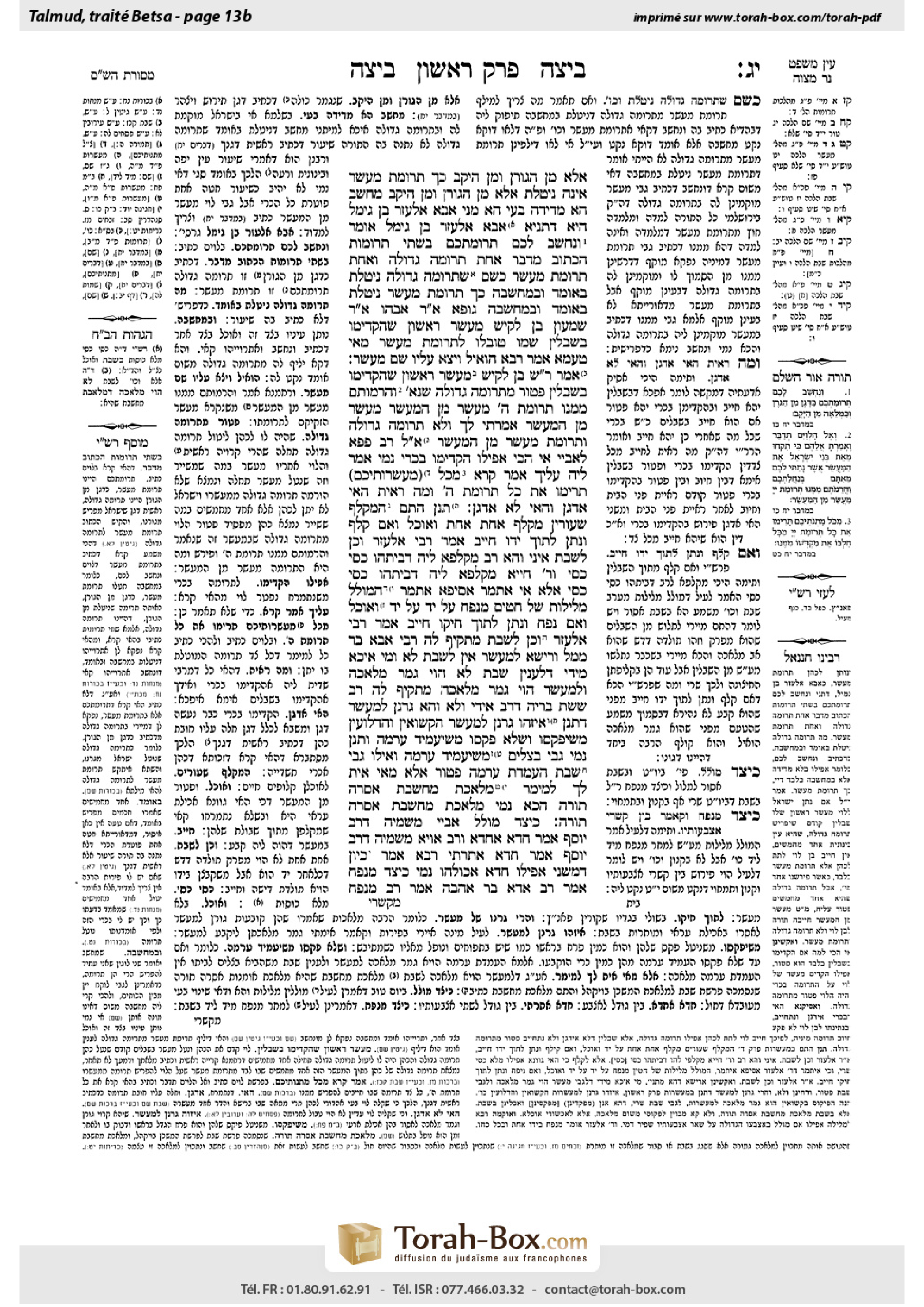
This page of Beitzah includes the Aramaic text, an English translation and an AI-generated French translation, alongside the scan above.
ביצה י״ג ב · Aramaic and Hebrew text
אֶלָּא מִן הַגּוֹרֶן וּמִן הַיֶּקֶב, כָּךְ תְּרוּמַת מַעֲשֵׂר אֵינָהּ נִיטֶּלֶת אֶלָּא מִן הַגּוֹרֶן וּמִן הַיֶּקֶב.
מְחַשֵּׁב? הָא מְדִידָה בָּעֵי!
הָא מַנִּי אַבָּא אֶלְעָזָר בֶּן גִּימֶל הִיא, דְּתַנְיָא: אַבָּא אֶלְעָזָר בֶּן גִּימֶל אוֹמֵר: ״וְנֶחְשַׁב לָכֶם תְּרוּמַתְכֶם״ — בִּשְׁתֵּי תְרוּמוֹת הַכָּתוּב מְדַבֵּר, אַחַת תְּרוּמָה גְּדוֹלָה וְאַחַת תְּרוּמַת מַעֲשֵׂר. כְּשֵׁם שֶׁתְּרוּמָה גְּדוֹלָה נִיטֶּלֶת בְּאוֹמֶד וּבְמַחְשָׁבָה — כָּךְ תְּרוּמַת מַעֲשֵׂר נִיטֶּלֶת בְּאוֹמֶד וּבְמַחְשָׁבָה.
גּוּפָא, אָמַר רַבִּי אֲבָהוּ אָמַר רַבִּי שִׁמְעוֹן בֶּן לָקִישׁ: מַעֲשֵׂר רִאשׁוֹן שֶׁהִקְדִּימוֹ בְּשִׁבֳּלִין — שְׁמוֹ טוֹבְלוֹ לִתְרוּמַת מַעֲשֵׂר. מַאי טַעְמָא? אָמַר רָבָא: הוֹאִיל וְיָצָא עָלָיו שֵׁם מַעֲשֵׂר.
אָמַר רַבִּי שִׁמְעוֹן בֶּן לָקִישׁ: מַעֲשֵׂר רִאשׁוֹן שֶׁהִקְדִּימוֹ בְּשִׁבֳּלִין — פָּטוּר מִתְּרוּמָה גְּדוֹלָה.
שֶׁנֶּאֱמַר: ״וַהֲרֵמוֹתֶם מִמֶּנּוּ תְּרוּמַת ה׳ מַעֲשֵׂר מִן הַמַּעֲשֵׂר״, מַעֲשֵׂר מִן הַמַּעֲשֵׂר אָמַרְתִּי לְךָ, וְלֹא תְּרוּמָה גְּדוֹלָה וּתְרוּמַת מַעֲשֵׂר מִן הַמַּעֲשֵׂר.
אֲמַר לֵיהּ רַב פָּפָּא לְאַבָּיֵי: אִי הָכִי, אֲפִילּוּ הִקְדִּימוֹ בִּכְרִי נָמֵי! אֲמַר לֵיהּ: עָלֶיךָ אָמַר קְרָא: ״מִכֹּל (מַעְשְׂרוֹתֵיכֶם) תָּרִימוּ אֵת כׇּל תְּרוּמַת ה׳״.
וּמָה רָאִיתָ? הַאי אִדְּגַן, וְהַאי לָא אִדְּגַן.
תְּנַן הָתָם: הַמְקַלֵּף שְׂעוֹרִין, מְקַלֵּף אַחַת אַחַת וְאוֹכֵל. וְאִם קִלֵּף וְנָתַן לְתוֹךְ יָדוֹ — חַיָּיב. אָמַר רַבִּי אֶלְעָזָר: וְכֵן לְשַׁבָּת.
אִינִי? וְהָא רַב מְקַלְּפָא לֵיהּ דְּבֵיתְהוּ כָּסֵי כָּסֵי! וְרַבִּי חִיָּיא מְקַלְּפָא לֵיהּ דְּבֵיתְהוּ כָּסֵי כָּסֵי! אֶלָּא אִי אִתְּמַר, אַסֵּיפָא אִתְּמַר: הַמּוֹלֵל מְלִילוֹת שֶׁל חִטִּים, מְנַפֵּחַ עַל יָד עַל יָד וְאוֹכֵל. וְאִם נִפַּח וְנָתַן לְתוֹךְ חֵיקוֹ — חַיָּיב. אָמַר רַבִּי אֶלְעָזָר: וְכֵן לְשַׁבָּת.
מַתְקֵיף לַהּ רַבִּי אַבָּא בַּר מֶמֶל: וְרֵישָׁא, לְמַעֲשֵׂר אִין לְשַׁבָּת לָא? וּמִי אִיכָּא מִידֵּי דִּלְעִנְיַן שַׁבָּת לָא הָוֵי גְּמַר מְלָאכָה, וּלְמַעֲשֵׂר הָוֵי גְּמַר מְלָאכָה?
מַתְקֵיף לַהּ רַב שֵׁשֶׁת בְּרֵיהּ דְּרַב אִידִי: וְלָא, וְהָא גׇּרְנָן לְמַעֲשֵׂר, דִּתְנַן: אֵיזֶהוּ גׇּרְנָן לְמַעֲשֵׂר? הַקִּשּׁוּאִין וְהַדִּלּוּעִין — מִשֶּׁיְּפַקְּסוּ. וְשֶׁלֹּא פִּקְּסוּ — מִשֶּׁיַּעֲמִיד עֲרֵמָה. וּתְנַן נָמֵי גַּבֵּי בְצָלִים — מִשֶּׁיַּעֲמִיד עֲרֵמָה. וְאֵלּוּ גַּבֵּי שַׁבָּת — הַעֲמָדַת עֲרֵמָה פָּטוּר.
אֶלָּא מַאי אִית לָךְ לְמֵימַר: מְלֶאכֶת מַחְשֶׁבֶת אָסְרָה תּוֹרָה, הָכָא נָמֵי: מְלֶאכֶת מַחְשֶׁבֶת אָסְרָה תּוֹרָה.
כֵּיצַד מוֹלֵל? אַבָּיֵי מִשְּׁמֵיהּ דְּרַב יוֹסֵף אָמַר: חֲדָא אַחֲדָא. וְרַב אַוְיָא מִשְּׁמֵיהּ דְּרַב יוֹסֵף אָמַר: חֲדָא אַתַּרְתֵּי. רָבָא אָמַר: כֵּיוָן דִּמְשַׁנֵּי — אֲפִילּוּ חֲדָא אַכּוּלְּהוּ נָמֵי.
כֵּיצַד מְנַפֵּחַ? אָמַר רַב אַדָּא בַּר אַהֲבָה אָמַר רַב: מְנַפֵּחַ
Beitzah 13b · English translation
but only from the granary and the winepress, so too, teruma of the tithe is separated only from the granary and the winepress.
The Gemara asks: If the mishna is referring to produce from which teruma gedola has not been separated, it is appropriate to use the term: Calculates. However, according to the suggestion that it is referring to a first tithe, from which teruma of the tithe must be separated, why does the mishna state: Calculates? The tanna of the mishna should have said: Measures. The amount of teruma gedola to be separated is calculated by estimation, as there is no fixed amount for this teruma according to Torah law. With regard to the teruma separated from first tithe, however, the Torah established the fixed amount of one-tenth, and one is required to measure precisely.
The Gemara explains: In accordance with whose opinion is this mishna? It is in accordance with the opinion of Abba Elazar ben Gimmel, as it is taught in a baraita: Abba Elazar ben Gimmel says: The verse states: “And your teruma shall be reckoned to you as though it were the corn of the granary and as the fullness of the winepress” (Numbers 18:27). The verse speaks of two terumot. One is teruma gedola, and the other one is teruma of the tithe. Just as teruma gedola is separated by estimation and is not measured exactly, and it is enough to separate it by thought, as the word “reckoned” implies that the mere intention to separate a particular portion serves to remove the rest of the produce from its untithed state, so too, teruma of the tithe can also be separated by estimation and by thought.
§ Since it was mentioned incidentally, the Gemara discusses the matter itself: Rabbi Abbahu said that Rabbi Shimon ben Lakish said: With regard to first tithe, in a case in which the Levite preceded the priest while the grain was still on the stalks, its name renders it untithed produce, until he separates from it the teruma of the tithe. The Gemara asks: What is the reason for this halakha? Rava said: Since the name of the first tithe was called upon it, the obligation of the teruma of the tithe takes effect as well.
The Gemara cites a similar halakha that Rabbi Shimon ben Lakish said: With regard to first tithe, in a case in which the Levite preceded the priest while the grain was still on the stalks, before it was threshed and turned into a pile, the owner separated first tithe before teruma. In that case, the separated tithe is exempt from teruma gedola. Although teruma gedola should have been separated from the produce first, and it should have included some of the produce taken as the first tithe, the Levite is nevertheless exempt from separating this teruma.
This is because it is stated: “And you shall set apart from it a teruma for the Lord, even a tenth part of the tithe” (Numbers 18:26), which indicates: A tenth part of the tithe, i.e., the teruma of the tithe, I, God, said to you that you must separate it, and you are not obligated in both teruma gedola and teruma of the tithe from the first tithe.
Rav Pappa said to Abaye: If so, if there is a source for this halakha in the Torah, even if the Levite preceded the priest, i.e., first tithe was separated after the grain had been threshed and the kernels of grain placed in a pile, then it should also be exempt from teruma gedola. Abaye said to Rav Pappa: With regard to your claim, the verse states: “From all that is given you, you shall set apart that which is the Lord’s teruma” (Numbers 18:29). This verse indicates that God’s teruma, i.e., teruma gedola, must be taken from all the produce, including the tithe.
The Gemara asks: And what did you see that led you to require the separation of teruma gedola from first tithe that was taken from processed grain piled in the granary but not from first tithe that was taken from grain on stalks? Abaye answers: This, grain that has been threshed and placed into piles, is completely processed and has become grain, and that, grain that remains on the stalk, has not yet become grain. Until the grain is threshed and assembled in a pile, the obligation to separate teruma does not take effect, as it is not considered grain. When such unprocessed grain is designated first tithe, it ceases to be untithed produce and the opportunity to separate teruma from it has been missed. However, once the grain has been processed, and the obligation to separate teruma has taken effect, it is as if the teruma is already mixed in, and the obligation to separate it cannot be overridden by the fact that this produce has been designated first tithe.
§ We learned in a mishna there (Ma’asrot 4:5): One who peels grains of barley to eat them raw may peel them one by one and eat them immediately without tithing them, as this is considered a casual manner of eating. But if he peeled and placed several of them into his hand, he is obligated to separate tithes. Rabbi Elazar said: And a similar halakha applies to Shabbat. Peeling grains of barley one by one is not considered threshing, and it is permitted; if a whole handful of grains are peeled together, this does constitute the prohibited labor of threshing.
The Gemara asks: Is that so? But didn’t Rav’s wife peel for him barley on Shabbat by the cupful? And likewise Rabbi Ḥiyya’s wife would peel barley for him on Shabbat by the cupful. Rather, if Rabbi Elazar’s comment was stated in this context, it was stated with regard to the latter clause of that same mishna (Ma’asrot 4:5): With regard to one who husks kernels of wheat by hand, he may blow onto the chaff to disperse it a little at a time and eat the kernels without separating tithes. But if he blows on the kernels and puts a large amount of them into his lap, he is obligated to separate tithes from the food. It was with regard to this teaching that Rabbi Elazar said: And a similar halakha applies to Shabbat.
Rabbi Abba bar Memel strongly objects to this: And with regard to the first clause of the mishna, one should conclude: Yes, if one peeled a handful of barley, it is considered prepared with regard to tithes, but no, it is not considered threshing with regard to Shabbat? But is there anything that, with regard to Shabbat, is not considered the completion of the labor and may be performed; and yet, with regard to tithes, it is considered the completion of the labor? Isn’t the prohibition against work on Shabbat far more stringent than tithes in all its details?
Rav Sheshet, son of Rav Idi, strongly objects to this claim: And is there no example of a halakha in which tithes are treated more stringently than Shabbat? And is there not the halakha of their granary for tithes, as we learned in a mishna (Ma’asrot 1:5): What is the equivalent of their granary, i.e., the point at which the processing of various vegetables is completed so that they become obligated in tithes? With regard to cucumbers and gourds, they become obligated from when one trims the thin hairs that cover them [misheyefaksu], and for those he did not trim, from when he assembles them in a pile. And we also learned in a mishna (Ma’asrot 1:6), with regard to onions, that it is from when one assembles them in a pile. Whereas with regard to Shabbat, one who assembles produce in a pile is exempt, as this is not a prohibited labor on Shabbat.
Rather, what have you to say? Why is one exempt if he forms a pile on Shabbat? The Torah prohibited only planned, constructive labor on Shabbat, the type of work that involves the creation of something new, and the formation of a pile is not considered that kind of labor. Here too, with regard to peeling barley, the Torah prohibited creative work. Although collecting the peeled barley in one’s hand is considered the completion of the labor in respect to tithes, it is not prohibited labor on Shabbat.
Apropos husking kernels on Shabbat, the Gemara asks: How may one husk grain on a Festival? Abaye said in the name of Rav Yosef: One finger on another, i.e., one may place the kernels between two fingers and rub. And Rav Avya said in the name of Rav Yosef: One may even do so one on two, i.e., between the thumb and two fingers. Rava said: Since he alters the manner in which he performs the activity, he may even do so with one finger on all the rest.
The Gemara further asks: How may one blow on the grain, to winnow it in a permitted manner on Shabbat? Rav Adda bar Ahava said that Rav said: One blows
Beitzah 13b · Traduction française (IA)
mais seulement à partir du grenier et de la vigne, de même, la terouma de la dîme est séparée seulement à partir du grenier et de la vigne.
La Guemara pose la question : Si la Michna fait référence à des produits dont la terouma gedola n’a pas été séparée, il est approprié d’utiliser le terme : Calculer. Cependant, selon la suggestion qui indique qu’elle fait référence à une première dîme, à partir de laquelle la terouma de la dîme doit être séparée, pourquoi la Michna dit-elle : Calculer ? Le tanna de la Michna aurait dû dire : Mesurer. La quantité de terouma gedola à séparer est calculée par estimation, car il n’y a pas de quantité fixe pour cette terouma selon la loi divine. En ce qui concerne la terouma séparée de la première dîme, cependant, la Torah a établi une quantité fixe d’un dixième, et l’on est tenu de mesurer précisément.
La Guemara explique : Selon quel avis est-ce que cette Michna ? C’est selon l’avis d’Abba Elazar ben Gimmel, comme il est enseigné dans une baraïta : Abba Elazar ben Gimmel dit : La Parashah dit : « Et ta terouma sera comptée pour toi comme si elle était la céréale du grenier et comme la plénitude de la vigne » (Nombres 18 : 27). La Parashah parle de deux teroumas. L’une est la terouma gedola, et l’autre est la terouma de la dîme. Tout comme la terouma gedola est séparée par estimation et n’est pas mesurée exactement, et il suffit de séparer par pensée, car le mot « comptée » implique que l’intention seule de séparer une portion particulière suffit à éloigner le reste des produits de leur état non titulé, de même, la terouma de la dîme peut aussi être séparée par estimation et par pensée.
§ Puisque cela a été mentionné de manière incidentelle, la Guemara discute la question elle-même : Rabbi Abbahu dit que Rabbi Shimon ben Lakish dit : En ce qui concerne la première dîme, dans un cas où le Lévi a précédé le prêtre pendant que les céréales étaient encore sur les tiges, son nom rend le produit non titulé, jusqu’à ce qu’il sépare de lui la terouma de la dîme. La Guemara pose la question : Quel est le motif de cette halakha ? Rava dit : Puisque le nom de la première dîme a été appelé sur elle, l’obligation de la terouma de la dîme prend effet également.
La Guemara cite une halakha similaire que Rabbi Shimon ben Lakish dit : En ce qui concerne la première dîme, dans un cas où le Lévi a précédé le prêtre pendant que les céréales étaient encore sur les tiges, avant qu’elles ne soient moulues et transformées en tas, l’propriétaire a séparé la première dîme avant la terouma. Dans ce cas, la dîme séparée est exemptée de la terouma gedola. Bien que la terouma gedola aurait dû être séparée d’abord des produits et qu’elle devait inclure une partie des produits pris comme première dîme, le Lévi est néanmoins exempt de séparer cette terouma.
C’est parce que cela est dit : « Et tu sépareras de lui une terouma pour l’Éternel, même dixième partie de la dîme » (Nombres 18 : 26), ce qui indique : Dixième partie de la dîme, c’est-à-dire la terouma de la dîme, moi, l’Éternel, ai dit à toi que tu dois la séparer, et tu n’es pas tenu à la fois de la terouma gedola et de la terouma de la dîme de la première dîme.
Rav Pappa dit à Abaye : Si c’est ainsi, si la source de cette halakha est dans la Torah, même si le Lévi a précédé le prêtre, c’est-à-dire que la première dîme a été séparée après que les céréales eurent été foulées et les grains placés en tas, alors elle devrait aussi être exemptée de la terouma gedola. Abaye dit à Rav Pappa : En ce qui concerne votre affirmation, la Parashah dit : « De tout ce qui te est donné, tu sépareras ce qui est la terouma de l’Éternel » (Nombres 18 : 29). Cette Parashah indique que la terouma de l’Éternel, c’est-à-dire la terouma gedola, doit être prise de tous les produits, y compris la dîme.
La Guemara pose la question : Et qu’as-tu vu qui t’a conduit à exiger la séparation de la terouma gedola de la première dîme qui a été prise de céréales foulées et placées en tas mais pas de la première dîme qui a été prise de céréales sur les tiges ? Abaye répond : Ces céréales foulées et placées en tas sont complètement traitées et sont devenues des céréales, et celles qui restent sur les tiges n’ont pas encore devenu des céréales. Jusqu’à ce que les céréales soient foulées et assemblées en tas, l’obligation de séparer la terouma ne prend effet, car elles ne sont pas encore considérées comme des céréales. Lorsque de telles céréales non traitées sont désignées comme première dîme, elles cessent d’être des produits non titulés et l’occasion de séparer la terouma d’elles a été manquée. Cependant, une fois que les céréales ont été traitées et que l’obligation de séparer la terouma a pris effet, c’est comme si la terouma était déjà mélangée, et l’obligation de la séparer ne peut pas être annulée par le fait que ce produit ait été désigné comme première dîme.
§ Nous avons appris dans une Michna là (Ma’asrot 4:5) : Celui qui épluche des grains deorge pour les manger crus peut éplucher un par un et les manger immédiatement sans les tituler, car cela est considéré comme une manière informelle de manger. Mais s’il épluche et place plusieurs d’entre eux dans sa main, il est tenu de séparer les dîmes. Rabbi Elazar dit : Et une halakha similaire s’applique à la Shabbat. Éplucher des grains deorge un par un n’est pas considéré comme le travail de meuler, et il est permis ; si on épluche ensemble une main de grains, cela constitue le travail interdit de meuler.
La Guemara pose la question : Est-ce ainsi ? Mais n’a-t-on pas vu que la femme de Rav épluchait du blé pour lui à la cuillère le sabbat ? Et de même, la femme de Rabbi Ḥiyya épluchait du blé pour lui à la cuillère le sabbat. Plutôt, si la remarque de Rabbi Elazar a été faite dans ce contexte, elle a été faite concernant la seconde partie de cette même Michna (Ma’asrot 4:5) : Concernant celui qui épluche des grains de blé à la main, il peut souffler sur la paille pour la disperser petit à petit et manger les grains sans séparer les dîmes. Mais s’il souffle sur les grains et met une grande quantité dans son coude, il est tenu de séparer les dîmes du repas. C’est à propos de cette enseignement que Rabbi Elazar a dit : Et une halakha similaire s’applique au sabbat.
Rabbi Abba bar Memel s'oppose fermement à cela : Et concernant la première clause de la mitsna, on devrait conclure : Oui, si l'on a épluché une poignée d'orge, cela est considéré comme préparé en ce qui concerne les dîmes, mais non, cela n'est pas considéré comme la moisson en ce qui concerne le Sabbat ? Mais y a-t-il quelque chose qui, en ce qui concerne le Sabbat, n'est pas considéré comme la fin de l'œuvre et peut être accompli ; et pourtant, en ce qui concerne les dîmes, il est considéré comme la fin de l'œuvre ? N'est-ce pas que l'interdiction de travailler le Sabbat est bien plus stricte que les dîmes en tous ses détails ?
Rav Sheshet, fils de Rav Idi, s'oppose fermement à cette affirmation : Et n'y a-t-il pas d'exemple d'une halakha où les dîmes sont traitées plus strictement que le Sabbat ? Et n'y a-t-il pas la halakha de leur grenier pour les dîmes, comme nous l'avons appris dans une mitsna (Ma'asrot 1:5) : Qu'est-ce qui équivaut à leur grenier, c'est-à-dire le point où la transformation de divers légumes est achevée afin qu'ils soient soumis aux dîmes ? En ce qui concerne les concombres et les citrouilles, ils deviennent soumis dès qu'on enlève les poils fins qui les recouvrent [misheyefaksu], et pour ceux qu'on n'a pas enlevés, dès qu'on les assemble en tas. Et nous avons également appris dans une mitsna (Ma'asrot 1:6), en ce qui concerne les oignons, que cela est dès qu'on les assemble en tas. En ce qui concerne le Sabbat, celui qui assemble les produits en tas est exempt, car cela n'est pas une œuvre interdite le Sabbat.
Plutôt, que réponds-tu ? Pourquoi est-on exempt s'il forme un tas le Sabbat ? La Torah interdit seulement l'œuvre planifiée, constructive le Sabbat, le genre de travail qui implique la création de quelque chose de nouveau, et la formation d'un tas n'est pas considérée comme ce type d'œuvre. Ici aussi, en ce qui concerne l'épluchage de l'orge, la Torah interdit l'œuvre créative. Bien que la collecte de l'orge épluché dans la main soit considérée comme la fin de l'œuvre en ce qui concerne les dîmes, elle n'est pas une œuvre interdite le Sabbat.
En ce qui concerne le dégarnissement des grains le Sabbat, la Guemara pose la question : Comment peut-on dégarnir des céréales pendant un festival ? Abaye a dit au nom de Rav Yosef : Un doigt sur un autre, c'est-à-dire qu'on peut placer les grains entre deux doigts et frotter. Et Rav Avya a dit au nom de Rav Yosef : On peut même le faire un sur deux, c'est-à-dire entre le pouce et deux doigts. Rava a dit : Puisque l'on modifie la manière d'accomplir l'activité, on peut même le faire avec un doigt sur tout le reste.
La Guemara pose également la question : Comment peut-on souffler sur les grains, afin de les séparer de manière permise le Sabbat ? Rav Adda bar Ahava a dit que Rav a dit : On souffle
Traduction française générée par IA à partir de l’édition anglaise de Sefaria. Vérifie toujours un passage avec le texte source.
Text from Sefaria: William Davidson Edition - Vocalized Aramaic (CC BY NC); William Davidson Edition - English (CC BY NC).