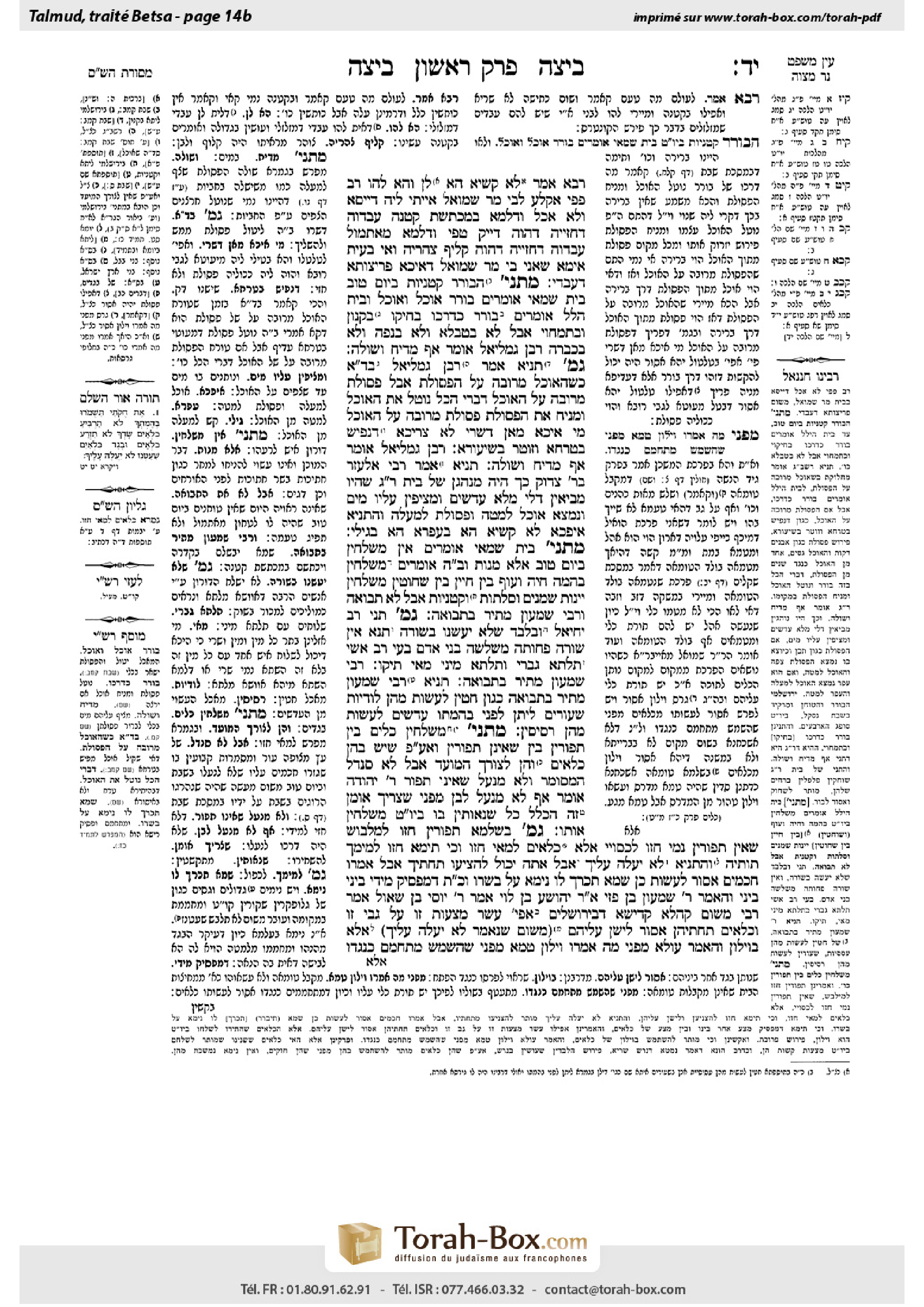
Beitzah 14b: Talmud study for Daf Yomi
Study the Talmud for Daf Yomi with scanned pages, Hebrew text, English translations from Sefaria and AI-generated French translations.
Passage selection and English or AI-generated French translation are available where the scan has annotations. Daf Study is independent of Torah-Box and Sefaria.
Browse Beitzah · ביצה · All tractatesBeitzah 14b text and translations
This page of Beitzah includes the Aramaic text, an English translation and an AI-generated French translation, alongside the scan above.
ביצה י״ד ב · Aramaic and Hebrew text
רָבָא אָמַר, לָא קַשְׁיָא: הָא לַן, וְהָא לְהוּ.
רַב פַּפֵּי אִקְּלַע לְבֵי מָר שְׁמוּאֵל. אַיְיתִי לֵיהּ דַּיְיסָא וְלָא אֲכַל. וְדִלְמָא בְּמַכְתֶּשֶׁת קְטַנָּה עַבְדוּהּ? דְּחַזְיֵיהּ דַּהֲוָה דְּיִיק טְפֵי.
וְדִלְמָא מֵאֶתְמוֹל עַבְדוּהּ? דְּחַזְיֵיהּ דַּהֲוָה קְלִיף צַהֲרֵיהּ. וְאִי בָּעֵית אֵימָא: שָׁאנֵי בֵּי מָר שְׁמוּאֵל, דְּאִיכָּא פְּרִיצוּתָא דְעַבְדֵי.
מַתְנִי׳ הַבּוֹרֵר קִטְנִיּוֹת בְּיוֹם טוֹב, בֵּית שַׁמַּאי אוֹמְרִים: בּוֹרֵר אוֹכֶל וְאוֹכֵל. וּבֵית הִלֵּל אוֹמְרִים: בּוֹרֵר כְּדַרְכּוֹ בְּחֵיקוֹ בַּקָּנוֹן וּבַתַּמְחוּי, אֲבָל לֹא בַּטַּבְלָא וְלֹא בַּנָּפָה וְלֹא בַּכְּבָרָה. רַבָּן גַּמְלִיאֵל אוֹמֵר: אַף מֵדִיחַ וְשׁוֹלֶה.
גְּמָ׳ תַּנְיָא, אָמַר רַבָּן גַּמְלִיאֵל: בַּמֶּה דְּבָרִים אֲמוּרִים — כְּשֶׁהָאוֹכֶל מְרוּבֶּה עַל הַפְּסוֹלֶת, אֲבָל פְּסוֹלֶת מְרוּבָּה עַל הָאוֹכֶל — דִּבְרֵי הַכֹּל נוֹטֵל אֶת הָאוֹכֵל וּמַנִּיחַ אֶת הַפְּסוֹלֶת.
פְּסוֹלֶת מְרוּבָּה עַל הָאוֹכֶל מִי אִיכָּא מַאן דְּשָׁרֵי? לָא צְרִיכָא, דִּנְפִישׁ בְּטִרְחָא וְזוּטַר בְּשִׁיעוּרָא.
רַבָּן גַּמְלִיאֵל אוֹמֵר: אַף מֵדִיחַ וְשׁוֹלֶה. תַּנְיָא, אָמַר רַבִּי אֶלְעָזָר בְּרַבִּי צָדוֹק: כָּךְ הָיָה מִנְהָגָן שֶׁל בֵּית רַבָּן גַּמְלִיאֵל, שֶׁהָיוּ מְבִיאִין דְּלִי מָלֵא עֲדָשִׁים וּמְצִיפִין עָלָיו מַיִם, וְנִמְצָא אוֹכֶל לְמַטָּה וּפְסוֹלֶת לְמַעְלָה.
וְהָתַנְיָא אִיפְּכָא? לָא קַשְׁיָא: הָא בְּעַפְרָא, הָא בְּגִילֵי.
מַתְנִי׳ בֵּית שַׁמַּאי אוֹמְרִים: אֵין מְשַׁלְּחִין בְּיוֹם טוֹב אֶלָּא מָנוֹת, וּבֵית הִלֵּל אוֹמְרִים: מְשַׁלְּחִין בְּהֵמָה חַיָּה וָעוֹף, בֵּין חַיִּין בֵּין שְׁחוּטִין. מְשַׁלְּחִין יֵינוֹת שְׁמָנִים וּסְלָתוֹת וְקִטְנִיּוֹת, אֲבָל לֹא תְּבוּאָה. וְרַבִּי שִׁמְעוֹן מַתִּיר בִּתְבוּאָה.
גְּמָ׳ תָּנֵי רַב יְחִיאֵל: וּבִלְבַד שֶׁלֹּא יַעֲשֶׂנּוּ בְּשׁוּרָה. תָּנָא: אֵין שׁוּרָה פְּחוּתָה מִשְּׁלֹשָׁה בְּנֵי אָדָם. בָּעֵי רַב אָשֵׁי: תְּלָתָא גַּבְרֵי וּתְלָתָא מִינֵי מַאי? תֵּיקוּ.
רַבִּי שִׁמְעוֹן מַתִּיר בִּתְבוּאָה. תַּנְיָא: רַבִּי שִׁמְעוֹן מַתִּיר בִּתְבוּאָה, כְּגוֹן: חִטִּין לַעֲשׂוֹת מֵהֶן לוּדִיּוֹת, שְׂעוֹרִים לִיתֵּן לִפְנֵי בְּהֶמְתּוֹ, עֲדָשִׁים לַעֲשׂוֹת מֵהֶן רְסִיסִין.
מַתְנִי׳ מְשַׁלְּחִין כֵּלִים בֵּין תְּפוּרִין בֵּין שֶׁאֵינָן תְּפוּרִין, וְאַף עַל פִּי שֶׁיֵּשׁ בָּהֶן כִּלְאַיִם וְהֵן לְצוֹרֶךְ הַמּוֹעֵד. אֲבָל לֹא סַנְדָּל הַמְסוּמָּר וְלֹא מִנְעָל שֶׁאֵינוֹ תָּפוּר. רַבִּי יְהוּדָה אוֹמֵר: אַף לֹא מִנְעָל לָבָן, מִפְּנֵי שֶׁצָּרִיךְ אוּמָּן. זֶה הַכְּלָל: כׇּל שֶׁנֵּאוֹתִין בּוֹ בְּיוֹם טוֹב — מְשַׁלְּחִין אוֹתוֹ.
גְּמָ׳ בִּשְׁלָמָא תְּפוּרִין — חֲזוּ לְמַלְבּוּשׁ, שֶׁאֵין תְּפוּרִין נָמֵי — חֲזוּ לְכַסּוֹיֵי, אֶלָּא כִּלְאַיִם לְמַאי חֲזוּ?
וְכִי תֵימָא חֲזוּ לְמֵימַךְ תּוּתֵיהּ, וְהָתַנְיָא: ״לֹא יַעֲלֶה עָלֶיךָ״, אֲבָל אַתָּה יָכוֹל לְהַצִּיעוֹ תַּחְתֶּיךָ. אֲבָל אָמְרוּ חֲכָמִים: אָסוּר לַעֲשׂוֹת כֵּן, שֶׁמָּא תִּכָּרֵךְ לוֹ נִימָא עַל בְּשָׂרוֹ.
וְכִי תֵּימָא דְּמַפְסֵיק מִידֵּי בֵּינֵי בֵּינֵי, וְהָאָמַר רַבִּי שִׁמְעוֹן בֶּן פַּזִּי, אָמַר רַבִּי יְהוֹשֻׁעַ בֶּן לֵוִי, אָמַר רַבִּי יוֹסֵי בֶּן שָׁאוּל, אָמַר רַבִּי מִשּׁוּם קְהָלָא קַדִּישָׁא דְּבִירוּשָׁלַיִם: אֲפִילּוּ עֶשֶׂר מַצָּעוֹת זוֹ עַל גַּבֵּי זוֹ וְכִלְאַיִם תַּחְתֵּיהֶן — אָסוּר לִישַׁן עֲלֵיהֶם (מִשּׁוּם שֶׁנֶּאֱמַר: ״לֹא יַעֲלֶה עָלֶיךָ״).
אֶלָּא, בְּוִילוֹן. וְהָאָמַר עוּלָּא: מִפְּנֵי מָה אָמְרוּ וִילוֹן טָמֵא — מִפְּנֵי שֶׁהַשַּׁמָּשׁ מִתְחַמֵּם כְּנֶגְדּוֹ.
Beitzah 14b · English translation
Rava said: This is not difficult; the baraitot do not contradict one another. This ruling, which permits a small mortar and pestle, is for us, the residents of Babylonia, who do not have servants, and that statement is for them, the inhabitants of Eretz Yisrael, who have many servants. Since servants might treat the prohibition lightly, by using a large mortar and pestle and claiming they had used only a small one, they are prohibited from pounding in all cases.
The Gemara relates: Rav Pappi happened to come on a Festival to the house of Mar Shmuel. He brought to him porridge, made from wheat groats, but he did not eat it, out of concern that the wheat might have been pounded on the same day. The Gemara asks: And perhaps they performed the pounding with a small mortar and pestle, in a permitted manner? The Gemara answers: This cannot be the case, as he observed that it was well ground, which cannot be achieved by means of a small mortar and pestle.
The Gemara asks: And perhaps they prepared it the day before, on the Festival eve? The Gemara answers: This cannot be the case, as he observed that the husks of the groats were bright, an indication that they had been prepared recently. And if you wish, say instead that he refrained from eating for another reason, because the house of Mar Shmuel is different, as he had slaves, and slaves are lax with regard to prohibitions. Therefore, Mar Shmuel ought to have prohibited all forms of grinding in his house, to ensure that no one grind anything in an inappropriate manner.
MISHNA: With regard to one who selects legumes on a Festival by separating the edible and inedible portions, Beit Shammai say: He may select food and eat it immediately, while leaving the refuse. And Beit Hillel say: He may select in his usual manner, in his lap, with a tray, or with a large vessel, but he may not do so with a tablet, nor with a winnow, nor with a sieve, as these vessels are specially designed for selecting, which gives his action the appearance of a weekday activity. Rabban Gamliel says: One may even wash the legumes in water and skim off the refuse floating on top.
GEMARA: It is taught in a baraita: Rabban Gamliel said: In what case is this statement said? Under what circumstances did Beit Hillel permit the removal of the refuse in the weekday manner of selecting? In a case where the quantity of the food is greater than the quantity of the refuse. However, if the quantity of refuse is greater than the quantity of food, everyone agrees that one must remove the food and leave the refuse.
The Gemara asks: If the quantity of refuse is greater than the quantity of food, is there an opinion that permits it? Since the smaller amount of food is nullified by the refuse, the entire mixture is considered muktze and may not be moved. The Gemara answers: No, it is necessary to state this halakha in a case where the removal of the refuse is greater in terms of effort, and yet it is smaller in size. In other words, there is actually more food than refuse, but since greater effort is required to remove the refuse, it is preferable to remove the food.
The mishna taught that Rabban Gamliel says: One may even wash the legumes in water and skim off the refuse floating on top. It is taught (Tosefta, Beitza 1): Rabbi Elazar, son of Rabbi Tzadok, said: This was the custom of the house of Rabban Gamliel, that they would bring a bucket full with lentils and pour water in it, and then the food would sink down and the refuse would float up, which spared them from having to separate the lentils from the refuse manually.
The Gemara asks: But isn’t the opposite taught in another baraita, that the food rose to the top while the refuse sunk below? The Gemara answers: It is not difficult. This baraita, which says the refuse sinks down, is referring to refuse in the form of earth, which sinks below the lentils; that baraita, where it is stated that the refuse rises, speaks of straw, which floats on water.
MISHNA: Beit Shammai say: One may send only portions of prepared food on a Festival, but not any other gifts. And Beit Hillel say: One may even send gifts of domesticated animals, undomesticated animals, and fowl, whether alive or slaughtered. Similarly, one may send wines, oils, and vessels of flour, and even legumes, but not grain, which is unfit for use, as one may not grind it on the Festival. And Rabbi Shimon permits sending gifts even in the case of grain, as it can be made into porridge without being ground.
GEMARA: Rav Yeḥiel teaches: And one may send these items provided that he does not do it by means of a convoy of people, as they would look as though they were transporting merchandise to the marketplace. It is taught in a baraita: A convoy consists of no less than three people; if there are fewer than three, it is not called a convoy and is permitted. Rav Ashi raised a dilemma: In a case of three people and three different types of food, what is the halakha? Is this considered a convoy, or does the fact that there are three different types of food mean that each of them is considered a separate item? The Gemara answers: The dilemma shall stand unresolved, as no answer was found.
The mishna taught that Rabbi Shimon permits the sending of grain. It is taught in a baraita: Rabbi Shimon permits the sending of grain, for example: Wheat to prepare from it ludiyot, a type of cookie; barley to place before his animal; or lentils to prepare from them resisin, a dish made from crushed lentils.
MISHNA: One may send clothes, whether they are sewn or whether they are unsewn, and even if they contain diverse kinds, a prohibited mixture of wool and linen [sha’atnez]. But one may do so only if they serve the purposes of the Festival. However, one may not send a spiked sandal, which has nails fixed to it, as the Sages decreed that one may not wear a sandal of this kind on a Shabbat or Festival, nor an unsewn shoe, which is not suitable for a Festival. Rabbi Yehuda says: One may not even send a white shoe, which people do not usually wear, because it requires an artisan to paint it black. This is the general principle: Anything that one may use on a Festival, one may send it.
GEMARA: The Gemara asks a question: Granted, it is permitted to send sewn clothes, as they are suitable for wearing. With regard to clothes that are not sewn as well, they are at least suitable for covering oneself. But in the case of clothes than contain diverse kinds, for what use are they suited? Since these clothes may not be used on the Festival, why is it permitted to send them?
And if you say that clothes of diverse kinds are suited for one to place underneath himself, but isn’t it taught in a baraita: “Neither shall there come upon you a garment of diverse kinds” (Leviticus 19:19)? This verse teaches that one may not wear this garment, but by Torah law you may spread it beneath you. However, the Sages said: It is prohibited to do so, lest a thread [nima] wind itself around his flesh. This shows that the Sages prohibited even spreading underneath oneself a cloth that contains a mixture of wool and linen.
And if you say that the allowance of cloth of diverse kinds is referring to a case where there is something separating between them, i.e., one may place a garment of diverse kinds beneath another object, but didn’t Rabbi Shimon ben Pazi say that Rabbi Yehoshua ben Levi said that Rabbi Yosei ben Shaul said that Rabbi Yehuda HaNasi said, in the name of the sacred congregation in Jerusalem: Even in a case of ten mattresses placed one on top of the other and a cloth of diverse kinds underneath them, it is prohibited to sleep on them, as it is stated: “Neither shall there come upon you” (Leviticus 19:19).
Rather, the mishna is referring to a curtain [vilon] of diverse kinds, which may be hung up, as it is not an item of clothing. The Gemara challenges this: But didn’t Ulla say: For what reason did the Sages say that a curtain is ritually impure, i.e., that it can contract the impurity of a vessel despite the fact that it is not directly used by people? Because the attendant warms himself with it. Since attendants use curtains as makeshift blankets when they are cold, a curtain may not be made from a mixture of wool and linen.
Beitzah 14b · Traduction française (IA)
Rava a dit : Ce n'est pas difficile ; les baraitot ne s'opposent pas les unes aux autres. Cette décision, qui permet l'usage d'un mortier et d'un pilon petits, est pour nous, les habitants de Babylone, qui n'avons pas de serviteurs, et cette déclaration est pour eux, les habitants de la Terre d'Israël, qui ont beaucoup de serviteurs. Puisque les serviteurs pourraient traiter la prohibition avec légèreté, en utilisant un mortier et un pilon grands et en affirmant qu'ils n'avaient utilisé qu'un petit, ils sont interdits de moudre dans tous les cas.
Le Guemara rapporte : Rav Pappi est venu un jour de fête chez Mar Shmuel. Il lui a apporté un bouillon fait de groseilles de blé, mais il n'a pas mangé, par crainte que le blé n'ait été moulé le même jour. Le Guemara demande : Et peut-être qu'ils ont effectué le moulage avec un mortier et un pilon petits, de manière permise ? Le Guemara répond : Cela ne peut pas être le cas, car il a observé qu'il était bien moulu, ce qui ne peut être réalisé avec un mortier et un pilon petits.
Le Guemara demande : Et peut-être qu'ils l'ont préparé la veille, le jour de la fête ? Le Guemara répond : Cela ne peut pas être le cas, car il a observé que les enveloppes des groseilles étaient brillantes, signe qu'ils avaient été préparés récemment. Et si vous le souhaitez, dites plutôt qu'il a refusé de manger pour une autre raison, car la maison de Mar Shmuel est différente, car il avait des serviteurs, et les serviteurs sont négligents en ce qui concerne les prohibitions. Ainsi, Mar Shmuel aurait dû interdire toute forme de moulage dans sa maison, pour s'assurer que personne ne moulait quoi que ce soit de manière inappropriée.
MICHNA : En ce qui concerne celui qui sélectionne des légumineuses lors d'une fête en séparant les parties comestibles et inedibles, Beit Shammai disent : Il peut sélectionner les aliments et les manger immédiatement, en laissant les déchets. Et Beit Hillel disent : Il peut sélectionner selon sa manière habituelle, sur ses genoux, avec un plateau ou avec un grand récipient, mais il ne doit pas le faire avec un tablet, un éventail ou un tamis, car ces récipients sont spécialement conçus pour la sélection, ce qui donne à son action l'aspect d'une activité du jour de travail. Rabban Gamliel dit : On peut même laver les légumineuses à l'eau et retirer les déchets flottants en surface.
GUEMARA : Il est enseigné dans une baraïta : Rabban Gamliel a dit : Dans quel cas cette déclaration est-elle dite ? Dans quelles circonstances Beit Hillel ont-ils permis l'élimination des déchets selon la manière du jour de travail ? Dans un cas où la quantité des aliments est supérieure à la quantité des déchets. Cependant, si la quantité des déchets est supérieure à celle des aliments, tout le monde convient que l'on doit éliminer les aliments et laisser les déchets.
Le Guemara demande : Si la quantité des déchets est supérieure à celle des aliments, y a-t-il un avis qui permet cela ? Puisque la quantité plus petite d'aliments est annulée par les déchets, l'ensemble du mélange est considéré comme muktze et ne peut pas être déplacé. Le Guemara répond : Non, il faut énoncer cette halakha dans un cas où l'élimination des déchets est plus pénible, mais plus petite en taille. En d'autres termes, il y a effectivement plus d'aliments que de déchets, mais puisque plus d'effort est requis pour éliminer les déchets, il est préférable d'éliminer les aliments.
La mishna a enseigné que Rabban Gamliel dit : On peut même laver les légumineuses à l'eau et retirer les déchets flottant en surface. Il est enseigné (Tosefta, Beitza 1) : Rabbi Elazar, fils de Rabbi Tzadok, a dit : C'était la coutume de la maison de Rabban Gamliel, qu'ils apportaient un seau plein de lentilles et qu'ils y versaient de l'eau, puis les aliments descendaient et les déchets montaient, ce qui leur épargnait de séparer manuellement les lentilles des déchets.
Le Guemara demande : Mais n'est-ce pas l'inverse qui est enseigné dans une autre baraïta, que les aliments montaient en surface tandis que les déchets s'abaissaient ? Le Guemara répond : Ce n'est pas difficile. Cette baraïta, qui dit que les déchets s'abaissent, fait référence aux déchets sous forme de terre, qui s'abaissent sous les lentilles ; cette baraïta, où il est dit que les déchets montent, parle de paille, qui flotte sur l'eau.
MICHNA : Beit Shammai disent : On peut envoyer seulement des portions d'aliments préparés lors d'une fête, mais pas d'autres cadeaux. Et Beit Hillel disent : On peut même envoyer des cadeaux d'animaux domestiques, d'animaux sauvages et d'oiseaux, qu'ils soient vivants ou tués. De même, on peut envoyer des vins, des huiles et des récipients de farine, et même des légumineuses, mais pas du grain, qui est inutilisable, car on ne peut le moudre lors de la fête. Et Rabbi Shimon permet l'envoi de cadeaux même dans le cas du grain, car il peut être transformé en bouillie sans être moulu.
GUEMARA : Rav Yeḥiel enseigne : On peut envoyer ces objets à condition qu'on ne le fasse pas par le biais d'un convoi de personnes, car cela pourrait donner l'impression de transporter des marchandises au marché. Il est enseigné dans une baraïta : Un convoi est composé de trois personnes au minimum ; s'il y a moins de trois, ce n'est pas considéré comme un convoi et est permis. Rav Ashi a posé un dilemme : Dans un cas de trois personnes et de trois types d'aliments différents, quelle est la halakha ? Est-ce considéré comme un convoi, ou le fait qu'il y ait trois types d'aliments signifie que chacun est considéré comme un objet séparé ? Le Guemara répond : Ce dilemme restera sans réponse, car aucune réponse n'a été trouvée.
La mishna a enseigné que Rabbi Shimon permet l'envoi du grain. Il est enseigné dans une baraïta : Rabbi Shimon permet l'envoi du grain, par exemple : Du blé pour en faire des ludiyot, un type de gâteau ; du seigle pour le placer devant son animal ; ou des lentilles pour en faire des resisin, un plat fait de lentilles écrasées.
MICHNA : On peut envoyer des vêtements, qu'ils soient cousus ou non, même s'ils contiennent diverses sortes, un mélange interdit de laine et de lin [sha’atnez]. Mais on peut le faire uniquement s'ils servent aux besoins de la fête. Cependant, on ne peut pas envoyer un sandal à clous, qui a des clous fixés, car les Sages ont décrété qu'on ne peut porter ce genre de sandale le sabbat ou la fête, ni une chaussure non cousue, qui n'est pas adaptée à la fête. Rabbi Yehuda dit : On ne peut pas non plus envoyer une chaussure blanche, que les gens ne portent pas habituellement, car cela nécessite un artisan pour le peindre en noir. C'est le principe général : Tout ce que l'on peut utiliser lors d'une fête, on peut l'envoyer.
GUEMARA : La Guemara pose une question : C'est évident qu'on peut envoyer des vêtements cousus, car ils sont adaptés à porter. En ce qui concerne les vêtements non cousus, ils sont au moins adaptés à couvrir son corps. Mais dans le cas de vêtements contenant diverses sortes, à quel usage sont-ils adaptés ? Puisque ces vêtements ne peuvent pas être utilisés lors de la fête, pourquoi est-il permis d'envoyer ces vêtements ?
Et si vous dites que les vêtements contenant diverses sortes sont adaptés pour qu'on les place sous soi, mais n'est-il pas enseigné dans une baraïta : « Ni un vêtement de diverses sortes ne viendra sur toi » (Lévitique 19:19) ? Cette verset enseigne qu'on ne peut pas porter ce vêtement, mais selon la loi de la Torah, on peut le poser sous soi. Cependant, les Sages ont dit : Il est interdit de le faire, de peur qu'un fil [nima] s'enroule autour de sa chair. Cela montre que les Sages ont interdit même de poser sous soi un tissu contenant un mélange de laine et de lin.
Et si vous dites que l'autorisation des vêtements de diverses sortes fait référence à un cas où il y a quelque chose entre eux, c'est-à-dire qu'on peut placer un vêtement de diverses sortes sous un autre objet, mais n'a-t-il pas dit Rabbi Shimon ben Pazi que Rabbi Yehoshua ben Levi a dit que Rabbi Yosei ben Shaul a dit que Rabbi Yehuda HaNasi a dit, en nom de la congrégation sacrée à Jérusalem : Même dans le cas de dix matelas placés les uns sur les autres et d'un vêtement de diverses sortes sous eux, il est interdit de dormir dessus, car il est dit : « Ni un vêtement de diverses sortes ne viendra sur toi » (Lévitique 19:19).
Plutôt, la mitsva fait référence à un rideau [vilon] de diverses sortes, qui peut être suspendu, car il n'est pas un vêtement. La Guemara remet en question cela : Mais n'a-t-il pas dit Ulla : Pourquoi les Sages ont-ils dit qu'un rideau est impur rituellement, c'est-à-dire qu'il peut contracter l'impureté d'un récipient malgré le fait qu'il n'est pas utilisé directement par les gens ? Parce que les serviteurs se réchauffent avec lui. Puisque les serviteurs utilisent les rideaux comme des couvertures improvisées lorsqu'ils sont froids, un rideau ne peut pas être fait d'un mélange de laine et de lin.
Traduction française générée par IA à partir de l’édition anglaise de Sefaria. Vérifie toujours un passage avec le texte source.
Text from Sefaria: William Davidson Edition - Vocalized Aramaic (CC BY NC); William Davidson Edition - English (CC BY NC).