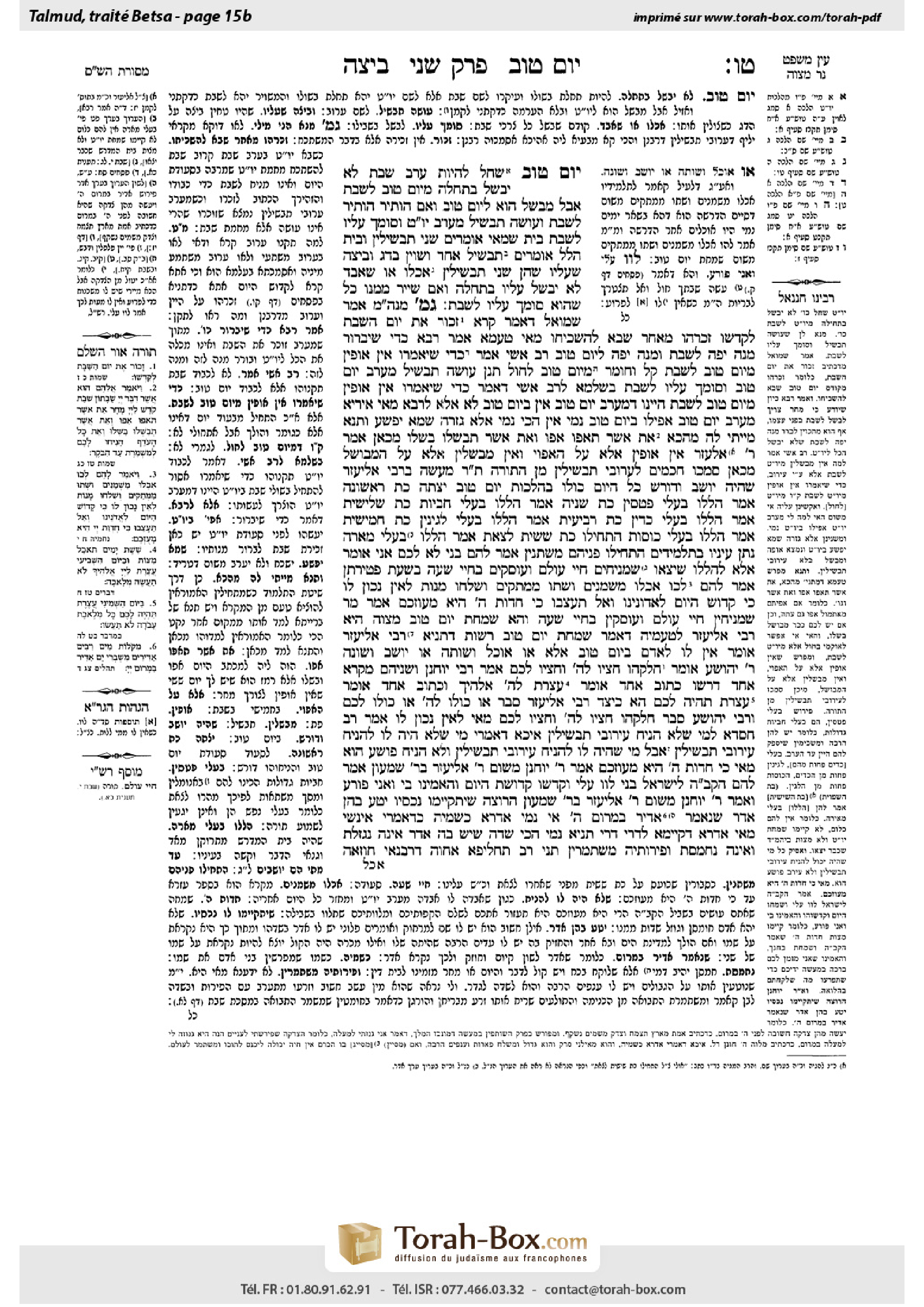
Beitzah 15b: Talmud study for Daf Yomi
Study the Talmud for Daf Yomi with scanned pages, Hebrew text, English translations from Sefaria and AI-generated French translations.
Passage selection and English or AI-generated French translation are available where the scan has annotations. Daf Study is independent of Torah-Box and Sefaria.
Browse Beitzah · ביצה · All tractatesBeitzah 15b text and translations
This page of Beitzah includes the Aramaic text, an English translation and an AI-generated French translation, alongside the scan above.
ביצה י״ה ב · Aramaic and Hebrew text
יוֹם טוֹב שֶׁחָל לִהְיוֹת עֶרֶב שַׁבָּת — לֹא יְבַשֵּׁל בַּתְּחִלָּה מִיּוֹם טוֹב לְשַׁבָּת. אֲבָל מְבַשֵּׁל הוּא לְיוֹם טוֹב, וְאִם הוֹתִיר — הוֹתִיר לַשַּׁבָּת. וְעוֹשֶׂה תַּבְשִׁיל מֵעֶרֶב יוֹם טוֹב, וְסוֹמֵךְ עָלָיו לַשַּׁבָּת.
בֵּית שַׁמַּאי אוֹמְרִים: שְׁנֵי תַבְשִׁילִין, ובֵית הִלֵּל אוֹמְרִים: תַּבְשִׁיל אֶחָד. וְשָׁוִין בְּדָג וּבֵיצָה שֶׁעָלָיו, שֶׁהֵן שְׁנֵי תַבְשִׁילִין.
אֲכָלוֹ אוֹ שֶׁאָבַד — לֹא יְבַשֵּׁל עָלָיו בַּתְּחִלָּה. וְאִם שִׁיֵּיר מִמֶּנּוּ כׇּל שֶׁהוּא, — סוֹמֵךְ עָלָיו לַשַּׁבָּת.
גְּמָ׳ מְנָא הָנֵי מִילֵּי? אָמַר שְׁמוּאֵל, דְּאָמַר קְרָא: ״זָכוֹר אֶת יוֹם הַשַּׁבָּת לְקַדְּשׁוֹ״, זׇכְרֵהוּ — מֵאַחֵר שֶׁבָּא לְהַשְׁכִּיחוֹ.
מַאי טַעְמָא? אָמַר רָבָא: כְּדַי שֶׁיִּבְרוֹר מָנָה יָפָה לַשַּׁבָּת וּמָנָה יָפָה לְיוֹם טוֹב.
רַב אָשֵׁי אָמַר: כְּדֵי שֶׁיֹּאמְרוּ אֵין אוֹפִין מִיּוֹם טוֹב לַשַּׁבָּת, קַל וָחוֹמֶר מִיּוֹם טוֹב לְחוֹל.
תְּנַן: עוֹשֶׂה תַּבְשִׁיל מֵעֶרֶב יוֹם טוֹב וְסוֹמֵךְ עָלָיו לַשַּׁבָּת. בִּשְׁלָמָא לְרַב אָשֵׁי דְּאָמַר כְּדֵי שֶׁיֹּאמְרוּ אֵין אוֹפִין מִיּוֹם טוֹב לַשַּׁבָּת, הַיְינוּ דְּמֵעֶרֶב יוֹם טוֹב — אִין, בְּיוֹם טוֹב — לָא. אֶלָּא לְרָבָא, מַאי אִירְיָא מֵעֶרֶב יוֹם טוֹב? אֲפִילּוּ בְּיוֹם טוֹב נָמֵי!
אִין הָכִי נָמֵי, אֶלָּא גְּזֵרָה שֶׁמָּא יִפְשַׁע.
וְתַנָּא מַיְיתֵי לַהּ מֵהָכָא: ״אֵת אֲשֶׁר תֹּאפוּ אֵפוּ וְאֵת אֲשֶׁר תְּבַשְּׁלוּ בַּשֵּׁלוּ״, מִכָּאן אָמַר רַבִּי אֱלִיעֶזֶר: אֵין אוֹפִין אֶלָּא עַל הָאָפוּי, וְאֵין מְבַשְּׁלִין אֶלָּא עַל הַמְבוּשָּׁל. מִכָּאן סָמְכוּ חֲכָמִים לְעֵרוּבֵי תַבְשִׁילִין מִן הַתּוֹרָה.
תָּנוּ רַבָּנַן: מַעֲשֶׂה בְּרַבִּי אֱלִיעֶזֶר שֶׁהָיָה יוֹשֵׁב וְדוֹרֵשׁ כׇּל הַיּוֹם כּוּלּוֹ בְּהִלְכוֹת יוֹם טוֹב. יָצְתָה כַּת רִאשׁוֹנָה, אָמַר: הַלָּלוּ בַּעֲלֵי פִטָּסִין. כַּת שְׁנִיָּה, אָמַר: הַלָּלוּ בַּעֲלֵי חָבִיּוֹת. כַּת שְׁלִישִׁית, אָמַר: הַלָּלוּ בַּעֲלֵי כַדִּין.
כַּת רְבִיעִית, אָמַר: הַלָּלוּ בַּעֲלֵי לְגִינִין. כַּת חֲמִישִׁית, אָמַר: הַלָּלוּ בַּעֲלֵי כוֹסוֹת. הִתְחִילוּ כַּת שִׁשִּׁית לָצֵאת, אָמַר: הַלָּלוּ בַּעֲלֵי מְאֵרָה.
נָתַן עֵינָיו בַּתַּלְמִידִים, הִתְחִילוּ פְּנֵיהֶם מִשְׁתַּנִּין. אָמַר לָהֶם: בָּנַי, לֹא לָכֶם אֲנִי אוֹמֵר, אֶלָּא לְהַלָּלוּ שֶׁיָּצְאוּ, שֶׁמַּנִּיחִים חַיֵּי עוֹלָם וְעוֹסְקִים בְּחַיֵּי שָׁעָה.
בִּשְׁעַת פְּטִירָתָן, אָמַר לָהֶם: ״לְכוּ אִכְלוּ מַשְׁמַנִּים וּשְׁתוּ מַמְתַקִּים וְשִׁלְחוּ מָנוֹת לְאֵין נָכוֹן לוֹ כִּי קָדוֹשׁ הַיּוֹם לַאֲדֹנֵינוּ וְאַל תֵּעָצֵבוּ כִּי חֶדְוַת ה׳ הִיא מָעֻזְּכֶם״.
אָמַר מָר: שֶׁמַּנִּיחִין חַיֵּי עוֹלָם וְעוֹסְקִין בְּחַיֵּי שָׁעָה — וְהָא שִׂמְחַת יוֹם טוֹב מִצְוָה הִיא! רַבִּי אֱלִיעֶזֶר לְטַעְמֵיהּ, דְּאָמַר: שִׂמְחַת יוֹם טוֹב רְשׁוּת.
דְּתַנְיָא, רַבִּי אֱלִיעֶזֶר אוֹמֵר: אֵין לוֹ לָאָדָם בְּיוֹם טוֹב, אֶלָּא אוֹ אוֹכֵל וְשׁוֹתֶה, אוֹ יוֹשֵׁב וְשׁוֹנֶה. רַבִּי יְהוֹשֻׁעַ אוֹמֵר, חַלְּקֵהוּ: חֶצְיוֹ לַה׳, וְחֶצְיוֹ לָכֶם.
אָמַר רַבִּי יוֹחָנָן: וּשְׁנֵיהֶם מִקְרָא אֶחָד דָּרְשׁוּ. כָּתוּב אֶחָד אוֹמֵר: ״עֲצֶרֶת לַה׳ אֱלֹהֶיךָ״, וְכָתוּב אֶחָד אוֹמֵר: ״עֲצֶרֶת תִּהְיֶה לָכֶם״. הָא כֵּיצַד? רַבִּי אֱלִיעֶזֶר סָבַר: אוֹ כּוּלּוֹ לַה׳, אוֹ כּוּלּוֹ לָכֶם. וְרַבִּי יְהוֹשֻׁעַ סָבַר: חַלְּקֵהוּ, חֶצְיוֹ לַה׳ וְחֶצְיוֹ לָכֶם.
מַאי ״לְאֵין נָכוֹן לוֹ״? אָמַר רַב חִסְדָּא: לְמִי שֶׁלֹּא הִנִּיחַ עֵירוּבֵי תַבְשִׁילִין. אִיכָּא דְּאָמְרִי: מִי שֶׁלֹּא הָיָה לוֹ לְהַנִּיחַ עֵירוּבֵי תַבְשִׁילִין, אֲבָל מִי שֶׁהָיָה לוֹ לְהַנִּיחַ עֵירוּבֵי תַבְשִׁילִין וְלֹא הִנִּיחַ — פּוֹשֵׁעַ הוּא.
מַאי ״כִּי חֶדְוַת ה׳ הִיא מָעֻזְּכֶם״? אָמַר רַבִּי יוֹחָנָן מִשּׁוּם רַבִּי אֱלִיעֶזֶר בְּרַבִּי שִׁמְעוֹן: אָמַר לָהֶם הַקָּדוֹשׁ בָּרוּךְ הוּא לְיִשְׂרָאֵל: בָּנַי, לְווּ עָלַי, וְקַדְּשׁוּ קְדוּשַּׁת הַיּוֹם, וְהַאֲמִינוּ בִּי וַאֲנִי פּוֹרֵעַ.
וְאָמַר רַבִּי יוֹחָנָן מִשּׁוּם רַבִּי אֱלִיעֶזֶר בְּרַבִּי שִׁמְעוֹן: הָרוֹצֶה שֶׁיִּתְקַיְּימוּ נְכָסָיו — יִטַּע בָּהֶן אֶדֶר, שֶׁנֶּאֱמַר: ״אַדִּיר בַּמָּרוֹם ה׳״.
אִי נָמֵי אַדְרָא כִּשְׁמֵיהּ, כִּדְאָמְרִי אִינָשֵׁי: מַאי אַדְרָא — דְּקָיְימָא לְדָרֵי דָּרֵי. תַּנְיָא נָמֵי הָכִי: שָׂדֶה שֶׁיֵּשׁ בָּהּ אֶדֶר אֵינָהּ נִגְזֶלֶת וְאֵינָהּ נֶחְמֶסֶת, וּפֵירוֹתֶיהָ מִשְׁתַּמְּרִין.
תָּנֵי רַב תַּחְלִיפָא אֲחוּהּ דְּרַבְנַאי חוֹזָאָה:
Beitzah 15b · English translation
MISHNA: With regard to a Festival that occurs on Shabbat eve, one may not cook on the Festival with the initial intent to cook for Shabbat. However, he may cook on that day for the Festival itself, and if he left over any food, he left it over for Shabbat. The early Sages also instituted an ordinance: The joining of cooked foods [eiruv tavshilin], which the mishna explains. One may prepare a cooked dish designated for Shabbat on a Festival eve and rely on it to cook on the Festival for Shabbat.
The tanna’im disagreed with regard to the details of this ordinance: Beit Shammai say: For the purpose of the joining of cooked foods one must prepare two cooked dishes, and Beit Hillel say: One dish is sufficient. And they both agree with regard to a fish and the egg that is fried on it that these are considered two dishes for this purpose.
If one ate the food prepared before the Festival as an eiruv and none of it remained for Shabbat, or if it was lost, he may not rely on it and cook with the initial intent to cook for Shabbat. If he left any part of the eiruv, he may rely on it to cook for Shabbat.
GEMARA: The Gemara asks: From where are these matters derived? What is the source of the halakha of the joining of cooked foods and of the halakha that one who failed to prepare such an eiruv may not cook on a Festival for Shabbat? Shmuel said that the source is as the verse states: “Remember the Shabbat day, to keep it holy” (Exodus 20:8); from which he infers: Remember it and safeguard it from another day that comes to make it forgotten. When a Festival occurs on Friday, preoccupation with the Festival and the preparation and enjoyment of its meals could lead one to overlook Shabbat. Therefore, the Sages instituted an ordinance to ensure that Shabbat will be remembered even then.
The Gemara asks: What is the reason that the Sages instituted this ordinance in particular to ensure that Shabbat would not be overlooked? Rava said: The Sages did so in deference to Shabbat, and they instituted an eiruv so that one will select a choice portion for Shabbat and a choice portion for the Festival. If one fails to prepare a dish specifically for Shabbat before the Festival, it could lead to failure to show the appropriate deference to Shabbat.
Rav Ashi stated a different reason: The Sages did so in deference to the Festival, so that people will say: One may not bake on a Festival for Shabbat unless he began to bake the day before; all the more so, one may not bake on a Festival for a weekday.
We learned in the mishna: One may prepare a cooked dish on a Festival eve and rely on it to cook for Shabbat. Granted, according to Rav Ashi, who said that the reason for an eiruv is so that people will say: One may not bake on a Festival for Shabbat; that is why on a Festival eve, yes, one may prepare the eiruv, but on the Festival itself, no, one may not do so, as it is a reminder that in principle one may not cook on a Festival for Shabbat. However, according to Rava, who stated that the reason for the eiruv is to ensure that one selects choice portions for both the Festival and Shabbat, why does the mishna discuss specifically preparation on a Festival eve? Even were one to prepare a dish for Shabbat on the Festival as well, it would guarantee that he accord the appropriate deference to Shabbat.
The Gemara answers: Yes, it is indeed so; that objective could have been achieved even on the Festival. However, the Sages issued a decree that the eiruv must be prepared on the Festival eve lest one be negligent and fail to prepare one entirely.
The Gemara comments: And a tanna cites the proof for eiruv tavshilin from here, the following verse: “Tomorrow is a day of rest, a holy Shabbat to the Lord. Bake that which you will bake and cook that which you will cook, and all that remains put aside to be kept for you until the morning” (Exodus 16:23). From here Rabbi Eliezer said: One may bake on a Festival for Shabbat only by relying on that which was already baked for Shabbat the day before, and adding to it; and one may cook only by relying on that which was already cooked. From this verse the Sages established an allusion to the joining of cooked foods from the Torah.
§ The Sages taught in a baraita: There was an incident involving Rabbi Eliezer, who was sitting and lecturing about the halakhot of the Festival throughout the entire Festival day. When the first group left in the middle of his lecture, he said: These must be owners of extremely large jugs [pittasin], who apparently have huge containers of wine awaiting them as well as a comparable amount of food, and they have left the house of study out of a craving for their food. After a while a second group departed. He said: These are owners of barrels, which are smaller than pittasin. Later a third group took its leave, and he said: These are owners of jugs, even smaller than barrels.
A fourth group left, and he said: These are owners of jars [laginin], which are smaller than jugs. Upon the departure of a fifth group, he said: These are owners of cups, which are smaller still. When a sixth group began to leave, he became upset that the house of study was being left almost completely empty and said: These are owners of a curse; i.e., they obviously do not have anything at home, so why are they leaving?
He cast his eyes upon the students remaining in the house of study. Immediately, their faces began to change color out of shame, as they feared he was referring to them and that perhaps they should have departed along with the others instead of staying. He said to them: My sons, I did not say that about you but about those who left, because they abandon the eternal life of Torah and engage in the temporary life of eating.
At the time of the remaining students’ departure at the conclusion of Rabbi Eliezer’s lecture, he said to them the verse: “Go your way, eat the fat and drink the sweet, and send portions to him for whom nothing is prepared, for this day is holy to our Lord; and do not be grieved, for the joy of the Lord is your strength” (Nehemiah 8:10).
The Gemara clarifies this baraita. The Master said above: Because they abandon eternal life and engage in temporary life. The Gemara wonders at this: But isn’t the joy of the Festival itself a mitzva and therefore part of eternal life? The Gemara answers: Rabbi Eliezer conforms to his standard line of reasoning, as he said: Physical joy on a Festival is merely optional.
As it is taught in a baraita that Rabbi Eliezer says: A person has no way of fulfilling the mitzva of a Festival correctly apart from either eating and drinking, thereby fulfilling the mitzva of joy in a completely physical manner, or sitting and studying Torah, thereby emphasizing only the spiritual; and those who did not engage in Torah study to the fullest extent acted inappropriately. Rabbi Yehoshua says: There is no need for such a dichotomy; rather, simply divide it: Half to God, Torah study, and half to yourselves, engaging in eating, drinking, and other pleasurable activities.
Rabbi Yoḥanan said: And both of them derived their opinions from one verse, i.e., the two of them addressed the same apparent contradiction between two verses, resolving it in different ways. One verse states: “It shall be a solemn assembly for the Lord, your God” (Deuteronomy 16:8), indicating a Festival dedicated to the service of God, and one verse states: “It shall be a solemn assembly for you” (Numbers 29:35), indicating a celebratory assembly for the Jewish people. How is this to be reconciled? Rabbi Eliezer holds that the two verses should be understood as offering a choice: The day is to be either entirely for God, in accordance with the one verse, or entirely for you, as per the other verse; and Rabbi Yehoshua holds that it is possible to fulfill both verses: Split the day into two, half of it for God and half of it for you.
§ Since the baraita mentions the verse from Nehemiah, the Gemara poses the following question: What is the meaning of: “Send portions to him for whom nothing is prepared” (Nehemiah 8:10)? Rav Ḥisda said: Send to one who does not have food of his own prepared for Shabbat that follows the Festival because he did not prepare a joining of cooked foods and must therefore rely on others. Some say that he said the following: It is necessary to provide food for one who did not have an opportunity to prepare a joining of cooked foods on the eve of the Festival; but one who had an opportunity to prepare a joining of cooked foods and did not prepare one is negligent, and there is no obligation to care for him.
The Gemara poses another question with regard to the same verse: What is the meaning of: “For the joy of the Lord is your strength”? Rabbi Yoḥanan said in the name of Rabbi Eliezer, son of Rabbi Shimon: The Holy One, Blessed be He, said to the Jewish people: My children, borrow on My account, and sanctify the sanctity of the day of Shabbat and the Festivals with wine, and trust in Me, and I will repay this debt.
Apropos the statement attributed to Rabbi Yoḥanan in the name of Rabbi Eliezer, son of Rabbi Shimon, the Gemara cites another statement that Rabbi Yoḥanan said in the name of Rabbi Eliezer, son of Rabbi Shimon: One who wants his properties to be preserved and protected from ruin should plant an eder tree among them, as it is stated: “The Lord on high is mighty [adir]” (Psalms 93:4). Due to the similarity of the words eder and adir, this is understood to mean that the eder tree bestows permanence.
Alternatively: The eder tree will preserve one’s property, as implied by its name, as people say: What is alluded to in the name of the eder? Its name hints that it endures for many generations [darei]. This is also taught in a baraita: A field that contains an eder tree will be neither stolen nor forcibly removed from one’s possession, as the eder serves as a clear indication of its owner, and its fruit is preserved, as the unique odor of the eder sap wards off insects.
§ The Gemara returns to the previous issue: Rav Taḥlifa, brother of Ravnai Ḥoza’a, taught:
Beitzah 15b · Traduction française (IA)
MICHNA: Concernant un festival qui tombe le soir du Shabbat, on ne peut pas cuire pour le festival avec l'intention initiale de cuire pour le Shabbat. Cependant, on peut cuire ce jour-là pour le festival lui-même, et si on a laissé du repas, on l'a laissé pour le Shabbat. Les sages anciens ont également institué une ordonnance : la réunion de plats cuits [eiruv tavshilin], que la mitsva explique. On peut préparer un plat cuisiné destiné au Shabbat le soir du festival et s'appuyer sur lui pour cuire le festival pour le Shabbat.
Les tannaïm ont divergé concernant les détails de cette ordonnance : Beit Shammai dit : Pour la réunion de plats cuits, il faut préparer deux plats cuits, et Beit Hillel dit : Un seul plat suffit. Et ils s'accordent concernant un poisson et l'œuf qui y est frit, qu'ils sont considérés comme deux plats à cet effet.
Si l'on a mangé le repas préparé avant le festival comme un eiruv et que rien n'en reste pour le Shabbat, ou s'il a été perdu, on ne peut pas s'appuyer sur cela et cuire avec l'intention initiale de cuire pour le Shabbat. Si l'on a laissé une partie de l'eiruv, on peut s'appuyer sur cela pour cuire pour le Shabbat.
GUEMARA : La Guemara pose la question : D'où sont-ils tirés ces points ? Quelle est la source de la halakha de la réunion de plats cuits et de la halakha selon laquelle celui qui n'a pas préparé un tel eiruv ne peut pas cuire pour le Shabbat durant un festival ? Shmuel dit que la source est comme le verset dit : « Souviens-toi du jour du Shabbat, afin de le garder saint » (Exode 20:8) ; d'où il déduit : Souviens-toi de lui et garde-le du jour qui vient le faire oublier. Lorsqu'un festival tombe le vendredi, l'occupation par le festival et la préparation et la dégustation de ses repas pourraient mener à négliger le Shabbat. Ainsi, les Sages ont institué une ordonnance pour garantir que le Shabbat sera souvenu même alors.
La Guemara pose la question : Pourquoi les Sages ont-ils institué cette ordonnance en particulier pour garantir que le Shabbat ne soit pas négligé ? Rava dit : Les Sages l'ont fait en hommage au Shabbat, et ils ont institué un eiruv afin que l'on choisisse une portion choisie pour le Shabbat et une portion choisie pour le festival. Si l'on ne prépare pas un plat spécifiquement pour le Shabbat avant le festival, cela pourrait mener à un manque d'hommage approprié au Shabbat.
Rav Ashi a avancé une autre raison : Les Sages l'ont fait en hommage au festival, afin que les gens disent : On ne peut pas cuire pour le Shabbat durant un festival à moins qu'on ait commencé à cuire la veille ; encore plus, on ne peut pas cuire pour un jour de semaine durant un festival.
Nous avons appris dans la mitsna : On peut préparer un plat cuisiné le soir du festival et s'appuyer sur lui pour cuire pour le Shabbat. En effet, selon Rav Ashi, qui a dit que la raison de l'eiruv est afin que les gens disent : On ne peut pas cuire le festival pour le Shabbat ; c'est pourquoi le soir du festival, oui, on peut préparer l'eiruv, mais le jour même du festival, non, on ne peut pas le faire, car c'est un rappel que, en principe, on ne peut pas cuire le festival pour le Shabbat. Cependant, selon Rava, qui a dit que la raison de l'eiruv est pour garantir que l'on accorde un hommage approprié au Shabbat et au festival, pourquoi la mitsna discute spécifiquement de la préparation le soir du festival ? Même si l'on préparait un plat pour le Shabbat le jour même du festival, cela garantirait que l'on accorde l'hommage approprié au Shabbat.
La Guemara répond : Oui, c'est effectivement ainsi ; cet objectif aurait pu être atteint même le jour même du festival. Cependant, les Sages ont émis un décret selon lequel l'eiruv doit être préparé le soir du festival afin que l'on ne soit pas négligent et qu'on ne prépare pas du tout.
La Guemara commente : Et un tanna cite la preuve de l'eiruv tavshilin à partir de là, le verset suivant : « Demain est un jour de repos, un saint Shabbat pour l'Éternel. Faites cuire ce que vous ferez cuire et préparez ce que vous préparerez, et tout ce qui reste, conservez-le pour vous jusqu'au matin » (Exode 16:23). À partir de ce verset, Rabbi Eliezer dit : On peut cuire le festival pour le Shabbat uniquement en s'appuyant sur ce qui a déjà été cuisiné pour le Shabbat la veille et en y ajoutant ; et on peut cuire uniquement en s'appuyant sur ce qui a déjà été cuisiné. À partir de ce verset, les Sages ont établi une allusion à la réunion de plats cuits à partir de la Torah.
§ Les Sages ont enseigné dans une baraïta : Il y avait un incident concernant Rabbi Eliezer, qui était assis et enseignait les halakhot du festival tout au long du jour du festival. Lorsque le premier groupe est parti au milieu de son enseignement, il a dit : Ces gens sont des propriétaires de très grands pittasin, qui ont visiblement des grandes quantités de vin en attente ainsi qu'une quantité comparable de nourriture, et ils sont partis de la maison d'étude en raison de leur faim pour leur nourriture. Plus tard, un deuxième groupe est parti. Il a dit : Ces gens sont des propriétaires de barriques, qui sont plus petites que les pittasin. Puis un troisième groupe est parti, et il a dit : Ces gens sont des propriétaires de tonneaux, encore plus petits que les barriques.
Un quatrième groupe est parti, et il a dit : Ces gens sont des propriétaires de laginin, qui sont plus petits que les tonneaux. Lorsque le cinquième groupe est parti, il a dit : Ces gens sont des propriétaires de coupes, encore plus petits. Lorsque le sixième groupe a commencé à partir, il s'est inquiété que la maison d'étude soit presque vide et a dit : Ces gens sont des propriétaires d'une malédiction ; c'est-à-dire qu'ils n'ont visiblement rien à la maison, alors pourquoi partent-ils ?
Il a regardé vers les étudiants restants dans la maison d'étude. Aussitôt, leurs visages ont commencé à changer de couleur par honte, car ils craignaient qu'il ne s'adresse à eux et qu'ils devraient être partis avec les autres au lieu de rester. Il a dit à eux : Mes fils, je n'ai pas dit cela à propos de vous mais à ceux qui sont partis, car ils abandonnent la vie éternelle de la Torah et s'engagent dans la vie temporaire de la nourriture.
Au moment où les élèves restants quittaient après la leçon du maître Rabbi Eliezer, il leur dit la parole : « Allez, mangez la graisse et buvez le doux, et envoyez des parts à celui pour qui rien n’est préparé, car ce jour est saint à notre Seigneur ; ne soyez pas tristes, car la joie du Seigneur est votre force » (Néhémie 8:10).
La Guemara clarifie ce baraïta. Le Maître dit ci-dessus : Parce qu'ils abandonnent la vie éternelle et s'engagent dans la vie temporaire. La Guemara s'interroge sur cela : Mais n'est-ce pas la joie du Festival elle-même une mitsva et donc partie de la vie éternelle ? La Guemara répond : Rabbi Eliezer suit sa ligne de raisonnement habituelle, car il a dit : La joie physique lors d'un Festival est simplement optionnelle.
Comme il est enseigné dans un baraïta que Rabbi Eliezer dit : Une personne ne peut accomplir correctement la mitsva du Festival sans soit manger et boire, accomplissant ainsi la mitsva de la joie de manière physique, soit s'asseoir et étudier la Torah, mettant ainsi l'accent uniquement sur l'aspect spirituel ; et ceux qui n'ont pas étudié la Torah dans la mesure nécessaire agissent de manière inappropriée. Rabbi Yéhoshua dit : Il n'y a pas besoin d'une telle dichotomie ; il suffit de diviser : la moitié à Dieu, l'étude de la Torah, et la moitié à vous, en engageant-vous dans la nourriture, la boisson et d'autres activités plaisantes.
Rabbi Yoḥanan dit : Et les deux ont tiré leurs opinions d'un même verset, c'est-à-dire que les deux ont abordé le même apparente contradiction entre deux versets, la résolvant différemment. Un verset dit : « Il sera une assemblée solennelle pour le Seigneur, votre Dieu » (Deutéronome 16:8), indiquant un festival dédié au service de Dieu, et un autre verset dit : « Il sera une assemblée solennelle pour vous » (Nombres 29:35), indiquant une assemblée festive pour le peuple juif. Comment cette contradiction peut-elle être résolue ? Rabbi Eliezer considère que les deux versets offrent un choix : le jour doit être entièrement pour Dieu, conformément à l'un des versets, ou entièrement pour vous, selon l'autre verset ; et Rabbi Yéhoshua considère qu'il est possible d'accomplir les deux versets : divisez la journée en deux, la moitié pour Dieu et la moitié pour vous.
§ Puisque le baraïta mentionne le verset de Néhémie, la Guemara pose la question suivante : Quelle est la signification de : « Envoyez des parts à celui pour qui rien n’est préparé » (Néhémie 8:10) ? Rav Ḥisda dit : Envoyez à celui qui n’a pas préparé de nourriture pour le Shabbat suivant le Festival, car il n’a pas préparé un mélange de plats cuits et doit donc se fier aux autres. Certains disent qu'il a dit ceci : Il est nécessaire de fournir de la nourriture à celui qui n’a pas eu l’occasion de préparer un mélange de plats cuits la veille du Festival ; mais celui qui avait l’occasion de le faire et n’a pas fait cela est négligent, et il n’y a pas d’obligation de s’occuper de lui.
La Guemara pose une autre question concernant le même verset : Quelle est la signification de : « La joie du Seigneur est votre force » ? Rabbi Yoḥanan dit en nom de Rabbi Eliezer, fils de Rabbi Shimon : Le Saint, le Très Haut, a dit au peuple juif : Mes enfants, empruntez à mon compte, et sanctifiez la sainteté du jour du Shabbat et des Fêtes avec du vin, et confiez-vous à moi, et je vous récompenserai pour cette dette.
À propos de la déclaration attribuée à Rabbi Yoḥanan en nom de Rabbi Eliezer, fils de Rabbi Shimon, la Guemara cite une autre déclaration que Rabbi Yoḥanan a dite en nom de Rabbi Eliezer, fils de Rabbi Shimon : Celui qui veut que ses biens soient préservés et protégés contre la ruine devrait planter un arbre d'édér parmi eux, car il est dit : « Le Seigneur au-dessus est puissant [adir] » (Psaumes 93:4). En raison de la similitude des mots éder et adir, cela signifie que l'arbre d'édér confère la permanence.
Une autre interprétation : L'arbre d'édér préservera vos biens, comme suggéré par son nom, car les gens disent : Quel est l'indice contenu dans le nom d'édér ? Son nom suggère qu'il endure pour plusieurs générations [darei]. Cela est également enseigné dans un baraïta : Un champ contenant un arbre d'édér ne sera ni volé ni forcé de quitter la possession de son propriétaire, car l'édér sert d'indication claire de son propriétaire, et ses fruits sont préservés, car l'odeur unique du sirop d'édér repousse les insectes.
§ La Guemara reprend l'ancienne question : Rav Taḥlifa, frère de Ravnai Ḥoza’a, enseignait :
Traduction française générée par IA à partir de l’édition anglaise de Sefaria. Vérifie toujours un passage avec le texte source.
Text from Sefaria: William Davidson Edition - Vocalized Aramaic (CC BY NC); William Davidson Edition - English (CC BY NC).