Beitzah 16a: Talmud study for Daf Yomi
Study the Talmud for Daf Yomi with scanned pages, Hebrew text, English translations from Sefaria and AI-generated French translations.
Passage selection and English or AI-generated French translation are available where the scan has annotations. Daf Study is independent of Torah-Box and Sefaria.
Browse Beitzah · ביצה · All tractatesBeitzah 16a text and translations
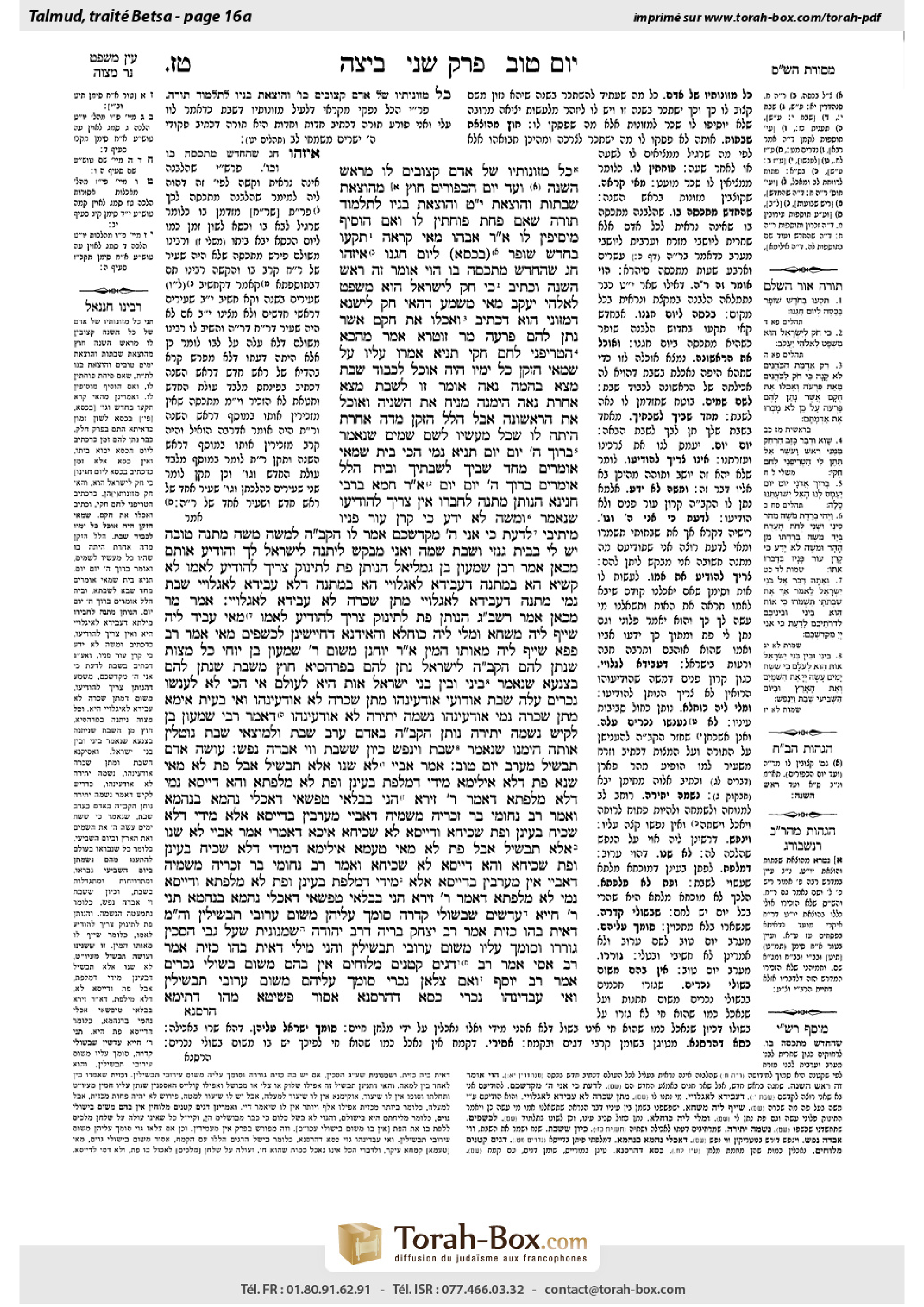
This page of Beitzah includes the Aramaic text, an English translation and an AI-generated French translation, alongside the scan above.
ביצה י״ו א · Aramaic and Hebrew text
כׇּל מְזוֹנוֹתָיו שֶׁל אָדָם קְצוּבִים לוֹ מֵרֹאשׁ הַשָּׁנָה וְעַד יוֹם הַכִּפּוּרִים, חוּץ מֵהוֹצָאַת שַׁבָּתוֹת וְהוֹצָאַת יוֹם טוֹב וְהוֹצָאַת בָּנָיו לְתַלְמוּד תּוֹרָה, שֶׁאִם פָּחַת — פּוֹחֲתִין לוֹ, וְאִם הוֹסִיף — מוֹסִיפִין לוֹ.
אָמַר רַבִּי אֲבָהוּ, מַאי קְרָאָה: ״תִּקְעוּ בַחֹדֶשׁ שׁוֹפָר (בַּכֵּסֶא) לְיוֹם חַגֵּנוּ״, אֵיזֶהוּ חַג שֶׁהַחֹדֶשׁ מִתְכַּסֶּה בּוֹ — הֱוֵי אוֹמֵר זֶה רֹאשׁ הַשָּׁנָה, וּכְתִיב: ״כִּי חֹק לְיִשְׂרָאֵל הוּא מִשְׁפָּט לֵאלֹהֵי יַעֲקֹב״.
מַאי מַשְׁמַע דְּהַאי ״חֹק״ לִישָּׁנָא דִּמְזוֹנֵי הוּא, דִּכְתִיב: ״וְאָכְלוּ אֶת חֻקָּם אֲשֶׁר נָתַן לָהֶם פַּרְעֹה״. מָר זוּטְרָא אָמַר, מֵהָכָא: ״הַטְרִיפֵנִי לֶחֶם חֻקִּי״.
תַּנְיָא: אָמְרוּ עָלָיו עַל שַׁמַּאי הַזָּקֵן, כׇּל יָמָיו הָיָה אוֹכֵל לִכְבוֹד שַׁבָּת. מָצָא בְּהֵמָה נָאָה, אוֹמֵר: זוֹ לַשַּׁבָּת. מָצָא אַחֶרֶת נָאָה הֵימֶנָּה — מַנִּיחַ אֶת הַשְּׁנִיָּה וְאוֹכֵל אֶת הָרִאשׁוֹנָה.
אֲבָל הִלֵּל הַזָּקֵן — מִדָּה אַחֶרֶת הָיְתָה לוֹ, שֶׁכׇּל מַעֲשָׂיו לְשֵׁם שָׁמַיִם, שֶׁנֶּאֱמַר: ״בָּרוּךְ ה׳ יוֹם יוֹם״, תַּנְיָא נָמֵי הָכִי, בֵּית שַׁמַּאי אוֹמְרִים: מֵחַד שַׁבָּיךְ לְשַׁבְּתָיךְ, וּבֵית הִלֵּל אוֹמְרִים: ״בָּרוּךְ ה׳ יוֹם יוֹם״.
אָמַר רַבִּי חָמָא בְּרַבִּי חֲנִינָא: הַנּוֹתֵן מַתָּנָה לַחֲבֵרוֹ אֵין צָרִיךְ לְהוֹדִיעוֹ, שֶׁנֶּאֱמַר: ״וּמֹשֶׁה לֹא יָדַע כִּי קָרַן עוֹר פָּנָיו״.
מֵיתִיבִי: ״לָדַעַת כִּי אֲנִי ה׳ מְקַדִּשְׁכֶם״, אָמַר לוֹ הַקָּדוֹשׁ בָּרוּךְ הוּא לְמֹשֶׁה: מֹשֶׁה! מַתָּנָה טוֹבָה יֵשׁ לִי בְּבֵית גְּנָזַי וְשַׁבָּת שְׁמָהּ, וַאֲנִי מְבַקֵּשׁ לִיתְּנָהּ לְיִשְׂרָאֵל, לֵךְ וְהוֹדִיעַ אוֹתָם. מִכָּאן אָמַר רַבָּן שִׁמְעוֹן בֶּן גַּמְלִיאֵל: הַנּוֹתֵן פַּת לְתִינוֹק, צָרִיךְ לְהוֹדִיעַ לְאִמּוֹ.
לָא קַשְׁיָא: הָא בְּמַתָּנָה דַּעֲבִידָא לְאִגַּלּוֹיֵי, הָא בְּמַתָּנָה דְּלָא עֲבִידָא לְאִגַּלּוֹיֵי. שַׁבָּת נָמֵי מַתָּנָה דַּעֲבִידָא לְאִגַּלּוֹיֵי! מַתַּן שְׂכָרָהּ לָא עֲבִידָא לְאִגַּלּוֹיֵי.
אָמַר מָר, מִכָּאן אָמַר רַבָּן שִׁמְעוֹן בֶּן גַּמְלִיאֵל: הַנּוֹתֵן פַּת לְתִינוֹק צָרִיךְ לְהוֹדִיעַ לְאִמּוֹ. מַאי עָבֵיד לֵיהּ? שָׁיֵיף לֵיהּ מִשְׁחָא וּמָלֵי לֵיהּ כּוּחְלָא. וְהָאִידָּנָא דְּחָיְישִׁינַן לִכְשָׁפִים, מַאי? אָמַר רַב פָּפָּא: שָׁיֵיף לֵיהּ מֵאוֹתוֹ הַמִּין.
אָמַר רַבִּי יוֹחָנָן מִשּׁוּם רַבִּי שִׁמְעוֹן בֶּן יוֹחַי: כׇּל מִצְוֹת שֶׁנָּתַן לָהֶם הַקָּדוֹשׁ בָּרוּךְ הוּא לְיִשְׂרָאֵל — נָתַן לָהֶם בְּפַרְהֶסְיָא, חוּץ מִשַּׁבָּת שֶׁנָּתַן לָהֶם בְּצִנְעָא, שֶׁנֶּאֱמַר: ״בֵּינִי וּבֵין בְּנֵי יִשְׂרָאֵל אוֹת הִיא לְעוֹלָם״.
אִי הָכִי, לָא לִעַנְשׁוּ גּוֹיִם עֲלַהּ? שַׁבָּת — אוֹדוֹעֵי אוֹדְעִינְהוּ, מַתַּן שְׂכָרָהּ — לָא אוֹדְעִינְהוּ. וְאִי בָּעֵית אֵימָא: מַתַּן שְׂכָרָהּ נָמֵי אוֹדְעִינְהוּ, נְשָׁמָה יְתֵירָה — לָא אוֹדְעִינְהוּ.
דְּאָמַר רַבִּי שִׁמְעוֹן בֶּן לָקִישׁ: נְשָׁמָה יְתֵירָה נוֹתֵן הַקָּדוֹשׁ בָּרוּךְ הוּא בָּאָדָם עֶרֶב שַׁבָּת, וּלְמוֹצָאֵי שַׁבָּת נוֹטְלִין אוֹתָהּ הֵימֶנּוּ, שֶׁנֶּאֱמַר: ״שָׁבַת וַיִּנָּפַשׁ״, כֵּיוָן שֶׁשָּׁבַת וַוי אָבְדָה נֶפֶשׁ.
עוֹשֶׂה אָדָם תַּבְשִׁיל מֵעֶרֶב יוֹם טוֹב. אָמַר אַבָּיֵי: לֹא שָׁנוּ אֶלָּא תַּבְשִׁיל, אֲבָל פַּת — לָא.
מַאי שְׁנָא פַּת דְּלָא? אִילֵּימָא מִידֵּי דִּמְלַפֵּת בָּעֵינַן, וּפַת לָא מְלַפְּתָא — וְהָא דַּיְיסָא נָמֵי דְּלָא מְלַפְּתָא, דְּאָמַר רַבִּי זֵירָא: הָנֵי בַּבְלָאֵי טַפְשָׁאֵי דְּאָכְלִי נַהֲמָא בְּנַהֲמָא. וְאָמַר רַב נְחוּמִי בַּר זְכַרְיָה מִשְּׁמֵיהּ דְּאַבָּיֵי: מְעָרְבִין בְּדַיְיסָא! אֶלָּא: מִידֵּי דְּלָא שְׁכִיחַ בָּעֵינַן, וּפַת שְׁכִיחָא, וְדַיְיסָא לָא שְׁכִיחָא.
אִיכָּא דְּאָמְרִי, אָמַר אַבָּיֵי: לֹא שָׁנוּ אֶלָּא תַּבְשִׁיל, אֲבָל פַּת — לָא. מַאי טַעְמָא? אִילֵּימָא דְּמִידֵּי דְּלָא שְׁכִיחַ בָּעֵינַן, וּפַת שְׁכִיחָא — וְהָא דַּיְיסָא לָא שְׁכִיחָא, וְאָמַר רַב נְחוּמִי בַּר זְכַרְיָה מִשְּׁמֵיהּ דְּאַבָּיֵי: אֵין מְעָרְבִין בְּדַיְיסָא! אֶלָּא: מִידֵּי דִּמְלַפֵּת בָּעֵינַן, וּפַת לָא מְלַפְּתָא, וְדַיְיסָא נָמֵי לָא מְלַפְּתָא. דְּאָמַר רַבִּי זֵירָא: הָנֵי בַּבְלָאֵי טַפְשָׁאֵי דְּאָכְלִי נַהֲמָא בְּנַהֲמָא.
תָּנֵי רַבִּי חִיָּיא: עֲדָשִׁים שֶׁבְּשׁוּלֵי קְדֵרָה סוֹמֵךְ עֲלֵיהֶן מִשּׁוּם עֵרוּבֵי תַבְשִׁילִין. וְהָנֵי מִילֵּי דְּאִית בְּהוּ כְּזַיִת. אָמַר רַב יִצְחָק בְּרֵיהּ דְּרַב יְהוּדָה: שַׁמְנוּנִית שֶׁעַל גַּבֵּי הַסַּכִּין — גּוֹרְרוֹ וְסוֹמֵךְ עָלָיו מִשּׁוּם עֵרוּבֵי תַבְשִׁילִין. וְהָנֵי מִילֵּי דְּאִית בְּהוּ כְּזַיִת.
אָמַר רַב אַסִּי אָמַר רַב: דָּגִים קְטַנִּים מְלוּחִים אֵין בָּהֶם מִשּׁוּם בִּשּׁוּלֵי גוֹיִם. אָמַר רַב יוֹסֵף: וְאִם צְלָאָן גּוֹי — סוֹמֵךְ עֲלֵיהֶם מִשּׁוּם עֵרוּבֵי תַבְשִׁילִין. וְאִי עַבְדִינְהוּ גּוֹי כָּסָא דְהַרְסָנָא — אָסוּר.
פְּשִׁיטָא! מַהוּ דְּתֵימָא:
Beitzah 16a · English translation
A person’s entire livelihood is allocated to him during the period from Rosh HaShana to Yom Kippur. During that time, as each individual is judged, it is decreed exactly how much money he will earn for all his expenditures of the coming year, except for expenditures for Shabbatot, and expenditures for Festivals, and expenditures for the school fees of his sons’ Torah study. In these areas, no exact amount is determined at the beginning of the year; rather, if he reduced the amount he spends for these purposes, his income is reduced and he earns that much less money in that year, and if he increased his expenditures in these areas, his income is increased to ensure that he can cover the expense. Therefore, one may borrow for these purposes, since he is guaranteed to have enough income to cover whatever he spends for them.
Rabbi Abbahu said: What is the verse from which this dictum is derived? The source is: “Blow the shofar at the New Moon, at the concealed time for our Festival day” (Psalms 81:4). On which Festival is the new moon concealed? You must say that it is Rosh HaShana, which occurs on the first of the month, when the moon is not yet visible, while the moon is visible during the other Festivals, which occur in the middle of the month. And it is written in the next verse: “For it is a statute [ḥok] for Israel, a judgment of the God of Jacob” (Psalms 81:5).
The Gemara explains: From where may it be inferred that this word “statute [ḥok]” is a term relating to food? As it is written: “And they ate their allotment [ḥukkam], which Pharaoh gave them” (Genesis 47:22). Mar Zutra said: One can learn that ḥok is referring to food from here: “Feed me with my allotted [ḥukki] bread” (Proverbs 30:8).
It is taught in a baraita: They said about Shammai the Elder that all his days he would eat in honor of Shabbat. How so? If he found a choice animal, he would say: This is for Shabbat. If he subsequently found another one choicer than it, he would set aside the second for Shabbat and eat the first. He would eat the first to leave the better-quality animal for Shabbat, which continually rendered his eating an act of honoring Shabbat.
However, Hillel the Elder had a different trait, that all his actions, including those on a weekday, were for the sake of Heaven, as it is stated: “Blessed be the Lord, day by day; He bears our burden, our God who is our salvation; Selah” (Psalms 68:20), meaning that God gives a blessing for each and every day. That is also taught in a baraita in more general terms: Beit Shammai say: From the first day of the week, Sunday, start preparing already for your Shabbat. And Beit Hillel say: “Blessed be the Lord, day by day.”
§ Apropos the statements about honoring Shabbat, the Gemara cites another statement on the same topic. Rabbi Ḥama, son of Rabbi Ḥanina, said: One who gives a gift to his friend need not inform him that he has given it to him, and he need not concern himself that the recipient might not realize who gave it to him. As it is stated: “And Moses did not know that the skin of his face was radiant” (Exodus 34:29); Moses received this gift unawares.
The Gemara raises an objection to this. Isn’t it written: “Nevertheless, you must keep My Shabbatot, for this is a sign between Me and you throughout your generations, that you may know that I am the Lord Who sanctifies you” (Exodus 31:13), which the Sages expounded as follows: The Holy One, Blessed be He, said to Moses: Moses, I have a good gift in My treasury, and its name is Shabbat, and I wish to give it to the Jewish people. Go and inform them of this intention of Mine. And from here Rabban Shimon ben Gamliel said: One who gives a gift of a piece of bread to a child must inform his mother of his actions, so that the child’s parents will be aware of the giver’s fond feelings for them, thereby enhancing friendly relations and companionship among Jews. This appears to be in direct contradiction to Rabbi Ḥama’s statement.
The Gemara answers: This is not difficult; this case, where one need not inform the recipient, is referring to a gift that is likely to be revealed, such as Moses’ shining face, which everyone would point out to him; that case, where one must inform the recipient, is referring to a gift that is not likely to be revealed in the natural course of events. The Gemara challenges: Isn’t Shabbat also a gift that is likely to be revealed, as the Jews would eventually be instructed with regard to the time and nature of Shabbat? The Gemara answers: Nevertheless, its reward is not likely to be revealed. Therefore, God told Moses to inform the Jews of the gift of Shabbat and its reward.
The Master said earlier that from here Rabban Shimon ben Gamliel said: One who gives a piece of bread to a child must inform his mother. The Gemara asks: What does he do to him; how does he inform the child’s mother? He rubs oil on him and paints his eyes blue, so that when the child arrives home his mother will ask him who did this to him and he will reply that it was a person who also gave him a piece of bread. The Gemara comments: And nowadays, when we are concerned about witchcraft, i.e., that painting the child’s eyes might have been performed as an act of sorcery, what should one do? Rav Pappa said: He rubs on the child a little of that same type of food that he put on the bread, such as butter or cheese, and this will cause the child’s mother to notice that he received a present.
The Gemara cites a further statement with regard to the gift of Shabbat to the Jewish people. Rabbi Yoḥanan said in the name of Rabbi Shimon ben Yoḥai: All the mitzvot that the Holy One, Blessed be He, gave to the Jewish people, He gave to them in public [parhesya] except for Shabbat, which he gave to them in private. As it is stated: “It is a sign between Me and the children of Israel forever” (Exodus 31:17), meaning that in a sense, it is a secret between God and the Jewish people.
The Gemara challenges: If it is so that it was given in secret so that not everyone knew about it, the gentiles should not be punished for not wanting to accept it; they are liable to receive punishment for refusing to accept the other mitzvot of the Torah. The Gemara answers: The Holy One, Blessed be He, did inform them of the concept of Shabbat, but He did not inform them of the reward for the fulfillment of the mitzva. And if you wish, say instead that He also informed the gentiles of its reward, but about the idea of the additional soul given to each person on Shabbat He did not inform them.
As Rabbi Shimon ben Lakish said: The Holy One, Blessed be He, gives a person an additional soul on Shabbat eve, and at the conclusion of Shabbat removes it from him, as it is stated: “He ceased from work and was refreshed [vayinafash]” (Exodus 31:17). Rabbi Shimon ben Lakish expounds the verse as follows: Since he ceased from work, and now Shabbat has concluded and his additional soul is removed from him, woe [vai] for the additional soul [nefesh] that is lost.
It was taught in the mishna that a person may prepare a cooked dish on a Festival eve and rely on it for Shabbat for the joining of cooked foods. Abaye said: They taught that the joining of cooked foods allows one to cook on a Festival for Shabbat only when it is made from a cooked dish; however, if it is composed of bread alone, no, this is not sufficient.
The Gemara asks: What is different about bread that makes it not fit for this purpose? If we say that we require something that accompanies bread, and bread does not accompany itself, the following difficulty arises: Porridge also does not accompany bread, as Rabbi Zeira said: Those foolish Babylonians eat bread with bread, referring to their custom of eating bread with porridge. This shows that porridge is no better accompaniment to bread than bread itself, and yet Rav Neḥumi bar Zekharya said in the name of Abaye: One may establish an eiruv with porridge. Rather, one must say as follows: We require something that is not routine, so that it will be clear that one is setting it aside for the purpose of an eiruv, and bread is routine, whereas porridge is not routine.
Some say a different version of this discussion: Abaye said: They taught that a joining of cooked foods allows one to cook on a Festival for Shabbat only when it is made from a cooked dish; however, if it is composed of bread, no, that is not sufficient. The Gemara asks: What is the reason for this? If we say that we require something that is not routine, and bread is routine, the following difficulty arises: Isn’t porridge not particularly routine? And yet Rav Neḥumi bar Zekharya said in the name of Abaye: One may not establish an eiruv with porridge. Rather, one should say as follows: We require something that accompanies bread, and bread does not accompany itself, and porridge, too, does not accompany bread, as Rabbi Zeira said: Those foolish Babylonians eat bread with bread, from which it is clear that like bread, porridge does not accompany bread and consequently cannot constitute an eiruv.
Rabbi Ḥiyya taught: With regard to lentils that remain at the bottom of a pot on the eve of a Festival, one may rely on them for the joining of cooked foods. Although they were not prepared with this purpose in mind, they are nevertheless considered a cooked dish. And this applies only if there is an olive-bulk of lentils in total. Similarly, Rav Yitzḥak, son of Rav Yehuda, said: With regard to fat of meat and the like that is on a knife, one may scrape it off the knife and rely on it for the joining of cooked foods; and this applies only if there is an olive-bulk of fat in total.
Rav Asi said that Rav said: Small salted fish that a gentile then cooked are not considered the cooked food of gentiles because cooking does not prepare them to be food any more than they already were, as they can be eaten in their salted state. Rav Yosef said: And even if a gentile roasted them, a Jew may rely on them for the joining of cooked foods, as they are not considered the cooked food of a gentile and are indeed already edible. However, if the gentile made them into fish fried with oil and flour [kasa deharsena], it is prohibited to eat them. In this case they are considered the cooked food of a gentile, since his actions have made them into noteworthy food.
The Gemara challenges: It is obvious that this is the case; it need not be taught. The Gemara answers: The justification for teaching it is lest you say that
Beitzah 16a · Traduction française (IA)
La subsistance entière d'une personne est déterminée pour la période allant du premier jour de l'année au Jour de l'Atonement. Pendant cette période, chaque individu est jugé, et il est décidé exactement combien d'argent il gagnera pour tous ses dépenses de l'année à venir, sauf pour les dépenses liées aux sabbats, aux fêtes et aux frais scolaires de ses fils dans l'étude de la Torah. Dans ces domaines, aucun montant précis n'est déterminé au début de l'année ; plutôt, si l'on réduit les dépenses dans ces domaines, son revenu est réduit et il gagne moins d'argent cette année, et si l'on augmente ses dépenses dans ces domaines, son revenu est augmenté pour garantir qu'il puisse couvrir les dépenses. Par conséquent, on peut emprunter pour ces besoins, car on est assuré d'avoir suffisamment de revenus pour couvrir ce qu'on dépense.
Rabbi Abbahu a dit : De quelle source provient cette déclaration ? La source est : « Sonnez la trompette à la nouvelle lune, à l'époque cachée de notre jour de fête » (Psaumes 81:4). De quelle fête est-ce que la nouvelle lune est cachée ? On doit dire que c'est le premier jour de l'année, qui tombe le premier du mois, lorsque la lune n'est pas encore visible, tandis que la lune est visible lors des autres fêtes, qui ont lieu au milieu du mois. Et il est écrit dans la verset suivant : « Car c'est une loi [ḥok] pour Israël, un jugement de Dieu de Jacob » (Psaumes 81:5).
La Guemara explique : D'où peut-on déduire que le mot « loi [ḥok] » fait référence à la nourriture ? Comme il est écrit : « Et ils mangèrent leur part [ḥukkam], que Pharaon leur avait donnée » (Genèse 47:22). Mar Zutra a dit : On peut apprendre que ḥok fait référence à la nourriture ici : « Alimente-moi avec mon pain assigné [ḥukki] » (Proverbes 30:8).
Il est enseigné dans une baraïta : On disait de Shammai l'Aîné qu'il mangeait avec honneur le sabbat toute sa vie. Comment cela se passait-il ? S'il trouvait un animal de choix, il disait : Cet animal est pour le sabbat. S'il trouvait ensuite un autre animal encore plus choisi, il réservait le second pour le sabbat et mangeait le premier. Il mangeait le premier pour laisser l'animal de meilleure qualité pour le sabbat, ce qui rendait continuellement son acte de manger un acte d'honneur pour le sabbat.
Cependant, Hillel l'Aîné avait une autre qualité, à savoir que toutes ses actions, y compris celles du jour de travail, étaient faites pour le Ciel, comme il est dit : « Béni soit l'Éternel, jour par jour ; Il porte notre fardeau, notre Dieu qui est notre salut ; Selah » (Psaumes 68:20), ce qui signifie que Dieu bénit chaque jour. Cela est également enseigné dans une baraïta de manière plus générale : Beit Shammai disent : À partir du premier jour de la semaine, le dimanche, commencez déjà à préparer votre sabbat. Et Beit Hillel disent : « Béni soit l'Éternel, jour par jour. »
En ce qui concerne les déclarations sur l'honneur du sabbat, la Guemara cite une autre déclaration sur le même sujet. Rabbi Ḥama, fils de Rabbi Ḥanina, a dit : Celui qui donne un cadeau à son ami n'a pas besoin de lui dire qu'il lui a donné ce cadeau, et il n'a pas besoin de s'inquiéter que le destinataire ne réalise pas qui lui a donné ce cadeau. Comme il est dit : « Et Moïse ne savait pas que la peau de son visage était radieuse » (Exode 34:29) ; Moïse a reçu ce cadeau sans le savoir.
La Guemara soulève une objection à cela. N'est-il pas écrit : « Cependant, vous devez garder mes sabbats, car c'est un signe entre moi et vous à travers vos générations, afin que vous sachiez que je suis l'Éternel qui sanctifie vous » (Exode 31:13), que les Sages ont expliqué ainsi : L'Éternel, béni soit Il, a dit à Moïse : Moïse, j'ai un bon cadeau dans mon trésor, et son nom est le sabbat, et je veux le donner au peuple d'Israël. Allez et informez-les de cette intention de la part de Moi. Et d'ici Rabban Shimon ben Gamliel a dit : Celui qui donne un morceau de pain à un enfant doit informer sa mère de ses actions, afin que les parents de l'enfant soient conscients des sentiments du donneur envers eux, ce qui renforce les relations amicales et l'entraide entre les Juifs. Cela semble être en contradiction directe avec la déclaration de Rabbi Ḥama.
La Guemara répond : Ce n'est pas difficile ; ce cas, où l'on n'a pas besoin d'informer le destinataire, fait référence à un cadeau susceptible d'être découvert, comme la face radieuse de Moïse, que tout le monde aurait pointé du doigt à son égard ; ce cas, où l'on doit informer le destinataire, fait référence à un cadeau susceptible de ne pas être découvert naturellement. La Guemara soulève un défi : N'est-ce pas que le sabbat est aussi un cadeau susceptible d'être découvert, car les Juifs seraient finalement instruits sur le moment et la nature du sabbat ? La Guemara répond : Cependant, son récompense n'est pas susceptible d'être découverte. Par conséquent, Dieu a dit à Moïse d'informer les Juifs du cadeau du sabbat et de sa récompense.
Le Maître a dit plus tôt que Rabban Shimon ben Gamliel a dit : Celui qui donne un morceau de pain à un enfant doit informer sa mère. La Guemara pose une question : Qu'est-ce qu'il fait à lui ; comment informe-t-il la mère de l'enfant ? Il applique de l'huile sur lui et colore ses yeux en bleu, de sorte que lorsque l'enfant rentre chez lui, sa mère lui demandera qui lui a fait cela et il répondra que c'était une personne qui lui a aussi donné un morceau de pain. La Guemara commente : Et aujourd'hui, lorsque nous sommes préoccupés par la sorcellerie, c'est-à-dire que colorer les yeux de l'enfant pourrait avoir été fait comme un acte de sorcellerie, que devrait-on faire ? Rav Pappa a dit : Il applique sur l'enfant une petite quantité de ce même type d'aliment que celui qu'il a mis sur le pain, comme du beurre ou du fromage, et cela fera en sorte que la mère de l'enfant remarque qu'il a reçu un cadeau.
La Guemara cite une autre déclaration concernant le cadeau du sabbat au peuple juif. Rabbi Yoḥanan a dit en nom de Rabbi Shimon ben Yoḥai : Toutes les mitsvot que l'Éternel, béni soit Il, a données au peuple juif, Il les a données en public [parhesya], sauf le sabbat, qu'Il a donné en privé. Comme il est dit : « C'est un signe entre Moi et les enfants d'Israël pour l'éternité » (Lévitique 31:17), ce qui signifie qu'en un sens, c'est un secret entre Dieu et le peuple juif.
La Guemara pose un défi : Si c'est ainsi que cela a été donné en secret afin que personne ne le sache, les Gentils ne devraient pas être punis pour ne pas vouloir l'accepter ; ils sont cependant tenus responsables de refuser d'accepter les autres mitsvot de la Torah. La Guemara répond : L'Éternel, béni soit-Il, a informé les Gentils de la notion du Shabbat, mais Il n'a pas informé les Gentils de la récompense pour la performance de la mitsva. Et si tu veux, dis plutôt qu'Il a également informé les Gentils de sa récompense, mais concernant l'idée de l'âme supplémentaire donnée à chaque personne le Shabbat, Il n'a pas informé les Gentils de cela.
Rabbi Shimon ben Lakish a dit : L'Éternel, béni soit-Il, donne à une personne une âme supplémentaire le soir du Shabbat, et à la fin du Shabbat, Il la retire de lui, comme il est dit : « Il s'est arrêté de l'œuvre et fut rafraîchi [vayinafash] » (Lévitique 31:17). Rabbi Shimon ben Lakish explique la parole ainsi : Puisqu'il s'est arrêté de l'œuvre, et maintenant que le Shabbat est terminé et que son âme supplémentaire est retirée, malheur [vai] à l'âme supplémentaire [nefesh] qui est perdue.
Il a été enseigné dans la mitsna que l'on peut préparer un plat cuit le soir d'un festival et s'appuyer sur lui pour le Shabbat afin de joindre des aliments cuits. Abaye a dit : Ils ont enseigné que la joindre des aliments cuits permet de cuire un plat le festival pour le Shabbat uniquement si c'est fait à partir d'un plat cuit ; cependant, si c'est composé de pain seul, non, cela n'est pas suffisant.
La Guemara pose la question : Qu'est-ce qui rend le pain différent pour qu'il ne soit pas adapté à ce but ? Si nous disons que nous exigeons quelque chose qui accompagne le pain, et que le pain ne s'accompagne pas lui-même, la difficulté suivante survient : La semoule ne s'accompagne pas non plus du pain, comme Rabbi Zéira a dit : Ces bêtes babyloniennes mangent du pain avec du pain, en référence à leur habitude de manger du pain avec de la semoule. Cela montre que la semoule n'est pas meilleur accompagnement du pain que le pain lui-même, et pourtant Rav Néchumi bar Zékhaïa a dit en nom d'Abaye : On peut établir un eiruv avec de la semoule. Plutôt, on doit dire comme suit : Nous exigeons quelque chose qui n'est pas habituel, afin qu'il soit clair que l'on le met de côté à l'intention d'un eiruv, et le pain est habituel, tandis que la semoule ne l'est pas.
Certains disent une version différente de cette discussion : Abaye a dit : Ils ont enseigné que la joindre des aliments cuits permet de cuire un plat le festival pour le Shabbat uniquement si c'est fait à partir d'un plat cuit ; cependant, si c'est composé de pain seul, non, cela n'est pas suffisant. La Guemara pose la question : Quel est le motif de cela ? Si nous disons que nous exigeons quelque chose qui n'est pas habituel, et que le pain est habituel, la difficulté suivante survient : N'est-ce pas que la semoule n'est pas particulièrement habituelle ? Et pourtant Rav Néchumi bar Zékhaïa a dit en nom d'Abaye : On ne peut pas établir un eiruv avec de la semoule. Plutôt, on doit dire comme suit : Nous exigeons quelque chose qui accompagne le pain, et le pain ne s'accompagne pas lui-même, et la semoule non plus ne s'accompagne pas du pain, comme Rabbi Zéira a dit : Ces bêtes babyloniennes mangent du pain avec du pain, d'où il ressort clairement que comme le pain, la semoule ne s'accompagne pas du pain et ne peut donc pas constituer un eiruv.
Rabbi Ḥiyya enseigna : En ce qui concerne les lentilles restant au fond d'une marmite le soir d'un festival, l'on peut s'appuyer sur elles pour joindre les aliments cuits. Bien qu'ils n'aient pas été préparés à cet effet, ils sont néanmoins considérés comme un plat cuit. Et cela s'applique uniquement si l'on a au total une quantité d'olive de lentilles. De même, Rav Yitzḥak, fils de Rav Yehuda, dit : En ce qui concerne la graisse de viande et les semblables qui sont sur un couteau, l'on peut enlever celle-ci du couteau et s'appuyer sur elle pour joindre les aliments cuits ; et cela s'applique uniquement si l'on a au total une quantité d'olive de graisse.
Rav Asi dit que Rav dit : Les petits poissons salés que les Gentils ont ensuite cuits ne sont pas considérés comme les aliments cuits des Gentils, car la cuisson ne les prépare pas à être de la nourriture plus que ce qu'ils étaient déjà, puisqu'ils peuvent être mangés dans leur état salé. Rav Yosef dit : Et même si un Gentil les a grillés, un Juif peut s'appuyer sur eux pour joindre les aliments cuits, car ils ne sont pas considérés comme les aliments cuits d'un Gentil et sont déjà comestibles. Cependant, si le Gentil les a transformés en poissons frits avec de l'huile et de la farine [kasa deharsena], il est interdit de les manger. Dans ce cas, ils sont considérés comme les aliments cuits d'un Gentil, car ses actions les ont rendus en valeur.
La Guemara pose un défi : Cela est évident, il n'a pas besoin d'être enseigné. La Guemara répond : La justification d'enseigner cela est pour ne pas dire que
Traduction française générée par IA à partir de l’édition anglaise de Sefaria. Vérifie toujours un passage avec le texte source.
Text from Sefaria: William Davidson Edition - Vocalized Aramaic (CC BY NC); William Davidson Edition - English (CC BY NC).