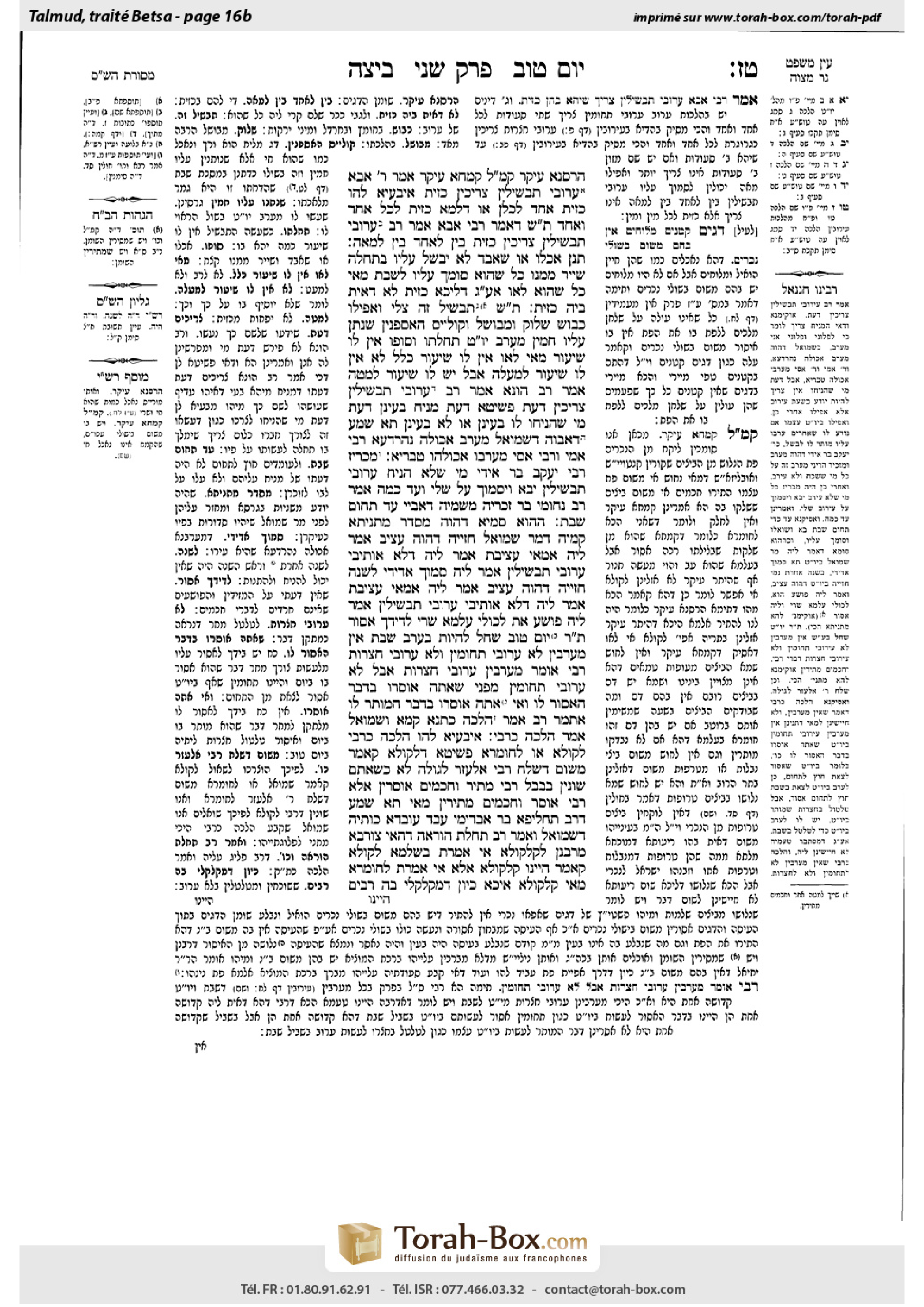
Beitzah 16b: Talmud study for Daf Yomi
Study the Talmud for Daf Yomi with scanned pages, Hebrew text, English translations from Sefaria and AI-generated French translations.
Passage selection and English or AI-generated French translation are available where the scan has annotations. Daf Study is independent of Torah-Box and Sefaria.
Browse Beitzah · ביצה · All tractatesBeitzah 16b text and translations
This page of Beitzah includes the Aramaic text, an English translation and an AI-generated French translation, alongside the scan above.
ביצה י״ו ב · Aramaic and Hebrew text
הַרְסָנָא עִיקָּר, קָא מַשְׁמַע לַן קִמְחָא עִיקָּר.
אָמַר רַבִּי אַבָּא: עֵרוּבֵי תַבְשִׁילִין צְרִיכִין כְּזַיִת. אִיבַּעְיָא לְהוּ: כְּזַיִת אֶחָד לְכֻלָּן, אוֹ דִלְמָא כְּזַיִת לְכׇל אֶחָד וְאֶחָד? תָּא שְׁמַע, דְּאָמַר רַבִּי אַבָּא אָמַר רַב: עֵרוּבֵי תַבְשִׁילִין צְרִיכִין כְּזַיִת בֵּין לְאֶחָד, בֵּין לְמֵאָה.
תְּנַן: אֲכָלוֹ אוֹ שֶׁאָבַד — לֹא יְבַשֵּׁל עָלָיו בַּתְּחִלָּה, שִׁיֵּיר מִמֶּנּוּ כׇּל שֶׁהוּא — סוֹמֵךְ עָלָיו לְשַׁבָּת. מַאי כׇּל שֶׁהוּא? לָאו אַף עַל גַּב דְּלֵיכָּא כְּזַיִת? לָא, דְּאִית בֵּיהּ כְּזַיִת.
תָּא שְׁמַע: תַּבְשִׁיל — זֶה צָלִי, וַאֲפִילּוּ כָּבוּשׁ שָׁלוּק וּמְבוּשָּׁל, וְקוֹלְיָיס הָאִסְפְּנִין שֶׁנָּתַן עָלָיו חַמִּין מֵעֶרֶב יוֹם טוֹב — תְּחִלָּתוֹ וְסוֹפוֹ אֵין לוֹ שִׁיעוּר. מַאי לָאו, אֵין לוֹ שִׁיעוּר כְּלָל? לָא, אֵין לוֹ שִׁיעוּר לְמַעְלָה, אֲבָל יֵשׁ לוֹ שִׁיעוּר לְמַטָּה.
אָמַר רַב הוּנָא אָמַר רַב: עֵרוּבֵי תַבְשִׁילִין צְרִיכִין דַּעַת. פְּשִׁיטָא, דַּעַת מַנִּיחַ בָּעֵינַן; דַּעַת מִי שֶׁהִנִּיחוּ לוֹ בָּעֵינַן, אוֹ לָא בָּעֵינַן?
תָּא שְׁמַע: דַּאֲבוּהּ דִּשְׁמוּאֵל מְעָרֵב אַכּוּלַּהּ נְהַרְדְּעָא, רַבִּי אַמֵּי וְרַבִּי אַסִּי מְעָרְבִי אַכּוּלַּהּ טְבֶרְיָא. מַכְרִיז רַבִּי יַעֲקֹב בַּר אִידִי: מִי שֶׁלֹּא הִנִּיחַ עֵרוּבֵי תַבְשִׁילִין, יָבֹא וְיִסְמוֹךְ עַל שֶׁלִּי. וְעַד כַּמָּה? אָמַר רַב נְחוּמִי בַּר זְכַרְיָה מִשְּׁמֵיהּ דְּאַבָּיֵי: עַד תְּחוּם שַׁבָּת.
הָהוּא סַמְיָא דַּהֲוָה מְסַדַּר מַתְנְיָתָא קַמֵּיהּ דְּמָר שְׁמוּאֵל, חַזְיֵיהּ דַּהֲוָה עֲצִיב, אֲמַר לֵיהּ: אַמַּאי עֲצִיבַתְּ? אֲמַר לֵיהּ: דְּלָא אוֹתִיבִי עֵרוּבֵי תַבְשִׁילִין. אָמַר לֵיהּ: סְמוֹךְ אַדִּידִי. לְשָׁנָה חַזְיֵיהּ דַּהֲוָה עֲצִיב, אֲמַר לֵיהּ: אַמַּאי עֲצִיבַתְּ? אֲמַר לֵיהּ: דְּלָא אוֹתִיבִי עֵרוּבֵי תַּבְשִׁילִין. אֲמַר לֵיהּ: פּוֹשֵׁעַ אַתְּ. לְכוּלֵּי עָלְמָא שְׁרֵי, לְדִידָךְ אֲסִיר.
תָּנוּ רַבָּנַן: יוֹם טוֹב שֶׁחָל לִהְיוֹת בְּעֶרֶב שַׁבָּת — אֵין מְעָרְבִין לֹא עֵרוּבֵי תְחוּמִין וְלֹא עֵרוּבֵי חֲצֵרוֹת.
רַבִּי אוֹמֵר: מְעָרְבִין עֵרוּבֵי חֲצֵרוֹת, אֲבָל לֹא עֵרוּבֵי תְחוּמִין. מִפְּנֵי שֶׁאַתָּה אוֹסְרוֹ בְּדָבָר הָאָסוּר לוֹ, וְאִי אַתָּה אוֹסְרוֹ בְּדָבָר הַמּוּתָּר לוֹ.
אִתְּמַר, רַב אָמַר: הֲלָכָה כְּתַנָּא קַמָּא. וּשְׁמוּאֵל אָמַר: הֲלָכָה כְּרַבִּי.
אִיבַּעְיָא לְהוּ: הֲלָכָה כְּרַבִּי לְקוּלָּא אוֹ לְחוּמְרָא? פְּשִׁיטָא דִּלְקוּלָּא קָאָמַר! מִשּׁוּם דְּשָׁלַח רַבִּי אֶלְעָזָר לַגּוֹלָה: לֹא כְּשֶׁאַתֶּם שׁוֹנִין בְּבָבֶל רַבִּי מַתִּיר וַחֲכָמִים אוֹסְרִין, אֶלָּא רַבִּי אוֹסֵר וַחֲכָמִים מַתִּירִין. מַאי?
תָּא שְׁמַע, דְּרַב תַּחְלִיפָא בַּר אַבְדִּימִי עֲבַד עוֹבָדָא כְּוָתֵיהּ דִּשְׁמוּאֵל, וְאָמַר רַב: תְּחִלַּת הוֹרָאָה דְּהַאי צוּרְבָּא מֵרַבָּנַן — לְקִלְקוּלָא. אִי אָמְרַתְּ בִּשְׁלָמָא לְקוּלָּא קָאָמַר — הַיְינוּ קִלְקוּלָא. אֶלָּא אִי אָמְרַתְּ לְחוּמְרָא — מַאי קִלְקוּלָא אִיכָּא?
כֵּיוָן דְּמִקַּלְקְלִי בַּהּ רַבִּים,
Beitzah 16b · English translation
the fish fat, which one is permitted to eat even if cooked by gentiles, is the essential element. Therefore, he teaches us that the flour is the essential element, and the gentile has created a new and significant dish, which is consequently prohibited.
Rabbi Abba said: A joining of cooked foods requires an olive-bulk of food. A dilemma was raised before the Sages: Is it enough to have one olive-bulk for all of the household members who are relying on this eiruv, or perhaps must there be a separate olive-bulk for each and every one in the household? Come and hear that which Rabbi Abba said that Rav said: A joining of cooked foods requires an olive-bulk, whether it is cooked for a single person or for one hundred people.
The Gemara comments: We learned in the mishna: If one ate the joining of cooked foods that he prepared, or if it was lost, he may not rely on it and cook with the initial intent to cook for Shabbat; but if he left any part of the eiruv, he may rely on it to cook for Shabbat. The Gemara asks: What is the meaning of: Any part of it? Doesn’t it mean that it is valid although there is not an olive-bulk? The Gemara answers: No, the phrase: Any part of it, means that there is at least an olive-bulk left.
The Gemara attempts to bring another proof. Come and hear: The cooked dish that is required for a joining of cooked foods may be roasted, or even pickled, or well-boiled, or boiled in the regular manner, or may even be Spanish soft sea fish [koleyas ha’ispenin] upon which one poured hot water on the eve of the Festival, rendering it cooked. With regard to its beginning and end, meaning its required size ab initio and after it has been reduced by being partially lost or partially eaten, the eiruv has no required measure. What, is it not that it has no required measure at all, not even a minimum one? The Gemara rejects this: No, it means it does not have a maximum measure, but it does have a minimum measure, namely an olive-bulk.
Rav Huna said that Rav said: A joining of cooked foods requires knowledge, meaning that one must be aware of the eiruv for it to be effective. The Gemara comments: It is obvious that we require the knowledge of the one who prepares the eiruv; the question is: Do we also require the knowledge of the one for whom the eiruv is prepared, or do we not require it?
The Gemara suggests: Come and hear a proof from the following testimonies: Shmuel’s father would prepare an eiruv for the entire city of Neharde’a, and Rabbi Ami and Rabbi Asi would prepare an eiruv for the entire city of Tiberias. Similarly, Rabbi Ya’akov bar Idi would announce: Anyone who did not prepare a joining of cooked foods for himself should come and rely on mine. The Gemara asks: And up to how much may one rely on it, i.e., how far may one be from such an eiruv and still rely upon it? Rav Neḥumi bar Zekharya said in the name of Abaye: One may be as far away as the Shabbat limit.
The Gemara relates: With regard to the blind person who would present mishnayot before Mar Shmuel, the latter observed that he was sad. Mar Shmuel said to him: Why are you sad? He said to him: Because I did not prepare a joining of cooked foods before the Festival. Mar Shmuel said to him: Then rely on mine. In the following year, he once again observed that he was sad. He said to him: Why are you sad? He said to him: Because I did not prepare a joining of cooked foods. Mar Shmuel said to him: If so, you are consistently negligent in this regard. Therefore, for the entire world, i.e., anyone else but you, it is permitted to rely on my eiruv if they forgot to prepare one, but for you it is prohibited to do so, as I did not intend to include such negligent people as yourself in my eiruv.
The Sages taught: If a Festival occurs on Shabbat eve, one may not prepare an eiruv on that day, neither a joining of Shabbat boundaries [eiruv teḥumin] nor a joining of courtyards [eiruv ḥatzerot], for Shabbat. If one did not prepare these before the Festival, he may not do so on the Festival itself.
Rabbi Yehuda HaNasi says: On a Festival that occurs on a Friday, one may prepare an eiruv for a joining of courtyards, but not for a joining of Shabbat boundaries. His reasoning is as follows: There is a distinction between the two types of eiruv because you may prohibit him from a matter that is prohibited to him, e.g., venturing beyond the Shabbat limit, which is prohibited on a Festival as well as Shabbat, but you may not prohibit him from a matter that is permitted to him, e.g., carrying from one domain to another, which is permitted on a Festival. Therefore, on a Festival, one may not prepare a joining of Shabbat boundaries in order to render it permitted to venture beyond the boundary on the Shabbat following the Festival. However, one may prepare a joining of courtyards on the Festival in order to render it permitted to carry from one domain to another on the Shabbat following the Festival.
It was stated that the amora’im disagreed as to the conclusive ruling. Rav said: The halakha is in accordance with the opinion of the first tanna, who said that it is prohibited to prepare both types of eiruvin, and Shmuel said: The halakha is in accordance with the opinion of Rabbi Yehuda HaNasi, and it is permitted to prepare a joining of courtyards on a Festival.
A dilemma was raised before the Sages: Is stating that the halakha is in accordance with the opinion of Rabbi Yehuda HaNasi a leniency or a stringency? The Gemara wonders at this query: It is obvious that he stated it as a leniency. The Gemara explains: The question was asked because Rabbi Elazar sent a message from Eretz Yisrael to the Diaspora: This baraita is not as you teach it in Babylonia, that Rabbi Yehuda HaNasi permits one to prepare a joining of courtyards on a Festival and the Rabbis prohibit it. Rather, the opinions should be reversed, so that Rabbi Yehuda HaNasi prohibits it and the Rabbis permit it. Therefore, the question arose: What is the conclusive ruling for this halakha? Is it lenient or stringent?
The Gemara attempts to cite a proof: Come and hear that Rav Taḥlifa bar Avdimi performed an action in accordance with the opinion of Shmuel, who ruled that the halakha is in accordance with the opinion of Rabbi Yehuda HaNasi, and Rav said in anger about this: The first public ruling of this young Torah scholar is bringing about corruption of the halakha. The Gemara analyzes this statement: Granted, if you say that Rabbi Yehuda HaNasi said it as a leniency, this explains the corruption of the halakha involved, as Rav was angered by a young scholar who relied on his own judgment to issue a lenient ruling on a disputed issue. However, if you say that Rabbi Yehuda HaNasi meant it as a stringency, what corruption of the halakha is there in the young scholar’s ruling?
The Gemara answers: Since it corrupts the behavior of the masses, as, if they refrain from preparing a joining of courtyards on the Festival although it is permitted to do so, they might mistakenly carry from one domain to another on Shabbat,
Beitzah 16b · Traduction française (IA)
Le gras de poisson, celui qui est permis à manger même s'il est cuit par des non-Juifs, est l'élément essentiel. Ainsi, il nous apprend que la farine est l'élément essentiel, et le non-Juif a créé un plat nouveau et significatif, qui est donc interdit.
Rabbi Abba a dit : L'union de plats cuits nécessite une quantité d'olive. Un dilemme a été soulevé devant les Sages : suffit-il d'avoir une quantité d'olive pour tous les membres de la famille qui s'appuient sur cet eiruv, ou faut-il une quantité d'olive séparée pour chacun des membres de la famille ? Viens écouter ce que Rabbi Abba a dit que Rav a dit : L'union de plats cuits nécessite une quantité d'olive, qu'il soit cuit pour une personne ou pour cent personnes.
La Guemara commente : Nous avons appris dans la mitsva : Si l'on a mangé l'union de plats cuits que l'on avait préparé, ou si elle a été perdue, on ne peut pas s'appuyer sur elle pour cuire avec l'intention initiale de cuire pour le Sabbat ; mais si l'on a laissé une partie de l'eiruv, on peut s'appuyer sur elle pour cuire pour le Sabbat. La Guemara demande : Qu'entend-on par « toute partie de cela » ? N'entend-on pas que cela est valide même s'il n'y a pas une quantité d'olive ? La Guemara répond : Non, la phrase « toute partie de cela » signifie qu'il reste au moins une quantité d'olive.
La Guemara tente d'apporter une autre preuve. Viens écouter : le plat cuisiné requis pour l'union de plats cuits peut être rôti, ou même mariné, ou bien bouilli, ou bouilli de manière normale, ou même être un poisson de mer doux espagnol [koleyas ha’ispenin] sur lequel on a versé de l'eau chaude la nuit de la fête, le rendant ainsi cuit. En ce qui concerne sa taille initiale et finale, c'est-à-dire sa taille requise au départ et après qu'il ait été partiellement perdu ou partiellement mangé, l'eiruv n'a pas de mesure requise. Qu'est-ce que cela ne signifie pas qu'il n'ait aucune mesure requise du tout, même une mesure minimale ? La Guemara rejette cela : Non, cela signifie qu'il n'a pas une mesure maximale, mais qu'il a une mesure minimale, à savoir une quantité d'olive.
Rav Huna a dit que Rav a dit : L'union de plats cuits nécessite la connaissance, c'est-à-dire qu'on doit être conscient de l'eiruv pour qu'il soit efficace. La Guemara commente : Il est évident que nous exigeons la connaissance de celui qui prépare l'eiruv ; la question est : exigeons-nous aussi la connaissance de celui pour qui l'eiruv est préparé, ou ne l'exigeons-nous pas ?
La Guemara suggère : Viens écouter une preuve à partir des témoignages suivants : le père de Shmuel préparait un eiruv pour toute la ville de Neharde’a, et Rabbi Ami et Rabbi Asi préparaient un eiruv pour toute la ville de Tiberias. De même, Rabbi Ya’akov bar Idi annonçait : Tout celui qui n'a pas préparé une union de plats cuits pour lui-même devrait venir s'appuyer sur le mien. La Guemara demande : Et jusqu'à quelle distance peut-on s'appuyer sur cela, c'est-à-dire jusqu'à quel point peut-on être éloigné de cet eiruv et encore s'appuyer sur lui ? Rav Neḥumi bar Zekharya a dit en nom d'Abaye : On peut être aussi loin que la limite du Sabbat.
La Guemara rapporte : En ce qui concerne la personne aveugle qui présentait des mitsvot devant Mar Shmuel, le dernier observa qu'il était triste. Mar Shmuel dit à lui : Pourquoi es-tu triste ? Il répondit : Parce que je n'ai pas préparé une union de plats cuits avant la fête. Mar Shmuel dit à lui : Alors s'appuie sur le mien. L'année suivante, il l'observa à nouveau être triste. Il lui demanda : Pourquoi es-tu triste ? Il répondit : Parce que je n'ai pas préparé une union de plats cuits. Mar Shmuel dit à lui : Si c'est ainsi, tu es constamment négligent à cet égard. Ainsi, pour le monde entier, c'est-à-dire pour tout autre que toi, il est permis de s'appuyer sur mon eiruv si l'on a oublié de préparer un, mais pour toi il est interdit de le faire, car je n'ai pas l'intention d'inclure de telles personnes négligentes comme toi dans mon eiruv.
Les Sages ont enseigné : Si une fête a lieu le soir du Sabbat, on ne peut pas préparer un eiruv ce jour-là, ni un eiruv teḥumin ni un eiruv ḥatzerot, pour le Sabbat. Si l'on n'a pas préparé ces eiruvin avant la fête, on ne peut pas le faire pendant la fête elle-même.
Rabbi Yehuda HaNasi dit : Sur une fête qui a lieu un vendredi, on peut préparer un eiruv pour un mélange de courtyards, mais pas pour un mélange de limites du Sabbat. Son raisonnement est le suivant : il y a une distinction entre les deux types d'eiruv car on peut interdire à une personne une chose qui lui est interdite, par exemple, sortir au-delà de la limite du Sabbat, qui est interdit aussi bien pendant la fête que le Sabbat, mais on ne peut pas interdire à une personne une chose qui lui est permise, par exemple, porter d'un domaine à un autre, qui est permis pendant la fête. Ainsi, pendant une fête, on ne peut pas préparer un mélange de limites du Sabbat afin de permettre de sortir au-delà de la limite le Sabbat suivant la fête. Cependant, on peut préparer un mélange de courtyards pendant la fête afin de permettre de porter d'un domaine à un autre le Sabbat suivant la fête.
Il a été dit que les amora’im étaient en désaccord sur la décision finale. Rav a dit : La halakha suit l'opinion du premier tanna, qui disait qu'il est interdit de préparer les deux types d'eiruvin, et Shmuel a dit : La halakha suit l'opinion de Rabbi Yehuda HaNasi, et il est permis de préparer un mélange de courtyards pendant une fête.
Un dilemme a été soulevé devant les Sages : l'affirmation que la halakha suit l'opinion de Rabbi Yehuda HaNasi est-elle une leniavité ou une stricteur ? La Guemara s'interroge sur cette question : il est évident qu'il l'a affirmé comme une leniavité. La Guemara explique : la question a été posée car Rabbi Elazar a envoyé un message d'Eretz Yisrael vers la Diaspora : ce baraïta n'est pas comme vous l'enseignez en Babylonie, que Rabbi Yehuda HaNasi permet de préparer un eiruv ḥatzerot pendant une fête et les Rabbins l'interdisent. Au contraire, les opinions devraient être inversées, de sorte que Rabbi Yehuda HaNasi l'interdise et les Rabbins le permettent. Ainsi, la question s'est levée : quelle est la décision finale pour cette halakha ? Est-ce une leniavité ou une stricteur ?
La Guemara tente de citer une preuve : Viens entendre que Rav Taḥlifa bar Avdimi a accompli une action conformément à l'opinion de Shmuel, qui avait décidé que la halakha suit l'opinion de Rabbi Yehuda HaNasi, et Rav a dit en colère à ce sujet : La première décision publique de ce jeune savant est source de corruption de la halakha. La Guemara analyse cette déclaration : D'accord, si tu dis que Rabbi Yehuda HaNasi l'a dit comme une facilité, cela explique la corruption de la halakha, car Rav était en colère contre un jeune savant qui s'appuyait sur son propre jugement pour émettre une décision facilitante sur un point disputé. Cependant, si tu dis que Rabbi Yehuda HaNasi l'a dit comme une stricte exigence, quelle corruption de la halakha y a-t-il dans la décision du jeune savant ?
La Guemara répond : Parce qu'elle corrompt le comportement des masses, car, si ils se abstiennent de préparer un raccordement de courtyards pendant le festival, même si cela est permis, ils pourraient errer en portant quelque chose d'un domaine à un autre le sabbat,
Traduction française générée par IA à partir de l’édition anglaise de Sefaria. Vérifie toujours un passage avec le texte source.
Text from Sefaria: William Davidson Edition - Vocalized Aramaic (CC BY NC); William Davidson Edition - English (CC BY NC).