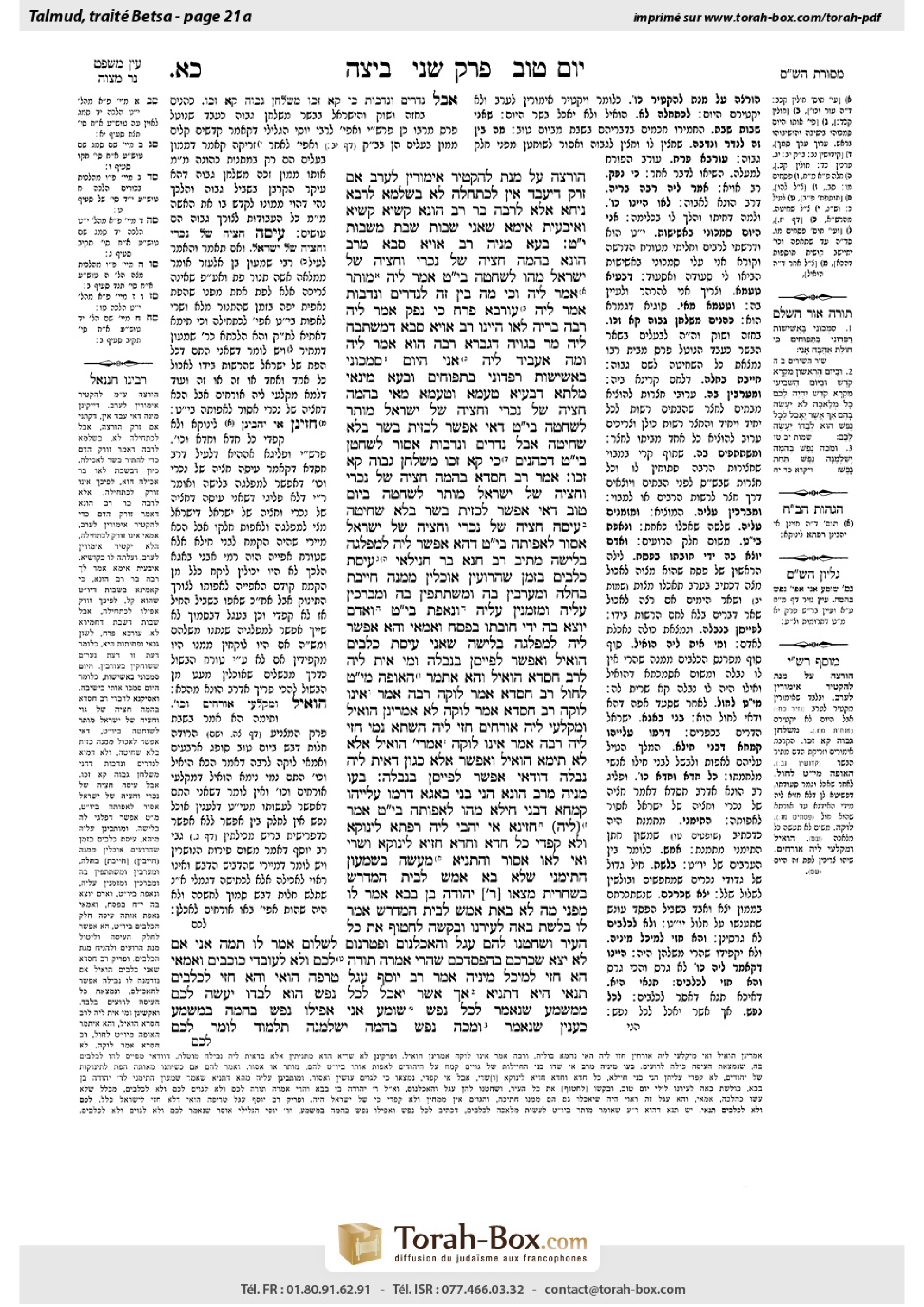
Beitzah 21a: Talmud study for Daf Yomi
Study the Talmud for Daf Yomi with scanned pages, Hebrew text, English translations from Sefaria and AI-generated French translations.
Passage selection and English or AI-generated French translation are available where the scan has annotations. Daf Study is independent of Torah-Box and Sefaria.
Browse Beitzah · ביצה · All tractatesBeitzah 21a text and translations
This page of Beitzah includes the Aramaic text, an English translation and an AI-generated French translation, alongside the scan above.
ביצה כ״א א · Aramaic and Hebrew text
הוּרְצָה, עַל מְנָת לְהַקְטִיר אֵימוּרִין לָעֶרֶב. אִם זָרַק, דִּיעֲבַד — אִין, לְכַתְּחִלָּה — לָא! בִּשְׁלָמָא לְרָבָא נִיחָא, אֶלָּא לְרַבָּה בַּר רַב הוּנָא קַשְׁיָא! קַשְׁיָא. וְאִיבָּעֵית אֵימָא: שָׁאנֵי שְׁבוּת שַׁבָּת מִשְּׁבוּת יוֹם טוֹב.
בְּעָא מִנֵּיהּ רַב אַוְיָא סָבָא מֵרַב הוּנָא: בְּהֵמָה חֶצְיָהּ שֶׁל גּוֹי וְחֶצְיָהּ שֶׁל יִשְׂרָאֵל, מַהוּ לְשׇׁחְטָהּ בְּיוֹם טוֹב? אָמַר לֵיהּ: מוּתָּר. אֲמַר לֵיהּ: וְכִי מָה בֵּין זֶה לִנְדָרִים וּנְדָבוֹת? אֲמַר לֵיהּ: עוֹרְבָא פָּרַח!
כִּי נְפַק אֲמַר לֵיהּ רַבָּה בְּרֵיהּ: לָאו הַיְינוּ רַב אַוְיָא סָבָא דְּמִשְׁתַּבַּח לֵיהּ מָר בְּגַוֵּיהּ דְּגַבְרָא רַבָּה הוּא? אֲמַר לֵיהּ: וּמָה אֶעֱבֵיד לֵיהּ, אֲנִי הַיּוֹם ״סַמְּכוּנִי בָּאֲשִׁישׁוֹת רַפְּדוּנִי בַּתַּפּוּחִים״, וּבְעָא מִינַּאי מִלְּתָא דְּבָעֲיָא טַעְמָא.
וְטַעְמָא מַאי? בְּהֵמָה חֶצְיָהּ שֶׁל גּוֹי וְחֶצְיָהּ שֶׁל יִשְׂרָאֵל מוּתָּר לְשׇׁחְטָהּ בְּיוֹם טוֹב, דְּאִי אֶפְשָׁר לִכְזַיִת בָּשָׂר בְּלֹא שְׁחִיטָה. אֲבָל נְדָרִים וּנְדָבוֹת אָסוּר לְשׇׁחְטָן בְּיוֹם טוֹב, דְּכֹהֲנִים כִּי קָא זָכוּ — מִשֻּׁלְחַן גָּבוֹהַּ קָא זָכוּ.
אָמַר רַב חִסְדָּא בְּהֵמָה חֶצְיָהּ שֶׁל גּוֹי וְחֶצְיָהּ שֶׁל יִשְׂרָאֵל — מוּתָּר לְשׇׁחְטָהּ בְּיוֹם טוֹב, דְּאִי אֶפְשָׁר לִכְזַיִת בָּשָׂר בְּלֹא שְׁחִיטָה. עִיסָּה חֶצְיָהּ שֶׁל גּוֹי וְחֶצְיָהּ שֶׁל יִשְׂרָאֵל — אָסוּר לֶאֱפוֹתָהּ בְּיוֹם טוֹב, דְּהָא אֶפְשָׁר לֵיהּ לְמִפְלְגַהּ בְּלֵישָׁה.
מֵתִיב רַב חָנָא בַּר חֲנִילַאי: עִיסַּת כְּלָבִים בִּזְמַן שֶׁהָרוֹעִין אוֹכְלִין מִמֶּנָּה — חַיֶּיבֶת בְּחַלָּה, וּמְעָרְבִין בָּהּ, וּמִשְׁתַּתְּפִין בָּהּ, וּמְבָרְכִין עָלֶיהָ, וּמְזַמְּנִין עָלֶיהָ, וְנֶאֱפֵת בְּיוֹם טוֹב, וְאָדָם יוֹצֵא בָּהּ יְדֵי חוֹבָתוֹ בַּפֶּסַח.
וְאַמַּאי? וְהָא אֶפְשָׁר לֵיהּ לְמִפְלְגַהּ בְּלֵישָׁה! שָׁאנֵי עִיסַּת כְּלָבִים, הוֹאִיל וְאֶפְשָׁר לְפַיְּיסָן בִּנְבֵלָה.
וּמִי אִית לֵיהּ לְרַב חִסְדָּא ״הוֹאִיל״? וְהָא אִתְּמַר: הָאוֹפֶה מִיּוֹם טוֹב לְחוֹל, רַב חִסְדָּא אָמַר: לוֹקֶה, רַבָּה אָמַר: אֵינוֹ לוֹקֶה.
רַב חִסְדָּא אָמַר: לוֹקֶה, לָא אָמְרִינַן ״הוֹאִיל וּמִקַּלְעִי לֵיהּ אוֹרְחִים חֲזֵי לֵיהּ — הַשְׁתָּא נָמֵי חֲזֵי לֵיהּ״. רַבָּה אָמַר: אֵינוֹ לוֹקֶה, אָמְרִינַן ״הוֹאִיל״.
אֶלָּא: לָא תֵּימָא ״הוֹאִיל וְאֶפְשָׁר״, אֶלָּא כְּגוֹן דְּאִית לֵיהּ נְבֵלָה, דְּוַדַּאי אֶפְשָׁר לְפַיְּיסַן בִּנְבֵלָה.
בְּעוֹ מִנֵּיהּ מֵרַב הוּנָא: הָנֵי בְּנֵי בָּאגָא דִּרְמוֹ עֲלַיְיהוּ קִמְחָא דִּבְנֵי חֵילָא מַהוּ לֶאֱפוֹתָהּ בְּיוֹם טוֹב? אֲמַר (לֵיהּ): חֲזֵינָא אִי יָהֲבִי לֵיהּ רִפְתָּא לְיָנוֹקָא וְלָא קָפְדִי, כׇּל חֲדָא וַחֲדָא חַזְיָא לְיָנוֹקָא, וּשְׁרֵי. וְאִי לָאו — אָסוּר.
וְהָתַנְיָא: מַעֲשֶׂה בְּשִׁמְעוֹן הַתִּימְנִי שֶׁלֹּא בָּא אֶמֶשׁ לְבֵית הַמִּדְרָשׁ. בְּשַׁחֲרִית מְצָאוֹ [רַבִּי] יְהוּדָה בֶּן בָּבָא, אָמַר לוֹ: מִפְּנֵי מָה לֹא בָּאתָ אֶמֶשׁ לְבֵית הַמִּדְרָשׁ? אָמַר לוֹ: בַּלֶּשֶׁת בָּאָה לְעִירֵנוּ, וּבִקְּשָׁה לַחְטוֹף אֶת כָּל הָעִיר, וְשָׁחַטְנוּ לָהֶם עֵגֶל וְהֶאֱכַלְנוּם, וּפְטַרְנוּם לְשָׁלוֹם.
אָמַר לוֹ: תָּמֵהַּ אֲנִי אִם לֹא יָצָא שְׂכַרְכֶם בְּהֶפְסֵדְכֶם, שֶׁהֲרֵי אָמְרָה תּוֹרָה: ״לָכֶם״ — וְלֹא לְגוֹיִם. וְאַמַּאי? הָא חֲזֵי לְמֵיכַל מִינֵּיהּ!
אָמַר רַב יוֹסֵף: עֵגֶל טְרֵפָה הֲוַאי. וְהָא חֲזֵי לִכְלָבִים!
תַּנָּאֵי הִיא. דְּתַנְיָא: ״אַךְ אֲשֶׁר יֵאָכֵל לְכׇל נֶפֶשׁ הוּא לְבַדּוֹ יֵעָשֶׂה לָכֶם״, מִמַּשְׁמַע שֶׁנֶּאֱמַר ״לְכׇל נֶפֶשׁ״, שׁוֹמֵעַ אֲנִי אֲפִילּוּ נֶפֶשׁ בְּהֵמָה בַּמַּשְׁמָע, כְּעִנְיָן שֶׁנֶּאֱמַר: ״וּמַכֵּה נֶפֶשׁ בְּהֵמָה יְשַׁלְּמֶנָּה״, תַּלְמוּד לוֹמַר ״לָכֶם״.
Beitzah 21a · English translation
the offering is accepted on condition that he burn the sacrificial parts that are brought upon the altar in the evening and not during the day. The wording of the baraita indicates that if the meat may not be eaten on that day, then only if he already sprinkled the blood, i.e., after the fact, yes, it is permitted; however, he may not sprinkle it ab initio. Granted, according to the opinion of Rava it works out well, but according to the opinion of Rabba bar Rav Huna, it is difficult. The Gemara comments: Indeed, it is difficult. And if you wish, say instead: A rabbinic decree concerning Shabbat is different from a rabbinic decree concerning a Festival, as the Sages were more stringent with regard to Shabbat than with regard to Festivals.
§ Rav Avya the Elder raised the following dilemma before Rav Huna: If an animal is owned in partnership, half of it belonging to a gentile and half of it to a Jew, what is the halakha with regard to slaughtering it on a Festival? Rav Huna said to him: It is permitted. Rav Avya said to him: And what is the difference between this case and that of vow-offerings and gift-offerings? Vow-offerings and gift-offerings are similar to jointly owned animals, as part of the animal is sacrificed upon the altar while the other part is eaten by the owner and the priest. Why, then, is it not similarly permitted to slaughter them on a Festival? Seeking to distract Rav Avya so that he need not answer his question, Rav Huna said to him: Look, a raven flies in the sky.
When Rav Avya left, Rabba, son of Rav Huna, said to his father: Was this not Rav Avya the Elder, whom Master would recommend to us, saying that he is a great man? If so, why did you treat him in that manner and evade his question? Rav Huna said to him: What should I have done for him? Today I am in a state best described by the verse: “Let me lean against the stout trunks; let me couch among the apple trees” (Song of Songs 2:5), meaning I am worn out and exhausted from all the communal responsibility that has fallen upon me, and he asked me about something that requires reasoning and careful examination, and therefore I could not provide an immediate answer.
The Gemara asks: And what, then, is the reason? The Gemara explains the difference between a jointly owned animal and a vow-offering or gift-offering: A jointly owned animal, half of which belongs to a gentile and half to a Jew, may be slaughtered on a Festival, as it is impossible to obtain an olive-bulk of meat without slaughtering. If a Jew wishes to eat even a small portion of meat, he has no alternative but to slaughter an entire animal, even though he will not use all of it. Therefore, it does not matter if part of the animal belongs to a gentile. However, it is prohibited to slaughter vow-offerings and gift-offerings on a Festival, because in this case there is no real joint ownership of the animal, as the priests, when they receive their portions of the meat of the offering, and similarly, when Israelites partake of the offering, they receive their portions from the table of the Most High. In other words, the entire offering belongs to God, and those who partake of it are considered guests at His table; and as stated above, one may not slaughter an animal on a Festival for the sake of God.
In continuation of the previous discussion, Rav Ḥisda said: A jointly owned animal, half of which belongs to a gentile and half to a Jew, may be slaughtered on a Festival because it is impossible to obtain an olive-bulk of meat without slaughtering. However, with regard to dough, half of which belongs to a gentile and half to a Jew, it is prohibited to bake it on a Festival, as it is possible for him to divide it in half during the kneading and bake only the part that belongs to the Jew.
Rav Ḥana bar Ḥanilai raised an objection from the following mishna: Dough for bread that is meant for dogs, when it is of such quality that even shepherds eat of it, is considered like regular bread. Accordingly, one is obligated to separate ḥalla from such dough, and one may use it to establish an eiruv, i.e., a joining of courtyards and a joining of Shabbat boundaries, and to establish a merging of alleyways, and one recites a blessing before and after eating it, and one invites those with whom he ate to recite Grace after Meals after eating it, and it may be baked on a Festival, like all foods fit for human consumption, and a person fulfills his obligation to eat matza on the first night of Passover with it if it has not leavened.
With regard to the allowance to bake this dough, the Gemara asks: And why may it be baked on a Festival? Isn’t it possible to divide it during the kneading, so that he bakes only the portion to be eaten by people and leaves aside the part given to dogs? The Gemara answers: Dough for bread meant for dogs is different, since it is possible to appease them with a carcass. It is possible that one of his animals will die, and he will feed the carcass to the dogs, in which case all of the dough will be eaten by people.
The Gemara challenges this explanation: Does Rav Ḥisda accept the principle of since, i.e., that since it is possible that the situation may change, the halakha is not determined based on the current circumstances? But wasn’t it stated that the amora’im disagreed about the halakha governing one who intentionally bakes on a Festival day for a weekday? Rav Ḥisda said: He is flogged for desecrating the Festival. Rabba said: He is not flogged.
The Gemara explains the two opinions: Rav Ḥisda said that he is flogged because he holds that we do not say that since, if guests happen to visit him, whatever he bakes will be fit for him on the Festival itself, now too, although guests have not yet arrived, it is considered fit for him. According to that logic, baking would not be considered a full-fledged transgression, and one cannot be forewarned about it and does not receive lashes. Rabba, however, said: He is not flogged, as he holds that we do say the principle of: Since. As Rav Ḥisda himself does not accept the principle of since, how can it be used to resolve a difficulty raised against him?
Rather, the Gemara retracts its previous answer: Do not say that dough for dogs is different, since it is possible that one of his animals will die and he will appease the dogs with the carcass. Rather, the reference here is to a case where he has a carcass ready, so that it is certainly possible to appease them with the carcass. Consequently, when the shepherds bake the dough, it is highly likely that they will consume it all themselves.
§ They raised a dilemma before Rav Huna: With regard to the Jewish residents of a village [baga] upon whom the authorities imposed the obligation to supply flour and bread to the gentile military troops serving in the area, what is the halakha with regard to baking it on a Festival? Rav Huna said to them: We examine the matter: If those villagers can give bread from the soldiers’ quota to a child and the soldiers are not particular about it, then each and every one of the loaves is fit for a Jewish child, and therefore it is permitted to bake them. But if the soldiers do not allow anyone else to partake of their bread, it is prohibited to bake the loaves for them on a Festival.
The Gemara challenges Rav Huna’s lenient ruling: But isn’t it taught in a baraita: There was an incident involving Shimon the Timnite, who did not come on the night of the Festival to the study hall. In the morning, Rabbi Yehuda ben Bava found him and said to him: Why did you not come last night to the study hall? He said to him: A military unit on a search mission [balleshet] came to our city and wanted to pillage the entire city. We slaughtered a calf in order to placate them, and we fed them with it and had them depart in peace.
Rav Yehuda ben Bava said to him: I wonder if your gain, that which you saved by preventing the soldiers from taking your possessions, was not outweighed by your loss, the punishment for your desecration of the Festival. As the Torah states: “Only that which every soul must eat, that alone may be done for you” (Exodus 12:16), which indicates that food may be prepared for you, but not for gentiles. The Gemara asks: But why did Rabbi Yehuda ben Bava say this? Wasn’t some portion of the calf fit to be eaten by them? The conclusion seems to be that even if a Jew may eat from an animal, it may not be slaughtered on a Festival for the sake of a gentile.
Rav Yosef said: In that case it was a calf with a condition that would cause it to die within twelve months [tereifa], which may not be eaten by Jews. The Gemara challenges: But wasn’t it still fit to be eaten by dogs, and it could be argued that it was slaughtered for the sake of dogs belonging to Jews?
The Gemara answers: The question of whether or not one may perform prohibited labor on a Festival for the sake of dogs is a dispute between tanna’im. As it is taught in a baraita: It is written: “Only that which every soul must eat, that alone may be done for you.” By inference, from that which is stated: “Every soul,” I might derive that even the soul of an animal is included, similar to that which is stated: “And he that kills the soul of an animal shall pay it” (Leviticus 24:18), indicating that the life force of an animal is also called a soul. Therefore, the verse states and emphasizes: “For you,”
Beitzah 21a · Traduction française (IA)
l'offrande est acceptée à la condition qu'il brûle les parties sacrificielles apportées sur l'autel le soir et non la journée. La formulation de la baraïta indique que si la viande ne peut être mangée ce jour-là, alors seulement s'il a déjà versé le sang, c'est-à-dire après coup, cela est permis ; cependant, il ne peut pas verser le sang dès le début. Bien que selon l'opinion de Rava cela fonctionne bien, selon l'opinion de Rabba bar Rav Huna, cela est difficile. La Guemara commente : En effet, cela est difficile. Et si vous le souhaitez, dites plutôt : un décret rabbinique concernant le Shabbat est différent d'un décret rabbinique concernant un festival, car les Sages étaient plus exigeants concernant le Shabbat que concernant les festivals.
§ Rav Avya le Vieux a soulevé devant Rav Huna le suivant dilemme : Si un animal est propriété en partage, la moitié appartenant à un non-Juif et la moitié à un Juif, quelle est la halakha concernant son sacrifice lors d'un festival ? Rav Huna lui a dit : C'est permis. Rav Avya lui a dit : Et quelle est la différence entre ce cas et celui des offrandes de vœux et d'offrandes de don ? Les offrandes de vœux et d'offrandes de don sont semblables aux animaux partagés, car une partie de l'animal est sacrifiée sur l'autel tandis que l'autre partie est mangée par l'propriétaire et le prêtre. Pourquoi, alors, n'est-il pas permis de les sacrifier lors d'un festival de la même manière ? Pour distraire Rav Avya afin qu'il n'ait pas à répondre à sa question, Rav Huna lui a dit : Regarde, un corbeau vole dans le ciel.
Quand Rav Avya est parti, Rabba, fils de Rav Huna, a dit à son père : N'était-ce pas Rav Avya le Vieux, celui que le Maître recommandait à nous, disant qu'il est un grand homme ? Si c'est le cas, pourquoi avez-vous traité ainsi et évité sa question ? Rav Huna lui a répondu : Que devais-je faire pour lui ? Aujourd'hui, je suis dans un état décrit par la versette : « Laisse-moi me reposer contre les troncs épais ; laisse-moi m'allonger parmi les arbres de laitue » (Psaumes 2:5), c'est-à-dire que je suis épuisé et fatigué de toute la responsabilité communautaire qui m'est tombée dessus, et il m'a posé une question qui exige une réflexion et une examen minutieux, et donc je n'ai pas pu fournir une réponse immédiate.
La Guemara demande : Et alors, quelle est la raison ? La Guemara explique la différence entre un animal partagé et une offrande de vœux ou d'offrande de don : un animal partagé, la moitié appartenant à un non-Juif et la moitié à un Juif, peut être sacrifié lors d'un festival, car il est impossible d'obtenir une quantité d'olive de viande sans sacrifier. Si un Juif veut manger même une petite portion de viande, il n'a pas d'autre choix que de sacrifier un animal entier, même s'il ne l'utilisera pas tout entier. Par conséquent, il n'y a pas de problème si une partie de l'animal appartient à un non-Juif. Cependant, il est interdit de sacrifier des offrandes de vœux et d'offrandes de don lors d'un festival, car dans ce cas, il n'y a pas de propriété partagée réelle de l'animal, car les prêtres, lorsqu'ils reçoivent leur part de viande de l'offrande, et de même, lorsqu'Israël consomme l'offrande, ils reçoivent leur part de la table du Très-Haut. En d'autres termes, l'offrande appartient entièrement à Dieu, et ceux qui en consomment sont considérés comme des invités à sa table ; et comme mentionné ci-dessus, on ne peut pas sacrifier un animal lors d'un festival au nom de Dieu.
En continuation de la discussion précédente, Rav Ḥisda a dit : Un animal partagé, la moitié appartenant à un non-Juif et la moitié à un Juif, peut être sacrifié lors d'un festival car il est impossible d'obtenir une quantité d'olive de viande sans sacrifier. Cependant, concernant la pâte, la moitié appartenant à un non-Juif et la moitié à un Juif, il est interdit de la cuire lors d'un festival, car il est possible de la diviser pendant la préparation et de cuire uniquement la partie appartenant au Juif.
Rav Ḥana bar Ḥanilai a soulevé une objection à partir de la suivante mitsna : La pâte pour le pain destinée aux chiens, lorsqu'elle est de telle qualité que même les bergers en mangent, est considérée comme du pain ordinaire. Ainsi, on est tenu de séparer ḥalla de cette pâte, et on peut l'utiliser pour établir un eiruv, c'est-à-dire un rapprochement de courtyards et un rapprochement des limites du Shabbat, et pour établir un mélange de passages, et on récite une bénédiction avant et après en avoir mangé, et on invite ceux avec qui on a mangé à réciter la Bérit après le repas, et elle peut être cuite lors d'un festival, comme toutes les aliments adaptés à la consommation humaine, et une personne remplit son obligation de manger du matza la première nuit du Pessa'h avec elle si elle n'a pas levé.
Concernant l'autorisation de cuire cette pâte, la Guemara demande : Et pourquoi peut-elle être cuite lors d'un festival ? N'est-il pas possible de la diviser pendant la préparation, de sorte qu'on cuit uniquement la partie à manger par les humains et on laisse de côté la partie donnée aux chiens ? La Guemara répond : La pâte pour le pain destinée aux chiens est différente, car on peut apaiser les chiens avec un cadavre. Il est possible qu'un de ses animaux meure, et il nourrisse le cadavre aux chiens, dans ce cas, toute la pâte sera mangée par les humains.
La Guemara conteste cette explication : Rav Ḥisda accepte-t-il le principe de « puisque », c'est-à-dire que puisque la situation peut changer, la halakha n'est pas déterminée en fonction des circonstances actuelles ? N'était-il pas dit que les amora’im étaient en désaccord sur la halakha concernant celui qui cuit intentionnellement lors d'un festival pour un jour de semaine ? Rav Ḥisda a dit : Il est battu pour avoir profané le festival. Rabba a dit : Il n'est pas battu.
La Guemara explique les deux opinions : Rav Ḥisda a dit qu'il est battu car il maintient que nous ne disons pas « puisque », c'est-à-dire que si des invités viennent à son domicile, ce qu'il cuit sera adapté à lui-même lors du festival lui-même, maintenant aussi, même si les invités n'ont pas encore arrivé, cela est considéré comme adapté à lui. Selon cette logique, la cuisson ne serait pas considérée comme une transgression complète, et on ne peut pas être averti à l'avance et ne reçoit pas de coups de fouet. Rabba, cependant, a dit : Il n'est pas battu, car il maintient que nous disons le principe de « puisque ». Comme Rav Ḥisda lui-même ne accepte pas le principe de « puisque », comment peut-il être utilisé pour résoudre une difficulté soulevée contre lui ?
Au contraire, la Guemara retire sa réponse précédente : Ne dis pas que la pâte pour chiens est différente, car il est possible que l'un de ses animaux meure et qu'il apaise les chiens avec le cadavre. En réalité, la référence ici est à un cas où il a un cadavre prêt, de sorte qu'il est certainement possible d'apaiser les chiens avec ce cadavre. Par conséquent, lorsque les bergers font cuire la pâte, il est très probable qu'ils la consomment tous eux-mêmes.
§ Ils posèrent un dilemme devant Rav Huna : En ce qui concerne les habitants juifs d'un village [baga] sur lesquels les autorités imposaient l'obligation de fournir du farine et du pain aux troupes militaires païennes stationnées dans la région, quelle est la halakha concernant la cuisson sur un festival ? Rav Huna leur dit : Examinons la question : Si ces villageois peuvent donner du pain provenant du quota des soldats à un enfant et que les soldats n'ont pas d'objection, alors chaque pain est adapté à un enfant juif, et donc il est permis de les cuire. Mais si les soldats ne permettent pas à quiconque d'en consommer, il est interdit de cuire les pains pour eux sur un festival.
La Guemara conteste la décision leniente de Rav Huna : Mais n'est-il pas enseigné dans une baraïta : Il y avait un incident concernant Shimon le Timnite, qui n'est pas venu la nuit du festival à la salle de étude. Le matin, Rabbi Yéhuda ben Bava le trouva et lui demanda : Pourquoi ne s'es-tu pas présenté la nuit dernière à la salle de étude ? Il lui répondit : Une unité militaire en mission de recherche [balleshet] est venue dans notre ville et voulait piller toute la ville. Nous avons tué un veau afin de calmer les soldats, et nous leur avons donné à manger et ils sont partis en paix.
Rav Yéhuda ben Bava lui dit : Je me demande si ton gain, ce que tu as sauvé en empêchant les soldats de prendre tes biens, n'a pas été compensé par ta perte, la punition pour ta profanation du festival. Comme la Torah dit : « Seul ce qui est nécessaire à chaque âme, cela seul peut être fait pour vous » (Exode 12:16), ce qui indique que l'on peut préparer de la nourriture pour vous, mais pas pour les païens. La Guemara demande : Mais pourquoi Rav Yéhuda ben Bava a-t-il dit cela ? N'était-ce pas une partie du veau qui pouvait être mangé par eux ? La conclusion semble être que même si un Juif peut manger d'un animal, il ne peut pas être sacrifié sur un festival à l'intention d'un païen.
Rav Yosef dit : Dans ce cas, il s'agissait d'un veau qui avait une maladie qui le ferait mourir dans les douze mois [tereifa], ce qui ne peut pas être mangé par les Juifs. La Guemara conteste : Mais n'était-il pas encore comestible pour les chiens, et on pourrait arguer qu'il a été sacrifié à l'intention des chiens appartenant aux Juifs ?
La Guemara répond : La question de savoir si l'on peut accomplir un travail interdit sur un festival à l'intention des chiens est un débat entre les tannaïm. Comme il est enseigné dans une baraïta : Il est écrit : « Seul ce qui est nécessaire à chaque âme, cela seul peut être fait pour vous. » Par déduction, à partir de ce qui est dit : « Chaque âme », on pourrait déduire que même l'âme d'un animal est incluse, semblable à ce qui est dit : « Et celui qui tue l'âme d'un animal paiera pour elle » (Lvïtique 24:18), indiquant que la force vitale d'un animal est aussi appelée âme. Par conséquent, la Sainte Écriture dit et insiste : « Pour vous »,
Traduction française générée par IA à partir de l’édition anglaise de Sefaria. Vérifie toujours un passage avec le texte source.
Text from Sefaria: William Davidson Edition - Vocalized Aramaic (CC BY NC); William Davidson Edition - English (CC BY NC).