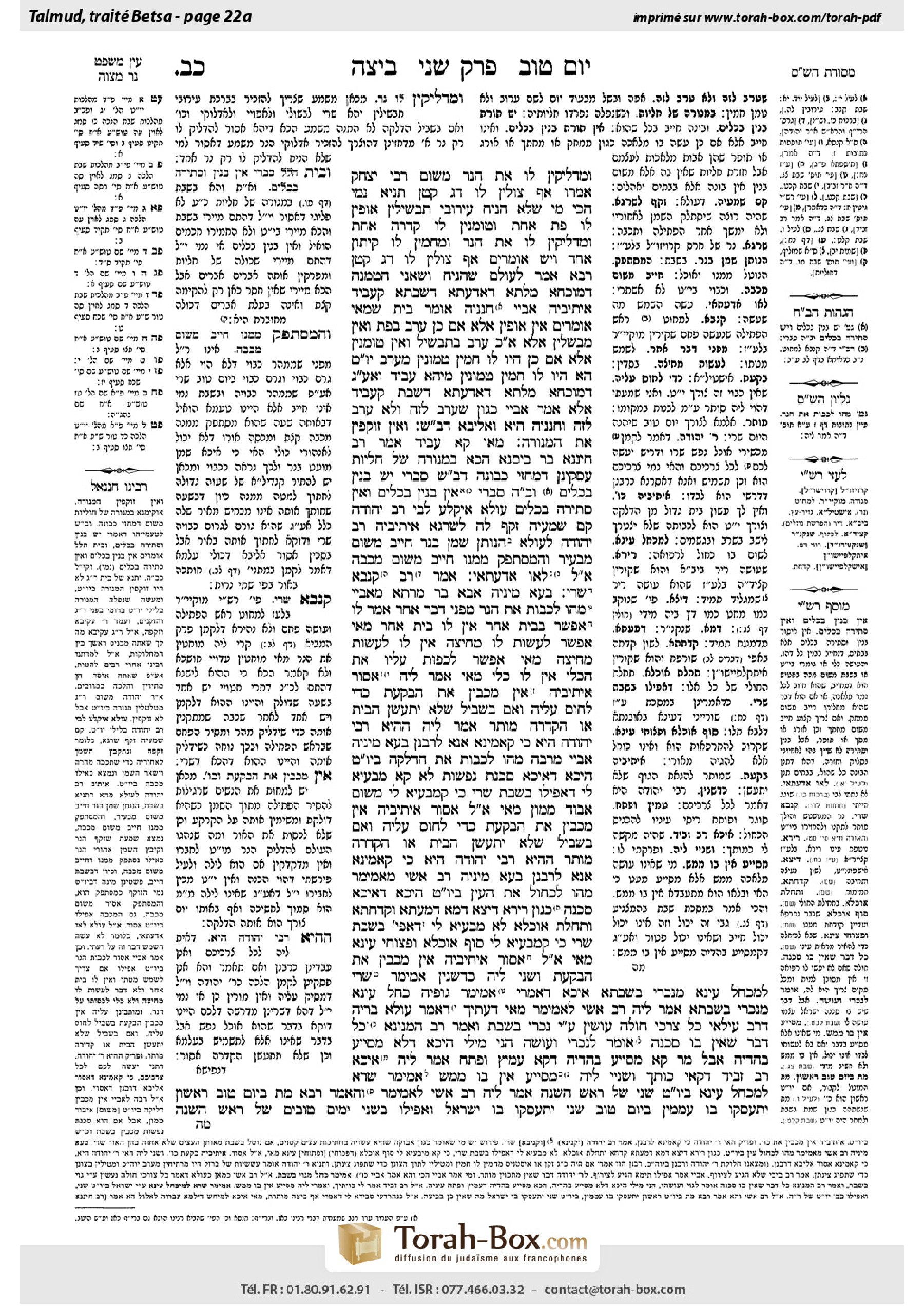
Beitzah 22a: Talmud study for Daf Yomi
Study the Talmud for Daf Yomi with scanned pages, Hebrew text, English translations from Sefaria and AI-generated French translations.
Passage selection and English or AI-generated French translation are available where the scan has annotations. Daf Study is independent of Torah-Box and Sefaria.
Browse Beitzah · ביצה · All tractatesBeitzah 22a text and translations
This page of Beitzah includes the Aramaic text, an English translation and an AI-generated French translation, alongside the scan above.
ביצה כ״ב א · Aramaic and Hebrew text
וּמַדְלִיקִין לוֹ אֶת הַנֵּר. מִשּׁוּם רַבִּי יִצְחָק אָמְרוּ: אַף צוֹלִין לוֹ דָּג קָטָן. תַּנְיָא נָמֵי הָכִי: מִי שֶׁלֹּא הִנִּיחַ עֵירוּבֵי תַבְשִׁילִין — אוֹפִין לוֹ פַּת אַחַת, וְטוֹמְנִין לוֹ קְדֵרָה אַחַת, וּמַדְלִיקִין לוֹ אֶת הַנֵּר, וּמְחַמִּין לוֹ קִיתוֹן אֶחָד, וְיֵשׁ אוֹמְרִים: אַף צוֹלִין לוֹ דָּג קָטָן.
רָבָא אָמַר: לְעוֹלָם שֶׁהִנִּיחַ — וְשָׁאנֵי הַטְמָנָה, דְּמוֹכְחָא מִלְּתָא דְּאַדַּעְתָּא דְשַׁבְּתָא קָעָבֵיד.
אֵיתִיבֵיהּ אַבָּיֵי: חֲנַנְיָה אוֹמֵר: בֵּית שַׁמַּאי אוֹמְרִים: אֵין אוֹפִין אֶלָּא אִם כֵּן עֵרֵב בְּפַת, וְאֵין מְבַשְּׁלִין אֶלָּא אִם כֵּן עֵרֵב בְּתַבְשִׁיל, וְאֵין טוֹמְנִין אֶלָּא אִם כֵּן הָיוּ לוֹ חַמִּין טְמוּנִין מֵעֶרֶב יוֹם טוֹב. הָא הָיוּ לוֹ חַמִּין טְמוּנִין — מִיהָא עָבֵיד, וְאַף עַל גַּב דְּמוֹכְחָא מִלְּתָא דְּאַדַּעְתָּא דְּשַׁבָּת קָעָבֵיד!
אֶלָּא אָמַר אַבָּיֵי: כְּגוֹן שֶׁעֵרַב לָזֶה וְלֹא עֵרַב לְזֶה, וַחֲנַנְיָה הִיא, וְאַלִּיבָּא דְּבֵית שַׁמַּאי.
וְאֵין זוֹקְפִין אֶת הַמְּנוֹרָה. מַאי קָא עָבֵיד? אָמַר רַב חִינָּנָא בַּר בִּיסְנָא: הָכָא בִּמְנוֹרָה שֶׁל חֻלְיוֹת עָסְקִינַן, דְּמִחֲזֵי כְּבוֹנֶה. דְּבֵית שַׁמַּאי סָבְרִי: יֵשׁ בִּנְיָן בְּכֵלִים, וּבֵית הִלֵּל סָבְרִי: אֵין בִּנְיָן בְּכֵלִים וְאֵין סְתִירָה בְּכֵלִים.
עוּלָּא אִיקְּלַע לְבֵי רַב יְהוּדָה, קָם שַׁמָּעֵיהּ זְקַף לֵהּ לִשְׁרָגָא. אֵיתִיבֵיהּ רַב יְהוּדָה לְעוּלָּא: הַנּוֹתֵן שֶׁמֶן בַּנֵּר — חַיָּיב מִשּׁוּם מַבְעִיר, וְהַמִּסְתַּפֵּק מִמֶּנּוּ — חַיָּיב מִשּׁוּם מְכַבֶּה! אֲמַר לֵיהּ: לָאו אַדַּעְתַּאי.
אָמַר רַב: קִנְבָא שְׁרֵי.
בְּעָא מִינֵּיהּ אַבָּא בַּר מָרְתָא מֵאַבָּיֵי: מַהוּ לְכַבּוֹת אֶת הַנֵּר מִפְּנֵי דָּבָר אַחֵר? אָמַר לוֹ: אֶפְשָׁר בְּבַיִת אַחֵר.
אֵין לוֹ בַּיִת אַחֵר, מַאי? אֶפְשָׁר לַעֲשׂוֹת לוֹ מְחִיצָה. אֵין לוֹ לַעֲשׂוֹת מְחִיצָה, מַאי? אֶפְשָׁר לִכְפּוֹת עָלָיו אֶת הַכְּלִי. אֵין לוֹ כְּלִי, מַאי? אֲמַר לֵיהּ: אָסוּר.
אֵיתִיבֵיהּ: אֵין מְכַבִּין אֶת הַבְּקַעַת כְּדֵי לָחוּס עָלֶיהָ, וְאִם בִּשְׁבִיל שֶׁלֹּא יִתְעַשֵּׁן הַבַּיִת אוֹ הַקְּדֵרָה — מוּתָּר! אֲמַר לֵיהּ: הָהִיא רַבִּי יְהוּדָה הִיא, כִּי קָאָמֵינָא אֲנָא, לְרַבָּנַן.
בְּעָא מִינֵּיהּ אַבָּיֵי מֵרַבָּה: מַהוּ לְכַבּוֹת אֶת הַדְּלֵקָה בְּיוֹם טוֹב? הֵיכָא דְּאִיכָּא סַכָּנַת נְפָשׁוֹת — לָא קָא מִבַּעְיָא לִי, דַּאֲפִילּוּ בְּשַׁבָּת שְׁרֵי. כִּי קָמִבַּעְיָא לִי מִשּׁוּם אִבּוּד מָמוֹן, מַאי? אֲמַר לֵיהּ: אָסוּר.
אֵיתִיבֵיהּ: אֵין מְכַבִּין אֶת הַבְּקַעַת כְּדֵי לְחוּס עָלֶיהָ, וְאִם בִּשְׁבִיל שֶׁלֹּא יִתְעַשֵּׁן הַבַּיִת אוֹ הַקְּדֵרָה — מוּתָּר! הָהִיא רַבִּי יְהוּדָה הִיא, כִּי קָאָמֵינָא אֲנָא, לְרַבָּנַן.
בְּעָא מִינֵּיהּ רַב אָשֵׁי מֵאַמֵּימָר: מַהוּ לִכְחוֹל אֶת הָעַיִן בְּיוֹם טוֹב? הֵיכָא דְּאִיכָּא סַכָּנָה, כְּגוֹן: רִירָא, דִּיצָא, דְּמָא, דִּמְעֲתָא, וְקַדַּחְתָּא, וּתְחִלַּת אוּכְלָא — לָא מִבַּעְיָא לִי, דַּאֲפִילּוּ בְּשַׁבָּת שְׁרֵי. כִּי קָמִבַּעְיָא לִי, סוֹף אוּכְלָא וּפַצּוֹחֵי עֵינָא, מַאי? אֲמַר לֵיהּ: אָסוּר.
אֵיתִיבֵיהּ: אֵין מְכַבִּין אֶת הַבְּקַעַת, וְשַׁנִּי לֵיהּ כִּדְשַׁנִּין.
אַמֵּימָר שָׁרֵי לְמִכְחַל עֵינָא מִגּוֹי בְּשַׁבְּתָא. אִיכָּא דְּאָמְרִי: אַמֵּימָר גּוּפֵיהּ כְּחַל עֵינָא מִגּוֹי בְּשַׁבְּתָא. אֲמַר לֵיהּ רַב אָשֵׁי לְאַמֵּימָר: מַאי דַּעְתָּיךְ — דְּאָמַר עוּלָּא בְּרֵיהּ דְּרַב עִילַּאי כׇּל צׇרְכֵי חוֹלֶה עוֹשִׂין עַל יְדֵי גּוֹי בְּשַׁבָּת, וְאָמַר רַב הַמְנוּנָא: כׇּל דָּבָר שֶׁאֵין בּוֹ סַכָּנָה — אוֹמֵר לְגוֹי וְעוֹשֶׂה.
הָנֵי מִילֵּי, הֵיכָא דְּלָא מְסַיַּיע בַּהֲדֵיהּ. אֲבָל מָר קָא מְסַיַּיע בַּהֲדֵיהּ, דְּקָא עָמֵיץ וּפָתַח! אֲמַר לֵיהּ: אִיכָּא רַב זְבִיד דְּקָאֵי כְּוָתָךְ, וְשַׁנַּיי לֵיהּ: מְסַיֵּיעַ אֵין בּוֹ מַמָּשׁ.
אַמֵּימָר שְׁרָא לְמִכְחַל עֵינָא בְּיוֹם טוֹב שֵׁנִי שֶׁל רֹאשׁ הַשָּׁנָה. אֲמַר לֵיהּ רַב אָשֵׁי לְאַמֵּימָר, וְהָאָמַר רָבָא: מֵת בְּיוֹם טוֹב רִאשׁוֹן — יִתְעַסְּקוּ בּוֹ עַמְמִין, בְּיוֹם טוֹב שֵׁנִי — יִתְעַסְּקוּ בּוֹ יִשְׂרָאֵל. וַאֲפִילּוּ בִּשְׁנֵי יָמִים טוֹבִים שֶׁל רֹאשׁ הַשָּׁנָה,
Beitzah 22a · English translation
and kindle a lamp for him. They said in the name of Rabbi Yitzḥak: They may even roast a small fish for him. That is also taught in a baraita: With regard to one who did not prepare an eiruv tavshilin, others may bake one loaf of bread for him, and insulate one pot of food for him, and kindle a lamp for him, and heat one small jug [kiton] of water for him. And some say: They may even roast a small fish for him.
Rava said: Actually, one can say that the mishna is referring to a case where one prepared an eiruv tavshilin, and nevertheless, if he did not insulate hot food on the eve of the Festival for Shabbat he may not do so on the Festival itself, because insulating hot food is different, as it is evident that he is acting with Shabbat in mind and not for the Festival. Beit Shammai view this as a desecration of the sanctity of the Festival.
Abaye raised an objection to Rava’s opinion from the following baraita: Ḥananya says that Beit Shammai say: One may not bake on a Festival for Shabbat that occurs on the following day unless he established a joining of cooked foods with bread, and he may not cook for Shabbat unless he established a joining of cooked foods with a cooked dish, and he may not insulate hot food for Shabbat unless he already had hot food insulated from the eve of the Festival. But this indicates that if he had hot food insulated, he may in any case act in that manner and insulate hot food for Shabbat, even though it is evident that he is acting with Shabbat in mind. This shows that even according to Ḥananya, who rules in accordance with the opinion of Beit Shammai, it is permitted to insulate hot food on a Festival for Shabbat.
Rather, Abaye said that the mishna is referring to a case where he established a joining of cooked foods for this, meaning he baked and cooked before the Festival for the sake of an eiruv, but he did not establish a joining of cooked foods for this, i.e., he did not insulate hot food for Shabbat on the Festival eve. And the mishna is in accordance with the opinion of Ḥananya, according to Beit Shammai, with Rabban Gamliel’s household being stringent upon themselves in this regard.
§ The mishna states that one of the three stringencies that Rabban Gamliel practiced in accordance with Beit Shammai was that on a Festival one may not set up a candelabrum that fell. The Gemara asks: What prohibited act does one perform when he sets a candelabrum upright? Rav Ḥinnana bar Bisna said: Here, we are dealing with a candelabrum composed of segments that come apart; it is prohibited to reassemble such a candelabrum because it looks like building. As Beit Shammai hold that there is a prohibition against building with regard to vessels, and therefore the pieces of this candelabrum may not be reconnected, whereas Beit Hillel hold that there is no prohibition against building with regard to vessels, and there is also no prohibition against dismantling with regard to vessels. One may therefore reattach the pieces of the candelabrum if they came apart.
The Gemara relates that Ulla once happened to come to the house of Rav Yehuda on a Festival. Ulla’s servant stood and tilted the oil lamp [sheragga], diverting most of the oil to one side, with the intention of preventing the oil from reaching the wick so that the light would be extinguished more quickly. Rav Yehuda raised an objection to Ulla from the following baraita, in which it is taught: One who adds oil to a lamp on Shabbat is liable for performing the prohibited labor of kindling on Shabbat, and one who supplies himself with oil from a lit lamp on Shabbat is liable for performing the prohibited labor of extinguishing, as he causes the light to be extinguished more quickly. This indicates that any action, even an indirect one, that causes a lamp to be extinguished earlier than it would have otherwise is considered extinguishing. Here too, by tilting the lamp, the servant extinguished a light on the Festival, which is prohibited. Ulla said to him: You are indeed correct; the act was performed by my servant without my knowledge.
With regard to the halakha governing extinguishing on a Festival, Rav said: It is permitted to trim the end of a wick that has become charcoal, so that it will burn better; this is not considered extinguishing.
With regard to this same issue, Abba bar Marta raised a dilemma before Abaye: What is the halakha with regard to extinguishing a lamp that is burning in a room on a Festival for another matter, a euphemism for marital relations? Since it is prohibited to have relations in a room where a lamp is burning, may one extinguish a lamp for this purpose? Abaye said to him: One may not extinguish it, as it is possible to have relations in a different room.
Abba bar Marta continued: If he does not have a different room, what should he do? Abaye replied: It is possible to erect for oneself a partition out of sheets and engage in relations on the other side of the partition. Abba bar Marta asked further: If he does not have sheets to erect a partition, what should he do? Abaye answered: It is possible to invert a vessel over the lamp in order to hide the light. Abba bar Marta further inquired: If he does not have a vessel, what should he do? Abaye said to him: It is prohibited; one may not extinguish the lamp.
Abba bar Marta raised an objection to Abaye’s opinion from the following baraita: One may not extinguish a piece of wood in order to save it from being needlessly burned, but if he extinguishes it so that the house or a pot not become smoky, it is permitted. This shows that it is permitted to extinguish a fire on a Festival if it serves people’s needs. Abaye said to him: That baraita is in accordance with the opinion of Rabbi Yehuda, who permits the performance of prohibited labors on a Festival for all of one’s needs and not only for the preparation of food; when I spoke, it was in accordance with the opinion of the Rabbis, who disagree.
Further on the topic of extinguishing, Abaye raised a dilemma before Rabba: What is the halakha with regard to extinguishing a fire on a Festival? He clarified his question: Where there is danger to life, I have no dilemma, as in that case it is permitted even on Shabbat. When I raised the dilemma, it was with regard to a case involving only monetary loss. What is the halakha? Rabba said to him: It is prohibited.
Abaye raised an objection to his opinion from the baraita cited above: One may not extinguish a piece of wood in order to save it from being needlessly burned, but if he extinguishes it so that the house or a pot not become smoky, it is permitted. This indicates that extinguishing a fire on a Festival is permitted even if only to prevent a small loss. Rabba replied: That baraita is in accordance with the opinion of Rabbi Yehuda; when I spoke, it was in accordance with the opinion of the Rabbis.
§ Rav Ashi raised a dilemma before Ameimar: What is the halakha with regard to painting an eye with a medicinal ointment on a Festival? He elaborated on his question: Where there is a danger to the eye, for example, the illnesses called rira, ditza, dema, dimata, and kadaḥta, or the beginning of an inflammation, I have no dilemma, as in such cases it is permitted to apply an ointment even on Shabbat. When I raised the dilemma, it was with regard to less serious ailments, such as at the end of an inflammation, or in order to brighten one’s eyesight. What is the halakha in such cases? Ameimar said to him: It is prohibited.
Rav Ashi raised an objection to him from the same baraita: One may not extinguish a piece of wood in order to save it from being needlessly burned, but if he extinguishes it so that the house or a pot not become smoky, it is permitted. This indicates that a prohibited labor is permitted on a Festival, if it is performed for the sake of a bodily need. And Ameimar answered him as we answered before, that the baraita is in accordance with the opinion of Rabbi Yehuda.
The Gemara relates that Ameimar permitted painting an eye for medicinal purposes on Shabbat by means of a gentile. Some say that Ameimar himself painted his eye on Shabbat by means of a gentile. Rav Ashi said to Ameimar: What is your reasoning in permitting this practice? You must rely upon that which Ulla, son of Rav Ilai, said: All the needs of an ill person whose life is not in danger are performed by means of a gentile on Shabbat. And similarly, Rav Hamnuna said: With regard to any matter in which there is no life-threatening danger but only potential illness, one says to the gentile to perform the act, and the gentile performs the act for him.
However, this applies only where the ill person, or any other Jew, does not assist the gentile. But in this case the Master, Ameimar, assists the gentile while the ointment is being applied, as he closes and opens his eye, thereby allowing the ointment to penetrate more deeply. Therefore, this should be prohibited. Ameimar said to Rav Ashi: There is also the opinion of Rav Zevid, who holds in accordance with your opinion; he, too, raised the objection that it should be prohibited due to the fact that the Jew assists the gentile. And I already answered him: The assistance provided by one who assists another in performing a task that the other could essentially have performed himself is insubstantial. Inasmuch as the action is primarily performed by the gentile, the minor assistance given by the Jew may be overlooked.
The Gemara further relates that Ameimar permitted painting an eye with a medicinal ointment on the second day of the festival of Rosh HaShana if the eye is causing pain and requires treatment. Rav Ashi said to Ameimar: But didn’t Rava say that if a person died on the first day of a Festival, gentiles may attend to his burial; if he died on the second day of a Festival observed in the Diaspora, Jews may attend to his burial? And this is the halakha even on the second day of the festival of Rosh HaShana,
Beitzah 22a · Traduction française (IA)
et allumer une lampe pour lui. Ils dirent en nom de Rabbi Yitzḥak : On peut même cuire un petit poisson pour lui. Cela est également enseigné dans une baraïta : Concernant celui qui n'a pas préparé un eiruv tavshilin, d'autres peuvent cuire un pain unique pour lui, et isoler une casserole de nourriture pour lui, et allumer une lampe pour lui, et chauffer un petit récipient [kiton] d'eau pour lui. Et certains disent : On peut même cuire un petit poisson pour lui.
Rava dit : En réalité, on peut dire que la mitsna fait référence à un cas où l'on a préparé un eiruv tavshilin, et pourtant, si l'on n'a pas isolé de nourriture chaude la veille du festival pour le sabbat, on ne peut pas le faire lui-même lors du festival, car isoler de nourriture chaude est différent, car il est évident qu'on agit en pensant au sabbat et non au festival. La vue de Beit Shammai considère cela comme une profanation de la sainteté du festival.
Abaye souleva une objection contre l'opinion de Rava à partir de la suivante baraïta : Ḥananya dit que Beit Shammai disent : On ne peut pas cuire sur un festival pour le sabbat qui arrive le lendemain, sauf s'il a établi un mélange de nourritures avec du pain, et on ne peut pas cuire pour le sabbat sans avoir établi un mélange de nourritures avec un plat cuisiné, et on ne peut pas isoler de nourriture chaude pour le sabbat sans avoir déjà isolé de nourriture chaude la veille du festival. Mais cela montre que si l'on a isolé de nourriture chaude, on peut en tout cas agir ainsi et isoler de nourriture chaude pour le sabbat, même si c'est évident qu'on agit en pensant au sabbat. Cela montre que même selon Ḥananya, qui suit l'opinion de Beit Shammai, il est permis d'isoler de nourriture chaude sur un festival pour le sabbat.
Plutôt, Abaye dit que la mitsna fait référence à un cas où il a établi un mélange de nourritures pour cela, c'est-à-dire qu'il a cuisiné et préparé avant le festival pour l'eiruv, mais il n'a pas établi un mélange de nourritures pour cela, c'est-à-dire qu'il n'a pas isolé de nourriture chaude pour le sabbat la veille du festival. Et la mitsna suit l'opinion de Ḥananya, selon Beit Shammai, avec la maison de Rabban Gamliel étant stricte à cet égard.
§ La mitsna dit que l'une des trois stricteurs que Rabban Gamliel pratiquait selon Beit Shammai était que sur un festival, on ne peut pas dresser un candelabrum tombé. La Guemara pose la question : Quel acte interdit effectue-t-on lorsqu'on redresse un candelabrum ? Rav Ḥinnana bar Bisna dit : Ici, nous parlons d'un candelabrum composé de segments qui se détachent ; il est interdit de le remettre ensemble car cela ressemble à la construction. Comme Beit Shammai considère qu'il y a une interdiction de construire concernant les objets, et donc les segments de ce candelabrum ne peuvent pas être reconnectés, tandis que Beit Hillel considère qu'il n'y a pas d'interdiction de construire concernant les objets, et qu'il n'y a pas non plus d'interdiction de démontage concernant les objets. On peut donc relier les pièces du candelabrum si elles sont tombées.
La Guemara rapporte que Ulla est un jour venu chez Rav Yehuda sur un festival. Le serviteur d'Ulla se tenait et penchait la lampe à huile [sheragga], déviant la plupart de l'huile vers un côté, avec l'intention de prévenir l'huile de parvenir à la mèche afin que la lumière s'éteigne plus rapidement. Rav Yehuda souleva une objection contre Ulla à partir de la baraïta suivante, dans laquelle il est enseigné : Celui qui ajoute de l'huile à une lampe le sabbat est responsable de l'acte interdit d'allumer le sabbat, et celui qui se ravit de l'huile d'une lampe allumée le sabbat est responsable de l'acte interdit d'éteindre, car il cause la lumière d'être éteinte plus rapidement. Cela montre que toute action, même indirecte, qui cause une lampe d'être éteinte plus tôt qu'elle ne le serait autrement est considérée comme l'éteindre. Ici aussi, en penchant la lampe, le serviteur éteignit une lumière sur le festival, ce qui est interdit. Ulla dit à lui : Vous avez raison ; l'acte a été commis par mon serviteur sans mon savoir.
Concernant la halakha régissant l'éteinte sur un festival, Rav dit : Il est permis de tailler la pointe d'une mèche devenue charbon, afin qu'elle brûle mieux ; cela n'est pas considéré comme l'éteinte.
Concernant cette même question, Abba bar Marta souleva un dilemme devant Abaye : Quelle est la halakha concernant l'éteinte d'une lampe brûlant dans une pièce sur un festival pour une autre raison, une expression pour les relations conjugales ? Puisque c'est interdit d'avoir des relations dans une pièce où une lampe brûle, peut-on éteindre une lampe à cet effet ? Abaye dit à lui : On ne peut pas éteindre la lampe, car il est possible d'avoir des relations dans une autre pièce.
Abba bar Marta continua : Si l'on n'a pas une autre pièce, que devrait-il faire ? Abaye répondit : Il est possible de dresser pour soi un paravent en utilisant des draps et d'avoir des relations de l'autre côté du paravent. Abba bar Marta demanda davantage : Si l'on n'a pas de draps pour dresser un paravent, que devrait-il faire ? Abaye répondit : Il est possible de poser un récipient sur la lampe afin de cacher la lumière. Abba bar Marta demanda encore : Si l'on n'a pas de récipient, que devrait-il faire ? Abaye dit à lui : C'est interdit ; on ne peut pas éteindre la lampe.
Abba bar Marta souleva une objection contre l'opinion d'Abaye à partir de la suivante baraïta : On ne peut pas éteindre un morceau de bois afin de le sauver de brûler inutilement, mais si l'on éteint ce morceau afin que la maison ou une casserole ne devienne pas fumante, cela est permis. Cela montre que l'éteinte d'un feu sur un festival est permise si cela sert aux besoins des gens. Abaye dit à lui : Cette baraïta suit l'opinion de Rabbi Yehuda, qui permet l'accomplissement d'actes interdits sur un festival pour tous ses besoins et non seulement pour la préparation de la nourriture ; lorsque j'ai parlé, j'étais en accord avec l'opinion des Rabbins, qui s'opposent.
Plus loin sur le sujet d'éteindre, Abaye a soulevé un dilemme devant Rabba : Quel est le halakha concernant l'éteinte d'un feu pendant un festival ? Il a clarifié sa question : Lorsqu'il y a un danger pour la vie, je n'ai pas de dilemme, car dans ce cas il est permis même le sabbat. Lorsque j'ai soulevé le dilemme, c'était dans un cas impliquant uniquement une perte financière. Quel est le halakha ? Rabba a répondu à lui : Il est interdit.
Abaye a soulevé un objet contre son opinion à partir de la baraïta citée ci-dessus : On ne peut pas éteindre un morceau de bois afin de le sauver d'être brûlé inutilement, mais si l'on éteint le feu afin que la maison ou une marmite ne devienne pas fumante, cela est permis. Cela indique que l'éteinte d'un feu pendant un festival est permise même si cela vise uniquement à éviter une petite perte. Rabba a répondu : Cette baraïta est selon l'opinion de Rabbi Yehuda ; lorsque j'ai parlé, c'était selon l'opinion des Rabbins.
§ Rav Ashi a soulevé un dilemme devant Ameimar : Quel est le halakha concernant l'application d'un onguent médicamenteux sur l'œil pendant un festival ? Il a développé sa question : Lorsqu'il y a un danger pour l'œil, par exemple, les maladies appelées rira, ditza, dema, dimata et kadaḥta, ou le début d'une inflammation, je n'ai pas de dilemme, car dans ces cas il est permis d'appliquer un onguent même le sabbat. Lorsque j'ai soulevé le dilemme, c'était concernant des maladies moins graves, comme à la fin d'une inflammation, ou afin d'améliorer la vue. Quel est le halakha dans ces cas ? Ameimar a répondu à lui : Il est interdit.
Rav Ashi a soulevé une objection contre lui à partir de la même baraïta : On ne doit pas éteindre un morceau de bois afin de le sauver d'être brûlé inutilement, mais si l'on éteint le feu afin que la maison ou une marmite ne devienne pas fumante, cela est permis. Cela indique qu'une activité interdite est permise pendant un festival si elle est faite à cause d'un besoin corporel. Et Ameimar a répondu à lui comme nous l'avons répondu avant, que la baraïta suit l'opinion de Rabbi Yehuda.
La Guemara rapporte que Ameimar a permis l'application d'un onguent médicamenteux sur l'œil le sabbat par le moyen d'un non-Juif. Certains disent que Ameimar lui-même a appliqué un onguent sur son œil le sabbat par le moyen d'un non-Juif. Rav Ashi a dit à Ameimar : Quel est votre raisonnement pour permettre cette pratique ? Vous devez vous appuyer sur ce que Ulla, fils de Rav Ilai, a dit : Tous les besoins d'une personne malade dont la vie n'est pas en danger sont accomplis par le moyen d'un non-Juif le sabbat. De même, Rav Hamnuna a dit : Concernant toute affaire où il n'y a pas de danger de vie mais seulement un risque de maladie, on dit au non-Juif d'accomplir l'acte, et le non-Juif l'accomplit pour lui.
Cependant, cela s'applique uniquement dans le cas où la personne malade, ou tout autre Juif, ne peut pas aider le non-Juif. Mais dans ce cas, le Maître, Ameimar, aide le non-Juif pendant l'application de l'onguent, car il ferme et ouvre son œil, permettant ainsi à l'onguent de pénétrer plus profondément. Par conséquent, cela devrait être interdit. Ameimar a dit à Rav Ashi : Il existe aussi l'opinion de Rav Zevid, qui suit votre opinion ; lui aussi a soulevé l'objection selon laquelle cela devrait être interdit en raison du fait que le Juif aide le non-Juif. Et j'ai déjà répondu à lui : L'aide fournie par celui qui aide un autre à accomplir une tâche que l'autre pourrait essentiellement accomplir lui-même est insignifiante. En ce sens, puisque l'action est principalement accomplie par le non-Juif, l'aide mineure fournie par le Juif peut être négligée.
La Guemara rapporte davantage que Ameimar a permis de mettre un onguent médicamenteux sur l'œil pendant la deuxième journée du festival de Rosh HaShana, si l'œil cause de la douleur et nécessite un traitement. Rav Ashi a dit à Ameimar : Mais n'a-t-il pas dit Rava que si une personne meurt la première journée d'un festival, les non-Juifs peuvent s'occuper de son enterrement ; si elle meurt la deuxième journée d'un festival observé en diaspora, les Juifs peuvent s'occuper de son enterrement ? Et c'est la halakha même le deuxième jour du festival de Rosh HaShana,
Traduction française générée par IA à partir de l’édition anglaise de Sefaria. Vérifie toujours un passage avec le texte source.
Text from Sefaria: William Davidson Edition - Vocalized Aramaic (CC BY NC); William Davidson Edition - English (CC BY NC).