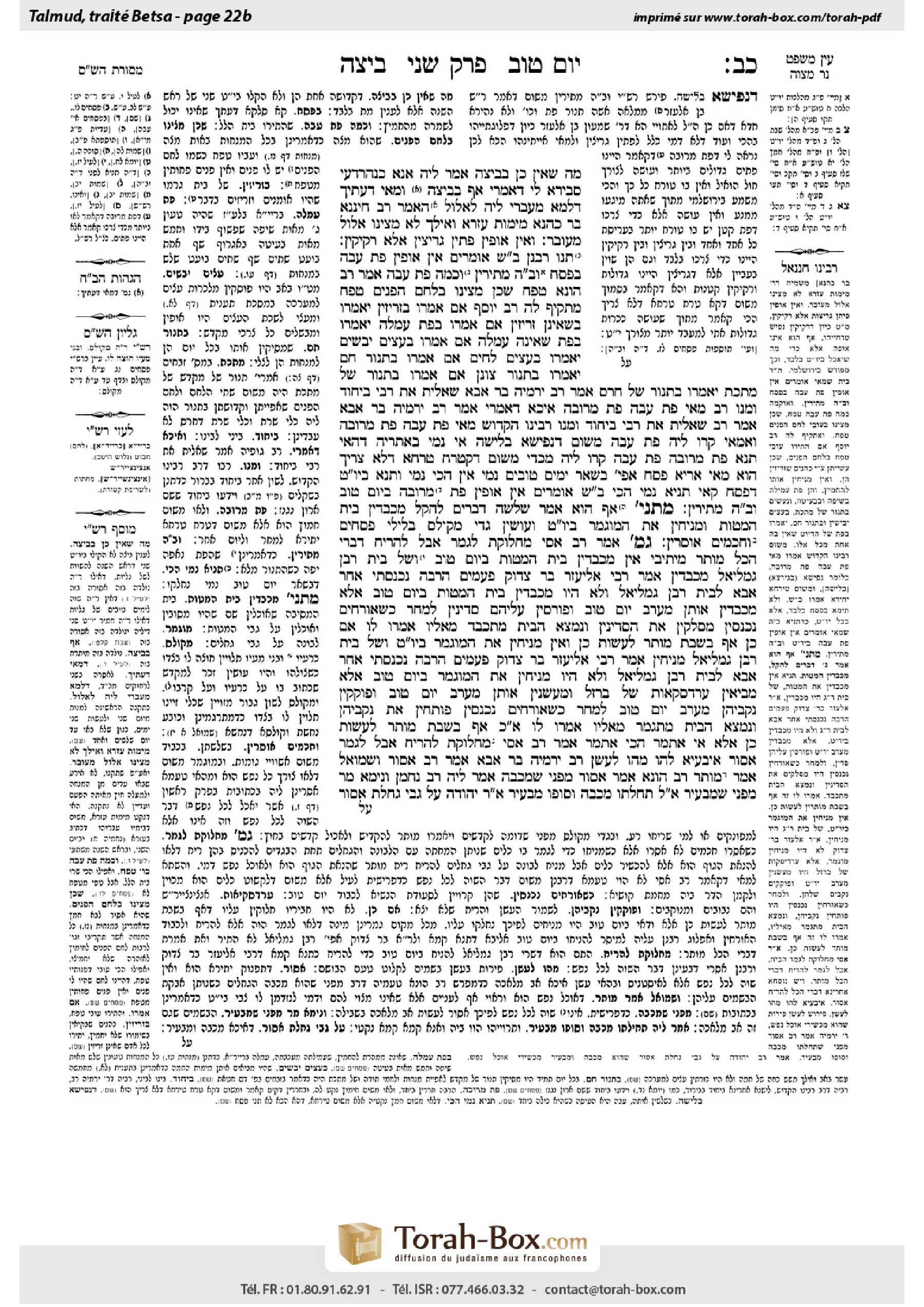
Beitzah 22b: Talmud study for Daf Yomi
Study the Talmud for Daf Yomi with scanned pages, Hebrew text, English translations from Sefaria and AI-generated French translations.
Passage selection and English or AI-generated French translation are available where the scan has annotations. Daf Study is independent of Torah-Box and Sefaria.
Browse Beitzah · ביצה · All tractatesBeitzah 22b text and translations
This page of Beitzah includes the Aramaic text, an English translation and an AI-generated French translation, alongside the scan above.
ביצה כ״ב ב · Aramaic and Hebrew text
מַה שֶּׁאֵין כֵּן בְּבֵיצָה!
אֲמַר לֵיהּ: אֲנָא כִּנְהַרְדָּעֵי סְבִירָא לִי, דְּאָמְרִי אַף בְּבֵיצָה. וּמַאי דַּעְתָּיךְ — דִּלְמָא מְעַבְּרִי לֵיהּ לֶאֱלוּל? הָאָמַר רַב חִינָּנָא בַּר כָּהֲנָא: מִימוֹת עֶזְרָא וְאֵילָךְ לֹא מָצִינוּ אֱלוּל מְעוּבָּר.
וְאֵין אוֹפִין פִּתִּין גְּרִיצִין אֶלָּא רְקִיקִין. תָּנוּ רַבָּנַן, בֵּית שַׁמַּאי אוֹמְרִים: אֵין אוֹפִין פַּת עָבָה בְּפֶסַח, וּבֵית הִלֵּל מַתִּירִין. וְכַמָּה פַּת עָבָה — אָמַר רַב הוּנָא: טֶפַח. שֶׁכֵּן מָצִינוּ בְּלֶחֶם הַפָּנִים, טֶפַח.
מַתְקֵיף לַהּ רַב יוֹסֵף: אִם אָמְרוּ בִּזְרִיזִין — יֹאמְרוּ בְּשֶׁאֵינָן זְרִיזִין? אִם אָמְרוּ בְּפַת עֲמִלָה — יֹאמְרוּ בְּפַת שֶׁאֵינָהּ עֲמִלָה?
אִם אָמְרוּ בְּעֵצִים יְבֵשִׁים — יֹאמְרוּ בְּעֵצִים לַחִים? אִם אָמְרוּ בַּתַּנּוּר חַם — יֹאמְרוּ בְּתַנּוּר צוֹנֵן? אִם אָמְרוּ בְּתַנּוּר שֶׁל מַתֶּכֶת — יֹאמְרוּ בְּתַנּוּר שֶׁל חֶרֶס?
אָמַר רַב יִרְמְיָה בַּר אַבָּא: שְׁאֵלִית אֶת רַבִּי בְּיִחוּד, וּמַנּוּ — רַב: מַאי פַּת עָבָה? פַּת מְרוּבָּה.
אִיכָּא דְּאָמְרִי, אָמַר רַב יִרְמְיָה בַּר אַבָּא אָמַר רַב: שְׁאֵלִית אֶת רַבִּי בְּיִחוּד, וּמַנּוּ — רַבֵּינוּ הַקָּדוֹשׁ: מַאי פַּת עָבָה? פַּת מְרוּבָּה. וְאַמַּאי קָרוּ לֵיהּ פַּת עָבָה? מִשּׁוּם דִּנְפִישָׁא בְּלִישָׁה. אִי נָמֵי, בְּאַתְרֵיהּ דְּהַאי תַּנָּא, פַּת מְרוּבָּה — פַּת עָבָה קָרוּ לֵיהּ
מִכְּדִי מִשּׁוּם דְּקָטָרַח טִרְחָא דְּלָא צְרִיךְ הוּא, מַאי אִרְיָא פֶּסַח? אֲפִילּוּ בִּשְׁאָר יָמִים טוֹבִים נָמֵי! אִין הָכִי נָמֵי. וְתַנָּא, בְּיוֹם טוֹב דְּפֶסַח קָאֵי. תַּנְיָא נָמֵי הָכִי, בֵּית שַׁמַּאי אוֹמְרִים: אֵין אוֹפִין פַּת מְרוּבָּה בְּיוֹם טוֹב, וּבֵית הִלֵּל מַתִּירִין.
מַתְנִי׳ אַף הוּא אָמַר שְׁלֹשָׁה דְּבָרִים לְהָקֵל: מְכַבְּדִין בֵּית הַמִּטּוֹת, וּמַנִּיחִין אֶת הַמּוּגְמָר בְּיוֹם טוֹב, וְעוֹשִׂין גְּדִי מְקוּלָּס בְּלֵילֵי פְסָחִים. וַחֲכָמִים אוֹסְרִין.
גְּמָ׳ אָמַר רַב אַסִּי: מַחְלוֹקֶת לְגַמֵּר, אֲבָל לְהָרִיחַ — דִּבְרֵי הַכֹּל מוּתָּר.
מֵיתִיבִי: אֵין מְכַבְּדִין בֵּית הַמִּטּוֹת בְּיוֹם טוֹב, וְשֶׁל בֵּית רַבָּן גַּמְלִיאֵל מְכַבְּדִין. אָמַר רַבִּי אֱלִיעֶזֶר בַּר צָדוֹק: פְּעָמִים הַרְבֵּה נִכְנַסְתִּי אַחַר אַבָּא, לְבֵית רַבָּן גַּמְלִיאֵל וְלֹא הָיוּ מְכַבְּדִין בֵּית הַמִּטּוֹת בְּיוֹם טוֹב, אֶלָּא מְכַבְּדִין אוֹתָן מֵעֶרֶב יוֹם טוֹב, וּפוֹרְסִין עֲלֵיהֶם סְדִינִין. לְמָחָר, כְּשֶׁאוֹרְחִים נִכְנָסִין, מְסַלְּקִין אֶת הַסְּדִינִין וְנִמְצָא הַבַּיִת מִתְכַּבֵּד מֵאֵלָיו. אָמְרוּ לוֹ: אִם כֵּן, אַף בַּשַּׁבָּת מוּתָּר לַעֲשׂוֹת כֵּן.
וְאֵין מַנִּיחִין אֶת הַמּוּגְמָר בְּיוֹם טוֹב, וְשֶׁל בֵּית רַבָּן גַּמְלִיאֵל מַנִּיחִין. אָמַר רַבִּי אֱלִיעֶזֶר בַּר צָדוֹק: פְּעָמִים הַרְבֵּה נִכְנַסְתִּי אַחַר אַבָּא לְבֵית רַבָּן גַּמְלִיאֵל, וְלֹא הָיוּ מַנִּיחִין אֶת הַמּוּגְמָר בְּיוֹם טוֹב, אֶלָּא מְבִיאִין עַרְדַּסְקָאוֹת שֶׁל בַּרְזֶל וּמְעַשְּׁנִין אוֹתָן מֵעֶרֶב יוֹם טוֹב, וּפוֹקְקִין נִקְבֵיהֶן מֵעֶרֶב יוֹם טוֹב. לְמָחָר, כְּשֶׁאוֹרְחִים נִכְנָסִין, פּוֹתְחִין אֶת נִקְבֵיהֶן וְנִמְצָא הַבַּיִת מִתְגַּמֵּר מֵאֵלָיו.
אָמְרוּ לוֹ: אִם כֵּן, אַף בַּשַּׁבָּת מוּתָּר לַעֲשׂוֹת כֵּן.
אֶלָּא, אִי אִתְּמַר הָכִי אִתְּמַר, אָמַר רַב אַסִּי: מַחְלוֹקֶת לְהָרִיחַ, אֲבָל לְגַמֵּר — אָסוּר.
אִיבַּעְיָא לְהוּ: מַהוּ לְעַשֵּׁן? רַב יִרְמְיָה בַּר אַבָּא אָמַר רַב: אָסוּר. וּשְׁמוּאֵל אָמַר: מוּתָּר. רַב הוּנָא אָמַר: אָסוּר, מִפְּנֵי שֶׁמְּכַבֶּה. אֲמַר לֵיהּ רַב נַחְמָן: וְנֵימָא מָר — מִפְּנֵי שֶׁמַּבְעִיר? אֲמַר לֵיהּ: תְּחִלָּתוֹ מְכַבֶּה וְסוֹפוֹ מַבְעִיר.
אָמַר רַב יְהוּדָה: עַל גַּבֵּי גַּחֶלֶת — אָסוּר.
Beitzah 22b · English translation
which is not so with regard to an egg. With regard to an egg laid on a Festival, the two days of Rosh HaShana are considered one long day and a single period of sanctity. It was only in deference to the dead that the Sages were lenient with regard to burial on the second day of Rosh HaShana, but with regard to all other matters, the two days of Rosh HaShana are viewed as one day and are governed by the same halakha.
Ameimar said to him: I hold in accordance with the opinion of the Sages of Neharde’a, who state this halakha even with regard to an egg laid on the Festival and other matters, as there is no difference between the two days of Rosh HaShana and the two days of other Festivals. And what is your reasoning that you are concerned? Is it that perhaps they will extend the month of Elul and declare it a thirty-day month, which would mean that the second day of the Festival is the first of Tishrei, the true date of Rosh HaShana? But didn’t Rav Ḥinnana bar Kahana say: From the days of Ezra and onward we have not found that the month of Elul was made a full, thirty-day month, and therefore there is no cause for this concern.
§ It is taught in the mishna: And one may not bake thick loaves on a Festival but only thin ones. The Sages taught the following baraita: Beit Shammai say that one may not bake thick bread on Passover, as it might become leavened before it has a chance to bake, whereas Beit Hillel permit it. And how much thickness renders a loaf thick bread that is permitted by Beit Hillel? Rav Huna said: It is up to a thickness of one handbreadth, as we find likewise with regard to the shewbread in the Temple, which must also be unleavened and which was one handbreadth thick.
Rav Yosef strongly objects to this argument of Rav Huna: If the Sages stated this leniency with regard to the shewbread that is prepared by priests, who are vigilant about the mitzvot and ensure that the dough is not leavened, would they say the same with regard to bread that is prepared by ordinary people, who are not as vigilant? Furthermore, if they said this with regard to the shewbread, which is well-kneaded [amela] bread, would they say the same with regard to bread that is not as well kneaded?
Rav Yosef continues: If they stated this leniency in the case of dry wood, which was used in the Temple, as it would burn well and bake the bread quickly, would they say the same in the case of moist wood, which is what most people use to heat their ovens? Furthermore, if they said this with regard to the hot oven found in the Temple, would they say the same with regard to a standard oven, which is typically cold in comparison to that of the Temple? And lastly, if they said this with regard to the Temple’s metal oven, which warms up quickly, would they say the same with regard to the earthenware oven that most people use to bake their bread?
Rav Yirmeya bar Abba said: I asked my teacher in private, and who is this teacher? It is Rav. Rav Yirmeya asked him: What is the meaning of thick bread? Rav explained that it means a large quantity of bread, a large amount of dough prepared in a single session. The concern here is not that the bread might become leavened, but that its preparation involves unnecessary exertion on the Festival.
Some say that Rav Yirmeya bar Abba said that Rav said: I asked this of my teacher in private; and who is Rav’s teacher? It is our holy Rabbi Yehuda HaNasi. And he explained the matter as follows: What is the meaning of thick bread? It means a large quantity of bread. And why do they call it thick bread? It is because it is greatly expanded at the time of kneading and therefore looks very thick. Alternatively, in the place where this tanna of the mishna lived, a large quantity of bread was called thick bread.
The Gemara asks: Now, since the prohibition here is because he exerts himself unnecessarily, then why did the baraita teach this halakha specifically with respect to Passover? The same halakha should apply with regard to the other Festivals as well. The Gemara answers: Yes, it is indeed so; the halakha is not limited to Passover. But the tanna who taught this halakha was dealing at the time with the festival of Passover and therefore mentioned this halakha in relation to that Festival, even though it applies in equal fashion to the other Festivals. The Gemara comments that this is also taught in a baraita: Beit Shammai say: One may not bake a large quantity of bread on any Festival, whereas Beit Hillel permit it.
MISHNA: Rabban Gamliel also said three things as leniencies, in opposition to the view of most of the Sages: One may sweep the room of the couches on a Festival, i.e., the dining room, where they would recline on couches to eat, as there is no concern that by sweeping the room one might come to fill in the holes and level the ground. And one may place incense consisting of fragrant herbs on burning coals in order to perfume one’s house on a Festival. And one may prepare a whole kid goat, meaning a kid goat roasted whole, with its entrails over its head, on the night of Passover, as was the custom when they roasted the Paschal lamb in the Temple. However, the Rabbis prohibit all three practices: It is prohibited to sweep lest one come to level the ground, it is prohibited to burn incense because it does not meet the criteria of permitted food preparation, and it is prohibited to eat a kid that was roasted whole on the night of Passover because it would appear as if he were eating consecrated food outside the Temple.
GEMARA: Rav Asi said: The dispute with regard to incense applies only to a case where one wishes to burn the incense in order to perfume his garments. However, if he burns the incense in order to enjoy the smell, all agree that this is like other bodily pleasures, the satisfaction of which has the same status as food preparation, and it is therefore permitted.
The Gemara raises an objection against Rav Asi’s understanding of the mishna from the following Tosefta: One may not sweep the room of the couches on a Festival lest he fill in holes and level the ground, but in the house of Rabban Gamliel they did sweep, as they did not share this concern. Rabbi Eliezer bar Tzadok said: On many occasions I followed Father, Rabbi Tzadok, into Rabban Gamliel’s house, and I observed that they would not actually sweep the room of the couches on a Festival, but rather they would do the following: They would sweep the room on the eve of the Festival and spread sheets over it so that it would not become dirty, and on the following day, when the guests entered, they removed the sheets, and it turned out that the house was cleaned on its own. The other Sages said to him: If so, it is permitted to do so on Shabbat as well, and there is no dispute in that case.
The Tosefta continues: Similarly, one may not place incense on burning coals on a Festival, but in the house of Rabban Gamliel they did place incense. Rabbi Eliezer bar Tzadok said: On many occasions I followed Father into Rabban Gamliel’s house, and I noticed that they would not actually place incense on burning coals on a Festival, but rather they would bring perforated coal pans [ardaska’ot] made of iron, filled them with fragrant smoke on the eve of the Festival, and plugged their holes on the Festival eve so that their fragrant smell would not escape. On the following day, when the guests entered, they opened the holes, releasing the smell throughout the house, and it turned out that the house was perfumed on its own.
The other Sages said to him: If so, it is permitted to do so on Shabbat as well. This shows that the issue was not the perfuming of clothes but rather the burning of incense for the smell in the house. It follows that the Sages prohibit the practice even when the incense is burned for the enjoyment of the smell, against the opinion of Rav Asi.
Rather, the Gemara retracts its previous statement and says that if this was stated, it was stated as follows: Rav Asi said that the dispute with regard to incense applies only to a case where one burns the incense in order to enjoy the smell. However, if he burns the incense in order to perfume his garments, all agree that it is prohibited.
A dilemma was raised before the Sages: What is the halakha with regard to smoking fruit on a Festival with incense in order to enhance its aroma? Rav Yirmeya bar Abba said that Rav said: It is prohibited, as it is not included in the category of permitted food preparation. And Shmuel said: It is permitted. Rav Huna said: It is prohibited because he extinguishes some of the coals when he sprinkles the aromatic powder on them. Rav Naḥman said to him: And let the Master say that it is prohibited because he kindles the coals, as afterward the fragrant spices cause the coals to burn even more strongly; why are you not concerned about this? Rav Huna said to him: Two prohibitions are indeed violated: Its beginning involves extinguishing, and its end involves kindling.
Rav Yehuda said: Sprinkling the aromatic spices on the coals themselves is in fact prohibited for the aforementioned reasons.
Beitzah 22b · Traduction française (IA)
Ce n'est pas le cas pour un œuf. En ce qui concerne un œuf pondu pendant un festival, les deux jours de Rosh HaShana sont considérés comme un seul jour et une seule période de sanctité. C'était uniquement par l'égard des morts que les Sages ont été indulgents concernant l'enterrement le deuxième jour de Rosh HaShana, mais concernant toutes les autres questions, les deux jours de Rosh HaShana sont vus comme un seul jour et soumis à la même halakha.
Ameimar dit à lui : Je suis d'avec l'opinion des Sages de Neharde’a, qui affirment cette halakha même concernant un œuf pondu pendant le festival et d'autres questions, car il n'y a pas de différence entre les deux jours de Rosh HaShana et les deux jours d'autres festivals. Et quelle est votre raison d'être préoccupé ? Est-ce que vous craignez qu'ils prolongent le mois d'Elul et l'annoncent comme un mois de trente jours, ce qui signifierait que le deuxième jour du festival est le premier de Tishrei, la date réelle de Rosh HaShana ? Mais n'a-t-il pas dit Rav Ḥinnana bar Kahana : Depuis les jours d'Ezra et après, nous n'avons pas trouvé que le mois d'Elul ait été rendu un mois complet de trente jours, et donc il n'y a pas lieu de s'inquiéter de cela.
§ Il est enseigné dans la mitsna : On ne doit pas cuire des pains épais pendant un festival, mais seulement des pains fins. Les Sages ont enseigné la suivante baraïta : Beit Shammai disent qu'on ne doit pas cuire des pains épais pendant la Pâque, car cela pourrait lever avant d'avoir eu le temps de cuire, tandis que Beit Hillel permettent cela. Et jusqu'à quelle épaisseur un pain est-il considéré comme un pain épais, autorisé par Beit Hillel ? Rav Huna a dit : Jusqu'à une épaisseur d'une paume, car nous trouvons également cela concernant le pain de proposition dans le Temple, qui doit être sans levain et qui était d'une paume d'épaisseur.
Rav Yosef s'oppose fermement à cet argument de Rav Huna : Si les Sages ont dit cette indulgence concernant le pain de proposition préparé par les prêtres, qui sont vigilants concernant les mitsvot et assurent que la pâte ne leve pas, auraient-ils dit la même chose concernant le pain préparé par les gens ordinaires, qui ne sont pas aussi vigilants ? De plus, si ils l'ont dit concernant le pain de proposition, qui est bien pétri [amela], auraient-ils dit la même chose concernant le pain qui n'est pas aussi bien pétri ?
Rav Yosef continue : Si ils ont dit cette indulgence dans le cas du bois sec, utilisé dans le Temple, car il brûle bien et cuit le pain rapidement, auraient-ils dit la même chose dans le cas du bois humide, qui est celui que la plupart des gens utilisent pour chauffer leurs fours ? De plus, si ils l'ont dit concernant le four chaud trouvé dans le Temple, auraient-ils dit la même chose concernant un four ordinaire, qui est généralement froid par rapport à celui du Temple ? Et en dernier lieu, si ils l'ont dit concernant le four en métal du Temple, qui s'chauffe rapidement, auraient-ils dit la même chose concernant le four en terre cuite que la plupart des gens utilisent pour cuire leur pain ?
Rav Yirmeya bar Abba a dit : J'ai demandé à mon maître en privé, et qui est ce maître ? C'est Rav. Rav Yirmeya a demandé : Quelle est la signification du pain épais ? Rav a expliqué que cela signifie une grande quantité de pain, une grande quantité de pâte préparée en une seule séance. La préoccupation ici n'est pas que le pain puisse lever, mais que sa préparation implique un effort inutile pendant le festival.
Certains disent que Rav Yirmeya bar Abba a dit que Rav a dit : J'ai demandé cela à mon maître en privé ; et qui est le maître de Rav ? C'est notre saint Rabbi Yehuda HaNasi. Et il a expliqué ainsi : Quelle est la signification du pain épais ? Cela signifie une grande quantité de pain. Et pourquoi l'appellent-ils pain épais ? C'est parce qu'il est très étalé lors du pétrissage et donc semble très épais. Alternativement, dans la région où ce tanna de la mitsna habitait, une grande quantité de pain était appelée pain épais.
La Guemara pose la question : Maintenant, puisque l'interdiction est due à l'effort inutile, pourquoi la baraïta a-t-elle enseigné cette halakha spécifiquement concernant la Pâque ? La même halakha devrait s'appliquer aux autres festivals également. La Guemara répond : Oui, c'est effectivement ainsi ; la halakha n'est pas limitée à la Pâque. Mais le tanna qui a enseigné cette halakha était à l'époque en train de traiter du festival de Pâque et a donc mentionné cette halakha en relation avec ce festival, même si elle s'applique de la même manière aux autres festivals. La Guemara commente que cela est également enseigné dans une baraïta : Beit Shammai disent : On ne doit pas cuire une grande quantité de pain pendant n'importe quel festival, tandis que Beit Hillel permettent cela.
MICHNA : Rabban Gamliel a également dit trois choses comme des leniencies, en opposition à la vue de la plupart des Sages : On peut balayer la pièce des coussins pendant un festival, c'est-à-dire la salle à manger, où ils se rejetaient sur des coussins pour manger, car il n'y a pas de crainte que par le balayage de la pièce on vienne à combler les trous et à niveler le sol. Et on peut placer de l'encens composé d'herbes parfumées sur des braises afin de parfumer sa maison pendant un festival. Et on peut préparer un petit agneau, c'est-à-dire un agneau cuit entier, avec ses entrailles sur sa tête, la nuit de Pâque, comme c'était la coutume lorsqu'ils cuitaient l'agneau pascal dans le Temple. Cependant, les Rabbins interdisent les trois pratiques : Il est interdit de balayer de peur qu'on vienne à niveler le sol, il est interdit de brûler de l'encens car cela ne correspond pas aux critères de préparation alimentaire autorisée, et il est interdit de manger un agneau cuit entier la nuit de Pâque car cela pourrait paraître qu'on mangeait un aliment consacré en dehors du Temple.
GUEMARA : Rav Asi a dit : Le débat concernant l'encens s'applique uniquement à un cas où l'on souhaite brûler l'encens afin de parfumer ses vêtements. Cependant, si l'on brûle l'encens afin de profiter de l'odeur, tous s'accordent à dire que cela est comme d'autres plaisirs corporels, dont la satisfaction a le même statut que la préparation alimentaire, et il est donc autorisé.
Le Guemara soulève une objection contre la compréhension de Rav Asi de la mitsna, à partir de la suivante Tosefta : On ne doit pas balayer la pièce des coussins pendant un festival, de peur de combler les trous et de niveler le sol, mais dans la maison de Rabban Gamliel ils balayaient, car ils ne partageaient pas cette préoccupation. Rabbi Eliezer bar Tzadok dit : J'ai suivi de nombreuses fois mon père, Rabbi Tzadok, dans la maison de Rabban Gamliel, et j'ai observé qu'ils ne balayaient pas effectivement la pièce des coussins pendant un festival, mais plutôt ils faisaient ceci : Ils balayaient la pièce la veille du festival et étendaient des draps sur elle afin qu'elle ne se salisse pas, et le lendemain, lorsqu'ils recevaient les invités, ils retiraient les draps, et il s'avérait que la maison était propre toute seule. Les autres Sages dirent à lui : Si c'est ainsi, il est permis de le faire aussi le sabbat, et il n'y a pas de débat dans ce cas-là.
La Tosefta continue ainsi : De même, on ne doit pas placer de parfum sur des braises brûlantes pendant un festival, mais dans la maison de Rabban Gamliel ils plaçaient du parfum. Rabbi Eliezer bar Tzadok dit : J'ai suivi de nombreuses fois mon père dans la maison de Rabban Gamliel, et j'ai remarqué qu'ils ne plaçaient pas effectivement du parfum sur des braises brûlantes pendant un festival, mais plutôt ils apportaient des récipients en fer percés [ardaska’ot], remplis de fumée parfumée la veille du festival, et ils bouchaient leurs trous la veille du festival afin que leur parfum ne s'échappe pas. Le lendemain, lorsqu'ils recevaient les invités, ils ouvraient les trous, libérant ainsi l'odeur dans toute la maison, et il s'avérait que la maison était parfumée toute seule.
Les autres Sages dirent à lui : Si c'est ainsi, il est permis de le faire aussi le sabbat. Cela montre que la question ne concernait pas le parfum des vêtements mais plutôt la combustion de parfum pour l'odeur de la maison. Il en suit que les Sages interdisent cette pratique même lorsque le parfum est brûlé pour l'agrément de l'odeur, contrairement à l'opinion de Rav Asi.
Au contraire, le Guemara retire sa déclaration précédente et dit que si cela a été dit, cela a été dit ainsi : Rav Asi dit que le débat concernant le parfum s'applique uniquement à un cas où l'on brûle le parfum pour l'agrément de l'odeur. Cependant, si l'on brûle le parfum pour parfumer ses vêtements, tous s'accordent à dire qu'il est interdit.
Un dilemme a été soulevé devant les Sages : Quelle est la halakha concernant la fumage de fruits pendant un festival avec du parfum afin d'augmenter leur odeur ? Rav Yirmeya bar Abba dit que Rav dit : C'est interdit, car cela n'appartient pas à la catégorie de la préparation alimentaire permise. Et Shmuel dit : C'est permis. Rav Huna dit : C'est interdit car il éteint certaines des braises lorsqu'il saupoudre la poudre parfumée dessus. Rav Naḥman dit à lui : Et que le Maître dise que c'est interdit car il allume les braises, car après cela les épices parfumés font brûler les braises encore plus fort ; pourquoi ne t'occupes-tu pas de cela ? Rav Huna dit à lui : Deux prohibitions sont en effet violées : son commencement implique d'éteindre, et sa fin implique d'allumer.
Rav Yehuda dit : Saupoudrer les épices aromatiques sur les braises elles-mêmes est en effet interdit pour les raisons mentionnées ci-dessus.
Traduction française générée par IA à partir de l’édition anglaise de Sefaria. Vérifie toujours un passage avec le texte source.
Text from Sefaria: William Davidson Edition - Vocalized Aramaic (CC BY NC); William Davidson Edition - English (CC BY NC).