Beitzah 23a: Talmud study for Daf Yomi
Study the Talmud for Daf Yomi with scanned pages, Hebrew text, English translations from Sefaria and AI-generated French translations.
Passage selection and English or AI-generated French translation are available where the scan has annotations. Daf Study is independent of Torah-Box and Sefaria.
Browse Beitzah · ביצה · All tractatesBeitzah 23a text and translations
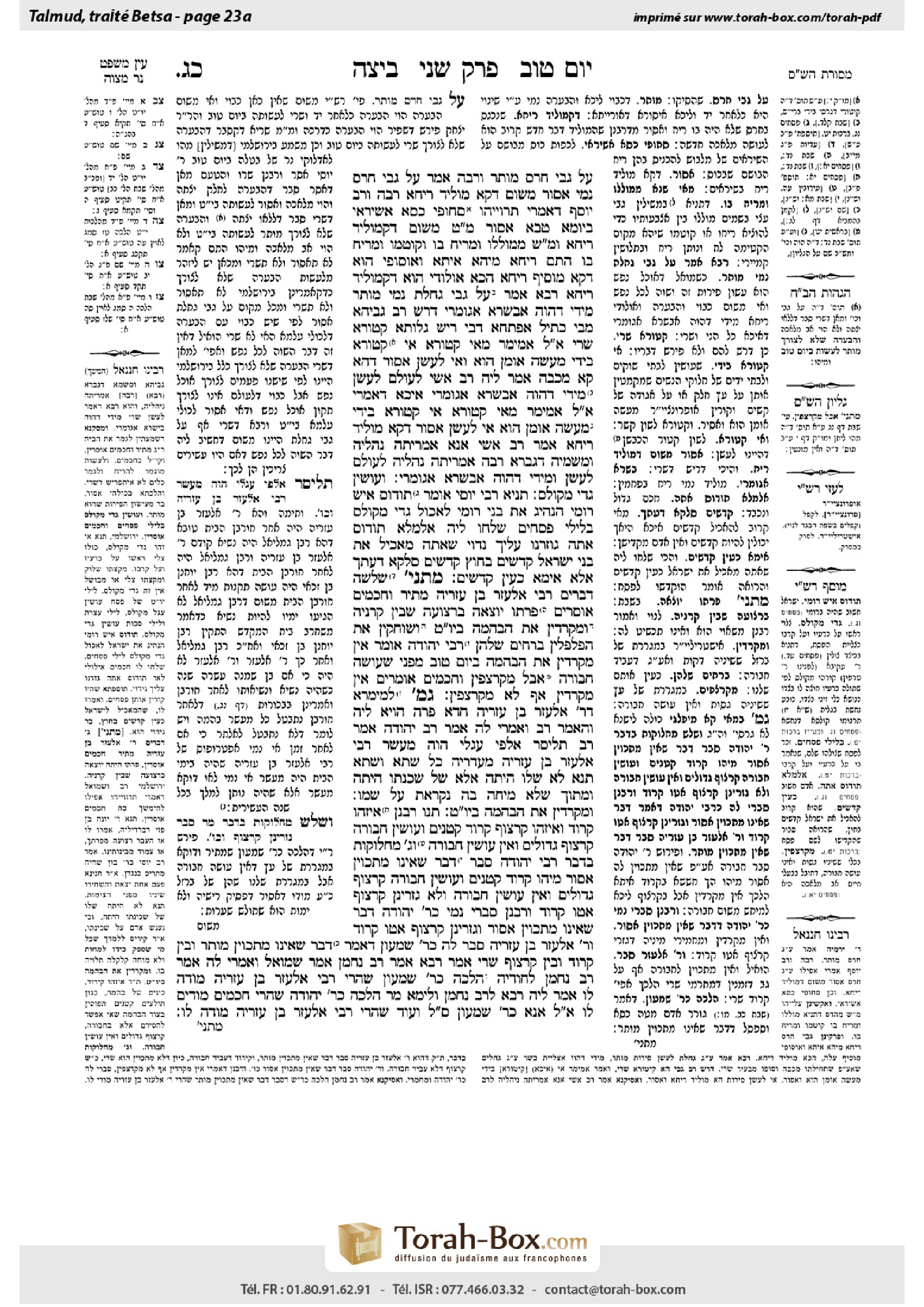
This page of Beitzah includes the Aramaic text, an English translation and an AI-generated French translation, alongside the scan above.
ביצה כ״ג א · Aramaic and Hebrew text
עַל גַּבֵּי חֶרֶס — מוּתָּר.
וְרַבָּה אָמַר: עַל גַּבֵּי חֶרֶס נָמֵי אָסוּר, מִשּׁוּם דְּקָא מוֹלֵיד רֵיחָא. רַבָּה וְרַב יוֹסֵף דְּאָמְרִי תַּרְוַיְיהוּ: סַחוֹפֵי כָּסָא אַשִּׁירָאֵי בְּיוֹמָא טָבָא — אָסוּר, מַאי טַעְמָא — מִשּׁוּם דְּקָמוֹלֵיד רֵיחָא.
וּמַאי שְׁנָא מִמּוֹלְלוֹ וּמֵרִיחַ בּוֹ וְקוֹטְמוֹ וּמֵרֵיחַ בּוֹ? הָתָם — רֵיחָא מִיהָא אִיתָא, וְאוֹסוֹפֵי הוּא דְּקָא מוֹסִיף רֵיחָא. הָכָא — אוֹלוֹדֵי הוּא דְּקָמוֹלֵיד רֵיחָא. רָבָא אָמַר: עַל גַּבֵּי גַּחֶלֶת נָמֵי מוּתָּר, מִידֵּי דְּהָוֵה אַבִּשְׂרָא אַגּוּמְרֵי.
דָּרֵשׁ רַב גְּבִיהָא מִבֵּי כְתִיל אַפִּתְחָא דְּבֵי רֵישׁ גָּלוּתָא: קִטּוּרָא שְׁרֵי. אֲמַר לֵיהּ אַמֵּימָר: מַאי ״קִטּוּרָא״? אִי קִטּוּרָא בִּידֵי — מַעֲשֵׂה אוּמָּן הוּא, וְאִי לְעַשֵּׁן — אָסוּר, דְּהָא קָא מְכַבֶּה! אֲמַר לֵיהּ רַב אָשֵׁי: לְעוֹלָם לְעַשֵּׁן, מִידֵּי דְּהָוֵה אַבִּשְׂרָא אַגּוּמְרֵי.
אִיכָּא דְאָמְרִי. אֲמַר לֵיהּ אַמֵּימָר: מַאי ״קִטּוּרָא״? אִי קִטּוּרָא בִּידֵי — מַעֲשֵׂה אוּמָּן הוּא. אִי לְעַשֵּׁן — אָסוּר דְּקָא מוֹלֵיד רֵיחָא! אָמַר רַב אָשֵׁי: אֲנָא אַמְרִיתַהּ נִהֲלֵיהּ, וּמִשְּׁמֵיהּ דְּגַבְרָא רַבָּה אַמְרִיתַהּ נִהֲלֵיהּ: לְעוֹלָם לְעַשֵּׁן, וּמִידֵּי דְּהָוֵה אַבִּשְׂרָא אַגּוּמְרֵי.
וְעוֹשִׂין גְּדִי מְקוּלָּס. תַּנְיָא רַבִּי יוֹסֵי אוֹמֵר: תּוֹדוֹס אִישׁ רוֹמִי הִנְהִיג אֶת בְּנֵי רוֹמִי לֶאֱכוֹל גְּדִי מְקוּלָּס בְּלֵילֵי פְּסָחִים. שְׁלַחוּ לֵיהּ: אִלְמָלֵא תּוֹדוֹס אַתָּה, גּוֹזְרָנוּ עָלֶיךָ נִדּוּי, שֶׁאַתָּה מַאֲכִיל אֶת בְּנֵי יִשְׂרָאֵל קָדָשִׁים בַּחוּץ.
קָדָשִׁים סָלְקָא דַּעְתָּךְ?! אֶלָּא אֵימָא: כְּעֵין קָדָשִׁים.
מַתְנִי׳ שְׁלֹשָׁה דְּבָרִים רַבִּי אֶלְעָזָר בֶּן עֲזַרְיָה מַתִּיר וַחֲכָמִים אוֹסְרִים: פָּרָתוֹ יוֹצְאָה בִּרְצוּעָה שֶׁבֵּין קַרְנֶיהָ.
וּמְקָרְדִין אֶת הַבְּהֵמָה בְּיוֹם טוֹב. וְשׁוֹחֲקִין אֶת הַפִּלְפְּלִין בָּרֵחַיִם שֶׁלָּהֶן.
רַבִּי יְהוּדָה אוֹמֵר: אֵין מְקָרְדִין אֶת הַבְּהֵמָה בְּיוֹם טוֹב, מִפְּנֵי שֶׁעוֹשֶׂה חַבּוּרָה, אֲבָל מְקַרְצְפִין. וַחֲכָמִים אוֹמְרִים: אֵין מְקָרְדִין, אַף לֹא מְקַרְצְפִין.
גְּמָ׳ לְמֵימְרָא דְּרַבִּי אֶלְעָזָר בֶּן עֲזַרְיָה חֲדָא פָּרָה הַוְיָא לֵיהּ? וְהָאָמַר רַב, וְאָמְרִי לַהּ אָמַר רַב יְהוּדָה אָמַר רַב: תְּלֵיסַר אַלְפֵי עִגְלֵי הֲוָה מְעַשַּׂר רַבִּי אֶלְעָזָר בֶּן עֲזַרְיָה מֵעֶדְרֵיהּ כׇּל שַׁתָּא וְשַׁתָּא. תָּנָא: לֹא שֶׁלּוֹ הָיְתָה, אֶלָּא שֶׁל שְׁכֶנְתּוֹ הָיְתָה, וּמִתּוֹךְ שֶׁלֹּא מִיחָה בָּהּ — נִקְרֵאת עַל שְׁמוֹ.
וּמְקָרְדִין אֶת הַבְּהֵמָה בְּיוֹם טוֹב. תָּנוּ רַבָּנַן: אֵיזֶהוּ קֵרוּד וְאֵיזֶהוּ קִרְצוּף? קֵרוּד — קְטַנִּים וְעוֹשִׂין חַבּוּרָה, קִרְצוּף — גְּדוֹלִים וְאֵין עוֹשִׂין חַבּוּרָה.
וְשָׁלֹשׁ מַחְלוֹקוֹת בַּדָּבָר, רַבִּי יְהוּדָה סָבַר: דָּבָר שֶׁאֵינוֹ מִתְכַּוֵּין — אָסוּר. מִיהוּ: קֵרוּד — קְטַנִּים, וְעוֹשִׂין חַבּוּרָה. קִרְצוּף — גְּדוֹלִים, וְאֵין עוֹשִׂין חַבּוּרָה. וְלָא גָּזְרִינַן קִרְצוּף אַטּוּ קֵרוּד.
וְרַבָּנַן סָבְרִי נָמֵי כְּרַבִּי יְהוּדָה, דָּבָר שֶׁאֵינוֹ מִתְכַּוֵּין — אָסוּר, וְגָזְרִינַן קִרְצוּף אַטּוּ קֵרוּד. וְרַבִּי אֶלְעָזָר בֶּן עֲזַרְיָה סָבַר לַהּ כְּרַבִּי שִׁמְעוֹן דְּאָמַר: דָּבָר שֶׁאֵינוֹ מִתְכַּוֵּין — מוּתָּר, וּבֵין קֵרוּד וּבֵין קִרְצוּף שְׁרֵי.
אָמַר רָבָא אָמַר רַב נַחְמָן אָמַר שְׁמוּאֵל, וְאָמְרִי לַהּ אָמַר רַב נַחְמָן לְחוֹדֵיהּ: הֲלָכָה כְּרַבִּי שִׁמְעוֹן, שֶׁהֲרֵי רַבִּי אֶלְעָזָר בֶּן עֲזַרְיָה מוֹדֶה לוֹ. אֲמַר לֵיהּ רָבָא לְרַב נַחְמָן: וְלֵימָא מָר, הֲלָכָה כְּרַבִּי יְהוּדָה שֶׁהֲרֵי חֲכָמִים מוֹדִים לוֹ! אֲמַר לֵיהּ: אֲנָא כְּרַבִּי שִׁמְעוֹן סְבִירָא לִי, וְעוֹד שֶׁהֲרֵי רַבִּי אֶלְעָזָר בֶּן עֲזַרְיָה מוֹדֶה לוֹ.
Beitzah 23a · English translation
However, placing them on a scalding fragment of earthenware is permitted, as there is no concern of extinguishing or kindling.
And Rabba said: Placing the spices on a hot piece of earthenware is also prohibited, because it produces a new scent in the earthenware, and one may not create new things on a Festival. The Gemara notes that similarly, Rabba and Rav Yosef both said the following: It is prohibited to overturn a cup containing perfume onto silk garments on a Festival. What is the reason for this prohibition? It is because it produces a new scent in the garment.
The Gemara asks: And in what way is this case different from the case discussed in the following baraita: One may press a piece of aromatic wood between his fingers and smell it, and one may also snip off a piece of it in order to release its fragrance and smell it? In those cases too he produces a scent. The Gemara answers: There, the scent exists in any case, and he merely adds to the fragrance, as his pressing or snipping causes the smell to be stronger. Here, on the other hand, where he overturns a cup of perfume on clothing, he produces a new scent. Rava, however, said: It is even permitted to sprinkle the aromatic spices on the coals themselves, just as it is permitted to place meat on coals for roasting.
The Gemara relates that Rav Geviha from Bei Katil once taught at the entrance to the house of the Exilarch that ketura is permitted on a Festival; but he did not add any further clarification. Ameimar said to him: What is the meaning of ketura? If it means tying [ketura] ornamental knots by hand, this is the act of a craftsman and is therefore certainly prohibited on a Festival. And if it is referring to burning incense [ketoret], this too is prohibited, as he extinguishes some of the coals when he sprinkles the aromatic powder on them. Rav Ashi said to him: Actually, it is referring to burning incense, which is permitted, just as it is permitted to place meat on coals for roasting.
Some say a slightly different version of this story, in which Ameimar said to Rav Geviha: What is the meaning of ketura? If it means tying ornamental knots by hand, this is the act of a craftsman, which is prohibited. If it is referring to burning incense, this too is prohibited, as he produces a new scent. Rav Ashi said: I said this halakha to Rav Geviha, and I said it in the name of a great man, Rava, that actually it is referring to burning incense, which is permitted, just as it is permitted to place meat on coals for roasting.
§ It is taught in the mishna that one of Rabban Gamliel’s three leniencies was that one may prepare a whole [mekulas] kid goat, meaning a goat roasted whole, with its entrails over its head, on the night of Passover. It is taught in a baraita in this regard that Rabbi Yosei says: Theodosius [Todos] of Rome, leader of the Jewish community there, instituted the custom for the Roman Jews to eat whole kids on the night of Passover, in commemoration of the practice followed in the Temple. The Sages sent a message to him: Were you not Theodosius, an important person, we would have decreed ostracism upon you, as you are feeding the Jewish people consecrated food, which may be eaten only in and around the Temple itself, outside the Temple.
The Gemara expresses surprise: Can it enter your mind that the Sages really meant that Theodosius was feeding the Jewish people consecrated food outside the Temple? These goats are certainly not consecrated animals. Rather, say that he was feeding the Jewish people something similar to consecrated food, which people might mistake for a Paschal offering.
MISHNA: There are three things that Rabbi Elazar ben Azarya permits and the Rabbis prohibit: His cow would go out on Shabbat with a decorative strap between its horns. Rabbi Elazar holds that such a strap is considered an ornament for the cow rather than a burden, whereas the Sages view it as a burden.
And one may comb [mekardin] an animal with a fine comb on a Festival in order to remove ticks and dirt from its hair; the Rabbis prohibit this due to a concern that he might thereby come to wound or bruise the animal. And one may grind pepper needed on the Festival even in its own mill, although this appears similar to a weekday labor.
Rabbi Yehuda says: One may not comb an animal to remove ticks and dirt from its hair on a Festival because this certainly creates a wound, but one may brush it with a wooden comb, as its blunt teeth do not wound the animal. But the Rabbis say: One may not comb, nor may one even brush.
GEMARA: With regard to the mishna’s statement that Rabbi Elazar ben Azarya’s cow would go out on Shabbat with a strap between its horns, the Gemara asks: Is that to say that Rabbi Elazar ben Azarya had only one cow? But didn’t Rav say, and some say that Rav Yehuda said that Rav said: Rabbi Elazar ben Azarya would tithe from his herds thirteen thousand calves each and every year, which means that he had ten times that number of calves alone. Why, then, does the mishna speak of his cow? The Gemara answers that it is taught in the Tosefta: This cow was not his; rather, it was his neighbor’s. And because he did not protest her conduct and tell her that it is prohibited to do so, the cow was called by his name to his discredit, as if it were his.
§ It is taught in the mishna that Rabbi Elazar ben Azarya holds that one may comb an animal on a Festival. The Sages taught in a baraita: What is considered combing and what is brushing? Combing is performed with a small-toothed comb and makes a wound; brushing is done with a large-toothed comb and does not make a wound.
And there are three disputes with regard to this matter. Rabbi Yehuda holds that an unintentional act, a permitted action from which an unintended prohibited labor ensues on Shabbat, is prohibited, as in his opinion it is prohibited to perform an action that involves a prohibited labor on Shabbat even if one has a permitted action in mind and does not intend to perform the labor in question. Therefore, one may not comb an animal in a manner that will cause a wound, even unintentionally. However, he differentiates between the cases: Although he prohibits combing with a small-toothed comb that makes a wound, he permits brushing with a large-toothed comb that does not make a wound, and we do not issue a decree and prohibit brushing due to combing, as there is no concern that people will err and come to permit even combing in the prohibited manner.
And the Rabbis also hold in accordance with the opinion of Rabbi Yehuda with regard to the fundamental issue that an unintentional act is prohibited. However, they maintain that we issue a decree and prohibit brushing due to combing. On the other hand, Rabbi Elazar ben Azarya holds in accordance with the dissenting opinion of Rabbi Shimon, who said that an unintentional act is permitted. Therefore, both combing and brushing are permitted, as even if the combing or brushing bruises the animal, there is no transgression of a prohibition, as there was certainly no intention to cause the animal a wound.
Rava said that Rav Naḥman said that Shmuel said, and some say that Rav Naḥman said this teaching himself: The halakha is in accordance with the opinion of Rabbi Shimon, that an unintentional act is permitted on Shabbat, as Rabbi Elazar ben Azarya agrees with him. Rava said to Rav Naḥman: And let the Master say the opposite, that the halakha is in accordance with the opinion of Rabbi Yehuda, as the Rabbis agree with him. Rav Naḥman said to him: Fundamentally I hold in accordance with the opinion of Rabbi Shimon; I am merely adding another reason for doing so, which is that Rabbi Elazar ben Azarya agrees with him.
Beitzah 23a · Traduction française (IA)
Cependant, placer les épices sur un fragment de terre cuite brûlant est permis, car il n'y a pas de crainte d'éteindre ou d'allumer.
Et Rabba a dit : Placer les épices sur un morceau de terre cuite chaud est également interdit, car cela produit un nouveau parfum dans la terre cuite, et l'on ne peut pas créer de nouvelles choses pendant un festival. La Guemara note que de même, Rabba et Rav Yosef ont tous les deux dit cela : Il est interdit de renverser une coupe contenant un parfum sur des vêtements de soie pendant un festival. Quelle est la raison de cette interdiction ? C'est parce qu'il produit un nouveau parfum dans le vêtement.
La Guemara pose la question : Et dans quelle mesure cette situation diffère-t-elle de celle discutée dans la baraïta suivante : On peut presser un morceau de bois aromatique entre ses doigts et en sentir l'odeur, et on peut aussi couper un morceau pour libérer son parfum et en sentir l'odeur ? Dans ces cas, l'odeur existe déjà, et il n'ajoute qu'à l'odeur, car sa pression ou sa coupure rend l'odeur plus forte. Ici, en revanche, où l'on renverse une coupe de parfum sur des vêtements, il produit un nouveau parfum. Rava, cependant, a dit : Il est même permis de pulvériser les épices aromatiques sur les braises elles-mêmes, tout comme il est permis de placer de la viande sur les braises pour la faire rôtir.
La Guemara rapporte que Rav Geviha de Bei Katil a un jour enseigné à l'entrée de la maison de l'Exilarch que le ketura est permis pendant un festival ; mais il n'a pas ajouté de clarification supplémentaire. Ameimar a dit à lui : Quel est le sens du ketura ? Si cela signifie faire des nœuds ornés à la main, c'est l'acte d'un artisan et est donc certainement interdit pendant un festival. Et si cela fait référence à la combustion d'encens [ketoret], cela est également interdit, car il éteint certaines des braises lorsqu'il pulvérise la poudre aromatique dessus. Rav Ashi a dit à lui : En réalité, cela fait référence à la combustion d'encens, qui est permise, tout comme il est permis de placer de la viande sur les braises pour la faire rôtir.
Certains racontent une version légèrement différente de cette histoire, dans laquelle Ameimar a dit à Rav Geviha : Quel est le sens du ketura ? Si cela signifie faire des nœuds ornés à la main, c'est l'acte d'un artisan, ce qui est interdit. Si cela fait référence à la combustion d'encens, cela est également interdit, car il produit un nouveau parfum. Rav Ashi a dit : J'ai dit cette halakha à Rav Geviha, et j'ai dit cela en nom d'un grand homme, Rava, que cela fait référence à la combustion d'encens, qui est permise, tout comme il est permis de placer de la viande sur les braises pour la faire rôtir.
§ Il est enseigné dans la mishna que l'une des trois leniencies de Rabban Gamliel était que l'on pouvait préparer un petit agneau entier, c'est-à-dire un agneau rôti entier, avec ses entrailles sur sa tête, la nuit du Pessah. Il est enseigné dans une baraïta à ce sujet que Rabbi Yosei dit : Theodosius [Todos] de Rome, chef de la communauté juive là-bas, a institué la coutume pour les Juifs romains de manger des agnelets entiers la nuit du Pessah, en souvenir de la pratique suivie dans le Temple. Les Sages ont envoyé un message à lui : N'étais-tu pas Theodosius, une personne importante, nous aurions décrété l'isolement contre toi, car tu nourris le peuple juif avec des aliments consacrés, qui peuvent être mangés uniquement dans et autour du Temple lui-même, en dehors du Temple.
La Guemara exprime une surprise : Est-ce que cela entre dans votre esprit que les Sages veulent vraiment dire que Théodose nourrissait le peuple juif avec des aliments consacrés en dehors du Temple ? Ces agneaux ne sont certainement pas des animaux consacrés. Plutôt, dites qu'il nourrissait le peuple juif quelque chose similaire aux aliments consacrés, que les gens pourraient confondre avec un sacrifice pascal.
MICHNA : Il y a trois choses que Rabbi Elazar ben Azarya permet et que les Rabbins interdisent : Sa vache sortait le sabbat avec une ceinture décorative entre ses cornes. Rabbi Elazar considère que cette ceinture est un ornement pour la vache plutôt qu'une charge, tandis que les Sages la considèrent comme une charge.
Et l'on peut peigner [mekardin] un animal avec un peigne fin pendant un festival afin d'enlever les tiques et la saleté de ses poils ; les Rabbins interdisent cela en raison de la crainte qu'il puisse ainsi blesser ou égratigner l'animal. Et l'on peut moudre du poivre nécessaire pendant le festival même dans sa propre moulin, bien que cela semble ressembler à un travail du jour de travail.
Rabbi Yehuda dit : On ne peut pas peigner un animal pour enlever les tiques et la saleté de ses poils pendant un festival, car cela crée certainement une blessure, mais on peut le balayer avec un peigne en bois, car ses dents sont lourdes et ne blessent pas l'animal. Mais les Rabbins disent : On ne peut pas peigner, ni même balayer.
GUEMARA : En ce qui concerne la déclaration de la mishna que Rabbi Elazar ben Azarya avait une vache qui sortait le sabbat avec une ceinture entre ses cornes, la Guemara pose la question : Est-ce que cela signifie que Rabbi Elazar ben Azarya avait seulement une vache ? Mais n'a-t-il pas dit Rav, et certains disent que Rav Yehuda a dit que Rav a dit : Rabbi Elazar ben Azarya titrait chaque année treize mille veaux de son troupeau, ce qui signifie qu'il avait dix fois plus de veaux seul. Pourquoi alors la mishna parle-t-elle de sa vache ? La Guemara répond que cela est enseigné dans la Tosefta : Cette vache n'était pas la sienne ; plutôt, c'était celle de son voisin. Et parce qu'il n'a pas protesté contre son comportement et ne lui a pas dit qu'il était interdit de le faire, la vache a été appelée par son nom à son déshonneur, comme si c'était la sienne.
§ Il est enseigné dans la mishna que Rabbi Elazar ben Azarya considère que l'on peut peigner un animal pendant un festival. Les Sages ont enseigné dans une baraïta : Qu'est-ce qui constitue le peignage et qu'est-ce qui constitue le balayage ? Le peignage est fait avec un peigne à dents fines et provoque une blessure ; le balayage est fait avec un peigne à dents larges et ne provoque pas de blessure.
Et il y a trois débats concernant cette question. Rabbi Yéhuda affirme qu'un acte non intentionnel, une action permise dont découle par inadvertance un travail interdit le sabbat, est interdit, car, selon son avis, il est interdit d'accomplir une action impliquant un travail interdit le sabbat, même si l'on a en tête une action permise et qu'on n'a pas l'intention d'accomplir le travail en question. Ainsi, on ne peut pas brosser un animal de manière à le faire souffrir, même par inadvertance. Cependant, il distingue les cas : bien qu'il interdise de brosser avec une brosse à dents fines qui cause une plaie, il permet de brosser avec une brosse à dents larges qui ne cause pas de plaie, et nous ne décrétions pas de prohiber la brossage en raison du brossage, car il n'y a pas de crainte que les gens s'égarent et autorisent même le brossage dans le mode interdit.
Les Sages aussi adoptent l'opinion de Rabbi Yéhuda concernant la question fondamentale, à savoir qu'un acte non intentionnel est interdit. Cependant, ils maintiennent que nous décrétions et prohibons le brossage en raison du brossage. D'un autre côté, Rabbi Eléazar ben Azaryah adopte l'opinion contraire de Rabbi Shim'on, qui affirmait qu'un acte non intentionnel est permis. Ainsi, tant le brossage que le brossage sont permis, car même si le brossage ou le brossage fait souffrir l'animal, il n'y a pas transgression d'un interdit, car il n'y avait certainement pas l'intention de faire souffrir l'animal.
Rava a dit que Rav Naḥman a dit que Shmuel a dit, et certains disent que Rav Naḥman a dit lui-même cette enseignement : La halakha suit l'opinion de Rabbi Shim'on, à savoir qu'un acte non intentionnel est permis le sabbat, car Rabbi Eléazar ben Azaryah est d'accord avec lui. Rava a dit à Rav Naḥman : Et que le Maître dise le contraire, à savoir que la halakha suit l'opinion de Rabbi Yéhuda, car les Sages sont d'accord avec lui. Rav Naḥman a répondu à lui : Fondamentalement, je suis d'accord avec l'opinion de Rabbi Shim'on ; je suis simplement en train d'ajouter une autre raison pour cela, à savoir que Rabbi Eléazar ben Azaryah est d'accord avec lui.
Traduction française générée par IA à partir de l’édition anglaise de Sefaria. Vérifie toujours un passage avec le texte source.
Text from Sefaria: William Davidson Edition - Vocalized Aramaic (CC BY NC); William Davidson Edition - English (CC BY NC).