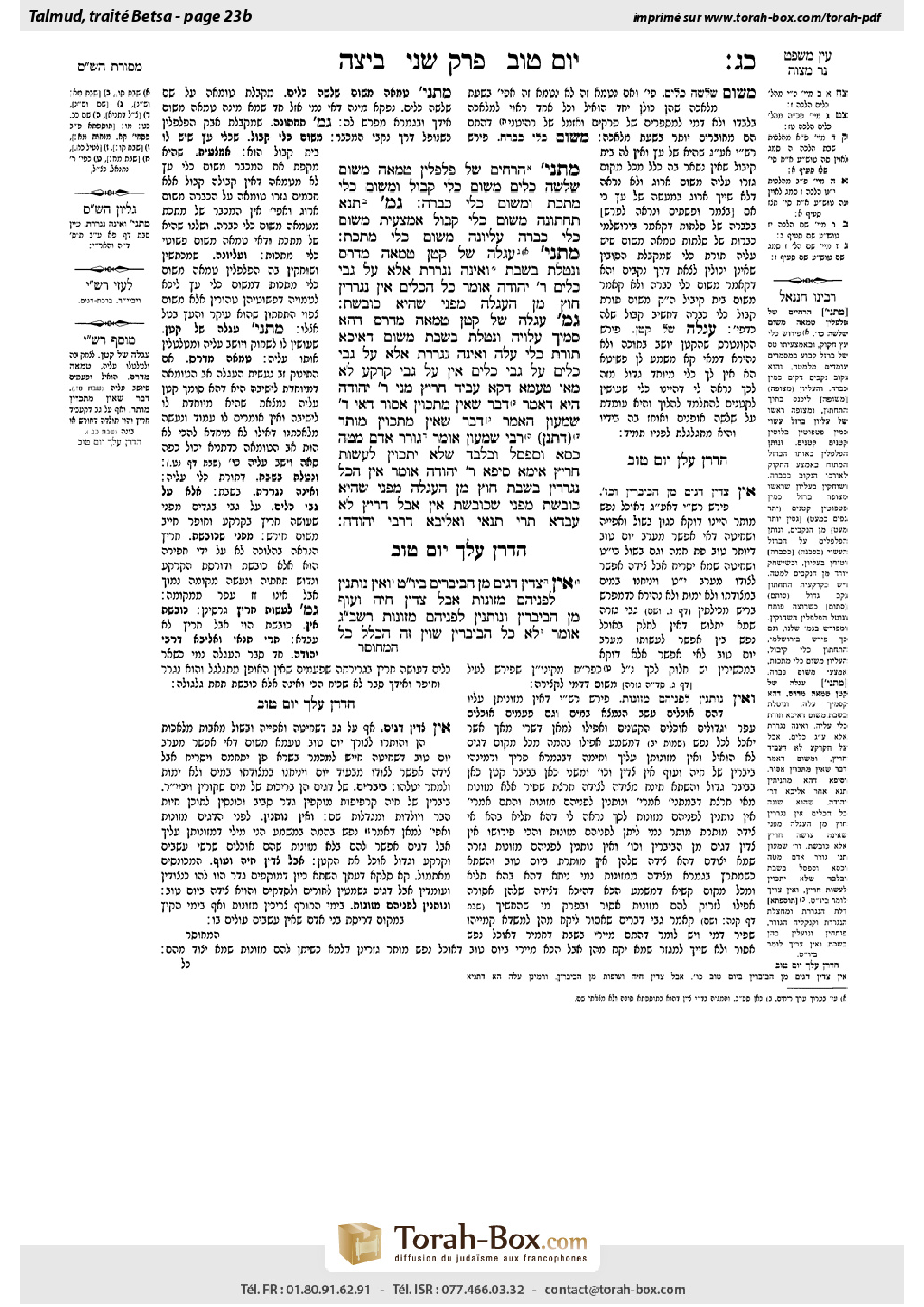
Beitzah 23b: Talmud study for Daf Yomi
Study the Talmud for Daf Yomi with scanned pages, Hebrew text, English translations from Sefaria and AI-generated French translations.
Passage selection and English or AI-generated French translation are available where the scan has annotations. Daf Study is independent of Torah-Box and Sefaria.
Browse Beitzah · ביצה · All tractatesBeitzah 23b text and translations
This page of Beitzah includes the Aramaic text, an English translation and an AI-generated French translation, alongside the scan above.
ביצה כ״ג ב · Aramaic and Hebrew text
מַתְנִי׳ הָרֵחַיִם שֶׁל פִּלְפְּלִין, טְמֵאָה מִשּׁוּם שְׁלֹשָׁה כֵּלִים: מִשּׁוּם כְּלִי קִבּוּל, וּמִשּׁוּם כְּלִי מַתֶּכֶת, וּמִשּׁוּם כְּלִי כְּבָרָה.
גְּמָ׳ תָּנָא: תַּחְתּוֹנָה — מִשּׁוּם כְּלִי קִבּוּל, אֶמְצָעִית — מִשּׁוּם כְּלִי כְּבָרָה, עֶלְיוֹנָה — מִשּׁוּם כְּלִי מַתֶּכֶת.
מַתְנִי׳ עֲגָלָה שֶׁל קָטָן — טְמֵאָה מִדְרָס, וְנִטֶּלֶת בְּשַׁבָּת, וְאֵינָהּ נִגְרֶרֶת אֶלָּא עַל גַּבֵּי כֵלִים.
רַבִּי יְהוּדָה אוֹמֵר: כׇּל הַכֵּלִים אֵין נִגְרָרִין, חוּץ מִן הָעֲגָלָה, מִפְּנֵי שֶׁהִיא כּוֹבֶשֶׁת.
גְּמָ׳ עֲגָלָה שֶׁל קָטָן — טְמֵאָה מִדְרָס, דְּהָא סָמֵיךְ עִלָּוַיהּ. וְנִטֶּלֶת בְּשַׁבָּת, מִשּׁוּם דְּאִיכָּא תּוֹרַת כְּלִי עֲלַהּ.
וְאֵינָהּ נִגְרֶרֶת אֶלָּא עַל גַּבֵּי כֵלִים. עַל גַּבֵּי כֵלִים — אִין, עַל גַּבֵּי קַרְקַע — לָא. מַאי טַעְמָא, דְּקָא עָבֵיד חָרִיץ. מַנִּי? רַבִּי יְהוּדָה הִיא, דְּאָמַר: דָּבָר שֶׁאֵין מִתְכַּוֵּין — אָסוּר.
דְּאִי רַבִּי שִׁמְעוֹן, הָאָמַר: דָּבָר שֶׁאֵין מִתְכַּוֵּין — מוּתָּר. (דִּתְנַן) רַבִּי שִׁמְעוֹן אוֹמֵר: גּוֹרֵר אָדָם מִטָּה כִּסֵּא וְסַפְסָל, וּבִלְבַד שֶׁלֹּא יִתְכַּוֵּין לַעֲשׂוֹת חָרִיץ.
אֵימָא סֵיפָא, רַבִּי יְהוּדָה אוֹמֵר: אֵין הַכֹּל נִגְרָרִין בְּשַׁבָּת, חוּץ מִן הָעֲגָלָה, מִפְּנֵי שֶׁהִיא כּוֹבֶשֶׁת. מִפְּנֵי שֶׁכּוֹבֶשֶׁת — אִין, אֲבָל חָרִיץ — לָא עָבְדָא?
תְּרֵי תַנָּאֵי, וְאַלִּיבָּא דְּרַבִּי יְהוּדָה.
הֲדַרַן עֲלָךְ יוֹם טוֹב
אֵין צָדִין דָּגִים מִן הַבִּיבָרִים בְּיוֹם טוֹב, וְאֵין נוֹתְנִין לִפְנֵיהֶם מְזוֹנוֹת.
אֲבָל צָדִין חַיָּה וְעוֹף מִן הַבִּיבָרִין, וְנוֹתְנִין לִפְנֵיהֶם מְזוֹנוֹת.
רַבָּן שִׁמְעוֹן בֶּן גַּמְלִיאֵל אוֹמֵר: לֹא כָּל הַבִּיבָרִין שָׁוִין. זֶה הַכְּלָל: כׇּל
Beitzah 23b · English translation
MISHNA: The aforementioned pepper mill is a composite vessel, and each of its parts must be considered independently with respect to ritual impurity. It is susceptible to ritual impurity because of each of the three vessels of which it is comprised: It is susceptible to impurity because it is a wooden receptacle, it is susceptible to impurity because it is a metal vessel, and it is susceptible to impurity because it is a sieve.
GEMARA: A Sage taught: The lower section of the mill is susceptible to impurity because it is viewed as a receptacle, since the ground pepper descends into it. The middle section is susceptible to impurity because it is a sieve, as it serves to filter the pepper. Finally, the upper part, in which the pepper is actually ground, is susceptible to impurity because it is a metal vessel. Although it is not a receptacle, it is nevertheless susceptible to impurity, since it is made of metal.
MISHNA: A child’s wagon, with which he plays and upon which he also sits, is susceptible to ritual impurity imparted by treading. It is considered a fixed seat of the child, so that if the child is a zav and he sits on the wagon, it contracts the ritual impurity imparted by the treading of a zav. And this wagon may be handled on Shabbat, as it is considered a vessel. And it may be dragged on the ground on Shabbat only upon cloth, a stone pavement, or the like, as otherwise it would create a furrow when dragged, and one would be liable due to the prohibited labor of plowing.
Rabbi Yehuda says: For this reason, no vessels may be dragged on the ground on Shabbat except for a wagon, which is permitted because its wheels do not make a furrow in the ground but merely press the earth down. Since no earth is moved from its place, this is not considered digging or plowing on Shabbat.
GEMARA: It is taught in the mishna that a child’s wagon is susceptible to ritual impurity imparted by treading. Why? It is because he leans on it. The mishna also teaches that this wagon may be handled on Shabbat. Why? It is because it has the status of a vessel, and one may handle a vessel on Shabbat.
The mishna further teaches that a child’s wagon may be dragged on Shabbat only upon cloth. The Gemara infers: Upon cloth, yes, it is permitted; but directly on the ground, no, it is not permitted. What is the reason for this halakha? It is because he creates a furrow in the ground when he drags the wagon across it. The Gemara asks: In accordance with whose opinion is this mishna? It is in accordance with the opinion of Rabbi Yehuda, who said: An unintentional act, i.e., a permitted action from which an unintended prohibited labor ensues on Shabbat, is prohibited, even though the person performing it does not have the prohibited labor in mind.
As, if it were in accordance with the opinion of Rabbi Shimon, didn’t he say: An unintentional act is permitted, since there was no intention to perform the prohibited action? As we learned explicitly in a mishna that Rabbi Shimon says: A person may drag a bed, a chair, or a bench on the ground, provided that he does not intend to make a furrow. Even if one forms a furrow unwittingly, one need not be concerned, as this was not his intention.
The Gemara raises a difficulty: If so, say the latter clause of the mishna as follows: Rabbi Yehuda says: No vessels may be dragged on the ground on Shabbat except for a wagon, because it merely presses the earth down. This is not prohibited as plowing because it does not create a furrow. This indicates that a wagon may be dragged on the ground on Shabbat because, yes, it presses the earth down, but it does not make a furrow. Since it has already been established that the first section of the mishna is also in accordance with the opinion of Rabbi Yehuda, and there it appears that a wagon dragged along the ground makes a furrow, Rabbi Yehuda seems to contradict himself.
The Gemara answers: It must be explained that this is a dispute between two tanna’im who hold in accordance with the opinion of Rabbi Yehuda but differ with regard to the content of that opinion. The first tanna holds that even a wagon makes a furrow, whereas the other tanna maintains in the name of Rabbi Yehuda that a wagon does not make a furrow.
MISHNA: One may not trap fish from their ponds on a Festival even with the intention of eating them, as this falls into the category of hunting, a type of labor that is not permitted on a Festival. Nor may one place food before them, as it is not his duty to feed them; rather, they maintain themselves by eating smaller fish or different types of algae that grow in the water.
However, one may trap an animal or a bird from their enclosures [beivarim], as they are viewed as already captured, and therefore the action is not considered an act of hunting. And one may also place food before them as one does for other household animals.
Rabban Shimon ben Gamliel says: Not all enclosures are identical with respect to the halakhot of hunting. This is the principle: With regard to any animal
Beitzah 23b · Traduction française (IA)
MICHNA : Le moulin à poivre mentionné précédemment est un récipient composé, et chaque partie doit être considérée séparément en ce qui concerne l'impureté rituelle. Il est susceptible d'impureté en raison de chacun des trois récipients dont il est constitué : il est susceptible d'impureté en raison de son être en bois, il est susceptible d'impureté en raison de son être en métal, et il est susceptible d'impureté en raison de son être en tamis.
GUEMARA : Un Sage a enseigné : La partie inférieure du moulin est susceptible d'impureté en raison de son être considéré comme un récipient, puisque la poudre de poivre descend dedans. La partie centrale est susceptible d'impureté en raison de son être en tamis, puisqu'il sert à filtrer la poudre. Enfin, la partie supérieure, dans laquelle la poudre est effectivement broyée, est susceptible d'impureté en raison de son être en métal. Bien qu'il ne soit pas un récipient, il est toutefois susceptible d'impureté, car il est fait de métal.
MICHNA : Une charrette de jeu pour un enfant, avec laquelle il joue et sur laquelle il s'assoit également, est susceptible d'impureté rituelle transmise par la marche. Elle est considérée comme un siège fixe pour l'enfant, de sorte que si l'enfant est un zav et qu'il s'assoit sur la charrette, elle contracte l'impureté rituelle transmise par la marche d'un zav. Et cette charrette peut être manipulée le sabbat, car elle est considérée comme un récipient. Elle peut être tirée sur le sol le sabbat uniquement sur un tissu, une pavé en pierre ou un tel objet, car autrement elle créerait une rigole en étant tirée, et l'on serait puni pour le travail interdit de labourer.
Rabbi Yehuda dit : Pour cette raison, aucun récipient ne peut être traîné sur le sol le sabbat, sauf la charrette, qui est permise car ses roues ne creusent pas le sol mais simplement appuient la terre. Puisque la terre n'est pas déplacée de son lieu, cela n'est pas considéré comme creuser ou labourer le sabbat.
GUEMARA : Il est enseigné dans la mishna que la charrette de jeu pour un enfant est susceptible d'impureté rituelle transmise par la marche. Pourquoi ? Parce qu'il s'appuie dessus. La mishna enseigne également que cette charrette peut être manipulée le sabbat. Pourquoi ? Parce qu'elle a le statut d'un récipient, et l'on peut manipuler un récipient le sabbat.
La mishna enseigne également que la charrette de jeu pour un enfant peut être tirée le sabbat uniquement sur un tissu. La Guemara en déduit : Sur un tissu, oui, cela est permis ; mais directement sur le sol, non, cela n'est pas permis. Quelle est la raison de cette halakha ? C'est parce qu'il crée une rigole dans le sol en tirant la charrette dessus. La Guemara pose la question : Selon quel avis est-ce que cette mishna ? C'est selon l'avis de Rabbi Yehuda, qui dit : Une action non intentionnelle, c'est-à-dire une action permise dont un travail interdit s'ensuit accidentellement le sabbat, est interdite, même si la personne qui l'accomplit n'a pas l'intention du travail interdit.
Comme, si c'était selon l'avis de Rabbi Shimon, n'a-t-il pas dit : Une action non intentionnelle est permise, puisque l'intention de commettre l'acte interdit n'était pas présente ? Comme nous l'avons appris explicitement dans une michna que Rabbi Shimon dit : Une personne peut tirer un lit, une chaise ou un banc sur le sol, à condition qu'elle n'ait pas l'intention de créer une rigole. Même si l'on forme une rigole sans le vouloir, on n'a pas à s'en soucier, car cela n'était pas son intention.
La Guemara soulève une difficulté : Si tel est le cas, disons la dernière partie de la michna ainsi : Rabbi Yehuda dit : Aucun récipient ne peut être tiré sur le sol le sabbat, sauf la charrette, car elle appuie simplement la terre. Cela n'est pas interdit comme le labourage, car elle ne crée pas une rigole. Cela indique que la charrette peut être tirée sur le sol le sabbat, car oui, elle appuie la terre, mais elle ne crée pas une rigole. Puisque cela a déjà été établi que la première partie de la michna est aussi selon l'avis de Rabbi Yehuda, et là il apparaît que la charrette tirée sur le sol crée une rigole, Rabbi Yehuda semble se contredire.
La Guemara répond : Il faut expliquer que c'est un débat entre deux tannaïm qui suivent l'avis de Rabbi Yehuda mais diffèrent sur le contenu de cet avis. Le premier tanna affirme que même la charrette crée une rigole, tandis que l'autre tanna maintient en nom de Rabbi Yehuda que la charrette ne crée pas une rigole.
MICHNA : On ne peut pas attraper des poissons de leurs étangs lors d'un festival même avec l'intention de les manger, car cela entre dans la catégorie de la chasse, un type de travail interdit lors d'un festival. On ne peut pas non plus placer de nourriture devant eux, car ce n'est pas leur devoir de se nourrir ; ils se nourrissent eux-mêmes en mangeant des petits poissons ou d'autres types d'algues qui poussent dans l'eau.
Cependant, on peut attraper un animal ou un oiseau de leurs enclos [beivarim], car ils sont considérés comme déjà capturés, et donc l'action n'est pas considérée comme une chasse. On peut également placer de la nourriture devant eux comme on le fait pour les autres animaux de la maison.
Rabban Shimon ben Gamliel dit : Ce n'est pas tous les enclos qui sont identiques en ce qui concerne les halakhot de la chasse. C'est le principe suivant : En ce qui concerne tout animal,
Traduction française générée par IA à partir de l’édition anglaise de Sefaria. Vérifie toujours un passage avec le texte source.
Text from Sefaria: William Davidson Edition - Vocalized Aramaic (CC BY NC); William Davidson Edition - English (CC BY NC).