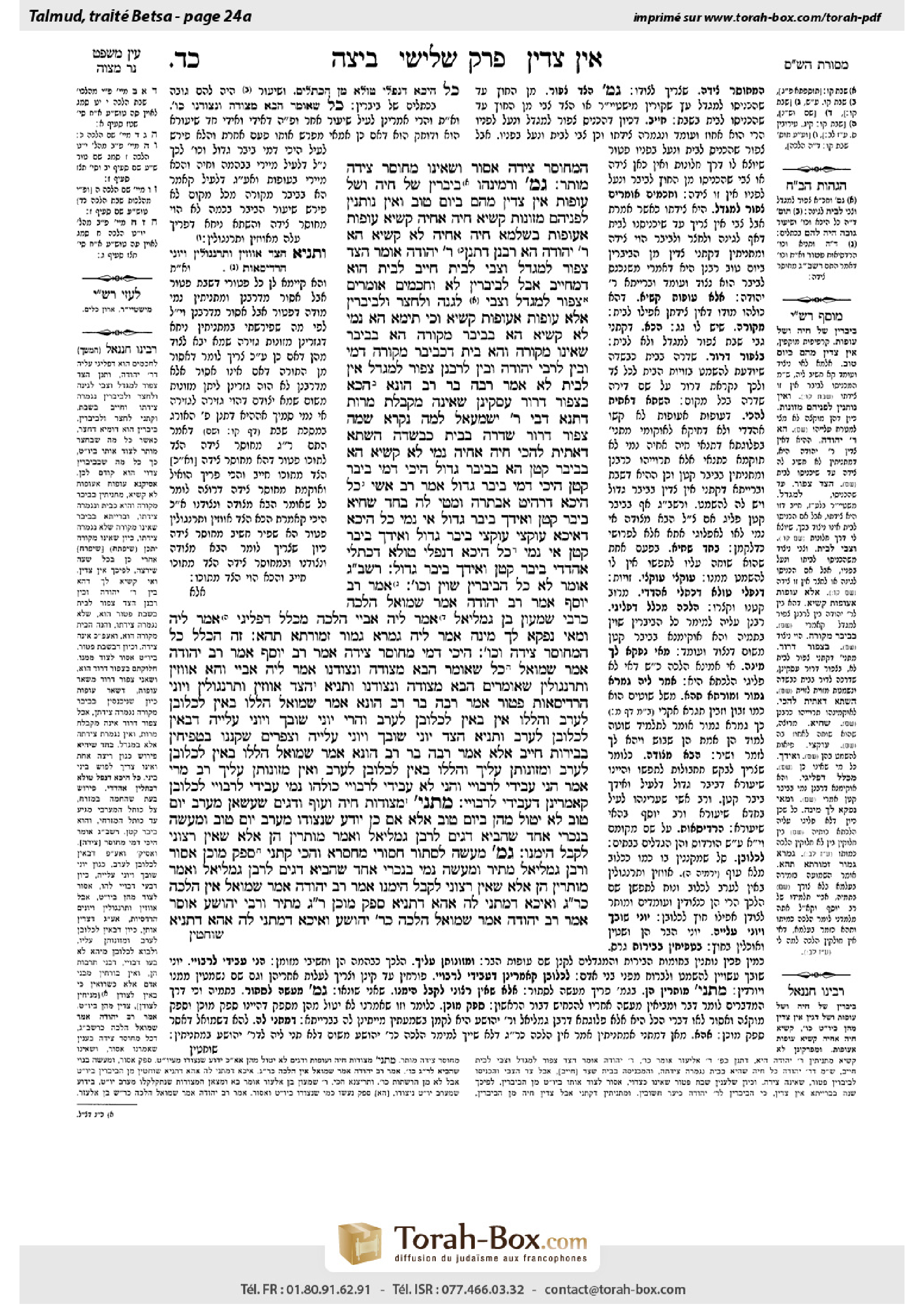
Beitzah 24a: Talmud study for Daf Yomi
Study the Talmud for Daf Yomi with scanned pages, Hebrew text, English translations from Sefaria and AI-generated French translations.
Passage selection and English or AI-generated French translation are available where the scan has annotations. Daf Study is independent of Torah-Box and Sefaria.
Browse Beitzah · ביצה · All tractatesBeitzah 24a text and translations
This page of Beitzah includes the Aramaic text, an English translation and an AI-generated French translation, alongside the scan above.
ביצה כ״ד א · Aramaic and Hebrew text
הַמְחוּסָּר צֵידָה — אָסוּר, וְשֶׁאֵינוֹ מְחוּסָּר צֵידָה — מוּתָּר.
גְּמָ׳ וּרְמִינְהוּ: בֵּיבָרִין שֶׁל חַיָּה וְשֶׁל עוֹפוֹת — אֵין צָדִין מֵהֶם בְּיוֹם טוֹב וְאֵין נוֹתְנִין לִפְנֵיהֶם מְזוֹנוֹת. קַשְׁיָא חַיָּה אַחַיָּה, קַשְׁיָא עוֹפוֹת אַעוֹפוֹת!
בִּשְׁלָמָא חַיָּה אַחַיָּה לָא קַשְׁיָא: הָא רַבִּי יְהוּדָה, הָא רַבָּנַן.
דִּתְנַן, רַבִּי יְהוּדָה אוֹמֵר: הַצָּד צִפּוֹר לַמִּגְדָּל וּצְבִי לַבַּיִת — חַיָּיב. לַבַּיִת הוּא דְּמִחַיַּיב, אֲבָל לְבִיבָרִין — לָא. וַחֲכָמִים אוֹמְרִים: צִפּוֹר — לַמִּגְדָּל, וּצְבִי — לַגִּנָּה וְלֶחָצֵר וְלַבִּיבָרִין.
אֶלָּא, עוֹפוֹת אַעוֹפוֹת קַשְׁיָא! וְכִי תֵּימָא הָא נָמֵי לָא קַשְׁיָא: הָא בְּבִיבָר מְקוֹרֶה, הָא בְּבִיבָר שֶׁאֵינוֹ מְקוֹרֶה.
וְהָא בַּיִת, דִּכְבִיבָר מְקוֹרֶה דָּמֵי, וּבֵין לְרַבִּי יְהוּדָה וּבֵין לְרַבָּנַן: צִפּוֹר לַמִּגְדָּל — אִין, לַבַּיִת — לָא!
אָמַר רַבָּה בַּר רַב הוּנָא: הָכָא בְּצִפּוֹר דְּרוֹר עָסְקִינַן, שֶׁאֵינָהּ מְקַבֶּלֶת מָרוּת. דְּתָנָא דְּבֵי רַבִּי יִשְׁמָעֵאל: לָמָּה נִקְרָא שְׁמָהּ צִפּוֹר דְּרוֹר — שֶׁדָּרָה בַּבַּיִת כְּבַשָּׂדֶה.
הַשְׁתָּא דְּאָתֵית לְהָכִי, חַיָּה אַחַיָּה נָמֵי לָא קַשְׁיָא: הָא — בְּבִיבָר קָטָן, הָא — בְּבִיבָר גָּדוֹל.
הֵיכִי דָּמֵי בִּיבָר קָטָן הֵיכִי דָּמֵי בִּיבָר גָּדוֹל? אָמַר רַב אָשֵׁי: כׇּל הֵיכָא דְּרָהֵיט אַבָּתְרַהּ וּמָטֵי לַהּ בְּחַד שִׁחְיָא — בִּיבָר קָטָן, וְאִידַּךְ — בִּיבָר גָּדוֹל. אִי נָמֵי: כׇּל הֵיכָא דְּאִיכָּא עוּקְצֵי עוּקְצֵי — בִּיבָר גָּדוֹל, וְאִידַּךְ — בִּיבָר קָטָן. אִי נָמֵי: כׇּל הֵיכָא דְּנָפְלִי טוּלָּא דְכֻתְלֵי אַהֲדָדֵי — בִּיבָר קָטָן, וְאִידַּךְ — בִּיבָר גָּדוֹל.
רַבָּן שִׁמְעוֹן בֶּן גַּמְלִיאֵל אוֹמֵר לֹא כָּל הַבֵּיבָרִין שָׁוִין וְכוּ׳. אָמַר רַב יוֹסֵף אָמַר רַב יְהוּדָה אָמַר שְׁמוּאֵל: הֲלָכָה כְּרַבִּי שִׁמְעוֹן בֶּן גַּמְלִיאֵל. אֲמַר לֵיהּ אַבָּיֵי: הֲלָכָה — מִכְּלָל דִּפְלִיגִי!
אֲמַר לֵיהּ: וּמַאי נָפְקָא לָךְ מִינַּהּ? אֲמַר לֵיהּ: גְּמָרָא גְּמוֹר, זְמוֹרְתָּא תְּהֵא?!
זֶה הַכְּלָל כׇּל הַמְחוּסָּר צֵידָה וְכוּ׳. הֵיכִי דָּמֵי מְחוּסָּר צֵידָה? אָמַר רַב יוֹסֵף אָמַר רַב יְהוּדָה אָמַר שְׁמוּאֵל: כׇּל שֶׁאוֹמֵר הָבֵא מְצוּדָה וּנְצוּדֶנּוּ.
אֲמַר לֵיהּ אַבָּיֵי: וְהָא אֲווֹזִין וְתַרְנְגוֹלִין, שֶׁאוֹמְרִים הָבֵא מְצוּדָה וּנְצוּדֶנּוּ, וְתַנְיָא: הַצָּד אֲווֹזִין וְתַרְנְגוֹלִין וְיוֹנֵי הַרְדִּיסָאוֹת — פָּטוּר!
אָמַר רַבָּה בַּר רַב הוּנָא אָמַר שְׁמוּאֵל: הַלָּלוּ בָּאִין לִכְלוּבָן לָעֶרֶב, וְהַלָּלוּ אֵין בָּאִין לִכְלוּבָן לָעֶרֶב.
וַהֲרֵי יוֹנֵי שׁוֹבָךְ וְיוֹנֵי עֲלִיָּיה, דְּבָאִין לִכְלוּבָן לָעֶרֶב, וְתַנְיָא: הַצָּד יוֹנֵי שׁוֹבָךְ וְיוֹנֵי עֲלִיָּיה וְצִפֳּרִים שֶׁקִּנְּנוּ בִּטְפִיחִין בַּבִּירוֹת — חַיָּיב!
אֶלָּא, אָמַר רַבָּה בַּר רַב הוּנָא אָמַר שְׁמוּאֵל: הַלָּלוּ בָּאִין לִכְלוּבָן לָעֶרֶב וּמְזוֹנוֹתָן עָלֶיךָ, וְהַלָּלוּ בָּאִין לִכְלוּבָן לָעֶרֶב וְאֵין מְזוֹנוֹתָן עָלֶיךָ.
רַב מָרִי אָמַר: הָנֵי עֲבִידִי לְרַבּוֹיֵי, וְהָנֵי לָא עֲבִידִי לְרַבּוֹיֵי. כּוּלְּהוּ נָמֵי עֲבִידִי לְרַבּוֹיֵי! לִכְלוּבָן קָאָמְרִינַן דַּעֲבִידִי לְרַבּוֹיֵי.
מַתְנִי׳ מְצוּדוֹת חַיָּה וְעוֹף וְדָגִים שֶׁעֲשָׂאָן מֵעֶרֶב יוֹם טוֹב — לֹא יִטּוֹל מֵהֶן בְּיוֹם טוֹב, אֶלָּא אִם כֵּן יוֹדֵעַ שֶׁנִּצּוֹדוּ מֵעֶרֶב יוֹם טוֹב. וּמַעֲשֶׂה בְּגוֹי אֶחָד שֶׁהֵבִיא דָּגִים לְרַבָּן גַּמְלִיאֵל, וְאָמַר מוּתָּרִין הֵן, אֶלָּא שֶׁאֵין רְצוֹנִי לְקַבֵּל הֵימֶנּוּ.
גְּמָ׳ מַעֲשֶׂה לִסְתּוֹר?! חַסּוֹרֵי מְחַסְּרָא וְהָכִי קָתָנֵי: סָפֵק מוּכָן — אָסוּר. וְרַבָּן גַּמְלִיאֵל מַתִּיר. וּמַעֲשֶׂה נָמֵי בְּגוֹי אֶחָד שֶׁהֵבִיא דָּגִים לְרַבָּן גַּמְלִיאֵל, וְאָמַר מוּתָּרִין הֵן, אֶלָּא שֶׁאֵין רְצוֹנִי לְקַבֵּל הֵימֶנּוּ.
אָמַר רַב יְהוּדָה אָמַר שְׁמוּאֵל: אֵין הֲלָכָה כְּרַבָּן גַּמְלִיאֵל. וְאִיכָּא דְּמַתְנֵי לַהּ אַהָא דְתַנְיָא: סָפֵק מוּכָן, רַבָּן גַּמְלִיאֵל מַתִּיר וְרַבִּי יְהוֹשֻׁעַ אוֹסֵר. אָמַר רַב יְהוּדָה אָמַר שְׁמוּאֵל: הֲלָכָה כְּרַבִּי יְהוֹשֻׁעַ. וְאִיכָּא דְּמַתְנֵי לַהּ אַהָא דְתַנְיָא:
Beitzah 24a · English translation
inside such an enclosure whose trapping is inadequate, meaning that the enclosure is large and contains hiding places so that it is still necessary to pursue and apprehend the animal, it is prohibited for one to catch it; and with regard to any animal whose trapping is not inadequate, as it is possible to seize it immediately without having to engage in further pursuit, it is permitted for one to catch it.
GEMARA: And the Gemara raises a contradiction from what is stated in the Tosefta: From enclosures of animals and of birds, one may not trap animals or birds on a Festival, nor may one place food before them. This is difficult due to a contradiction between the ruling with regard to an animal in the mishna and the ruling with regard to an animal in the Tosefta. This is similarly difficult due to a contradiction between the ruling with regard to birds in the mishna and the ruling with regard to birds in the Tosefta.
The Gemara resolves the first contradiction: Granted, with regard to the contradiction between the ruling concerning an animal in the mishna and the ruling concerning an animal in the Tosefta, it is not difficult, because this, the baraita that prohibits trapping and feeding animals in the enclosures, is in accordance with the opinion of Rabbi Yehuda, who holds that an animal trapped in an enclosure whose trapping is inadequate, i.e., it is still necessary to pursue and apprehend the animal, is not considered trapped, and therefore one may not trap it from the enclosure on a Festival. Whereas that, the mishna that permits trapping and feeding the animals in the enclosures, is in accordance with the opinion of the Rabbis, who maintain that an animal in an enclosure is considered trapped, and therefore removing it from there is not considered an act of hunting.
As we learned in a mishna: Rabbi Yehuda says: One who drives and traps a bird into a closet or a deer into a house is liable. The Gemara infers from this: It is only if he traps the animal into a house that he is liable, but if he traps it into an enclosure, he is not liable. And the Rabbis say: One is liable for trapping a bird into a closet, and for trapping a deer into a garden, or into a courtyard, or into an enclosure. This demonstrates that according to the Rabbis, an animal found inside an enclosure is regarded as already captured, whereas Rabbi Yehuda disagrees. From this it follows that Rabbi Yehuda and the Rabbis similarly disagree about catching an animal inside an enclosure and removing it from there on a Festival.
However, concerning the contradiction between the ruling with regard to birds in the mishna and the ruling with regard to birds in the Tosefta, it is difficult, as all agree that they may not be caught, even in one’s house. And if you say that this contradiction is also not difficult, because this, the mishna that permits trapping, is referring to a roofed enclosure, in which a bird is considered captured, and therefore there is no prohibition against apprehending it on a Festival, and that, the baraita that prohibits trapping, is referring to an unroofed enclosure, in which a bird is not considered trapped and apprehending it is prohibited, that does not resolve the contradiction.
The Gemara explains why the proposed resolution must be rejected: As with regard to a house, which is like a roofed enclosure, there is no dispute. And according to both Rabbi Yehuda and the Rabbis, a bird trapped into a closet, yes, it is considered trapped, while a bird into a house, no, it is not considered trapped.
Rabba bar Rav Huna said: Here, in the mishna, according to which a bird in a house is not considered trapped, we are dealing with a free bird, a sparrow, which does not accept authority. That bird is not intimidated and evades capture even in a house. As the school of Rabbi Yishmael taught: Why is it called a free [dror] bird? Because it dwells [dara] in a house as it does in a field, flittering from place to place. For this reason, it is not considered captured when it is inside a house. Therefore, the distinction between a roofed and an unroofed enclosure resolves the apparent contradiction between the mishna and the Tosefta.
The Gemara comments: Now that you have arrived at this understanding, that the difference between the rulings in the two sources is predicated on different circumstances and not on a tannaitic dispute, the apparent contradiction between the ruling with regard to an animal in the mishna and the ruling with regard to an animal in the Tosefta is also not difficult. This, the ruling in the mishna that permits apprehending the animal, is referring to a small enclosure, in which the animal cannot evade its pursuers and requires no further trapping. That, the ruling in the Tosefta that prohibits apprehending the animal, is referring to a large enclosure, from which the animal cannot escape, but it can still avoid being caught.
The Gemara asks: What are the circumstances of a small enclosure, and what are the circumstances of a large enclosure? Rav Ashi said: Any enclosure where one can run after an animal and reach it in one stoop is a small enclosure. And any other is a large enclosure. Or perhaps, any enclosure that has a series of corners in which the animal could hide and evade capture is a large enclosure, and any other is a small enclosure. Or perhaps, any enclosure where the shadows from the different walls fall upon each other, because the walls are close together, is a small enclosure. And any other, a larger area where the walls are further apart, is a large enclosure.
§ It was taught in the mishna: Rabban Shimon ben Gamliel says: Not all enclosures are identical. If the animal is inadequately trapped in the enclosure, it is prohibited for one to catch it; whereas if it is adequately trapped, he is permitted to do so. Rav Yosef said that Rav Yehuda said that Shmuel said: The halakha is in accordance with the opinion of Rabban Shimon ben Gamliel. Abaye said to Rav Yosef: If one rules that the halakha is in accordance with his opinion, does that mean by inference that the Rabbis disagree, or perhaps there is no dispute and everyone accepts the opinion of Rabban Shimon ben Gamliel?
Rav Yosef said to him: And what difference is there to you whether or not the Rabbis disagree? In either case the halakha is in accordance with the opinion of Rabban Shimon ben Gamliel. Why then does it matter whether or not the issue was in dispute? Abaye said to him, invoking a folk expression with regard to one who learns without reaching understanding: Is it simply learn the lesson; let it be like a song? In other words, is it sufficient to simply parrot the halakhic ruling? Rather, it is necessary to examine the issue to understand it even if it does not yield a practical halakhic difference.
It was further taught in the mishna: This is the principle: Any animal inside such an enclosure whose trapping is inadequate may not be caught and removed from there on a Festival, whereas any animal whose trapping is not inadequate may be apprehended and removed from there. The Gemara asks: What are the circumstances of an animal whose trapping is inadequate? Rav Yosef said that Rav Yehuda said that Shmuel said: Any animal with regard to which one would say: Bring a trap so that we may catch it, as the animal cannot be apprehended without the aid of a trap.
Abaye said to him: But aren’t geese and chickens that are loose in a courtyard creatures with regard to which one would say: Bring a trap so that we may catch it, as they freely roam about and evade capture? And nevertheless, it is taught in a baraita: One who traps geese, chickens, or domestic doves is exempt, as they are considered already trapped.
Rabba bar Rav Huna said that Shmuel said: There is a difference between the two cases: These, the geese and chickens, enter their coop in the evening and use it as their fixed dwelling place and are therefore considered trapped, while these animals in the enclosure do not enter their coop in the evening and therefore flee from those trying to seize them.
The Gemara challenges this argument: But don’t doves of a dovecote and doves of a loft enter their coop in the evening, and yet it is taught in a baraita: One who traps doves of a dovecote, doves of a loft, or birds that are nesting in pitchers in buildings is liable for their capture, although they enter their coop in the evening?
Rather, Rabba bar Rav Huna said that Shmuel said: A distinction can be made as follows: These, the geese and chickens, enter their coop in the evening, and providing them with their feed is your responsibility. They are therefore accustomed to their owners and considered as trapped. Whereas these, the doves of a dovecote and the other birds mentioned in the baraita, admittedly enter their coop in the evening, but feeding them is not your responsibility.
Rav Mari said an alternative distinction: These, the doves of a dovecote, are likely to flee from people, and therefore require trapping, while these, the geese, chickens, and domestic doves, are not likely to flee from them. The Gemara asks: All of them are also likely to flee when being pursued, even chickens. The Gemara answers: We meant to say that they are likely to flee to their coop. In other words, even when they reach their coop they do not remain still but continue in their attempts to escape, and are therefore not considered trapped.
MISHNA: If traps for animals, birds, and fish were set on the eve of a Festival, one may not take anything from them on the Festival, unless he knows that the animals found in the traps had already been caught on the eve of the Festival. And an incident is related where a certain gentile brought fish to Rabban Gamliel, and the latter said: The fish are permitted, but I do not wish to accept them from him, as I despise him.
GEMARA: The Gemara raises a question about the story involving Rabban Gamliel. Was an incident cited above to contradict a previously stated halakha? The mishna first teaches that one may not eat an animal caught on a Festival, and then relates an incident in which Rabban Gamliel ruled that this is permitted. The Gemara answers: The mishna is incomplete; it is missing an important element, and it teaches the following: Even in a case where it is uncertain whether or not the animal was prepared before the Festival, as it is unclear whether it was caught today or on the previous day, it is prohibited; and Rabban Gamliel permits it. And an incident is also related where a certain gentile brought fish to Rabban Gamliel, and the latter said: The fish are permitted, but I do not wish to accept them from him.
Rav Yehuda said that Shmuel said: The halakha is not in accordance with the opinion of Rabban Gamliel. Some teach this halakhic ruling with regard to this baraita, as it is taught: With regard to something about which an uncertainty exists whether or not it was prepared before the Festival, Rabban Gamliel permits it, and Rabbi Yehoshua prohibits it. Rav Yehuda said that Shmuel said: The halakha is in accordance with the opinion of Rabbi Yehoshua. And others teach it in reference to this baraita, as it is taught:
Beitzah 24a · Traduction française (IA)
Dans un enclos dont la capture est insuffisante, c'est-à-dire un enclos grand et qui contient des recoins où l'animal peut se cacher, de sorte qu'il faut encore le poursuivre et le capturer, il est interdit de le capturer ; et concernant tout animal dont la capture est suffisante, c'est-à-dire un animal dont on peut le saisir immédiatement sans avoir à poursuivre davantage, il est permis de le capturer.
GUEMARA : Et la Guemara soulève une contradiction avec ce qui est dit dans la Tosefta : On ne peut pas capturer des animaux ou des oiseaux dans des enclos, ni placer de la nourriture devant eux, pendant un festival. Cela est difficile à résoudre en raison d'une contradiction entre la décision concernant un animal dans la mitsva et la décision concernant un animal dans la Tosefta. Cela est également difficile à résoudre en raison d'une contradiction entre la décision concernant les oiseaux dans la mitsva et la décision concernant les oiseaux dans la Tosefta.
La Guemara résout la première contradiction : Cela n'est pas difficile, car cette baraïta qui interdit la capture et la nourriture des animaux dans les enclos est selon l'opinion de Rabbi Yéhuda, qui considère qu'un animal capturé dans un enclos dont la capture est insuffisante, c'est-à-dire qu'il faut encore le poursuivre et le capturer, n'est pas considéré comme capturé, et par conséquent on ne peut pas le capturer dans l'enclos pendant un festival. En revanche, cette mitsva qui permet la capture et la nourriture des animaux dans les enclos est selon l'opinion des Rabbins, qui pensent qu'un animal dans un enclos est considéré comme capturé, et par conséquent enlever celui-ci de là n'est pas considéré comme une chasse.
Comme nous avons appris dans une mitsna : Rabbi Yéhuda dit : Celui qui fait fuir et capture un oiseau dans un réduit ou un cerf dans une maison est puni. La Guemara en déduit : C'est seulement si on capture l'animal dans une maison qu'on est puni, mais si on le capture dans un enclos, on n'est pas puni. Et les Rabbins disent : On est puni pour avoir capturé un oiseau dans un réduit, et pour avoir capturé un cerf dans un jardin, ou dans une cour, ou dans un enclos. Cela montre que selon les Rabbins, un animal trouvé à l'intérieur d'un enclos est considéré comme déjà capturé, tandis que Rabbi Yéhuda en désaccorde. De cela découle que Rabbi Yéhuda et les Rabbins s'entendent également sur la capture d'un animal à l'intérieur d'un enclos et son retrait de là pendant un festival.
Cependant, concernant la contradiction entre la décision concernant les oiseaux dans la mitsna et la décision concernant les oiseaux dans la baraïta, cela est difficile, car tous s'accordent sur le fait qu'ils ne peuvent pas être capturés, même dans sa maison. Et si vous dites que cette contradiction n'est pas difficile, car cette mitsna qui permet la capture fait référence à un enclos toisé, dans lequel un oiseau est considéré comme capturé, et par conséquent il n'y a pas de prohibition contre sa capture pendant un festival, et que cette baraïta qui interdit la capture fait référence à un enclos non toisé, dans lequel un oiseau n'est pas considéré comme capturé et sa capture est interdite, cela ne résout pas la contradiction.
La Guemara explique pourquoi cette résolution proposée doit être rejetée : Comme concernant une maison, qui est comme un enclos toisé, il n'y a pas de débat. Et selon les deux, Rabbi Yéhuda et les Rabbins, un oiseau capturé dans un réduit est considéré comme capturé, tandis qu'un oiseau dans une maison n'est pas considéré comme capturé.
Rabba bar Rav Huna a dit : Ici, dans la mitsna, selon laquelle un oiseau dans une maison n'est pas considéré comme capturé, nous parlons d'un oiseau libre, un moineau, qui ne reconnaît pas l'autorité. Cet oiseau n'est pas intimidé et échappe à la capture même dans une maison. Comme l'a enseigné la maison de Rabbi Yishmael : Pourquoi est-il appelé un oiseau libre [dror] ? Parce qu'il demeure [dara] dans une maison comme dans un champ, volant d'un endroit à l'autre. Pour cette raison, il n'est pas considéré comme capturé lorsqu'il est à l'intérieur d'une maison. Ainsi, la distinction entre un enclos toisé et un enclos non toisé résout la contradiction apparente entre la mitsna et la Tosefta.
La Guemara commente : Maintenant que vous avez atteint cette compréhension, que la différence entre les décisions dans les deux sources est fondée sur des circonstances différentes et non sur un débat tannaitique, la contradiction apparente entre la décision concernant un animal dans la mitsna et la décision concernant un animal dans la Tosefta n'est pas difficile. Cette décision dans la mitsna qui permet la capture de l'animal fait référence à un petit enclos, dans lequel l'animal ne peut pas échapper à ses poursuivants et ne nécessite pas de capture supplémentaire. Cette décision dans la Tosefta qui interdit la capture de l'animal fait référence à un grand enclos, d'où l'animal ne peut pas s'échapper, mais il peut encore éviter d'être capturé.
La Guemara pose la question : Quelles sont les circonstances d'un petit enclos et celles d'un grand enclos ? Rav Ashi a dit : Tout enclos où l'on peut courir après un animal et le rejoindre en un seul effort est un petit enclos. Et tout autre enclos est un grand enclos. Ou peut-être, tout enclos qui a une série de recoins où l'animal pourrait se cacher et échapper à la capture est un grand enclos, et tout autre enclos est un petit enclos. Ou peut-être, tout enclos où les ombres des murs différents se chevauchent, car les murs sont proches l'un de l'autre, est un petit enclos. Et tout autre enclos, une grande surface où les murs sont plus éloignés, est un grand enclos.
§ Il a été enseigné dans la mitsva : Rabban Shimon ben Gamliel dit : Ce n'est pas que tous les enclos sont identiques. Si l'animal est insuffisamment capturé dans l'enclos, il est interdit de le capturer ; tandis que si l'animal est suffisamment capturé, il est permis de le capturer. Rav Yosef a dit que Rav Yéhuda a dit que Shmuel a dit : La halakha suit l'opinion de Rabban Shimon ben Gamliel. Abaye a dit à Rav Yosef : Si l'on décide que la halakha suit son opinion, cela signifie-t-il par déduction que les Rabbins s'entendent, ou peut-être qu'il n'y a pas de débat et que tout le monde accepte l'opinion de Rabban Shimon ben Gamliel ?
Rav Yosef dit à lui : Et quelle différence cela fait-il pour vous que les Sages soient d'accord ou non ? Dans tous les cas, la halakha suit l'opinion de Rabban Shimon ben Gamliel. Pourquoi alors cela a-t-il de l'importance ? Abaye lui répondit, en invoquant une expression populaire concernant celui qui apprend sans comprendre : Est-ce simplement apprendre la leçon ; qu'elle soit comme une chanson ? Autrement dit, est-ce suffisant de simplement répéter la décision halakhique ? Plutôt, il est nécessaire d'examiner la question pour la comprendre, même si cela ne donne pas de différence pratique halakhique.
Il fut également enseigné dans la mitsna : Ce principe est le suivant : Tout animal à l'intérieur d'un tel enclos, dont la capture est insuffisante, ne peut pas être attrapé et retiré de là pendant un festival, tandis que tout animal dont la capture n'est pas insuffisante peut être appréhendé et retiré de là. La Guemara pose la question : Quelles sont les circonstances d'un animal dont la capture est insuffisante ? Rav Yosef dit que Rav Yehuda dit que Shmuel dit : Tout animal concernant lequel on dirait : Apporte un piège afin que nous puissions le capturer, car l'animal ne peut être appréhendé sans l'aide d'un piège.
Abaye lui dit : Mais ne sont-ce pas les canards et les poules qui sont libres dans une cour, des créatures concernant lesquelles on dirait : Apporte un piège afin que nous puissions les capturer, car ils errant librement et échappent à la capture ? Et pourtant, il est enseigné dans une baraïta : Celui qui piège des canards, des poules ou des pigeons domestiques est exempt, car ils sont considérés comme déjà capturés.
Rabba bar Rav Huna dit que Shmuel dit : Il y a une différence entre les deux cas : Ces animaux, les canards et les poules, entrent dans leur poulailler le soir et l'utilisent comme leur lieu de demeure fixe, et sont donc considérés comme capturés, tandis que ces animaux dans l'enclos ne rentrent pas dans leur poulailler le soir et fuient donc ceux qui essaient de les saisir.
La Guemara conteste cet argument : Mais ne sont-ce pas les pigeons d'un poulailler et les pigeons d'un grenier qui entrent dans leur poulailler le soir, et pourtant il est enseigné dans une baraïta : Celui qui piège des pigeons d'un poulailler, des pigeons d'un grenier ou des oiseaux qui nichent dans des récipients dans les bâtiments est responsable de leur capture, même s'ils entrent dans leur poulailler le soir ?
Plutôt, Rabba bar Rav Huna dit que Shmuel dit : On peut faire une distinction comme suit : Ces animaux, les canards et les poules, entrent dans leur poulailler le soir, et la fourniture de leur nourriture est votre responsabilité. Ils sont donc habitués à leurs propriétaires et considérés comme capturés. Tandis que ces autres, les pigeons d'un poulailler et les autres oiseaux mentionnés dans la baraïta, bien qu'ils entrent dans leur poulailler le soir, la fourniture de leur nourriture n'est pas votre responsabilité.
Rav Mari dit une autre distinction : Ces pigeons d'un poulailler sont susceptibles de fuir des gens, et nécessitent donc d'être piégés, tandis que ces canards, poules et pigeons domestiques ne sont pas susceptibles de fuir. La Guemara pose la question : Tous sont également susceptibles de fuir lorsqu'ils sont poursuivis, même les poules. La Guemara répond : Nous voulions dire qu'ils sont susceptibles de fuir vers leur poulailler. Autrement dit, même lorsqu'ils atteignent leur poulailler, ils ne restent pas immobiles mais continuent leurs efforts d'évasion, et ne sont donc pas considérés comme capturés.
MICHNA : Si des pièges pour animaux, oiseaux et poissons étaient mis la veille d'un festival, on ne peut pas prendre quelque chose d'eux pendant le festival, sauf si l'on sait que les animaux trouvés dans les pièges avaient déjà été capturés la veille du festival. Et un incident est rapporté où un certain non-Juif apporta des poissons à Rabban Gamliel, et le dernier dit : Les poissons sont permis, mais je ne veux pas les accepter de lui, car je le déteste.
GUEMARA : La Guemara soulève une question concernant l'incident avec Rabban Gamliel. L'incident cité ci-dessus a-t-il été rapporté pour contredire une halakha précédemment établie ? La mitsna commence par enseigner que l'on ne peut pas manger un animal capturé pendant un festival, puis rapporte un incident où Rabban Gamliel a décidé que cela est permis. La Guemara répond : La mitsna est incomplète ; elle manque d'un élément important, et elle enseigne ce qui suit : Même dans un cas où il est incertain si l'animal a été préparé avant le festival, comme il est unclear s'il a été capturé aujourd'hui ou la veille, il est interdit ; et Rabban Gamliel permet cela. Et un incident est également rapporté où un certain non-Juif apporta des poissons à Rabban Gamliel, et le dernier dit : Les poissons sont permis, mais je ne veux pas les accepter de lui.
Rav Yehuda dit que Shmuel dit : La halakha ne suit pas l'opinion de Rabban Gamliel. Certains enseignent cette décision halakhique concernant cette baraïta, car il est enseigné : Concernant quelque chose dont il est incertain s'il a été préparé avant le festival, Rabban Gamliel permet cela, et Rabbi Yehoshua l'interdit. Rav Yehuda dit que Shmuel dit : La halakha suit l'opinion de Rabbi Yehoshua. Et d'autres enseignent cela en référence à cette baraïta, car il est enseigné :
Traduction française générée par IA à partir de l’édition anglaise de Sefaria. Vérifie toujours un passage avec le texte source.
Text from Sefaria: William Davidson Edition - Vocalized Aramaic (CC BY NC); William Davidson Edition - English (CC BY NC).