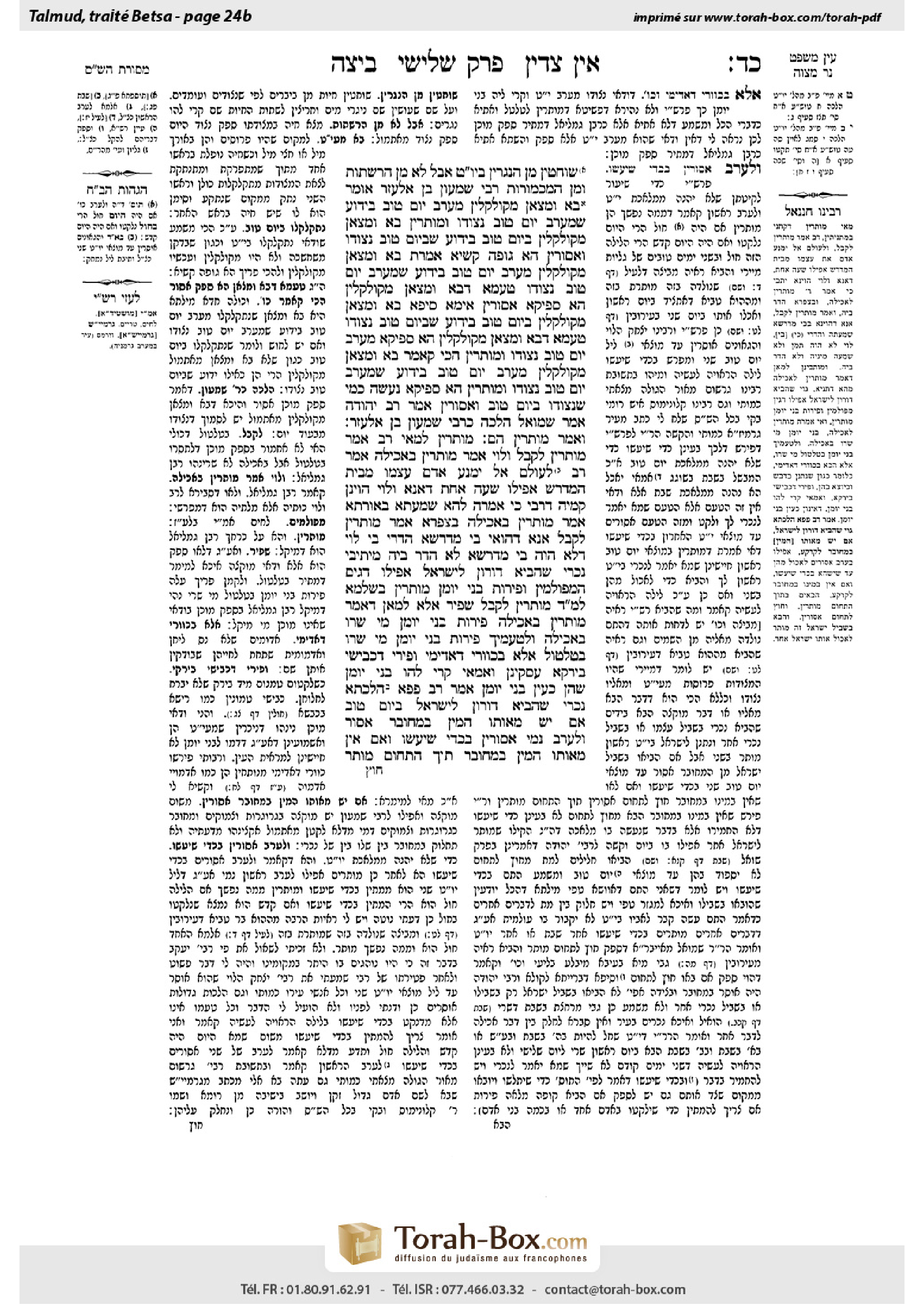
Beitzah 24b: Talmud study for Daf Yomi
Study the Talmud for Daf Yomi with scanned pages, Hebrew text, English translations from Sefaria and AI-generated French translations.
Passage selection and English or AI-generated French translation are available where the scan has annotations. Daf Study is independent of Torah-Box and Sefaria.
Browse Beitzah · ביצה · All tractatesBeitzah 24b text and translations
This page of Beitzah includes the Aramaic text, an English translation and an AI-generated French translation, alongside the scan above.
ביצה כ״ד ב · Aramaic and Hebrew text
שׁוֹחֲטִין מִן הַנְּגָרִין בְּיוֹם טוֹב, אֲבָל לֹא מִן הָרְשָׁתוֹת וּמִן הַמִּכְמוֹרוֹת. רַבִּי שִׁמְעוֹן בֶּן אֶלְעָזָר אוֹמֵר: בָּא וּמְצָאָן מְקוּלְקָלִין מֵעֶרֶב יוֹם טוֹב — בְּיָדוּעַ שֶׁמֵּעֶרֶב יוֹם טוֹב נִצּוֹדוּ, וּמוּתָּרִין. בָּא וּמְצָאָן מְקוּלְקָלִין בְּיוֹם טוֹב — בְּיָדוּעַ שֶׁבְּיוֹם טוֹב נִצּוֹדוּ, וַאֲסוּרִין.
הָא גּוּפַהּ קַשְׁיָא, אָמְרַתְּ: בָּא וּמְצָאָן מְקוּלְקָלִין מֵעֶרֶב יוֹם טוֹב — בְּיָדוּעַ שֶׁמֵּעֶרֶב יוֹם טוֹב נִצּוֹדוּ. טַעְמָא דְּבָא וּמְצָאָן מְקוּלְקָלִין, הָא סְפֵיקָא — אֲסוּרִין. אֵימָא סֵיפָא: בָּא וּמְצָאָן מְקוּלְקָלִין בְּיוֹם טוֹב — בְּיָדוּעַ שֶׁבְּיוֹם טוֹב נִצּוֹדוּ. טַעְמָא דְּבָא וּמְצָאָן מְקוּלְקָלִין, הָא סְפֵיקָא — מֵעֶרֶב יוֹם טוֹב נִצּוֹדוּ, וּמוּתָּרִין.
הָכִי קָאָמַר: בָּא וּמְצָאָן מְקוּלְקָלִין מֵעֶרֶב יוֹם טוֹב — בְּיָדוּעַ שֶׁמֵּעֶרֶב יוֹם טוֹב נִצּוֹדוּ, וּמוּתָּרִין. הָא סְפֵיקָא — נַעֲשָׂה כְּמִי שֶׁנִּצּוֹדוּ בְּיוֹם טוֹב, וַאֲסוּרִין.
אָמַר רַב יְהוּדָה אָמַר שְׁמוּאֵל: הֲלָכָה כְּרַבִּי שִׁמְעוֹן בֶּן אֶלְעָזָר.
וְאָמַר מוּתָּרִין הֵם. מוּתָּרִין לְמַאי? רַב אָמַר: מוּתָּרִין לְקַבֵּל. וְלֵוִי אָמַר: מוּתָּרִין בַּאֲכִילָה.
אָמַר רַב: לְעוֹלָם אַל יִמְנַע אָדָם עַצְמוֹ מִבֵּית הַמִּדְרָשׁ אֲפִילּוּ שָׁעָה אַחַת. דַּאֲנָא וְלֵוִי הֲוֵינַן קַמֵּיהּ דְּרַבִּי כִּי אַמְרַהּ לְהָא שְׁמַעְתָּא, בְּאוּרְתָּא אָמַר: מוּתָּרִין בַּאֲכִילָה, בְּצַפְרָא אָמַר: מוּתָּרִין לְקַבֵּל. אֲנָא דַּהֲוַאי בֵּי מִדְרְשָׁא — הֲדַרִי בִּי. לֵוִי דְּלָא הֲוָה בִּי מִדְרְשָׁא — לָא הֲדַר בֵּיהּ.
מֵיתִיבִי: גּוֹי שֶׁהֵבִיא דּוֹרוֹן לְיִשְׂרָאֵל, אֲפִילּוּ דָּגִים הַמְפוּלָּמִין וּפֵירוֹת בְּנֵי יוֹמָן — מוּתָּרִין. בִּשְׁלָמָא לְמַאן דְּאָמַר מוּתָּרִין לְקַבֵּל — שַׁפִּיר. אֶלָּא לְמַאן דְּאָמַר מוּתָּרִין בַּאֲכִילָה, פֵּירוֹת בְּנֵי יוֹמָן מִי שָׁרוּ בַּאֲכִילָה?
וּלְטַעְמָיךְ: פֵּירוֹת בְּנֵי יוֹמָן מִי שָׁרוּ בְּטִלְטוּל? אֶלָּא, בִּכְווֹרֵי דַּאֲדִימֵי וּפֵירֵי דִּכְבִישִׁי בְּיַרְקָא עָסְקִינַן, וְאַמַּאי קָרֵי לְהוּ בְּנֵי יוֹמָן — שֶׁהֵן כְּעֵין בְּנֵי יוֹמָן.
אָמַר רַב פָּפָּא, הִלְכְתָא: גּוֹי שֶׁהֵבִיא דּוֹרוֹן לְיִשְׂרָאֵל בְּיוֹם טוֹב, אִם יֵשׁ מֵאוֹתוֹ הַמִּין בִּמְחוּבָּר — אָסוּר. וְלָעֶרֶב נָמֵי אֲסוּרִין בִּכְדֵי שֶׁיֵּעָשׂוּ.
וְאִם אֵין מֵאוֹתוֹ הַמִּין בִּמְחוּבָּר, תּוֹךְ הַתְּחוּם — מוּתָּר,
Beitzah 24b · English translation
One may slaughter animals from pens containing pools of drinking water on a Festival, but not from those found caught in nets or in traps, as they may have been caught on the Festival itself. Rabbi Shimon ben Elazar says: If he came and found the nets and traps out of order on the eve of the Festival, which indicates that an animal had been caught in them, then it is known that the animals were caught on the eve of the Festival, and they are therefore permitted. However, if he checked the nets and traps shortly before the onset of the Festival and found them intact, and he later came and found them out of order on the Festival, it is known that the animals were caught on the Festival, and they are therefore prohibited.
The Gemara poses a question: The baraita itself is difficult because it contains an internal contradiction between its clauses: You first said that if he came and found them out of order on the eve of the Festival, it is known that they were caught on the eve of the Festival. The reason is that he came and found them out of order, but if there is uncertainty, the animals are prohibited. But say now the latter clause of that same baraita: If he came and found them out of order on the Festival, it is known that they were caught on the Festival. The reason is that he came and found them out of order, but in a case of uncertainty, the assumption is that they were caught on the eve of the Festival and are permitted.
The Gemara explains: This is what the baraita is saying: If he came and found them out of order on the eve of the Festival, it is known that they were caught on the eve of the Festival, and they are permitted. But in a case of uncertainty, it is considered as if they were caught on the Festival, and they are prohibited.
Rav Yehuda said that Shmuel said: The halakha is in accordance with the opinion of Rabbi Shimon ben Elazar. All these versions of Shmuel’s ruling are basically in agreement: In a case of uncertainty as to whether or not an item was prepared before the Festival, it is prohibited.
§ It was stated in the mishna that Rabban Gamliel said that the fish brought to him on the Festival by the gentile are permitted. The Gemara asks: Permitted for what purpose? Rav said: They are permitted to be received and moved, but they may not be eaten. Levi said: They are even permitted to be eaten.
Rav said: A person should never prevent himself from attending the study hall for even one moment, and the proof is from this issue; as Levi and I were before Rabbi Yehuda HaNasi when he stated this halakha. In the evening he said: They are permitted to be eaten, but the following morning he said: They are permitted only to be received. I, who was in the study hall in the morning as well, retracted what I said, and taught the matter in accordance with Rabbi Yehuda HaNasi’s second opinion. Levi, who was not in the study hall in the morning, did not retract his statement.
The Gemara raises an objection from the following baraita: If a gentile brought a gift [doron] to a Jew on a Festival, even moist [mefulamin] fish or produce from that same day, they are permitted. Granted, according to the one who said they are permitted to be received, it is well; the halakha is understandable. However, according to the one who said they are permitted to be eaten, is produce from that same day permitted to be eaten? If it was picked from the tree on that day, it is subject to the prohibition of muktze.
The Gemara responds with a counter-question: And according to your reasoning, is produce picked on that same day permitted to be moved? Why, then, is it obvious to you that the produce is permitted to be received? Rather, it must be explained that we are dealing with fish whose gills are still red and with produce that is preserved in greens, not with produce that was actually picked on that day. Why, then, is it called produce of that same day? Because it is fresh and similar to produce picked on that same day. Such produce is permitted not only to be moved, but even to be eaten.
Rav Pappa said that the halakha in this regard is as follows: In the case of a gentile who brought a gift to a Jew on a Festival, if there is of that species still attached to a tree or the ground, it is prohibited to be eaten, as it may be assumed that the gentile picked it that same day. And in the evening as well, after the conclusion of the Festival, it is prohibited for the period of time needed for its preparation, i.e., the period of time necessary to detach it from the tree or the ground, as one may not derive benefit from a prohibited labor that was performed on a Festival on behalf of a Jew.
And if none of that species is still attached to the ground, then if the gift was brought from within the limit, i.e., the distance one may travel on a Festival, it is permitted, as no prohibited labor has been performed.
Beitzah 24b · Traduction française (IA)
On peut sacrifier des animaux provenant d'enclos contenant des bassins d'eau potable lors d'une fête, mais pas ceux trouvés coincés dans des filets ou des pièges, car ils pourraient avoir été capturés pendant la fête elle-même. Rabbi Shimon ben Elazar dit : Si l'on découvre les filets et les pièges défectueux la veille de la fête, ce qui indique qu'un animal avait été capturé, alors on sait qu'ils ont été capturés la veille de la fête et sont donc permis. Cependant, si l'on examine les filets et les pièges peu avant le début de la fête et qu'ils sont intacts, et qu'on les découvre ensuite défectueux pendant la fête, on sait qu'ils ont été capturés pendant la fête et sont donc interdits.
La Guemara pose une question : La baraïta elle-même est difficile, car elle contient une contradiction interne entre ses clauses : Vous avez d'abord dit que si l'on découvre les filets et les pièges défectueux la veille de la fête, on sait qu'ils ont été capturés la veille de la fête. La raison est que l'on découvre les filets et les pièges défectueux, mais si l'on est incertain, les animaux sont interdits. Mais dites maintenant la clause ultérieure de cette même baraïta : Si l'on découvre les filets et les pièges défectueux pendant la fête, on sait qu'ils ont été capturés pendant la fête. La raison est que l'on découvre les filets et les pièges défectueux, mais en cas d'incertitude, on suppose qu'ils ont été capturés la veille de la fête et sont donc permis.
La Guemara explique : C'est ce que la baraïta dit : Si l'on découvre les filets et les pièges défectueux la veille de la fête, on sait qu'ils ont été capturés la veille de la fête et sont donc permis. Mais en cas d'incertitude, on considère qu'ils ont été capturés pendant la fête et sont donc interdits.
Rav Yehuda a dit que Shmuel a dit : La halakha suit l'opinion de Rabbi Shimon ben Elazar. Toutes ces versions de la décision de Shmuel sont essentiellement en accord : En cas d'incertitude quant à la préparation d'un objet avant la fête, il est interdit.
§ Il a été dit dans la mishna que Rabban Gamliel a dit que les poissons apportés à lui par un non-Juif pendant la fête sont permis. La Guemara pose une question : Permis à quel effet ? Rav a dit : Ils sont permis à être reçus et déplacés, mais ils ne peuvent pas être mangés. Levi a dit : Ils sont même permis à être mangés.
Rav a dit : Une personne ne doit jamais se priver de l'étude du hall même pendant une seule minute, et la preuve en est ce problème ; car Levi et moi étions présents devant Rabbi Yehuda HaNasi lorsqu'il a énoncé cette halakha. Le soir, il a dit : Ils sont permis à être mangés, mais le lendemain matin, il a dit : Ils sont permis seulement à être reçus. Je, qui étais dans le hall le matin également, ai rétracté ce que j'avais dit et j'ai enseigné la question selon l'opinion du second discours de Rabbi Yehuda HaNasi. Levi, qui n'était pas dans le hall le matin, n'a pas rétracté son affirmation.
La Guemara soulève une objection tirée de la suivante baraïta : Si un non-Juif apporte un cadeau [doron] à un Juif pendant une fête, même des poissons ou des produits humides [mefulamin] du même jour, ils sont permis. Cela est bien, selon celui qui dit qu'ils sont permis à être reçus ; la halakha est claire. Cependant, selon celui qui dit qu'ils sont permis à être mangés, est-ce que les produits du même jour sont permis à être mangés ? Si ils ont été cueillis sur l'arbre ce jour-là, ils sont soumis à l'interdiction de muktze.
La Guemara répond avec une contre-question : Et selon votre raisonnement, est-ce que les produits cueillis ce même jour sont permis à être déplacés ? Pourquoi alors est-ce évident pour vous que les produits sont permis à être reçus ? Plutôt, il faut expliquer que nous parlons de poissons dont les branchies sont encore rouges et de produits conservés dans des feuilles, pas de produits qui ont été réellement cueillis ce jour-là. Pourquoi alors est-ce appelé produits du même jour ? Parce qu'ils sont frais et semblables aux produits cueillis ce même jour. De tels produits sont permis non seulement à être déplacés, mais même à être mangés.
Rav Pappa a dit que la halakha dans ce cas est la suivante : Dans le cas d'un non-Juif qui apporte un cadeau à un Juif pendant une fête, si il y a de ce genre encore attaché à un arbre ou au sol, il est interdit de les manger, car on peut supposer que le non-Juif les a cueillis ce même jour. Et aussi le soir, après la fin de la fête, il est interdit pendant la période nécessaire à leur préparation, c'est-à-dire la période nécessaire pour les détacher de l'arbre ou du sol, car on ne peut pas tirer un bénéfice d'un travail interdit effectué pendant la fête au nom d'un Juif.
Et si aucun de ces genres n'est encore attaché au sol, alors si le cadeau a été apporté à l'intérieur de la limite, c'est-à-dire la distance qu'on peut parcourir pendant un festival, il est permis, car aucun travail interdit n'a été effectué.
Traduction française générée par IA à partir de l’édition anglaise de Sefaria. Vérifie toujours un passage avec le texte source.
Text from Sefaria: William Davidson Edition - Vocalized Aramaic (CC BY NC); William Davidson Edition - English (CC BY NC).