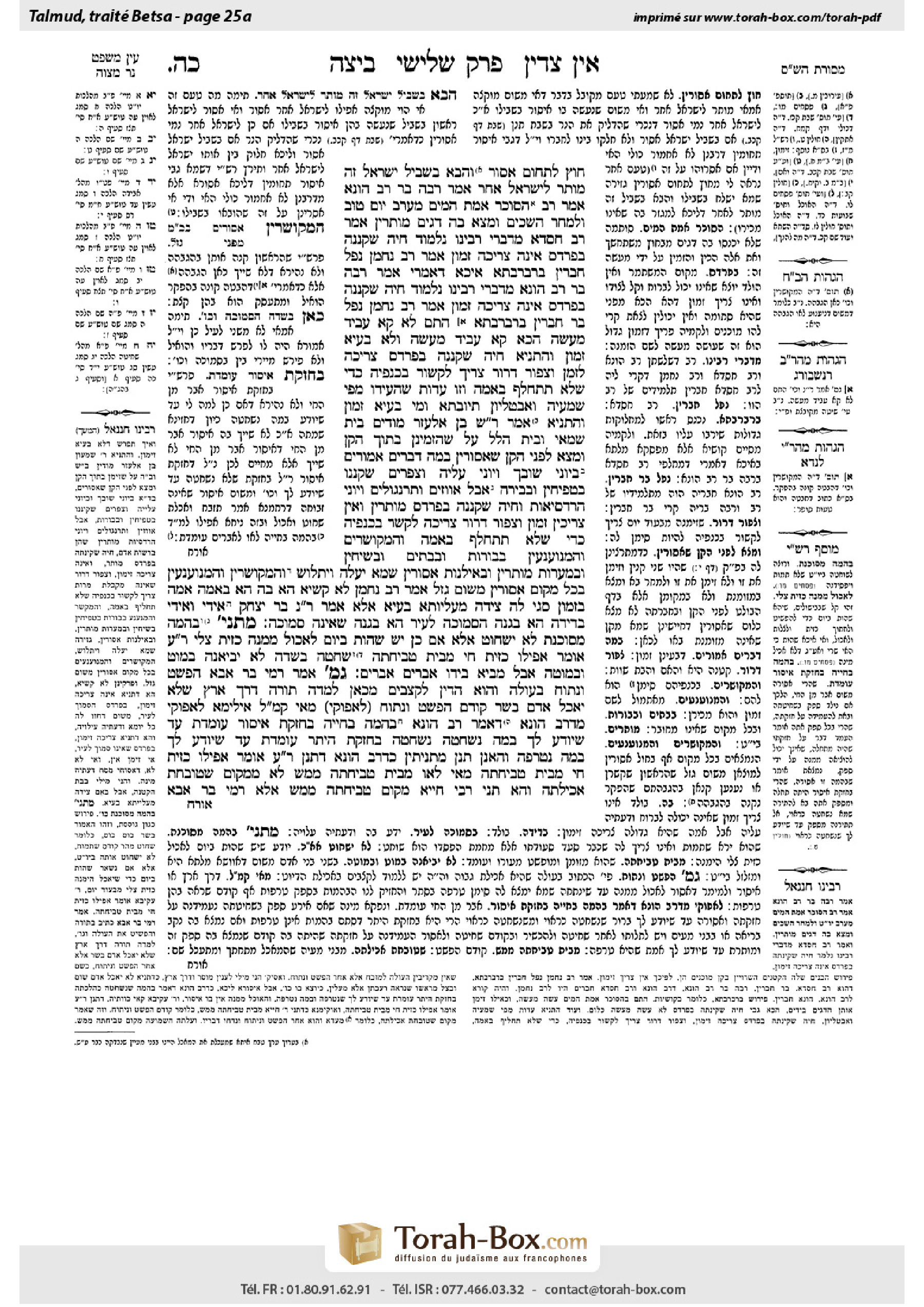
Beitzah 25a: Talmud study for Daf Yomi
Study the Talmud for Daf Yomi with scanned pages, Hebrew text, English translations from Sefaria and AI-generated French translations.
Passage selection and English or AI-generated French translation are available where the scan has annotations. Daf Study is independent of Torah-Box and Sefaria.
Browse Beitzah · ביצה · All tractatesBeitzah 25a text and translations
This page of Beitzah includes the Aramaic text, an English translation and an AI-generated French translation, alongside the scan above.
ביצה כ״ה א · Aramaic and Hebrew text
חוּץ לַתְּחוּם — אָסוּר. וְהַבָּא בִּשְׁבִיל יִשְׂרָאֵל זֶה — מוּתָּר לְיִשְׂרָאֵל אַחֵר.
אָמַר רַבָּה בַּר רַב הוּנָא אָמַר רַב: הַסּוֹכֵר אַמַּת הַמַּיִם מֵעֶרֶב יוֹם טוֹב, וּלְמָחָר הִשְׁכִּים וּמָצָא בָּהּ דָּגִים — מוּתָּרִין.
אָמַר רַב חִסְדָּא, מִדִּבְרֵי רַבֵּינוּ נִלְמוֹד: חַיָּה שֶׁקִּנְּנָה בְּפַרְדֵּס — אֵינָהּ צְרִיכָה זִמּוּן. אָמַר רַב נַחְמָן: נְפַל חַבְרִין, בְּרַבְרְבָתָא. אִיכָּא דְּאָמְרִי: אָמַר רַבָּה בַּר רַב הוּנָא, מִדִּבְרֵי רַבֵּינוּ נִלְמוֹד: חַיָּה שֶׁקִּנְּנָה בְּפַרְדֵּס — אֵינָהּ צְרִיכָה זִמּוּן. אָמַר רַב נַחְמָן: נְפַל בַּר חַבְרִין בְּרַבְרְבָתָא.
הָתָם לָא קָא עָבֵיד מַעֲשֶׂה, הָכָא קָא עָבֵיד מַעֲשֶׂה.
וְלָא בָּעֲיָא זִמּוּן? וְהָתַנְיָא: חַיָּה שֶׁקִּנְּנָה בְּפַרְדֵּס — צְרִיכָה לְזַמֵּן, וְצִפּוֹר דְּרוֹר — צָרִיךְ לִקְשׁוֹר בִּכְנָפֶיהָ כְּדֵי שֶׁלֹּא תִּתְחַלֵּף בְּאִמָּהּ. וְזוֹ עֵדוּת שֶׁהֵעִידוּ מִפִּי שְׁמַעְיָה וְאַבְטַלְיוֹן. תְּיוּבְתָּא.
וּמִי בָּעֲיָא זִמּוּן? וְהָתַנְיָא, אָמַר רַבִּי שִׁמְעוֹן בֶּן אֶלְעָזָר: מוֹדִים בֵּית שַׁמַּאי וּבֵית הִלֵּל עַל שֶׁהִזְמִינָן בְּתוֹךְ הַקֵּן וּמָצָא לִפְנֵי הַקֵּן — שֶׁאֲסוּרִין. בַּמֶּה דְּבָרִים אֲמוּרִים — בְּיוֹנֵי שׁוֹבָךְ וְיוֹנֵי עֲלִיָּה, וְצִפֳּרִים שֶׁקִּנְּנוּ בִּטְפִיחִין וּבְבִירָה. אֲבָל אֲווֹזִים וְתַרְנְגוֹלִים וְיוֹנֵי הַרְדָּסִיָּאוֹת וְחַיָּה שֶׁקִּנְּנָה בְּפַרְדֵּס — מוּתָּרִין, וְאֵין צְרִיכִין זִמּוּן. וְצִפּוֹר דְּרוֹר צְרִיכָה לְקַשֵּׁר בִּכְנָפֶיהָ, כְּדֵי שֶׁלֹּא תִּתְחַלֵּף בְּאִמָּהּ.
וְהַמְקוּשָּׁרִים וְהַמְנוּעֲנָעִין, בְּבוֹרוֹת וּבְבָתִּים וּבְשִׁיחִין וּבִמְעָרוֹת — מוּתָּרִין, וּבְאִילָנוֹת — אֲסוּרִין, שֶׁמָּא יַעֲלֶה וְיִתְלוֹשׁ. וְהַמְקוּשָּׁרִין וְהַמְנוּעֲנָעִין — בְּכׇל מָקוֹם אֲסוּרִין, מִשּׁוּם גָּזֵל.
אָמַר רַב נַחְמָן, לָא קַשְׁיָא: הָא בַּהּ, הָא בְּאִמַּהּ. אִמַּהּ בְּזִמּוּן סַגִּי לַהּ? צֵידָה מְעַלְּיוּתָא בָּעֲיָא!
אֶלָּא אָמַר רַב נַחְמָן בַּר יִצְחָק: אִידֵּי וְאִידֵּי בְּדִידַהּ. הָא בְּגִנָּה הַסְּמוּכָה לָעִיר, הָא בְּגִנָּה שֶׁאֵינָהּ סְמוּכָה.
מַתְנִי׳ בְּהֵמָה מְסוּכֶּנֶת — לֹא יִשְׁחוֹט, אֶלָּא אִם כֵּן יֵשׁ שְׁהוּת בַּיּוֹם לֶאֱכוֹל מִמֶּנָּה כְּזַיִת צָלִי. רַבִּי עֲקִיבָא אוֹמֵר: אֲפִילּוּ כְּזַיִת חַי מִבֵּית טְבִיחָתָהּ.
שְׁחָטָהּ בַּשָּׂדֶה — לֹא יְבִיאֶנָּה בְּמוֹט וּבְמוֹטָה, אֲבָל מֵבִיא בְּיָדוֹ אֵבָרִים אֵבָרִים.
גְּמָ׳ אָמַר רָמֵי בַּר אַבָּא: הֶפְשֵׁט וְנִתּוּחַ בְּעוֹלָה, וְהוּא הַדִּין לְקַצָּבִים. מִכָּאן לִמְּדָה תּוֹרָה דֶּרֶךְ אֶרֶץ: שֶׁלֹּא יֹאכַל אָדָם בָּשָׂר קוֹדֶם הֶפְשֵׁט וְנִתּוּחַ.
(לְאַפּוֹקֵי) מַאי קָא מַשְׁמַע לַן? אִילֵּימָא לְאַפּוֹקֵי מִדְּרַב הוּנָא, דְּאָמַר רַב הוּנָא: בְּהֵמָה בְּחַיֶּיהָ — בְּחֶזְקַת אִיסּוּר עוֹמֶדֶת, עַד שֶׁיִּוָּדַע לָךְ בַּמֶּה נִשְׁחֲטָה.
נִשְׁחֲטָה — בְּחֶזְקַת הֶיתֵּר עוֹמֶדֶת, עַד שֶׁיִּוָּדַע לָךְ בַּמֶּה נִטְרְפָה.
וְהָאֲנַן תְּנַן מַתְנִיתִין כִּדְרַב הוּנָא! דִּתְנַן, רַבִּי עֲקִיבָא אוֹמֵר: אֲפִילּוּ כְּזַיִת חַי מִבֵּית טְבִיחָתָהּ. מַאי לָאו, מִבֵּית טְבִיחָתָהּ מַמָּשׁ?
לָא: מִמָּקוֹם שֶׁטּוֹבַחַת אֲכִילָתָהּ.
וְהָא תָּנֵי רַבִּי חִיָּיא: מְקוֹם טְבִיחָתָהּ מַמָּשׁ. אֶלָּא, רָמֵי בַּר אַבָּא
Beitzah 25a · English translation
If, however, the gift was brought from outside the limit, it is prohibited. And an item that came from outside the limit for one Jew is permitted to another Jew. No prohibition applies to the second recipient, as the gentile’s intention was not fulfilled. Since the halakha of limits is a rabbinic prohibition, the Sages decreed that the object is prohibited only to the one on behalf of whom it was brought, but not to others.
§ The Gemara continues its discussion about trapping animals on a Festival. Rabba bar Rav Huna said that Rav said: If one dammed a water channel that was used to irrigate a field on the eve of a Festival, and the following day he arose and found fish in it, they are permitted. These fish presumably arrived with the water before the Festival and were unable to escape, as the channel had been obstructed. Therefore, the fish are considered as having been prepared before the Festival.
Rav Ḥisda said: From this statement of our teacher, Rav, we learn that an undomesticated animal that nested in an orchard near one’s house does not require special designation but is considered prepared. Rav Naḥman said in response to this conclusion: Our colleague, Rav Ḥisda, has fallen upon a great matter, i.e., an issue that is not at all straightforward but is the subject of various disagreements. Some say a slightly different version of this statement, that Rabba bar Rav Huna said: From this statement of our teacher, Rav, we learn that an undomesticated animal that nested in an orchard does not require special designation, and with regard to this statement, Rav Naḥman said that Rabba, son of our colleague, Rav Huna, has fallen upon a great matter. Rav Huna was a contemporary of Rav Naḥman’s, and they were both students of Rav; consequently, Rav Naḥman referred to Rav Huna as his colleague and called Rabba the son of his colleague.
Rav Naḥman explains the difference between the cases: There, in the case where the undomesticated animal nested in an orchard, the person performed no action at all, as the animal came of its own accord, whereas here, in the case where he dammed the water channel, he performed an action when he blocked the water from leaving the channel.
Rav Naḥman concludes his challenge: And does the animal not require further designation? Isn’t it taught explicitly in a baraita: An undomesticated animal that nested in an orchard requires designation. And as for a free bird, one is required to tie its wings so that it will not be mistaken for its mother, i.e., so that he not take a different bird, such as its mother, in its place. And this is a testimony that was reported in the name of Shemaya and Avtalyon. The Gemara comments: Indeed, this is a conclusive refutation of the Sages who drew an inference from Rav’s statement.
The Gemara asks: Does an undomesticated animal in an orchard really require designation? But isn’t it taught in a baraita that Rabbi Shimon ben Elazar said: Beit Shammai and Beit Hillel concede with regard to doves and the like that one had designated on the eve of a Festival when they were inside the nest, and on the Festival itself he found them in front of the nest, that they are prohibited, as these doves might not be the same ones that he had designated but rather others that came from somewhere else? In what case is this statement said? It is with regard to doves of a dovecote, doves of a loft, and birds nesting in pitchers or in a building. However, geese, chicken, domestic doves, and an undomesticated animal that nested in an orchard are permitted in all cases, and they do not require designation in advance. In the case of a free bird, one is required to tie its wings so that it is not mistaken for its mother.
And with regard to those birds whose wings were tied as a sign, and similarly, those that were shaken in advance in order to designate them for the Festival, if they were in cisterns, in houses, in trenches, or in caves, they are permitted on the Festival. However, if they were in trees, they are prohibited, lest one climb up the tree and detach something from it, which is prohibited. And those birds whose wings were tied by another, and similarly, those that were shaken by another are prohibited in all places, even not on a Festival, due to the prohibition against stealing. Tying or shaking is considered an act of acquisition, and therefore others may not take them. In any case, this baraita clearly states that an undomesticated animal that nested in an orchard does not require designation.
Rav Naḥman said: This is not difficult. This baraita, which teaches that an animal nesting in an orchard is permitted even without designation, is referring to it, a young animal that cannot escape; whereas that baraita, which states that designation is required, is referring to its mother, which is larger and can escape. The Gemara asks: But is mere designation sufficient for its mother? Doesn’t it require complete capture, as it is an undomesticated animal?
Rather, Rav Naḥman bar Yitzḥak said that both this baraita and that one are referring to it, a young animal that is unable to escape, and the difference between them is as follows: This baraita, which does not require designation, is referring to a garden situated near the city, so that one knows precisely where the animal is located and he can take it at any time. That baraita, which requires designation, is referring to a garden that is not located nearby.
MISHNA: If an animal is in danger of dying, in which case its meat would be prohibited as the animal had not been properly slaughtered, and one wishes to slaughter it in the hope that it will be found fit for eating and he will be spared a loss, he may not slaughter it on a Festival unless there is still time in the day for him to eat an olive-bulk of roasted meat from the animal, so that it is possible to say that he slaughtered the animal for the sake of the Festival. Rabbi Akiva says: There need not be enough time for him to roast it; rather, it is sufficient even if there is only time to eat an olive-bulk of raw meat from the place where the animal is slaughtered, i.e., from its neck, without going to the trouble of removing its hide and roasting it.
If one slaughtered an animal on a Festival in the field, he may not bring it to his house on a pole or on a set of poles carried by two people, as this appears similar to a weekday activity. Rather, he must alter his usual weekday manner of performing this action and bring it in by hand, limb by limb.
GEMARA: Rami bar Abba said: The mitzva of flaying and cutting the animal into pieces is mentioned in the Torah with regard to the burnt-offering, and the same is true for butchers. That is to say, we learn from the halakhot of the burnt offering that a butcher should first remove the hide and cut the animal into pieces. From here the Torah taught proper etiquette, that a person should not eat meat before flaying and cutting the animal into pieces.
The Gemara asks: What new halakha is Rami bar Abba teaching us? If we say that he wishes to exclude the opinion of Rav Huna, there is a difficulty, as Rav Huna said: An animal, while alive, retains its presumptive status of being subject to the prohibition against eating a limb from a living creature, and it retains that status after slaughter until it becomes known to you how it was slaughtered. As long as it has not yet been clarified that the animal was slaughtered properly, it is presumed to be prohibited.
However, once the animal has been slaughtered properly, it retains its presumptive status of being permitted until it becomes known to you how it became a tereifa, an animal suffering from a wound or illness that would cause it to die within twelve months, which is prohibited to be eaten even after ritual slaughter. There is no need to conduct a special examination of the animal to determine if it had a defect or illness, as it is presumed to be permitted. Even if a defect is found, this does not necessarily render the animal a tereifa, as one can say that it appeared only after the animal was slaughtered.
One might have understood from Rami bar Abba’s statement that he disagrees with Rav Huna and requires that the animal be examined. However, this is difficult, as didn’t we learn in the mishna in accordance with the opinion of Rav Huna? As we learned in the mishna that Rabbi Akiva says: It is sufficient even if there is only time to eat an olive-bulk of raw meat from the place where the animal is slaughtered. What, is it not referring to meat from the actual place where the animal is slaughtered, from which it follows that one need not remove the hide or examine the animal?
The Gemara rejects this argument: No, the mishna can be understood as follows: From the place where the animal slaughters its food, i.e., from its intestines, where digestion takes place. The hide must still be removed and the animal must be examined before it can be eaten.
But didn’t Rabbi Ḥiyya teach: From the actual place where the animal is slaughtered? Rather, the Gemara rejects the previous explanation and says that Rami bar Abba
Beitzah 25a · Traduction française (IA)
Si cependant l'offrande a été apportée en dehors de la limite, elle est interdite. Et un objet qui est venu en dehors de la limite pour un Juif est permis à un autre Juif. Aucune interdiction ne s'applique au second destinataire, car l'intention du Gentil n'a pas été accomplie. Puisque la halakha des limites est une interdiction rabbinique, les Sages ont décrété que l'objet est interdit uniquement à celui pour qui il a été apporté, mais pas aux autres.
§ La Guemara continue sa discussion sur l'attrapage d'animaux pendant un festival. Rabba bar Rav Huna a dit que Rav a dit : Si l'on a bouché un canal d'eau utilisé pour arroser un champ la veille d'un festival, et qu'on découvre le lendemain des poissons dans ce canal, ils sont permis. Ces poissons sont probablement arrivés avec l'eau avant le festival et n'ont pas pu s'échapper, car le canal avait été obstrué. Ainsi, les poissons sont considérés comme ayant été préparés avant le festival.
Rav Ḥisda a dit : D'après cette déclaration de notre maître, Rav, nous apprenons que tout animal sauvage qui a fait son nid dans un verger proche de la maison ne nécessite pas de désignation particulière mais est considéré comme préparé. Rav Naḥman a répondu à cette conclusion : Notre collègue, Rav Ḥisda, a abordé une grande question, c'est-à-dire une question qui n'est pas du tout claire mais qui fait l'objet de divers désaccords. Certains disent une version légèrement différente de cette déclaration, que Rabba bar Rav Huna a dit : D'après cette déclaration de notre maître, Rav, nous apprenons que tout animal sauvage qui a fait son nid dans un verger ne nécessite pas de désignation particulière, et concernant cette déclaration, Rav Naḥman a dit que Rabba, fils de notre collègue, Rav Huna, a abordé une grande question. Rav Huna était un contemporain de Rav Naḥman et ils étaient tous deux des élèves de Rav ; par conséquent, Rav Naḥman a appelé Rav Huna son collègue et a appelé Rabba le fils de son collègue.
Rav Naḥman explique la différence entre les cas : Là, dans le cas où l'animal sauvage a fait son nid dans un verger, la personne n'a pas accompli d'action du tout, car l'animal est venu de lui-même, tandis que ici, dans le cas où l'on a bouché le canal d'eau, la personne a accompli une action en bloquant l'eau pour qu'elle ne sorte pas du canal.
Rav Naḥman conclut son défi : Et l'animal ne nécessite-t-il pas une désignation supplémentaire ? N'est-il pas enseigné explicitement dans une baraïta : Un animal sauvage qui a fait son nid dans un verger nécessite une désignation. Et concernant un oiseau libre, on est tenu de ligaturer ses ailes afin qu'il ne soit pas confondu avec sa mère, c'est-à-dire afin qu'on ne prenne pas un autre oiseau, tel que sa mère, à sa place. Et c'est un témoignage rapporté au nom de Shemaya et Avtalyon. La Guemara commente : En effet, c'est une réfutation concluante des Sages qui ont tiré une conséquence de la déclaration de Rav.
La Guemara pose la question : Un animal sauvage dans un verger nécessite-t-il vraiment une désignation ? Mais n'est-il pas enseigné dans une baraïta que Rabbi Shimon ben Elazar a dit : Beit Shammai et Beit Hillel reconnaissent, concernant les moineaux et les semblables, que l'on avait désigné la veille du festival lorsqu'ils étaient dans le nid, et qu'on les a trouvés devant le nid pendant le festival, qu'ils sont interdits, car ces moineaux pourraient ne pas être les mêmes que ceux que l'on avait désignés mais plutôt d'autres qui sont venus d'ailleurs ? Dans quel cas cette déclaration est-elle dite ? C'est concernant les moineaux d'un poulaillers, les moineaux d'un toit, et les oiseaux qui nichent dans des récipients ou dans un bâtiment. Cependant, les canards, les poulets, les moineaux domestiques et un animal sauvage qui a fait son nid dans un verger sont permis dans tous les cas et n'ont pas besoin d'être désignés à l'avance. Concernant un oiseau libre, on est tenu de ligaturer ses ailes afin qu'il ne soit pas confondu avec sa mère.
Et concernant ces oiseaux dont les ailes ont été ligaturées comme signe, ainsi que ceux qui ont été secoués à l'avance afin de les désigner pour le festival, si ils étaient dans des citernes, des maisons, des fossés ou des grottes, ils sont permis pendant le festival. Cependant, s'ils étaient dans les arbres, ils sont interdits, de peur qu'on monte dans l'arbre et qu'on détache quelque chose de là, ce qui est interdit. Et ces oiseaux dont les ailes ont été ligaturées par un autre, ainsi que ceux qui ont été secoués par un autre sont interdits dans tous les lieux, même hors du festival, en raison de l'interdiction de voler. La ligature ou le secouage est considéré comme un acte d'acquisition, et par conséquent, d'autres ne peuvent pas les prendre. En tout cas, cette baraïta clairement indique qu'un animal sauvage qui a fait son nid dans un verger n'a pas besoin de désignation.
Rav Naḥman a dit : Ce n'est pas difficile. Cette baraïta, qui enseigne qu'un animal nichant dans un verger est permis même sans désignation, fait référence à un jeune animal qui ne peut pas s'échapper ; tandis que cette baraïta, qui stipule que la désignation est requise, fait référence à sa mère, qui est plus grande et peut s'échapper. La Guemara pose la question : Mais la simple désignation suffit-elle pour sa mère ? N'a-t-elle pas besoin d'être entièrement capturée, car c'est un animal sauvage ?
Plutôt, Rav Naḥman bar Yitzḥak a dit que ces deux baraitas font référence à un jeune animal qui ne peut pas s'échapper, et la différence entre elles est la suivante : Cette baraïta, qui ne nécessite pas de désignation, fait référence à un jardin situé près de la ville, de sorte qu'on sait précisément où l'animal est et qu'on peut le prendre à tout moment. Cette baraïta, qui exige une désignation, fait référence à un jardin qui n'est pas situé près de la ville.
MICHNA : Si un animal est en danger de mourir, dans le cas où sa viande serait interdite car l'animal n'a pas été correctement sacrifié, et qu'on souhaite le sacrifier en espérant qu'il sera trouvé propre à l'ingestion et qu'on évitera ainsi une perte, on ne peut pas le sacrifier pendant un festival à moins qu'il reste du temps dans la journée pour manger une quantité de viande rôti égale à une olive, de sorte qu'on puisse dire qu'on a sacrifié l'animal à l'intention du festival. Rabbi Akiva dit : Il n'est pas nécessaire qu'il reste assez de temps pour le rôtir ; il suffit même qu'il reste du temps pour manger une quantité de viande crue égale à une olive, c'est-à-dire à partir de la place où l'animal a été sacrifié, c'est-à-dire de son cou, sans avoir à se donner la peine de retirer sa peau et de le rôtir.
Si l'on a sacrifié un animal pendant un festival en plein champ, on ne peut pas l'amener chez soi sur une poutre ou sur un ensemble de poutres porté par deux personnes, car cela ressemble à une activité du jour de travail. Il faut plutôt modifier sa manière habituelle de faire cela le jour de travail et l'amener à la main, membre par membre.
GUEMARA : Rami bar Abba a dit : La mitsva de dépecer et de découper l'animal en morceaux est mentionnée dans la Torah concernant l'holocauste, et c'est pareil pour les bouchers. Cela signifie que nous apprenons des halakhot de l'holocauste que le boucher doit d'abord retirer la peau et découper l'animal en morceaux. De là, la Torah a enseigné la bonne éducation, que la personne ne doit pas manger de viande avant de dépecer et de découper l'animal en morceaux.
La Guemara pose la question : Quelle nouvelle halakha Rami bar Abba nous enseigne-t-il ? Si nous disons qu'il veut exclure l'opinion de Rav Huna, cela pose un problème, car Rav Huna a dit : L'animal, tant qu'il est vivant, conserve son statut présomptif de prohibition de manger un membre d'un animal vivant, et il conserve ce statut après la sacrifice jusqu'à ce qu'il soit connu comment il a été sacrifié. Aussi longtemps qu'il n'a pas été clarifié que l'animal a été sacrifié correctement, il est présomptivement interdit.
Cependant, une fois que l'animal a été sacrifié correctement, il conserve son statut présomptif de permis jusqu'à ce qu'il soit connu comment il est devenu tereifa, un animal souffrant d'une blessure ou d'une maladie qui le ferait mourir en douze mois, ce qui est interdit de manger même après la sacrifice rituel. Il n'est pas nécessaire d'effectuer une vérification spéciale de l'animal pour déterminer s'il avait un défaut ou une maladie, car il est présomptivement permis. Même si un défaut est trouvé, cela ne rend pas nécessairement l'animal tereifa, car on peut dire qu'il est apparu après que l'animal ait été sacrifié.
On pourrait avoir compris de la déclaration de Rami bar Abba que celui-ci s'oppose à Rav Huna et exige que l'animal soit examiné. Cependant, cela est difficile, car n'avons-nous pas appris dans la mishna selon l'opinion de Rav Huna ? Comme nous avons appris dans la mishna que Rabbi Akiva dit : Il suffit même si il n'y a que le temps de manger une quantité d'ongle de viande crue du lieu où l'animal est sacrifié. Qu'est-ce que cela ne signifie pas par le lieu où l'animal est sacrifié, duquel il suit que l'on n'a pas besoin de retirer la peau ou d'examiner l'animal ?
La Guemara rejette cet argument : Non, la mishna peut être comprise ainsi : Du lieu où l'animal sacrifie sa nourriture, c'est-à-dire de son intestin, où se produit la digestion. La peau doit encore être retirée et l'animal doit être examiné avant qu'il ne puisse être mangé.
Mais n’a-t-on pas appris que Rabbi Ḥiyya a dit : Du lieu réel où l’animal est sacrifié ? Plutôt, la Guemara rejette cette explication précédente et affirme que Rami bar Abba
Traduction française générée par IA à partir de l’édition anglaise de Sefaria. Vérifie toujours un passage avec le texte source.
Text from Sefaria: William Davidson Edition - Vocalized Aramaic (CC BY NC); William Davidson Edition - English (CC BY NC).