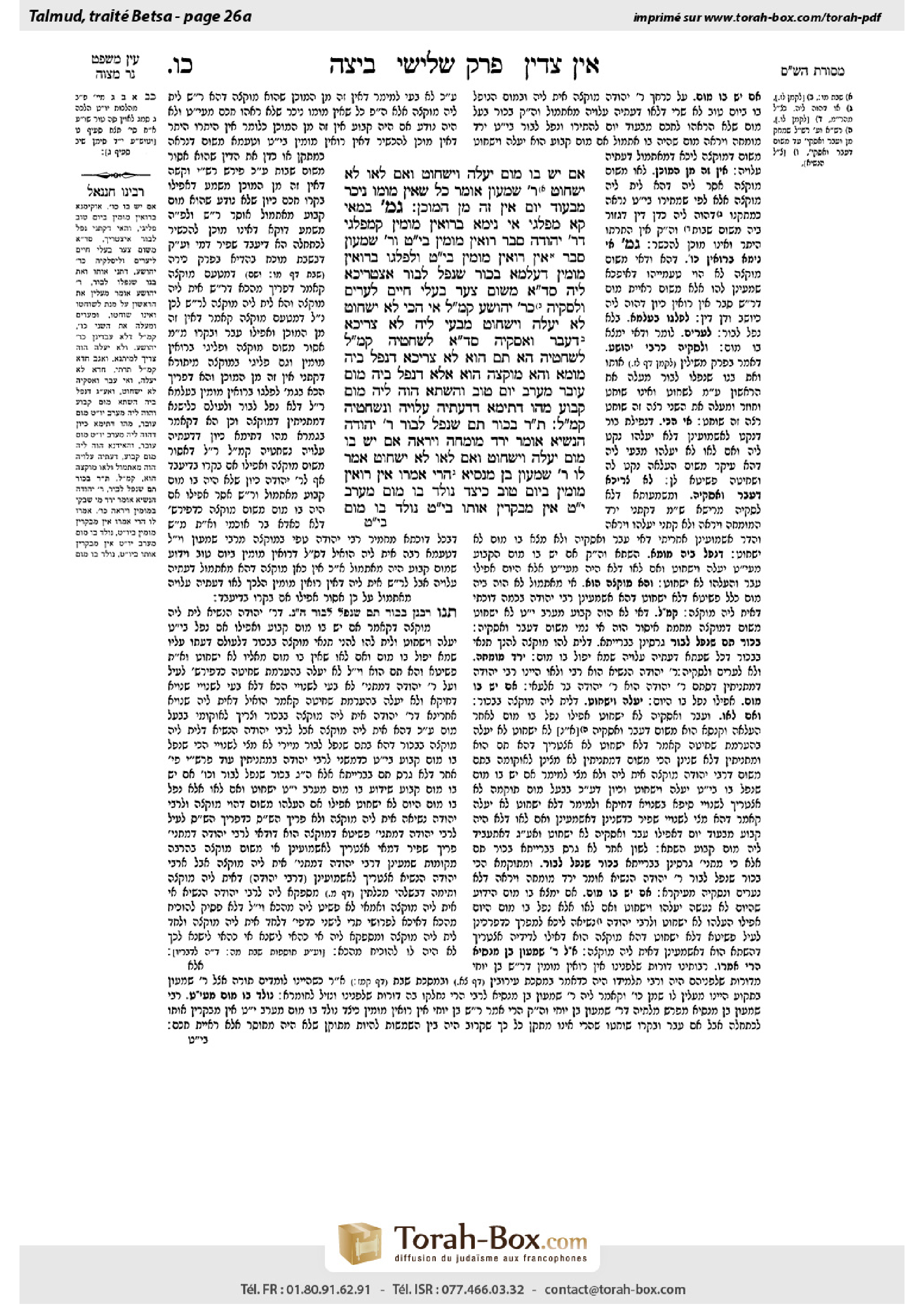
Beitzah 26a: Talmud study for Daf Yomi
Study the Talmud for Daf Yomi with scanned pages, Hebrew text, English translations from Sefaria and AI-generated French translations.
Passage selection and English or AI-generated French translation are available where the scan has annotations. Daf Study is independent of Torah-Box and Sefaria.
Browse Beitzah · ביצה · All tractatesBeitzah 26a text and translations
This page of Beitzah includes the Aramaic text, an English translation and an AI-generated French translation, alongside the scan above.
ביצה כ״ו א · Aramaic and Hebrew text
אִם יֵשׁ בּוֹ מוּם — יַעֲלֶה וְיִשְׁחוֹט, וְאִם לָאו — לֹא יִשְׁחוֹט. רַבִּי שִׁמְעוֹן אוֹמֵר: כֹּל שֶׁאֵין מוּמוֹ נִיכָּר מִבְּעוֹד יוֹם, אֵין זֶה מִן הַמּוּכָן —
גְּמָ׳ בְּמַאי קָא מִפַּלְגִי? אִי נֵימָא בְּרוֹאִין מוּמִין קָמִפַּלְגִי, דְּרַבִּי יְהוּדָה סָבַר: רוֹאִין מוּמִין בְּיוֹם טוֹב, וְרַבִּי שִׁמְעוֹן סָבַר: אֵין רוֹאִין מוּמִין בְּיוֹם טוֹב, וְלִפַּלְגוּ בְּרוֹאִין מוּמִין דְּעָלְמָא!
בְּכוֹר שֶׁנָּפַל לַבּוֹר אִצְטְרִיכָא לֵיהּ, סָלְקָא דַּעְתָּךְ אָמֵינָא: מִשּׁוּם צַעַר בַּעֲלֵי חַיִּים לַעֲרֵים וְלַסְּקֵיהּ כְּרַבִּי יְהוֹשֻׁעַ — קָא מַשְׁמַע לַן.
אִי הָכִי, ״לֹא יִשְׁחוֹט״? ״לֹא יַעֲלֶה וְיִשְׁחוֹט״ מִבְּעֵי לֵיהּ! לָא צְרִיכָא — דַּעֲבַר וְאַסְּקֵיהּ, סָלְקָא דַּעְתָּךְ אָמֵינָא: לִשְׁחֲטֵיהּ, קָא מַשְׁמַע לַן.
לִשְׁחֲטֵיהּ?! הָא תָּם הוּא! לָא צְרִיכָא, דִּנְפַל בֵּיהּ מוּמָא. וְהָא מוּקְצֶה הוּא!
אֶלָּא: דִּנְפַל בֵּיהּ מוּם עוֹבֵר מֵעֶרֶב יוֹם טוֹב, וְהַשְׁתָּא הֲוָה לֵיהּ מוּם קָבוּעַ. מַהוּ דְּתֵימָא: דְּדַעְתֵּיהּ עִלָּוֵיהּ, וְנִשְׁחֲטֵיהּ, קָא מַשְׁמַע לַן.
תָּנוּ רַבָּנַן: בְּכוֹר תָּם שֶׁנָּפַל לַבּוֹר, רַבִּי יְהוּדָה הַנָּשִׂיא אוֹמֵר: יֵרֵד מוּמְחֶה וְיִרְאֶה, אִם יֵשׁ בּוֹ מוּם — יַעֲלֶה וְיִשְׁחוֹט, וְאִם לָאו — לֹא יִשְׁחוֹט. אָמַר לוֹ רַבִּי שִׁמְעוֹן בֶּן מְנַסְיָא: הֲרֵי אָמְרוּ אֵין רוֹאִין מוּמִין בְּיוֹם טוֹב. כֵּיצַד? נוֹלַד בּוֹ מוּם מֵעֶרֶב יוֹם טוֹב, אֵין מְבַקְּרִין אוֹתוֹ בְּיוֹם טוֹב. נוֹלַד בּוֹ מוּם
Beitzah 26a · English translation
If it has a permanent blemish, owing to which it may be slaughtered and eaten, he may raise it from the cistern and slaughter it; but if it does not have a blemish, or if its blemish is temporary, he may not slaughter it. Rabbi Shimon says: Even if it has a blemish, it is prohibited to slaughter it, as any firstborn animal whose blemish is not perceptible while it is still day, i.e., on the day before the Festival, is not considered to be among the animals prepared prior to the Festival for use on the Festival.
GEMARA: The Gemara asks: With regard to what principle do Rabbi Yehuda and Rabbi Shimon disagree? If we say that they disagree about whether or not one may examine blemishes on a Festival, such that Rabbi Yehuda holds that one may examine blemishes on a Festival, and Rabbi Shimon holds that one may not examine blemishes on a Festival, if so, let them disagree with regard to examining blemishes in general on a Festival and not only with respect to the particular case of a firstborn that fell into a cistern.
The Gemara answers: It was necessary to teach the disagreement with regard to the case of a firstborn that fell into a cistern, as it could enter your mind to say that because of the matter of the suffering of living creatures, one should employ an artifice to circumvent the halakha and raise the animal from the cistern. This would be in accordance with the opinion of Rabbi Yehoshua, who states elsewhere (37a) with regard to a different case that one may employ an artifice in order to rescue an animal that fell into a cistern on a Festival. Therefore, the mishna teaches us that Rabbi Yehuda and Rabbi Shimon disagree even in the case of a firstborn that fell into a cistern.
The Gemara asks: If so, if the mishna mentions the case of a firstborn that fell into a cistern in order to teach that an artifice may not be employed to raise the animal from the cistern, the phrase: He may not slaughter it, is inaccurate. Rather, it should have stated: He may not raise the animal and slaughter it. The Gemara answers: No, this teaching is necessary in a case where he transgressed the prohibition and already raised it, as it could enter your mind to say that he may now slaughter it. Therefore, the mishna teaches us that even then he may not do so.
The Gemara expresses wonder at this answer: How could one think that he may now slaughter it? Isn’t the animal unblemished? How could one imagine that it is permitted to slaughter a firstborn that is unblemished? The Gemara answers: This teaching is necessary only in a case where it developed a blemish after it fell. The Gemara challenges this argument: But how could one think that he may now slaughter the animal? Doesn’t it fall into the category of muktze, as it was not fit to be eaten on the eve of the Festival, since at that time it was still unblemished? In that case, it should remain in the category of muktze for the duration of the Festival.
Rather, the mishna is speaking of a case where the animal developed a temporary blemish, one that might eventually heal, on the eve of the Festival, and now, after falling, it has a permanent blemish. Lest you say that his mind was set on the animal as food already before the Festival due to the temporary blemish and therefore he should now be allowed to slaughter it, the mishna teaches us that since it was not fit to be eaten before the Festival, it is not considered prepared for use on the Festival. Rather, it falls into the category of muktze and may not be slaughtered.
The Sages taught the following baraita: With regard to an unblemished firstborn that fell into a cistern on a Festival, Rabbi Yehuda HaNasi says: An expert in these matters goes down into the cistern and examines the animal. If it now has a permanent blemish as a result of the fall, he may raise it from the cistern and slaughter it; but if not, then even if he proceeds to raise it, he may not slaughter it, even if afterwards it develops a blemish. Rabbi Shimon ben Menasya said to him: The Sages of earlier generations already said that one may not examine blemishes on a Festival. How so? If a blemish came into being on the eve of a Festival, one may not examine it on the Festival itself to see whether it is in fact of the type that permits the animal to be slaughtered. And if the blemish came into being
Beitzah 26a · Traduction française (IA)
Si l'animal a une tache permanente, en raison de laquelle il peut être sacrifié et mangé, il peut le retirer du puits et le sacrifier ; mais si l'animal n'a pas de tache, ou si sa tache est temporaire, il ne peut pas le sacrifier. Rabbi Shimon dit : Même s'il a une tache, il est interdit de le sacrifier, car tout premier-né dont la tache n'est pas perceptible pendant la journée, c'est-à-dire le jour avant la fête, n'est pas considéré comme étant parmi les animaux préparés avant la fête pour être utilisés lors de la fête.
GUEMARA : La Guemara pose la question : Sur quel principe Rabbi Yehuda et Rabbi Shimon s'opposent-ils ? Si nous disons qu'ils s'opposent sur la question de savoir si l'on peut examiner les taches pendant la fête, de sorte que Rabbi Yehuda maintient que l'on peut examiner les taches pendant la fête, et Rabbi Shimon maintient que l'on ne peut pas examiner les taches pendant la fête, si tel est le cas, qu'ils s'opposent sur l'examen des taches en général pendant la fête et non seulement sur le cas particulier d'un premier-né tombé dans un puits.
La Guemara répond : Il était nécessaire d'enseigner ce désaccord concernant le cas d'un premier-né tombé dans un puits, car il pourrait entrer en vous-même à l'idée qu'en raison de la souffrance des créatures vivantes, on devrait employer un artifice pour contourner la halakha et retirer l'animal du puits. Cela serait en conformité avec l'opinion de Rabbi Yehoshua, qui énonce ailleurs (37a) concernant un cas différent que l'on peut employer un artifice afin de sauver un animal tombé dans un puits pendant la fête. Par conséquent, la mitsva nous apprend que Rabbi Yehuda et Rabbi Shimon s'opposent même dans le cas d'un premier-né tombé dans un puits.
La Guemara pose la question : Si tel est le cas, si la mitsva mentionne le cas d'un premier-né tombé dans un puits afin d'enseigner que l'on ne peut pas employer un artifice pour retirer l'animal du puits, la phrase : Il ne peut pas le sacrifier, est inexacte. Plutôt, elle aurait dû dire : Il ne peut pas retirer l'animal et le sacrifier. La Guemara répond : Non, cette enseignement est nécessaire dans un cas où il a transgressé l'interdiction et l'a déjà retiré, car il pourrait entrer en vous-même à l'idée qu'il peut maintenant le sacrifier. Par conséquent, la mitsva nous apprend que même alors il ne doit pas le faire.
La Guemara exprime une surprise à l'égard de cette réponse : Comment pourrait-on penser qu'il puisse maintenant le sacrifier ? N'est-ce pas que l'animal est sans tache ? Comment pourrait-on imaginer qu'il soit permis de sacrifier un premier-né qui est sans tache ? La Guemara répond : Cet enseignement est nécessaire uniquement dans un cas où il a développé une tache après avoir tombé. La Guemara conteste cet argument : Mais comment pourrait-on penser qu'il puisse maintenant le sacrifier ? N'est-ce pas qu'il tombe dans la catégorie de muktze, car il n'était pas adapté à être mangé la veille de la fête, puisqu'à ce moment-là il était encore sans tache ? Dans ce cas, il devrait rester dans la catégorie de muktze pendant toute la fête.
Plutôt, la mitsva parle d'un cas où l'animal a développé une tache temporaire, celle qui pourrait guérir, la veille de la fête, et maintenant, après avoir tombé, il a une tache permanente. Lest que vous disiez que son esprit était déjà fixé sur l'animal comme nourriture avant la fête en raison de la tache temporaire et qu'il devrait donc maintenant être autorisé à le sacrifier, la mitsva nous apprend que puisque l'animal n'était pas adapté à être mangé avant la fête, il n'est pas considéré comme préparé pour être utilisé lors de la fête. Plutôt, il tombe dans la catégorie de muktze et ne peut pas être sacrifié.
Les Sages ont enseigné la suivante baraïta : Concernant un premier-né sans tache tombé dans un puits pendant la fête, Rabbi Yehuda HaNasi dit : Un expert dans ces matières descend dans le puits et examine l'animal. Si maintenant il a une tache permanente en raison de la chute, il peut le retirer du puits et le sacrifier ; mais si non, alors même s'il procède à le retirer, il ne peut pas le sacrifier, même si par la suite il développe une tache. Rabbi Shimon ben Menasya lui répond : Les Sages des générations précédentes ont déjà dit qu'on ne peut pas examiner les taches pendant la fête. Comment cela est-il ? Si une tache est apparue la veille d'une fête, on ne peut pas l'examiner pendant la fête elle-même pour voir si elle est effectivement de la sorte qui permet à l'animal d'être sacrifié. Et si la tache est apparue
Traduction française générée par IA à partir de l’édition anglaise de Sefaria. Vérifie toujours un passage avec le texte source.
Text from Sefaria: William Davidson Edition - Vocalized Aramaic (CC BY NC); William Davidson Edition - English (CC BY NC).