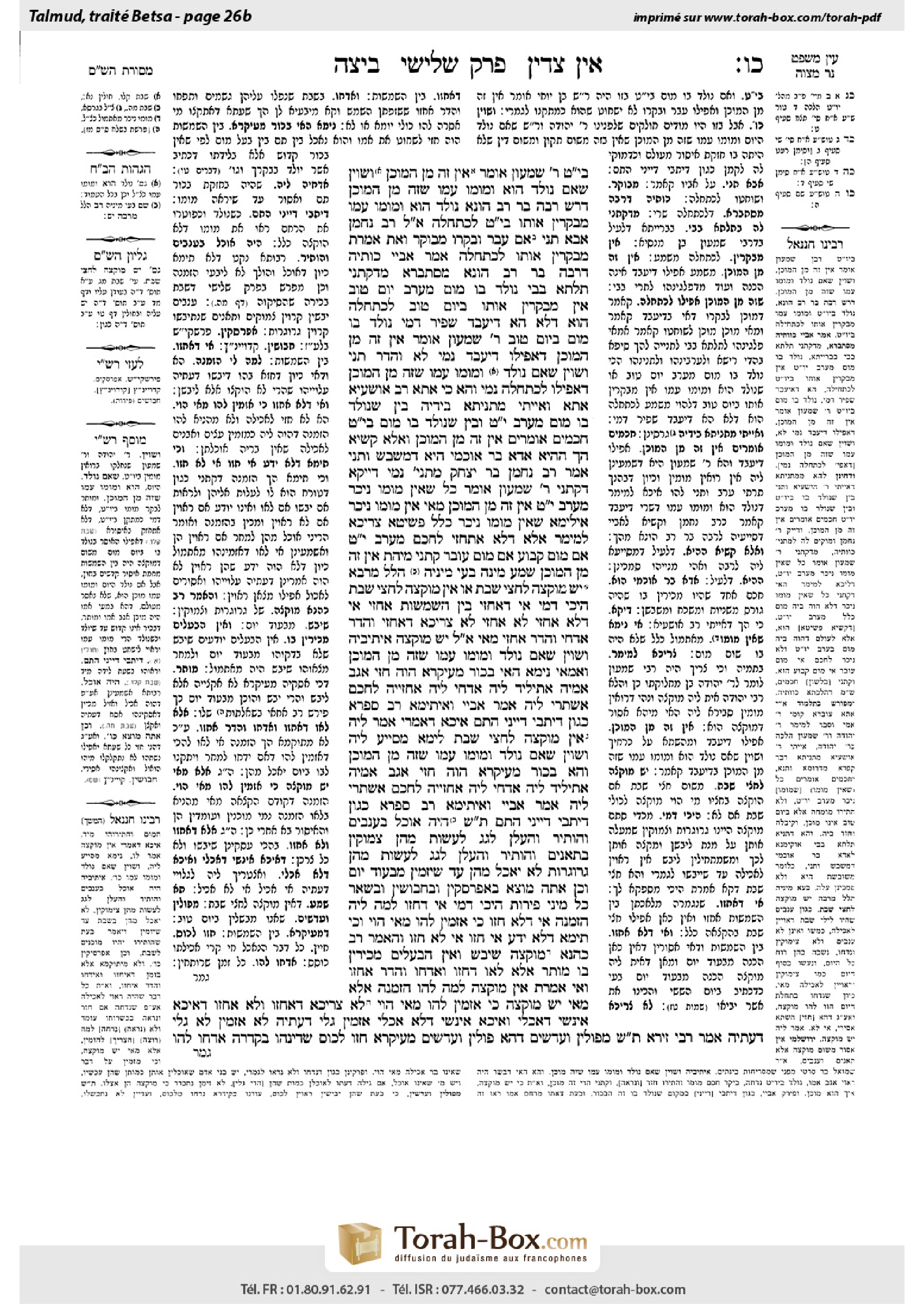
Beitzah 26b: Talmud study for Daf Yomi
Study the Talmud for Daf Yomi with scanned pages, Hebrew text, English translations from Sefaria and AI-generated French translations.
Passage selection and English or AI-generated French translation are available where the scan has annotations. Daf Study is independent of Torah-Box and Sefaria.
Browse Beitzah · ביצה · All tractatesBeitzah 26b text and translations
This page of Beitzah includes the Aramaic text, an English translation and an AI-generated French translation, alongside the scan above.
ביצה כ״ו ב · Aramaic and Hebrew text
בְּיוֹם טוֹב, רַבִּי שִׁמְעוֹן אוֹמֵר: אֵין זֶה מִן הַמּוּכָן. וְשָׁוִין שֶׁאִם נוֹלַד הוּא וּמוּמוֹ עִמּוֹ — שֶׁזֶּה מִן הַמּוּכָן.
דָּרֵשׁ רַבָּה בַּר רַב הוּנָא: נוֹלַד הוּא וּמוּמוֹ עִמּוֹ — מְבַקְּרִין אוֹתוֹ בְּיוֹם טוֹב לְכַתְּחִלָּה. אֲמַר לֵיהּ רַב נַחְמָן, אַבָּא תָּנֵי: אִם עָבַר וּבִקְּרוֹ — מְבוּקָּר, וְאַתְּ אָמְרַתְּ מְבַקְּרִין אוֹתוֹ לְכַתְּחִלָּה!
אָמַר אַבָּיֵי: כְּוָתֵיהּ דְּרַבָּה בַּר רַב הוּנָא מִסְתַּבְּרָא, מִדְּקָתָנֵי תְּלָתָא בָּבֵי: נוֹלַד בּוֹ מוּם מֵעֶרֶב יוֹם טוֹב — אֵין מְבַקְּרִין אוֹתוֹ בְּיוֹם טוֹב. לְכַתְּחִלָּה הוּא דְּלָא, הָא דִּיעֲבַד — שַׁפִּיר דָּמֵי.
נוֹלַד בּוֹ מוּם בְּיוֹם טוֹב, רַבִּי שִׁמְעוֹן אוֹמֵר: אֵין זֶה מִן הַמּוּכָן — דַּאֲפִילּוּ דִּיעֲבַד נָמֵי לָא. וַהֲדַר תָּנֵי: וְשָׁוִין שֶׁאִם נוֹלַד וּמוּמוֹ עִמּוֹ, שֶׁזֶּה מִן הַמּוּכָן — דַּאֲפִילּוּ לְכַתְּחִלָּה נָמֵי.
וְהָא כִּי אֲתָא רַב אוֹשַׁעְיָא, אֲתָא וְאַיְיתִי מַתְנִיתָא בִּידֵיהּ: בֵּין שֶׁנּוֹלַד בּוֹ מוּם מֵעֶרֶב יוֹם טוֹב, וּבֵין שֶׁנּוֹלַד בּוֹ מוּם בְּיוֹם טוֹב, חֲכָמִים אוֹמְרִים: אֵין זֶה מִן הַמּוּכָן.
וְאֶלָּא קַשְׁיָא הָךְ! הָהִיא — אַדָּא בַּר אוּכָּמֵי הִיא, דִּמְשַׁבֵּשׁ וְתָנֵי.
אָמַר רַב נַחְמָן בַּר יִצְחָק: מַתְנִיתִין נָמֵי דַּיְיקָא. דְּקָתָנֵי, רַבִּי שִׁמְעוֹן אוֹמֵר: כֹּל שֶׁאֵין מוּמוֹ נִיכָּר מֵעֶרֶב יוֹם טוֹב — אֵין זֶה מִן הַמּוּכָן. מַאי אֵין מוּמוֹ נִיכָּר? אִילֵּימָא שֶׁאֵין מוּמוֹ נִיכָּר כְּלָל — פְּשִׁיטָא, צְרִיכָא לְמֵימַר?
אֶלָּא, דְּלָא אִתְחֲזִי לְחָכָם מֵעֶרֶב יוֹם טוֹב אִם מוּם קָבוּעַ אִם מוּם עוֹבֵר. קָתָנֵי מִיהַת אֵין זֶה מִן הַמּוּכָן, שְׁמַע מִינַּהּ.
בָּעֵי מִינֵּיהּ הִלֵּל מֵרָבָא: יֵשׁ מוּקְצֶה לַחֲצִי שַׁבָּת אוֹ אֵין מוּקְצֶה לַחֲצִי שַׁבָּת? הֵיכִי דָמֵי: אִי דְּאִחֲזִי בֵּין הַשְּׁמָשׁוֹת — אִחֲזִי. אִי דְּלָא אִחֲזִי — לָא אִחֲזִי?
לָא צְרִיכָא: דְּאִחֲזִי, וַהֲדַר אִדְּחִי, וַהֲדַר אִחֲזִי. מַאי? אֲמַר לֵיהּ: יֵשׁ מוּקְצֶה.
אֵיתִיבֵיהּ: וְשָׁוִין שֶׁאִם נוֹלַד וּמוּמוֹ עִמּוֹ — שֶׁזֶּה מִן הַמּוּכָן. וְאַמַּאי? נֵימָא: הַאי בְּכוֹר מֵעִיקָּרָא הֲוָה חֲזֵי אַגַּב אִמֵּיהּ, אִתְיְלִיד לֵיהּ — אִדְּחִי לֵיהּ, אַחְזְיֵיהּ לְחָכָם — אִשְׁתְּרִי לֵיהּ!
אָמַר אַבָּיֵי וְאִיתֵּימָא רַב סָפְרָא: כְּגוֹן דְּיָתְבִי דַּיָּינֵי הָתָם.
אִיכָּא דְאָמְרִי, אֲמַר לֵיהּ: אֵין מוּקְצֶה לַחֲצִי שַׁבָּת. לֵימָא מְסַיַּיע לֵיהּ: וְשָׁוִין שֶׁאִם נוֹלַד וּמוּמוֹ עִמּוֹ — שֶׁזֶּה מִן הַמּוּכָן. וְהָא בְּכוֹר מֵעִיקָּרָא הֲוָה חֲזִי אַגַּב אִמֵּיהּ, אִתְיְלִיד לֵיהּ — אִדְּחִי לֵיהּ, אַחְזְיֵיהּ לְחָכָם — אִשְׁתְּרִי לֵיהּ.
אָמַר אַבָּיֵי וְאִיתֵּימָא רַב סָפְרָא: כְּגוֹן דְּיָתְבִי דַּיָּינֵי הָתָם.
תָּא שְׁמַע: הָיָה אוֹכֵל בַּעֲנָבִים, וְהוֹתִיר וְהֶעֱלָן לַגָּג לַעֲשׂוֹת מֵהֶן צִמּוּקִין, בִּתְאֵנִים, וְהוֹתִיר וְהֶעֱלָן לַגָּג לַעֲשׂוֹת מֵהֶן גְּרוֹגְרוֹת — לֹא יֹאכַל מֵהֶן עַד שֶׁיַּזְמִין מִבְּעוֹד יוֹם. וְכֵן אַתָּה מוֹצֵא בַּאֲפַרְסְקִין וּבַחֲבוּשִׁין וּבִשְׁאָר כׇּל מִינֵי פֵירוֹת.
הֵיכִי דָמֵי? אִי דַּחֲזוּ — לְמָה לֵיהּ הַזְמָנָה? אִי דְּלָא חֲזוּ — כִּי אַזְמֵין לְהוּ מַאי הָוֵי!
וְכִי תֵּימָא, דְּלָא יָדַע אִי חֲזוּ אִי לָא חֲזוּ, וְהָאָמַר רַב כָּהֲנָא: מוּקְצֶה שֶׁיָּבַשׁ וְאֵין הַבְּעָלִים מַכִּירִין בּוֹ — מוּתָּר.
אֶלָּא לָאו, דִּחֲזוֹ וְאִדְּחוֹ, וַהֲדַר אִחֲזוֹ. וְאִי אָמְרַתְּ אֵין מוּקְצֶה, לְמָה לְהוּ הַזְמָנָה? אֶלָּא מַאי יֵשׁ מוּקְצֶה? כִּי אַזְמֵין לְהוּ מַאי הָוֵי!
לָא צְרִיכָא: דְּאִחֲזוֹ וְלָא אִחֲזוֹ. דְּאִיכָּא אִינָשֵׁי דְּאָכְלִי, וְאִיכָּא אִינָשֵׁי דְּלָא אָכְלִי. אַזְמֵין — גַּלִּי דַּעְתֵּיהּ, לָא אַזְמֵין — לָא גַּלִּי דַּעְתֵּיהּ.
אָמַר רַבִּי זֵירָא: תָּא שְׁמַע מִפּוֹלִין וַעֲדָשִׁים. דְּהָא פּוֹלִין וַעֲדָשִׁים מֵעִיקָּרָא חֲזוּ לָכוֹס, שְׁדִינְהוּ בִּקְדֵרָה — אִדְּחוֹ לְהוּ,
Beitzah 26b · English translation
on the Festival itself, Rabbi Shimon says: It is not considered to be among the animals prepared prior to the Festival for use on the Festival; therefore, even if it was examined by an expert, it may not be slaughtered. And Rabbi Yehuda and Rabbi Shimon agree that if the animal was born with its blemish, it is considered to be among the animals prepared for use on the Festival.
Rabba bar Rav Huna taught the halakha as follows: If a firstborn was born with its blemish, experts may examine it on a Festival ab initio, and if the blemish is found to be permanent, the animal may then be slaughtered. Rav Naḥman said to him: Father would teach on this matter that if he transgressed and examined it, it is considered examined after the fact, and you say that one may examine it even ab initio?
Abaye said: It stands to reason that the halakha is in accordance with the opinion of Rabba bar Rav Huna from the fact that the baraita is taught in three parts, which suggests that each part contains a novel halakha. The first section states: If a firstborn developed a blemish on the eve of a Festival one may not examine it on the Festival itself, from which one can learn that it is only ab initio that one may not examine it; but after the fact, it seems well, and the examination is valid.
The second section of the baraita states: If it developed a blemish on the Festival itself, Rabbi Shimon says: It is not considered to be among the animals prepared prior to the Festival for use on the Festival. In other words, even after the fact, no, if the animal was examined by an expert, it may not be slaughtered and eaten. And then in the third section it teaches: And Rabbi Yehuda and Rabbi Shimon agree that if the animal was born with its blemish, it is considered to be among the animals prepared for use on the Festival. The fact that the baraita taught this halakha as an independent clause indicates that even ab initio as well, the animal may be examined.
The Gemara raises an objection: But isn’t it so that when Rav Oshaya came from Eretz Yisrael to Babylonia, he came and brought the following baraita in his hand: Whether the animal developed a blemish on the eve of the Festival or it developed a blemish on the Festival itself, the Rabbis say: It is not considered to be among the animals prepared for use on the Festival, so that even after the fact, if the animal was examined, it may not be slaughtered and eaten. According to this, the allowance granted in the case of a firstborn that was born with its blemish can be only after the fact, as argued by Rav Naḥman, and not ab initio, as maintained by Rabba bar Rav Huna. Why, then, does Abaye accept the opinion of the latter and not that of the former?
The Gemara asks: But if so, that baraita cited earlier, which presents these halakhot differently, is difficult. The Gemara answers: This does not pose a problem, as that baraita was taught by Adda bar Ukhmei, who would often confuse the opinions in the text and teach an inaccurate version of the dispute; therefore, his version is unreliable.
Rav Naḥman bar Yitzḥak said: The mishna is also precise in its wording according to the opinion that no blemish may be examined ab initio. As the mishna teaches that Rabbi Shimon says: Even if the animal has a blemish, it is prohibited to slaughter it, since any firstborn animal whose blemish is not perceptible on the eve of the Festival while it is still day is not considered to be among the animals prepared prior to the Festival for use on the Festival. What is the meaning of the phrase: Whose blemish is not perceptible? If we say that its blemish is not perceptible at all, it is obvious. Need it be said that an animal whose blemish was not perceptible at all prior to the Festival is not considered prepared for use on the Festival?
Rather, one must say that the animal had a perceptible blemish, but it was not shown to a Sage on the eve of the Festival to determine whether it is a permanent blemish or a temporary blemish. In any event, the mishna teaches: It is not considered to be among the animals prepared prior to the Festival for use on the Festival, which indicates that it is not considered prepared even after the fact. It follows that the allowance granted in the case of a firstborn that was born with its blemish is also only after the fact, but the blemish may not be examined ab initio. The Gemara concludes: Indeed, learn from this that this is so.
§ Hillel raised a dilemma before Rava: Is there a prohibition of muktze for half of Shabbat or is there no prohibition of muktze for half of Shabbat? The Gemara asks: What are the circumstances of this case? If an item was fit for eating or for some other purpose at twilight between Friday and Shabbat, it would then be fit for the entire Shabbat. And if it was not fit at twilight, it is not fit for the entire day, as anything considered muktze at twilight remains so throughout Shabbat. How, then, could there be a case of an item that is considered muktze for half of Shabbat?
The Gemara explains: No, it is necessary to raise this dilemma in a case where the item had once been fit for use, and then became disqualified on Shabbat itself for some reason, and then once again became fit. It is about such a case that Hillel asked: What is the halakha? Rava said to Hillel: There is a prohibition of muktze for half of Shabbat, that is to say, once an item becomes disqualified for use on Shabbat, it retains that status for the rest of the day.
Hillel raised an objection from the previously cited baraita that taught: And Rabbi Yehuda and Rabbi Shimon agree that if the animal was born with its blemish, it is considered to be among the animals prepared before the Festival for use on the Festival. But why should this be? Let us say as follows: This firstborn was fit at the outset to be eaten on account of its mother, as had its mother been slaughtered before giving birth to the firstborn, it would have been permitted to eat them both. This being the case, when the firstborn was born, it became disqualified, since once a firstborn is born, it may not be eaten until it acquires a permanent blemish. And later, when he showed it to a Sage, it once again became permitted to him. This shows that although the animal had the status of muktze for part of the day of the Festival, it did not retain that status for the entire day.
Abaye said, and some say it was Rav Safra who said: Here, the baraita is referring to a case where judges were sitting there, observing the firstborn as it was being born, and they immediately saw that it was blemished. Therefore, the animal never lost its permitted status even for a moment.
Some say that Rava said the opposite to Hillel: There is no prohibition of muktze for half of Shabbat, that is to say, even if an item becomes disqualified for use on Shabbat, once it becomes fit again, it is no longer prohibited. The Gemara responds: Let us say that the previously cited baraita supports Rava: And Rabbi Yehuda and Rabbi Shimon agree that if the animal was born with its blemish, it is considered to be among the animals prepared before the Festival for use on the Festival. But wasn’t this firstborn fit to be eaten at the outset on account of its mother; and then when it was born it became disqualified; and then later, when he showed it to a Sage, it once again became permitted to him? This indicates that for half of Shabbat there is no prohibition of muktze.
Abaye said, and some say it was Rav Safra who said: This proof is inconclusive, as the baraita may be referring to a case where judges were sitting there when the firstborn was born, and they immediately saw that it was blemished; therefore the animal never acquired the status of muktze at all.
The Gemara suggests: Come and hear a proof from a different baraita: If one was eating grapes and left some over and took them up to the roof to dry in order to make them into raisins, or if he was eating figs and left some over and took them up to the roof in order to make them into dried figs, he may not eat from them on Shabbat unless he designates them as food to be eaten while it is still day. Otherwise, they are prohibited as muktze. And you would find the same with regard to peaches, and quinces, and all other types of fruit that one left out to dry. It is prohibited to eat any of them on Shabbat due to the prohibition of muktze.
The Gemara proceeds to clarify this baraita: What are the circumstances? If they are fit to be eaten, as they have already dried, why does he require prior designation? Since he placed them there in order to eat them after they dried, they should be considered food that has been designated to be eaten. And if they are not fit to be eaten, as they are yet not dry, even if he designates them the day before, what of it? Of what use is such designation, seeing that the fruit is still unfit to be eaten?
And if you say the baraita is referring to a case where he could not ascend to the roof to examine them, and therefore he did not know whether they were fit or unfit, so that his designation was conditional, there is a difficulty. As didn’t Rav Kahana say: If fruit had been set aside for drying, and it dried and became fit for eating before Shabbat, but the owner did not know about it before Shabbat but only on Shabbat, the fruit is permitted, since he removed it from his mind only for as long as it would be unfit for eating.
Rather, is the baraita not referring to a case where the fruits were fit, and then became disqualified, and then once again became fit, and therefore they have the status of muktze? And if you say that there is no prohibition of muktze for half of Shabbat, why do they require prior designation? The Gemara refutes this argument: Rather, what then do you say, that there is in fact a prohibition of muktze for half of Shabbat? In that case, if he designates them the day before, what of it? How does his designation permit that which is prohibited as muktze?
The Gemara answers: No, the baraita is necessary for a case where the fruits were fit but not completely fit, meaning that there are people who eat them in that state and there are other people who do not eat them. Therefore, if he designated them as food to be eaten, he has revealed his intention that he is included among those who do eat them; if he did not designate them as food, he has not revealed his intention. Therefore, no proof can be adduced from here.
Rabbi Zeira said: Come and hear a resolution to the problem raised above from the halakha governing beans and lentils cooked on a Festival. As beans and lentils at the outset, at twilight, when they are still raw and uncooked, are fit to be chewed as they are and are therefore not in the category of muktze; then, when he casts them into the pot to cook them, they become disqualified because while they are being cooked they are fit neither to be chewed raw nor to be eaten cooked.
Beitzah 26b · Traduction française (IA)
Sur le festival lui-même, Rabbi Shimon dit : Il ne considère pas que l'animal appartienne aux bêtes préparées avant le festival pour être utilisées lors du festival ; par conséquent, même s'il a été examiné par un expert, il ne peut pas être sacrifié. Et Rabbi Yéhuda et Rabbi Shimon s'accordent sur le fait que si l'animal était né avec sa tache, il est considéré comme appartenant aux bêtes préparées pour être utilisées lors du festival.
Rabba bar Rav Huna enseigna la halakha ainsi : Si un premier-né était né avec sa tache, les experts peuvent l'examiner dès le début du festival, et si la tache est trouvée permanente, l'animal peut alors être sacrifié. Rav Naḥman dit à lui : Père enseignait sur ce sujet que si l'on a transgressé et l'a examiné, il est considéré comme examiné après coup, et vous dites que l'on peut l'examiner même dès le début ?
Abaye dit : Il est logique que la halakha suit l'opinion de Rabba bar Rav Huna, du fait que la baraïta est enseignée en trois parties, ce qui suggère que chaque partie contient une halakha nouvelle. La première section dit : Si un premier-né développe une tache le soir du festival, on ne peut pas l'examiner lors du festival lui-même, d'où l'on peut apprendre qu'on ne peut pas l'examiner dès le début ; mais après coup, cela semble bien, et l'examen est valide.
La deuxième section de la baraïta stipule : Si l'animal a développé une tache durant le festival lui-même, Rabbi Shimon dit : Il ne considère pas que cet animal appartienne aux bêtes préparées avant le festival pour être utilisées durant le festival. En d'autres termes, même après coup, non, si l'animal a été examiné par un expert, il ne peut pas être sacrifié et mangé. Et puis, dans la troisième section, elle enseigne : Et Rabbi Yéhuda et Rabbi Shimon s'accordent sur le fait que si l'animal était né avec sa tache, il est considéré comme appartenant aux bêtes préparées pour être utilisées durant le festival. Le fait que la baraïta ait enseigné cette halakha comme une clause indépendante indique que même dès le début, l'animal peut être examiné.
La Guemara soulève une objection : Mais n'est-ce pas ainsi que lorsque Rav Oshaya est venu de la Terre d'Israël vers Babylone, il est venu et a apporté la baraïta suivante dans sa main : Quel que soit le moment où l'animal a développé sa tache, soit le soir du festival soit durant le festival lui-même, les Rabbins disent : Il ne considère pas que l'animal appartienne aux bêtes préparées pour être utilisées durant le festival, de sorte que même après coup, si l'animal a été examiné, il ne peut pas être sacrifié et mangé. Selon cela, l'autorisation donnée dans le cas d'un premier-né né avec sa tache ne peut être que après coup, comme l'argumente Rav Naḥman, et non dès le début, comme le maintient Rabba bar Rav Huna. Pourquoi, alors, Abaye accepte-t-il l'opinion de ce dernier et non celle de l'autre ?
La Guemara demande : Mais si c'est ainsi, cette baraïta citée plus tôt, qui présente ces halakhot différemment, est difficile. La Guemara répond : Cela ne pose pas de problème, car cette baraïta a été enseignée par Adda bar Ukhmei, qui confondait souvent les opinions dans le texte et enseignait une version inexacte du débat ; par conséquent, sa version n'est pas fiable.
Rav Naḥman bar Yitzḥak dit : La mitsna est aussi précise dans son expression selon l'opinion que aucune tache ne peut être examinée dès le début. Comme la mitsna enseigne que Rabbi Shimon dit : Même si l'animal a une tache, il est interdit de le sacrifier, car tout premier-né dont la tache n'est pas perceptible le soir du festival alors qu'il est encore jour n'est pas considéré comme appartenant aux bêtes préparées avant le festival pour être utilisées lors du festival. Quelle est la signification de la phrase : Dont la tache n'est pas perceptible ? Si nous disons que sa tache n'est pas perceptible du tout, c'est évident. Pourquoi dire que l'animal dont la tache n'était pas perceptible du tout avant le festival n'est pas considéré comme préparé pour être utilisé lors du festival ?
Plutôt, il faut dire que l'animal avait une tache perceptible, mais elle n'a pas été montrée à un Sage le soir du festival pour déterminer si c'est une tache permanente ou temporaire. En tout cas, la mitsna enseigne : Il n'est pas considéré comme appartenant aux bêtes préparées avant le festival pour être utilisées lors du festival, ce qui indique qu'il n'est pas considéré comme préparé même après coup. Il en suit que l'autorisation donnée dans le cas d'un premier-né né avec sa tache est aussi seulement après coup, mais la tache ne peut pas être examinée dès le début. La Guemara conclut : En effet, apprenez-en que c'est ainsi.
§ Hillel a soulevé un dilemme devant Rava : Y a-t-il une interdiction de muktze pour la moitié du Shabbat ou n'y a-t-il pas ? La Guemara demande : Quelles sont les circonstances de ce cas ? Si un objet était adapté à la consommation ou à un autre usage à la tombée de la nuit entre le vendredi et le Shabbat, il serait alors adapté tout au long du Shabbat. Et si cet objet n'était pas adapté à la tombée de la nuit, il n'est pas adapté tout le jour, car tout objet considéré comme muktze à la tombée de la nuit reste ainsi tout au long du Shabbat. Comment, alors, pourrait-il y avoir un cas d'objet considéré comme muktze pour la moitié du Shabbat ?
La Guemara explique : Non, il est nécessaire de soulever ce dilemme dans un cas où l'objet avait été propre à l'usage, puis devenu inadapté le jour même du Shabbat pour une raison, puis à nouveau propre à l'usage. Il s'agit de ce cas-là que Hillel a demandé : Quelle est la halakha ? Rava dit à Hillel : Il y a une interdiction de muktze pour la moitié du Shabbat, c'est-à-dire que lorsqu'un objet devient inadapté pour l'usage du Shabbat, il conserve ce statut pour le reste de la journée.
Hillel a soulevé une objection à partir de la baraïta précédemment citée, qui enseignait : Et Rabbi Yéhuda et Rabbi Shimon s'entendent sur le fait que si l'animal était né avec sa tache, il est considéré comme étant parmi les animaux préparés avant la Fête pour être utilisé lors de la Fête. Mais pourquoi cela ? Disons plutôt ceci : Ce premier-né était d'abord apte à être mangé en raison de sa mère, car si sa mère avait été sacrifiée avant de donner naissance au premier-né, ils auraient été permis à tous les deux. Cela étant, lorsque le premier-né est né, il est devenu disqualifié, car une fois qu'un premier-né est né, il ne peut pas être mangé avant qu'il ne développe une tache permanente. Plus tard, lorsqu'il l'a montré à un Sage, il est de nouveau devenu permis à son égard. Cela montre que bien que l'animal ait eu le statut de muktze pendant une partie de la journée de la Fête, il n'a pas conservé ce statut toute la journée.
Abaye a dit, et certains disent que c'était Rav Safra qui a dit : Ici, la baraïta fait référence à un cas où des juges étaient présents, observant le premier-né lors de sa naissance, et ils ont immédiatement constaté qu'il était taché. Ainsi, l'animal n'a jamais perdu son statut autorisé, même pendant une seconde.
Certains disent que Rava a dit l'opposé de Hillel : Il n'y a pas de prohibition de muktze pour la moitié de la Shabbat, c'est-à-dire même si un objet devient disqualifié pour l'usage de la Shabbat, une fois qu'il devient à nouveau apte, il n'est plus interdit. La Guemara répond : Disons que la baraïta précédemment citée soutient Rava : Et Rabbi Yéhuda et Rabbi Shimon s'entendent sur le fait que si l'animal était né avec sa tache, il est considéré comme étant parmi les animaux préparés avant la Fête pour être utilisé lors de la Fête. Mais n'était-ce pas ce premier-né qui était d'abord apte à être mangé en raison de sa mère ; et puis, lorsqu'il est né, il est devenu disqualifié ; et puis, plus tard, lorsqu'il l'a montré à un Sage, il est de nouveau devenu permis à son égard ? Cela indique que pour la moitié de la Shabbat, il n'y a pas de prohibition de muktze.
Abaye a dit, et certains disent que c'était Rav Safra qui a dit : Cette preuve est insuffisante, car la baraïta pourrait faire référence à un cas où des juges étaient présents lorsque le premier-né était né, et ils ont immédiatement constaté qu'il était blemi ; par conséquent, l'animal n'a jamais acquis le statut de muktze du tout.
La Guemara suggère : Viens écouter une preuve à partir d'une autre baraïta : Si l'on mangeait des raisins et en laissait certains en suspens, puis les emportait sur le toit pour les sécher afin de les transformer en raisins secs, ou si l'on mangeait des figues et en laissait certains en suspens, puis les emportait sur le toit pour les transformer en figues sèches, on ne peut pas manger de ces fruits le sabbat sans les désigner comme nourriture à consommer pendant la journée. Sinon, ils sont interdits en tant que muktze. Et tu trouveras la même chose concernant les pêches, les nectarines et tous les autres types de fruits laissés sécher. Il est interdit de manger n'importe lequel d'entre eux le sabbat en raison de la prohibition de muktze.
La Guemara poursuit pour clarifier cette baraïta : Quelles sont les circonstances ? Si ils sont aptes à être mangés, comme ils sont déjà secs, pourquoi a-t-on besoin d'une désignation préalable ? Puisque l'on les a placés là pour les manger après qu'ils soient secs, ils devraient être considérés comme de la nourriture désignée à être mangée. Et si ils ne sont pas aptes à être mangés, comme ils ne sont pas encore secs, même si l'on désigne ceux-ci la veille, qu'y a-t-il de particulier ? À quel usage cette désignation peut-elle servir, vu que le fruit n'est pas encore apte à être mangé ?
Et si tu dis que la baraïta fait référence à un cas où l'on ne pouvait pas monter sur le toit pour les examiner, et donc l'on ne savait pas s'ils étaient aptes ou non, de sorte que sa désignation était conditionnelle, il y a une difficulté. Car n'a-t-il pas dit Rav Kahana : Si des fruits avaient été mis de côté pour séchage, et s'ils s'étaient séchés et étaient devenus aptes à être mangés avant la Shabbat, mais que l'owner n'avait pas su cela avant la Shabbat mais seulement le jour de la Shabbat, les fruits sont permis, car il les avait retirés de son esprit seulement pendant le temps où ils étaient inaptes à être mangés.
Plutôt, la baraïta ne fait-elle pas référence à un cas où les fruits étaient aptes, puis disqualifiés, puis à nouveau aptes, et donc ils ont le statut de muktze ? Et si tu dis qu'il n'y a pas de prohibition de muktze pour la moitié de la Shabbat, pourquoi ont-ils besoin d'une désignation préalable ? La Guemara réfute cet argument : Plutôt, que dis-tu alors, qu'il y a effectivement une prohibition de muktze pour la moitié de la Shabbat ? Dans ce cas, si l'on désigne ceux-ci la veille, qu'y a-t-il de particulier ? Comment cette désignation permet-elle ce qui est interdit en tant que muktze ?
La Guemara répond : Non, la baraïta est nécessaire pour un cas où les fruits étaient aptes mais pas complètement aptes, c'est-à-dire qu'il y a des gens qui les mangent dans cet état et d'autres qui ne les mangent pas. Par conséquent, si l'on désigne ceux-ci comme nourriture à manger, l'on révèle son intention d'être inclus parmi ceux qui les mangent ; si l'on ne désigne pas ceux-ci comme nourriture, l'on n'a pas révélé son intention. Par conséquent, aucune preuve ne peut être tirée d'ici.
Rabbi Zéira a dit : Viens écouter une résolution à la problématique soulevée ci-dessus à partir de la halakha concernant les haricots et les lentilles cuits pendant une Fête. Comme les haricots et les lentilles, à l'origine, à l'heure du crépuscule, lorsqu'ils sont encore crus et non cuits, sont aptes à être mâchés tels quels et donc ne sont pas dans la catégorie de muktze ; puis, lorsqu'on les jette dans la marmite pour les cuire, ils deviennent disqualifiés, car pendant leur cuisson, ils ne sont ni aptes à être mâchés crus ni à être mangés cuits.
Traduction française générée par IA à partir de l’édition anglaise de Sefaria. Vérifie toujours un passage avec le texte source.
Text from Sefaria: William Davidson Edition - Vocalized Aramaic (CC BY NC); William Davidson Edition - English (CC BY NC).