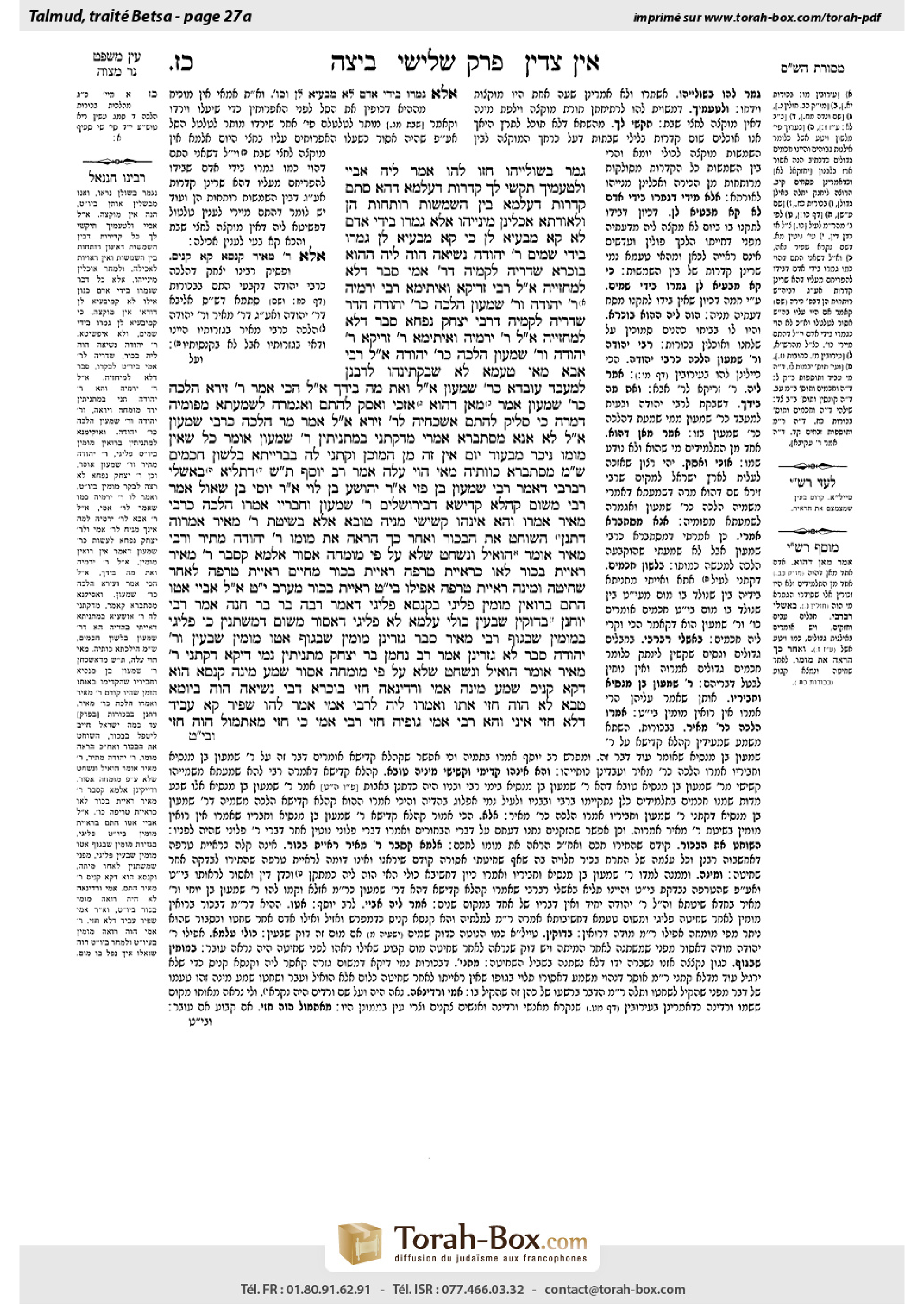
Beitzah 27a: Talmud study for Daf Yomi
Study the Talmud for Daf Yomi with scanned pages, Hebrew text, English translations from Sefaria and AI-generated French translations.
Passage selection and English or AI-generated French translation are available where the scan has annotations. Daf Study is independent of Torah-Box and Sefaria.
Browse Beitzah · ביצה · All tractatesBeitzah 27a text and translations
This page of Beitzah includes the Aramaic text, an English translation and an AI-generated French translation, alongside the scan above.
ביצה כ״ז א · Aramaic and Hebrew text
גָּמַר בִּשּׁוּלַיְיהוּ — חֲזוּ לְהוּ.
אֲמַר לֵיהּ אַבָּיֵי: וּלְטַעְמָיךְ, תִּקְשֵׁי לָךְ קְדֵרוֹת דְּעָלְמָא, דְּהָא סְתָם קְדֵרוֹת דְּעָלְמָא בֵּין הַשְּׁמָשׁוֹת רוֹתְחוֹת הֵן, וּלְאוּרְתָּא אָכְלִינַן מִינַּיְיהוּ!
אֶלָּא גְּמָרוֹ בִּידֵי אָדָם לָא קָא מִבַּעְיָא לַן. כִּי קָא מִבַּעְיָא לַן גְּמָרוֹ בִּידֵי שָׁמַיִם.
רַבִּי יְהוּדָה נְשִׂיאָה הֲוָה לֵיהּ הָהוּא בּוּכְרָא. שַׁדְּרֵיהּ לְקַמֵּיהּ דְּרַבִּי אַמֵּי, סְבַר דְּלָא לְמֶחְזְיֵיהּ. אֲמַר לֵיהּ רַבִּי זְרִיקָא וְאִיתֵּימָא רַבִּי יִרְמְיָה: רַבִּי יְהוּדָה וְרַבִּי שִׁמְעוֹן — הֲלָכָה כְּרַבִּי יְהוּדָה. הֲדַר שַׁדְּרֵיהּ לְקַמֵּיהּ דְּרַבִּי יִצְחָק נַפָּחָא, סְבַר דְּלָא לְמֶחְזְיֵיהּ. אֲמַר לֵיהּ רַבִּי יִרְמְיָה וְאִיתֵּימָא רַבִּי זְרִיקָא: רַבִּי יְהוּדָה וְרַבִּי שִׁמְעוֹן — הֲלָכָה כְּרַבִּי יְהוּדָה.
אֲמַר לֵיהּ רַבִּי אַבָּא: מַאי טַעְמָא לָא שְׁבַקְתִּינְהוּ לְרַבָּנַן לְמֶעְבַּד עוֹבָדָא כְּרַבִּי שִׁמְעוֹן? אֲמַר לֵיהּ: וְאַתְּ מָה בִּידָךְ? אֲמַר לֵיהּ, הָכִי אָמַר רַבִּי זֵירָא: הֲלָכָה כְּרַבִּי שִׁמְעוֹן.
אֲמַר מַאן דְּהוּא: אֶזְכֵּי וְאֶסַּק לְהָתָם, וְאֶגְמְרַהּ לִשְׁמַעְתָּא מִפּוּמֵּיהּ דְּמָרַהּ. כִּי סָלֵיק לְהָתָם, אַשְׁכְּחֵיהּ לְרַבִּי זֵירָא, אֲמַר לֵיהּ: אֲמַר מָר הֲלָכָה כְּרַבִּי שִׁמְעוֹן? אֲמַר לֵיהּ: לָא, אֲנָא ״מִסְתַּבְּרָא״ אֲמַרִי.
מִדְּקָתָנֵי בְּמַתְנִיתִין: רַבִּי שִׁמְעוֹן אוֹמֵר כֹּל שֶׁאֵין מוּמוֹ נִיכָּר מִבְּעוֹד יוֹם — אֵין זֶה מִן הַמּוּכָן, וְקָתָנֵי לַהּ בְּבָרַיְיתָא בִּלְשׁוֹן חֲכָמִים — שְׁמַע מִינַּהּ מִסְתַּבְּרָא כְּווֹתֵיהּ.
מַאי הָוֵי עֲלַהּ? אָמַר רַב יוֹסֵף: תָּא שְׁמַע, דְּתַלְיָא בְּאַשְׁלֵי רַבְרְבֵי. דְּאָמַר רַבִּי שִׁמְעוֹן בֶּן פַּזִּי אָמַר רַבִּי יְהוֹשֻׁעַ בֶּן לֵוִי אָמַר רַבִּי יוֹסֵי בֶּן שָׁאוּל אָמַר רַבִּי מִשּׁוּם קְהָלָא קַדִּישָׁא דְּבִירוּשָׁלַיִם: רַבִּי שִׁמְעוֹן וַחֲבֵרָיו אָמְרוּ הֲלָכָה כְּרַבִּי מֵאִיר.
אָמְרוּ? וְהָא אִינְהוּ קַשִּׁישֵׁי מִנֵּיהּ טוּבָא! אֶלָּא: בְּשִׁיטַת רַבִּי מֵאִיר אֲמָרוּהָ.
דִּתְנַן: הַשּׁוֹחֵט אֶת הַבְּכוֹר וְאַחַר כָּךְ הֶרְאָה אֶת מוּמוֹ — רַבִּי יְהוּדָה מַתִּיר. וְרַבִּי מֵאִיר אוֹמֵר: הוֹאִיל וְנִשְׁחַט שֶׁלֹּא עַל פִּי מוּמְחֶה — אָסוּר. אַלְמָא קָסָבַר רַבִּי מֵאִיר: רְאִיַּית בְּכוֹר לָאו כִּרְאִיַּית טְרֵפָה, רְאִיַּית בְּכוֹר — מֵחַיִּים, רְאִיַּית טְרֵפָה — לְאַחַר שְׁחִיטָה.
וּמִינַּהּ: רְאִיַּית טְרֵפָה — אֲפִילּוּ בְּיוֹם טוֹב, רְאִיַּית בְּכוֹר — מֵעֶרֶב יוֹם טוֹב.
אֲמַר לֵיהּ אַבָּיֵי: אַטּוּ הָתָם, בְּרוֹאִין מוּמִין פְּלִיגִי? בִּקְנָסָא פְּלִיגִי. דְּאָמַר רַבָּה בַּר בַּר חָנָה אָמַר רַבִּי יוֹחָנָן: בְּדוּקִּין שֶׁבָּעַיִן — כּוּלֵּי עָלְמָא לָא פְּלִיגִי דְּאָסוּר, מִשּׁוּם דְּמִשְׁתַּנִּין.
כִּי פְּלִיגִי בְּמוּמִין שֶׁבַּגּוּף, רַבִּי מֵאִיר סָבַר: גָּזְרִינַן מוּמִין שֶׁבַּגּוּף אַטּוּ מוּמִין שֶׁבָּעַיִן. וְרַבִּי יְהוּדָה סָבַר: לָא גָּזְרִינַן.
אָמַר רַב נַחְמָן בַּר יִצְחָק: מַתְנִיתִין נָמֵי דַּיְקָא, דְּקָתָנֵי: רַבִּי מֵאִיר אוֹמֵר: הוֹאִיל וְנִשְׁחַט שֶׁלֹּא עַל פִּי מוּמְחֶה — אָסוּר. שְׁמַע מִינַּהּ: קְנָסָא הוּא דְּקָא קָנֵיס, שְׁמַע מִינַּהּ.
אַמֵּי וַרְדִּינָאָה חָזֵי בּוּכְרָא דְּבֵי נְשִׂיאָה הֲוָה. בְּיוֹמָא טָבָא לָא הֲוָה חָזֵי. אֲתוֹ וַאֲמַרוּ לֵיהּ לְרַבִּי אַמֵּי, אֲמַר לְהוּ: שַׁפִּיר קָא עָבֵיד דְּלָא חָזֵי. אִינִי? וְהָא רַבִּי אַמֵּי גּוּפֵיהּ חָזֵי! רַבִּי אַמֵּי כִּי חָזֵי — מֵאֶתְמוֹל הֲוָה חָזֵי,
Beitzah 27a · English translation
And then when their cooking is finished, they once again become fit for eating. This demonstrates that even food that had temporarily been set aside because it had become inedible does not remain prohibited for the entire day.
Abaye said to him: And according to your reasoning that foods are temporarily considered muktze while being cooked, cooked dishes in general present a difficulty for you on Shabbat as well. As ordinary cooked dishes in general are still bubbling at twilight and not yet edible, and yet we partake of them later in the evening. This demonstrates that although the food was considered muktze at the critical moment of twilight, it is not prohibited for the duration of Shabbat.
Rather, it must be that we have no dilemma with regard to a food whose completion, which brings it to its finished and edible form, is entirely in the hands of a person, e.g., beans and lentils. Such foods are certainly not considered as muktze for all of Shabbat simply because they had become temporarily unfit for eating. Where we have a dilemma is with regard to an item whose completion is in the hands of Heaven, such as figs and grapes, which dry by the heat of the sun. This dilemma remains unresolved.
§ The Gemara returns to the issue of permitting firstborn animals. Rabbi Yehuda Nesia had a firstborn animal that acquired a blemish on a Festival, and he wished to serve it to priests staying at his house. He sent it to be presented before Rabbi Ami for examination, and Rabbi Ami thought that he should not examine it, in accordance with the opinion of Rabbi Shimon. Rabbi Zerika said to him, and some say it was Rabbi Yirmeya: The principle is that in cases of dispute between Rabbi Yehuda and Rabbi Shimon, the halakha is in accordance with the opinion of Rabbi Yehuda, who in this case permits examination of the firstborn. Rabbi Yehuda Nesia then sent the firstborn to be presented before Rabbi Yitzḥak Nappaḥa, who likewise thought that he should not examine it. Rabbi Yirmeya said to him, and some say it was Rabbi Zerika: The principle is that in cases where Rabbi Yehuda and Rabbi Shimon disagree, the halakha is in accordance with the opinion of Rabbi Yehuda.
Rabbi Abba said to Rabbi Yirmeya: What is the reason that you did not allow the Sages to act in accordance with the opinion of Rabbi Shimon? He said to him: And you, what do you have? Do you have a tradition that the halakha is in accordance with the opinion of Rabbi Shimon? Rabbi Abba said to him that Rabbi Zeira said as follows: The halakha in this case is in accordance with the opinion of Rabbi Shimon.
The Gemara relates that a certain unidentified person in Babylonia said: May it be His will that I merit to go up there to Eretz Yisrael, and that I learn this teaching from the mouth of its Master; I will ask Rabbi Zeira himself for his opinion on this matter. When he went up there to Eretz Yisrael, he found Rabbi Zeira and said to him: Did the Master say that the halakha is in accordance with the opinion of Rabbi Shimon? Rabbi Zeira said to him: No, that is not what I said; rather, I said: It stands to reason that this is so. It is reasonable to rule in accordance with Rabbi Shimon on this issue, although I do not have a definitive tradition to this effect.
Rabbi Zeira explains: Why do I think so? From the fact that it teaches in the mishna that Rabbi Shimon says: Any firstborn animal whose blemish is not perceptible while it is still day is not considered to be among the animals prepared prior to the Festival for use on the Festival. And a baraita taught the same ruling in the name of the Sages, indicating that this is the majority opinion. One should therefore learn from this that it stands to reason that the halakha is ruled in accordance with the opinion of Rabbi Shimon.
The Gemara asks: In the final analysis, what conclusion was reached about this matter? Whose opinion does the halakha follow? Rav Yosef said: Come and hear, as this matter hangs on great trees, meaning it is the subject of a dispute among the early Sages. As Rabbi Shimon ben Pazi said that Rabbi Yehoshua ben Levi said that Rabbi Yosei ben Shaul said that Rabbi Yehuda HaNasi said in the name of the holy community in Jerusalem: Rabbi Shimon ben Menasya and his colleagues said that the halakha is in accordance with the opinion of Rabbi Meir.
The Gemara wonders at the wording of this report: How could the holy community in Jerusalem have reported that Rabbi Shimon ben Menasya and his colleagues said that the halakha is in accordance with the opinion of Rabbi Meir? Aren’t they much older than he? Why, then, would they have reported a halakha in his name? The Gemara answers: Rather, the holy community in Jerusalem said the following: Rabbi Shimon ben Menasya and his colleagues, who said that one may not examine blemishes on a Festival, spoke in accordance with the opinion of Rabbi Meir.
To which teaching of Rabbi Meir is the Gemara referring? It is as we learned in a mishna (Bekhorot 28a): If one slaughtered a firstborn before it was shown to a Sage and deemed permitted, and afterward he showed its blemish to a Sage, who confirmed that it was indeed a permanent blemish that permitted the animal to be slaughtered, Rabbi Yehuda permits it, as it had been established that the animal was blemished. And Rabbi Meir says: Since it was slaughtered without the permission of an expert, it is prohibited. Apparently Rabbi Meir holds that the examination of a firstborn is not as simple a process as the examination of a tereifa, since it involves more than a mere examination of the body of the animal. The examination of a firstborn must be conducted when the animal is alive, whereas the examination of a tereifa may be performed even after slaughtering.
And from this Rabbi Shimon ben Menasya and his colleagues inferred that the examination of a tereifa, which consists merely of clarifying the facts of the animal’s physical state, may be done even on a Festival. On the other hand, the more stringent examination of a firstborn, which can be likened to the rendering of a judgment, a process with principles of its own, must be performed on the eve of the Festival.
Abaye said to Rav Yosef: Is that to say that there, in that mishna, Rabbi Yehuda and Rabbi Meir disagree about whether or not one may examine blemishes on a Festival? That was not their dispute; rather, they disagree with regard to the question of whether or not there is a penalty for one who acted improperly. As Rabba bar bar Ḥana said that Rabbi Yoḥanan said: If the blemish was in the eyelids, e.g., if a fissure developed there that disqualifies the animal, everyone, including Rabbi Meir, agrees that the animal is prohibited, because such a blemish changes its appearance after the slaughter. It is possible that after slaughter what was a temporary blemish will then look like a permanent one, and the animal will incorrectly be permitted retroactively.
When they disagree is in a case of blemishes in the body, e.g., if an ear had been cut off or a foreleg broken, which are prominent blemishes whose appearance does not change after death. Rabbi Meir holds that we issue a decree that blemishes in the body are prohibited due to blemishes in the eye, and Rabbi Yehuda holds that we do not issue such a decree.
Rav Naḥman bar Yitzḥak said: The wording of the mishna in tractate Bekhorot is also precise according to this explanation, as it teaches that Rabbi Meir says: Since it was slaughtered without the permission of an expert who confirmed that this is a permanent blemish, it is prohibited. Learn from this that this is a penalty that Rabbi Meir imposes and nothing else. The Gemara concludes: Indeed, learn from this that this is the correct understanding of the mishna.
§ The Gemara relates that Ami of Vardina was the examiner of firstborns in the household of the Nasi. On Festivals he would not examine firstborn blemishes. They came and told Rabbi Ami about this. He said to them: He does well not to examine them. The Gemara raises an objection: Is that so? But didn’t Rabbi Ami himself examine firstborns for blemishes on a Festival? The Gemara answers: When Rabbi Ami would examine the blemishes of firstborns, it was on the day before the Festival that he would examine them, to see whether the blemishes were permanent or temporary.
Beitzah 27a · Traduction française (IA)
Et après que leur cuisson soit terminée, ils deviennent à nouveau aptes à l'ingestion. Cela montre que même les aliments qui avaient été mis de côté temporairement car ils devenaient inedibles ne restent pas interdits toute la journée.
Abaye dit à lui : Et selon votre raisonnement, les aliments sont temporairement considérés comme muktze pendant la cuisson, les plats cuits en général posent un problème pour vous aussi le sabbat. En effet, les plats cuits ordinaires sont encore bouillants à l'heure du crépuscule et ne sont pas encore comestibles, et pourtant nous les consommons plus tard dans la soirée. Cela montre que bien que l'aliment ait été considéré comme muktze au moment critique du crépuscule, il n'est pas interdit durant toute la durée du sabbat.
Au contraire, il doit être que nous n'avons pas de difficulté concernant un aliment dont la finalisation, qui le rend comestible, est entièrement entre les mains d'une personne, par exemple les haricots et les lentilles. Ces aliments ne sont certainement pas considérés comme muktze durant tout le sabbat simplement parce qu'ils avaient devenu temporairement inedibles. C'est concernant un objet dont la finalisation est entre les mains de Dieu, comme les figues et les raisins, qui sèchent par la chaleur du soleil, que nous avons une difficulté non résolue.
§ Le Guemara reprend l'affaire de la permission des animaux premiers-nés. Rabbi Yehuda Nesia avait un animal premier-né qui s'était abîmé pendant un festival, et il souhaitait le servir aux prêtres logés chez lui. Il l'envoya présenter devant Rabbi Ami pour examen, et Rabbi Ami pensait qu'il ne devrait pas l'examiner, conformément à l'opinion de Rabbi Shimon. Rabbi Zerika dit à lui, et on dit que c'était Rabbi Yirmeya : Le principe est que dans les cas de désaccord entre Rabbi Yehuda et Rabbi Shimon, la halakha suit l'opinion de Rabbi Yehuda, qui dans ce cas permet l'examen du premier-né. Rabbi Yehuda Nesia envoya alors le premier-né présenter devant Rabbi Yitzḥak Nappaḥa, qui pensait également qu'il ne devrait pas l'examiner. Rabbi Yirmeya dit à lui, et on dit que c'était Rabbi Zerika : Le principe est que dans les cas où Rabbi Yehuda et Rabbi Shimon s'opposent, la halakha suit l'opinion de Rabbi Yehuda.
Rabbi Abba dit à Rabbi Yirmeya : Quelle est la raison pour laquelle vous n'avez pas permis aux Sages d'agir selon l'opinion de Rabbi Shimon ? Il lui dit : Et vous, qu'avez-vous ? Avez-vous une tradition que la halakha suit l'opinion de Rabbi Shimon ? Rabbi Abba dit à lui que Rabbi Zeira a dit comme suit : La halakha dans ce cas suit l'opinion de Rabbi Shimon.
Le Guemara rapporte qu'un certain inconnu en Babylonie dit : Que ce soit selon sa volonté, je mérite d'aller là-haut en Terre d'Israël, et d'apprendre cette enseignement de la bouche de son Maître ; je demanderai à Rabbi Zeira lui-même son avis sur cette question. Quand il est allé là-haut en Terre d'Israël, il a trouvé Rabbi Zeira et lui a dit : Le Maître a-t-il dit que la halakha suit l'opinion de Rabbi Shimon ? Rabbi Zeira lui a dit : Non, ce n'est pas ce que j'ai dit ; plutôt, j'ai dit : Il est raisonnable de penser que c'est ainsi. Il est raisonnable de décider selon l'opinion de Rabbi Shimon sur cette question, bien que je n'aie pas une tradition définitive à cet égard.
Rabbi Zeira explique : Pourquoi pense-t-on ainsi ? À partir du fait que la Michna enseigne que Rabbi Shimon dit : Tout premier-né dont la tache n'est pas perceptible pendant la journée n'est pas considéré comme étant parmi les animaux préparés avant le festival pour l'usage du festival. Et une baraïta a enseigné la même décision au nom des Sages, indiquant que c'est l'opinion majoritaire. On devrait donc apprendre de cela que c'est raisonnable de penser que la halakha suit l'opinion de Rabbi Shimon.
Le Guemara pose la question : En fin de compte, quelle conclusion a été atteinte sur cette affaire ? Quelle opinion suit la halakha ? Rav Yosef dit : Viens écouter, car cette affaire repose sur des grands arbres, c'est-à-dire qu'il s'agit d'une dispute parmi les Sages anciens. Comme Rabbi Shimon ben Pazi a dit que Rabbi Yehoshua ben Levi a dit que Rabbi Yosei ben Shaul a dit que Rabbi Yehuda HaNasi a dit au nom de la communauté sainte à Jérusalem : Rabbi Shimon ben Menasya et ses collègues ont dit que la halakha suit l'opinion de Rabbi Meir.
Le Guemara s'interroge sur la formulation de ce rapport : Comment la communauté sainte à Jérusalem a-t-elle pu rapporter que Rabbi Shimon ben Menasya et ses collègues ont dit que la halakha suit l'opinion de Rabbi Meir ? Ne sont-ils pas beaucoup plus âgés que lui ? Pourquoi alors rapporter une halakha en son nom ? Le Guemara répond : Plutôt, la communauté sainte à Jérusalem a dit ceci : Rabbi Shimon ben Menasya et ses collègues, qui ont dit qu'on ne doit pas examiner les taches pendant un festival, parlaient selon l'opinion de Rabbi Meir.
À quelle enseignement de Rabbi Meir le Guemara fait-il référence ? C'est comme nous l'avons appris dans une Michna (Bekhorot 28a) : Si l'on a sacrifié un premier-né avant qu'il ne soit montré à un Sage et déclaré permis, et ensuite l'on a montré sa tache à un Sage, qui a confirmé qu'il s'agissait d'une tache permanente qui permettait de sacrifier l'animal, Rabbi Yehuda le permet, car il avait été établi que l'animal était taché. Et Rabbi Meir dit : Puisque l'on a sacrifié sans la permission d'un expert, il est interdit. Apparemment, Rabbi Meir considère que l'examen d'un premier-né n'est pas aussi simple qu'un examen d'un tereifa, car cela implique plus qu'un simple examen du corps de l'animal. L'examen d'un premier-né doit être effectué lorsque l'animal est vivant, tandis que l'examen d'un tereifa peut être effectué même après la mise à mort.
Et d'après cela, Rabbi Šimʿon ben Menassyah et ses collègues ont déduit que l'examen d'un téréifah, qui consiste simplement à clarifier les faits concernant l'état physique de l'animal, peut être effectué même pendant un festival. D'un autre côté, l'examen plus strict d'un premier-né, qui peut être comparé à la prononciation d'un jugement, un processus doté de ses propres principes, doit être effectué la veille du festival.
Abaye dit à Rava Yosef : Est-ce que cela signifie que, dans cette mitsva, Rabbi Yéhuda et Rabbi Meir s'opposent sur le fait que l'on puisse examiner les blemishes pendant un festival ? Ce n'était pas leur débat ; plutôt, ils s'opposent concernant la question de savoir s'il y a une sanction pour celui qui agit de manière inappropriée. Comme Rabba bar bar Ḥana a dit que Rabbi Yoḥanan a dit : Si le blemish était dans les paupières, par exemple, si une fissure s'était développée là qui rend l'animal inacceptable, tout le monde, y compris Rabbi Meir, est d'accord sur le fait que l'animal est interdit, car un tel blemish modifie son apparence après la mise à mort. Il est possible que, après la mise à mort, ce qui était un blemish temporaire puisse alors ressembler à un blemish permanent, et l'animal pourrait être incorrectement autorisé rétroactivement.
Le point de désaccord est dans le cas de blemishes dans le corps, par exemple, si un oreille avait été coupée ou un avant-bras brisé, qui sont des blemishes évidents dont l'apparence ne change pas après la mort. Rabbi Meir considère que nous émettons un décret selon lequel les blemishes dans le corps sont interdits en raison des blemishes dans les yeux, et Rabbi Yéhuda considère que nous ne nous émettons pas un tel décret.
Rav Naḥman bar Yitzḥak a dit : La formulation de la mitsna dans le traité Bekhorot est aussi précise selon cette explication, car elle enseigne que Rabbi Meir dit : Puisque l'animal a été sacrifié sans l'autorisation d'un expert qui a confirmé que ce blemish est permanent, il est interdit. Apprenez-en que c'est une sanction que Rabbi Meir impose et rien d'autre. La Guemara conclut : En effet, apprenez-en que c'est la bonne compréhension de la mitsna.
§ La Guemara rapporte que Ami de Vardina était l'examinateur des premiers-nés dans la maison du Nasi. Pendant les festivals, il ne faisait pas d'examen des blemishes des premiers-nés. Ils vinrent lui rapporter cela. Il dit à ceux-ci : Il fait bien de ne pas les examiner. La Guemara soulève une objection : Est-ce que cela est vrai ? Mais n'avait-il pas lui-même examiné les blemishes des premiers-nés pendant un festival ? La Guemara répond : Lorsque Rabbi Ami examinait les blemishes des premiers-nés, il le faisait le jour avant le festival pour voir si les blemishes étaient permanents ou temporaires.
Traduction française générée par IA à partir de l’édition anglaise de Sefaria. Vérifie toujours un passage avec le texte source.
Text from Sefaria: William Davidson Edition - Vocalized Aramaic (CC BY NC); William Davidson Edition - English (CC BY NC).