Beitzah 27b: Talmud study for Daf Yomi
Study the Talmud for Daf Yomi with scanned pages, Hebrew text, English translations from Sefaria and AI-generated French translations.
Passage selection and English or AI-generated French translation are available where the scan has annotations. Daf Study is independent of Torah-Box and Sefaria.
Browse Beitzah · ביצה · All tractatesBeitzah 27b text and translations
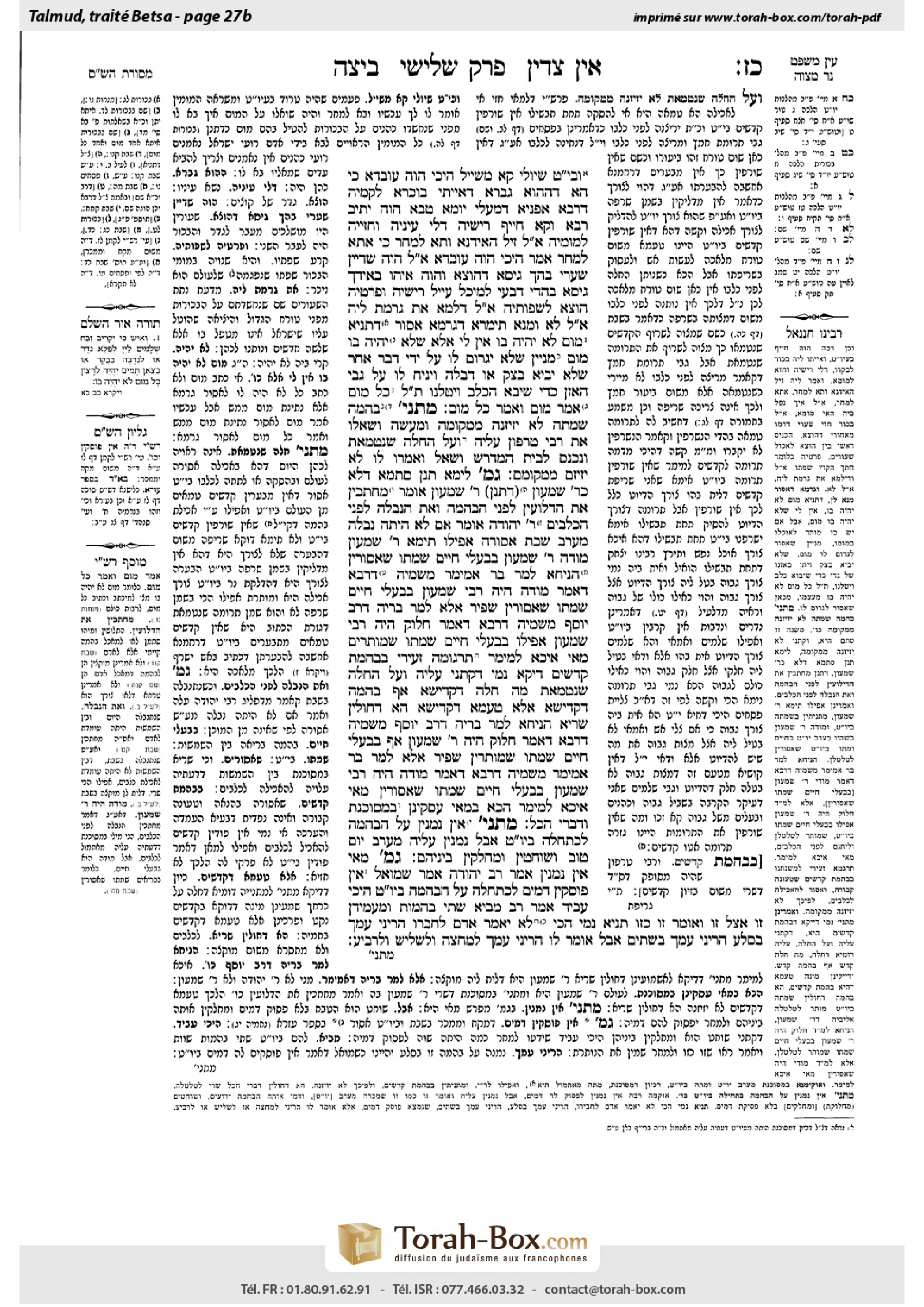
This page of Beitzah includes the Aramaic text, an English translation and an AI-generated French translation, alongside the scan above.
ביצה כ״ז ב · Aramaic and Hebrew text
וּבְיוֹם טוֹב שַׁיּוֹלֵי קָא מְשַׁיֵּיל הֵיכִי הֲוָה עוֹבָדָא. כִּי הָא דְּהָהוּא גַּבְרָא דְּאַיְיתִי בּוּכְרָא לְקַמֵּיהּ דְּרָבָא אַפַּנְיָא דְּמַעֲלֵי יוֹמָא טָבָא. הֲוָה יָתֵיב רָבָא וְקָא חָיֵיף רֵישֵׁיהּ. דַּלִּי עֵינֵיהּ וְחַזְיֵיהּ לְמוּמֵיהּ. אֲמַר לֵיהּ: זִיל הָאִידָּנָא וְתָא לִמְחַר.
כִּי אֲתָא לִמְחַר, אֲמַר: הֵיכִי הֲוָה עוֹבָדָא? אֲמַר לֵיהּ: הֲוָה שַׁדְיָין שְׂעָרֵי בְּהָךְ גִּיסָא דְּהוּצָא, וַהֲוָה אִיהוּ בְּאִידַּךְ גִּיסָא. בַּהֲדֵי דְּבָעֵי לְמֵיכַל, עַיֵּיל רֵישֵׁיהּ וּפַרְטֵיהּ הוּצָא לְשִׂפְוָתֵיהּ. אֲמַר לֵיהּ: דִּלְמָא אַתְּ גְּרַמְתְּ לֵיהּ? אֲמַר לֵיהּ: לָא.
וּמְנָא תֵּימְרָא דִּגְרָמָא אָסוּר, דְּתַנְיָא: ״מוּם לֹא יִהְיֶה בּוֹ״, אֵין לִי אֶלָּא שֶׁלֹּא יִהְיֶה בּוֹ מוּם, מִנַּיִין שֶׁלֹּא יִגְרוֹם לוֹ עַל יְדֵי דָּבָר אַחֵר, שֶׁלֹּא יָבִיא בָּצֵק אוֹ דְבֵלָה וְיַנִּיחַ לוֹ עַל גַּבֵּי הָאֹזֶן כְּדֵי שֶׁיָּבֹא הַכֶּלֶב וְיִטְּלֶנּוּ — תַּלְמוּד לוֹמַר: ״כׇּל מוּם״. אָמַר ״מוּם״, וְאָמַר ״כׇּל מוּם״.
מַתְנִי׳ בְּהֵמָה שֶׁמֵּתָה — לֹא יְזִיזֶנָּה מִמְּקוֹמָהּ. וּמַעֲשֶׂה וְשָׁאֲלוּ אֶת רַבִּי טַרְפוֹן עָלֶיהָ וְעַל הַחַלָּה שֶׁנִּטְמֵאת, וְנִכְנַס לְבֵית הַמִּדְרָשׁ וְשָׁאַל, וְאָמְרוּ לוֹ: לֹא יְזִיזֵם מִמְקוֹמָם.
גְּמָ׳ לֵימָא תְּנַן סְתָמָא דְּלָא כְּרַבִּי שִׁמְעוֹן? (דִּתְנַן) רַבִּי שִׁמְעוֹן אוֹמֵר: מְחַתְּכִין אֶת הַדִּלּוּעִין לִפְנֵי הַבְּהֵמָה, וְאֶת הַנְּבֵלָה לִפְנֵי הַכְּלָבִים. רַבִּי יְהוּדָה אוֹמֵר: אִם לֹא הָיְתָה נְבֵלָה מֵעֶרֶב שַׁבָּת — אֲסוּרָה.
אֲפִילּוּ תֵּימָא רַבִּי שִׁמְעוֹן, מוֹדֶה רַבִּי שִׁמְעוֹן בְּבַעֲלֵי חַיִּים שֶׁמֵּתוּ, שֶׁאֲסוּרִין.
הָנִיחָא לְמָר בַּר אַמֵּימָר מִשְּׁמֵיהּ דְּרָבָא דְּאָמַר: מוֹדֶה הָיָה רַבִּי שִׁמְעוֹן בְּבַעֲלֵי חַיִּים שֶׁמֵּתוּ שֶׁאֲסוּרִין, שַׁפִּיר. אֶלָּא לְמָר בְּרֵיהּ דְּרַב יוֹסֵף מִשְּׁמֵיהּ דְּרָבָא דְּאָמַר: חָלוּק הָיָה רַבִּי שִׁמְעוֹן אֲפִילּוּ בְּבַעֲלֵי חַיִּים שֶׁמֵּתוּ, שֶׁמּוּתָּרִים — מַאי אִיכָּא לְמֵימַר?
תַּרְגְּומַהּ זְעֵירִי, בְּבֶהֱמַת קֳדָשִׁים. דַּיְקָא נָמֵי, דְּקָתָנֵי: עָלֶיהָ וְעַל הַחַלָּה שֶׁנִּטְמֵאת. מָה חַלָּה — דְּקַדִּישָׁא, אַף בְּהֵמָה — דְּקַדִּישָׁא.
אֶלָּא טַעְמָא דְּקַדִּישָׁא הָא דְּחוּלִּין — שַׁרְיָא. הָנִיחָא לְמָר בְּרֵיהּ דְּרַב יוֹסֵף מִשְּׁמֵיהּ דְּרָבָא, דְּאָמַר: חָלוּק הָיָה רַבִּי שִׁמְעוֹן אַף בְּבַעֲלֵי חַיִּים שֶׁמֵּתוּ שֶׁמּוּתָּרִין — שַׁפִּיר. אֶלָּא לְמָר בַּר אַמֵּימָר מִשְּׁמֵיהּ דְּרָבָא, דְּאָמַר: מוֹדֶה הָיָה רַבִּי שִׁמְעוֹן בְּבַעֲלֵי חַיִּים שֶׁמֵּתוּ שֶׁאֲסוּרִין — מַאי אִיכָּא לְמֵימַר?
הָכָא בְּמַאי עָסְקִינַן — בִּמְסוּכֶּנֶת, וְדִבְרֵי הַכֹּל.
מַתְנִי׳ אֵין נִמְנִין עַל הַבְּהֵמָה לְכַתְּחִלָּה בְּיוֹם טוֹב. אֲבָל נִמְנִין עָלֶיהָ מֵעֶרֶב יוֹם טוֹב, וְשׁוֹחֲטִין וּמְחַלְּקִין בֵּינֵיהֶם.
גְּמָ׳ מַאי אֵין נִמְנִין? אָמַר רַב יְהוּדָה אָמַר שְׁמוּאֵל: אֵין פּוֹסְקִין דָּמִים לְכַתְּחִלָּה עַל הַבְּהֵמָה בְּיוֹם טוֹב. הֵיכִי עָבֵיד? אָמַר רַב: מֵבִיא שְׁתֵּי בְהֵמוֹת וּמַעֲמִידָן זוֹ אֵצֶל זוֹ, וְאוֹמֵר: זוֹ כָּזוֹ?
תַּנְיָא נָמֵי הָכִי: לֹא יֹאמַר אָדָם לַחֲבֵרוֹ הֲרֵינִי עִמְּךָ בְּסֶלַע, הֲרֵינִי עִמְּךָ בִּשְׁתַּיִם, אֲבָל אוֹמֵר לוֹ: הֲרֵינִי עִמְּךָ לְמֶחֱצָה וְלִשְׁלִישׁ וְלִרְבִיעַ.
Beitzah 27b · English translation
And on the Festival itself he would ask only how the incident occurred, meaning that he would investigate the cause of the blemish, as in that case where a certain man who was a priest brought a firstborn before Rava, close to nightfall on a Festival eve. Rava was sitting and washing the hair on his head. He raised his eyes and saw the firstborn’s blemish. He then said to the owner of the firstborn: Go now, and come back tomorrow.
When he came back on the following day, Rava said to him: How did the incident that caused the blemish occur? The owner said to Rava: Barley grains were scattered on one side of a fence of thorns, while the firstborn was standing on the other side. When it wanted to eat, it stuck its head through the fence and a thorn cut its lip. Rava said to the owner: Perhaps you caused the blemish by deliberately placing the barley on the other side of the fence? He said to him: No.
The Gemara comments: And from where do you say that causing a blemish to an offering is prohibited? As it is taught in a baraita: It is written with regard to offerings: “There must not be any blemish in it” (Leviticus 22:21). I have only an explicit prohibition that it may not have a blemish; from where is it derived that one may not cause a blemish to it by means of something else, e.g., that he does not bring dough or a dried fig and place it on its ear so that a dog will come and take it, thereby biting off part of the animal’s ear and leaving it blemished? Therefore the verse states “any blemish.” It says “blemish” and it says “any blemish”; the word “any” comes to teach that one may not cause a blemish.
MISHNA: With regard to an animal that died, one may not move it from its place on a Festival. And such an incident once occurred and they asked Rabbi Tarfon about it. And on that same occasion they also asked him about ḥalla that had been separated from dough and then became ritually impure on a Festival. Such ḥalla is not fit to be eaten by anyone, nor may it be used in any other manner, e.g., as animal feed or as fuel for a fire, on that day. Rabbi Tarfon entered the study hall and inquired about these matters, and the Sages said to him: One may not move them from their place.
GEMARA: The Gemara suggests: Let us say that we learned the unattributed mishna not in accordance with the opinion of Rabbi Shimon. As we learned in a mishna (Shabbat 156b) that Rabbi Shimon says: One may cut up gourds for an animal on Shabbat so that it can eat them more easily, and similarly, one may cut up an unslaughtered animal carcass for dogs. Rabbi Yehuda says: If it was not an animal carcass already on the eve of Shabbat, but rather it died on Shabbat itself, it is prohibited. Since Rabbi Yehuda distinguishes between an animal that died on Shabbat and one that died before Shabbat, it would appear that Rabbi Shimon holds that one may move an animal carcass and feed it to dogs even if it died on Shabbat. Accordingly, the mishna that prohibits moving an animal that died on a Festival seems to conflict with Rabbi Shimon’s opinion.
The Gemara rejects this argument: The mishna can be understood even if you say that it is in accordance with the opinion of Rabbi Shimon, as Rabbi Shimon nevertheless concedes in the case of animals that were entirely healthy at twilight but died on the Festival that they are prohibited. Since they were healthy at twilight, the owner had no intention at that point in time of feeding them to dogs, and they are therefore prohibited as muktze. The baraita, on the other hand, is referring to an animal that had been sick on the previous day; since the owner knew that it was close to death, he had in mind to feed it to his dogs after it died.
The Gemara asks: This works out well according to the opinion of Mar bar Ameimar in the name of Rava, who said that Rabbi Shimon concedes in the case of animals that died on the Festival without having been mortally sick the day before that they are prohibited on the Festival due to muktze; according to this opinion, it is well. However, according to the opinion of Mar, son of Rav Yosef, in the name of Rava, who said that Rabbi Shimon was in disagreement even in the case of animals that died suddenly, and he holds that they are permitted, what is there to say? The unattributed mishna appears to contradict this opinion.
The Gemara answers: Ze’iri explained it as follows: The mishna is referring to a sacred animal that died; since it is sacred property, one may not derive benefit from it, and therefore one may not give it to dogs. The Gemara comments: The language of the mishna is also precise according to this interpretation, as it teaches: They asked Rabbi Tarfon about it and about ḥalla that became ritually impure, from which it may be inferred: Just as ḥalla is sacred, so too, the animal mentioned here is one that was sacred, rather than a non-sacred animal.
The Gemara asks: Rather, according to this explanation, the reason that the animal may not be moved is that the animal was sacred; but if it was a non-sacred animal that died, it would be permitted to move it. If so, this works out well according to the opinion of Mar, son of Rav Yosef, in the name of Rava, who said that Rabbi Shimon was in disagreement even in the case of animals that died, and he holds that they are permitted; according to this opinion, it is well, as one can say that the mishna, which indicates that one may move an animal that died on a Festival, is in accordance with the opinion of Rabbi Shimon. However, according to the opinion of Mar bar Ameimar in the name of Rava, who said that Rabbi Shimon concedes in the case of animals that died that they are prohibited, what is there to say? The mishna is in accordance with neither Rabbi Shimon nor Rabbi Yehuda.
The Gemara answers: With what are we dealing here? It is with a case where the animal was in danger of dying the day before, and the owner had in mind to feed it to his dogs after it died, and all agree with regard to the ruling. Therefore, according to Rabbi Shimon, an allowance is granted to move the animal if it was a non-sacred animal and it had been in danger prior to the Festival; and if the animal was sacred, even he agrees that it is prohibited, as it may not be fed to dogs.
MISHNA: One may not register to have a portion of an animal on a Festival ab initio, since it is prohibited to divide up an animal into portions for different people, as this is similar to conducting business, a weekday activity, on a Festival. But one may register for the animal on the eve of the Festival, and then those who registered for the animal may slaughter and divide it between them on the Festival itself in accordance with the agreement reached the day before. The next day, each pays the slaughterer according to his portion of the animal.
GEMARA: The Gemara asks: What is the meaning of: One may not register? Rav Yehuda said that Shmuel said: One may not fix a sum of money and set a particular price for each portion of an animal on a Festival ab initio. The Gemara asks: What should one do on a Festival to divide up the animal without fixing a price? Rav said: He should bring two animals and stand them one next to the other and say: Is this one equal in value to the other one? If the purchasers confirm that this is the case, then after the Festival they assess the value of the animal that is identical to the animal that had been slaughtered on the Festival, and in that way they establish the amount that each person must pay.
This is also taught in a baraita that states: A person may not say to another on a Festival: I am hereby in partnership with you in this animal that you are about to slaughter for the value of a sela, or: I am hereby in partnership with you for two sela. However, he may say to him: I am hereby in partnership with you for half the animal, or for a third or a quarter, without stipulating the value of that share, and after the Festival they may determine how much each share is worth.
Beitzah 27b · Traduction française (IA)
Et sur la fête elle-même, il demandait seulement comment l'incident s'était produit, c'est-à-dire qu'il enquêtait sur la cause de la tache, comme dans le cas où un certain homme, prêtre, présenta un premier-né devant Rava, près du coucher du soleil sur la nuit de la fête. Rava était assis et lavait les cheveux de sa tête. Il leva les yeux et vit la tache du premier-né. Il dit alors à l'propriétaire du premier-né : Va maintenant, et reviens demain.
Lorsqu'il revint le lendemain, Rava lui demanda : Comment s'est produit l'incident qui a causé la tache ? L'propriétaire dit à Rava : Des grains de blé étaient dispersés d'un côté d'un mur de buissons, tandis que le premier-né était debout de l'autre côté. Lorsqu'il voulait manger, il passa sa tête à travers le mur et un buisson le blessa à la lèvre. Rava dit à l'propriétaire : Peut-être as-tu causé la tache intentionnellement en plaçant le blé de l'autre côté du mur ? Il dit : Non.
La Guemara commente : Et d'où dis-tu que causer une tache à une offrande est interdit ? Comme il est enseigné dans une baraïta : Il est écrit concernant les offrandes : « Il ne doit pas y avoir de tache en lui » (Lévitique 22:21). J'ai seulement une interdiction explicite qu'il ne doive pas avoir de tache ; d'où est-il dérivé que l'on ne doive pas causer une tache à l'aide d'une autre chose, par exemple, qu'on ne doive pas apporter de pâte ou de figue sèche et les placer sur l'oreille de l'animal afin qu'un chien vienne les prendre, ce qui mordrait une partie de l'oreille de l'animal et le laisserait taché ? Ainsi, la verset dit « toute tache ». Il dit « tache » et il dit « toute tache » ; le mot « toute » vient enseigner que l'on ne doit pas causer une tache.
MICHNA : Concernant un animal mort, on ne doit pas le déplacer de son lieu sur une fête. Et un tel incident s'était produit et on demanda à Rabbi Tarfon à ce sujet. Et sur la même occasion, on demanda également à Rabbi Tarfon concernant la challa séparée du pain et devenue impure sur une fête. Cette challa n'est pas propre à être mangée par personne, ni peut-elle être utilisée d'une autre manière, par exemple en nourriture pour bêtes ou comme combustible pour un feu, ce jour-là. Rabbi Tarfon entra dans la salle de study et demanda à ce sujet, et les Sages lui dirent : On ne doit pas les déplacer de leur lieu.
GUEMARA : La Guemara suggère : Disons que nous avons appris la mishna non attribuée sans suivre l'opinion de Rabbi Shimon. Comme nous avons appris dans une mishna (Shabbat 156b) que Rabbi Shimon dit : On peut couper des citrouilles pour un animal le sabbat afin qu'il puisse les manger plus facilement, et de même, on peut couper un cadavre d'animal non sacrifié pour les chiens. Rabbi Yehuda dit : Si ce n'était pas un cadavre d'animal déjà sur la veille du sabbat, mais qu'il était mort le sabbat lui-même, il est interdit. Puisque Rabbi Yehuda distingue entre un animal mort le sabbat et un animal mort avant le sabbat, il semble que Rabbi Shimon considère que l'on peut déplacer un cadavre d'animal et le nourrir aux chiens même s'il est mort le sabbat. Ainsi, la mishna qui interdit de déplacer un animal mort sur une fête semble entrer en conflit avec l'opinion de Rabbi Shimon.
La Guemara rejette cet argument : La mishna peut être comprise même si vous dites qu'elle est en conformité avec l'opinion de Rabbi Shimon, car Rabbi Shimon reconnaît toutefois le cas d'animaux entièrement sains à l'heure du coucher du soleil mais morts sur la fête, qu'ils sont interdits. Puisque ces animaux étaient sains à l'heure du coucher du soleil, l'owner n'avait pas l'intention à ce moment-là de les nourrir aux chiens, et ils sont donc interdits comme muktze. La baraïta, en revanche, fait référence à un animal qui était malade la veille ; puisque l'owner savait qu'il était proche de la mort, il avait l'intention de nourrir les chiens après sa mort.
La Guemara pose la question : Cela s'adapte bien selon l'opinion de Mar bar Ameimar en nom de Rava, qui dit que Rabbi Shimon reconnaît le cas d'animaux morts sur la fête sans avoir été malades la veille, qu'ils sont interdits sur la fête en raison de muktze ; selon cette opinion, cela s'adapte bien. Cependant, selon l'opinion de Mar, fils de Rav Yosef, en nom de Rava, qui dit que Rabbi Shimon était en désaccord même dans le cas d'animaux morts soudainement, et qu'il considère qu'ils sont permis, que dire alors ? La mishna semble entrer en conflit avec cette opinion.
La Guemara répond : Ze’iri l'explique ainsi : La mishna fait référence à un animal sacré qui est mort ; puisque c'est une propriété sacrée, on ne peut pas en tirer un bénéfice, et donc on ne peut pas le donner aux chiens. La Guemara commente : La formulation de la mishna est aussi précise selon cette interprétation, car elle enseigne : Ils demandèrent à Rabbi Tarfon à ce sujet et à propos de la challa devenue impure, d'où il peut être inféré : Comme la challa est sacrée, ainsi l'animal mentionné ici est un animal sacré, plutôt qu'un animal non sacré.
La Guemara pose la question : Plutôt, selon cette explication, la raison pour laquelle l'animal ne peut être déplacé est que l'animal était sacré ; mais si c'était un animal non sacré qui était mort, il serait permis de le déplacer. Si c'est ainsi, cela s'adapte bien selon l'opinion de Mar, fils de Rav Yosef, en nom de Rava, qui dit que Rabbi Shimon était en désaccord même dans le cas d'animaux morts, et qu'il considère qu'ils sont permis ; selon cette opinion, cela s'adapte bien, car on peut dire que la mishna, qui indique que l'on peut déplacer un animal mort sur une fête, est en conformité avec l'opinion de Rabbi Shimon. Cependant, selon l'opinion de Mar bar Ameimar en nom de Rava, qui dit que Rabbi Shimon reconnaît le cas d'animaux morts qu'ils sont interdits, que dire alors ? La mishna est en conformité ni avec Rabbi Shimon ni avec Rabbi Yehuda.
La Guemara répond : De quoi est-ce que nous parlons ici ? De cas où l'animal était en danger de mourir la veille, et l'propriétaire avait l'intention de le nourrir à ses chiens après sa mort, et tous s'accordent sur la décision. Ainsi, selon Rabbi Shimon, une autorisation est donnée pour déplacer l'animal si c'était un animal non sacré et s'il était en danger avant la fête ; et si l'animal était sacré, même lui convient qu'il est interdit, car il ne peut être nourri aux chiens.
MICHNA : On ne peut pas s'inscrire à l'avance pour une part d'animaux pendant un festival, car il est interdit de diviser un animal en parts pour différentes personnes, car cela ressemble à une activité commerciale, une activité du jour de semaine, pendant un festival. Mais on peut s'inscrire pour l'animal à la veille du festival, et ensuite ceux qui s'étaient inscrits peuvent sacrifier et diviser l'animal entre eux pendant le festival lui-même selon l'accord conclu la veille. Le lendemain, chacun paie le boucher selon sa part de l'animal.
GUEMARA : La Guemara demande : De quoi signifie-t-il : On ne peut pas s'inscrire ? Rav Yéhouda a dit que Shmuel a dit : On ne peut pas fixer une somme d'argent et établir un prix particulier pour chaque part d'animaux pendant un festival à l'avance. La Guemara demande : Qu'est-ce qu'on doit faire pendant un festival pour diviser l'animal sans fixer un prix ? Rav a dit : Il doit apporter deux animaux et les placer côte à côte et dire : Celui-ci est-il égal en valeur à l'autre ? Si les acheteurs confirment que c'est le cas, ensuite après le festival, ils évaluent la valeur de l'animal identique à celui qui avait été sacrifié pendant le festival, et ainsi ils établissent le montant que chaque personne doit payer.
Cela est également enseigné dans une baraïta qui dit : Une personne ne peut pas dire à une autre pendant un festival : Je suis désormais en partenariat avec toi pour cet animal que tu vas sacrifier, à la valeur d'un sela, ou : Je suis désormais en partenariat avec toi pour deux sela. Cependant, il peut dire à lui : Je suis désormais en partenariat avec toi pour la moitié de l'animal, ou pour un tiers ou un quart, sans stipuler la valeur de cette part, et après le festival, ils peuvent déterminer combien vaut chaque part.
Traduction française générée par IA à partir de l’édition anglaise de Sefaria. Vérifie toujours un passage avec le texte source.
Text from Sefaria: William Davidson Edition - Vocalized Aramaic (CC BY NC); William Davidson Edition - English (CC BY NC).