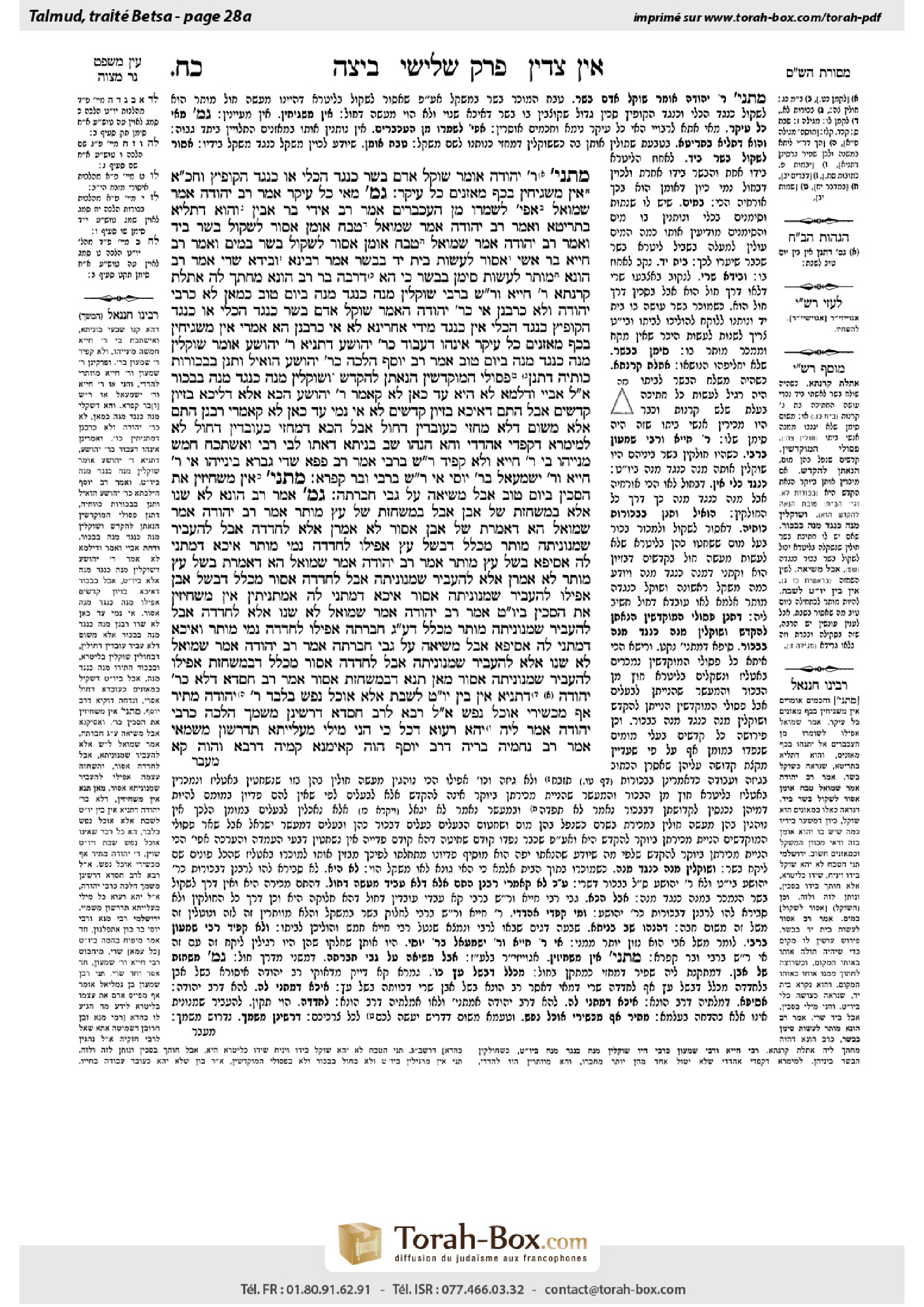
Beitzah 28a: Talmud study for Daf Yomi
Study the Talmud for Daf Yomi with scanned pages, Hebrew text, English translations from Sefaria and AI-generated French translations.
Passage selection and English or AI-generated French translation are available where the scan has annotations. Daf Study is independent of Torah-Box and Sefaria.
Browse Beitzah · ביצה · All tractatesBeitzah 28a text and translations
This page of Beitzah includes the Aramaic text, an English translation and an AI-generated French translation, alongside the scan above.
ביצה כ״ח א · Aramaic and Hebrew text
מַתְנִי׳ רַבִּי יְהוּדָה אוֹמֵר: שׁוֹקֵל אָדָם בָּשָׂר כְּנֶגֶד הַכְּלִי אוֹ כְּנֶגֶד הַקּוֹפִיץ. וַחֲכָמִים אוֹמְרִים: אֵין מַשְׁגִּיחִין בְּכַף מֹאזְנַיִם כׇּל עִיקָּר.
גְּמָ׳ מַאי ״כׇּל עִיקָּר״? אָמַר רַב יְהוּדָה אָמַר שְׁמוּאֵל: אֲפִילּוּ לְשׇׁמְרוֹ מִן הָעַכְבָּרִים. אָמַר רַב אִידִי בַּר אָבִין: וְהוּא דְּתַלְיָא בִּתְרִיטָא.
וְאָמַר רַב יְהוּדָה אָמַר שְׁמוּאֵל: טַבָּח אוּמָּן אָסוּר לִשְׁקוֹל בָּשָׂר בַּיָּד. וְאָמַר רַב יְהוּדָה אָמַר שְׁמוּאֵל: טַבָּח אוּמָּן אָסוּר לִשְׁקוֹל בָּשָׂר בְּמַיִם.
וְאָמַר רַב חִיָּיא בַּר אָשֵׁי: אָסוּר לַעֲשׂוֹת בֵּית יָד בַּבָּשָׂר. אָמַר רָבִינָא: וּבִידָא שְׁרֵי.
אָמַר רַב הוּנָא: מוּתָּר לַעֲשׂוֹת סִימָן בַּבָּשָׂר, כִּי הָא דְּרַבָּה בַּר רַב הוּנָא מְחַתֵּךְ לַהּ אַתְּלָת קַרְנָתָא.
רַבִּי חִיָּיא וְרַבִּי שִׁמְעוֹן בְּרַבִּי שׁוֹקְלִין מָנָה כְּנֶגֶד מָנָה בְּיוֹם טוֹב. כְּמַאן? לָא כְּרַבִּי יְהוּדָה וְלֹא כְּרַבָּנַן! אִי כְּרַבִּי יְהוּדָה, הָאָמַר: שׁוֹקֵל אָדָם בָּשָׂר כְּנֶגֶד הַכְּלִי אוֹ כְּנֶגֶד הַקּוֹפִיץ. כְּנֶגֶד הַכְּלִי — אִין, כְּנֶגֶד מִידֵּי אַחֲרִינָא — לָא! אִי כְּרַבָּנַן, הָא אָמְרִי: אֵין מַשְׁגִּיחִין בְּכַף מֹאזְנַיִם כׇּל עִיקָּר!
אִינְהוּ דַּעֲבוּד כְּרַבִּי יְהוֹשֻׁעַ. דְּתַנְיָא, רַבִּי יְהוֹשֻׁעַ אוֹמֵר: שׁוֹקְלִין מָנָה כְּנֶגֶד מָנָה בְּיוֹם טוֹב. אֲמַר רַב יוֹסֵף: הֲלָכָה כְּרַבִּי יְהוֹשֻׁעַ, הוֹאִיל וּתְנַן בִּבְכוֹרוֹת כְּוָתֵיהּ.
דִּתְנַן: פְּסוּלֵי הַמּוּקְדָּשִׁין — הֲנָאָתָן לַהֶקְדֵּשׁ, וְשׁוֹקְלִין מָנָה כְּנֶגֶד מָנָה בַּבְּכוֹר.
אֲמַר לֵיהּ אַבָּיֵי: וְדִלְמָא לָא הִיא, עַד כָּאן לָא קָאָמַר רַבִּי יְהוֹשֻׁעַ הָכָא, אֶלָּא דְּלֵיכָּא בִּזְיוֹן קָדָשִׁים, אֲבָל הָתָם דְּאִיכָּא בִּזְיוֹן קֳדָשִׁים — לָא.
אִי נָמֵי, עַד כָּאן לָא קָאָמְרִי רַבָּנַן הָתָם אֶלָּא מִשּׁוּם דְּלָא מִחֲזֵי כְּעוֹבָדִין דְּחוֹל, אֲבָל הָכָא דְּמִחֲזֵי כְּעוֹבָדִין דְּחוֹל — לָא.
לְמֵימְרָא דְּקָפְדִי אַהֲדָדֵי? וְהָא הָנְהוּ שַׁב בִּנְיָתָא דַּאֲתוֹ לְבֵי רַבִּי, וְאִשְׁתַּכַּח חֲמֵשׁ מִנַּיְיהוּ בֵּי רַבִּי חִיָּיא, וְלָא קָפֵיד רַבִּי שִׁמְעוֹן בְּרַבִּי!
אָמַר רַב פָּפָּא, שְׁדִי גַּבְרָא בֵּינַיְיהוּ: אִי רַבִּי חִיָּיא וְרַבִּי יִשְׁמָעֵאל בְּרַבִּי יוֹסֵי, אִי רַבִּי שִׁמְעוֹן בְּרַבִּי וּבַר קַפָּרָא.
מַתְנִי׳ אֵין מַשְׁחִיזִין אֶת הַסַּכִּין בְּיוֹם טוֹב, אֲבָל מַשִּׂיאָהּ עַל גַּבֵּי חֲבֶרְתָּהּ.
גְּמָ׳ אָמַר רַב הוּנָא: לֹא שָׁנוּ אֶלָּא בְּמַשְׁחֶזֶת שֶׁל אֶבֶן, אֲבָל בְּמַשְׁחֶזֶת שֶׁל עֵץ — מוּתָּר. אָמַר רַב יְהוּדָה אָמַר שְׁמוּאֵל: הָא דְּאָמְרַתְּ שֶׁל אֶבֶן אָסוּר, לָא אֲמַרַן אֶלָּא לְחַדְּדָהּ, אֲבָל לְהַעֲבִיר שַׁמְנוּנִיתָהּ — מוּתָּר. מִכְּלָל דִּבְשֶׁל עֵץ — אֲפִילּוּ לְחַדְּדָהּ, נָמֵי מוּתָּר.
אִיכָּא דְּמַתְנֵי לַהּ אַסֵּיפָא: בְּשֶׁל עֵץ מוּתָּר, אָמַר רַב יְהוּדָה אָמַר שְׁמוּאֵל: הָא דְּאָמְרַתְּ בְּשֶׁל עֵץ מוּתָּר, לָא אֲמַרַן אֶלָּא לְהַעֲבִיר שַׁמְנוּנִיתָהּ, אֲבָל לְחַדְּדָהּ — אָסוּר. מִכְּלָל דִּבְשֶׁל אֶבֶן — אֲפִילּוּ לְהַעֲבִיר שַׁמְנוּנִיתָהּ אָסוּר.
אִיכָּא דְּמַתְנֵי לַהּ אַמַּתְנִיתִין: אֵין מַשְׁחִיזִין אֶת הַסַּכִּין בְּיוֹם טוֹב, אֲמַר רַב יְהוּדָה אָמַר שְׁמוּאֵל: לֹא שָׁנוּ אֶלָּא לְחַדְּדָהּ, אֲבָל לְהַעֲבִיר שַׁמְנוּנִיתָהּ — מוּתָּר, מִכְּלָל דְּעַל גַּבֵּי חֲבֶרְתָּהּ — אֲפִילּוּ לְחַדְּדָהּ, נָמֵי מוּתָּר.
וְאִיכָּא דְּמַתְנֵי לַהּ אַסֵּיפָא: אֲבָל מַשִּׂיאָהּ עַל גַּבֵּי חֲבֶרְתָּהּ, אָמַר רַב יְהוּדָה אָמַר שְׁמוּאֵל: לֹא שָׁנוּ אֶלָּא לְהַעֲבִיר שַׁמְנוּנִיתָהּ, אֲבָל לְחַדְּדָהּ — אָסוּר. מִכְּלָל דִּבְמַשְׁחֶזֶת — אֲפִילּוּ לְהַעֲבִיר שַׁמְנוּנִיתָהּ אָסוּר.
מַאן תַּנָּא דִּבְמַשְׁחֶזֶת אָסוּר? אָמַר רַב חִסְדָּא: דְּלָא כְּרַבִּי יְהוּדָה. דְּתַנְיָא: אֵין בֵּין יוֹם טוֹב לַשַּׁבָּת אֶלָּא אוֹכֶל נֶפֶשׁ בִּלְבָד. רַבִּי יְהוּדָה מַתִּיר אַף מַכְשִׁירֵי אוֹכֶל נֶפֶשׁ.
אֲמַר לֵיהּ רָבָא לְרַב חִסְדָּא: דָּרְשִׁינַן מִשְּׁמָךְ הֲלָכָה כְּרַבִּי יְהוּדָה. אֲמַר לֵיהּ: יְהֵא רַעֲוָא דְּכׇל כִּי הָנֵי מִילֵּי מְעַלְּיָיתָא תִּדְרְשׁוּן מִשְּׁמַאי.
אָמַר רַב נְחֶמְיָה בְּרֵיהּ דְּרַב יוֹסֵף: הֲוָה קָאֵימְנָא קַמֵּיהּ דְּרָבָא, וַהֲוָה קָא
Beitzah 28a · English translation
MISHNA: Rabbi Yehuda says: A person selling meat on a Festival who wishes to know its weight in order to determine its price may not weigh it against regular weights in the ordinary weekday manner, but he may weigh the meat against a vessel or against a cleaver [kofitz] and then calculate the weight of the meat by weighing the vessel or cleaver later. And the Rabbis say: One may not look at the pans of a balance scale at all, meaning that they may not be used for weighing in any manner or for any other purpose.
GEMARA: The Gemara asks: What is the meaning of: One may not look at the pans of a scale at all? Rav Yehuda said that Shmuel said: Even if one has meat and he wishes to protect it from mice, he may not put it on a scale, since it would look as if he were weighing it. Rav Idi bar Avin said: And this ruling applies only where the scale is hanging on the ring used for balancing it. However, if the scale is hanging in such a manner that it is not fit for weighing, one may use it as he would use any other vessel.
And Rav Yehuda said that Shmuel said: It is prohibited for an expert butcher to weigh meat on a Festival even by hand because he can arrive at its precise weight using this method, and so it is prohibited like weighing with a scale. And likewise, Rav Yehuda said that Shmuel said: It is prohibited for an expert butcher to weigh meat on a Festival even in water. Butchers would calculate the weight of a slab of meat by placing it into a tub of water and measuring the amount of water that it displaces with the help of markings on the container. Since this procedure enables the butcher to determine the precise weight of the meat, it may not be performed on a Festival.
And Rav Ḥiyya bar Ashi said: It is prohibited to make a hole to serve as a handle in meat on a Festival, since this is a weekday act. Ravina said: But it is permitted to make such a handle by hand, rather than with a knife or some other implement, since this is an atypical manner of making a hole.
Rav Huna said: It is permitted to make a sign on meat even on a Festival, so that it not be mistaken for the meat of another person. This is like that which Rabba bar Rav Huna would do when he sent meat by means of a messenger to his house; he would cut it into triangles as a sign that the meat was his and it was fit to be eaten.
The Gemara relates an incident in connection to the basic halakha of the mishna: Rabbi Ḥiyya and Rabbi Shimon, son of Rabbi Yehuda HaNasi, would weigh one portion against another portion on a Festival in order to divide the meat between them. The Gemara asks: In accordance with whose opinion did they do so? This seems to be neither in accordance with the opinion of Rabbi Yehuda nor in accordance with the opinion of the Rabbis in the mishna. As, if it is in accordance with the opinion of Rabbi Yehuda, didn’t he say: A person may weigh meat against a vessel or against a cleaver, from which it may be inferred: Against a vessel or a cleaver, yes, one may do so; but against anything else, no, he may not. And if it is in accordance with the opinion of the Rabbis, didn’t they say: One may not look at the pans of a scale at all?
The Gemara explains: Rabbi Ḥiyya and Rabbi Shimon, son of Rabbi Yehuda HaNasi, acted in accordance with the opinion of Rabbi Yehoshua. As it is taught in a baraita that Rabbi Yehoshua says: One may weigh one portion against another portion on a Festival. Rav Yosef said: The halakha is in accordance with the opinion of Rabbi Yehoshua, since we learned in a mishna in tractate Bekhorot (31a) in accordance with his opinion.
As we learned there: With regard to consecrated animals that have become disqualified because of a blemish, all the benefit that accrues from their sale belongs to the Temple treasury of consecrated property. And one may weigh one portion of meat against another portion of meat in the case of a firstborn that developed a blemish. Although the meat of a firstborn may not be sold by weight in the manner of non-sacred meat, one may weigh one portion against another portion in order to determine its price. This indicates that even in a case where it is prohibited to weigh an item in the ordinary manner, one may still weigh one portion of it against another portion.
Abaye said to him: Perhaps that is not so, and the two cases are not similar. It is possible that Rabbi Yehoshua stated his opinion that one may weigh one portion against another only here, on a Festival, where the action does not involve a show of degradation of sacred items; but there, in the case of a firstborn, where the weighing involves a display of degradation of sacred items, perhaps he did not permit weighing of any kind.
Alternatively, it is possible that the Rabbis stated their opinion that one may weigh one portion against another only there, in the case of a firstborn, because it does not look like a weekday activity; but here, on a Festival, where it looks like a weekday activity, perhaps they would not have permitted it. It is therefore possible that even the Rabbis would prohibit this action on a Festival.
With regard to the incident involving Rabbi Ḥiyya and Rabbi Shimon, son of Rabbi Yehuda HaNasi, the Gemara asks: Is this to say that they were particular with each other with regard to such matters, to the extent that they had to weigh one portion against another so that their portions would be exactly equal? But wasn’t there the incident of the seven fish that were brought to the house of Rabbi Yehuda HaNasi, and five of them were later found in the house of Rabbi Ḥiyya, who had taken them from Rabbi Yehuda HaNasi; and Rabbi Shimon, son of Rabbi Yehuda HaNasi, was not particular about this, as they treated each other like family?
Rav Pappa said: Cast a person between them. In other words, a third party must have been involved in the incident. How so? Either the two who divided the meat between themselves were Rabbi Ḥiyya and Rabbi Yishmael, son of Rabbi Yosei, or else they were Rabbi Shimon, son of Rabbi Yehuda HaNasi and bar Kappara. Although these pairs of scholars were colleagues, they were exacting with each other in monetary matters. Consequently, they weighed one portion of meat against the other to ensure that they would each receive the same amount.
MISHNA: One may not sharpen a knife on a Festival in the ordinary weekday manner. However, one may do so in an unusual fashion, e.g., to run one knife over another, thereby sharpening the blade.
GEMARA: Rav Huna said: They taught that one may not sharpen a knife on a Festival only if he does so in the typical manner, with a stone knife sharpener, but if he does so with a wooden knife sharpener, it is permitted, as this is an unusual way of sharpening knives. Rav Yehuda said that Shmuel said: With regard to that which you said, that a stone sharpener is prohibited, we said this only where one’s intention is to sharpen the knife, but if he merely means to remove the accumulated fat by scraping it off with the stone, it is permitted. This proves by inference that with a sharpener made of wood, even if his intention is to sharpen the knife, it is permitted.
Some teach the statement of Rav Yehuda as referring to the latter clause of Rav Huna’s statement, where he says: But if he uses a sharpener made of wood, it is permitted. Rav Yehuda said that Shmuel said: With regard to that which you said, that with a wooden sharpener it is permitted, we said this only where one’s intention is to remove its fat, but if he does so in order to sharpen it, it is prohibited. This proves by inference that with a sharpener made of stone, even if he intended merely to remove its fat, it is prohibited.
Some teach the statement of Rav Yehuda as referring to the mishna itself, which teaches: One may not sharpen a knife on a Festival. Rav Yehuda said that Shmuel said: They taught that this is prohibited only where one’s intention is to sharpen the knife, but if his aim is merely to remove its fat, it is permitted. This proves by inference that running one knife over another is permitted even if his intention is to sharpen the knife.
And some teach the statement of Rav Yehuda as referring to the latter clause of the mishna, which teaches: However, one may run one knife over another. Rav Yehuda said that Shmuel said: They taught this only where one’s intention is to remove its fat, but if he does so to sharpen it, it is prohibited. This proves by inference that with a sharpener, it is prohibited even to remove its fat.
The Gemara asks: Who is the tanna who holds that with a sharpener it is entirely prohibited? Rav Ḥisda said: This tanna does not hold in accordance with the opinion of Rabbi Yehuda, as it is taught in a baraita: The difference between a Festival and Shabbat is only with regard to the preparation of food, as it is permitted to perform labor for the purpose of food preparation on a Festival, but not on Shabbat; Rabbi Yehuda permits even actions that facilitate preparation of food on a Festival, e.g., repairing utensils with which food is prepared on the Festival.
Rava said to Rav Ḥisda: We teach in your name that the halakha is in accordance with the opinion of Rabbi Yehuda. He said to him: May it be God’s will that you teach in my name all outstanding matters like this. In other words, Rav Ḥisda was pleased that this teaching was attributed to him, as he too agreed with it.
The Gemara relates that Rav Neḥemya, son of Rav Yosef, said: I was once standing before Rava, and he was
Beitzah 28a · Traduction française (IA)
MICHNA: Rabbi Yehuda dit : Un homme vendant de la viande pendant un festival qui veut connaître le poids de la viande afin de déterminer son prix ne peut pas peser la viande avec des poids ordinaires comme le fait normalement un jour de semaine, mais il peut peser la viande contre un récipient ou contre un couteau [kofitz] et ensuite calculer le poids de la viande en pesant le récipient ou le couteau plus tard. Et les Sages disent : On ne doit pas regarder les plateaux d'une balance, ce qui signifie qu'ils ne peuvent être utilisés pour peser de quelque manière que ce soit ou à d'autres fins.
GUEMARA : La Guemara pose la question : Quelle est la signification de : On ne doit pas regarder les plateaux d'une balance ? Rav Yehuda a dit que Shmuel a dit : Même si l'on a de la viande et qu'on veut la protéger des rats, on ne peut pas la placer sur une balance, car cela pourrait sembler qu'on la pèse. Rav Idi bar Avin a dit : Et cette décision s'applique uniquement lorsque la balance est suspendue au anneau utilisé pour l'équilibrage. Cependant, si la balance est suspendue de telle manière qu'elle n'est pas adaptée à la pesée, on peut l'utiliser comme on le ferait avec tout autre récipient.
Et Rav Yehuda a dit que Shmuel a dit : Il est interdit à un boucher expert de peser de la viande pendant un festival même à la main, car il peut déterminer le poids exact de la viande avec cette méthode, et donc il est interdit comme si on utilisait une balance. De même, Rav Yehuda a dit que Shmuel a dit : Il est interdit à un boucher expert de peser de la viande pendant un festival même dans l'eau. Les bouchers calculent le poids d'une tranche de viande en la plongeant dans un bac d'eau et en mesurant la quantité d'eau déplacée grâce aux marques du récipient. Puisque cette procédure permet au boucher de déterminer le poids exact de la viande, elle ne peut pas être effectuée pendant un festival.
Et Rav Ḥiyya bar Ashi a dit : Il est interdit de percer un trou pour servir de manche dans la viande pendant un festival, car cela est une activité du jour de semaine. Ravina a dit : Mais il est permis de percer un tel manche à la main, plutôt qu'avec un couteau ou un autre outil, car cela est une manière inhabituelle de percer un trou.
Rav Huna a dit : Il est permis de faire un signe sur la viande même pendant un festival, afin qu'elle ne soit pas confondue avec la viande d'une autre personne. C'est comme ce que faisait Rabba bar Rav Huna lorsqu'il envoyait de la viande par un messager vers sa maison ; il la coupait en triangles comme signe que la viande était la sienne et qu'elle était propre à être mangée.
La Guemara rapporte un incident lié à la halakha fondamentale de la mitsna : Rabbi Ḥiyya et Rabbi Shimon, fils de Rabbi Yehuda HaNasi, pesaient une portion contre une autre portion pendant un festival afin de diviser la viande entre eux. La Guemara pose la question : Selon l'opinion de qui ont-ils agi ainsi ? Cela semble ne correspondre ni à l'opinion de Rabbi Yehuda ni à celle des Sages dans la mitsna. En effet, si c'est selon l'opinion de Rabbi Yehuda, n'a-t-il pas dit : Un homme peut peser la viande contre un récipient ou contre un couteau, ce qui suggère : contre un récipient ou un couteau, oui, on peut le faire ; mais contre tout autre objet, non, on ne peut pas. Et si c'est selon l'opinion des Sages, n'ont-ils pas dit : On ne doit pas regarder les plateaux d'une balance du tout ?
La Guemara explique : Rabbi Ḥiyya et Rabbi Shimon, fils de Rabbi Yehuda HaNasi, agissaient selon l'opinion de Rabbi Yehoshua. Car il est enseigné dans une baraïta que Rabbi Yehoshua dit : On peut peser une portion contre une autre portion pendant un festival. Rav Yosef a dit : La halakha suit l'opinion de Rabbi Yehoshua, car nous avons appris dans une mitsva du traité Bekhorot (31a) selon son opinion.
Comme nous l'avons appris là : En ce qui concerne les animaux consacrés devenus inaptes en raison d'une tache, tous les bénéfices issus de leur vente appartiennent au trésor du Temple des biens consacrés. Et on peut peser une portion de viande contre une autre portion de viande dans le cas d'un premier-né qui a développé une tache. Bien que la viande d'un premier-né ne puisse pas être vendue par poids comme la viande non sacrée, on peut peser une portion contre une autre portion afin de déterminer son prix. Cela montre que même dans un cas où il est interdit de peser un objet de la manière ordinaire, on peut encore peser une portion contre une autre portion.
Abaye a dit à lui : Peut-être que cela n'est pas ainsi, et les deux cas ne sont pas comparables. Il est possible que Rabbi Yehoshua ait exprimé son opinion selon laquelle on peut peser une portion contre une autre uniquement ici, pendant un festival, où l'action ne met pas en scène la dégradation des objets sacrés ; mais là, dans le cas d'un premier-né, où la pesée implique une démonstration de dégradation des objets sacrés, peut-être qu'il n'a pas permis toute sorte de pesée.
Une autre possibilité est que les Sages aient exprimé leur opinion selon laquelle on peut peser une portion contre une autre uniquement dans le cas d'un premier-né, car cela ne ressemble pas à une activité du jour de semaine ; mais ici, pendant un festival, où cela ressemble à une activité du jour de semaine, peut-être qu'ils n'auraient pas permis cela. Il est donc possible que même les Sages interdisent cette action pendant un festival.
En ce qui concerne l'incident impliquant Rabbi Ḥiyya et Rabbi Shimon, fils de Rabbi Yehuda HaNasi, la Guemara pose la question : Est-ce que cela signifie qu'ils étaient particuliers les uns envers les autres sur de tels sujets, à tel point qu'ils devaient peser une portion contre une autre afin que leurs portions soient exactement égales ? Mais n'y avait-il pas l'incident des sept poissons apportés à la maison de Rabbi Yehuda HaNasi, et cinq d'entre eux ayant été trouvés chez Rabbi Ḥiyya, qui les avait pris à Rabbi Yehuda HaNasi ; et Rabbi Shimon, fils de Rabbi Yehuda HaNasi, n'était pas particulier à ce sujet, car ils traitaient l'un l'autre comme de la famille ?
Rav Pappa a dit : On place une personne entre eux. Autrement dit, un tiers devait être impliqué dans l'incident. Comment cela se passe-t-il ? Soit les deux qui ont divisé la viande entre eux étaient Rabbi Ḥiyya et Rabbi Yishmael, fils de Rabbi Yosei, soit ils étaient Rabbi Shimon, fils de Rabbi Yehuda HaNasi et bar Kappara. Bien que ces deux savants fussent collègues, ils exigeaient l'un envers l'autre en matière de propriété. Ainsi, ils pesaient une portion de viande contre l'autre pour s'assurer qu'ils recevraient la même quantité.
MICHNA : On ne peut pas aiguiser un couteau pendant un festival selon la manière ordinaire du jour de semaine. Cependant, on peut le faire de manière inhabituelle, par exemple, en faisant glisser un couteau sur un autre, ce qui aiguisera le tranchant.
GUEMARA : Rav Huna a dit : On enseigne que l'on ne peut pas aiguiser un couteau pendant un festival que si l'on le fait selon la méthode habituelle, avec un aiguisoir en pierre, mais si l'on le fait avec un aiguisoir en bois, cela est permis, car cela constitue une méthode inhabituelle d'aiguisage. Rav Yehuda a dit que Shmuel a dit : En ce qui concerne ce que vous avez dit, que l'aiguisoir en pierre est interdit, nous avons dit cela uniquement dans le cas où l'intention est d'aiguiser le couteau, mais si l'intention est simplement de retirer la graisse accumulée en frottant avec la pierre, cela est permis. Cela prouve par déduction que, même avec un aiguisoir en bois, même si l'intention est d'aiguiser le couteau, cela est permis.
Certains enseignent la déclaration de Rav Yehuda comme faisant référence à la seconde partie de la déclaration de Rav Huna, où il dit : Mais si l'on utilise un aiguisoir en bois, cela est permis. Rav Yehuda a dit que Shmuel a dit : En ce qui concerne ce que vous avez dit, que l'aiguisoir en bois est permis, nous avons dit cela uniquement dans le cas où l'intention est de retirer la graisse, mais si l'on le fait dans l'intention d'aiguiser, cela est interdit. Cela prouve par déduction que, même avec un aiguisoir en pierre, même si l'intention est simplement de retirer la graisse, cela est interdit.
Certains enseignent la déclaration de Rav Yehuda comme faisant référence à la Michna elle-même, qui enseigne : On ne peut pas aiguiser un couteau pendant un festival. Rav Yehuda a dit que Shmuel a dit : On enseigne cela uniquement dans le cas où l'intention est d'aiguiser le couteau, mais si l'intention est simplement de retirer la graisse, cela est permis. Cela prouve par déduction que faire glisser un couteau sur un autre est permis même si l'intention est d'aiguiser le couteau.
Certains enseignent la déclaration de Rav Yehuda comme faisant référence à la seconde partie de la Michna, qui enseigne : Cependant, on peut faire glisser un couteau sur un autre. Rav Yehuda a dit que Shmuel a dit : On enseigne cela uniquement dans le cas où l'intention est de retirer la graisse, mais si l'on le fait dans l'intention d'aiguiser, cela est interdit. Cela prouve par déduction que, même avec un aiguisoir, il est interdit de retirer la graisse.
La Guemara pose la question : Qui est le tanna qui considère que l'utilisation d'un aiguisoir est entièrement interdite ? Rav Ḥisda a dit : Ce tanna ne suit pas l'opinion de Rabbi Yehuda, car il est enseigné dans une baraïta : La différence entre un festival et le sabbat concerne uniquement la préparation des aliments, car il est permis de faire un travail pour la préparation des aliments pendant un festival, mais pas le sabbat ; Rabbi Yehuda permet même les actions qui facilitent la préparation des aliments pendant un festival, par exemple, la réparation des ustensiles utilisés pour la préparation des aliments pendant le festival.
Rava a dit à Rav Ḥisda : Nous enseignons en votre nom que la halakha suit l'opinion de Rabbi Yehuda. Il lui a dit : Que Dieu accomplisse la volonté qu'il vous attribue tous les points importants comme celui-ci. Autrement dit, Rav Ḥisda était content que cette enseignement soit attribué à lui, car il était d'accord avec cela.
La Guemara rapporte que Rav Néchemyah, fils de Rav Yosef, a dit : J'étais une fois devant Rava, et il était
Traduction française générée par IA à partir de l’édition anglaise de Sefaria. Vérifie toujours un passage avec le texte source.
Text from Sefaria: William Davidson Edition - Vocalized Aramaic (CC BY NC); William Davidson Edition - English (CC BY NC).