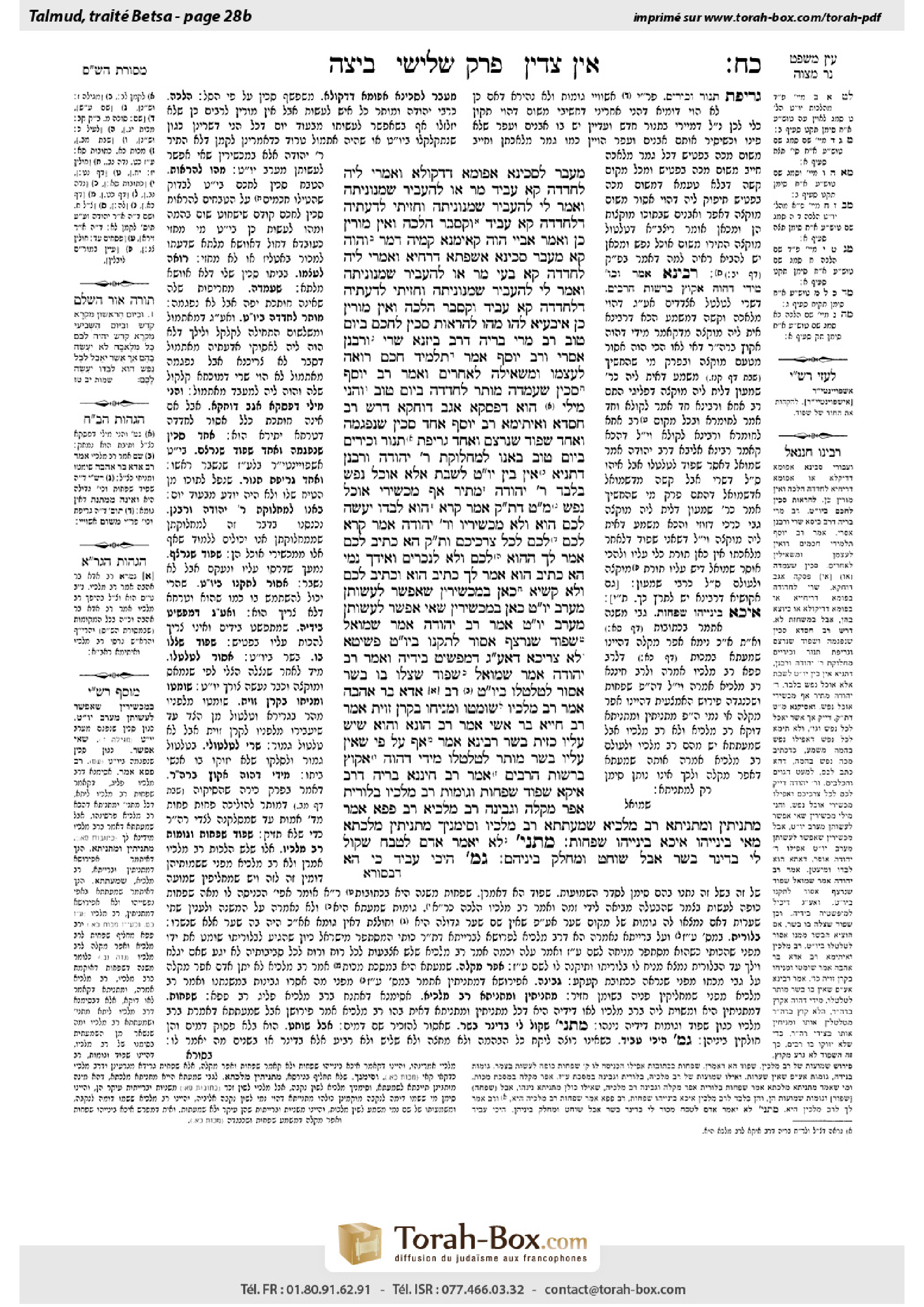
Beitzah 28b: Talmud study for Daf Yomi
Study the Talmud for Daf Yomi with scanned pages, Hebrew text, English translations from Sefaria and AI-generated French translations.
Passage selection and English or AI-generated French translation are available where the scan has annotations. Daf Study is independent of Torah-Box and Sefaria.
Browse Beitzah · ביצה · All tractatesBeitzah 28b text and translations
This page of Beitzah includes the Aramaic text, an English translation and an AI-generated French translation, alongside the scan above.
ביצה כ״ח ב · Aramaic and Hebrew text
מְעַבַּר לְסַכִּינָא אַפּוּמָּא דְּדִקּוּלָא, וְאָמְרִי לֵיהּ: לְחַדְּדָהּ קָא עָבֵיד מָר, אוֹ לְהַעֲבִיר שַׁמְנוּנִיתָהּ? וְאָמַר לִי: לְהַעֲבִיר שַׁמְנוּנִיתָהּ. וַחֲזֵיתִי לְדַעְתֵּיהּ דִּלְחַדְּדָהּ קָא עָבֵיד, וְקָסָבַר: הֲלָכָה, וְאֵין מוֹרִין כֵּן.
וְאָמַר אַבָּיֵי: הֲוָה קָאֵימְנָא קַמֵּיהּ דְּמָר, וַהֲוָה קָא מְעַבַּר סַכִּינָא אַשִּׂפְתָּא דְרִחְיָא. וַאֲמַרִי לֵיהּ: לְחַדְּדָהּ קָא בָּעֵי מָר, אוֹ לְהַעֲבִיר שַׁמְנוּנִיתָהּ? וְאָמַר לִי: לְהַעֲבִיר שַׁמְנוּנִיתָהּ. וַחֲזִיתִי לְדַעְתֵּיהּ דִּלְחַדְּדָהּ קָא עָבֵיד, וְקָסָבַר: הֲלָכָה, וְאֵין מוֹרִין כֵּן.
אִיבַּעְיָא לְהוּ: מַהוּ לְהַרְאוֹת סַכִּין לְחָכָם בְּיוֹם טוֹב? רַב מָרִי בְּרֵיהּ דְּרַב בִּיזְנָא שָׁרֵי, וְרַבָּנַן אָסְרִי. וְרַב יוֹסֵף אָמַר: תַּלְמִיד חָכָם רוֹאֶה לְעַצְמוֹ, וּמַשְׁאִילָהּ לַאֲחֵרִים.
וְאָמַר רַב יוֹסֵף: סַכִּין שֶׁעָמְדָה — מוּתָּר לְחַדְּדָהּ בְּיוֹם טוֹב. וְהָנֵי מִילֵּי הוּא דְּפָסְקָא אַגַּב דּוּחְקָא.
דָּרַשׁ רַב חִסְדָּא, וְאִיתֵּימָא רַב יוֹסֵף: אֶחָד סַכִּין שֶׁנִּפְגְּמָה, וְאֶחָד שַׁפּוּד שֶׁנִּרְצַם, וְאֶחָד גְּרִיפַת תַּנּוּר וְכִירַיִם בְּיוֹם טוֹב — בָּאנוּ לְמַחְלוֹקֶת רַבִּי יְהוּדָה וְרַבָּנַן. דְּתַנְיָא: אֵין בֵּין יוֹם טוֹב לַשַּׁבָּת אֶלָּא אוֹכֶל נֶפֶשׁ בִּלְבָד. רַבִּי יְהוּדָה מַתִּיר אַף מַכְשִׁירֵי אוֹכֶל נֶפֶשׁ.
מַאי טַעְמָא דְּתַנָּא קַמָּא — אָמַר קְרָא: ״הוּא לְבַדּוֹ יֵעָשֶׂה לָכֶם״. ״הוּא״ — וְלֹא מַכְשִׁירָיו. וְרַבִּי יְהוּדָה, אָמַר קְרָא: ״לָכֶם״, לָכֶם — לְכׇל צׇרְכֵיכֶם.
וְתַנָּא קַמָּא, הָא כְּתִיב ״לָכֶם״? אָמַר לָךְ: הַהוּא, ״לָכֶם״ — וְלֹא לְגוֹיִם.
וְאִידַּךְ נָמֵי, הָא כְּתִיב ״הוּא״, אָמַר לָךְ: כְּתִיב ״הוּא״, וּכְתִיב ״לָכֶם״, וְלָא קַשְׁיָא: כָּאן בְּמַכְשִׁירִין שֶׁאֶפְשָׁר לַעֲשׂוֹתָן מֵעֶרֶב יוֹם טוֹב, כָּאן בְּמַכְשִׁירִין שֶׁאִי אֶפְשָׁר לַעֲשׂוֹתָן מֵעֶרֶב יוֹם טוֹב.
אָמַר רַב יְהוּדָה אָמַר שְׁמוּאֵל: שַׁפּוּד שֶׁנִּרְצַף — אָסוּר לְתַקְּנוֹ בְּיוֹם טוֹב. פְּשִׁיטָא! לָא צְרִיכָא, דְּאַף עַל גַּב דְּמִפְּשִׁיט בִּידֵיהּ.
וְאָמַר רַב יְהוּדָה אָמַר שְׁמוּאֵל: שַׁפּוּד שֶׁצָּלוּ בּוֹ בָּשָׂר — אָסוּר לְטַלְטְלוֹ בְּיוֹם טוֹב. רַב אַדָּא בַּר אַהֲבָה אָמַר רַב מַלְכִּיּוֹ: שׁוֹמְטוֹ וּמַנִּיחוֹ בְּקֶרֶן זָוִית.
אָמַר רַב חִיָּיא בַּר אָשֵׁי אָמַר רַב הוּנָא: וְהוּא שֶׁיֵּשׁ עָלָיו כְּזַיִת בָּשָׂר. רָבִינָא אָמַר: אַף עַל פִּי שֶׁאֵין עָלָיו בָּשָׂר — מוּתָּר לְטַלְטְלוֹ, מִידֵּי דְּהָוֵה אַקּוֹץ בִּרְשׁוּת הָרַבִּים.
אָמַר רַב חִינָּנָא בְּרֵיהּ דְּרַב אִיקָא: שַׁפּוּד, שְׁפָחוֹת, וְגוּמוֹת — רַב מַלְכִּיּוֹ.
בְּלוֹרִית, אֵפֶר מִקְלֶה, וּגְבִינָה — רַב מַלְכִּיָּא.
רַב פָּפָּא אָמַר: מַתְנִיתִין וּמַתְנִיתָא — רַב מַלְכִּיָּא. שְׁמַעְתָּתָא — רַב מַלְכִּיּוֹ. וְסִימָנָיךְ: מַתְנִיתִין מַלְכְּתָא. מַאי בֵּינַיְיהוּ? אִיכָּא בֵּינַיְיהוּ שְׁפָחוֹת.
מַתְנִי׳ לֹא יֹאמַר אָדָם לַטַּבָּח: שְׁקוֹל לִי בְּדִינָר בָּשָׂר, אֲבָל שׁוֹחֵט וּמְחַלֵּק בֵּינֵיהֶם.
גְּמָ׳ הֵיכִי עָבֵיד? כִּי הָא
Beitzah 28b · English translation
running a knife over the rim of a basket on a Festival. And I said to him: Is the Master doing so in order to sharpen it or in order to remove its fat? And he said to me: To remove its fat. And I nevertheless perceived his intention, that he did so in order to sharpen it. He concealed this from me, however, because he holds that Rabbi Yehuda’s opinion is the halakha but a public ruling is not issued to that effect; therefore he did not wish to permit the practice explicitly.
Similarly, Abaye said: I was standing before my Master and teacher, Rabba, and he was running a knife over the edge of a millstone on a Festival. And I said to him: Does the Master wish to sharpen it, or is he doing this in order to remove its fat? And he said to me: To remove its fat. And I perceived his intention, that he did so in order to sharpen it, but he holds: This is the halakha, but a public ruling is not issued to that effect.
A dilemma was raised before the Sages: What is the halakha with regard to showing a slaughtering knife to a Sage on a Festival so that he may examine it for nicks and imperfections that would render it unfit to be used for slaughtering? Rav Mari, son of Rav Bizna, permitted it, whereas the Rabbis prohibited it, as this is somewhat similar to a weekday activity. And Rav Yosef said: A Torah scholar may examine a knife for himself in his own home and then lend it to others, who may also slaughter with it. Since the examination is not performed in public, it does not appear similar to a weekday activity.
§ And Rav Yosef said: With regard to a knife that became blunt without being nicked, it is permitted to sharpen it on a Festival. And this applies only if the knife still cuts, albeit with difficulty, so that when he sharpens it he is seen not as making a new utensil but merely as improving an old one. However, if the knife no longer cuts at all, it is prohibited to sharpen it.
Rav Ḥisda taught, and some say it was Rav Yosef who taught: A knife that became nicked on a Festival, a roasting skewer [shappud] that was crushed on a Festival and its point broke off, and the sweeping of the coals in an oven and a stove on a Festival to prepare them for baking, with regard to all of these we have arrived at the dispute between Rabbi Yehuda and the Rabbis. As it is taught in a baraita: The difference between a Festival and Shabbat is only with regard to the preparation of food. Rabbi Yehuda permits even actions that facilitate preparation of food on a Festival.
The Gemara explains: What is the reason of the first tanna for prohibiting actions that facilitate food preparation? The verse states: “Save that which every person must eat, that alone may be done for you” (Exodus 12:16), from which it may be inferred: “That” may be done on a Festival, but not actions that facilitate it. And Rabbi Yehuda adduces proof for his view from the fact that the verse states: “For you,” indicating: For you, for all your needs, and that which facilitates food preparation is also a need.
The Gemara asks: And according to the first tanna, is it not written “for you”? What does he learn from this phrase? The Gemara answers: That tanna could have said to you that that phrase comes to teach: For you, but not for gentiles.
The Gemara asks: And according to the other tanna, Rabbi Yehuda, too, isn’t it written: “That,” which indicates a limitation? The Gemara explains that Rabbi Yehuda could have said to you: The limiting word “that” is written, and the expansive phrase “for you,” indicating all your needs, is written as well, but this is not difficult and no contradiction is involved. One can say that here, it is referring to actions that facilitate food preparation that can be performed on the eve of the Festival; the Torah prohibits these on a Festival. There, it is referring to actions that facilitate food preparation that cannot be performed on the eve of the Festival. The latter may be performed even on the Festival itself, as they too are part of the preparation of food, similar to cooking.
Rav Yehuda said that Shmuel said: With regard to a roasting skewer that became bent, it is prohibited to repair it on a Festival. The Gemara asks: This is obvious; it is clear that one may not fix a utensil on a Festival. The Gemara answers: No, it is necessary to state this halakha with regard to a particular case: Although the skewer can be straightened by hand and no special tool is needed for this task, it is nevertheless prohibited.
And Rav Yehuda said that Shmuel said: With regard to a skewer upon which one roasted meat, it is prohibited to move it on a Festival, as it has already served its purpose on the Festival, and it is not fit for any other use. Rav Adda bar Ahava said that Rav Malkiyu said: He may pull the skewer out and place it in a corner so that it will not endanger anyone, as it could if it were left in the middle of the house.
Rav Ḥiyya bar Ashi said that Rav Huna said: And this ruling applies only where the skewer has an olive-bulk of meat on it; in such a case he may move the skewer on account of the meat and drag it into the corner in an unusual manner. However, if it does not have an olive-bulk of meat on it, he may not move it at all. Ravina said: Although it does not have an olive-bulk of meat on it, it is permitted to move it in the regular manner and place it in a corner, just as in the case of a thorn lying in the public domain. For the sake of public safety, it is permitted to remove such a thorn by moving it in increments, each less than four cubits. The same applies to this skewer; since it might harm someone where it is, it may be moved to a corner.
Apropos Rav Malkiyu, to whom only a few halakhot are attributed, the Gemara mentions that Rav Ḥinnana, son of Rav Ika, said: The halakha with regard to a skewer that had been used for roasting meat but no longer has an olive-bulk of meat on it, that it may be moved to a corner; and likewise, the halakha concerning maidservants, that even if a woman brought one hundred maidservants into the marriage as her dowry, her husband may nevertheless compel her to perform some sort of work so that her boredom not bring her to sin (Ketubot 61b); and finally, the halakha with regard to follicles, that if a girl has two hair follicles in her pubic region, even if there are no hairs growing from them, she is considered to have reached majority and may perform ḥalitza; these three halakhot were all stated by Rav Malkiyu.
However, the halakha concerning a forelock, that a Jew who cuts the hair of a gentile must stop before he reaches his forelock at a distance of three fingerbreadths on every side, as the gentiles would grow their forelocks for idolatry, and the Jew must not appear as if he were dressing the forelock for idolatrous purposes; and likewise, the halakha concerning burnt ashes, that one may not place them on a wound, as it looks like a tattoo; and finally, the halakha with regard to cheese made by a gentile, that it is forbidden because gentiles smooth the surface of their cheese with lard; these three halakhot were all stated by a different Sage named Rav Malkiya.
Rav Pappa said a different principle: The teachings mentioned above that relate to a mishna or a baraita were stated by Rav Malkiya, whereas halakhot that are not related to a mishna or baraita were taught by Rav Malkiyu. And your mnemonic to remember this is: The mishna is a queen [malketa]; the comments that are referring to a mishna were made by Rav Malkiya, whose name is similar to the Aramaic term for queen. The Gemara asks: What is the practical difference between Rav Ḥinnana and Rav Pappa? The Gemara answers: There is a practical difference between them with regard to the halakha concerning maidservants. According to Rav Ḥinnana, this halakha was stated by Rav Malkiyu, whereas Rav Pappa holds that it was taught by Rav Malkiya, since it is referring to a dispute in a mishna.
MISHNA: A person may not say to a butcher on a Festival: Weigh for me a dinar’s worth of meat, since if he mentions a sum of money, it looks like a commercial transaction. But the butcher may slaughter an animal and apportion it among his customers without stipulating a price.
GEMARA: The Gemara asks: What should one do if he wishes to take part of an animal on a Festival, but is barred from mentioning its price? The Gemara answers: As
Beitzah 28b · Traduction française (IA)
Courir un couteau le long du bord d'un panier pendant un festival. Et je lui dis : Le Maître le fait-il pour l'aiguiser ou pour enlever sa graisse ? Et il me répondit : Pour enlever sa graisse. Et je perçus néanmoins son intention, qu'il le faisait pour l'aiguiser. Cependant, il me dissimula cela, car il considère que l'opinion de Rabbi Yehuda est la halakha, mais qu'une décision publique n'est pas rendue à cet effet ; par conséquent, il ne souhaitait pas autoriser explicitement cette pratique.
De même, Abaye dit : J'étais devant mon Maître et mon maître, Rabba, et il courait un couteau le long du bord d'une meule pendant un festival. Et je lui dis : Le Maître désire-t-il l'aiguiser, ou fait-il cela pour enlever sa graisse ? Et il me répondit : Pour enlever sa graisse. Et je perçus son intention, qu'il le faisait pour l'aiguiser, mais il considère : C'est la halakha, mais une décision publique n'est pas rendue à cet effet.
Un dilemme fut soulevé devant les Sages : Quelle est la halakha concernant l'exposition d'un couteau de boucherie à un Sage pendant un festival afin qu'il puisse l'examiner pour des entailles et imperfections qui le rendraient inutilisable pour la boucherie ? Rav Mari, fils de Rav Bizna, permit cela, tandis que les Rabbins l'interdirent, car cela ressemble quelque peu à une activité du jour de semaine. Et Rav Yosef dit : Un savant de la Torah peut s'auto-examiner un couteau dans son propre domicile et puis le prêter à d'autres, qui peuvent également boucher avec. Puisque l'examen n'est pas fait en public, cela ne ressemble pas à une activité du jour de semaine.
§ Et Rav Yosef dit : Concernant un couteau devenu tranchant sans être entaillé, il est permis de le aiguiser pendant un festival. Et cela s'applique uniquement si le couteau peut encore couper, même avec difficulté, de sorte que lorsqu'on l'aiguisera, on le verra non pas comme on fabrique un ustensile nouveau, mais simplement comme on améliore un ancien. Cependant, si le couteau ne peut plus couper du tout, il est interdit de l'aiguiser.
Rav Ḥisda enseigna, et certains disent que c'était Rav Yosef qui enseigna : Un couteau devenu entaillé pendant un festival, un bâton de grillade [shappud] qui a été écrasé pendant un festival et dont le point s'est cassé, et le balayage des braises dans une fournaise et une cheminée pendant un festival pour les préparer à la cuisson, concernant tous ces cas, nous avons atteint le débat entre Rabbi Yehuda et les Rabbins. Comme il est enseigné dans une baraïta : La différence entre un festival et le sabbat est uniquement concernant la préparation des aliments. Rabbi Yehuda permet même les actions qui facilitent la préparation des aliments pendant un festival.
La Guemara explique : Quel est le raisonnement du premier tanna qui interdit les actions qui facilitent la préparation des aliments ? La Sainte Écriture dit : « Sauvegarde ce qui est nécessaire à chaque personne pour manger, et cela seul peut être fait pour vous » (Exode 12:16), d'où on peut déduire : « Cela » peut être fait pendant un festival, mais pas les actions qui facilitent cela. Et Rabbi Yehuda tire une preuve de son point de vue du fait que la Sainte Écriture dit : « Pour vous », indiquant : Pour vous, pour toutes vos besoins, et ce qui facilite la préparation des aliments est également une nécessité.
La Guemara demande : Et selon le premier tanna, n'est-il pas écrit « pour vous » ? De quoi apprend-on cela ? La Guemara répond : Ce tanna aurait pu dire à vous que cette phrase vient enseigner : Pour vous, mais pas pour les non-Juifs.
La Guemara demande : Et selon l'autre tanna, Rabbi Yehuda, n'est-il pas écrit : « Cela », qui indique une limitation ? La Guemara explique que Rabbi Yehuda aurait pu dire à vous : Le mot limitant « cela » est écrit, et la phrase expansive « pour vous », indiquant toutes vos besoins, est également écrite, mais cela n'est pas difficile et il n'y a pas de contradiction. On peut dire que là, il s'agit d'actions qui facilitent la préparation des aliments qui peuvent être faites le soir du festival ; la Torah interdit cela pendant le festival. Là, il s'agit d'actions qui facilitent la préparation des aliments qui ne peuvent pas être faites le soir du festival. Ces dernières peuvent être faites même pendant le festival lui-même, car elles font également partie de la préparation des aliments, semblables à la cuisson.
Rav Yehuda dit que Shmuel dit : Concernant un bâton de grillade devenu courbé, il est interdit de le réparer pendant un festival. La Guemara demande : Cela est évident ; il est clair qu'on ne peut pas réparer un ustensile pendant un festival. La Guemara répond : Non, il est nécessaire d'énoncer cette halakha concernant un cas particulier : Bien que le bâton puisse être redressé à la main et qu'aucun outil spécial ne soit nécessaire pour cette tâche, il est tout de même interdit.
Et Rav Yehuda dit que Shmuel dit : Concernant un bâton sur lequel on a grillé de la viande, il est interdit de le déplacer pendant un festival, car il a déjà accompli son but pendant le festival et il n'est plus adapté à une autre utilisation. Rav Adda bar Ahava dit que Rav Malkiyu dit : Il peut tirer le bâton et le placer dans un coin afin qu'il ne menace personne, car il pourrait le faire s'il était laissé au milieu de la maison.
Rav Ḥiyya bar Ashi dit que Rav Huna dit : Et cette décision s'applique uniquement lorsque le bâton a une quantité d'olive de viande sur lui ; dans ce cas, il peut déplacer le bâton en raison de la viande et le tirer dans un coin de manière inhabituelle. Cependant, si ce n'est pas le cas, il ne peut pas le déplacer du tout. Ravina dit : Bien qu'il n'ait pas une quantité d'olife de viande sur lui, il est permis de le déplacer de manière normale et de le placer dans un coin, tout comme dans le cas d'une épine dans le domaine public. Pour la sécurité publique, il est permis d'enlever un tel épine en le déplaçant par étapes, chacune inférieure à quatre coudées. La même chose s'applique à ce bâton ; puisque cela pourrait nuire à quelqu'un là où il est, il peut être déplacé dans un coin.
En ce qui concerne Rav Malkiyu, à qui on attribue seulement quelques halakhot, la Guemara mentionne que Rav Ḥinnana, fils de Rav Ika, a dit : La halakha concernant un pique ayant été utilisé pour cuire de la viande mais ne possédant plus une quantité d'olive de viande sur lui, qu'il peut être déplacé dans un coin ; et de même, la halakha concernant les servantes, qu'une femme, même si elle a apporté cent servantes dans le mariage en tant que dot, son mari peut néanmoins la contraindre à effectuer un certain travail afin que sa monotonie ne l'entraîne pas à pécher (Ketubot 61b) ; et enfin, la halakha concernant les follicules, qu'une fille ayant deux follicules pileux dans sa région génitale, même s'il n'y a pas de poils poussant dessus, est considérée comme majeure et peut effectuer la ḥalitza ; ces trois halakhot ont toutes été émises par Rav Malkiyu.
Cependant, la halakha concernant la moustache, qu'un Juif qui taille les cheveux d'un non-Juif doit s'arrêter avant d'atteindre sa moustache à une distance de trois doigts de chaque côté, car les non-Juifs laissent pousser leurs moustaches pour l'idolâtrie, et le Juif ne doit pas avoir l'air de s'occuper de la moustache à des fins idolâtriques ; et de même, la halakha concernant les cendres brûlées, qu'on ne doit pas les placer sur une plaie, car cela ressemble à un tatouage ; et enfin, la halakha concernant le fromage fait par un non-Juif, qu'il est interdit car les non-Juifs lisent la surface de leur fromage avec du beurre de porc ; ces trois halakhot ont toutes été émises par un autre Sage nommé Rav Malkiya.
Rav Pappa a déclaré un principe différent : Les enseignements mentionnés ci-dessus qui concernent une mitsva ou une baraïta ont été énoncés par Rav Malkiya, tandis que les halakhot qui ne sont pas liés à une mitsva ou à une baraïta ont été enseignés par Rav Malkiyu. Et votre mnémonique pour se souvenir de cela est : La mitsva est une reine [malketa] ; les commentaires qui font référence à une mitsva ont été faits par Rav Malkiya, dont le nom est similaire au terme araméen pour reine. La Guemara demande : Quelle est la différence pratique entre Rav Ḥinnana et Rav Pappa ? La Guemara répond : Il existe une différence pratique entre eux concernant la halakha concernant les servantes. Selon Rav Ḥinnana, cette halakha a été énoncée par Rav Malkiyu, tandis que Rav Pappa considère qu'elle a été enseignée par Rav Malkiya, car elle fait référence à un débat dans une mitsva.
MICHNA : Une personne ne peut pas dire à un boucher lors d'un festival : Pèse-moi une quantité de viande égale à un dinar, car s'il mentionne une somme d'argent, cela ressemble à une transaction commerciale. Mais le boucher peut sacrifier un animal et le répartir parmi ses clients sans stipuler un prix.
GUEMARA : La Guemara demande : Que doit-on faire si l'on souhaite prendre une partie d'un animal lors d'un festival, mais qu'on est empêché de mentionner son prix ? La Guemara répond : Comme
Traduction française générée par IA à partir de l’édition anglaise de Sefaria. Vérifie toujours un passage avec le texte source.
Text from Sefaria: William Davidson Edition - Vocalized Aramaic (CC BY NC); William Davidson Edition - English (CC BY NC).