Beitzah 29a: Talmud study for Daf Yomi
Study the Talmud for Daf Yomi with scanned pages, Hebrew text, English translations from Sefaria and AI-generated French translations.
Passage selection and English or AI-generated French translation are available where the scan has annotations. Daf Study is independent of Torah-Box and Sefaria.
Browse Beitzah · ביצה · All tractatesBeitzah 29a text and translations
This page of Beitzah includes the Aramaic text, an English translation and an AI-generated French translation, alongside the scan above.
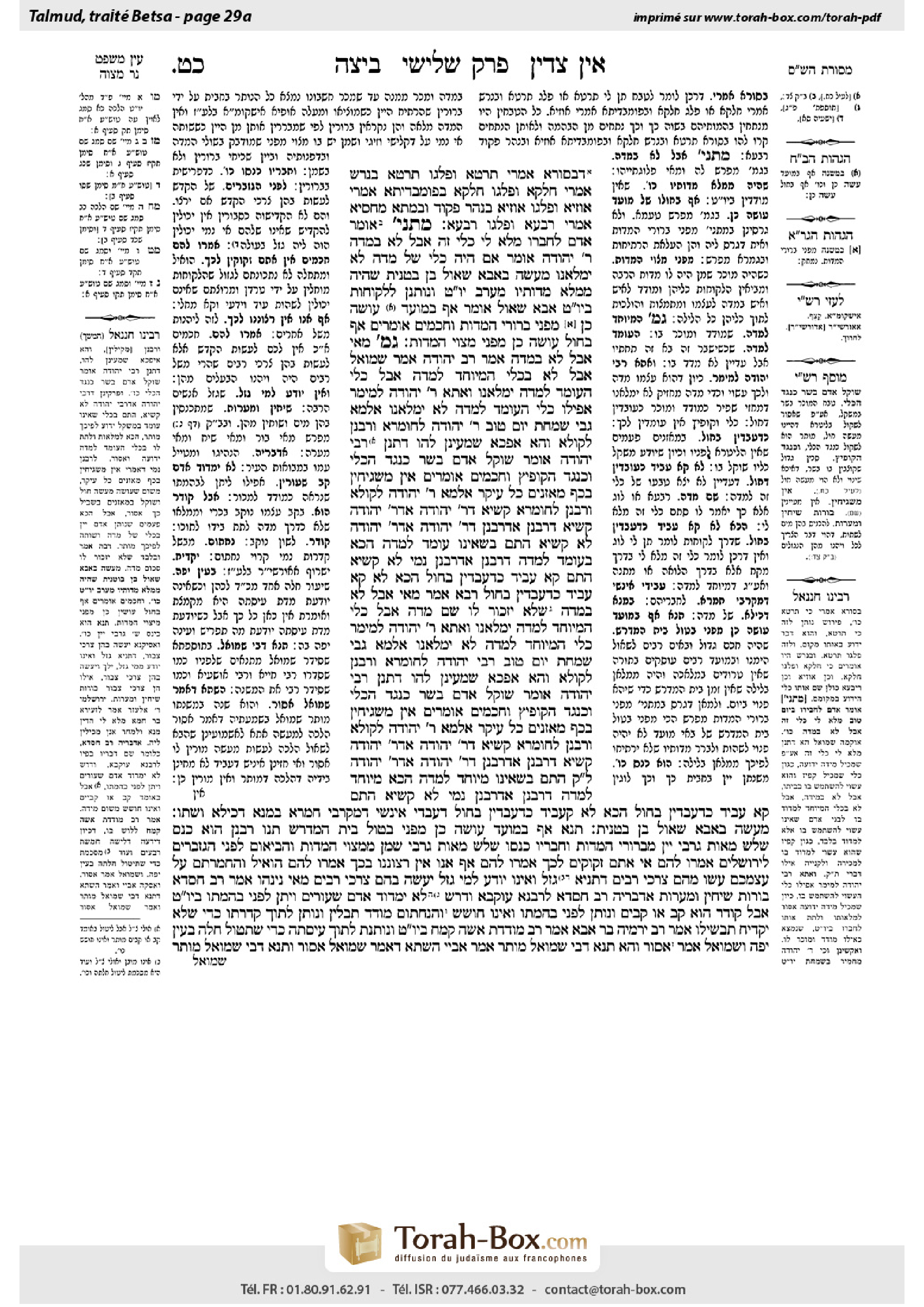
ביצה כ״ט א · Aramaic and Hebrew text
דִּבְסוּרָא אָמְרִי: תַּרְטָא וּפַלְגוּ תַּרְטָא. בְּנַרֶשׁ אָמְרִי: חֶלְקָא וּפַלְגוּ חֶלְקָא. בְּפוּמְבְּדִיתָא אָמְרִי: אוּזְיָא וּפַלְגוּ אוּזְיָא. בִּנְהַר פְּקוֹד וּבְמָתָא מַחְסֵיָא אָמְרִי: רִבְעָא וּפַלְגוּ רִבְעָא.
מַתְנִי׳ אוֹמֵר אָדָם לַחֲבֵרוֹ: מַלֵּא לִי כְּלִי זֶה, אֲבָל לֹא בְּמִדָּה. רַבִּי יְהוּדָה אוֹמֵר: אִם הָיָה כְּלִי שֶׁל מִדָּה — לֹא יְמַלְּאֶנּוּ. מַעֲשֶׂה בְּאַבָּא שָׁאוּל בֶּן בָּטְנִית, שֶׁהָיָה מְמַלֵּא מִדּוֹתָיו מֵעֶרֶב יוֹם טוֹב וְנוֹתְנָן לַלָּקוֹחוֹת בְּיוֹם טוֹב.
אַבָּא שָׁאוּל אוֹמֵר: אַף בַּמּוֹעֵד עוֹשֶׂה כֵּן, מִפְּנֵי בֵּרוּרֵי הַמִּדּוֹת. וַחֲכָמִים אוֹמְרִים: אַף בַּחוֹל עוֹשֶׂה כֵּן, מִפְּנֵי מִצּוּי הַמִּדּוֹת.
גְּמָ׳ מַאי ״אֲבָל לֹא בְּמִדָּה״? אָמַר רַב יְהוּדָה אָמַר שְׁמוּאֵל: אֲבָל לֹא בִּכְלִי הַמְיוּחָד לְמִדָּה. אֲבָל כְּלִי הָעוֹמֵד לְמִדָּה — יְמַלְּאֶנּוּ. וַאֲתָא רַבִּי יְהוּדָה לְמֵימַר אֲפִילּוּ כְּלִי הָעוֹמֵד לְמִדָּה לֹא יְמַלְּאֶנּוּ.
אַלְמָא גַּבֵּי שִׂמְחַת יוֹם טוֹב רַבִּי יְהוּדָה לְחוּמְרָא וְרַבָּנַן לְקוּלָּא? וְהָא אִפְּכָא שָׁמְעִינַן לְהוּ! דִּתְנַן, רַבִּי יְהוּדָה אוֹמֵר: שׁוֹקֵל אָדָם בָּשָׂר כְּנֶגֶד הַכְּלִי וּכְנֶגֶד הַקּוֹפִיץ, וַחֲכָמִים אוֹמְרִים: אֵין מַשְׁגִּיחִין בְּכַף מֹאזְנַיִם כׇּל עִיקָּר. אַלְמָא רַבִּי יְהוּדָה לְקוּלָּא וְרַבָּנַן לְחוּמְרָא. קַשְׁיָא דְּרַבִּי יְהוּדָה אַדְּרַבִּי יְהוּדָה, קַשְׁיָא דְּרַבָּנַן אַדְּרַבָּנַן!
דְּרַבִּי יְהוּדָה אַדְּרַבִּי יְהוּדָה לָא קַשְׁיָא: הָתָם בְּשֶׁאֵינוֹ עוֹמֵד לְמִדָּה, הָכָא בְּעוֹמֵד לְמִדָּה.
דְּרַבָּנַן אַדְּרַבָּנַן נָמֵי לָא קַשְׁיָא: הָתָם קָא עָבֵיד כִּדְעָבְדִין בְּחוֹל, הָכָא לָא קָא עָבֵיד כִּדְעָבְדִין בְּחוֹל.
רָבָא אָמַר: מַאי ״אֲבָל לֹא בְּמִדָּה״ — שֶׁלֹּא יִזְכּוֹר לוֹ שֵׁם מִדָּה, אֲבָל כְּלִי הַמְיוּחָד לְמִדָּה — יְמַלְּאֶנּוּ. וַאֲתָא רַבִּי יְהוּדָה לְמֵימַר: כְּלִי הַמְיוּחָד לְמִדָּה — לֹא יְמַלְּאֶנּוּ.
אַלְמָא גַּבֵּי שִׂמְחַת יוֹם טוֹב רַבִּי יְהוּדָה לְחוּמְרָא וְרַבָּנַן לְקוּלָּא? וְהָא אִפְּכָא שָׁמְעִינַן לְהוּ! דִּתְנַן, רַבִּי יְהוּדָה אוֹמֵר: שׁוֹקֵל אָדָם בָּשָׂר כְּנֶגֶד הַכְּלִי וּכְנֶגֶד הַקּוֹפִיץ, וַחֲכָמִים אוֹמְרִים: אֵין מַשְׁגִּיחִין בְּכַף מֹאזְנַיִם כׇּל עִיקָּר. אַלְמָא רַבִּי יְהוּדָה לְקוּלָּא וְרַבָּנַן לְחוּמְרָא. קַשְׁיָא דְּרַבִּי יְהוּדָה אַדְּרַבִּי יְהוּדָה, קַשְׁיָא דְּרַבָּנַן אַדְּרַבָּנַן!
דְּרַבִּי יְהוּדָה אַדְּרַבִּי יְהוּדָה לָא קַשְׁיָא: הָתָם בְּשֶׁאֵינוֹ מְיוּחָד לְמִדָּה, הָכָא מְיוּחָד לְמִדָּה. דְּרַבָּנַן אַדְּרַבָּנַן נָמֵי לָא קַשְׁיָא: הָתָם קָא עָבֵיד כִּדְעָבְדִין בְּחוֹל, הָכָא לָא קָעָבֵיד כִּדְעָבְדִין בְּחוֹל, דְּעָבְדִי אִינָשֵׁי דִּמְקָרְבִי חַמְרָא בְּמָנָא דְכִילָא וְשָׁתוּ.
מַעֲשֶׂה בְּאַבָּא שָׁאוּל בֶּן בָּטְנִית. תָּנָא: אַף בַּמּוֹעֵד עוֹשֶׂה כֵּן מִפְּנֵי בִּטּוּל בֵּית הַמִּדְרָשׁ.
תָּנוּ רַבָּנַן: הוּא כָּנַס שְׁלֹשׁ מֵאוֹת גַּרְבֵי יַיִן מִבֵּרוּרֵי הַמִּדּוֹת, וַחֲבֵרָיו כָּנְסוּ שְׁלֹשׁ מֵאוֹת גַּרְבֵי שֶׁמֶן מִמִּצּוּי הַמִּדּוֹת, וֶהֱבִיאוּם לִפְנֵי הַגִּזְבָּרִים לִירוּשָׁלַיִם.
אָמְרוּ לָהֶם: אִי אַתֶּם זְקוּקִים לְכָךְ. אָמְרוּ לָהֶם: אַף אָנוּ אֵין רְצוֹנֵנוּ בְּכָךְ.
אָמְרוּ לָהֶם: הוֹאִיל וְהֶחְמַרְתֶּם עַל עַצְמְכֶם — עֲשׂוּ מֵהֶם צׇרְכֵי רַבִּים. דְּתַנְיָא: גָּזַל וְאֵינוֹ יוֹדֵעַ מִמִּי גָּזַל — יַעֲשֶׂה בָּהֶם צׇרְכֵי רַבִּים. מַאי נִינְהוּ? אָמַר רַב חִסְדָּא: בּוֹרוֹת, שִׁיחִין וּמְעָרוֹת.
אַדְבְּרֵיהּ רַב חִסְדָּא לְרַבָּנָא עוּקְבָא, וּדְרַשׁ: לֹא יִמְדּוֹד אָדָם שְׂעוֹרִים וְיִתֵּן לִפְנֵי בְּהֶמְתּוֹ בְּיוֹם טוֹב, אֲבָל קוֹדֵר הוּא קַב אוֹ קַבִּים וְנוֹתֵן לִפְנֵי בְּהֶמְתּוֹ, וְאֵינוֹ חוֹשֵׁשׁ. וְהַנַּחְתּוֹם מוֹדֵד תַּבְלִין וְנוֹתֵן לְתוֹךְ קְדֵרָתוֹ, כְּדֵי שֶׁלֹּא יַקְדִּיחַ תַּבְשִׁילוֹ.
אָמַר רַב יִרְמְיָה בַּר אַבָּא אָמַר רַב: מוֹדֶדֶת אִשָּׁה קֶמַח בְּיוֹם טוֹב וְנוֹתֶנֶת לְתוֹךְ עִיסָּתָהּ כְּדֵי שֶׁתִּטּוֹל חַלָּה בְּעַיִן יָפָה. וּשְׁמוּאֵל אָמַר: אָסוּר. וְהָא תָּנָא דְּבֵי שְׁמוּאֵל, מוּתָּר!
אָמַר אַבָּיֵי: הַשְׁתָּא דְּאָמַר שְׁמוּאֵל אָסוּר, וְתָנָא דְּבֵי שְׁמוּאֵל מוּתָּר,
Beitzah 29a · English translation
they would say in Sura: Give me that cut of meat called a tarta or half a tarta, without naming a price. In Neresh they would say in reference to those same portions: A part or half a part. In Pumbedita they would say: An uzya or half an uzya. In Nehar Pekod and in Mata Meḥasya they would say: Give me a quarter or half a quarter, thereby establishing the size of the portion without mentioning its price.
MISHNA: One person may say to another on a Festival: Fill this vessel for me, and I will return its contents or reimburse you after the Festival, but he may not ask him to fill the vessel in a particular measure. Rabbi Yehuda says: If it was a measuring utensil, he may not fill it. There was an incident involving Abba Shaul ben Botnit, a Sage who was also a grocer, who would fill his measures on the eve of a Festival and give them to his customers on the Festival. In this way he would know exactly how much he had given each person, without conducting any measurements on the Festival itself.
Abba Shaul, a Sage distinct from Abba Shaul ben Botnit, says: He would do this even on the intermediate days of a Festival because of the clarity of the measures, i.e., in order to clarify precisely how much must be given to each customer, since the measurement is more precise once the foam of the liquid being measured has subsided. And the Rabbis say: Even on a weekday it is proper to do so, because of the draining of the measures. This method allows all the liquid to drain fully out of the seller’s measuring utensil so that the amount is exact.
GEMARA: The Gemara asks: What is the meaning of the phrase: But not in a measure? Rav Yehuda said that Shmuel said: But not with a vessel designated for measuring; however, in the case of a vessel that can be used for measuring but has yet to be used for this purpose, he may fill it. According to this, Rabbi Yehuda comes to disagree and say that he may not fill even a vessel that can be used for measuring.
The Gemara asks: Apparently, Rabbi Yehuda is stringent with regard to the joy of the Festival in that he prohibits the use of any sort of measuring utensil, while the Rabbis are lenient. But didn’t we hear them state the opposite, as we learned in an earlier mishna (28a) that Rabbi Yehuda says: A person selling meat on a Festival may weigh the meat against a vessel or against a cleaver, and the Rabbis say: One may not look at the pans of a balance scale at all? Apparently, here, the opinion of Rabbi Yehuda is lenient, while the opinion of the Rabbis is stringent. Therefore, there is a contradiction between the one statement of Rabbi Yehuda and the other statement of Rabbi Yehuda, as well as a contradiction between the one statement of the Rabbis and the other statement of the Rabbis.
The Gemara answers: With regard to the contradiction between the one teaching of Rabbi Yehuda and the other teaching of Rabbi Yehuda, this is not difficult. There, where he is lenient, he is dealing with a vessel that cannot be used for measuring on a regular basis at all, whereas here, he is referring to a vessel that can be used for measuring, and therefore he is stringent even if the vessel has not yet actually been used in this capacity.
With regard to the contradiction between the one statement of the Rabbis and the other statement of the Rabbis, it is also not difficult. There, he is acting in a weekday manner, and consequently they prohibit the weighing, whereas here, he is not acting in a weekday manner, as the vessel is not a measuring utensil, and consequently they permit him to use it. This completes the Gemara’s discussion of Shmuel’s explanation of the mishna.
The Gemara offers a second explanation of the mishna. Rava said: What is the meaning of the phrase: But not by measure? It means that he may not mention to him the name of the measure. For example, he may not say: Fill for me one kav, or two kav. However, he may fill a vessel even if it is designated for measuring. And Rabbi Yehuda comes to say: He may not fill a vessel designated for measuring, even if he does not stipulate a particular measure.
The Gemara asks: Apparently, with regard to the joy of the Festival, Rabbi Yehuda is stringent, and the Rabbis are lenient. But didn’t we hear them state the opposite, as we learned in an earlier mishna (28a) that Rabbi Yehuda says: A person may weigh meat against a vessel or against a cleaver, and the Rabbis prohibit this and say: One may not look at the pans of a balance scale at all? Apparently, Rabbi Yehuda is lenient, while the Rabbis are stringent. Therefore, there is a contradiction between one statement of Rabbi Yehuda and the other statement of Rabbi Yehuda, and there is also a contradiction between one statement of the Rabbis and the other statement of the Rabbis.
The Gemara answers: With regard to the contradiction between one teaching of Rabbi Yehuda and the other teaching of Rabbi Yehuda, this is not difficult. There, with regard to weighing meat against a vessel, he is dealing with a vessel that is not designated for measuring, and therefore he is lenient, whereas here, he is referring to a vessel that is designated for measuring, with regard to which he is stringent. With regard to the contradiction between one statement of the Rabbis and the other statement of the Rabbis, this is also not difficult. There, he is acting in a weekday manner, and consequently they prohibit the weighing, whereas here, he is not acting in a weekday manner, as people are accustomed to offer their friends wine in a measuring utensil and drink. Since the use of such a vessel is not exclusive to commercial transactions, the Rabbis permitted it here as well.
§ The mishna recounted an incident involving Abba Shaul ben Botnit, a Sage who was also a grocer, who would fill his measures on the eve of a Festival and give them to his customers on the Festival. A tanna taught in a baraita: He would do this even on the intermediate days of a Festival, in order to prevent dereliction of Torah study in the study hall. Since he wanted to spend most of his day in the study hall and not have to interrupt his study to carry out measurements, he would measure for his customers at night, when it was not a time of study.
The Sages taught in a baraita: Abba Shaul ben Botnit collected three hundred earthenware jugs of wine, to which he thought he was not entitled due to the clarity of the measures, as he thought that he had unfairly profited from the foam at the top of the liquid he measured. And his colleagues, similarly God-fearing grocers, collected three hundred earthenware jugs of oil, which they thought were not rightly theirs due to the draining of the measures; they were concerned that because they had measured for their customers using their own vessels, they might not have drained the entire measure from their containers into the customers’ vessels. And they brought these jugs of wine and oil to Jerusalem before the Temple treasurers, as they did not want to benefit from possibly stolen goods.
The treasurers said to them: You need not do this, as all buyers take into account the foam and what is left in the sellers’ vessels and pay with this in mind. They said to them: Just like the buyers give up their claim to it, we too do not wish to benefit from this, even if strictly speaking it is not considered stolen property.
The treasurers said to them: Since you are so stringent with yourselves, use the wine and oil for communal needs. As it is taught in a baraita: If one stole and does not know from whom he stole, he should use the stolen items for communal needs, thereby repaying all of the Jewish people. The Gemara asks: What are communal needs? Rav Ḥisda said: He should finance the digging of cisterns, ditches, and caves, for storing water for travelers.
§ Rav Ḥisda authorized Rabbana Ukva to give a public lecture, and he taught the following: A person may not measure barley and place it before his animal on a Festival, but he may cut out [koder] a hole in the pile of grain by means of a vessel of one kav or two kav, and place the barley before his animal, and he need not be concerned about the measuring this entails, as he does not transgress the prohibition against using a measuring utensil if he is not particular about measuring precisely. And a baker may measure spices and put them in his pot, so as not to spoil his dish, since if he puts in too much he will ruin the food.
Rav Yirmeya bar Abba said that Rav said: A woman may measure flour on a Festival and put it into her dough in order to separate ḥalla generously, because if she knows the exact amount of dough she can separate the proper amount of ḥalla. And Shmuel said: It is prohibited, as she can estimate the amount that must be set aside as ḥalla. The Gemara asks: But didn’t a Sage of the school of Shmuel teach a baraita stating that this is permitted?
Abaye said: Now that it is known that Shmuel said it is prohibited and a Sage of the school of Shmuel taught a baraita that it is permitted,
Beitzah 29a · Traduction française (IA)
Ils disaient à Sura : Donnez-moi cette portion de viande appelée un tarta ou la moitié d’un tarta, sans mentionner un prix. À Neresh, ils disaient à propos de ces mêmes portions : Une part ou la moitié d’une part. À Pumbedita, ils disaient : Un uzya ou la moitié d’un uzya. À Nehar Pekod et à Mata Meḥasya, ils disaient : Donnez-moi un quart ou la moitié d’un quart, ce qui permettait d’établir la taille de la portion sans mentionner son prix.
MICHNA : Une personne peut dire à une autre lors d’un festival : Remplis ce récipient pour moi, et je te rembourserai son contenu ou je te rétribuerai après le festival, mais il ne peut pas lui demander de le remplir selon une mesure précise. Rabbi Yehuda dit : Si c’était un récipient de mesure, il ne peut pas le remplir. Il y avait un cas concernant Abba Shaul ben Botnit, un sage qui était aussi un marchand, qui remplissait ses mesures à la veille du festival et les donnait à ses clients pendant le festival. Ainsi, il savait exactement combien il avait donné à chaque personne, sans avoir à mesurer pendant le festival lui-même.
Abba Shaul, un sage distinct d’Abba Shaul ben Botnit, dit : Il faisait cela même aux jours intermédiaires du festival en raison de la clarté des mesures, c’est-à-dire afin de clarifier précisément combien doit être donné à chaque client, car la mesure est plus précise une fois que la mousse du liquide à mesurer a disparu. Et les Rabbins disent : Même un jour de semaine, il est convenable de le faire, en raison du vidage des mesures. Cette méthode permet à tout le liquide de s’écouler pleinement du récipient de mesure du vendeur, ce qui garantit une mesure exacte.
GUEMARA : La Guemara pose la question : Quelle est la signification de la phrase : Mais pas en mesure ? Rav Yehuda a dit que Shmuel a dit : Mais pas avec un récipient désigné pour la mesure ; cependant, dans le cas d’un récipient qui peut être utilisé pour la mesure mais qui n’a pas encore été utilisé à cet effet, il peut le remplir. Selon cela, Rabbi Yehuda vient à contester et à dire qu’il ne peut pas le remplir même si le récipient peut être utilisé pour la mesure.
La Guemara pose la question : Apparemment, Rabbi Yehuda est strict concernant la joie du festival, car il interdit l’utilisation de tout récipient de mesure, tandis que les Rabbins sont plus indulgents. Mais n’avons-nous pas entendu cela auparavant, comme nous l’avons appris dans une autre mishna (28a), que Rabbi Yehuda dit : Une personne vendant de la viande lors d’un festival peut peser la viande contre un récipient ou contre un couteau, et les Rabbins disent : On ne doit pas regarder les plateaux d’une balance ? Apparemment, ici, l’opinion de Rabbi Yehuda est indulgente, tandis que celle des Rabbins est strict. Ainsi, il y a une contradiction entre l’une des déclarations de Rabbi Yehuda et l’autre, ainsi qu’une contradiction entre l’une des déclarations des Rabbins et l’autre.
La Guemara répond : Concernant la contradiction entre l’une des enseignements de Rabbi Yehuda et l’autre, cela n’est pas difficile. Là, où il est indulgent, il s’agit d’un récipient qui ne peut pas être utilisé pour la mesure en général, tandis que ici, il s’agit d’un récipient qui peut être utilisé pour la mesure, et donc il est strict même si le récipient n’a pas encore été utilisé à cet effet.
Concernant la contradiction entre l’une des déclarations des Rabbins et l’autre, cela n’est pas difficile non plus. Là, il s’agit d’une action en journée ordinaire, et par conséquent ils interdisent la pesée, tandis que ici, il ne s’agit pas d’une action en journée ordinaire, car le récipient n’est pas un récipient de mesure, et par conséquent ils permettent son utilisation. Cela termine la discussion de la Guemara sur l’explication de Shmuel de la mishna.
La Guemara propose une autre explication de la mishna. Rava dit : Quelle est la signification de la phrase : Mais pas en mesure ? Cela signifie qu’il ne peut pas mentionner le nom de la mesure. Par exemple, il ne peut pas dire : Remplis-moi un kav, ou deux kav. Cependant, il peut remplir un récipient même s’il est désigné pour la mesure. Et Rabbi Yehuda vient à dire : Il ne peut pas remplir un récipient désigné pour la mesure, même s’il ne stipule pas une mesure précise.
La Guemara pose la question : Apparemment, concernant la joie du festival, Rabbi Yehuda est strict, et les Rabbins sont indulgents. Mais n’avons-nous pas entendu cela auparavant, comme nous l’avons appris dans une autre mishna (28a), que Rabbi Yehuda dit : Une personne peut peser la viande contre un récipient ou contre un couteau, et les Rabbins interdisent cela et disent : On ne doit pas regarder les plateaux d’une balance ? Apparemment, Rabbi Yehuda est indulgent, tandis que les Rabbins sont stricts. Ainsi, il y a une contradiction entre l’une des déclarations de Rabbi Yehuda et l’autre, ainsi qu’une contradiction entre l’une des déclarations des Rabbins et l’autre.
La Guemara répond : Concernant la contradiction entre l’une des enseignements de Rabbi Yehuda et l’autre, cela n’est pas difficile. Là, concernant la pesée de la viande contre un récipient, il s’agit d’un récipient non désigné pour la mesure, et donc il est indulgent, tandis que ici, il s’agit d’un récipient désigné pour la mesure, concernant lequel il est strict. Concernant la contradiction entre l’une des déclarations des Rabbins et l’autre, cela n’est pas difficile non plus. Là, il s’agit d’une action en journée ordinaire, et par conséquent ils interdisent la pesée, tandis que ici, il ne s’agit pas d’une action en journée ordinaire, car les gens sont habitués à offrir du vin à leurs amis dans un récipient de mesure et à le boire. Puisque l’utilisation de tel récipient n’est pas exclusive aux transactions commerciales, les Rabbins ont permis cela ici également.
§ La Michna rapporte un incident concernant Abba Shaul ben Botnit, un Sage qui était aussi un marchand de blé, qui remplissait ses mesures la veille d’un festival et les donnait à ses clients lors du festival. Un tanna enseigna dans une baraïta : Il le faisait même aux jours intermédiaires d’un festival, afin d’éviter la négligence dans l’étude de la Torah dans la salle de study. Puisqu’il voulait passer la plupart de sa journée dans la salle de study et ne pas être contraint d’interrompre son étude pour effectuer des mesures, il mesurait pour ses clients la nuit, lorsqu’il ne s’agissait pas d’un moment d’étude.
Les Sages enseignèrent dans une baraïta : Abba Shaul ben Botnit avait collecté trois cents jarres de vin, qu’il pensait ne pas être autorisé à posséder en raison de la clarté des mesures, car il croyait avoir injustement profité de la mousse au sommet du liquide qu’il mesurait. Et ses collègues, des marchands craignant Dieu, avaient collecté trois cents jarres d’huile, qu’ils pensaient ne pas leur appartenir en raison de l’écoulement des mesures ; ils craignaient que, en mesurant pour leurs clients avec leurs propres récipients, ils n’aient pas vidé entièrement la mesure de leurs conteneurs dans les récipients de leurs clients. Et ils avaient apporté ces jarres de vin et d’huile à Jérusalem devant les trésoriers du Temple, car ils ne voulaient pas bénéficier de biens possiblement volés.
Les trésoriers dirent à eux : Vous n’avez pas besoin de faire cela, car tous les acheteurs tiennent compte de la mousse et de ce qui reste dans les récipients des vendeurs et paient en connaissance de cause. Ils dirent à eux : Tout comme les acheteurs renoncent à leur revendication, nous aussi nous ne voulons pas bénéficier de cela, même si, strictement parlant, cela n’est pas considéré comme un bien volé.
Les trésoriers dirent à eux : Puisque vous êtes si stricts avec vous-mêmes, utilisez le vin et l’huile pour les besoins communaux. Comme il est enseigné dans une baraïta : Si quelqu’un a volé et ne sait pas de qui il a volé, il devrait utiliser les objets volés pour les besoins communaux, afin de réparer tout le peuple juif. La Guemara pose la question : Quels sont les besoins communaux ? Rav Ḥisda dit : Il devrait financer la construction de puits, de canaux et de grottes pour stocker de l’eau pour les voyageurs.
§ Rav Ḥisda autorisa Rabbana Ukva à donner une conférence publique, et il enseigna ce qui suit : Une personne ne doit pas mesurer le blé et le placer devant son animal lors d’un festival, mais il peut percer [koder] un trou dans la pile de blé avec un récipient d’un kav ou deux kav, et placer le blé devant son animal, et il n’a pas à s’inquiéter de la mesure qu’il implique, car il ne transgresse pas l’interdiction d’utiliser un ustensile de mesure s’il n’est pas exigeant de mesurer précisément. Et un boulanger peut mesurer des épices et les mettre dans sa marmite afin de ne pas gâter son plat, car s’il en met trop il ruinera la nourriture.
Rav Yirmeya bar Abba dit que Rav dit : Une femme peut mesurer la farine lors d’un festival et la mettre dans sa pâte afin de séparer la ḥalla de manière généreuse, car si elle connaît la quantité exacte de pâte, elle peut séparer la quantité appropriée de ḥalla. Et Shmuel dit : C’est interdit, car elle peut estimer la quantité à séparer comme ḥalla. La Guemara pose la question : Mais n’a-t-il pas été enseigné par un Sage de la scolé de Shmuel une baraïta disant que cela est permis ?
Abaye dit : Maintenant que l'on sait que Shmuel a dit qu'il est interdit et qu'un Sage de la scolé de Shmuel a enseigné une baraïta disant qu'il est permis,
Traduction française générée par IA à partir de l’édition anglaise de Sefaria. Vérifie toujours un passage avec le texte source.
Text from Sefaria: William Davidson Edition - Vocalized Aramaic (CC BY NC); William Davidson Edition - English (CC BY NC).