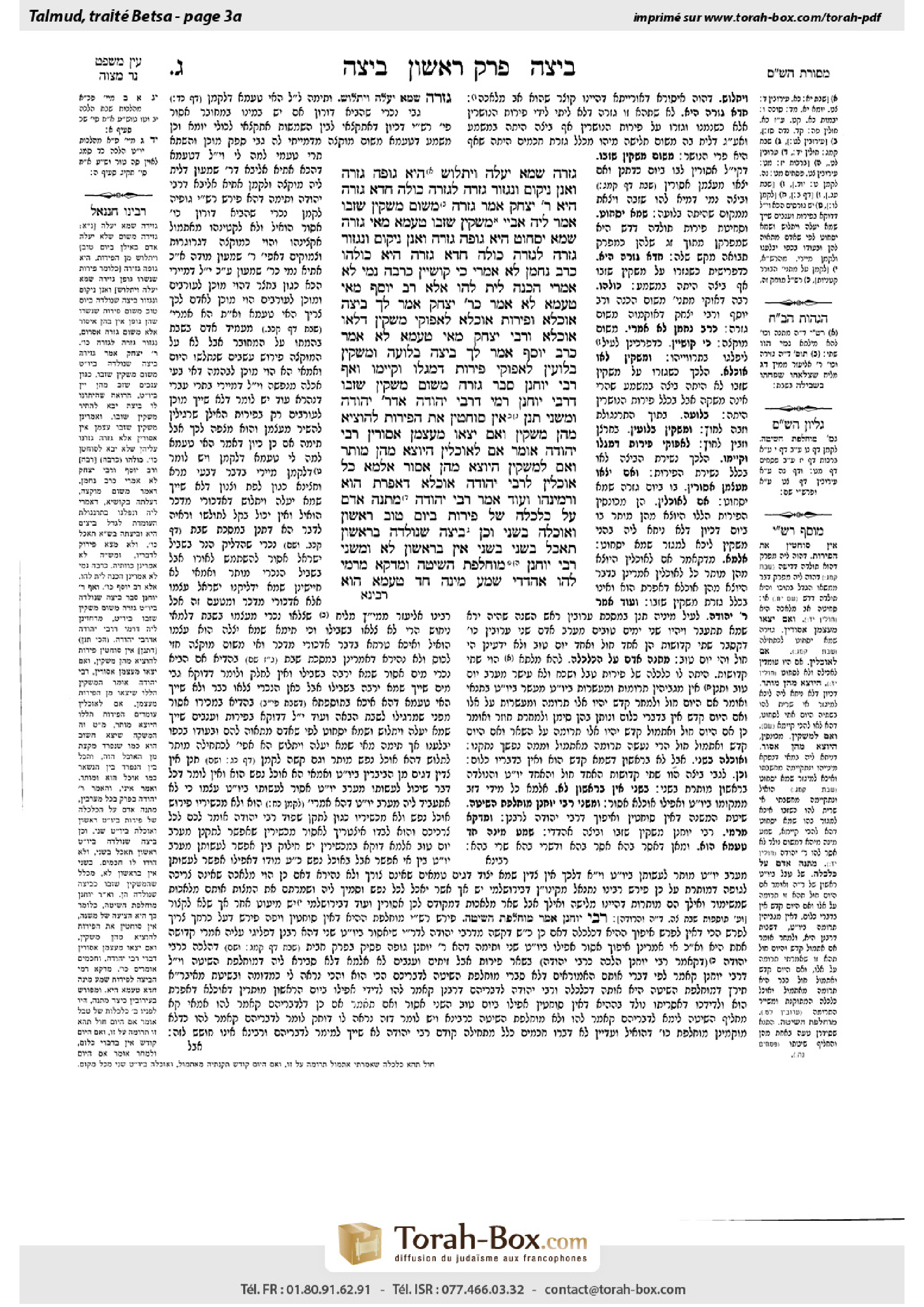
Beitzah 3a: Talmud study for Daf Yomi
Study the Talmud for Daf Yomi with scanned pages, Hebrew text, English translations from Sefaria and AI-generated French translations.
Passage selection and English or AI-generated French translation are available where the scan has annotations. Daf Study is independent of Torah-Box and Sefaria.
Browse Beitzah · ביצה · All tractatesBeitzah 3a text and translations
This page of Beitzah includes the Aramaic text, an English translation and an AI-generated French translation, alongside the scan above.
ביצה ג׳ א · Aramaic and Hebrew text
גְּזֵרָה שֶׁמָּא יַעֲלֶה וְיִתְלוֹשׁ. הִיא גּוּפַהּ גְּזֵרָה, וַאֲנַן נֵיקוּם וְנִגְזוֹר גְּזֵרָה לִגְזֵרָה? כּוּלָּהּ חֲדָא גְּזֵרָה הִיא.
רַבִּי יִצְחָק אָמַר: גְּזֵרָה מִשּׁוּם מַשְׁקִין שֶׁזָּבוּ.
אֲמַר לֵיהּ אַבָּיֵי: מַשְׁקִין שֶׁזָּבוּ טַעְמָא מַאי — גְּזֵרָה שֶׁמָּא יִסְחוֹט, הִיא גּוּפַהּ גְּזֵרָה, וַאֲנַן נֵיקוּם וְנִגְזוֹר גְּזֵרָה לִגְזֵרָה? כּוּלַּהּ חֲדָא גְּזֵרָה הִיא.
כּוּלְּהוּ כְּרַב נַחְמָן לָא אָמְרִי — כִּי קוּשְׁיַין. כְּרַבָּה נָמֵי לָא אָמְרִי — הֲכָנָה לֵית לְהוּ.
אֶלָּא רַב יוֹסֵף מַאי טַעְמָא לָא אָמַר כְּרַבִּי יִצְחָק? אָמַר לָךְ: בֵּיצָה אוּכְלָא, וּפֵירוֹת אוּכְלָא. לְאַפּוֹקֵי מַשְׁקִין — דְּלָאו אוּכְלָא.
וְרַבִּי יִצְחָק מַאי טַעְמָא לָא אָמַר כְּרַב יוֹסֵף? אָמַר לָךְ: בֵּיצָה בְּלוּעָה, וּמַשְׁקִין בְּלוּעִין. לְאַפּוֹקֵי פֵּירוֹת — דְּמִגַּלּוּ וְקָיְימוּ.
וְאַף רַבִּי יוֹחָנָן סָבַר גְּזֵרָה מִשּׁוּם מַשְׁקִין שֶׁזָּבוּ. דְּרַבִּי יוֹחָנָן רָמֵי דְּרַבִּי יְהוּדָה אַדְּרַבִּי יְהוּדָה, וּמְשַׁנֵּי.
תְּנַן: אֵין סוֹחֲטִין אֶת הַפֵּירוֹת לְהוֹצִיא מֵהֶן מַשְׁקִין, וְאִם יָצְאוּ מֵעַצְמָן — אֲסוּרִין. רַבִּי יְהוּדָה אוֹמֵר: אִם לָאוֹכָלִין — הַיּוֹצֵא מֵהֶן מוּתָּר, וְאִם לְמַשְׁקִין — הַיּוֹצֵא מֵהֶן אָסוּר.
אַלְמָא כָּל אוֹכָלִין לְרַבִּי יְהוּדָה — אוּכְלָא דְאִפְּרַת הוּא.
וּרְמִינְהוּ, וְעוֹד אָמַר רַבִּי יְהוּדָה: מַתְנֶה אָדָם עַל כַּלְכָּלָה שֶׁל פֵּירוֹת בְּיוֹם טוֹב רִאשׁוֹן,
וְאוֹכְלָהּ בַּשֵּׁנִי. וְכֵן בֵּיצָה שֶׁנּוֹלְדָה בָּרִאשׁוֹן, תֵּאָכֵל בַּשֵּׁנִי.
בַּשֵּׁנִי אִין, בָּרִאשׁוֹן לָא! וּמְשַׁנֵּי רַבִּי יוֹחָנָן: מוּחְלֶפֶת הַשִּׁיטָה.
וּמִדְּקָא מַרְמֵי לְהוּ אַהֲדָדֵי, שְׁמַע מִינַּהּ חַד טַעְמָא הוּא.
Beitzah 3a · English translation
It is a decree lest one climb the tree and pick the fruit, as this would constitute the prohibited labor of harvesting. If so, the prohibition against eating fruit is itself due to a decree. And will we arise and issue a decree to prevent violation of another decree? Rav Yosef responded: That is not so; rather, when the Sages issued the initial decree, they enacted the prohibitions against both fruit that fall and a laid egg, as all the prohibitions are components of one decree. In other words, the similar cases of the fruit and the egg were both included in the original decree.
Rabbi Yitzḥak said a different reason: An egg that was laid on a Festival is prohibited as a decree due to liquids that seeped from the fruit (Eiruvin 39b), which is prohibited on that day. The legal status of an egg that was laid on a Festival is like that of liquids that seeped from a fruit on a Festival.
Abaye said to him: With regard to liquid that seeped from fruit, what is the reason that the Sages prohibited it? It is a decree lest one purposely squeeze the fruit, and thereby perform the prohibited labor of threshing. However, the prohibition against consuming this juice is itself a rabbinic decree. And will we arise and issue a decree to prevent violation of another decree? Rabbi Yitzḥak replied: All the prohibitions are components of one decree. When the Sages prohibited this juice, they banned the eating of an egg laid on a Festival for the same reason, as the actions are similar.
As various explanations have been offered for this mishna, the Gemara seeks to clarify why each Sage was dissatisfied with the other explanations and suggested an alternative. The Gemara says: All of them, Rabba, Rav Yosef, and Rabbi Yitzḥak, did not state their explanations in accordance with the opinion of Rav Naḥman, as stated in our previously stated objection to Rav Naḥman’s explanation. The other Sages also did not state their explanations in accordance with the opinion of Rabba, as they do not accept that there is a Torah prohibition of using items whose preparation was from Shabbat to a Festival or from a Festival to Shabbat.
However, the following question arises: Since Rav Yosef provides an explanation that is similar to that of Rabbi Yitzḥak, what is the reason that he did not state his explanation in accordance with the opinion of Rabbi Yitzḥak? The Gemara answers that Rav Yosef could have said to you: An egg is food, and fruit is food, i.e., an egg is comparable to fruits that fall. This observation would serve to exclude juice, which is not food but drink. Consequently, an egg is not comparable to juice and would not be included in the same decree.
The Gemara asks the reverse question: And with regard to Rabbi Yitzḥak, what is the reason that he did not state his explanation in accordance with the opinion of Rav Yosef? The Gemara answers: He could have said to you that the case of an egg is more similar to juices that seep from fruit. How so? An egg is enclosed inside a chicken before it is laid, and likewise juice is enclosed inside the fruit. This observation serves to exclude fruits that fall from a tree, which are standing exposed on the tree. Therefore, the comparison between fruits that fall and an egg is weaker than the comparison between liquid that seeped from fruit and an egg.
§ The Gemara notes: And Rabbi Yoḥanan also holds that the prohibition against eating an egg laid on a Festival is a decree due to liquid that seeped from fruit. What proof can be cited for this? It is proven as Rabbi Yoḥanan raised a contradiction between one statement of Rabbi Yehuda and a different statement of Rabbi Yehuda, and he resolved the apparent contradiction in a manner that indicates his own opinion.
The Gemara elaborates on the previous statement. We learned in a mishna (Shabbat 143b): One may not squeeze fruits to extract liquids from them on Shabbat, and if the liquids seeped out on their own, it is prohibited to use them on Shabbat, lest he come to squeeze fruits intentionally. Rabbi Yehuda says: If the fruit is designated for eating, e.g., apples, the liquid that seeps from them is permitted. Since there is no concern that one might squeeze the fruit, there is no reason to prohibit its liquid. And if the fruit was originally designated for liquids, such as grapes for wine, there are grounds for concern that one might squeeze them, and therefore the liquid that seeps from them is prohibited.
From the fact that Rabbi Yehuda said that liquid from fruit intended for eating is permitted, one can infer that, apparently, all food that comes out of another food is classified as food that was separated, according to the opinion of Rabbi Yehuda. Food that was separated is not considered a new food, but part of the food that previously existed.
And the Gemara raises a contradiction against this from a different source: And Rabbi Yehuda said further, concerning untithed fruit, which may not be rendered fit to be eaten on a Festival by separating teruma and tithes from it (Eiruvin 39a): A person may stipulate a condition with regard to a basket of untithed fruit on the first day of a Festival, and say: If today is the true Festival day, the second Festival day is actually a weekday. Therefore, this fruit is permitted, once I separate tithes from it, as on any other weekday. And vice versa: If today is, in fact, a weekday, and tomorrow is the Festival, I hereby separate its tithes today.
Likewise, on the following day, he should again stipulate: If today is a weekday and yesterday was holy, I hereby separate tithes from the fruit now; if today is holy and yesterday was a weekday, separating the tithes yesterday was sufficient. And he may then eat the produce on the second Festival day, as in either case no prohibition is involved. And similarly, an egg laid on the first Festival day may be eaten on the second day, regardless of which day is the actual Festival.
Rabbi Yehuda’s statement indicates that on the second day, yes, it is permitted to partake of the egg; but if the egg was laid on the first day, no, one may not eat it. If so, Rabbi Yehuda apparently contradicts himself, as he said previously that liquid from food prepared for eating has the same status as the food itself, and that its emergence is considered to be nothing more than the separation of two foods from each other. And Rabbi Yoḥanan resolves the difficulty: The attribution of the opinions with regard to the second day of the Festival is reversed (Berakhot 17b), so that Rabbi Yehuda’s opinion corresponds with his ruling above.
The significance of Rabbi Yoḥanan’s statement for the issue at hand is as follows: Since Rabbi Yoḥanan raised a contradiction between the cases of an egg and liquid that oozed, one may conclude from this that it is the same reason in both cases, i.e., an egg is prohibited on a Festival due to the rabbinic decree against liquid that oozed from fruit.
Beitzah 3a · Traduction française (IA)
C'est une déclaration afin que l'on ne monte pas dans l'arbre pour récolter les fruits, car cela constituerait le travail interdit de la récolte. Si c'est ainsi, l'interdiction de manger les fruits est elle-même due à une déclaration. Et pourrions-nous nous lever pour émettre une déclaration afin d'éviter la violation d'une autre déclaration ? Rav Yosef répondit : Ce n'est pas ainsi ; plutôt, lorsque les Sages ont émis la première déclaration, ils ont institué les interdits concernant à la fois les fruits tombés et un œuf pondu, car toutes les interdictions sont des composantes d'une seule déclaration. En d'autres termes, les cas similaires des fruits et de l'œuf ont tous deux été inclus dans la déclaration originale.
Rabbi Yitzḥak dit une autre raison : Un œuf pondu pendant un festival est interdit en vertu d'une déclaration due aux liquides qui s'échappent des fruits (Eiruvin 39b), qui sont interdits ce jour-là. Le statut juridique d'un œuf pondu pendant un festival est comparable à celui des liquides qui s'échappent d'un fruit pendant un festival.
Abaye dit à lui : Concernant le liquide qui s'échappe des fruits, quelle est la raison pour laquelle les Sages l'ont interdit ? C'est une déclaration afin que l'on ne presse pas délibérément les fruits, et ainsi accomplisse le travail interdit de la meunage. Cependant, l'interdiction de consommer ce jus est elle-même une déclaration rabbinique. Et pourrions-nous nous lever pour émettre une déclaration afin d'éviter la violation d'une autre déclaration ? Rabbi Yitzḥak répondit : Toutes les interdictions sont des composantes d'une seule déclaration. Lorsque les Sages ont interdit ce jus, ils ont banni la consommation d'un œuf pondu pendant un festival pour la même raison, car les actions sont similaires.
Comme diverses explications ont été offertes pour cette mitsva, la Guemara cherche à clarifier pourquoi chaque Sage était insatisfait des autres explications et a suggéré une alternative. La Guemara dit : Tous ceux-ci, Rabba, Rav Yosef et Rabbi Yitzḥak, n'ont pas formulé leurs explications conformément à l'opinion de Rav Naḥman, comme indiqué dans notre objection précédente à l'explication de Rav Naḥman. Les autres Sages n'ont pas non plus formulé leurs explications conformément à l'opinion de Rabba, car ils ne reconnaissent pas un interdit de la Torah concernant l'utilisation d'objets dont la préparation était faite du Shabbat à un festival ou d'un festival au Shabbat.
Cependant, la question suivante se pose : Puisque l'explication de Rav Yosef est similaire à celle de Rabbi Yitzḥak, quelle est la raison qu'il n'a pas formulé son explication conformément à l'opinion de Rabbi Yitzḥak ? La Guemara répond que Rav Yosef aurait pu dire à vous : Un œuf est de la nourriture, et un fruit est de la nourriture, c'est-à-dire qu'un œuf est comparable aux fruits qui tombent. Cette observation servirait à exclure le jus, qui n'est pas de la nourriture mais un breuvage. Ainsi, un œuf n'est pas comparable au jus et ne serait pas inclus dans la même déclaration.
La Guemara pose la question inverse : Et concernant Rabbi Yitzḥak, quelle est la raison qu'il n'a pas formulé son explication conformément à l'opinion de Rav Yosef ? La Guemara répond : Il aurait pu dire à vous que le cas de l'œuf est plus comparable aux liquides qui s'échappent des fruits. Comment cela ? Un œuf est enfermé dans un poulet avant d'être pondu, de même que le jus est enfermé dans le fruit. Cette observation sert à exclure les fruits qui tombent d'un arbre, qui sont exposés sur l'arbre. Ainsi, la comparaison entre les fruits tombés et l'œuf est plus faible que celle entre le liquide qui s'échappe des fruits et l'œuf.
§ La Guemara note que Rabbi Yoḥanan considère également que l'interdiction de manger un œuf pondu pendant un festival est due à un décret lié à un liquide qui s'échappe des fruits. Quelle preuve peut être citée pour cela ? C'est prouvé par le fait que Rabbi Yoḥanan a soulevé une contradiction entre une déclaration de Rabbi Yehuda et une autre déclaration de Rabbi Yehuda, et il a résolu la contradiction apparemment existante d'une manière qui indique son propre avis.
La Guemara développe la déclaration précédente. Nous avons appris dans une mitsna (Shabbat 143b) : On ne peut pas presser les fruits pour en extraire des liquides le Shabbat, et si les liquides s'échappent d'eux-mêmes, il est interdit d'utiliser ces liquides le Shabbat, de peur qu'on vienne à presser délibérément les fruits. Rabbi Yehuda dit : Si le fruit est destiné à être mangé, par exemple des pommes, le liquide qui s'échappe d'eux est permis. Il n'y a pas de crainte que l'on presse le fruit, donc il n'y a pas de raison d'interdire ce liquide. Et si le fruit était initialement destiné aux liquides, comme les raisins pour le vin, il y a des raisons de crainte que l'on presse, et donc le liquide qui s'échappe d'eux est interdit.
Du fait que Rabbi Yehuda a dit que le liquide provenant d'un fruit destiné à être mangé est permis, on peut en déduire que, visiblement, selon l'opinion de Rabbi Yehuda, toute nourriture qui sort d'une autre nourriture est classée comme une nourriture séparée. La nourriture séparée n'est pas considérée comme une nourriture nouvelle, mais comme une partie de la nourriture qui existait précédemment.
Et la Guemara soulève une contradiction contre cela à partir d'une autre source : Rabbi Yehuda dit encore, concernant les fruits non titrés, qui ne peuvent pas être rendus comestibles pendant un festival en séparant la terouma et les titres de ceux-ci (Eiruvin 39a) : Une personne peut stipuler une condition concernant un panier de fruits non titrés le premier jour d'un festival, et dire : Si aujourd'hui est le jour véritable du festival, le deuxième jour du festival est en réalité un jour ordinaire. Ainsi, ce fruit est permis, une fois que j'ai séparé les titres de celui-ci, comme sur n'importe quel autre jour ordinaire. Et inversement : Si aujourd'hui est effectivement un jour ordinaire, et demain est le festival, je stipule ici la séparation des titres de ce fruit.
De même, le lendemain, il devrait à nouveau stipuler : Si aujourd'hui est un jour ordinaire et hier était saint, je stipule ici la séparation des titres du fruit ; si aujourd'hui est saint et hier était un jour ordinaire, la séparation des titres hier suffisait. Il peut alors manger les produits le deuxième jour du festival, car dans aucun cas il n'y a de prohibition. De même, un œuf pondu le premier jour du festival peut être mangé le deuxième jour, indépendamment de quel jour est effectivement le festival.
La déclaration du Rabbi Yéhuda indique que le deuxième jour, oui, il est permis de manger l'œuf ; mais si l'œuf a été pondu le premier jour, non, on ne peut pas le manger. Si c'est ainsi, le Rabbi Yéhuda semble se contredire, puisqu'il avait dit précédemment que le liquide issu d'aliments préparés à la consommation a le même statut que l'aliment lui-même, et que son émanation est considérée comme rien de plus que la séparation de deux aliments entre eux. Et le Rabbi Yoḥanan résout cette difficulté : L'attribution des opinions concernant le deuxième jour de la fête est inversée (Berakhot 17b), de sorte que l'opinion du Rabbi Yéhuda correspond à son jugement ci-dessus.
La signification de la déclaration du Rabbi Yoḥanan concernant la question en débat est la suivante : Puisque le Rabbi Yoḥanan a soulevé une contradiction entre le cas de l'œuf et le cas du liquide qui s'écoule, on peut en conclure que c'est la même raison qui s'applique dans les deux cas, c'est-à-dire que l'œuf est interdit pendant la fête en raison du décret rabbinique contre le liquide qui s'écoule des fruits.
Traduction française générée par IA à partir de l’édition anglaise de Sefaria. Vérifie toujours un passage avec le texte source.
Text from Sefaria: William Davidson Edition - Vocalized Aramaic (CC BY NC); William Davidson Edition - English (CC BY NC).