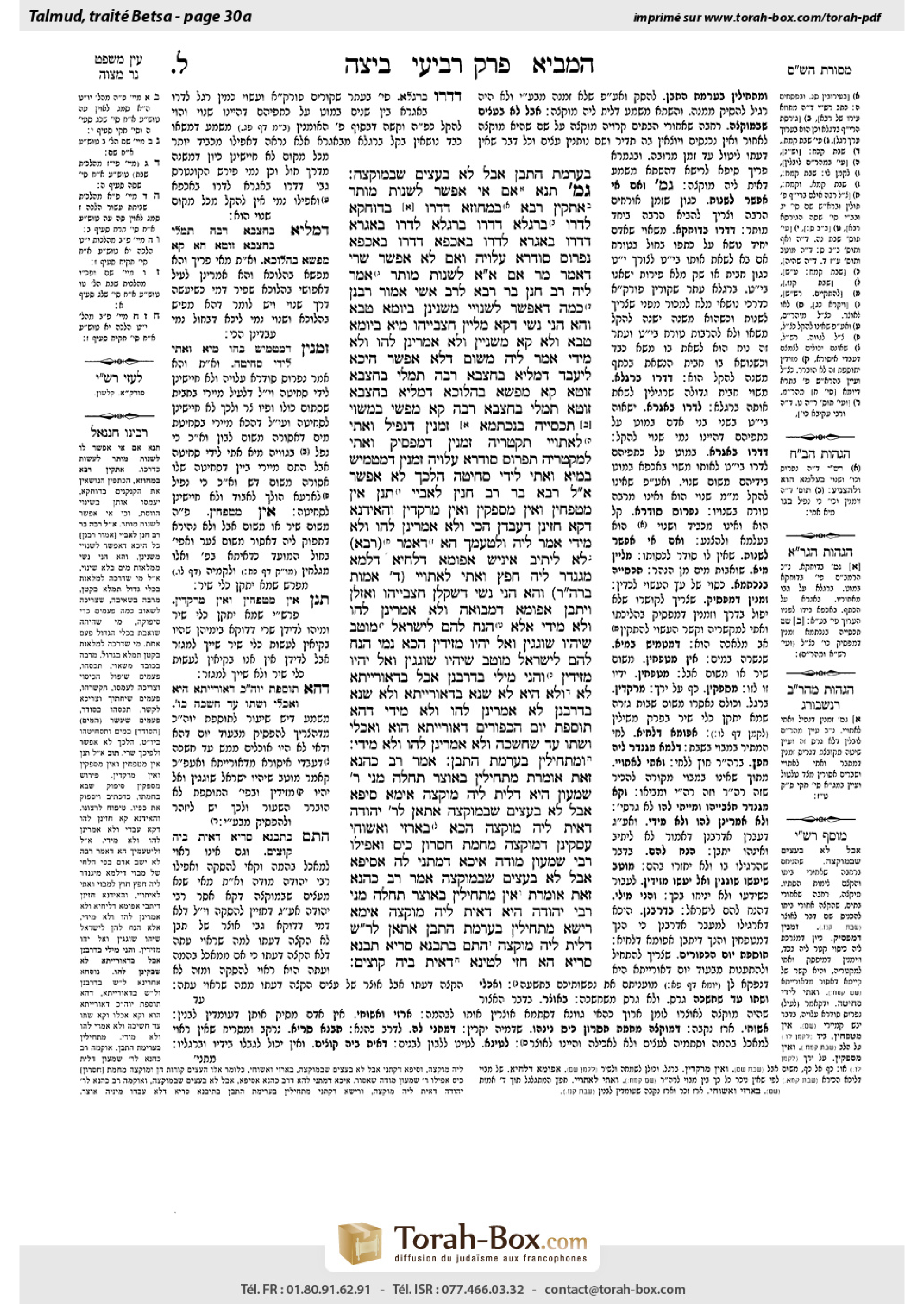
Beitzah 30a: Talmud study for Daf Yomi
Study the Talmud for Daf Yomi with scanned pages, Hebrew text, English translations from Sefaria and AI-generated French translations.
Passage selection and English or AI-generated French translation are available where the scan has annotations. Daf Study is independent of Torah-Box and Sefaria.
Browse Beitzah · ביצה · All tractatesBeitzah 30a text and translations
This page of Beitzah includes the Aramaic text, an English translation and an AI-generated French translation, alongside the scan above.
ביצה ל׳ א · Aramaic and Hebrew text
בַּעֲרֵמַת הַתֶּבֶן, אֲבָל לֹא בָּעֵצִים שֶׁבַּמּוּקְצֶה.
גְּמָ׳ תָּנָא: אִם אִי אֶפְשָׁר לְשַׁנּוֹת — מוּתָּר.
אַתְקִין רָבָא בְּמָחוֹזָא: דְּדָרוּ בְּדוּחְקָא — לִדְרוֹ בְּרִגְלָא. דְּדָרוּ בְּרִגְלָא — לִדְרוֹ בְּאַגְרָא. דְּדָרוּ בְּאַגְרָא — לִדְרוֹ בְּאַכְפָּא. דְּדָרוּ בְּאַכְפָּא — נִפְרוֹס סוּדָרָא עִלָּוֵיהּ, וְאִם לָא אֶפְשָׁר — שְׁרֵי. דְּאָמַר מָר: אִם אִי אֶפְשָׁר לְשַׁנּוֹת — מוּתָּר.
אֲמַר לֵיהּ רַב חָנָן בַּר רָבָא לְרַב אָשֵׁי: אֲמוּר רַבָּנַן כַּמָּה דְּאֶפְשָׁר לְשַׁנּוֹיֵי מְשַׁנֵּינַן בְּיוֹמָא טָבָא. וְהָא הָנֵי נְשֵׁי דְּקָא מָלְיָין חַצְבַיְיהוּ מַיָּא בְּיוֹמָא טָבָא, וְלָא קָא מְשַׁנְּיָין, וְלָא אָמְרִינַן לְהוּ וְלָא מִידֵּי!
אֲמַר לֵיהּ: מִשּׁוּם דְּלָא אֶפְשָׁר. הֵיכָא לֶיעְבַּד? דְּמָלְיָא בְּחַצְבָּא רַבָּה תִּמְלֵי בְּחַצְבָּא זוּטָא — קָא מַפְּשָׁא בְּהִלּוּכָא.
דְּמָלְיָא בְּחַצְבָּא זוּטָא תִּמְלֵי בְּחַצְבָּא רַבָּה — קָא מַפְּשָׁא בְּמַשּׂוֹי. תְּכַסְּיֵיהּ בְּנִכְתְּמָא — זִמְנִין דְּנָפֵיל וְאָתֵי לְאֵתוֹיֵי. תִּקְטְרֵיהּ — זִמְנִין דְּמִפְּסִיק וְאָתֵי לְמִקְטְרֵיהּ. תִּפְרוֹס סוּדָרָא עִלָּוֵיהּ — זִמְנִין דְּמִטְּמִישׁ בְּמַיָּא וְאָתֵי לִידֵי סְחִיטָה. הִלְכָּךְ לָא אֶפְשָׁר.
אֲמַר לֵיהּ רָבָא בַּר רַב חָנִין לְאַבָּיֵי, תְּנַן: אֵין מְטַפְּחִין וְאֵין מְסַפְּקִין וְאֵין מְרַקְּדִין, וְהָאִידָּנָא דְּקָא חָזֵינַן דְּעָבְדָן הָכִי, וְלָא אָמְרִינַן לְהוּ וְלָא מִידֵּי?
אֲמַר לֵיהּ: וּלְטַעְמָךְ הָא דְּאָמַר (רָבָא): לָא לֵיתֵיב אִינִישׁ אַפּוּמָּא דְלִחְיָא, דִּלְמָא מִגַּנְדַּר לֵיהּ חֵפֶץ וְאָתֵי לְאֵתוֹיֵי (אַרְבַּע אַמּוֹת בִּרְשׁוּת הָרַבִּים), וְהָא הָנֵי נְשֵׁי דְּשָׁקְלָן חַצְבַיְיהוּ, וְאָזְלָן וְיָתְבָן אַפּוּמָּא דִמְבוֹאָה, וְלָא אָמְרִינַן לְהוּ וְלָא מִידֵּי!
אֶלָּא: הַנַּח לָהֶם לְיִשְׂרָאֵל, מוּטָב שֶׁיִּהְיוּ שׁוֹגְגִין וְאַל יִהְיוּ מְזִידִין. הָכָא נָמֵי: הַנַּח לָהֶם לְיִשְׂרָאֵל, מוּטָב שֶׁיִּהְיוּ שׁוֹגְגִין וְאַל יִהְיוּ מְזִידִין.
וְהָנֵי מִילֵּי בִּדְרַבָּנַן, אֲבָל בִּדְאוֹרָיְיתָא — לָא. וְלָא הִיא, לָא שְׁנָא בִּדְאוֹרָיְיתָא וְלָא שְׁנָא בִּדְרַבָּנַן, לָא אָמְרִינַן לְהוּ וְלָא מִידֵּי, דְּהָא תּוֹסֶפֶת יוֹם הַכִּפּוּרִים דְּאוֹרָיְיתָא הוּא, וְאָכְלִי וְשָׁתוּ עַד שֶׁחָשְׁכָה, וְלָא אָמְרִינַן לְהוּ וְלָא מִידֵּי.
וּמַתְחִילִין בַּעֲרֵמַת הַתֶּבֶן. אָמַר רַב כָּהֲנָא: זֹאת אוֹמֶרֶת, מַתְחִילִין בָּאוֹצָר תְּחִלָּה. מַנִּי — רַבִּי שִׁמְעוֹן הִיא, דְּלֵית לֵיהּ מוּקְצֶה.
אֵימָא סֵיפָא: אֲבָל לֹא בָּעֵצִים שֶׁבַּמּוּקְצֶה. אֲתָאן לְרַבִּי יְהוּדָה, דְּאִית לֵיהּ מוּקְצֶה! הָכָא בְּאַרְזֵי וְאַשּׁוּחֵי עָסְקִינַן, דְּמוּקְצֶה מֵחֲמַת חֶסְרוֹן כִּיס, וַאֲפִילּוּ רַבִּי שִׁמְעוֹן מוֹדֶה.
אִיכָּא דְּמַתְנֵי לַהּ אַסֵּיפָא: אֲבָל לֹא בָּעֵצִים שֶׁבַּמּוּקְצֶה. אָמַר רַב כָּהֲנָא: זֹאת אוֹמֶרֶת, אֵין מַתְחִילִין בָּאוֹצָר תְּחִלָּה. מַנִּי — רַבִּי יְהוּדָה הִיא, דְּאִית לֵיהּ מוּקְצֶה. אֵימָא רֵישָׁא: מַתְחִילִין בַּעֲרֵמַת הַתֶּבֶן, אֲתָאן לְרַבִּי שִׁמְעוֹן דְּלֵית לֵיהּ מוּקְצֶה! הָתָם בְּתִבְנָא סַרְיָא.
תִּבְנָא סַרְיָא, הָא חֲזֵי לְטִינָא! דְּאִית בֵּיהּ קוֹצִים.
Beitzah 30a · English translation
from the pile of straw, although he did not designate the pile for this purpose the day before; but one may not begin to take from the wood in the wood storage, a small yard behind the house where people store various items that they do not intend to use in the near future.
GEMARA: A tanna taught in a baraita: If it is impossible to modify the manner in which one carries a vessel, whether due to the vessel or due to time constraints, it is permitted to act in the typical weekday manner.
The Gemara relates that Rava instituted the following in his city, Meḥoza: One who usually carries his burden with difficulty on a weekday should modify his habit on a Festival and carry it on a pitchfork. One who usually carries it on a pitchfork should carry it on a carrying pole held by two people on their shoulders. One who carries it on a carrying pole held by two people on their shoulders should carry it on a carrying pole in his hands, although he is not thereby making it easier for himself. One who carries burdens on a carrying pole in his hands should spread a scarf [sudara] over it. And if it is not possible to make these modifications due to time constraints, it is permitted to proceed in the usual manner, as the Master said above: If it is impossible to modify, it is permitted.
Rav Ḥanan bar Rava said to Rav Ashi: The Sages said: As much as it is possible to modify the weekday manner, one should modify on a Festival. A question was asked of Rav Ashi: But don’t those women fill their jugs with water on a Festival without modifying, and we say nothing to them by way of protest; why do we not instruct them to alter their usual manner?
He said to him: It is because it is not possible for them to fill their jugs any other way. How should they act? She who is accustomed to filling a large jug, should she instead fill a small jug? Won’t this mean that she increases her walking, since she has to make more than one trip to bring home more than one jug, and she will thereby perform unnecessary labor on the Festival?
If one were to suggest the opposite, that one who fills a small jug should fill a large jug, won’t this mean that she increases her load? Furthermore, if one were to suggest that she should cover the jug with a wooden cover, sometimes it falls and she might come to bring it by hand, in the manner of a burden. Should she tie the cover to the jug, the rope might occasionally break, and she might come to tie it, a prohibited labor. Finally, should she spread a scarf over it, it occasionally falls off and becomes soaked in water, and she might come to transgress the prohibition against squeezing. Therefore, it is not possible to make a modification, and those women may act in the regular manner.
Rava bar Rav Ḥanin said to Abaye: We learned in a mishna: The Rabbis decreed that one may not clap, nor strike a hand on his thigh, nor dance on a Festival, lest he come to repair musical instruments. But nowadays we see that women do so, and yet we do not say anything to them.
He said to him: And according to your reasoning, how do you explain that which Rava said: A person should not sit at the entrance to an alleyway, next to the side post that has been placed at the edge of an alleyway in order for it to be considered a private domain, as perhaps an object will roll away from him and he will come to carry it four cubits in the public domain, thereby transgressing a biblical prohibition? But don’t these women take their jugs, and go, and sit at the entrance to an alleyway, and we do not say anything to them?
Rather, the accepted principle is: Leave the Jews alone; it is better that they be unwitting sinners and not be intentional sinners. If people engage in a certain behavior that cannot be corrected, it is better not to reprove them, as they are likely to continue regardless of the reproof, and then they will be sinning intentionally. It is therefore preferable for them to be unaware that they are violating a prohibition and remain merely unwitting sinners. Here, too, with regard to clapping and dancing, leave the Jews alone; it is better that they be unwitting sinners and not be intentional sinners.
The Gemara comments: There were those who understood that this principle applies only to rabbinic prohibitions but not to Torah prohibitions, with regard to which the transgressors must be reprimanded. However, this is not so; it is no different whether the prohibition is by Torah law or whether it is by rabbinic law, we do not say anything to them. For example, on the eve of Yom Kippur, there is an obligation that one begin the fast while it is still day, before sunset, as the extension of Yom Kippur. During this time, one must observe all the halakhot. This mitzva of extending Yom Kippur is by Torah law, and yet people eat and drink until darkness falls but we do not say anything to them, as we know they will pay no attention.
It is taught in the mishna: And one may begin taking straw from the pile of straw. Rav Kahana said: That is to say that one may begin removing items from a storeroom on a Festival ab initio. Although the items in this storeroom are designated for other purposes, it is not assumed that one put them out of his mind. If so, in accordance with whose opinion is this mishna? It is in accordance with the opinion of Rabbi Shimon, who is not of the opinion that there is a prohibition of set-aside [muktze]. According to him, on Shabbat and Festivals it is not prohibited to handle items that one has removed from his mind.
The Gemara challenges: Say the latter clause of the same mishna as follows: But not wood in the wood storage. If so, we have come to the opinion of Rabbi Yehuda, who is of the opinion that there is a prohibition of muktze. The Gemara answers: Here, we are dealing with wood of cedars and firs, which are expensive and used only in the construction of important buildings, not for kindling; the wood storage is therefore considered muktze due to potential monetary loss. With regard to an item that one removes from his mind due to the financial loss he might suffer were he to use it, but not due to any prohibition involved, even Rabbi Shimon concedes that it may not be handled due to the prohibition of muktze.
There are those who taught the statement of Rav Kahana as referring to the latter clause of the mishna, as follows: But not wood from the wood storage area. Rav Kahana said: That is to say that one may not begin removing items from a storeroom ab initio. If so, in accordance with whose opinion is the mishna? It is in accordance with the opinion of Rabbi Yehuda, who maintains that there is a prohibition of muktze. The Gemara challenges: Say the first clause of the mishna, which states that one may begin taking from the pile of straw. If so, we have come to the opinion of Rabbi Shimon, who is not of the opinion that there is a prohibition of muktze. The Gemara answers: There, in the first clause of the mishna, it is dealing with straw that has rotted and become rancid. Since it is no longer fit as animal fodder, even Rabbi Yehuda concedes that it will be used for kindling and is not muktze.
The Gemara asks: Isn’t rancid straw fit for clay in the making of bricks; why can one assume that it will be used as fuel? The Gemara answers: The mishna is referring to straw that has thorns, which cannot be kneaded into clay. It will certainly be used only for kindling.
Beitzah 30a · Traduction française (IA)
On peut prendre de la paille du tas de paille, même s'il n'avait pas désigné ce tas à cette fin la veille ; mais on ne peut pas commencer à prendre du bois dans le magasin de bois, un petit jardin derrière la maison où les gens stockent divers objets qu'ils n'ont pas l'intention d'utiliser dans les prochaines semaines.
GUEMARA : Un tanna a enseigné dans une baraïta : Si c'est impossible de modifier la manière dont on transporte un objet, que ce soit en raison de l'objet lui-même ou en raison de contraintes temporelles, il est permis d'agir selon la manière habituelle d'un jour de semaine.
La Guemara rapporte que Rava a institué dans sa ville, Meḥoza, la suivante : Celui qui transporte généralement son fardeau avec difficulté un jour de semaine devrait le modifier le jour de fête et le transporter sur une poutre. Celui qui transporte généralement son fardeau sur une poutre devrait le transporter sur une poutre portée par deux personnes sur leurs épaules. Celui qui transporte généralement son fardeau sur une poutre portée par deux personnes sur leurs épaules devrait le transporter sur une poutre qu'il tient lui-même, même s'il ne rend ainsi pas le transport plus facile. Celui qui transporte des fardeaux sur une poutre qu'il tient lui-même devrait étendre un foulard [sudara] sur celui-ci. Et si ces modifications ne peuvent pas être effectuées en raison de contraintes temporelles, il est permis d'agir selon la manière habituelle, comme le Maître a dit plus haut : Si c'est impossible de modifier, il est permis.
Rav Ḥanan bar Rava a dit à Rav Ashi : Les Sages ont dit : Comme il est possible de modifier la manière habituelle d'un jour de semaine, on devrait le modifier le jour de fête. Une question a été posée à Rav Ashi : Mais ne sont-ce pas ces femmes qui remplissent leurs seaux d'eau le jour de fête sans modifier leur manière, et nous ne disons rien contre elles ; pourquoi ne les instruisons-nous pas de modifier leur manière habituelle ?
Il lui a répondu : C'est parce qu'il n'est pas possible pour elles de remplir leurs seaux d'une autre manière. Comment devraient-elles agir ? Celles qui sont habituées à remplir un grand seau devraient-elles remplir un petit seau ? Ne serait-ce pas cela qui augmenterait leur marche, car elles devraient faire plus d'un trajet pour ramener plus d'un seau, et elles effectueraient ainsi un travail inutile le jour de fête ?
Si l'on suggérait l'inverse, à savoir que celui qui remplit un petit seau devrait remplir un grand seau, ne serait-ce pas cela qui augmenterait sa charge ? De plus, si l'on suggérait qu'elle devrait couvrir le seau avec un couvercle en bois, parfois il tombe et elle pourrait le ramener à la main, comme une charge. Si elle attache le couvercle au seau, la corde pourrait parfois se rompre, et elle pourrait être contrainte de le faire, un travail interdit. Enfin, si l'on suggérait qu'elle étende un foulard sur celui-ci, il pourrait tomber et s'humidifier, et elle pourrait être contrainte de le presser, en transgressant ainsi l'interdiction de presser. Par conséquent, il n'est pas possible de modifier, et ces femmes peuvent agir selon leur manière habituelle.
Rava bar Rav Ḥanin a dit à Abaye : Nous avons appris dans une michna : Les Rabbins ont décrété qu'on ne doit pas claquer des mains, ni frapper son cuisse, ni danser le jour de fête, de peur qu'on vienne à réparer des instruments de musique. Mais aujourd'hui, nous voyons que les femmes le font, et pourtant nous ne disons rien contre elles.
Il lui a répondu : Et selon votre raisonnement, comment expliquez-vous ce que Rava a dit : Une personne ne doit pas s'asseoir à l'entrée d'un passage, à côté du poteau placé à l'extrémité d'un passage afin qu'il soit considéré comme un domaine privé, de peur qu'un objet ne glisse de ses mains et qu'il vienne à le transporter quatre cubits dans le domaine public, en transgressant ainsi une interdiction biblique ? Mais ne prennent pas ces femmes leurs seaux, et vont, et s'assoient à l'entrée d'un passage, et nous ne disons rien contre elles ?
Plutôt, le principe accepté est : Laissez les Juifs tranquilles ; il est préférable qu'ils soient des pécheurs inconscients plutôt que des pécheurs intentionnels. Si les gens s'engagent dans un comportement qui ne peut être corrigé, il est préférable de ne pas les réprimander, car ils continueront de toute façon, et alors ils commettront des péchés intentionnels. Il est donc préférable qu'ils soient inconscients de leur transgression et restent simplement des pécheurs inconscients. Ici aussi, concernant le claquement et la danse, laissez les Juifs tranquilles ; il est préférable qu'ils soient des pécheurs inconscients plutôt que des pécheurs intentionnels.
La Guemara commente : Il y avait ceux qui pensaient que ce principe s'applique uniquement aux prohibitions rabbiniques mais pas aux prohibitions de la Torah, concernant lesquelles les transgressants doivent être réprimandés. Cependant, cela n'est pas vrai ; il n'y a pas de différence que la prohibition soit de la Torah ou de la loi rabbinique, nous ne disons rien à leur sujet. Par exemple, la veille de Yom Kippur, il y a une obligation de commencer le jeûne pendant la journée, avant le coucher du soleil, comme l'extension de Yom Kippur. Pendant cette période, on doit observer toutes les halakhot. Cette mitsva d'extension de Yom Kippur est de la Torah, et pourtant les gens mangent et boivent jusqu'au noir, mais nous ne disons rien à leur sujet, car nous savons qu'ils n'écouteront pas.
Il est enseigné dans la mishna : Et on peut commencer à prendre de la paille du tas de paille. Rav Kahana a dit : Cela signifie que l'on peut commencer à retirer des objets d'une pièce de stockage le jour de fête dès le début. Bien que ces objets soient destinés à d'autres usages, on ne suppose pas qu'ils aient été mis de côté. Si tel est le cas, selon quel avis est-ce que cette mishna ? C'est selon l'avis de Rabbi Shimon, qui n'est pas de l'avis qu'il y a une prohibition de muktze. Selon lui, le sabbat et les fêtes ne prohibent pas de manipuler des objets que l'on a oublié.
La Guemara pose un défi : Dites la seconde partie de la même mitsna ainsi : mais pas du bois du lieu de stockage. Si c'est ainsi, nous sommes tombés dans l'opinion de Rabbi Yéhuda, qui considère qu'il y a une interdiction de muktze. La Guemara répond : ici, il s'agit de bois de cèdre et de pin, qui sont coûteux et utilisés uniquement dans la construction d'immeubles importants, pas pour allumer un feu ; le lieu de stockage du bois est donc considéré comme muktze en raison du risque de perte financière. En ce qui concerne un objet que l'on retire de son esprit en raison de la perte financière qu'il pourrait subir s'il le utilisait, mais pas en raison d'une interdiction, même Rabbi Shimon reconnaît qu'il ne peut pas être manipulé en raison de l'interdiction de muktze.
Certains ont enseigné que la déclaration de Rav Kahana faisait référence à la seconde partie de la mitsna, ainsi : mais pas du bois du lieu de stockage. Rav Kahana a dit : cela signifie que l'on ne peut pas commencer à retirer des objets d'une pièce de stockage dès le début. Si c'est ainsi, selon quelle opinion est la mitsna ? C'est selon l'opinion de Rabbi Yéhuda, qui maintient qu'il y a une interdiction de muktze. La Guemara pose un défi : Dites la première partie de la mitsna, qui stipule qu'on peut commencer à prendre du foin. Si c'est ainsi, nous sommes tombés dans l'opinion de Rabbi Shimon, qui ne considère pas qu'il y a une interdiction de muktze. La Guemara répond : là, dans la première partie de la mitsna, il s'agit de foin pourri et rance. Puisque cela n'est plus adapté en nourriture pour les animaux, même Rabbi Yéhuda reconnaît qu'il sera utilisé pour allumer un feu et n'est pas muktze.
La Guemara pose une question : Ne peut-on pas utiliser ce foin rance pour la fabrication de la terre pour des briques ? Pourquoi suppose-t-on qu'il sera utilisé comme combustible ? La Guemara répond : la mitsna fait référence à du foin qui a des épines, qui ne peut pas être mélangé à la terre. Il sera certainement utilisé uniquement comme combustible.
Traduction française générée par IA à partir de l’édition anglaise de Sefaria. Vérifie toujours un passage avec le texte source.
Text from Sefaria: William Davidson Edition - Vocalized Aramaic (CC BY NC); William Davidson Edition - English (CC BY NC).