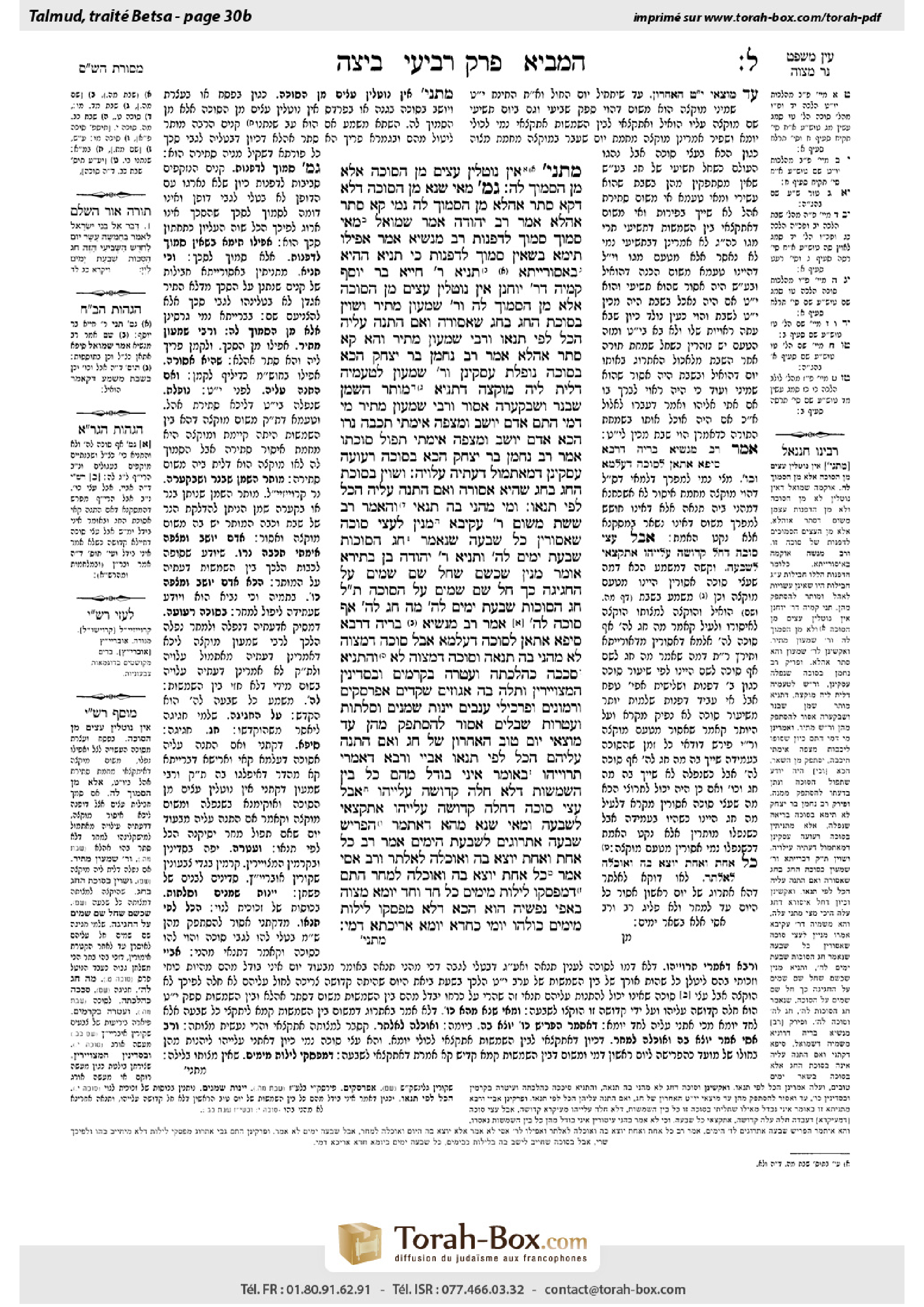
Beitzah 30b: Talmud study for Daf Yomi
Study the Talmud for Daf Yomi with scanned pages, Hebrew text, English translations from Sefaria and AI-generated French translations.
Passage selection and English or AI-generated French translation are available where the scan has annotations. Daf Study is independent of Torah-Box and Sefaria.
Browse Beitzah · ביצה · All tractatesBeitzah 30b text and translations
This page of Beitzah includes the Aramaic text, an English translation and an AI-generated French translation, alongside the scan above.
ביצה ל׳ ב · Aramaic and Hebrew text
מַתְנִי׳ אֵין נוֹטְלִין עֵצִים מִן הַסּוּכָּה, אֶלָּא מִן הַסָּמוּךְ לָהּ.
גְּמָ׳ מַאי שְׁנָא מִן הַסּוּכָּה דְּלָא — דְּקָא סָתַר אֻהְלָא, מִן הַסָּמוּךְ לָהּ נָמֵי — קָא סָתַר אֻהְלָא?
אָמַר רַב יְהוּדָה אָמַר שְׁמוּאֵל: מַאי סָמוּךְ — סָמוּךְ לַדְּפָנוֹת. רַב מְנַשְּׁיָא אָמַר: אֲפִילּוּ תֵּימָא בְּשֶׁאֵין סָמוּךְ לַדְּפָנוֹת, כִּי תַּנְיָא הָהִיא — בְּאִסּוּרְיָיתָא.
תַּנְיָא רַבִּי חִיָּיא בַּר יוֹסֵף קַמֵּיהּ דְּרַבִּי יוֹחָנָן: אֵין נוֹטְלִין עֵצִים מִן הַסּוּכָּה אֶלָּא מִן הַסָּמוּךְ לָהּ, וְרַבִּי שִׁמְעוֹן מַתִּיר. וְשָׁוִין בְּסוּכַּת הַחַג בֶּחָג — שֶׁאֲסוּרָה. וְאִם הִתְנָה עָלֶיהָ — הַכֹּל לְפִי תְנָאוֹ.
וְרַבִּי שִׁמְעוֹן מַתִּיר? וְהָא קָא סָתַר אֻהְלָא! אָמַר רַב נַחְמָן בַּר יִצְחָק: הָכָא בְּסוּכָּה נוֹפֶלֶת עָסְקִינַן, וְרַבִּי שִׁמְעוֹן לְטַעְמֵיהּ, דְּלֵית לֵיהּ מוּקְצֶה. דְּתַנְיָא: מוֹתַר הַשֶּׁמֶן שֶׁבַּנֵּר וְשֶׁבַּקְּעָרָה — אָסוּר. וְרַבִּי שִׁמְעוֹן מַתִּיר.
מִי דָּמֵי? הָתָם אָדָם יוֹשֵׁב וּמְצַפֶּה אֵימָתַי תִּכְבֶּה נֵרוֹ, הָכָא אָדָם יוֹשֵׁב וּמְצַפֶּה אֵימָתַי תִּפּוֹל סוּכָּתוֹ?
אָמַר רַב נַחְמָן בַּר יִצְחָק: הָכָא בְּסוּכָּה רְעוּעָה עָסְקִינַן, דְּמֵאֶתְמוֹל דַּעְתֵּיהּ עִלָּוַהּ.
וְשָׁוִין בְּסוּכַּת הֶחָג בֶּחָג שֶׁהִיא אֲסוּרָה, וְאִם הִתְנָה עָלֶיהָ — הַכֹּל לְפִי תְנָאוֹ. וּמִי מַהֲנֵי בַּהּ תְּנַאי?
וְהָאָמַר רַב שֵׁשֶׁת מִשּׁוּם רַבִּי עֲקִיבָא: מִנַּיִן לַעֲצֵי סוּכָּה שֶׁאֲסוּרִין כׇּל שִׁבְעָה — שֶׁנֶּאֱמַר: ״חַג הַסּוּכּוֹת שִׁבְעַת יָמִים לַה׳״, וְתַנְיָא, רַבִּי יְהוּדָה בֶּן בְּתִירָא אוֹמֵר: מִנַּיִן שֶׁכְּשֵׁם שֶׁחָל שֵׁם שָׁמַיִם עַל הַחֲגִיגָה, כָּךְ חָל שֵׁם שָׁמַיִם עַל הַסּוּכָּה — תַּלְמוּד לוֹמַר: ״חַג הַסּוּכּוֹת שִׁבְעַת יָמִים לַה׳״, מָה חַג לַה׳ — אַף סוּכָּה לַה׳.
אָמַר רַב מְנַשְּׁיָא בְּרֵיהּ דְּרָבָא: סֵיפָא אֲתָאן לְסוּכָּה דְעָלְמָא, אֲבָל סוּכָּה דְמִצְוָה — לָא מַהֲנֵי בַּהּ תְּנָאָה.
וְסוּכָּה דְּמִצְוָה לָא? וְהָתַנְיָא: סִכְּכָהּ כְּהִלְכָתָהּ וְעִטְּרָהּ בִּקְרָמִים וּבִסְדִינִין הַמְצוּיָּירִין, וְתָלָה בָּהּ אֱגוֹזִים שְׁקֵדִים אֲפַרְסְקִים וְרִמּוֹנִים וּפַרְכִּילֵי עֲנָבִים, יֵינוֹת שְׁמָנִים וּסְלָתוֹת וְעַטְרוֹת שִׁבֳּלִים — אָסוּר לְהִסְתַּפֵּק מֵהֶן עַד מוֹצָאֵי יוֹם טוֹב הָאַחֲרוֹן שֶׁל חַג. וְאִם הִתְנָה עֲלֵיהֶם — הַכֹּל לְפִי תְנָאוֹ.
אַבָּיֵי וְרָבָא דְּאָמְרִי תַּרְוַיְיהוּ: בְּאוֹמֵר אֵינִי בּוֹדֵל מֵהֶם כׇּל בֵּין הַשְּׁמָשׁוֹת, דְּלָא חָלָה קְדוּשָּׁה עֲלַיְיהוּ. אֲבָל עֲצֵי סוּכָּה, דְּחָלָה קְדוּשָּׁה עֲלַיְיהוּ — אִתַּקְצַאי לְשִׁבְעָה.
וּמַאי שְׁנָא מֵהָא דְּאִתְּמַר: הִפְרִישׁ שִׁבְעָה אֶתְרוֹגִים לְשִׁבְעַת הַיָּמִים, אָמַר רַב: כׇּל אַחַת וְאַחַת יוֹצֵא בָּהּ וְאוֹכְלָהּ לְאַלְתַּר. וְרַב אַסִּי אָמַר: כׇּל אַחַת יוֹצֵא בָּהּ וְאוֹכְלָהּ לְמָחָר!
הָתָם, דְּמַפְסְקוּ לֵילוֹת מִיָּמִים — כׇּל חַד וְחַד יוֹמָא מִצְוָה בְּאַפֵּי נַפְשֵׁיהּ הוּא. הָכָא, דְּלָא מַפְסְקוּ לֵילוֹת מִיָּמִים — כּוּלְּהוּ יוֹמֵי כַּחֲדָא יוֹמָא אֲרִיכְתָּא דָּמֵי.
Beitzah 30b · English translation
MISHNA: One may not take wood from a sukka on any Festival, not only on the festival of Sukkot, because this is considered dismantling, but one may take from near it.
GEMARA: The Gemara poses a question with regard to the mishna: In what way is this case different? Why did the mishna teach that from the sukka itself one may not remove wood? It is because one thereby dismantles a tent, which is a prohibited labor. But if so, if one takes wood from near it, too, doesn’t he thereby dismantle a tent? Why, then, does the mishna permit him to do so?
Rav Yehuda said that Shmuel said: What is the meaning of: Near it? It means near the walls. Wood placed near the walls may be removed because it is not part of the sukka itself; the walls themselves may not be removed. Rav Menashya said: Even if you say that it is referring to a case where the wood is not near the walls but is part of the roof of the sukka itself, when that baraita was taught, it was with regard to bundles of reeds that are not considered part of the roof of the sukka, as they have not been untied. Therefore, one may remove them.
Rabbi Ḥiyya bar Yosef taught the following baraita before Rabbi Yoḥanan: One may not take wood from the sukka itself but only from the nearby wood. And Rabbi Shimon permits one to take wood from the sukka as well. And all agree, even Rabbi Shimon, that with regard to the sukka that was built for the festival of Sukkot, during the Festival it is prohibited to remove wood from it. But if at the outset one stipulated a condition with regard to it allowing him to use it for other purposes, it is all according to his stipulation.
The Gemara questions this baraita: And does Rabbi Shimon permit one to take wood from the sukka itself? But isn’t one dismantling a tent, which is a prohibited labor? The Gemara answers that Rav Naḥman bar Yitzḥak said: Here, we are dealing with a sukka that has already collapsed. Therefore, the only potential concern is muktze, not dismantling. And Rabbi Shimon conforms to his standard line of reasoning, as he is not of the opinion that there is a prohibition of muktze, as it is taught in a baraita: If a wick in oil was lit before Shabbat, and it went out on Shabbat, the remainder of the oil in a lamp or in a bowl is prohibited for use, as it is muktze. And Rabbi Shimon permits one to use it. Consequently, Rabbi Shimon also permits one to take wood from the sukka.
The Gemara rejects this claim: Is it comparable? There, in the case of oil in a lamp, a person sits and anticipates when his lamp will be extinguished. It is clear to him that it will be extinguished, and he can safely assume that a certain amount of oil will remain in the lamp or the bowl. Here, however, can it be said that a person sits and anticipates when his sukka will fall? He cannot know ahead of time that his sukka will collapse.
Rav Naḥman bar Yitzḥak said: Here, we are dealing with a sukka that is not sturdy, as from yesterday, the Festival eve, one already had his mind on it. He thought it might collapse, and therefore he did not remove the possibility of using its wood from his mind.
§ The above baraita states: All agree with regard to the sukka that was built for the festival of Sukkot, that during the Festival it is prohibited to remove wood from it, but if one stipulated a condition with regard to it, it is all according to his condition. The Gemara asks: And is a condition effective with regard to it?
But didn’t Rav Sheshet say in the name of Rabbi Akiva: From where is it derived that the wood of a sukka is prohibited to be used for any other use all seven days of the Festival? It is as it is stated: “The festival of Sukkot to the Lord, seven days” (Leviticus 23:34). And it is taught in a different baraita in explanation of this that Rabbi Yehuda ben Beteira says: From where is it derived that just as the name of Heaven takes effect upon the Festival peace-offering, so too, does the name of Heaven take effect upon the sukka? The verse states: “The festival of Sukkot to the Lord, seven days” (Leviticus 23:34), from which it is learned: Just as the Festival offering is consecrated to the Lord, so too, the sukka is consecrated to the Lord. Since the wood of the sukka is compared to consecrated objects, how may one stipulate a condition with regard to it?
Rav Menashya, son of Rava, said: In the latter clause, where the stipulation is mentioned, we have arrived at the case of a regular sukka, a hut used throughout the year, not specifically for the Festival. With regard to such a sukka, one may stipulate to use the wood as he wishes; but as for a sukka of mitzva, used for the Festival, a condition is not effective with regard to it.
The Gemara asks a question from a different angle: And is a condition not effective for a sukka of mitzva? But isn’t it taught in the Tosefta: In the case of a sukka that one roofed in accordance with its halakha, and decorated it with embroidered clothes and with patterned sheets, and hung on it nuts, almonds, peaches, pomegranates, and vines [parkilei], of grapes and glass containers filled with wine, oil, and flour, and wreaths of ears of corn for decoration, it is prohibited to derive benefit from any of these until the conclusion of the last Festival day. But if one stipulated a condition with regard to them whereby he allows himself to use them, it is all according to his condition. This shows that conditions are effective even with regard to a sukka of mitzva.
The Gemara answers based on the opinion of Abaye and Rava, who both say that this is referring to a case where one says: I am not removing myself from them throughout twilight. In other words, he announces from the outset that he will not set them aside as sukka decorations, but rather he will use them for other purposes as well. In that case, no sanctity devolves upon them at all, and he may therefore use them throughout the Festival. However, as for the actual wood of a sukka, sanctity devolves upon it through the very construction of the sukka, and it has therefore been set aside from use for the entire seven days.
The Gemara asks: And in what way is it different from that which was stated with regard to a different halakha: In the case of one who separated seven etrogim for each of the seven Festival days, one for each day, Rav said: He fulfills his obligation through each and every one of them when he recites the blessing over the lulav and etrog, and if he so desires he may eat it immediately after the blessing. And Rav Asi said: He fulfills his obligation through each one, and he may eat it the following day, as it retains its sanctity for the duration of that entire day. In any case, all agree that the sanctity of each etrog does not extend to the following day. If so, why does the sanctity of the sukka extend through all seven days?
The Gemara answers: There is a difference between an etrog and a sukka. There, with regard to an etrog, the nights are divided from the days, as the mitzva of etrog applies only during the day and not at night. This means that each and every day is its own mitzva, and therefore an item that is sanctified for one day is not necessarily sanctified for the following day. However, here, with regard to a sukka, where the nights are not divided from the days, as the mitzva of sukka applies at night as well, all seven days are considered as one long day. Throughout the Festival, there is no moment during which the sanctity of sukka leaves the wood; it leaves only at the conclusion of the Festival.
Beitzah 30b · Traduction française (IA)
MICHNA: On ne peut pas prendre du bois d'une sukka pendant un festival, pas seulement pendant le festival de la Sukkot, car cela est considéré comme la démolition, mais on peut prendre du bois à proximité de celle-ci.
GUEMARA: La Guemara pose une question concernant la mishna : Dans quel sens cette situation est-elle différente ? Pourquoi la mishna enseigne-t-elle que l'on ne peut pas retirer du bois de la sukka elle-même ? C'est parce que cela constituerait la démolition d'un abri, un travail interdit. Mais si c'est ainsi, ne serait-ce pas également la démolition d'un abri si l'on prenait du bois à proximité ? Pourquoi, alors, la mishna permet-elle cela ?
Rav Yehuda a dit que Shmuel a dit : Qu'entend-on par « à proximité » ? Cela signifie à proximité des murs. Le bois placé à proximité des murs peut être retiré car il n'est pas partie de la sukka elle-même ; les murs eux-mêmes ne peuvent pas être retirés. Rav Menashya a dit : Même si vous dites qu'il s'agit d'un cas où le bois n'est pas à proximité des murs mais fait partie du toit de la sukka, lorsque ce baraïta a été enseigné, il était question de faisceaux de roseaux qui ne sont pas considérés comme faisant partie du toit de la sukka, car ils n'ont pas été dénoués. Par conséquent, on peut les retirer.
Rabbi Ḥiyya bar Yosef a enseigné la suivante baraïta devant Rabbi Yoḥanan : On ne peut pas prendre du bois de la sukka elle-même, mais seulement du bois à proximité. Et Rabbi Shimon permet à l'individu de prendre du bois de la sukka elle-même. Et tous s'accordent, même Rabbi Shimon, sur le fait que concernant la sukka construite pour le festival de Sukkot, pendant le festival, il est interdit de retirer du bois de celle-ci. Mais si, dès le début, on stipule une condition concernant celle-ci permettant son utilisation à d'autres fins, tout est selon sa stipulation.
La Guemara question cette baraïta : Et Rabbi Shimon permet-il à l'individu de prendre du bois de la sukka elle-même ? Mais n'est-ce pas la démolition d'un abri, un travail interdit ? La Guemara répond que Rav Naḥman bar Yitzḥak a dit : Ici, nous sommes en présence d'une sukka qui a déjà effondré. Par conséquent, la seule préoccupation est le muktze, pas la démolition. Et Rabbi Shimon suit sa ligne de raisonnement habituelle, car il ne considère pas que le muktze soit interdit, comme il est enseigné dans une baraïta : Si une mèche d'huile a été allumée avant le sabbat et s'est éteinte le sabbat, l'huile restante dans une lampe ou dans un bol est interdite d'utilisation, car elle est muktze. Et Rabbi Shimon permet d'en faire usage. Par conséquent, Rabbi Shimon permet également de prendre du bois de la sukka.
La Guemara rejette cette affirmation : Est-ce comparable ? Là, dans le cas d'huile dans une lampe, une personne s'assoit et attend que sa lampe s'éteigne. Il sait qu'elle s'éteindra et peut raisonnablement supposer que de l'huile restera dans la lampe ou le bol. Ici, cependant, peut-on dire qu'une personne s'assoit et attend que sa sukka s'effondre ? Il ne peut pas savoir à l'avance que sa sukka s'effondrera.
Rav Naḥman bar Yitzḥak a dit : Ici, nous sommes en présence d'une sukka instable, car depuis hier, la veille du festival, on avait déjà l'esprit sur elle. On pensait qu'elle pourrait s'effondrer, et par conséquent, on n'avait pas retiré de l'esprit l'idée d'utiliser son bois.
§ La baraïta mentionnée ci-dessus affirme : Tous s'accordent sur le fait que concernant la sukka construite pour le festival de Sukkot, pendant le festival, il est interdit de retirer du bois de celle-ci, mais si l'on stipule une condition concernant celle-ci, tout est selon sa condition. La Guemara pose une question : Et une condition est-elle efficace concernant celle-ci ?
Mais n'a-t-on pas dit que Rav Sheshet, en nom de Rabbi Akiva, a dit : D'où est tiré le fait que le bois de la sukka est interdit d'utilisation pour d'autres usages pendant les sept jours du festival ? C'est comme il est dit : « Le festival de Sukkot au Seigneur, sept jours » (Lévitique 23:34). Et il est enseigné dans une autre baraïta en explication de cela que Rabbi Yehuda ben Beteira dit : D'où est tiré le fait que justement comme le nom du Ciel s'applique à l'offrande de paix du festival, ainsi s'applique-t-il à la sukka ? La versette dit : « Le festival de Sukkot au Seigneur, sept jours » (Lévitique 23:34), d'où on tire : Justement comme l'offrande de paix est consacrée au Seigneur, ainsi la sukka est consacrée au Seigneur. Puisque le bois de la sukka est comparé aux objets consacrés, comment peut-on stipuler une condition concernant celui-ci ?
Rav Menashya, fils de Rava, a dit : Dans la clause ultérieure, où la stipulation est mentionnée, nous sommes arrivés au cas d'une sukka ordinaire, une hutte utilisée toute l'année, pas spécifiquement pour le festival. Concernant une telle sukka, on peut stipuler d'utiliser le bois comme on le souhaite ; mais concernant une sukka de mitsva, utilisée pour le festival, une condition n'est pas efficace concernant celle-ci.
La Guemara pose une question sous un autre angle : Et une condition n'est-elle pas efficace concernant une sukka de mitsva ? Mais n'est-il pas enseigné dans la Tosefta : Dans le cas d'une sukka dont on a recouvert le toit conformément à sa halakha, et décoré avec des vêtements brodés et des draps à motifs, et suspendu des noix, des amandes, des pêches, des grenades et des raisins [parkilei], des bocaux remplis de vin, d'huile et de farine, et des couronnes de blé pour la décoration, il est interdit d'en tirer un bénéfice jusqu'à la fin du dernier jour du festival. Mais si l'on stipule une condition concernant ceux-ci permettant leur utilisation, tout est selon sa condition. Cela montre que les conditions sont efficaces même concernant une sukka de mitsva.
Le Guemara répond selon l'opinion d'Abaye et de Rava, qui disent tous les deux que cela concerne un cas où l'on dit : Je ne me détourne pas d'eux tout au long du crépuscule. Autrement dit, il annonce dès le départ qu'il ne les écarte pas comme décorations de hutte, mais plutôt qu'il les utilisera à d'autres fins. Dans ce cas, aucune sanctité ne s'applique à eux du tout, et il peut donc les utiliser tout au long du festival. Cependant, concernant le bois même de la hutte, la sanctité s'applique à travers la construction de la hutte, et il a donc été écarté de l'usage pour les sept jours entiers.
Le Guemara demande : Et en quoi cela diffère-t-il de ce qui a été dit concernant une autre halakha : dans le cas d'une personne qui a séparé sept citrons pour chaque jour du festival, un pour chaque jour, Rav dit : Il rempli son obligation avec chacun d'eux lorsqu'il récite la bénédiction sur le lulav et le citron, et s'il le désire, il peut manger immédiatement après la bénédiction. Et Rav Asi dit : Il rempli son obligation avec chacun d'eux, et il peut manger le lendemain, car la sanctité persiste durant toute la journée. En tout cas, tous s'accordent sur le fait que la sanctité de chaque citron ne s'étend pas au lendemain. Si c'est ainsi, pourquoi la sanctité de la hutte s'étend-elle sur les sept jours entiers ?
Le Guemara répond : Il y a une différence entre un citron et une hutte. Là, concernant un citron, les nuits sont séparées des jours, car la mitsva de l'agout s'applique uniquement pendant la journée et non la nuit. Cela signifie que chaque jour est une mitsva à part, et donc un objet sanctifié pour un jour n'est pas nécessairement sanctifié pour le jour suivant. Cependant, ici, concernant une hutte, où les nuits ne sont pas séparées des jours, car la mitsva de hutte s'applique aussi la nuit, les sept jours sont considérés comme un seul jour prolongé. Pendant tout le festival, il n'y a aucun moment où la sanctité de la hutte quitte le bois ; elle quitte seulement à la fin du festival.
Traduction française générée par IA à partir de l’édition anglaise de Sefaria. Vérifie toujours un passage avec le texte source.
Text from Sefaria: William Davidson Edition - Vocalized Aramaic (CC BY NC); William Davidson Edition - English (CC BY NC).