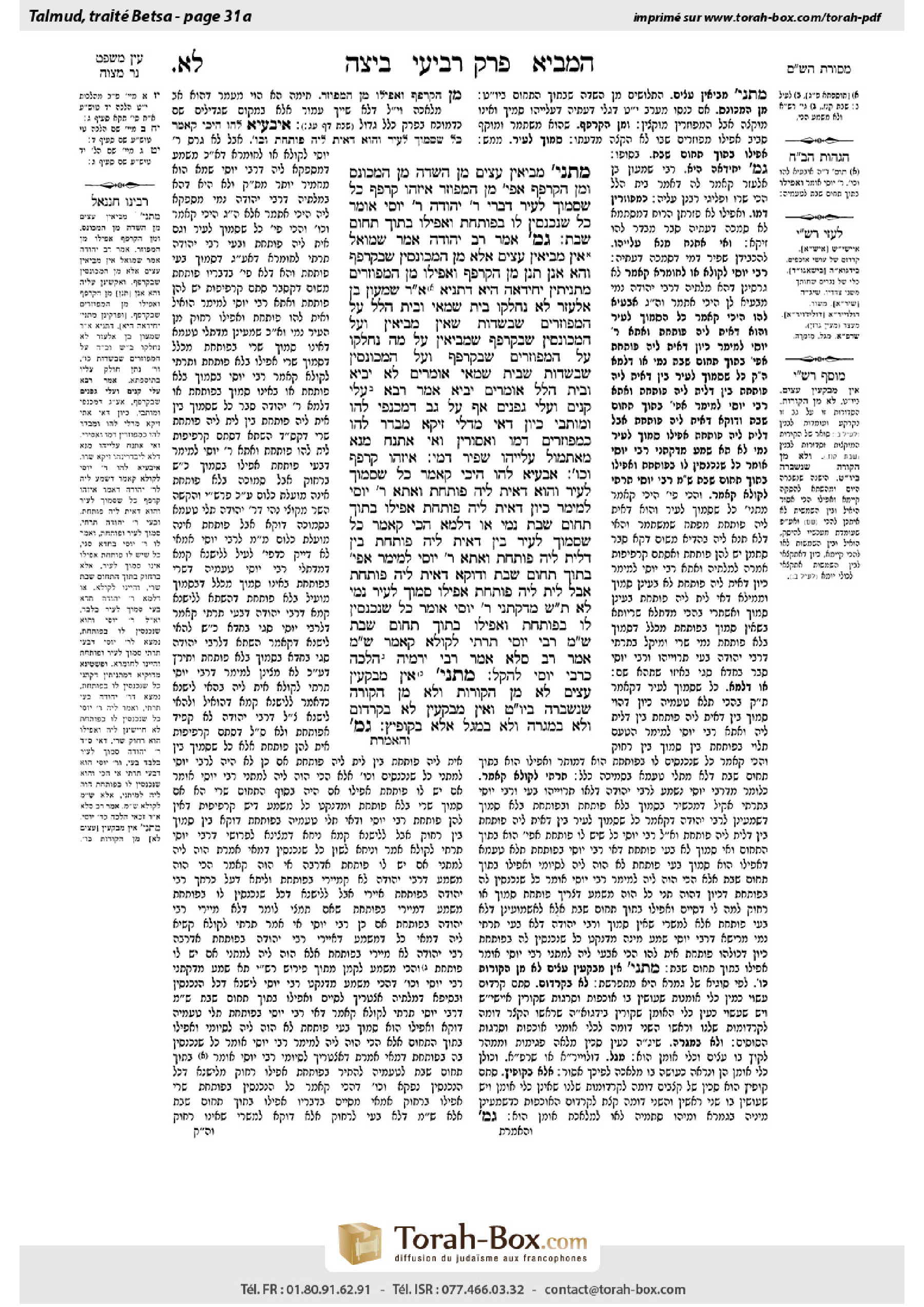
Beitzah 31a: Talmud study for Daf Yomi
Study the Talmud for Daf Yomi with scanned pages, Hebrew text, English translations from Sefaria and AI-generated French translations.
Passage selection and English or AI-generated French translation are available where the scan has annotations. Daf Study is independent of Torah-Box and Sefaria.
Browse Beitzah · ביצה · All tractatesBeitzah 31a text and translations
This page of Beitzah includes the Aramaic text, an English translation and an AI-generated French translation, alongside the scan above.
ביצה ל״א א · Aramaic and Hebrew text
מַתְנִי׳ מְבִיאִין עֵצִים מִן הַשָּׂדֶה — מִן הַמְכוּנָּס, וּמִן הַקַּרְפֵּף — אֲפִילּוּ מִן הַמְפוּזָּר. אֵיזֶהוּ קַרְפֵּף — כׇּל שֶׁסָּמוּךְ לְעִיר, דִּבְרֵי רַבִּי יְהוּדָה. רַבִּי יוֹסֵי אוֹמֵר: כׇּל שֶׁנִּכְנָסִין לוֹ בְּפוֹתַחַת, וַאֲפִילּוּ בְּתוֹךְ תְּחוּם שַׁבָּת.
גְּמָ׳ אָמַר רַב יְהוּדָה אָמַר שְׁמוּאֵל: אֵין מְבִיאִין עֵצִים אֶלָּא מִן הַמְכוּנָּסִין שֶׁבַּקַּרְפֵּף. וְהָא אֲנַן תְּנַן: מִן הַקַּרְפֵּף — וַאֲפִילּוּ מִן הַמְפוּזָּרִים! מַתְנִיתִין יְחִידָאָה הִיא.
דְּתַנְיָא, אָמַר רַבִּי שִׁמְעוֹן בֶּן אֶלְעָזָר: לֹא נֶחְלְקוּ בֵּית שַׁמַּאי וּבֵית הִלֵּל עַל הַמְפוּזָּרִים שֶׁבַּשָּׂדוֹת — שֶׁאֵין מְבִיאִין, וְעַל הַמְכוּנָּסִין שֶׁבַּקַּרְפֵּף — שֶׁמְּבִיאִין. עַל מָה נֶחְלְקוּ — עַל הַמְפוּזָּרִים שֶׁבַּקַּרְפֵּף וְעַל הַמְכוּנָּסִין שֶׁבַּשָּׂדוֹת, שֶׁבֵּית שַׁמַּאי אוֹמְרִים: לֹא יָבִיא, וּבֵית הִלֵּל אוֹמְרִים: יָבִיא.
אָמַר רָבָא: עֲלֵי קָנִים וַעֲלֵי גְפָנִים, אַף עַל גַּב דִּמְכַנְּפִי לְהוּ וּמוֹתְבִי, כֵּיוָן דְּאִי מִדְּלֵי זִיקָא מְבַדַּר לְהוּ — כִּמְפוּזָּרִים דָּמוּ וַאֲסוּרִין. וְאִי אַתְנַח מָנָא מֵאֶתְמוֹל עֲלַיְיהוּ — שַׁפִּיר דָּמֵי.
אֵיזֶהוּ קַרְפֵּף וְכוּ׳. אִבַּעְיָא לְהוּ: הֵיכִי קָאָמַר, כׇּל שֶׁסָּמוּךְ לָעִיר — וְהוּא דְּאִית לֵיהּ פּוֹתַחַת, וַאֲתָא רַבִּי יוֹסֵי לְמֵימַר: כֵּיוָן דְּאִית לֵיהּ פּוֹתַחַת — אֲפִילּוּ בְּתוֹךְ תְּחוּם שַׁבָּת נָמֵי.
אוֹ דִלְמָא הָכִי קָאָמַר: כׇּל שֶׁסָּמוּךְ לָעִיר — בֵּין דְּאִית לֵיהּ פּוֹתַחַת, בֵּין דְּלֵית לֵיהּ פּוֹתַחַת, וַאֲתָא רַבִּי יוֹסֵי לְמֵימַר: אֲפִילּוּ בְּתוֹךְ תְּחוּם שַׁבָּת, וְדַוְקָא דְּאִית לֵיהּ פּוֹתַחַת, אֲבָל לֵית לֵיהּ פּוֹתַחַת — אֲפִילּוּ סָמוּךְ לָעִיר נָמֵי לָא.
תָּא שְׁמַע: מִדְּקָתָנֵי, רַבִּי יוֹסֵי אוֹמֵר: כׇּל שֶׁנִּכְנָסִין לוֹ בְּפוֹתַחַת — וַאֲפִילּוּ בְּתוֹךְ תְּחוּם שַׁבָּת, שְׁמַע מִינַּהּ רַבִּי יוֹסֵי תַּרְתֵּי לְקוּלָּא קָאָמַר. שְׁמַע מִינַּהּ. אָמַר רַב סַלָּא אָמַר רַבִּי יִרְמְיָה: הֲלָכָה כְּרַבִּי יוֹסֵי לְהָקֵל.
מַתְנִי׳ אֵין מְבַקְּעִין עֵצִים לֹא מִן הַקּוֹרוֹת וְלֹא מִן הַקּוֹרָה שֶׁנִּשְׁבְּרָה בְּיוֹם טוֹב. וְאֵין מְבַקְּעִין לֹא בְּקַרְדּוֹם וְלֹא בִּמְגֵרָה וְלֹא בְּמַגָּל, אֶלָּא בְּקוֹפִיץ.
Beitzah 31a · English translation
MISHNA: One may bring wood chopped from a tree the previous day from an unfenced field, but only from that which has been gathered into a pile before the Festival for the purpose of using it for kindling. However, scattered wood is muktze and may not be handled. And if one brings wood from a karpef used for storage, he may bring even from the scattered wood, as it is considered a guarded courtyard rather than a field, and one does not remove even scattered items from his mind if they are stored inside such an enclosure. The mishna explains: What is a karpef? It is any enclosure that is near a city, but if it is far from a city, it is considered a field; this is the statement of Rabbi Yehuda. Rabbi Yosei says: Any fenced place into which one can enter only with a key is a karpef, even if it is located at a distance from a city, provided that it is within the Shabbat limit.
GEMARA: Rav Yehuda said that Shmuel said: One may not bring wood except from the wood that was gathered in a karpef. The Gemara challenges: But didn’t we learn in the mishna: And from a karpef, even from scattered wood? The Gemara answers: The mishna follows an individual opinion.
One may not rely on it, as is clear from a different source that the majority view is otherwise, as it is taught in a baraita that Rabbi Shimon ben Elazar said: Beit Shammai and Beit Hillel did not disagree with regard to wood scattered in fields that one may not bring it on a Festival to one’s house for kindling, nor with regard to wood gathered in a karpef that one may bring it. With regard to what did they disagree? It is with regard to scattered wood in a karpef and gathered wood in fields, as Beit Shammai say: He may not bring it, and Beit Hillel say: He may bring it. Although the lenient opinion with regard to gathered wood in a field is attributed to Beit Hillel, this is only according to the minority view of Rabbi Shimon ben Elazar. However, most Sages disagree and say that one may not bring wood from a field at all, even according to Beit Hillel.
Rava said: With regard to reed leaves and vine leaves, although they are gathered together and placed in the same spot, since if a wind comes it will scatter them, they are already considered scattered and are therefore prohibited. Given that they are likely to be scattered in the wind, one does not intend to use them. However, if one placed a vessel on them the day before to prevent their being scattered in the wind, it seems well and is permitted.
The mishna discussed the question: What is a karpef? Rabbi Yehuda states that it is any enclosure that is near a city, while in Rabbi Yosei’s opinion it is any fenced place into which one can enter only with a key, provided that it is within the Shabbat limit of a city. A dilemma was raised before the Sages: With regard to what case is the mishna speaking? Does Rabbi Yehuda mean to say that a karpef is any place that is near a city, provided that it has a key, otherwise it is not a karpef at all; and Rabbi Yosei comes to say: Since it has a key, even if it is not near a city, as long as it is within the Shabbat limit it is also considered a karpef? According to this understanding, Rabbi Yosei’s view is more lenient than that of Rabbi Yehuda.
Or perhaps this is what Rabbi Yehuda is saying: Any enclosure that is near a city is a karpef, whether it has a key or does not have a key, and Rabbi Yosei comes to say: With regard to the distance, it is a karpef even if it is not near a city, provided that it is within the Shabbat limit, but specifically if it has a key. However, if it does not have a key, even if it is near a city it is also not considered a karpef. According to this understanding, the opinion of Rabbi Yosei is not necessarily the more lenient one; rather, for him the defining issue is whether or not there is a key, regardless of distance.
The Gemara answers: Come and hear from the fact that it is taught in the mishna that Rabbi Yosei says: Any place into which one enters with a key, even within the Shabbat limit, and he does not say: If one enters, but rather: Any place into which one enters, it shows that the key is not the determining factor. One may learn from this that Rabbi Yosei stated two conditions as leniencies. In other words, he is not more stringent than Rabbi Yehuda in any situation; he is lenient in all cases. The Gemara concludes: Indeed, learn from here that this is the case. Rav Salla said that Rabbi Yirmeya said: The halakha is in accordance with the opinion of Rabbi Yosei as a leniency; Rabbi Yosei should be understood in this manner, and one should rule accordingly.
MISHNA: One may not chop wood on a Festival neither from beams intended for construction nor from a beam that broke on a Festival, although it no longer serves any purpose. And one may not chop wood on a Festival, neither with an ax, nor with a saw, nor with a sickle, as these are clearly craftsman’s tools used on weekdays. Rather, one may chop only with a cleaver. Using this tool differs greatly from the weekday manner in which wood is chopped.
Beitzah 31a · Traduction française (IA)
MICHNA : On peut apporter du bois coupé la veille d’un arbre d’un champ non clôturé, mais seulement celui qui a été rassemblé en tas avant la fête pour l’utiliser comme allume-feu. Cependant, le bois épars est muktze et ne peut pas être manipulé. Et si l’on apporte du bois d’un karpef utilisé pour le stockage, on peut apporter même le bois épars, car il est considéré comme un courtil protégé plutôt qu’un champ, et on ne retire même pas les objets épars de son esprit s’ils sont stockés à l’intérieur de tels enclos. La mishna explique : Qu’est-ce qu’un karpef ? C’est tout enclos proche d’une ville, mais s’il est éloigné d’une ville, il est considéré comme un champ ; c’est la déclaration de Rabbi Yehuda. Rabbi Yosei dit : Tout lieu clôturé dans lequel on peut entrer uniquement avec une clé est un karpef, même s’il est situé à une distance d’une ville, à condition qu’il soit à l’intérieur des limites du Shabbat.
GUEMARA : Rav Yehuda a dit que Shmuel a dit : On ne peut apporter du bois que celui qui a été rassemblé dans un karpef. La Guemara soulève un défi : Mais n’avons-nous pas appris dans la mishna : Et d’un karpef, même du bois épars ? La Guemara répond : La mishna suit une opinion individuelle.
On ne peut pas s’y fier, comme il est clair d’une autre source que la majorité des sages sont d’un avis contraire, comme il est enseigné dans une baraïta que Rabbi Shimon ben Elazar a dit : Beit Shammai et Beit Hillel n’ont pas divergé concernant le bois épars dans les champs que l’on ne peut apporter sur la fête à sa maison pour l’allume-feu, ni concernant le bois rassemblé dans un karpef que l’on peut apporter. Sur quel point ont-ils divergé ? C’est sur le bois épars dans un karpef et le bois rassemblé dans un champ, comme Beit Shammai disent : On ne peut pas l’apporter, et Beit Hillel disent : On peut l’apporter. Bien que l’avis accommodant concernant le bois rassemblé dans un champ soit attribué à Beit Hillel, cela est seulement selon la minorité d’opinion de Rabbi Shimon ben Elazar. Cependant, la plupart des sages divergent et disent que l’on ne peut pas apporter du bois d’un champ du tout, même selon Beit Hillel.
Rava a dit : Concernant les feuilles de roseau et de vigne, bien qu’elles soient rassemblées et placées au même endroit, puisqu’avec un vent elles se dispersent, elles sont déjà considérées comme éparses et donc interdites. Puisque elles sont susceptibles de se disperser avec le vent, on ne veut pas les utiliser. Cependant, si l’on a placé un récipient sur elles la veille pour les empêcher de se disperser avec le vent, cela semble bien et est permis.
La mishna discute la question : Qu’est-ce qu’un karpef ? Rabbi Yehuda affirme que c’est tout enclos proche d’une ville, tandis que selon l’opinion de Rabbi Yosei, c’est tout lieu clôturé dans lequel on peut entrer uniquement avec une clé, à condition qu’il soit à l’intérieur des limites du Shabbat d’une ville. Un dilemme a été soulevé devant les Sages : À quel cas la mishna fait-elle référence ? Rabbi Yehuda veut-il dire qu’un karpef est tout lieu proche d’une ville, qu’il ait une clé ou non, et que, s’il n’a pas de clé, il n’est pas considéré comme un karpef du tout ; et Rabbi Yosei affirme : Puisque c’est un lieu clôturé, même s’il est éloigné d’une ville, tant qu’il est à l’intérieur des limites du Shabbat, il est également considéré comme un karpef ? Selon cette compréhension, l’opinion de Rabbi Yosei est plus accommodante que celle de Rabbi Yehuda.
Peut-être que c’est ce que Rabbi Yehuda affirme : Tout enclos proche d’une ville est un karpef, qu’il ait une clé ou non, et Rabbi Yosei affirme : Concernant la distance, c’est un karpef même s’il est éloigné d’une ville, à condition qu’il soit à l’intérieur des limites du Shabbat, mais spécifiquement s’il a une clé. Cependant, s’il n’a pas de clé, même s’il est proche d’une ville, il n’est pas considéré comme un karpef. Selon cette compréhension, l’opinion de Rabbi Yosei n’est pas nécessairement plus accommodante ; plutôt, pour lui, le point déterminant est la présence d’une clé, indépendamment de la distance.
La Guemara répond : Viens écouter de ce que la Michna enseigne que Rabbi Yosei dit : Tout lieu dans lequel on entre avec une clé, même à l’intérieur des limites du Shabbat, et il ne dit pas : Si on entre, mais plutôt : Tout lieu dans lequel on entre, cela montre que la clé n’est pas le facteur déterminant. On peut apprendre de cela que Rabbi Yosei a énoncé deux conditions comme des leniencies. En d’autres termes, il n’est pas plus strict que Rabbi Yehuda dans aucun cas ; il est lenient dans tous les cas. La Guemara conclut : En effet, apprends-en ici que c’est le cas. Rav Salla a dit que Rabbi Yirmeya a dit : La halakha suit l’opinion de Rabbi Yosei comme une leniency ; Rabbi Yosei doit être compris ainsi, et on doit régler selon cela.
MICHNA : On ne peut pas couper du bois sur la fête, ni d’un poteau destiné à la construction, ni d’un poteau qui s’est brisé sur la fête, même s’il ne sert plus à rien. Et on ne peut pas couper du bois sur la fête, ni avec un marteau, ni avec une scie, ni avec un faucille, car ces outils sont clairement des outils de menuisier utilisés les jours de semaine. On peut couper uniquement avec un ciseau. L’utilisation de cet outil diffère grandement de la manière habituelle de couper du bois les jours de semaine.
Traduction française générée par IA à partir de l’édition anglaise de Sefaria. Vérifie toujours un passage avec le texte source.
Text from Sefaria: William Davidson Edition - Vocalized Aramaic (CC BY NC); William Davidson Edition - English (CC BY NC).