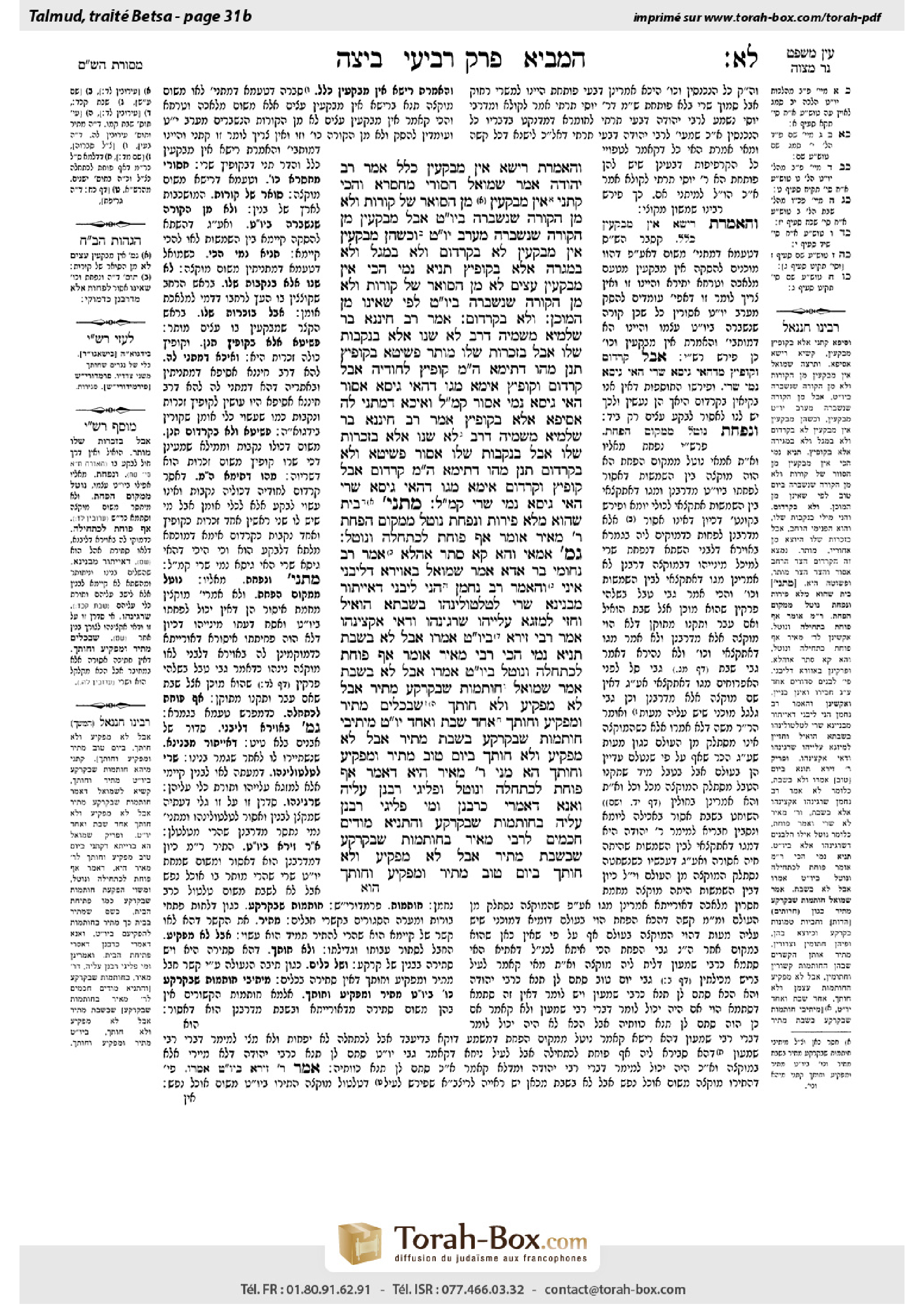
Beitzah 31b: Talmud study for Daf Yomi
Study the Talmud for Daf Yomi with scanned pages, Hebrew text, English translations from Sefaria and AI-generated French translations.
Passage selection and English or AI-generated French translation are available where the scan has annotations. Daf Study is independent of Torah-Box and Sefaria.
Browse Beitzah · ביצה · All tractatesBeitzah 31b text and translations
This page of Beitzah includes the Aramaic text, an English translation and an AI-generated French translation, alongside the scan above.
ביצה ל״א ב · Aramaic and Hebrew text
גְּמָ׳ וְהָאָמְרַתְּ רֵישָׁא אֵין מְבַקְּעִין כְּלָל? אָמַר רַב יְהוּדָה אָמַר שְׁמוּאֵל: חַסּוֹרֵי מְחַסְּרָא וְהָכִי קָתָנֵי: אֵין מְבַקְּעִין מִן הַסְּוָאר שֶׁל קוֹרוֹת, וְלֹא מִן הַקּוֹרָה שֶׁנִּשְׁבְּרָה בְּיוֹם טוֹב. אֲבָל מְבַקְּעִין מִן הַקּוֹרָה שֶׁנִּשְׁבְּרָה מֵעֶרֶב יוֹם טוֹב.
וּכְשֶׁהֵן מְבַקְּעִין — אֵין מְבַקְּעִין לֹא בְּקַרְדּוֹם וְלֹא בְּמַגָּל וְלֹא בִּמְגֵרָה, אֶלָּא בְּקוֹפִיץ. תַּנְיָא נָמֵי הָכִי: אֵין מְבַקְּעִין עֵצִים לֹא מִן הַסְּוָאר שֶׁל קוֹרוֹת וְלֹא מִן הַקּוֹרָה שֶׁנִּשְׁבְּרָה בְּיוֹם טוֹב, לְפִי שֶׁאֵינוֹ מִן הַמּוּכָן.
וְלֹא בְּקַרְדּוֹם. אָמַר רַב חִינָּנָא בַּר שֶׁלֶמְיָא מִשְּׁמֵיהּ דְּרַב: לֹא שָׁנוּ אֶלָּא בְּנַקְבוּת שֶׁלּוֹ, אֲבָל בְּזַכְרוּת שֶׁלּוֹ — מוּתָּר.
פְּשִׁיטָא, בְּקוֹפִיץ תְּנַן! מַהוּ דְּתֵימָא: הָנֵי מִילֵּי קוֹפִיץ לְחוֹדֵיהּ, אֲבָל קַרְדּוֹם וְקוֹפִיץ, אֵימָא: מִגּוֹ דְּהַאי גִּיסָא אָסוּר — הַאי גִּיסָא נָמֵי אָסוּר, קָא מַשְׁמַע לַן.
וְאִיכָּא דְּמַתְנֵי לַהּ אַסֵּיפָא: אֶלָּא בְּקוֹפִיץ. אָמַר רַב חִינָּנָא בַּר שֶׁלֶמְיָא מִשְּׁמֵיהּ דְּרַב: לֹא שָׁנוּ אֶלָּא בְּזַכְרוּת שֶׁלּוֹ, אֲבָל בְּנַקְבוּת שֶׁלּוֹ — אָסוּר. פְּשִׁיטָא, וְלֹא בְּקַרְדּוֹם תְּנַן! מַהוּ דְּתֵימָא: הָנֵי מִילֵּי קַרְדּוֹם, אֲבָל קוֹפִיץ וְקַרְדּוֹם, אֵימָא: מִגּוֹ דְּהַאי גִּיסָא שְׁרֵי — הַאי גִּיסָא נָמֵי שְׁרֵי, קָא מַשְׁמַע לַן.
מַתְנִי׳ בַּיִת שֶׁהוּא מָלֵא פֵּירוֹת וְנִפְחַת — נוֹטֵל מִמְּקוֹם הַפְּחָת. רַבִּי מֵאִיר אוֹמֵר: אַף פּוֹחֵת לְכַתְּחִלָּה וְנוֹטֵל.
גְּמָ׳ אַמַּאי? וְהָא קָא סָתַר אֻהְלָא! אָמַר רַב נְחוּמִי בַּר אַדָּא אָמַר שְׁמוּאֵל: בְּאַוֵּירָא דְלִיבְנֵי. אִינִי?! וְהָאָמַר רַב נַחְמָן: הָנֵי לִיבְנֵי דְּאִיַּיתּוּר מִבִּנְיָנָא — שְׁרֵי לְטַלְטוֹלִינְהוּ בְּשַׁבְּתָא, הוֹאִיל וַחֲזֵי לְמִזְגֵּא עֲלַיְיהוּ. שַׁרְגִינְהוּ — וַדַּאי אַקְצִינְהוּ!
אָמַר רַבִּי זֵירָא: בְּיוֹם טוֹב אָמְרוּ, אֲבָל לֹא בְּשַׁבָּת. תַּנְיָא נָמֵי הָכִי, רַבִּי מֵאִיר אוֹמֵר: אַף פּוֹחֵת לְכַתְּחִלָּה וְנוֹטֵל. בְּיוֹם טוֹב אָמְרוּ, אֲבָל לֹא בְּשַׁבָּת.
אָמַר שְׁמוּאֵל: חוֹתָמוֹת שֶׁבַּקַּרְקַע — מַתִּיר, אֲבָל לֹא מַפְקִיעַ וְלֹא חוֹתֵךְ. שֶׁבַּכֵּלִים — מַתִּיר וּמַפְקִיעַ וְחוֹתֵךְ, אֶחָד שַׁבָּת וְאֶחָד יוֹם טוֹב.
מֵיתִיבִי: חוֹתָמוֹת שֶׁבַּקַּרְקַע, בְּשַׁבָּת — מַתִּיר אֲבָל לֹא מַפְקִיעַ וְלֹא חוֹתֵךְ. בְּיוֹם טוֹב — מַתִּיר וּמַפְקִיעַ וְחוֹתֵךְ!
הָא מַנִּי — רַבִּי מֵאִיר הִיא, דְּאָמַר: אַף פּוֹחֵת לְכַתְּחִלָּה וְנוֹטֵל, וּפְלִיגִי רַבָּנַן עֲלֵיהּ, וַאֲנָא דַּאֲמַרִי כְּרַבָּנַן. וּמִי פְּלִיגִי רַבָּנַן עֲלֵיהּ בְּחוֹתָמוֹת שֶׁבַּקַּרְקַע? וְהָתַנְיָא: מוֹדִים חֲכָמִים לְרַבִּי מֵאִיר בְּחוֹתָמוֹת שֶׁבַּקַּרְקַע, שֶׁבְּשַׁבָּת מַתִּיר — אֲבָל לֹא מַפְקִיעַ וְלֹא חוֹתֵךְ, בְּיוֹם טוֹב — מַתִּיר וּמַפְקִיעַ וְחוֹתֵךְ!
Beitzah 31b · English translation
GEMARA: The Gemara wonders at the wording of the mishna: But didn’t you say in the first clause of the mishna that one may not chop beams at all on a Festival, ostensibly due to the extra effort involved? Why, then, does the mishna later define how one may chop, and even permit the use of a cleaver? Rav Yehuda said that Shmuel said: The mishna is incomplete and is teaching the following: One may not chop wood from the pile of beams intended for construction, nor from a beam that broke on the Festival itself, as it is considered muktze. However, one may chop wood from a beam that broke on the eve of the Festival, since it has presumably been designated as firewood.
Yet even when one chops such a beam, it must not be done in the weekday manner; an adjustment must be made. Therefore, one may not chop it neither with an ax, nor with a saw, nor with a sickle, but with a cleaver. The Gemara comments: This opinion, which is in accordance with the opinion of Shmuel, is also taught in a baraita: One may not chop wood, neither from the pile of beams nor from the beam that broke on the Festival itself, as it is not considered prepared.
It is taught in the mishna that even when it is permitted to chop wood on a Festival, one may not do so with an ax. Rav Ḥinnana bar Shelemya said in the name of Rav: They taught this prohibition only with regard to a case where one chops with its female side, i.e., the broad side of the ax, as was normally done. But if one chops with its male side, i.e., the narrow side, this is permitted because it is an unusual manner of chopping.
The Gemara challenges: It is obvious that one may do so in this unusual fashion, as we learned in the mishna that it is permitted to chop with a cleaver, and chopping with the narrow side of an ax is similar to chopping with a cleaver. The Gemara explains: It was necessary to teach this halakha lest you say: This applies only to a cleaver, as it is narrow on both sides, but with regard to a tool that is an ax on one side and like a cleaver on the other, one might say: Since this side, that which is like an ax, is prohibited, the other, side, which is like a cleaver, should also be prohibited. Rav therefore teaches us that the cleaver side is in fact permitted.
And some teach this halakha in relation to the latter clause of the mishna: Rather, with a cleaver. Rav Ḥinnana bar Shelemya said in the name of Rav: They taught that it is permitted to chop wood on a Festival from a beam that was broken the day before, as stated previously, when one does so only with its male side; but if he chops with its female side, it is prohibited. The Gemara challenges: This is obvious. Didn’t we learn in the mishna that one may not use an ax? The Gemara answers: It was necessary to teach this halakha lest you say: This prohibition applies only to an ax, but with regard to a utensil that is both an ax and a cleaver, i.e., that is broad on one side and narrow on the other, one might say: Since this side, the narrower one, is permitted, the other, broader side should also be permitted. Rav therefore teaches us that they did not permit one side due to the other.
MISHNA: If there is a house that is filled with produce and locked on all sides, and a hole formed in one of its walls or its roof, one may remove produce through the place of the hole. The produce is not considered muktze, even though one cannot reach it without the existence of the hole. Rabbi Meir says: One may even make a hole ab initio and take produce through that opening.
GEMARA: The Gemara wonders at Rabbi Meir’s statement: Why does he permit one to make a hole in order to remove the produce ab initio? Isn’t one who does so dismantling a tent, thereby performing a biblically prohibited labor? Rav Naḥumi bar Adda said that Shmuel said: Here, it is referring to bricks placed one on top of the other [aveira delivni] but not cemented together. This is not considered a building at all. The Gemara challenges: Is that so? But didn’t Rav Naḥman say: With regard to these bricks remaining from a building, it is permitted to handle them on Shabbat, since they are fit to sit on; however, if one arranged them in rows, one on top of the other, he has certainly set them aside from his intentions? This indicates that even bricks placed on top of one another without being cemented together are nonetheless considered muktze.
Rabbi Zeira said: Rabbi Meir was referring to a Festival. On a Festival they said that one may do so, but they did not allow it on Shabbat even in such a manner, and Rav Naḥman was speaking of Shabbat. This opinion was also taught explicitly in the following baraita: Rabbi Meir says: One may even make a hole on a Festival ab initio and remove the produce from inside; they said this with regard to a Festival, but not with regard to Shabbat.
Shmuel said: In the case of fastenings made of knotted ropes that are attached to the ground and that serve as closures for doors of cellars and caves, one may untie the knot, but one may not unravel the rope itself into its constituent fibers nor cut the rope. This constitutes the prohibited labor of dismantling the cellar or cave on Shabbat. With regard to fastenings that are on the doors of vessels, e.g., cupboards, it is permitted to untie, or unravel, or cut them if necessary, both on Shabbat and on a Festival, as the prohibition against dismantling does not apply to vessels.
The Gemara raises an objection to this from the following baraita: In a case of fastenings that are attached to the ground, which are on doors, on Shabbat one may untie the rope but not unravel or cut it. Although it is permitted to do so by Torah law, the Sages prohibited it. However, on a Festival, one may untie or unravel or cut it, as this is not prohibited even by rabbinic law. This appears to contradict the opinion of Shmuel, who does not differentiate between Shabbat and Festivals.
Shmuel could respond: In accordance with whose opinion is this baraita? It is in accordance with the opinion of Rabbi Meir, who said: One may even make a hole and remove produce ab initio, whereas the Rabbis disagree with him and prohibit it, and I spoke in accordance with the opinion of the Rabbis. The Gemara asks: And do the Rabbis disagree with him with regard to doors sealed to the ground? But isn’t it taught in a baraita: The Rabbis concede to Rabbi Meir with regard to doors sealed to the ground that one may untie them on Shabbat but not unravel or cut them, while on a Festival one may untie or unravel or cut them?
Beitzah 31b · Traduction française (IA)
GUEMARA : La Guemara s'interroge sur la formulation de la mitsna : Mais n'avez-vous pas dit dans la première clause de la mitsna que l'on ne doit pas couper de poutres du tout pendant un festival, apparemment en raison de l'effort supplémentaire requis ? Pourquoi, alors, la mitsna définit-elle plus tard comment l'on peut couper, et permet même l'utilisation d'un marteau ? Rav Yéhuda a dit que Shmuel a dit : La mitsna est incomplète et enseigne ceci : On ne doit pas couper du bois provenant de la pile de poutres destinées à la construction, ni d'une poutre qui s'est cassée pendant le festival lui-même, car cela est considéré comme muktze. Cependant, on peut couper du bois provenant d'une poutre qui s'est cassée la veille du festival, car elle a probablement été désignée comme bois de chauffage.
Et même lorsqu'on coupe une telle poutre, cela ne doit pas être fait de la manière du jour de semaine ; une adaptation doit être faite. Ainsi, on ne peut pas la couper ni avec un marteau, ni avec une scie, ni avec un faucille, mais avec un marteau. La Guemara commente : Cette opinion, qui s'aligne sur l'opinion de Shmuel, est également enseignée dans une baraïta : On ne doit pas couper du bois, ni de la pile de poutres, ni d'une poutre qui s'est cassée pendant le festival lui-même, car cela n'est pas considéré comme préparé.
Il est enseigné dans la mitsna que même lorsqu'il est permis de couper du bois pendant un festival, on ne peut pas le faire avec un marteau. Rav Ḥinnana bar Shelemya a dit en nom de Rav : Ils ont enseigné cette interdiction uniquement dans le cas où l'on coupe avec le côté féminin, c'est-à-dire le côté large du marteau, comme cela était normalement fait. Mais si l'on coupe avec le côté masculin, c'est-à-dire le côté étroit, cela est permis car c'est une manière inhabituelle de couper.
La Guemara conteste : Il est évident que l'on peut le faire de cette manière inhabituelle, comme nous l'avons appris dans la mitsva que l'on peut couper avec un marteau, et couper avec le côté étroit d'un hache est similaire à couper avec un marteau. La Guemara explique : Il était nécessaire d'enseigner cette halakha afin que l'on ne dise pas : Cela s'applique uniquement au marteau, car il est étroit des deux côtés, mais concernant un outil qui est un hache d'un côté et comme un marteau de l'autre, l'on pourrait dire : Puisque ce côté, celui qui est comme un hache, est interdit, l'autre côté, celui qui est comme un marteau, devrait également être interdit. Rav a donc enseigné que le côté du marteau est en fait permis.
Et certains enseignent cette halakha en relation avec la dernière clause de la mitsva : Plutôt, avec un marteau. Rav Ḥinnana bar Shelemya a dit en nom de Rav : Ils ont enseigné que l'on peut couper du bois pendant un festival provenant d'une poutre qui s'était cassée la veille, comme mentionné précédemment, lorsque l'on le fait uniquement avec son côté masculin ; mais si l'on coupe avec son côté féminin, cela est interdit. La Guemara conteste : Cela est évident. N'avons-nous pas appris dans la mitsva que l'on ne peut pas utiliser un hache ? La Guemara répond : Il était nécessaire d'enseigner cette halakha afin que l'on ne dise pas : Cette interdiction s'applique uniquement à un hache, mais concernant un ustensile qui est à la fois un hache et un marteau, c'est-à-dire qui est large d'un côté et étroit de l'autre, l'on pourrait dire : Puisque ce côté, celui qui est étroit, est permis, l'autre côté, celui qui est large, devrait également être permis. Rav a donc enseigné que l'on n'a pas permis un côté en raison de l'autre.
MITSVA : Si une maison est remplie de produits et verrouillée de tous les côtés, et qu'un trou s'est formé dans l'une de ses murs ou de son toit, on peut retirer les produits par l'ouverture. Les produits ne sont pas considérés comme muktze, même si l'on ne peut les atteindre sans l'existence du trou. Rabbi Meir dit : On peut même faire un trou dès le début et retirer les produits par cette ouverture.
GUEMARA : La Guemara s'interroge sur l'affirmation de Rabbi Meir : Pourquoi permet-il de faire un trou afin de retirer les produits dès le début ? N'est-ce pas démanteler une tente, ce qui constitue un travail interdit bibliquement ? Rav Naḥumi bar Adda a dit que Shmuel a dit : Ici, il s'agit de des briques placées les unes sur les autres [aveira delivni], mais pas cimentées ensemble. Ce n'est pas considéré comme un bâtiment. La Guemara conteste : Est-ce ainsi ? Mais n'a-t-on pas dit que Rav Naḥman : Concernant ces briques restantes d'un bâtiment, il est permis de les manipuler le sabbat, car elles sont adaptées à s'asseoir ; cependant, si l'on les a alignées en rangs, l'une sur l'autre, l'on a certainement mis de côté ses intentions ? Cela indique que même des briques placées les unes sur les autres sans être cimentées ensemble sont considérées comme muktze.
Rabbi Zeira a dit : Rabbi Meir faisait référence à un festival. Sur un festival, ils ont dit qu'on pouvait le faire, mais ils ne l'ont pas autorisé le sabbat même dans ce cas, et Rav Naḥman parlait du sabbat. Cette opinion a également été enseignée explicitement dans la baraïta suivante : Rabbi Meir dit : On peut même faire un trou dès le début sur un festival et retirer les produits à l'intérieur ; ils ont dit cela concernant un festival, mais pas concernant le sabbat.
Shmuel a dit : Dans le cas de fermetures faites de cordes nœudées attachées au sol et servant de fermetures pour les portes des caves et des souterrains, on peut dénouer le nœud, mais on ne peut pas dénouer la corde elle-même en fils individuels ni la couper. Cela constitue le travail interdit de démanteler la cave ou le souterrain le sabbat. Concernant les fermetures sur les portes des récipients, par exemple les armoires, il est permis de dénouer, ou de dénouer, ou de couper si nécessaire, tant le sabbat que le festival, car l'interdiction de démanteler ne s'applique pas aux récipients.
La Guemara soulève une objection à cela à partir de la baraïta suivante : Dans le cas de fermetures attachées au sol, qui sont sur des portes, on peut dénouer la corde le sabbat, mais pas la dénouer ou la couper. Bien que cela soit permis par la loi divine, les Sages l'ont interdit. Cependant, pendant un festival, on peut dénouer, dénouer ou couper, car cela n'est pas interdit même par la loi rabbinique. Cela semble contredire l'opinion de Shmuel, qui ne distingue pas entre le sabbat et les festivals.
Shmuel pourrait répondre : Selon l'opinion de qui est cette baraïta ? Elle est selon l'opinion de Rabbi Meir, qui a dit : On peut même percer un trou et retirer les produits dès le début, tandis que les Rabbins s'y opposent et l'interdisent, et j'ai parlé selon l'opinion des Rabbins. La Guemara demande : Et les Rabbins s'opposent-ils à lui concernant les portes scellées au sol ? Mais n'est-il pas enseigné dans une baraïta : Les Rabbins reconnaissent à Rabbi Meir concernant les portes scellées au sol que l'on peut les délier le sabbat, mais pas les dénouer ou les couper, tandis que lors d'une fête, on peut les délier, les dénouer ou les couper ?
Traduction française générée par IA à partir de l’édition anglaise de Sefaria. Vérifie toujours un passage avec le texte source.
Text from Sefaria: William Davidson Edition - Vocalized Aramaic (CC BY NC); William Davidson Edition - English (CC BY NC).