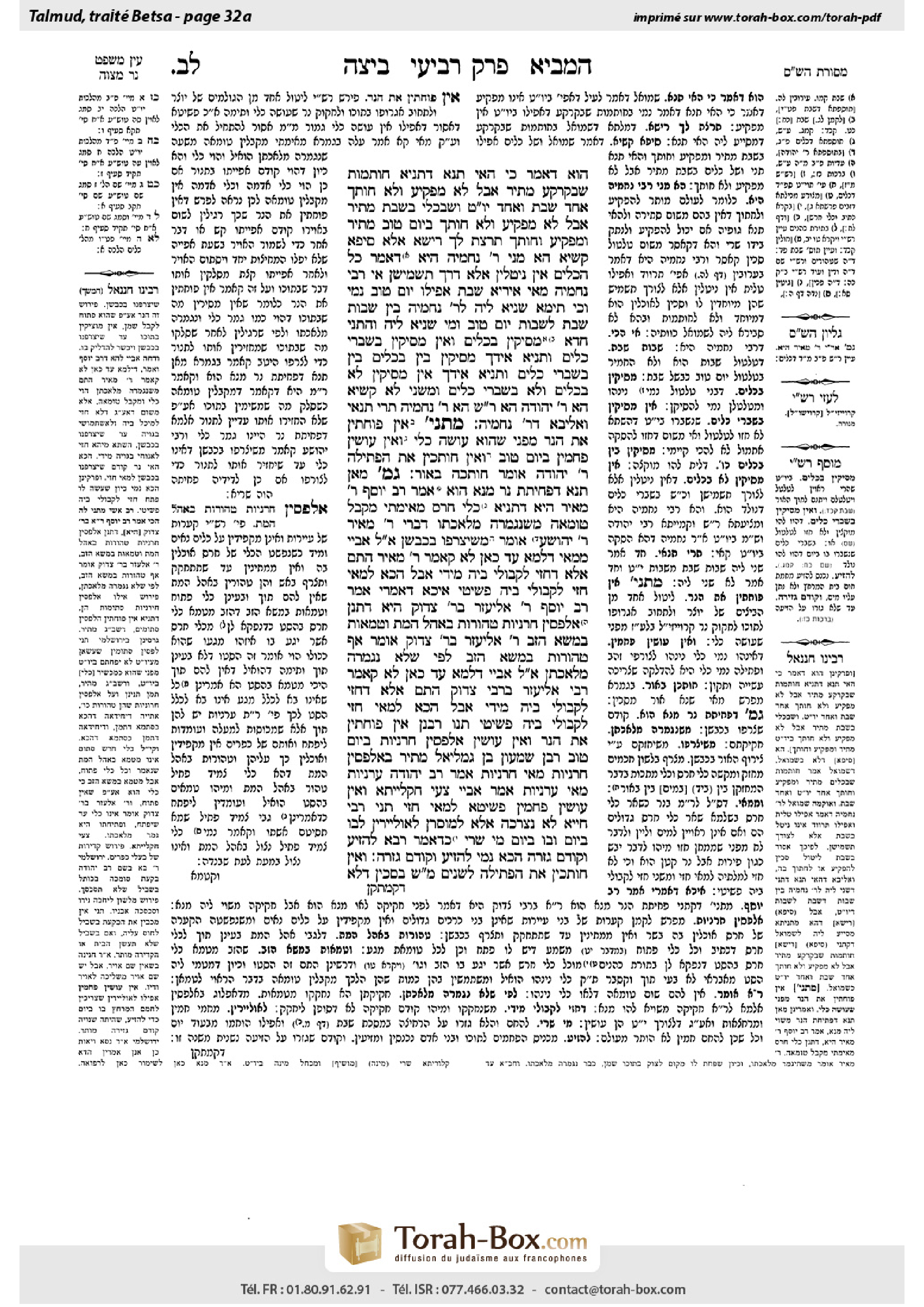
Beitzah 32a: Talmud study for Daf Yomi
Study the Talmud for Daf Yomi with scanned pages, Hebrew text, English translations from Sefaria and AI-generated French translations.
Passage selection and English or AI-generated French translation are available where the scan has annotations. Daf Study is independent of Torah-Box and Sefaria.
Browse Beitzah · ביצה · All tractatesBeitzah 32a text and translations
This page of Beitzah includes the Aramaic text, an English translation and an AI-generated French translation, alongside the scan above.
ביצה ל״ב א · Aramaic and Hebrew text
הוּא דְּאָמַר כִּי הַאי תַּנָּא, דְּתַנְיָא: חוֹתָמוֹת שֶׁבַּקַּרְקַע — מַתִּיר, אֲבָל לֹא מַפְקִיעַ וְלֹא חוֹתֵךְ, אֶחָד שַׁבָּת וְאֶחָד יוֹם טוֹב. וְשֶׁבַּכְּלִי — בְּשַׁבָּת מַתִּיר, אֲבָל לֹא מַפְקִיעַ וְלֹא חוֹתֵךְ, בְּיוֹם טוֹב — מַתִּיר וּמַפְקִיעַ וְחוֹתֵךְ.
תָּרֵצְתְּ לָךְ רֵישָׁא, אֶלָּא סֵיפָא קַשְׁיָא!
הָא מַנִּי — רַבִּי נְחֶמְיָה הִיא, דְּאָמַר: כׇּל הַכֵּלִים אֵין נִיטָּלִין אֶלָּא דֶּרֶךְ תַּשְׁמִישָׁן.
אִי רַבִּי נְחֶמְיָה, מַאי אִירְיָא שַׁבָּת? אֲפִילּוּ יוֹם טוֹב נָמֵי! וְכִי תֵּימָא שַׁנְיָא לֵיהּ לְרַבִּי נְחֶמְיָה בֵּין שְׁבוּת שַׁבָּת לִשְׁבוּת יוֹם טוֹב, וּמִי שַׁנְיָא לֵיהּ?
וְהָתָנֵי חֲדָא: מַסִּיקִין בְּכֵלִים וְאֵין מַסִּיקִין בְּשִׁבְרֵי כֵלִים, וְתַנְיָא אִידַּךְ: מַסִּיקִין בֵּין בְּכֵלִים בֵּין בְּשִׁבְרֵי כֵּלִים, וְתַנְיָא אִידַּךְ: אֵין מַסִּיקִין לֹא בְּכֵלִים וְלֹא בְּשִׁבְרֵי כֵלִים.
וּמְשַׁנֵּי, לָא קַשְׁיָא: הָא רַבִּי יְהוּדָה, הָא רַבִּי שִׁמְעוֹן, הָא רַבִּי נְחֶמְיָה!
תְּרֵי תַנָּאֵי וְאַלִּיבָּא דְּרַבִּי נְחֶמְיָה.
מַתְנִי׳ אֵין פּוֹחֲתִין אֶת הַנֵּר מִפְּנֵי שֶׁהוּא עוֹשֶׂה כֶּלִי, וְאֵין עוֹשִׂין פֶּחָמִין בְּיוֹם טוֹב, וְאֵין חוֹתְכִין אֶת הַפְּתִילָה. רַבִּי יְהוּדָה אוֹמֵר: חוֹתְכָהּ בָּאוּר.
גְּמָ׳ מַאן תְּנָא דִּפְחִיתַת נֵר מָנָא הוּא? אָמַר רַב יוֹסֵף: רַבִּי מֵאִיר הִיא. דְּתַנְיָא: כְּלִי חֶרֶס, מֵאֵימָתַי מְקַבֵּל טוּמְאָה — מִשֶּׁנִּגְמְרָה מְלַאכְתּוֹ, דִּבְרֵי רַבִּי מֵאִיר. רַבִּי יְהוֹשֻׁעַ אוֹמֵר: מִשֶּׁיִּצְרְפוֹ בַּכִּבְשָׁן.
אֲמַר לֵיהּ אַבָּיֵי: מִמַּאי? דִּלְמָא עַד כָּאן לָא קָאָמַר רַבִּי מֵאִיר הָתָם אֶלָּא דַּחֲזֵי לְקַבּוֹלֵי בֵּיהּ מִידֵּי, אֲבָל הָכָא לְמַאי חֲזִי? לְקַבּוֹלֵי בֵּיהּ פְּשִׁיטֵי.
אִיכָּא דְּאָמְרִי, אָמַר רַב יוֹסֵף: רַבִּי אֱלִיעֶזֶר בְּרַבִּי צָדוֹק הִיא, דִּתְנַן: אִלְפָּסִין חִרָנִיּוֹת — טְהוֹרוֹת בְּאֹהֶל הַמֵּת, וּטְמֵאוֹת בְּמַשָּׂא הַזָּב.
רַבִּי אֱלִיעֶזֶר בְּרַבִּי צָדוֹק אוֹמֵר: אַף טְהוֹרוֹת בְּמַשָּׂא הַזָּב, לְפִי שֶׁלֹּא נִגְמְרָה מְלַאכְתָּן.
אֲמַר לֵיהּ אַבָּיֵי: דִּלְמָא עַד כָּאן לָא קָאָמַר רַבִּי אֱלִיעֶזֶר בְּרַבִּי צָדוֹק הָתָם, אֶלָּא דַּחֲזֵי לְקַבּוֹלֵי בֵּיהּ מִידֵּי, אֲבָל הָכָא לְמַאי חָזֵי? לְקַבּוֹלֵי בֵּיהּ פְּשִׁיטֵי.
תָּנוּ רַבָּנַן: אֵין פּוֹחֲתִין אֶת הַנֵּר, וְאֵין עוֹשִׂין אִלְפָּסִין חִרָנִיּוֹת בְּיוֹם טוֹב. רַבָּן שִׁמְעוֹן בֶּן גַּמְלִיאֵל מַתִּיר בְּאִלְפָּסִין חִרָנִיּוֹת. מַאי חִרָנִיּוֹת? אָמַר רַב יְהוּדָה: עִרָנִיּוֹת. מַאי עִרָנִיּוֹת? אָמַר אַבָּיֵי: צָעֵי חַקְלָיָיתָא.
וְאֵין עוֹשִׂין פֶּחָמִין. פְּשִׁיטָא, לְמַאי חָזֵי? תָּנֵי רַבִּי חִיָּיא: לֹא נִצְרְכָה אֶלָּא לְמוֹסְרָן לְאוֹלְיָירִין לְבוֹ בַּיּוֹם.
וּבוֹ בַּיּוֹם מִי שְׁרֵי? כִּדְאָמַר רָבָא: לְהַזִּיעַ, וְקוֹדֶם גְּזֵרָה. הָכָא נָמֵי: לְהַזִּיעַ, וְקוֹדֶם גְּזֵרָה.
וְאֵין חוֹתְכִין אֶת הַפְּתִילָה לִשְׁנַיִם. מַאי שְׁנָא בְּסַכִּין דְּלָא —
Beitzah 32a · English translation
The Gemara responds: It was he, Shmuel, who spoke in accordance with the opinion of that tanna, as it is taught in a baraita: With regard to fastenings that are to the ground, e.g., those on doors, one may untie them but not unravel or cut them, both on Shabbat and on a Festival. And with regard to those fastenings of a vessel, on Shabbat one may untie them, but one may not unravel or cut them; on a Festival one may untie, or unravel, or cut them.
The Gemara challenges further: You have thereby answered the first clause of Shmuel’s statement, with regard to fastenings attached to the ground, e.g., those on doors, by finding a tanna who permits untying them, as does Shmuel. However, the latter clause is difficult because the baraita states that one may not unravel even ropes of vessels on Shabbat, whereas Shmuel permits unraveling in all cases.
The Gemara answers: In accordance with whose opinion is this baraita? It is in accordance with the opinion of Rabbi Neḥemya, whose opinion is a minority view, as he said: All vessels may be handled only in the manner of their designated use. Therefore, the rope may not be cut, not because it is prohibited to unravel it but because one may not handle a knife for this purpose, as the designated use of the knife is cutting food rather than rope.
The Gemara challenges: If it is in accordance with the opinion of Rabbi Neḥemya, why discuss particularly Shabbat? The same halakha should apply even on a Festival, as there is no distinction between Shabbat and Festivals with regard to the halakhot of handling items. And if you say that there is a distinction according to Rabbi Neḥemya between a rabbinic decree of Shabbat, when a vessel may be moved only for its designated purpose, and a rabbinic decree of a Festival, when it may not be moved for any purpose, there is a problem. Does he differentiate between them in this manner?
But isn’t it taught in one baraita: On a Festival one may kindle fire with vessels, but one may not kindle fire with shards of vessels, as they are muktze? And it is taught in another baraita: One may kindle fire both with vessels and with shards of vessels. And it is taught in yet another baraita: One may kindle fire neither with vessels nor with shards of vessels.
And this contradiction between the baraitot is resolved in the following manner: It is not difficult; this first baraita is in accordance with the opinion of Rabbi Yehuda, who accepts the law of muktze. One may therefore kindle fire with vessels, as they are not muktze, but not with shards of vessels, as they are muktze and may not be handled. This second baraita is in accordance with the opinion of Rabbi Shimon, who does not accept the law of muktze. According to him, one may use shards of vessels as well. This one that prohibits using even vessels that are intact is in accordance with the opinion of Rabbi Neḥemya, who allows vessels to be used only for their designated purpose. This indicates that Rabbi Neḥemya prohibits handling even whole vessels on Festivals as well.
The Gemara replies: These are two tanna’im who both hold in accordance with the opinion of Rabbi Neḥemya. Two later tanna’im disagreed with each other in reporting the opinion of Rabbi Neḥemya. Both agree that one may use vessels only for their designated purpose, but they disagree with regard to whether this halakha applies only on Shabbat or on Festivals as well.
MISHNA: On a Festival, one may not hollow out a piece of clay to form a lamp into which he will place oil and a wick because he thereby creates a vessel. And similarly, one may not produce charcoal at all on a Festival because this is not labor for sustenance. And similarly, one may not cut the wick, as this is considered mending a vessel. Rabbi Yehuda says: If one requires a wick of a particular length, he may cut it by burning it in a fire but not by cutting it with a knife.
GEMARA: Who is the tanna who taught that hollowing out a lamp is considered creating a vessel, even if it is not fired in a furnace? Rav Yosef said: It is Rabbi Meir, as it is taught in a baraita with regard to the halakhot of ritual impurity: From when is an earthenware vessel susceptible to ritual impurity? It is from when its work is completed, i.e., when the clay has been made into the form of a vessel; this is the statement of Rabbi Meir. Rabbi Yehoshua says: It is from when the vessel is fired in the furnace.
Abaye said to him: From where do you conclude that this is the same opinion? Perhaps Rabbi Meir stated his opinion only there, with regard to vessels, since they are fit to contain something. Although they cannot hold liquids before being fired in a furnace, they can contain other items. But here, for what use is this lamp fit? The Gemara responds: It can be used to contain small coins.
Some say the following version of the discussion: Rav Yosef said: The mishna is in accordance with the opinion of Rabbi Eliezer, son of Rabbi Tzadok, as we learned: Ḥaraniyyot pots [ilpasin] are unfinished earthenware pots made together with their covers. The covers are removed after they are fired in a furnace. They are pure with regard to contracting the impurity of a tent over a corpse, as they do not have a receptacle. Earthenware vessels can contract impurity imparted by a corpse only if they have a hollow space that can contain something. But ḥaraniyyot pots are rendered impure by the carrying of a zav, even if the zav moved them without actually touching them, as this impurity applies to any earthenware vessels that serve some purpose.
Rabbi Eliezer, son of Rabbi Tzadok, says: These vessels are even pure with regard to the impurity imparted by the carrying of a zav because their labor is not completed; therefore, they are not fully formed. This implies that when the pots are completed, they are considered full-fledged vessels, even before they have been fired in a furnace.
Abaye said to him: Perhaps it is not so, as it is possible to say that Rabbi Eliezer, son of Rabbi Tzadok, stated his opinion only there, in the case of ḥaraniyyot pots, since they are fit to contain something. But here, in the case of a lamp, for what is it fit? The Gemara replies: It is fit to contain small coins.
The Sages taught: One may not hollow out a lamp, and one may not create ḥaraniyyot pots on a Festival. Rabban Shimon ben Gamliel permits creating ḥaraniyyot pots. The Gemara asks: What is the meaning of ḥaraniyyot? Rav Yehuda said: They are pots of a city [iraniyyot]. The Gemara again inquires: What is the meaning of iraniyyot? Abaye said: It means villagers’ bowls who will use even clay vessels that have not been fully formed or fired, as they are not particular with regard to half-finished utensils.
It is taught in the mishna: And one may not produce charcoal on a Festival. The Gemara challenges: It is obvious that one may perform only labor for sustenance. For what is charcoal fit; what purpose does it have for the sake of sustenance? Rabbi Ḥiyya taught: It is necessary to teach this halakha only in the case of handing the charcoal over to bathhouse attendants [olyarin] who heat up the bathhouse for that day. One might have thought that since charcoal is used for the sake of washing on a Festival, producing it should be permitted.
The Gemara questions this: And on that day is it permitted to heat up water for washing? The Sages decreed that one may not wash in a bathhouse on a Festival, even if the water was heated up the day before, and certainly it is prohibited if the water was heated on the Festival itself. The Gemara replies: As Rava said with regard to a different issue, this decree does not refer to actual washing but to entering a bathhouse merely in order to sweat, and it was stated before the enactment of the decree against sweating in a bathhouse. Here, too, one can explain that the statement of Rabbi Ḥiyya is referring to a case where one entered to sweat, and he entered at a time before the decree was enacted.
It was taught in the mishna: And one may not cut a wick into two, but Rabbi Yehuda permits cutting it by means of fire. The Gemara asks: What is different about cutting a wick with fire as opposed to with a knife, that one may not cut a wick with a knife?
Beitzah 32a · Traduction française (IA)
Le Guemara répond : C’est lui, Shmuel, qui a parlé conformément à l’opinion de ce tanna, comme il est enseigné dans une baraïta : En ce qui concerne les attaches qui sont au sol, par exemple celles des portes, on peut les délier mais pas les dénouer ou les couper, à la fois le sabbat et les fêtes. Et en ce qui concerne les attaches d’un récipient, le sabbat on peut les délier, mais on ne peut pas les dénouer ou les couper ; les fêtes on peut les délier, ou les dénouer, ou les couper.
Le Guemara conteste davantage : Vous avez ainsi répondu à la première partie de l’affirmation de Shmuel, concernant les attaches attachées au sol, par exemple celles des portes, en trouvant un tanna qui permet de les délier, comme le fait Shmuel. Cependant, la seconde partie est difficile, car la baraïta stipule qu’on ne peut pas dénouer même les cordes des récipients le sabbat, alors que Shmuel permet le dénouement dans tous les cas.
Le Guemara répond : Selon l’opinion de quel tanna est-ce que cette baraïta ? C’est selon l’opinion de Rabbi Neḥemya, dont l’opinion est une vue minoritaire, comme il a dit : Tous les récipients peuvent être manipulés uniquement selon leur usage désigné. Ainsi, la corde ne peut pas être coupée, pas parce qu’il est interdit de la dénouer, mais parce qu’on ne peut pas manipuler un couteau à cette fin, car l’usage désigné du couteau est de couper les aliments plutôt que la corde.
Le Guemara questionne : Si c’est selon l’opinion de Rabbi Neḥemya, pourquoi parler spécifiquement du sabbat ? La même halakha devrait s’appliquer même aux fêtes, car il n’y a pas de distinction entre le sabbat et les fêtes concernant les halakhot de manipulation des objets. Et si vous dites que selon Rabbi Neḥemya il y a une distinction entre un décret rabbinique du sabbat, où un récipient peut être déplacé uniquement selon son usage désigné, et un décret rabbinique des fêtes, où il ne peut pas être déplacé pour tout usage, il y a un problème. Différencie-t-il ainsi ?
Mais n’est-il pas enseigné dans une baraïta : Sur les fêtes, on peut allumer du feu avec des récipients, mais on ne peut pas allumer du feu avec des fragments de récipients, car ils sont muktze ? Et il est enseigné dans une autre baraïta : On peut allumer du feu à la fois avec des récipients et avec des fragments de récipients. Et il est enseigné dans une autre baraïta : On ne peut pas allumer du feu ni avec des récipients ni avec des fragments de récipients.
Et cette contradiction entre les baraitot est résolue ainsi : Ce n’est pas difficile ; cette première baraïta est selon l’opinion de Rabbi Yehuda, qui accepte la loi du muktze. On peut donc allumer du feu avec des récipients, car ils ne sont pas muktze, mais pas avec des fragments de récipients, car ils sont muktze et ne peuvent pas être manipulés. Cette seconde baraïta est selon l’opinion de Rabbi Shimon, qui ne reconnaît pas la loi du muktze. Selon lui, on peut utiliser des fragments de récipients également. Cette troisième baraïta qui interdit l’utilisation même des récipients intacts est selon l’opinion de Rabbi Neḥemya, qui permet l’utilisation des récipients uniquement selon leur usage désigné. Cela indique que Rabbi Neḥemya interdit la manipulation même des récipients entiers aux fêtes.
Le Guemara répond : Ces deux tanna’im sont ceux qui tiennent selon l’opinion de Rabbi Neḥemya. Deux tanna’im ultérieurs ont divergé entre eux dans la transmission de l’opinion de Rabbi Neḥemya. Ils s’accordent sur le fait qu’on peut utiliser les récipients uniquement selon leur usage désigné, mais ils divergent sur le fait que cette halakha s’applique uniquement le sabbat ou aussi aux fêtes.
MICHNA : Les fêtes, on ne peut pas creuser une pièce de terre pour former une lampe dans laquelle on placera de l’huile et une mèche, car cela crée un récipient. De même, on ne peut pas produire du charbon du tout les fêtes, car cela n’est pas un travail pour la subsistance. De même, on ne peut pas couper la mèche, car cela est considéré comme la réparation d’un récipient. Rabbi Yehuda dit : Si l’on a besoin d’une mèche de longueur particulière, on peut la couper en la brûlant dans un feu, mais pas en la coupant avec un couteau.
GUEMARA : Qui est le tanna qui a enseigné que creuser une lampe est considéré comme la création d’un récipient, même s’il n’est pas cuisson dans un four ? Rav Yosef dit : C’est Rabbi Meir, comme il est enseigné dans une baraïta concernant les halakhot de l’impureté rituelle : À partir de quand un récipient en terre est susceptible d’impureté ? C’est à partir de quand son travail est achevé, c’est-à-dire quand la terre a été faite en forme de récipient ; c’est l’affirmation de Rabbi Meir. Rabbi Yehoshua dit : C’est à partir de quand le récipient est cuisson dans le four.
Abaye dit à lui : D’où concluez-vous que c’est la même opinion ? Peut-être que Rabbi Meir a exprimé son opinion uniquement là, concernant les récipients, puisqu’ils sont adaptés à contenir quelque chose. Bien qu’ils ne puissent pas contenir des liquides avant d’être cuits dans un four, ils peuvent contenir d’autres objets. Mais ici, à quel usage cette lampe est-elle adaptée ? Le Guemara répond : Elle peut être utilisée pour contenir des petites pièces de monnaie.
Certains disent la version suivante de la discussion : Rav Yosef dit : La mishna est selon l’opinion de Rabbi Eliezer, fils de Rabbi Tzadok, comme nous l’avons appris : Les pots ḥaraniyyot sont des pots en terre non achevés faits ensemble avec leurs couvercles. Les couvercles sont retirés après cuisson dans un four. Ils sont purs concernant la contraction de l’impureté d’un tentérieur sur un cadavre, car ils n’ont pas un récipient. Les récipients en terre peuvent contracter l’impureté transmise par un cadavre uniquement s’ils ont un espace creux capable de contenir quelque chose. Mais les pots ḥaraniyyot sont rendus impurs par le portage d’un zav, même si le zav les a déplacés sans les toucher, car cette impureté s’applique à tout récipient en terre qui sert un usage.
Rabbi Eliezer, fils de Rabbi Tzadok, dit : Ces récipients sont même purs concernant l’impureté transmise par le portage d’un zav, car leur travail n’est pas achevé ; donc, ils ne sont pas pleinement formés. Cela implique que quand les pots sont achevés, ils sont considérés comme des récipients complets, même avant d’être cuits dans un four.
Abaye dit à lui : Peut-être n'en est-il pas ainsi, car on peut dire que Rabbi Eliezer, fils de Rabbi Tzadok, a exprimé son opinion uniquement dans le cas des pots ḥaraniyyot, puisqu'ils sont adaptés à contenir quelque chose. Mais ici, dans le cas d'une lampe, à quoi est-elle adaptée ? La Guemara répond : Elle est adaptée à contenir des petits pièces de monnaie.
Les Sages enseignèrent : On ne doit pas tailler une lampe, et on ne doit pas fabriquer des pots ḥaraniyyot pendant un festival. Rabban Shimon ben Gamliel permet la fabrication des pots ḥaraniyyot. La Guemara demande : Quelle est la signification de ḥaraniyyot ? Rav Yehuda dit : Ce sont des pots d'une ville [iraniyyot]. La Guemara demande à nouveau : Quelle est la signification d'iraniyyot ? Abaye dit : Cela signifie des bols des villages qui utilisent même des vases en argile non encore pleinement formés ou cuisson, car ils ne sont pas exigeants en ce qui concerne les ustensiles inachevés.
Il est enseigné dans la michna : Et on ne doit pas produire du charbon pendant un festival. La Guemara questionne : C'est évident que l'on peut effectuer uniquement des travaux pour la subsistance. À quoi le charbon est-il adapté ; quelle est son utilité pour la subsistance ? Rabbi Ḥiyya enseigna : Il est nécessaire d'enseigner cette halakha uniquement dans le cas où l'on livre le charbon aux employés des bains [olyarin] qui chauffent les bains pour cette journée. On pourrait penser que puisque le charbon est utilisé à l'effet du lavage pendant un festival, sa production devrait être permise.
La Guemara questionne cela : Et ce jour-là est-il permis de chauffer l'eau pour le lavage ? Les Sages ont décrété qu'on ne doit pas se laver dans un bain pendant un festival, même si l'eau avait été chauffée la veille, et certainement si l'eau avait été chauffée pendant le festival lui-même. La Guemara répond : Comme Rava a dit concernant une autre question, cette décrétation ne concerne pas le lavage réel mais l'entrée dans un bain simplement pour transpirer, et cela a été dit avant l'ordonnance interdisant de transpirer dans un bain. Ici aussi, on peut expliquer que l'expression de Rabbi Ḥiyya fait référence à un cas où l'on est entré pour transpirer, et l'on est entré à un moment avant que l'ordonnance ne soit émise.
Il est enseigné dans la michna : Et on ne doit pas couper une mèche en deux, mais Rabbi Yehuda permet de la couper par le feu. La Guemara demande : Qu'est-ce qui diffère dans le cas de la coupe d'une mèche avec le feu par rapport à la coupe avec un couteau, que l'on ne peut pas couper une mèche avec un couteau ?
Traduction française générée par IA à partir de l’édition anglaise de Sefaria. Vérifie toujours un passage avec le texte source.
Text from Sefaria: William Davidson Edition - Vocalized Aramaic (CC BY NC); William Davidson Edition - English (CC BY NC).