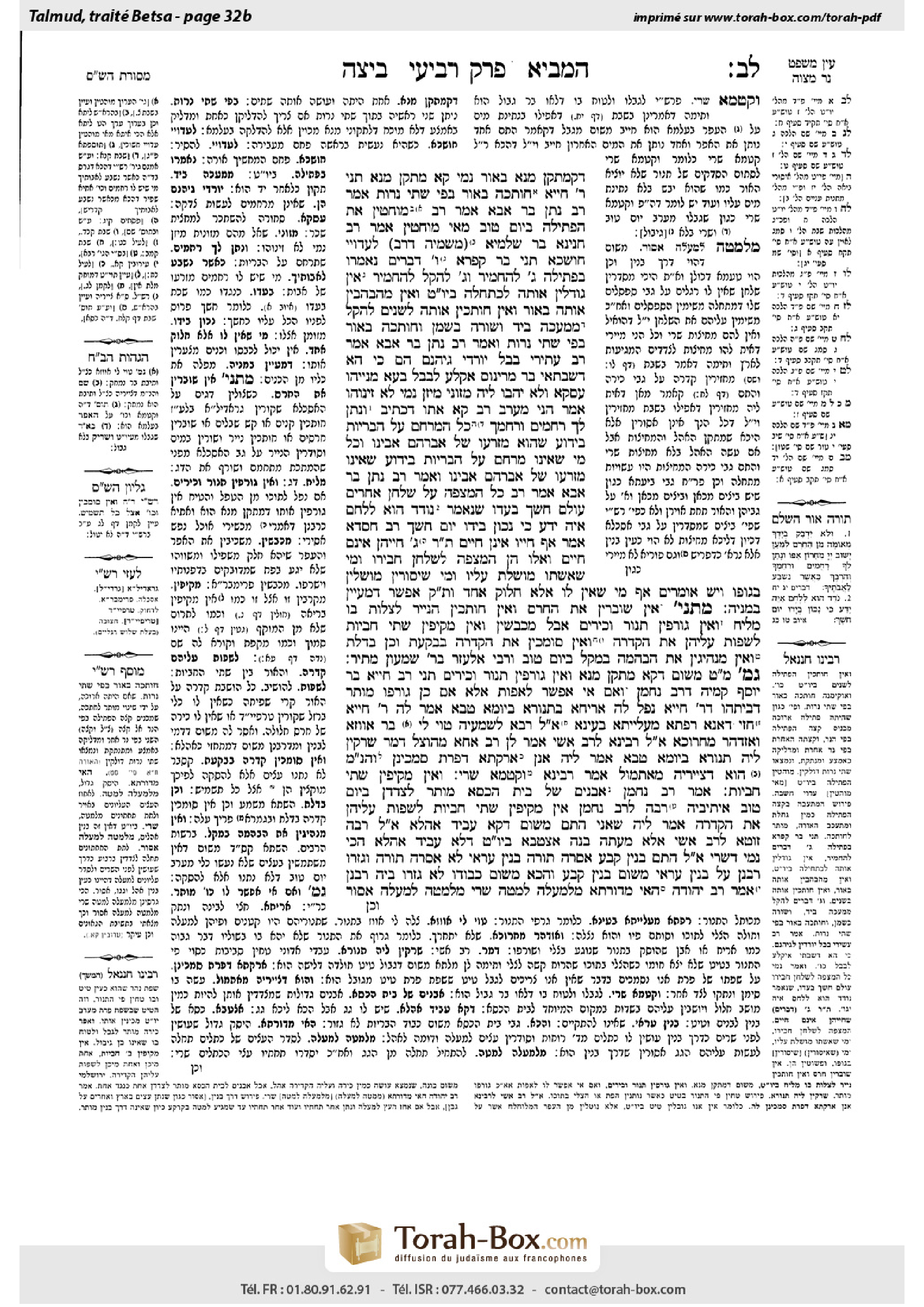
Beitzah 32b: Talmud study for Daf Yomi
Study the Talmud for Daf Yomi with scanned pages, Hebrew text, English translations from Sefaria and AI-generated French translations.
Passage selection and English or AI-generated French translation are available where the scan has annotations. Daf Study is independent of Torah-Box and Sefaria.
Browse Beitzah · ביצה · All tractatesBeitzah 32b text and translations
This page of Beitzah includes the Aramaic text, an English translation and an AI-generated French translation, alongside the scan above.
ביצה ל״ב ב · Aramaic and Hebrew text
דְּקָמְתַקֵּן מָנָא, בָּאוּר נָמֵי קָא מְתַקֵּן מָנָא! תָּנֵי רַבִּי חִיָּיא: חוֹתְכָהּ בָּאוּר בְּפִי שְׁתֵּי נֵרוֹת. אָמַר רַב נָתָן בַּר אַבָּא אָמַר רַב: מוֹחֲטִין אֶת הַפְּתִילָה בְּיוֹם טוֹב. מַאי ״מוֹחֲטִין״? אָמַר רַב חֲנִינָא בַּר שֶׁלֶמְיָא (מִשְּׁמֵיהּ דְּרַב): לְעַדּוֹיֵי חוּשְׁכָא.
תָּנֵי בַּר קַפָּרָא: שִׁשָּׁה דְּבָרִים נֶאֶמְרוּ בִּפְתִילָה. שְׁלֹשָׁה לְהַחְמִיר, וּשְׁלֹשָׁה לְהָקֵל. לְהַחְמִיר: אֵין גּוֹדְלִין אוֹתָהּ לְכַתְּחִלָּה בְּיוֹם טוֹב, וְאֵין מְהַבְהֲבִין אוֹתָהּ בָּאוּר, וְאֵין חוֹתְכִין אוֹתָהּ לִשְׁנַיִם. לְהָקֵל: מְמַעֲכָהּ בַּיָּד, וְשׁוֹרָהּ בְּשֶׁמֶן, וְחוֹתְכָהּ בָּאוּר בְּפִי שְׁתֵּי נֵרוֹת.
וְאָמַר רַב נָתָן בַּר אַבָּא אָמַר רַב: עַתִּירֵי בָּבֶל, יוֹרְדֵי גֵיהִנָּם הֵם. כִּי הָא דְּשַׁבְּתַאי בַּר מָרִינוּס אִקְּלַע לְבָבֶל, בְּעָא מִנַּיְיהוּ עִסְקָא — וְלָא יְהַבוּ לֵיהּ. מְזוֹנֵי מֵיזָן — נָמֵי לָא זַיְנוּהוּ.
אָמַר: הָנֵי מֵעֵרֶב רַב קָא אָתוּ, דִּכְתִיב: ״וְנָתַן לְךָ רַחֲמִים וְרִחַמְךָ״, כׇּל הַמְרַחֵם עַל הַבְּרִיּוֹת — בְּיָדוּעַ שֶׁהוּא מִזַּרְעוֹ שֶׁל אַבְרָהָם אָבִינוּ, וְכׇל מִי שֶׁאֵינוֹ מְרַחֵם עַל הַבְּרִיּוֹת — בְּיָדוּעַ שֶׁאֵינוֹ מִזַּרְעוֹ שֶׁל אַבְרָהָם אָבִינוּ.
וְאָמַר רַב נָתָן בַּר אַבָּא אָמַר רַב: כׇּל הַמְצַפֶּה עַל שֻׁלְחַן אֲחֵרִים — עוֹלָם חָשַׁךְ בַּעֲדוֹ, שֶׁנֶּאֱמַר: ״נוֹדֵד הוּא לַלֶּחֶם אַיֵּה יָדַע כִּי נָכוֹן בְּיָדוֹ יוֹם חֹשֶׁךְ״. רַב חִסְדָּא אָמַר: אַף חַיָּיו אֵינָן חַיִּים.
תָּנוּ רַבָּנַן: שְׁלֹשָׁה חַיֵּיהֶן אֵינָם חַיִּים, וְאֵלּוּ הֵן: הַמְצַפֶּה לְשֻׁלְחַן חֲבֵירוֹ, וּמִי שֶׁאִשְׁתּוֹ מוֹשֶׁלֶת עָלָיו, וּמִי שֶׁיִּסּוּרִין מוֹשְׁלִין בְּגוּפוֹ. וְיֵשׁ אוֹמְרִים: אַף מִי שֶׁאֵין לוֹ אֶלָּא חָלוּק אֶחָד. וְתַנָּא קַמָּא: אֶפְשָׁר דִּמְעַיֵּין בְּמָנֵיהּ.
מַתְנִי׳ אֵין שׁוֹבְרִין אֶת הַחֶרֶס, וְאֵין חוֹתְכִין הַנְּיָיר לִצְלוֹת בּוֹ מָלִיחַ.
וְאֵין גּוֹרְפִין תַּנּוּר וְכִירַיִם, אֲבָל מְכַבְּשִׁין.
וְאֵין מַקִּיפִין שְׁתֵּי חָבִיּוֹת לִשְׁפּוֹת עֲלֵיהֶן אֶת הַקְּדֵרָה, וְאֵין סוֹמְכִין אֶת הַקְּדֵרָה בַּבְּקַעַת, וְכֵן בַּדֶּלֶת. וְאֵין מַנְהִיגִין אֶת הַבְּהֵמָה בַּמַּקֵּל בְּיוֹם טוֹב, וְרַבִּי אֶלְעָזָר בְּרַבִּי שִׁמְעוֹן מַתִּיר.
גְּמָ׳ מַאי טַעְמָא — מִשּׁוּם דְּקָא מְתַקֵּן מָנָא.
וְאֵין גּוֹרְפִין תַּנּוּר וְכִירַיִם. תָּנֵי רַב חִיָּיא בַּר יוֹסֵף קַמֵּיהּ דְּרַב נַחְמָן: וְאִם אִי אֶפְשָׁר לֶאֱפוֹת אֶלָּא אִם כֵּן גּוֹרְפוֹ — מוּתָּר. דְּבֵיתְהוּ דְּרַבִּי חִיָּיא נְפַל לַהּ אֲרִיחָא בְּתַנּוּרָא בְּיוֹמָא טָבָא, אֲמַר לַהּ רַבִּי חִיָּיא: חֲזַי, דַּאֲנָא רִפְתָּא מְעַלַּיְיתָא בָּעֵינָא. אֲמַר לֵיהּ רָבָא לְשַׁמָּעֵיהּ: טְוִי לִי בַּר אֲווֹזָא, וְאִזְדְּהַר מֵחֲרוֹכָא.
אֲמַר לֵיהּ רָבִינָא לְרַב אָשֵׁי: אָמַר לַן רַב אַחָא מֵהוּצָל, דְּמָר שָׁרְקִין לֵיהּ תַּנּוּרָא בְּיוֹמָא טָבָא. אֲמַר לֵיהּ: אֲנַן אַרַקְתָּא דִפְרָת סָמְכִינַן, וְהָנֵי מִילֵּי הוּא דְּצַיְּירֵיהּ מֵאֶתְמוֹל. אָמַר רָבִינָא: וְקִטְמָא — שְׁרֵי.
וְאֵין מַקִּיפִין שְׁתֵּי חָבִיּוֹת. אָמַר רַב נַחְמָן: אֲבָנִים שֶׁל בֵּית הַכִּסֵּא, מוּתָּר לְצַדְּדָן בְּיוֹם טוֹב. אֵיתִיבֵיהּ רַבָּה לְרַב נַחְמָן: אֵין מַקִּיפִין שְׁתֵּי חָבִיּוֹת לִשְׁפּוֹת עֲלֵיהֶן אֶת הַקְּדֵרָה! אֲמַר לֵיהּ: שָׁאנֵי הָתָם, מִשּׁוּם דְּקָא עָבֵיד אֻהְלָא.
אֲמַר לֵיהּ רַבָּה זוּטָא, לְרַב אָשֵׁי: אֶלָּא מֵעַתָּה, בָּנָה אִצְטְבָא בְּיוֹם טוֹב, דְּלָא עָבֵיד אֻהְלָא — הָכִי נָמֵי דִּשְׁרֵי? אֲמַר לֵיהּ: הָתָם, בִּנְיַן קֶבַע אָסְרָה תּוֹרָה, בִּנְיַן עֲרַאי לָא אָסְרָה תּוֹרָה. וּגְזַרוּ רַבָּנַן עַל בִּנְיַן עֲרַאי מִשּׁוּם בִּנְיַן קֶבַע, וְהָכָא מִשּׁוּם כְּבוֹדוֹ לָא גְּזַרוּ בֵּיהּ רַבָּנַן.
אָמַר רַב יְהוּדָה: הַאי מְדוּרְתָּא, מִלְּמַעְלָה לְמַטָּה — שְׁרֵי. מִלְּמַטָּה לְמַעְלָה — אָסוּר.
Beitzah 32b · English translation
Is it because he thereby mends a vessel? If so, when one cuts it in the fire, he is also preparing a vessel for use. Rabbi Ḥiyya taught in explanation: He cuts it by fire in the mouth of two candles. In other words, he does not simply cut a wick, but rather inserts a long wick into two lamps, which he subsequently lights in the middle. This indeed leads to the formation of two separate wicks, but only as a result of kindling two lamps. Rav Natan bar Abba said that Rav said: One may moḥet a wick on a Festival. The term moḥet was unknown, and the Gemara therefore asks: What is the meaning of the word moḥet? Rav Ḥanina bar Shelemya said in the name of Rav: To remove the dark; in other words, it is permitted to remove the burnt, charcoaled section to make the lamp shine more brightly.
Bar Kappara taught: Six matters were stated with regard to the halakhot of a wick on a Festival, three of which are to be stringent and three of which are to be lenient. The three halakhot to be stringent are: One may not spin or twist it ab initio on a Festival, and one may not singe it in fire before lighting it so that it will burn well, and one may not cut it into two. The three halakhot to be lenient are: One may crush it by hand, as although it is prohibited to twist it into a wick, one may adjust its shape in an unusual manner; and one may soak it in oil so that it will later burn well; and one may cut it by fire in the mouth of two candles.
§ After citing one teaching in the name of Rav Natan bar Abba, the Gemara quotes a few more statements attributed to the same scholar. Since he is not mentioned often, Rav Natan’s teachings are arranged together, so that they can be remembered more easily. Rav Natan bar Abba said that Rav said: The wealthy Jews of Babylonia will descend to Gehenna because they do not have compassion on others. This is illustrated by incidents such as this: Shabbetai bar Marinus happened to come to Babylonia. He requested their participation in a business venture, to lend him money and receive half the profits in return, and they did not give it to him. Furthermore, when he asked them to sustain him with food, they likewise refused to sustain him.
He said: These wealthy people are not descendants of our forefathers, but they came from the mixed multitude, as it is written: “And show you compassion, and have compassion upon you, and multiply you, as He has sworn to your fathers” (Deuteronomy 13:18), from which it is derived: Anyone who has compassion for God’s creatures, it is known that he is of the descendants of Abraham, our father, and anyone who does not have compassion for God’s creatures, it is known that he is not of the descendants of Abraham, our father. Since these wealthy Babylonians do not have compassion on people, clearly they are not descended from Abraham, Isaac, and Jacob.
This is another teaching that Rav Natan bar Abba said that Rav said: Whoever looks to the table of others for his sustenance, the world is dark for him. Everything looks bleak and hopeless to him, for it is stated: “He wanders abroad for bread: Where is it? He knows the day of darkness is ready at his hand” (Job 15:23). Rav Ḥisda said: Even his life is no life, as he receives no satisfaction from it.
In support of this last claim, the Gemara cites a baraita in which the Sages taught: There are three whose lives are not lives, and they are as follows: One who looks to the table of others for his sustenance; and one whose wife rules over him; and one whose body is ruled by suffering. And some say: Even one who has only one robe. Since he cannot wash it properly, he suffers from lice and dirt. The Gemara comments: And the first tanna, who did not include such a person, maintains: It is possible for him to examine his clothes and remove the lice, which would alleviate his suffering.
MISHNA: One may not break earthenware on a Festival. And one may not cut paper in order to roast salted fish on it. Earthenware shards or pieces of paper that have been soaked in water were placed on the metal surface or in the oven in which the fish was roasted, so that it would not be burned by the heat.
And one may not sweep out anything that has fallen into an oven or stove that interferes with the baking, such as plaster. But one may press down and flatten any accumulated dust and ashes at the bottom of the oven, which might prevent it from lighting properly.
And one may not draw two barrels together in order to place a pot on them, so that its contents will be cooked by a fire lit between the barrels. And one may not prop a pot that does not stand straight with a piece of wood, in order to prevent it from falling. And similarly, with a door. And one may not lead an animal with a stick in the public domain on a Festival; and Rabbi Elazar, son of Rabbi Shimon, permits it.
GEMARA: With regard to the issue of breaking earthenware and cutting paper, the Gemara explains: What is the reason for this prohibition? Because one is thereby preparing a vessel for use.
It was taught in the mishna: And one may not sweep out an oven or stove. Rabbi Ḥiyya bar Yosef taught before Rav Naḥman: And if it is not possible to bake unless one sweeps it out, it is permitted. The Gemara relates an incident with regard to the wife of Rabbi Ḥiyya: A part of a brick fell into her oven on a Festival, preventing her from baking. Rav Ḥiyya said to her: See, you should know that I want good-quality bread. He thereby stated that it would be impossible unless she removed the brick, making it permissible for her to do so. Similarly, Rava said to his attendant: Roast for me a duck in an oven, and be careful not to singe it. He thereby implied that the attendant may remove all impediments from the oven in order to fulfill this requirement because otherwise it would not be possible to cook without singeing.
In a related case, Ravina said to Rav Ashi: Rav Aḥa from Hutzal said to us that the master, Rav Ashi, allows his attendants to plaster the mouth of the oven for him on a Festival. This was done in order to ensure that the roasted or cooked dish would be fully prepared. Why does this not constitute the prohibited labor of kneading on a Festival? He said to him: We rely on the bank of the Euphrates River. We avoid the labor of kneading by taking sufficiently kneaded mud from the riverbank. The Gemara comments: And this applies only when one wrapped or made some mark on the mud the day before, so that it not be muktze. Ravina said: And as for kneading with ashes for this purpose, it is permitted, since the labor of kneading does not apply to ashes.
§ It was taught in the mishna: One may not draw two barrels together in order to place a pot on them. Rav Naḥman said: With regard to large stones of a lavatory, upon which one sits to attend to his needs, it is permitted to put them together in the proper manner, so that they may be used on a Festival. Rabba raised an objection to Rav Naḥman: Wasn’t it taught that one may not draw two barrels together in order to place a pot on them? This seems to indicate that any arrangement resembling building is prohibited. He said to him: There, with regard to barrels, it is different, because one makes a tent. It is not the drawing of the barrels close together that is prohibited. Rather, the placement of the pot over them forms a kind of covering, which is similar to building a tent.
Rabba the Younger, so called to distinguish him from the more famous amora known as Rabba, said to Rav Ashi: However, if that is so, then if, on a Festival, one built a solid bench [itztaba], without a gap below the seat, a situation in which one does not make a tent, so too, will you say that it is permitted? He said to him: The two cases are not comparable: There, with regard to a proper construction, such as a bench, the Torah prohibited erecting a permanent construction, but the Torah did not prohibit erecting a temporary construction. The Sages, however, decreed against creating a temporary construction on a Festival due to a permanent construction. However, here, with regard to a lavatory, due to the dignity of the user, the Sages did not decree with regard to it.
Rav Yehuda said: With regard to this bonfire, in which the wood is arranged in the form of a house, if one arranges it from above to below it is permitted, as this is not the regular manner of building. However, if one prepares it in the usual fashion, from below to above, it is prohibited, for this is considered building.
Beitzah 32b · Traduction française (IA)
Est-ce à cause de cela qu'il répare un vase ? Si c'est le cas, lorsqu'on le coupe au feu, on prépare aussi un vase à l'usage. Rabbi Ḥiyya enseigna en expliquant : Il le coupe au feu dans la bouche de deux bougies. Autrement dit, il ne coupe pas simplement une mèche, mais il insère une longue mèche dans deux lampes, qu'il allume ensuite au milieu. Cela permet effectivement la formation de deux mèches distinctes, mais uniquement en raison de l'allumage de deux lampes. Rav Natan bar Abba dit que Rav dit : On peut moḥet une mèche pendant un festival. Le terme moḥet était inconnu, et la Guemara demande donc : Quelle est la signification du mot moḥet ? Rav Ḥanina bar Shelemya dit en nom de Rav : Pour enlever l'obscurité ; autrement dit, il est permis d'enlever la partie brûlée, carbonisée, afin que la lampe brille davantage.
Bar Kappara enseigna : Six choses ont été dites concernant les halakhot d'une mèche pendant un festival, trois d'entre elles exigeant la stricteur et trois la lenienc. Les trois halakhot exigeant la stricteur sont : On ne peut pas tordre ou faire tourner la mèche dès le début du festival, et on ne peut pas la brûler au feu avant de l'allumer afin qu'elle brûle bien, et on ne peut pas la couper en deux. Les trois halakhot exigeant la lenienc sont : On peut la modeler à la main, car bien qu'il soit interdit de la tordre en mèche, on peut ajuster sa forme d'une manière inhabituelle ; et on peut la tremper dans l'huile afin qu'elle brûle bien plus tard ; et on peut la couper au feu dans la bouche de deux bougies.
§ Après avoir cité une enseignement en nom de Rav Natan bar Abba, la Guemara cite quelques autres déclarations attribuées au même savant. Puisqu'il n'est pas souvent mentionné, les enseignements de Rav Natan sont regroupés ensemble afin qu'ils soient plus facilement retenus. Rav Natan bar Abba dit que Rav dit : Les Juifs riches de Babylone descendront en Gehenna car ils n'ont pas de compassion envers les autres. Cela est illustré par des incidents tels que celui-ci : Shabbetai bar Marinus est venu à Babylone. Il demanda leur participation à un projet commercial, afin de prêter de l'argent et de recevoir la moitié des profits en retour, et ils ne lui donnèrent pas. De plus, lorsqu'il demanda de le sustenter avec de la nourriture, ils refusèrent également de le sustenter.
Il dit : Ces gens riches ne sont pas descendants de nos pères, mais ils viennent de la multitude mélangée, comme il est écrit : « Et montrez-vous miséricordieux, et ayez pitié de vous, et multipliez-vous, comme il a juré à vos pères » (Deutéronome 13:18), d'où on déduit : Quiconque a pitié des créatures de Dieu, on sait qu'il est descendant d'Abraham, notre père, et quiconque n'a pas de pitié pour les créatures de Dieu, on sait qu'il n'est pas descendant d'Abraham, notre père. Puisque ces Juifs riches de Babylone n'ont pas de compassion envers les gens, ils ne sont clairement pas descendants d'Abraham, d'Isaac et de Jacob.
C'est une autre enseignement que Rav Natan bar Abba dit que Rav dit : Celui qui cherche le repas des autres pour sa subsistance, le monde est sombre pour lui. Tout lui semble sombre et désespéré, car il est dit : « Il erre pour du pain : Où est-il ? Il sait que la journée de l'obscurité est prête à sa main » (Job 15:23). Rav Ḥisda dit : Même sa vie n'est pas une vie, car il ne trouve aucun plaisir en elle.
Pour soutenir cette dernière affirmation, la Guemara cite une baraïta dans laquelle les Sages enseignèrent : Il y a trois dont la vie n'est pas une vie, et ils sont les suivants : Celui qui cherche le repas des autres pour sa subsistance ; et celui dont la femme le domine ; et celui dont le corps est dominé par la souffrance. Et certains disent : Même celui qui a seulement une robe. Puisqu'il ne peut pas la laver correctement, il souffre de poux et de saleté. La Guemara commente : Et le premier tanna, qui n'a pas inclus une telle personne, maintient : Il est possible qu'il examine ses vêtements et enlève les poux, ce qui atténuerait sa souffrance.
MICHNA : On ne peut pas briser de la vaisselle sur un festival. Et on ne peut pas couper du papier afin de faire rôtir un poisson salé dessus. Des fragments de vaisselle ou des morceaux de papier trempés dans l'eau ont été placés sur la surface métallique ou dans le four où le poisson était rôti, afin qu'il ne brûle pas à cause de la chaleur.
Et on ne peut pas balayer quoi que ce soit qui est tombé dans un four ou une cuisinière qui entrave la cuisson, comme le plâtre. Mais on peut appuyer et aplatisser toute la poussière et les cendres accumulés au fond du four, ce qui pourrait empêcher la flamme de s'allumer correctement.
Et on ne peut pas rapprocher deux tonneaux ensemble afin de placer une marmite dessus, de sorte que son contenu cuise au feu allumé entre les tonneaux. Et on ne peut pas soutenir une marmite qui ne tient pas debout avec un morceau de bois, afin d'éviter qu'elle ne tombe. Et de même, avec une porte. Et on ne peut pas faire avancer un animal avec une baguette dans le domaine public pendant un festival ; et Rabbi Elazar, fils de Rabbi Shimon, permet cela.
GUEMARA : Concernant l'interdiction de briser de la vaisselle et de couper du papier, la Guemara explique : Quelle est la raison de cette interdiction ? Parce qu'on prépare ainsi un vase à l'usage.
Il a été enseigné dans la mishna : Et on ne peut pas balayer un four ou une cuisinière. Rabbi Ḥiyya bar Yosef enseigna devant Rav Naḥman : Et si on ne peut pas cuire sans balayer, il est permis. La Guemara rapporte un incident concernant la femme de Rabbi Ḥiyya : Une partie d'un briquet avait tombé dans son four pendant un festival, empêchant la cuisson. Rabbi Ḥiyya dit à sa femme : Voyez, vous devez savoir que je veux du pain de qualité. Il a ainsi indiqué qu'il serait impossible de cuire sans qu'elle enlève le briquet, rendant ainsi permis qu'elle le fasse. De même, Rava dit à son serviteur : Faites rôtir un canard dans un four, et faites attention de ne pas le brûler. Il a ainsi impliqué que le serviteur pouvait enlever tous les obstacles du four afin de remplir cette exigence, car autrement il ne serait pas possible de cuisiner sans le brûler.
Dans un cas similaire, Ravina a dit à Rav Ashi : Rav Aḥa de Hutzal a dit à nous que le maître, Rav Ashi, autorise ses serviteurs à enduire la bouche de la fournaise pour lui lors d’un festival. Cela a été fait afin de garantir que le plat rôti ou cuit serait entièrement préparé. Pourquoi cela ne constitue-t-il pas le travail interdit de pétrissage lors d’un festival ? Il a répondu à lui : Nous nous appuyons sur la rive du fleuve Euphrate. Nous évitons le travail de pétrissage en prenant suffisamment pétrissé de boue de la rive. La Guemara commente : Et cela s’applique uniquement lorsqu’on enveloppe ou qu’on fait un marquage sur la boue la veille, afin qu’elle ne soit pas muktze. Ravina a dit : Et quant à la pétrissure avec des cendres à cette fin, elle est permise, car le travail de pétrissage ne s’applique pas aux cendres.
§ Il a été enseigné dans la mitsna : On ne peut pas rapprocher deux tonneaux afin de poser une marmite dessus. Rav Naḥman a dit : En ce qui concerne les grandes pierres d’une latrine, sur lesquelles on s’assoit pour ses besoins, il est permis de les assembler correctement afin qu’elles puissent être utilisées lors d’un festival. Rabba a opposé un argument à Rav Naḥman : N’était-il pas enseigné que l’on ne peut pas rapprocher deux tonneaux afin de poser une marmite dessus ? Cela semble indiquer que toute disposition ressemblant à la construction est interdite. Il a répondu à lui : Là, concernant les tonneaux, c’est différent, car on fait un abri. Ce n’est pas le rapprochement des tonneaux qui est interdit. Plutôt, la pose de la marmite sur eux forme un genre de couverture, ce qui ressemble à la construction d’un abri.
Rabba le Jeune, ainsi appelé pour le distinguer du plus célèbre amora connu sous le nom de Rabba, a dit à Rav Ashi : Cependant, si c’est ainsi, alors si, lors d’un festival, l’on construit un banc solide [itztaba], sans espace sous le siège, une situation où l’on ne fait pas un abri, ne diras-tu pas aussi que cela est permis ? Il a répondu à lui : Les deux cas ne sont pas comparables : Là, concernant une construction propre, telle qu’un banc, la Torah a interdit la construction permanente, mais la Torah n’a pas interdit la construction temporaire. Les Sages, cependant, ont décrété contre la construction temporaire lors d’un festival en raison de la construction permanente. Cependant, ici, concernant une latrine, en raison de la dignité de l’utilisateur, les Sages n’ont pas décrété à ce sujet.
Rav Yehuda a dit : Concernant ce feu de camp, dans lequel les bois sont disposés en forme de maison, si l’on dispose celui-ci du haut vers le bas, il est permis, car cela n’est pas la manière habituelle de construire. Cependant, si l’on prépare celui-ci dans le sens habituel, du bas vers le haut, il est interdit, car cela est considéré comme une construction.
Traduction française générée par IA à partir de l’édition anglaise de Sefaria. Vérifie toujours un passage avec le texte source.
Text from Sefaria: William Davidson Edition - Vocalized Aramaic (CC BY NC); William Davidson Edition - English (CC BY NC).