Beitzah 33a: Talmud study for Daf Yomi
Study the Talmud for Daf Yomi with scanned pages, Hebrew text, English translations from Sefaria and AI-generated French translations.
Passage selection and English or AI-generated French translation are available where the scan has annotations. Daf Study is independent of Torah-Box and Sefaria.
Browse Beitzah · ביצה · All tractatesBeitzah 33a text and translations
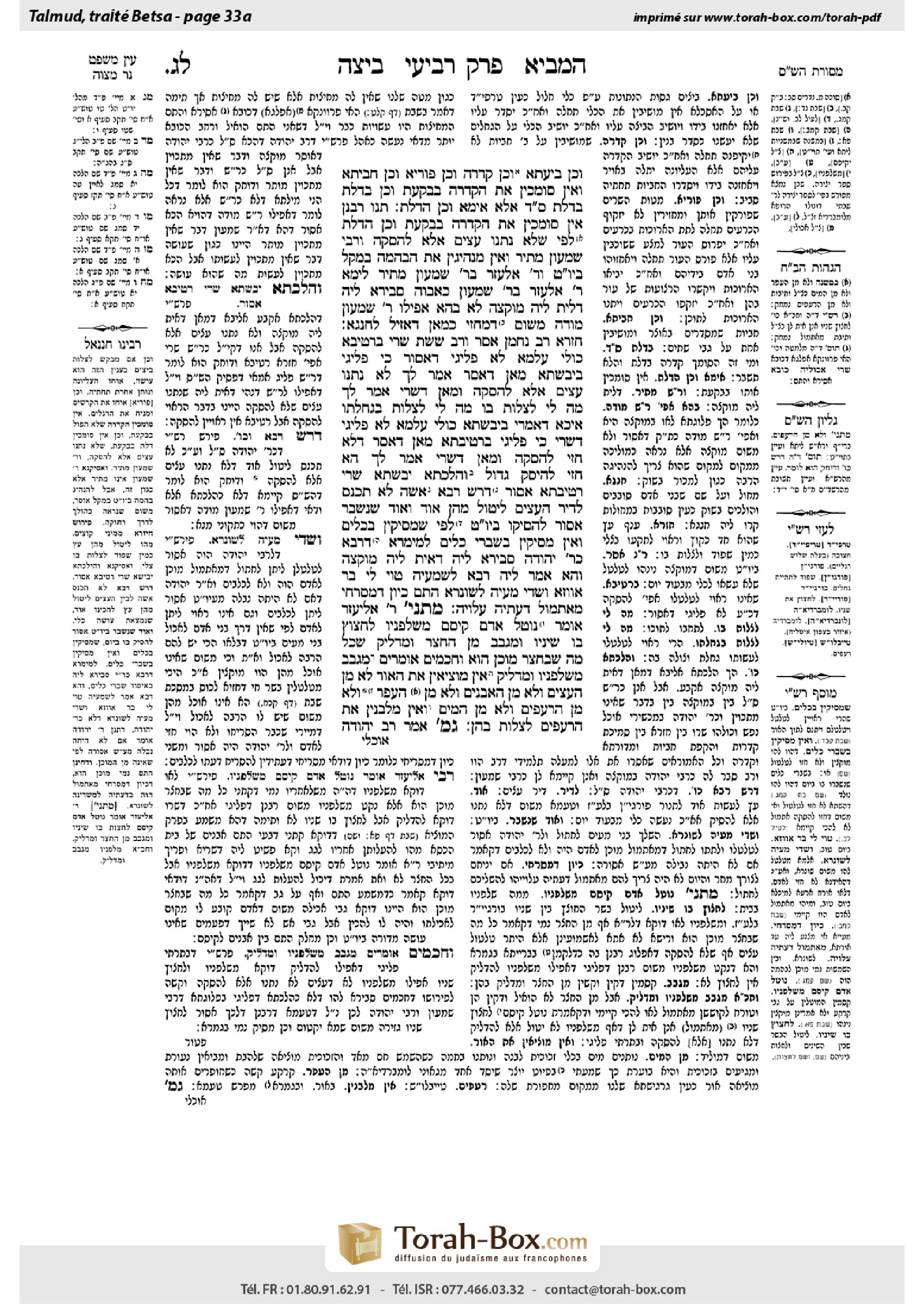
This page of Beitzah includes the Aramaic text, an English translation and an AI-generated French translation, alongside the scan above.
ביצה ל״ג א · Aramaic and Hebrew text
וְכֵן בֵּיעֲתָא, וְכֵן קְדֵרָה, וְכֵן פּוּרְיָא, וְכֵן חָבִיתָא.
וְאֵין סוֹמְכִין אֶת הַקְּדֵרָה בַּבְּקַעַת, וְכֵן בַּדֶּלֶת. בַּדֶּלֶת סָלְקָא דַּעְתָּךְ?! אֶלָּא אֵימָא: וְכֵן הַדֶּלֶת. תָּנוּ רַבָּנַן: אֵין סוֹמְכִין אֶת הַקְּדֵרָה בַּבְּקַעַת, וְכֵן הַדֶּלֶת, לְפִי שֶׁלֹּא נִתְּנוּ עֵצִים אֶלָּא לְהַסָּקָה. וְרַבִּי שִׁמְעוֹן מַתִּיר.
וְאֵין מַנְהִיגִין אֶת הַבְּהֵמָה בַּמַּקֵּל בְּיוֹם טוֹב, וְרַבִּי אֶלְעָזָר בְּרַבִּי שִׁמְעוֹן מַתִּיר. לֵימָא רַבִּי אֶלְעָזָר בְּרַבִּי שִׁמְעוֹן כַּאֲבוּהּ סְבִירָא לֵיהּ, דְּלֵית לֵיהּ מוּקְצֶה? לָא, בְּהָא אֲפִילּוּ רַבִּי שִׁמְעוֹן מוֹדֶה, מִשּׁוּם דְּמִחֲזֵי כְּמַאן דְּאָזֵיל לְחִנְגָּא.
חִזְרָא, רַב נַחְמָן אָסַר, וְרַב שֵׁשֶׁת שָׁרֵי. בְּרַטִּיבָא — כּוּלֵּי עָלְמָא לָא פְּלִיגִי דְּאָסוּר. כִּי פְּלִיגִי — בְּיַבִּשְׁתָּא. מַאן דְּאָסַר, אָמַר לָךְ: לֹא נִתְּנוּ עֵצִים אֶלָּא לְהַסָּקָה. וּמַאן דְּשָׁרֵי, אָמַר לָךְ: מָה לִי לִצְלוֹת בּוֹ, מָה לִי לִצְלוֹת בְּגַחַלְתּוֹ?
אִיכָּא דְּאָמְרִי: בְּיַבִּשְׁתָּא — כּוּלֵּי עָלְמָא לָא פְּלִיגִי דִּשְׁרֵי. כִּי פְּלִיגִי — בְּרַטִּיבְתָּא. מַאן דְּאָסַר, דְּלָא חֲזֵי לְהַסָּקָה, וּמַאן דְּשָׁרֵי אָמַר לָךְ: הָא חֲזֵי לְהֶיסֵּק גָּדוֹל. וְהִלְכְתָא: יַבִּשְׁתָּא שְׁרֵי, רַטִּיבְתָּא אֲסִיר.
דָּרֵשׁ רָבָא: אִשָּׁה לֹא תִּכָּנֵס לְדִיר הָעֵצִים לִיטּוֹל מֵהֶן אוּד. וְאוּד שֶׁנִּשְׁבַּר — אָסוּר לְהַסִּיקוֹ בְּיוֹם טוֹב, לְפִי שֶׁמַּסִּיקִין בְּכֵלִים, וְאֵין מַסִּיקִין בְּשִׁבְרֵי כֵלִים.
לְמֵימְרָא דְּרָבָא כְּרַבִּי יְהוּדָה סְבִירָא לֵיהּ, דְּאִית לֵיהּ מוּקְצֶה? וְהָא אֲמַר לֵיהּ רָבָא לְשַׁמָּעֵיהּ: טְוִי לִי בַּר אֲווֹזָא וּשְׁדִי מְעֵיהּ לְשׁוּנָּרָא! הָתָם כֵּיוָן דְּמַסְרְחִי — מֵאֶתְמוֹל דַּעְתֵּיהּ עִלָּוֵיהּ.
מַתְנִי׳ רַבִּי אֱלִיעֶזֶר אוֹמֵר: נוֹטֵל אָדָם קֵיסָם מִשֶּׁלְּפָנָיו, לַחְצוֹץ בּוֹ שִׁינָּיו. וּמְגַבֵּב מִן הֶחָצֵר וּמַדְלִיק, שֶׁכׇּל מַה שֶּׁבֶּחָצֵר — מוּכָן הוּא. וַחֲכָמִים אוֹמְרִים: מְגַבֵּב מִשֶּׁלְּפָנָיו וּמַדְלִיק.
אֵין מוֹצִיאִין אֶת הָאוּר לֹא מִן הָעֵצִים, וְלֹא מִן הָאֲבָנִים, וְלֹא מִן הֶעָפָר וְלֹא מִן הָרְעָפִים, וְלֹא מִן הַמַּיִם. וְאֵין מְלַבְּנִין אֶת הָרְעָפִים לִצְלוֹת בָּהֶן.
גְּמָ׳ אָמַר רַב יְהוּדָה:
Beitzah 33a · English translation
And similarly, if one wishes to place eggs on the mouth of a hollow vessel or on a grill sitting above coals, he must first hold the vessel in his hands and put the eggs on it, and only afterward position them both on the coals. And similarly, with regard to a pot placed on barrels, one must hold the pot above the barrels before placing them underneath it. And similarly, in the case of a collapsible bed, whose legs and cover are separate pieces, one must first stretch the upper part, then add the legs. And similarly, in the case of barrels positioned one on top of the other, the upper one must be held in place first and then the others added below.
§ It was taught in the mishna: And one may not prop a pot with a piece of wood, and similarly a door. The Gemara asks: With regard to a door, can this enter your mind? Is it possible to prop a pot by means of a door? Rather, say and correct the wording as follows: And similarly, one may not prop a door with a piece of wood. The Sages taught: One may not prop a pot with a piece of wood, and similarly a door, as wood is to be used only for kindling. With regard to any use other than kindling, wood is considered muktze. And Rabbi Shimon, who does not accept the prohibition of muktze, permits it.
The baraita continues: And one may not lead an animal with a stick on a Festival, but Rabbi Elazar, son of Rabbi Shimon, permits it. The Gemara asks: Shall we say that Rabbi Elazar, son of Rabbi Shimon, holds in accordance with the opinion of his father, Rabbi Shimon, who is not of the opinion that there is a prohibition of muktze, and he therefore permits one to take any stick and lead an animal with it? The Gemara rejects this: No, there is no issue of muktze here at all, for in this case even Rabbi Shimon concedes to the first tanna that this activity is prohibited, not due to muktze but because one who does so looks like one who is going to the market [ḥinga] in the manner of a weekday. On a Festival, one must therefore lead the animal in an unusual fashion.
§ In a case where one takes a bamboo branch to use as a skewer, Rav Naḥman prohibits it because it is muktze, since it was not made into a vessel the day before, and Rav Sheshet permits it. The Gemara elaborates: In the case of a wet branch, everyone agrees that it is prohibited; it is unfit for kindling and is therefore muktze. When they disagree, it is in the case of a dry branch. The one who prohibits handling it, Rav Naḥman, could have said to you: Wood is only for kindling, but it is considered muktze with regard to any other use. And the one who permits handling it, Rav Sheshet, could have said to you: Since all wood is to be used for roasting, what is it to me to roast with it when it is inserted into meat? What is it to me to roast with its coals? Just as it is permitted to burn the bamboo as coal, so it is permitted to use it as a skewer for cooking.
Some say a different version of the explanation of this dispute: In the case of a dry branch, everyone agrees that it is permitted; when they disagree, it is in the case of a wet one. The one who prohibits handling it does so because it is not fit for kindling. And the one who permits it could have said to you: Isn’t it at least fit for a large fire, which will dry out the branch and enable it to burn as well? The Gemara concludes: And the halakha is that a dry one is permitted and a wet one is prohibited.
Rava taught: A woman may not enter a storehouse of wood in order to take from them a firebrand, a partly burnt piece of wood used for turning over the wood of the bonfire, because this piece of wood was not made into a vessel the day before and it is therefore muktze. And a firebrand that broke may not be kindled on a Festival, for one may kindle fire with vessels but one may not kindle fire with shards of vessels, and this firebrand was considered a vessel before it broke.
The Gemara asks: Is that to say that in this case Rava holds in accordance with the opinion of Rabbi Yehuda, who is of the opinion that there is a prohibition of muktze? But didn’t Rava say to his attendant: Roast a duck for me, and throw its innards to the cat? According to Rabbi Yehuda, it is prohibited to give the innards to animals, as they were not prepared for this purpose the day before. The Gemara answers: There, since the innards become rancid when they were left, from yesterday, the Festival eve, his mind was on them. At that point in time, he already intended to give them to the cats in his house.
MISHNA: Rabbi Eliezer says: On a Festival, a person may remove a sliver from a pile of straw or from similar material that is before him, in order to clean with it between his teeth. And he may collect straw from a courtyard and kindle it, for anything in a courtyard is considered prepared for all purposes. The Rabbis say: He may collect these materials only from things placed before him in his house, as they are certainly prepared for all uses, and kindle them. With regard to objects lying in his courtyard, however, as their collection takes great effort, he certainly did not have them in mind the day before, and they are therefore muktze.
The mishna states a different halakha: One may not produce fire, neither from wood, by rubbing one piece against another; nor from stones knocked against each other; nor from hot dirt; nor from tiles struck against each other; nor from water placed in round, glass vessels, which produces fire by focusing the rays of the sun. And similarly, one may not whiten tiles with a burning-hot heat in order to roast upon them afterward.
GEMARA: Rav Yehuda said:
Beitzah 33a · Traduction française (IA)
Et de même, si l'on veut placer des œufs sur la bouche d'un récipient vide ou sur une grille placée au-dessus de braises, il faut d'abord tenir le récipient entre ses mains et poser les œufs dessus, et seulement ensuite les placer tous les deux sur les braises. Et de même, dans le cas d'une marmite placée sur des barils, il faut tenir la marmite au-dessus des barils avant de les placer sous elle. Et de même, dans le cas d'un lit pliant, dont les jambes et la couverture sont des pièces séparées, il faut d'abord étendre la partie supérieure, puis ajouter les jambes. Et de même, dans le cas de barils placés les uns sur les autres, le baril supérieur doit être tenu en place d'abord, puis les autres ajoutés en dessous.
§ Il fut enseigné dans la Michna : On ne doit pas soutenir une marmite avec un morceau de bois, et de même une porte. La Guemara demande : En ce qui concerne une porte, cela entre-t-il dans votre esprit ? Est-il possible de soutenir une marmite avec une porte ? Plutôt, dites et corrigiez la formulation comme suit : Et de même, on ne doit pas soutenir une porte avec un morceau de bois. Les Sages enseignent : On ne doit pas soutenir une marmite avec un morceau de bois, et de même une porte, car le bois est à utiliser uniquement pour allumer. En ce qui concerne toute autre utilisation, le bois est considéré comme muktze. Et Rabbi Shimon, qui ne reconnaît pas la prohibition de muktze, permet cela.
La baraïta continue : On ne doit pas faire marcher un animal avec un bâton pendant un festival, mais Rabbi Eléazar, fils de Rabbi Shimon, permet cela. La Guemara demande : Devons-nous dire que Rabbi Eléazar, fils de Rabbi Shimon, suit l'opinion de son père, Rabbi Shimon, qui ne considère pas la prohibition de muktze, et il permet donc de prendre n'importe quel bâton pour faire marcher l'animal ? La Guemara rejette cette interprétation : Non, il n'y a pas de problème de muktze ici du tout, car dans ce cas même Rabbi Shimon reconnaît la position du premier tanna que cette activité est interdite, pas en raison de muktze mais parce que celui qui le fait ressemble à quelqu'un qui va au marché [ḥinga] comme un jour de semaine. Pendant un festival, il faut donc faire marcher l'animal d'une manière inhabituelle.
§ Dans un cas où l'on prend une branche de bambou pour l'utiliser comme un bâton de grillage, Rav Naḥman l'interdit car c'est muktze, car elle n'a pas été faite en récipient la veille, et Rav Sheshet permet cela. La Guemara explique : Dans le cas d'une branche humide, tout le monde est d'accord pour l'interdire ; elle n'est pas adaptée à l'allumage et est donc muktze. Lorsqu'ils divergent, c'est dans le cas d'une branche sèche. Celui qui interdit l'utilisation de cette branche, Rav Naḥman, aurait pu dire : Le bois est uniquement utilisé pour l'allumage, mais il est considéré comme muktze en ce qui concerne toute autre utilisation. Et celui qui permet l'utilisation de cette branche, Rav Sheshet, aurait pu dire : Puisque tout le bois est utilisé pour la cuisson, à quoi m'importe de cuisiner avec lui quand il est inséré dans la viande ? À quoi m'importe de cuisiner avec ses braises ? Tout comme il est permis de brûler le bambou comme braise, il est permis d'utiliser ce bambou comme bâton de grillage pour la cuisson.
Certains donnent une autre version de l'explication de ce débat : Dans le cas d'une branche sèche, tout le monde est d'accord pour l'autoriser ; lorsqu'ils divergent, c'est dans le cas d'une branche humide. Celui qui interdit l'utilisation de cette branche le fait parce qu'elle n'est pas adaptée à l'allumage. Et celui qui permet l'utilisation pourrait dire : N'est-ce pas au moins adapté à un grand feu, qui séchera la branche et permettra qu'elle brûle aussi ? La Guemara conclut : Et la halakha est que la branche sèche est permise et la branche humide est interdite.
Rava enseigna : Une femme ne doit pas entrer dans un entrepôt de bois afin de prendre un morceau de bois pour allumer un feu, un morceau de bois partiellement brûlé utilisé pour retourner le bois du feu de camp, car ce morceau de bois n'a pas été fait en récipient la veille et est donc muktze. Et un morceau de bois qui s'est brisé ne doit pas être allumé pendant un festival, car on peut allumer un feu avec des récipients mais on ne peut pas allumer un feu avec des fragments de récipients, et ce morceau de bois était considéré comme un récipient avant qu'il ne se brise.
La Guemara demande : Est-ce que cela signifie que dans ce cas Rava suit l'opinion de Rabbi Yéhuda, qui considère que la prohibition de muktze existe ? Mais n'a-t-il pas dit à son serviteur : Faites cuire un canard pour moi, et jetez ses entrailles au chat ? Selon Rabbi Yéhuda, il est interdit de donner les entrailles aux animaux, car elles n'ont pas été préparées à cette fin la veille. La Guemara répond : Là, puisque les entrailles deviennent rances lorsqu'elles ont été laissées, depuis hier, le jour du festival, son esprit était sur elles. À ce moment-là, il avait déjà l'intention de les donner aux chats de sa maison.
MICHNA : Rabbi Eléazar dit : Pendant un festival, une personne peut retirer une fine lame d'un tas de paille ou d'un matériau similaire qui est devant lui, afin de nettoyer entre ses dents avec. Et il peut ramasser de la paille d'un jardin et l'allumer, car tout ce qui est dans un jardin est considéré comme préparé à toutes les utilisations. Les Rabbins disent : Il peut ramasser ces matériaux uniquement de choses placées devant lui dans sa maison, car ils sont certainement préparés à toutes les utilisations, et les allumer. En ce qui concerne les objets situés dans son jardin, cependant, puisque leur ramassage exige un grand effort, il n'a certainement pas eu l'intention la veille, et ils sont donc muktze.
La mitsva énonce une autre halakha : On ne doit pas produire du feu, ni à partir du bois, en frottant un morceau contre un autre ; ni à partir des pierres frappées les unes contre les autres ; ni à partir de la terre chaude ; ni à partir des tuiles frappées les unes contre les autres ; ni à partir de l'eau placée dans des récipients en verre ronds, qui produit du feu en concentrant les rayons du soleil. Et de même, on ne doit pas blanchir des tuiles avec une chaleur brûlante afin de les cuire ensuite dessus.
GUEMARA : Rav Yéhuda dit :
Traduction française générée par IA à partir de l’édition anglaise de Sefaria. Vérifie toujours un passage avec le texte source.
Text from Sefaria: William Davidson Edition - Vocalized Aramaic (CC BY NC); William Davidson Edition - English (CC BY NC).