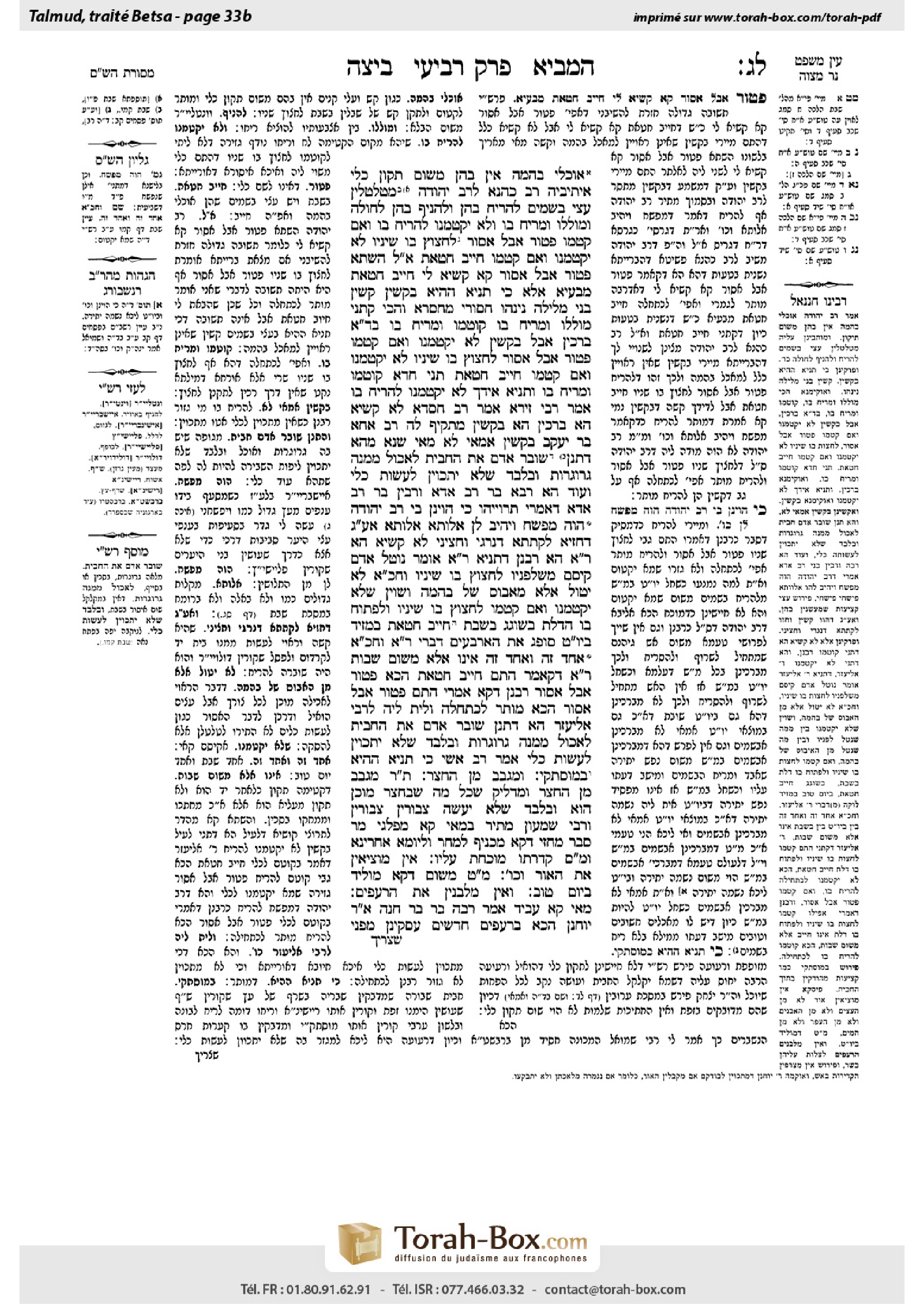
Beitzah 33b: Talmud study for Daf Yomi
Study the Talmud for Daf Yomi with scanned pages, Hebrew text, English translations from Sefaria and AI-generated French translations.
Passage selection and English or AI-generated French translation are available where the scan has annotations. Daf Study is independent of Torah-Box and Sefaria.
Browse Beitzah · ביצה · All tractatesBeitzah 33b text and translations
This page of Beitzah includes the Aramaic text, an English translation and an AI-generated French translation, alongside the scan above.
ביצה ל״ג ב · Aramaic and Hebrew text
אוֹכְלֵי בְּהֵמָה — אֵין בָּהֶן מִשּׁוּם תִּקּוּן כְּלִי.
אֵיתִיבֵיהּ רַב כָּהֲנָא לְרַב יְהוּדָה: מְטַלְטְלִין עֲצֵי בְּשָׂמִים לְהָרִיחַ בָּהֶן, וּלְהָנִיף בָּהֶן לַחוֹלֶה, וּמוֹלְלוֹ וּמֵרִיחַ בּוֹ. וְלֹא יִקְטְמֶנּוּ לְהָרִיחַ בּוֹ, וְאִם קְטָמוֹ — פָּטוּר אֲבָל אָסוּר. לַחְצוֹץ בּוֹ שִׁינָּיו — לָא יִקְטְמֶנּוּ, וְאִם קְטָמוֹ — חַיָּיב חַטָּאת!
אֲמַר לֵיהּ: הַשְׁתָּא פָּטוּר אֲבָל אָסוּר קָא קַשְׁיָא לִי, חַיָּיב חַטָּאת מִבַּעְיָא? אֶלָּא: כִּי תַּנְיָא הָהִיא בְּקָשִׁין. קָשִׁין בְּנֵי מְלִילָה נִינְהוּ?
חַסּוֹרֵי מְחַסְּרָא וְהָכִי קָתָנֵי: מוֹלְלוֹ וּמֵרִיחַ בּוֹ, קוֹטְמוֹ וּמֵרִיחַ בּוֹ. בַּמֶּה דְּבָרִים אֲמוּרִים — בְּרַכִּין, אֲבָל בְּקָשִׁין — לֹא יִקְטְמֶנּוּ, וְאִם קְטָמוֹ — פָּטוּר אֲבָל אָסוּר. לַחְצוֹץ בּוֹ שִׁינָּיו — לֹא יִקְטְמֶנּוּ, וְאִם קְטָמוֹ — חַיָּיב חַטָּאת.
תָּנֵי חֲדָא: קוֹטְמוֹ וּמֵרִיחַ בּוֹ, תַּנְיָא אִידַּךְ: לֹא יִקְטְמֶנּוּ לְהָרִיחַ בּוֹ. אָמַר רַבִּי זֵירָא אָמַר רַב חִסְדָּא, לָא קַשְׁיָא: הָא — בְּרַכִּין, הָא — בְּקָשִׁין.
מַתְקֵיף לַהּ רַב אַחָא בַּר יַעֲקֹב: בְּקָשִׁין אַמַּאי לָא? מַאי שְׁנָא מֵהָא דִּתְנַן: שׁוֹבֵר אָדָם אֶת הֶחָבִית לֶאֱכוֹל מִמֶּנָּה גְּרוֹגְרוֹת, וּבִלְבַד שֶׁלֹּא יִתְכַּוֵּין לַעֲשׂוֹת כְּלִי! וְעוֹד: הָא רָבָא בַּר רַב אַדָּא וְרָבִין בַּר רַב אַדָּא דְּאָמְרִי תַּרְוַיְיהוּ: כִּי הֲוֵינַן בֵּי רַב יְהוּדָה, הֲוָה מְפַשַּׁח וְיָהֵיב לַן אַלְוָתָא אַלְוָתָא, אַף עַל גַּב דְּחַזְיָא לְקַתָּתָא דְּנַרְגֵי וַחֲצִינֵי.
לָא קַשְׁיָא: הָא רַבִּי אֱלִיעֶזֶר, הָא רַבָּנַן. דְּתַנְיָא, רַבִּי אֱלִיעֶזֶר אוֹמֵר: נוֹטֵל אָדָם קֵיסָם מִשֶּׁלְּפָנָיו לַחְצוֹץ בּוֹ שִׁינָּיו, וַחֲכָמִים אוֹמְרִים: לֹא יִטּוֹל אֶלָּא מֵאֵבוּס שֶׁל בְּהֵמָה. וְשָׁוִין שֶׁלֹּא יִקְטְמֶנּוּ, וְאִם קְטָמוֹ לַחְצוֹץ בּוֹ שִׁינָּיו וְלִפְתּוֹחַ בּוֹ הַדֶּלֶת, בְּשׁוֹגֵג בְּשַׁבָּת — חַיָּיב חַטָּאת, בְּמֵזִיד בְּיוֹם טוֹב — סוֹפֵג אֶת הָאַרְבָּעִים, דִּבְרֵי רַבִּי אֱלִיעֶזֶר.
וַחֲכָמִים אוֹמְרִים: אֶחָד זֶה וְאֶחָד זֶה, אֵינוֹ אֶלָּא מִשּׁוּם שְׁבוּת. רַבִּי אֱלִיעֶזֶר דְּקָאָמַר הָתָם חַיָּיב חַטָּאת — הָכָא פָּטוּר אֲבָל אָסוּר. רַבָּנַן דְּקָא אָמְרִי הָתָם פָּטוּר אֲבָל אָסוּר — הָכָא מוּתָּר לְכַתְּחִלָּה.
וְלֵית לֵיהּ לְרַבִּי אֱלִיעֶזֶר הָא דִּתְנַן: שׁוֹבֵר אָדָם אֶת הֶחָבִית לֶאֱכוֹל מִמֶּנָּה גְּרוֹגְרוֹת, וּבִלְבַד שֶׁלֹּא יִתְכַּוֵּין לַעֲשׂוֹת כְּלִי? אָמַר רַב אָשֵׁי: כִּי תַּנְיָא הָהִיא, בְּמוּסְתָּקִי.
וּמְגַבֵּב מִן הֶחָצֵר. תָּנוּ רַבָּנַן: מְגַבֵּב מִן הֶחָצֵר וּמַדְלִיק, שֶׁכׇּל מַה שֶּׁבֶּחָצֵר מוּכָן הוּא, וּבִלְבַד שֶׁלֹּא יַעֲשֶׂה צִבּוּרִין צִבּוּרִין. וְרַבִּי שִׁמְעוֹן מַתִּיר. בְּמַאי קָא מִפַּלְגִי? מָר סָבַר: מִחֲזֵי דְּקָא מְכַנֵּיף לִמְחַר וּלְיוֹמָא אַחֲרִינָא. וּמָר סָבַר: קְדֵרָתוֹ מוֹכַחַת עָלָיו.
אֵין מוֹצִיאִין אֶת הָאוּר וְכוּ׳. מַאי טַעְמָא? מִשּׁוּם דְּקָא מוֹלֵיד בְּיוֹם טוֹב.
וְאֵין מְלַבְּנִין אֶת הָרְעָפִים. מַאי קָא עָבֵיד? אָמַר רַבָּה בַּר בַּר חָנָה אָמַר רַבִּי יוֹחָנָן: הָכָא בִּרְעָפִים חֲדָשִׁים עָסְקִינַן, מִפְּנֵי
Beitzah 33b · English translation
Animal fodder, such as straw and reed branches, does not have any associated prohibition due to the preparing of a vessel. One may therefore trim it on Shabbat and use it as one wishes.
Rav Kahana raised an objection to Rav Yehuda from the following baraita: One may handle wood of a spice tree on Shabbat in order to smell them and to wave them before a sick person to fan him. And he may crush it between his fingers to release its fragrance, and he may smell it. However, he may not cut it from the branch in order to produce a moist spot on the branch that will emit a strong fragrance, so as to smell it; and if he did cut it, he is exempt from punishment according to Torah law, but it is prohibited to do so. If he intends to clean his teeth with it, he may not cut it, and if he did cut it, he is liable to bring a sin-offering for transgressing a prohibited labor on Shabbat. This indicates that although some wood of a spice tree was used as animal fodder, it is nevertheless prohibited to cut it. This appears to contradict Rav Yehuda.
Rav Yehuda said to Rav Kahana: Now, even the statement exempt but prohibited poses a difficulty to my opinion, and it is not reasonable. Is it required to say the opposite, i.e., liable to bring a sin-offering? This teaching cannot be understood at face value; rather, it must be understood as follows: When that baraita was taught, it was referring to hard pieces of wood such as beams, with regard to which there is a concern that one might perform a prohibited labor. The Gemara questions this: And can hard branches be crushed by hand?
The Gemara replies: The baraita is incomplete and is teaching the following: With regard to wood of a spice tree, one may crush it and smell it and cut it and smell it. In what case is this statement said? With regard to soft pieces of wood, but with regard to hard ones, one may not cut them. And if he did cut it he is exempt, but it is prohibited to do so. If he intended to clean his teeth with it, he may not cut it, and if he did cut it, he is liable to bring a sin-offering.
Similarly, it is taught in one baraita: One may cut it and smell it, and it is taught in another baraita: One may not cut it to smell it. Rabbi Zeira said that Rav Ḥisda said: This is not difficult. In this case, when it is permitted, it is referring to soft wood. In that case, where the baraita prohibits it, it is referring to hard pieces of wood.
With regard to the halakha itself, Rav Aḥa bar Ya’akov strongly objects to this: With hard ones, why not? In what way is this case different from that which we learned in a mishna: A person may break a barrel in order to eat dried figs from it, provided that he does not thereby intend to make a vessel, and he may use the barrel afterward. Breaking off wood in order to smell it is certainly not more of a prohibited labor than breaking a barrel. And furthermore, it is Rava bar Rav Adda and Ravin bar Rav Adda, who both say: When we were at the house of Rav Yehuda, he would break and give us many sticks of wood of a spice tree, although they were hard enough to be fit for handles of axes and hatchets.
The Gemara answers: This is not difficult; this case is in accordance with the opinion of Rabbi Eliezer, whereas that case follows the Rabbis. As it is taught in a baraita: Rabbi Eliezer says: On Shabbat or a Festival, a person may take a sliver of wood from before him to clean his teeth with it, and the Rabbis say: One may take a toothpick only from an animal’s trough; since it is fit for animal fodder, it is considered prepared for all purposes. And they agree that he may not pluck it. And if he did pluck it to clean his teeth with it or to use it as a key and open a door with it, if he did so unwittingly on Shabbat, he is liable to bring a sin-offering. If he did so intentionally on a Festival, he receives the forty lashes administered to one who desecrates the Festival by performing labor. These are the words of Rabbi Eliezer.
And the Rabbis say: Both this and this, whether one did so on Shabbat or a Festival, even if he plucked it by hand to use it as a key, it is prohibited only due to a rabbinic decree. Therefore, Rabbi Eliezer, who states there that one who plucks a toothpick on Shabbat unwittingly in order to make a vessel such as a key is liable to bring a sin-offering, then here, in the case of one who cuts a sliver of wood in order to smell it, he is exempt, but it is prohibited. However, the Rabbis who state there, in the case of plucking a toothpick, that he is exempt but it is prohibited, then here, when one cuts a sliver of wood for purposes of smelling, it is permitted ab initio.
The Gemara asks: And does Rabbi Eliezer not accept this halakha that we learned in a mishna: A person may break a barrel in order to eat dried figs from it, provided that he does not thereby intend to make a vessel? This shows that if one does not intend to make a vessel, it is permitted ab initio; whereas Rabbi Eliezer maintains that he is exempt, but it is prohibited. The Gemara answers: Rav Ashi said: When that baraita was taught, its lenient ruling was with regard to a vessel patched with pitch [mustaki], meaning a vessel that had previously been broken and its pieces glued together with pitch. If one breaks it for his own needs, he does not smash a complete vessel, and he is therefore not considered to have fashioned a vessel.
§ It is taught in the mishna: And one may collect straw from the courtyard on a Festival. The Sages taught: One may collect materials from a courtyard and kindle a fire because everything in a courtyard is considered prepared, provided he does not arrange it in piles, and Rabbi Shimon permits it even in such a manner. The Gemara asks: With regard to what do they disagree; what is the basis of their dispute? One Sage, i.e., the Rabbis, who are stringent, holds: It looks as though he is collecting for tomorrow and another day, and it is therefore prohibited, so that one will not be suspected of preparing from a Festival to a weekday. And one Sage, Rabbi Shimon, holds: His pot proves his intention. When onlookers see that he is using the straw for cooking, they will not suspect him of preparing for after the Festival.
§ It is taught in the mishna that one may not produce new fire on a Festival in any manner. The Gemara asks: What is the reason for this? The Gemara explains: Because he creates something new on a Festival. This is similar to an act of creation, and it is therefore prohibited.
§ The mishna states that one may not whiten tiles by heating them, in order to roast food on them. The Gemara asks: What does one thereby do; since his intention is to prepare food, how does this differ from any other manner of roasting? Rabba bar bar Ḥana said that Rabbi Yoḥanan said: Here we are dealing with new tiles, and it is prohibited because
Beitzah 33b · Traduction française (IA)
Le foin et les branches de roseau, qui sont des aliments pour les animaux, ne sont pas soumis à une interdiction en raison de la préparation d'un récipient. On peut donc les tailler le sabbat et les utiliser comme on l'entend.
Rav Kahana a soulevé un objet contre Rav Yehuda à partir de la suivante baraïta : On peut manipuler le bois des arbres aromatiques le sabbat afin de les sentir et de les agiter devant une personne malade pour le faire respirer. Il peut aussi les écraser entre ses doigts pour libérer leur parfum et les sentir. Cependant, il ne peut pas les couper de la branche afin de produire un point humide sur la branche qui émettrait un parfum fort, afin de les sentir ; et s'il a coupé le bois, il est exempt de punition selon la loi juive, mais il est interdit de le faire. Si l'intention est de se nettoyer les dents avec cela, il ne peut pas le couper, et s'il l'a coupé, il est tenu responsable de présenter un sacrifice expiatoire pour avoir transgressé une activité interdite le sabbat. Cela montre que même si certaines branches de bois aromatiques étaient utilisées comme nourriture pour les animaux, il est tout de même interdit de les couper. Cela semble contredire Rav Yehuda.
Rav Yehuda a dit à Rav Kahana : Maintenant, même l'affirmation d'exemption mais d'interdiction pose un problème pour mon opinion, et cela n'est pas raisonnable. Faut-il dire l'opposé, c'est-à-dire être tenu responsable de présenter un sacrifice expiatoire ? Cet enseignement ne peut pas être compris à la lettre ; il faut le comprendre ainsi : Lorsque cette baraïta a été enseignée, elle faisait référence à des morceaux durs de bois tels que des poutres, concernant lesquels il y a une crainte qu'on accomplisse une activité interdite. La Guemara questionne cela : Et peut-on écraser des branches dures à la main ?
La Guemara répond : Cette baraïta est incomplète et enseigne ceci : Concernant le bois des arbres aromatiques, on peut l'écraser et le sentir, le couper et le sentir. Dans quel cas cette déclaration est-elle dite ? Concernant des morceaux de bois mous, mais concernant des morceaux durs, on ne peut pas les couper. Et s'il les a coupés, il est exempt, mais il est interdit de le faire. Si l'intention est de se nettoyer les dents avec cela, il ne peut pas le couper, et s'il l'a coupé, il est tenu responsable de présenter un sacrifice expiatoire.
De même, il est enseigné dans une baraïta : On peut le couper et le sentir, et il est enseigné dans une autre baraïta : On ne peut pas le couper pour le sentir. Rabbi Zeira a dit que Rav Ḥisda a dit : Cela n'est pas difficile. Dans ce cas, lorsque cela est permis, il s'agit de bois mous. Dans ce cas, où la baraïta interdit cela, il s'agit de morceaux durs de bois.
Concernant la halakha elle-même, Rav Aḥa bar Ya’akov s'oppose fermement à cela : Pour les durs, pourquoi pas ? Dans quelle mesure ce cas diffère-t-il de celui que nous avons appris dans une mitsva : Une personne peut briser un tonneau afin de manger des figues sèches à partir de lui, à condition qu'il n'ait pas l'intention de faire un récipient, et il peut utiliser le tonneau après. Briser un morceau de bois afin de le sentir est certainement moins interdit qu'une activité interdite que de briser un tonneau. Et de plus, c'est Rava bar Rav Adda et Ravin bar Rav Adda qui disent tous les deux : Lorsque nous étions chez Rav Yehuda, il nous donnait beaucoup de morceaux de bois aromatiques, même s'ils étaient durs suffisamment pour être adaptés aux manches des haches et des marteaux.
La Guemara répond : Cela n'est pas difficile ; ce cas suit l'opinion de Rabbi Eliezer, tandis que celui-ci suit les Rabbins. Comme il est enseigné dans une baraïta : Rabbi Eliezer dit : Le sabbat ou un festival, une personne peut prendre un morceau de bois devant lui pour se nettoyer les dents avec. Les Rabbins disent : On peut prendre un bâton de dents seulement d'une mangeoire d'animaux ; puisque c'est adapté à la nourriture animale, il est considéré comme préparé à toutes les utilisations. Et ils s'accordent sur le fait qu'on ne peut pas le tirer. Et s'il l'a tiré pour se nettoyer les dents ou pour l'utiliser comme une clé et ouvrir une porte, s'il l'a fait sans intention le sabbat, il est tenu responsable de présenter un sacrifice expiatoire. S'il l'a fait intentionnellement un festival, il reçoit les quarante coups administrés à celui qui profane le festival par une activité. Ces sont les paroles de Rabbi Eliezer.
Et les Rabbins disent : Les deux, que ce soit le sabbat ou le festival, même s'il l'a tiré à la main pour l'utiliser comme une clé, il est interdit seulement en vertu d'un décret rabbinique. Donc Rabbi Eliezer, qui dit là que celui qui tire un bâton de dents le sabbat sans intention pour faire un récipient tel qu'une clé est tenu responsable de présenter un sacrifice expiatoire, alors ici, dans le cas où l'on coupe un morceau de bois pour le sentir, il est exempt, mais il est interdit. Cependant, les Rabbins qui disent là, dans le cas de tirer un bâton de dents, qu'il est exempt mais interdit, alors ici, dans le cas où l'on coupe un morceau de bois pour des raisons de sent, il est permis dès le début.
La Guemara demande : Et Rabbi Eliezer ne accepte-t-il pas cette halakha que nous avons appris dans une mitsna : Une personne peut briser un tonneau afin de manger des figues sèches à partir de lui, à condition qu'il n'ait pas l'intention de faire un récipient ? Cela montre que si l'intention n'est pas de faire un récipient, il est permis dès le début ; alors que Rabbi Eliezer maintient qu'il est exempt, mais il est interdit. La Guemara répond : Rav Ashi a dit : Lorsque cette baraïta a été enseignée, sa décision leniente était concernant un récipient réparé avec de la cire [mustaki], c'est-à-dire un récipient qui avait été brisé et dont les morceaux avaient été collés avec de la cire. Si l'on brise cela pour ses besoins, il ne brise pas un récipient complet, et il n'est donc pas considéré comme avoir façonné un récipient.
§ Il est enseigné dans la mitsna : Et l'on peut ramasser du foin du jardin pendant le festival. Les Sages ont enseigné : On peut ramasser des matériaux du jardin et allumer un feu, car tout dans un jardin est considéré comme préparé, à condition qu'on ne l'empile pas, et Rabbi Shimon permet cela même dans ce cas. La Guemara demande : Concernant quoi s'entendent-ils ? Quelle est la base de leur débat ? Un Sage, c'est-à-dire les Rabbins, qui sont stricts, dit : Il semble qu'il ramasse pour demain et un autre jour, et c'est donc interdit, afin que l'on ne soit pas soupçonné de préparer du festival à un jour de semaine. Et un Sage, Rabbi Shimon, dit : Son pot prouve son intention. Lorsque les spectateurs voient qu'il utilise le foin pour cuisiner, ils ne soupçonnent pas qu'il prépare pour après le festival.
§ Il est enseigné dans la mishna que l'on ne peut pas produire un feu nouveau pendant un festival de toute manière. La Guemara demande : Quelle est la raison de cela ? La Guemara explique : Parce qu'il crée quelque chose de nouveau pendant un festival. Cela ressemble à un acte de création, et il est donc interdit.
§ La mishna stipule que l'on ne peut pas blanchir des carreaux en les chauffant afin de cuire de la nourriture dessus. La Guemara demande : Qu'est-ce que l'on fait ainsi ; puisque son intention est de préparer de la nourriture, comment cela diffère-t-il d'une autre manière de cuire ? Rabba bar bar Ḥana a dit que Rabbi Yoḥanan a dit : Ici, nous parlons de nouveaux carreaux, et cela est interdit parce que
Traduction française générée par IA à partir de l’édition anglaise de Sefaria. Vérifie toujours un passage avec le texte source.
Text from Sefaria: William Davidson Edition - Vocalized Aramaic (CC BY NC); William Davidson Edition - English (CC BY NC).