Beitzah 34a: Talmud study for Daf Yomi
Study the Talmud for Daf Yomi with scanned pages, Hebrew text, English translations from Sefaria and AI-generated French translations.
Passage selection and English or AI-generated French translation are available where the scan has annotations. Daf Study is independent of Torah-Box and Sefaria.
Browse Beitzah · ביצה · All tractatesBeitzah 34a text and translations
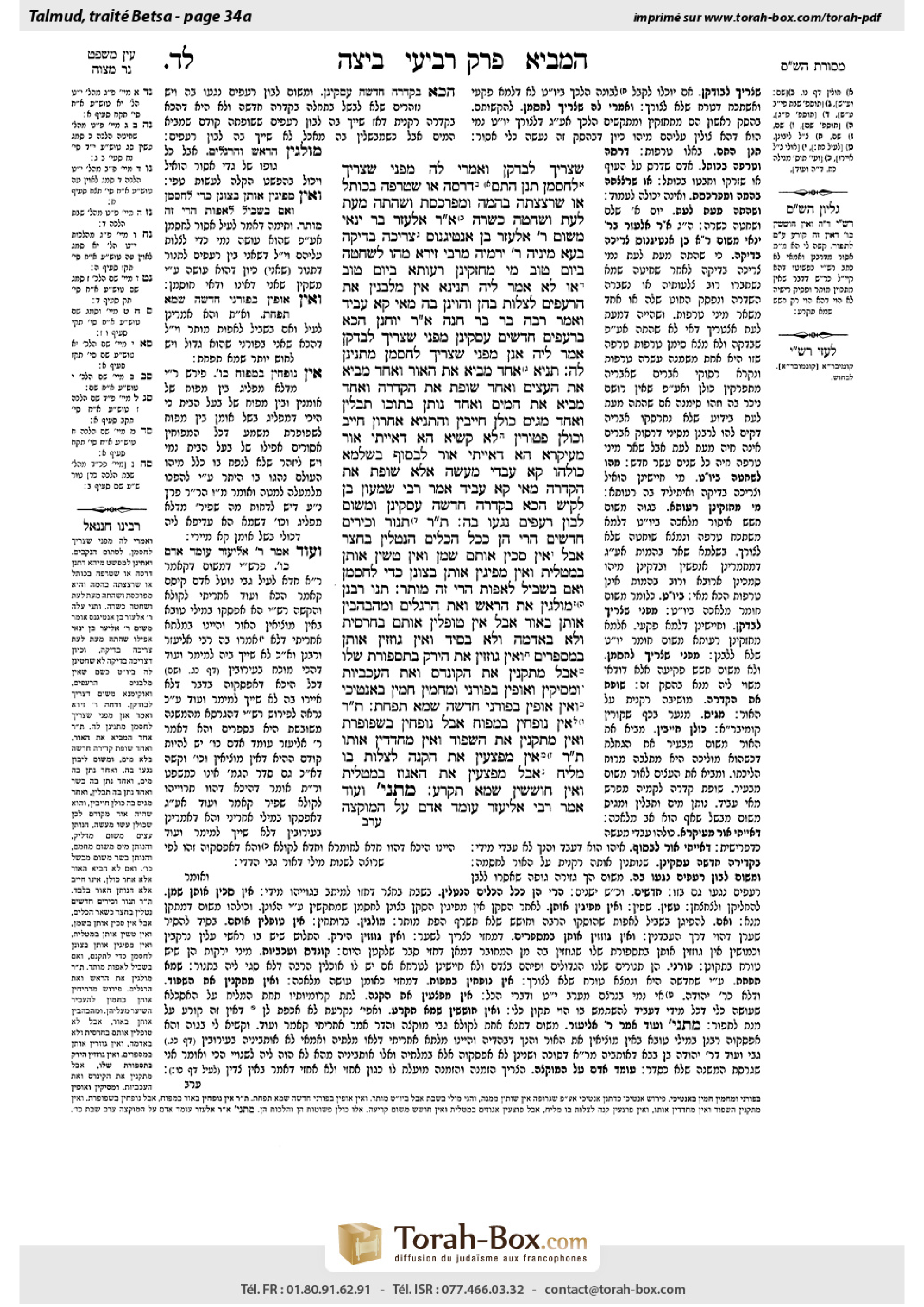
This page of Beitzah includes the Aramaic text, an English translation and an AI-generated French translation, alongside the scan above.
ביצה ל״ד א · Aramaic and Hebrew text
שֶׁצָּרִיךְ לְבׇדְקָן. וְאָמְרִי לַהּ: מִפְּנֵי שֶׁצָּרִיךְ לְחׇסְמָן.
תְּנַן הָתָם: דְּרָסָהּ אוֹ שֶׁטְּרָפָהּ בַּכּוֹתֶל, אוֹ שֶׁרְצָצַתָּה בְּהֵמָה וּמְפַרְכֶּסֶת, וְשָׁהֲתָה מֵעֵת לְעֵת וּשְׁחָטָהּ — כְּשֵׁרָה. אָמַר רַבִּי אֶלְעָזָר בַּר יַנַּאי מִשּׁוּם רַבִּי אֶלְעָזָר בֶּן אַנְטִיגְנוֹס: צְרִיכָה בְּדִיקָה.
בְּעָא מִינֵּיהּ רַבִּי יִרְמְיָה מֵרַבִּי זֵירָא: מַהוּ לְשׇׁחְטָהּ בְּיוֹם טוֹב? מִי מַחְזְקִינַן רֵעוּתָא בְּיוֹם טוֹב, אוֹ לָא?
אֲמַר לֵיהּ, תְּנֵינָא: אֵין מְלַבְּנִין אֶת הָרְעָפִים לִצְלוֹת בָּהֶן. וַהֲוֵינַן בַּהּ: מַאי קָא עָבֵיד? וְאָמַר רַבָּה בַּר בַּר חָנָה אָמַר רַבִּי יוֹחָנָן: הָכָא בִּרְעָפִים חֲדָשִׁים עָסְקִינַן, מִפְּנֵי שֶׁצָּרִיךְ לְבׇדְקָן.
אֲמַר לֵיהּ: אֲנַן מִפְּנֵי שֶׁצָּרִיךְ לְחׇסְמָן מַתְנִינַן לַהּ.
תַּנְיָא: אֶחָד מֵבִיא אֶת הָאוּר, וְאֶחָד מֵבִיא אֶת הָעֵצִים, וְאֶחָד שׁוֹפֵת אֶת הַקְּדֵרָה, וְאֶחָד מֵבִיא אֶת הַמַּיִם, וְאֶחָד נוֹתֵן בְּתוֹכוֹ תַּבְלִין, וְאֶחָד מֵגִיס — כּוּלָּן חַיָּיבִין. וְהָתַנְיָא: אַחֲרוֹן חַיָּיב וְכוּלָּן פְּטוּרִין! לָא קַשְׁיָא: הָא דְּאַיְיתִי אוּר מֵעִיקָּרָא, הָא דְּאַיְיתִי אוּר לְבַסּוֹף.
בִּשְׁלָמָא כּוּלְּהוּ קָא עָבְדִי מַעֲשֶׂה, אֶלָּא שׁוֹפֵת אֶת הַקְּדֵרָה מַאי קָא עָבֵיד? אָמַר רַבִּי שִׁמְעוֹן בֶּן לָקִישׁ: הָכָא בִּקְדֵרָה חֲדָשָׁה עָסְקִינַן, וּמִשּׁוּם לִבּוּן רְעָפִים נָגְעוּ בָּהּ.
תָּנוּ רַבָּנַן: תַּנּוּר וְכִירַיִם חֲדָשִׁים — הֲרֵי הֵן כְּכׇל הַכֵּלִים הַנִּטָּלִין בֶּחָצֵר. אֲבָל אֵין סָכִין אוֹתָם שֶׁמֶן, וְאֵין טָשִׁין אוֹתָן בְּמַטְלִית, וְאֵין מְפִיגִין אוֹתָן בְּצוֹנֵן כְּדֵי לְחׇסְמָן, וְאִם בִּשְׁבִיל לֶאֱפוֹת — הֲרֵי זֶה מוּתָּר.
תָּנוּ רַבָּנַן: מוֹלְגִין אֶת הָרֹאשׁ וְאֶת הָרַגְלַיִם וּמְהַבְהֲבִין אוֹתָן בָּאוּר, אֲבָל אֵין טוֹפְלִין אוֹתָם בְּחַרְסִית, וְלֹא בַּאֲדָמָה, וְלֹא בְּסִיד. וְאֵין גּוֹזְזִין אוֹתָן בְּמִסְפָּרַיִם.
וְאֵין גּוֹזְזִין אֶת הַיָּרָק בַּתִּסְפּוֹרֶת שֶׁלּוֹ. אֲבָל מְתַקְּנִין אֶת הַקּוּנְדָּס וְאֶת הָעַכָּבִיּוֹת, וּמַסִּיקִין וְאוֹפִין בְּפוּרְנִי, וּמְחַמִּין חַמִּין בְּאַנְטִיכִי, וְאֵין אוֹפִין בְּפוּרְנִי חֲדָשָׁה שֶׁמָּא תִּפָּחֵת.
תָּנוּ רַבָּנַן: אֵין נוֹפְחִין בְּמַפּוּחַ, אֲבָל נוֹפְחִין בִּשְׁפוֹפֶרֶת. וְאֵין מְתַקְּנִין אֶת הַשַּׁפּוּד, וְאֵין מְחַדְּדִין אוֹתוֹ. תָּנוּ רַבָּנַן: אֵין מְפַצְּעִין אֶת הַקָּנֶה לִצְלוֹת בּוֹ מָלִיחַ, אֲבָל מְפַצְּעִין אֶת הָאֱגוֹז בְּמַטְלִית, וְאֵין חוֹשְׁשִׁין שֶׁמָּא תִּקָּרַע.
מַתְנִי׳ וְעוֹד אָמַר רַבִּי אֱלִיעֶזֶר: עוֹמֵד אָדָם עַל הַמּוּקְצֶה
Beitzah 34a · English translation
it is necessary to test them to ensure that they do not burst when heated. If they are heated for the first time on a Festival, he will be thereby testing them, which is a prohibited labor. And some say: Because it is necessary to harden them by overheating them the first time to make them fit for use, which is considered preparing a vessel for use and is prohibited on a Festival.
In relation to the above, the Gemara cites the following teaching: We learned in a mishna there: If one trampled fowl with his foot, or threw it against a wall, or if an animal crushed it, and it is twitching but cannot stand; if the animal waited, i.e., remained alive, from the time of the injury until the same time twenty-four hours later, and he subsequently slaughtered it, it is kosher, provided no other defect is found in it that would have caused it to die within twelve months, which would render it a tereifa. Rabbi Elazar bar Yannai said in the name of Rabbi Elazar ben Antigonus: It requires examination after slaughtering, to make sure it does not have a defect.
In relation to the same issue, Rabbi Yirmeya inquired of Rabbi Zeira: What is the halakha with regard to slaughtering it on a Festival? Do we assume on a Festival that it has a flaw or not? In other words, may one rely on the assumption that a typical chicken has no defect? Or perhaps, since there is concern with regard to this particular bird and it requires examination, one should refrain from slaughtering it lest it turn out to be a tereifa. If so, he will have performed labor for no purpose.
He said to him in response: We already learned that one may not whiten tiles in order to roast on them. And we discussed it: What does he thereby do? And Rabba bar bar Ḥana said that Rabbi Yoḥanan said: Here we are dealing with new tiles, and the Sages prohibited heating them because one first needs to test them, and they might crack when heated. If they were heated for the first time on a Festival and cracked, it would show that they were unfit for use, in which case heating them would have been an unnecessary labor. This indicates that one may not take a chance on a Festival with regard to something that might be flawed, and therefore a possible tereifa should be similarly prohibited.
He said to him: This is no proof; we learned that the reason for that halakha is because it is necessary to harden them in order to make them into proper vessels. Therefore, there is no connection between making a vessel and conducting an examination. Consequently, there is no reason to prohibit the slaughter of such a chicken on a Festival.
It is taught in a baraita: It is possible for several people to perform a single act of cooking on Shabbat, and all will be liable. How so? One brings the fire, and one brings the wood, and one places the pot on the stove, and one brings the water for the pot, and one puts spices into the food, and one stirs the pot; they are all liable for cooking. The Gemara wonders at this: But wasn’t it taught in a different baraita that the last one is liable and all the rest are exempt? The Gemara responds: This is not difficult. This case, where all are liable, is referring to a situation in which he brought fire at the outset, and therefore each of them performed part of the act of cooking; that case, where only the last one is liable, is referring to a situation in which he brought fire at the end. In that case, none of the earlier people performed any aspect of cooking at all, as the labor of cooking begins only from when fire is brought.
The Gemara asks: Granted, all of them performed an action that constitutes a prohibited labor, and they are therefore partners in a prohibited act and the desecration of Shabbat. But the one who places the pot on the stove, what prohibited labor has he performed? Rabbi Shimon ben Lakish said: Here we are dealing with a new pot, and due to whitening tiles they applied the same prohibition to it. This means that one is not liable for cooking the food in the pot but for strengthening the pot itself, as is the case with heating tiles.
§ The Sages taught in the Tosefta: New ovens and stoves are similar to all vessels that may be carried in a courtyard on a Festival, as one can place items on them. However, one may not anoint them with oil, nor rub them with a rag, nor cool them with cold liquids to harden them, as all these actions are considered preparing the vessel for use, which may not be done on a Festival. And if one did so in order to bake in the oven on the Festival itself, this is permitted.
§ The Sages taught in the Tosefta: During a Festival one may scald the head and the feet of a slaughtered animal with hot water in order to remove the hairs from them, and one may singe them in fire for this purpose, but one may not smear them with clay, nor earth, nor lime in order to remove the hairs because this involves great effort, and it appears as though he is processing the skin. And one may not shear those hairs with scissors, as it appears as though he is performing the labor of shearing in an effort to obtain the hairs themselves.
Similarly, one may not trim the top of the leaves connected to the vegetable with its special shears, but one may prepare kundas and akaviyot, bitter vegetables that can be eaten only after extensive cooking, although this involves great effort. And one may kindle fire and bake in a large baker’s oven [purnei], and one may heat water in an antikhi, a kind of large urn, but one may not bake in a new baker’s oven lest it break. If the oven cracks when heated because it was not properly made, one will have performed unnecessary work on a Festival.
§ The Sages taught similarly in the Tosefta: One may not blow a fire with bellows, because this is the manner of a weekday activity, but one may blow a fire with a tube, in an unusual manner. And one may not mend a skewer nor sharpen it. The Sages further taught in the Tosefta: One may not break a reed in order to make a kind of skewer upon which to roast salted fish, but one may crack a nut covered with a rag, and there is no concern lest it tear, for even if this occurs, no prohibited labor has been performed.
MISHNA: And Rabbi Eliezer further stated the following leniency: A person may stand over objects in storage, such as produce that he has for some reason previously set aside from use,
Beitzah 34a · Traduction française (IA)
Il est nécessaire de les tester pour s'assurer qu'ils ne se brisent pas lorsqu'ils sont chauffés. Si on les chauffe pour la première fois pendant un festival, il testera ainsi les bocaux, ce qui constitue un travail interdit. Et certains disent : car il est nécessaire de les durcir en les chauffant à haute température la première fois afin qu'ils soient adaptés à l'usage, ce qui est considéré comme la préparation d'un récipient à l'usage et est interdit pendant un festival.
En ce qui concerne l'enseignement ci-dessus, le Guemara cite l'enseignement suivant : Nous avons appris dans une mitsna : Si l'on foulait un oiseau avec son pied, ou si l'on le lançait contre un mur, ou si un animal l'écrasait, et s'il tressaillait mais ne pouvait pas se tenir debout ; si l'animal attendait, c'est-à-dire restait vivant, du moment de la blessure jusqu'au même moment vingt-quatre heures plus tard, et s'il tuait ensuite l'animal, il est considéré comme propre, à condition qu'aucun autre défaut ne soit trouvé dans l'animal qui aurait causé sa mort dans les douze mois précédents, ce qui le rendrait tereifa. Rabbi Elazar bar Yannai a dit en nom de Rabbi Elazar ben Antigonus : il faut examiner après la bête, pour s'assurer qu'elle n'a pas de défaut.
En ce qui concerne la même question, Rabbi Yirmeya a interrogé Rabbi Zeira : Quel est le halakha concernant la bête sur un festival ? Supposons-t-on sur un festival que la bête a un défaut ou non ? En d'autres termes, peut-on compter sur l'hypothèse selon laquelle un poulet ordinaire n'a pas de défaut ? Ou peut-être, en raison de la préoccupation concernant cette bête particulière et la nécessité d'examiner, devrait-on éviter de la tuer de peur qu'elle se révèle tereifa. Si c'est le cas, il aura accompli un travail inutile.
Il lui répondit : Nous avons déjà appris que l'on ne peut pas blanchir des carreaux pour cuire dessus. Et nous avons discuté de cela : Qu'est-ce qu'il fait alors ? Et Rabba bar bar Ḥana dit que Rabbi Yoḥanan a dit : Ici nous sommes en présence de carreaux nouveaux, et les Sages ont interdit de les chauffer car l'on doit d'abord les tester, et ils pourraient se fissurer lorsqu'ils sont chauffés. Si on les avait chauffés pour la première fois pendant un festival et qu'ils se fissuraient, cela montrerait qu'ils n'étaient pas adaptés à l'usage, dans ce cas le chauffage aurait été un travail inutile. Cela indique que l'on ne doit pas prendre de risques sur un festival concernant quelque chose qui pourrait être défectueux, et par conséquent un possible tereifa devrait être interdit de la même manière.
Il lui dit : Cela n'est pas une preuve ; nous avons appris que la raison de cette halakha est qu'il est nécessaire de les durcir afin de les rendre en état de service. Par conséquent, il n'y a pas de lien entre la fabrication d'un récipient et l'examen. Ainsi, il n'y a pas de raison d'interdire la bataille de ce genre sur un festival.
Il est enseigné dans une baraïta : Il est possible que plusieurs personnes accomplissent ensemble un seul acte de cuisson le sabbat, et toutes seront tenues responsables. Comment cela se passe-t-il ? L'un allume le feu, l'autre apporte le bois, l'autre place la marmite sur la cuisinière, l'autre apporte l'eau pour la marmite, l'autre ajoute des épices à la nourriture, et l'autre remue la marmite ; tous sont tenus responsables de la cuisson. Le Guemara s'interroge sur cela : Mais n'avait-on pas appris dans une autre baraïta que seul le dernier est responsable et les autres sont exemptés ? Le Guemara répond : Cela n'est pas difficile. Ce cas, où tous sont responsables, fait référence à une situation où l'on a allumé le feu au début, et donc chacun a accompli une partie de l'acte de cuisson ; ce cas, où seul le dernier est responsable, fait référence à une situation où l'on a allumé le feu à la fin. Dans ce cas, aucun des personnes précédentes n'a accompli aucune partie de la cuisson, car l'acte de cuisson commence seulement lorsque le feu est allumé.
Le Guemara demande : D'accord, tous ont accompli une action qui constitue un travail interdit, et ils sont donc partenaires dans un acte interdit et la profanation du sabbat. Mais celui qui place la marmite sur la cuisinière, quel travail interdit a-t-il accompli ? Rabbi Shimon ben Lakish dit : Ici nous sommes en présence d'une marmite nouvelle, et en raison de la blanchiment des carreaux, on a appliqué la même interdiction à celle-ci. Cela signifie que l'on n'est pas tenu responsable de la cuisson de la nourriture dans la marmite, mais du renforcement de la marmite elle-même, comme c'est le cas avec le chauffage des carreaux.
§ Les Sages ont enseigné dans la Tosefta : Les fours et cuisinières nouveaux sont semblables à tous les récipients qui peuvent être portés dans un jardin pendant un festival, car l'on peut placer des objets dessus. Cependant, on ne peut pas les huiler, ni les frotter avec un chiffon, ni les refroidir avec des liquides froids pour les durcir, car toutes ces actions sont considérées comme la préparation du récipient à l'usage, ce qui ne peut pas être fait pendant un festival. Et si l'on l'a fait afin de cuire dans le four pendant le festival lui-même, cela est permis.
§ Les Sages ont enseigné dans la Tosefta : Pendant un festival, on peut faire bouillir la tête et les pieds d'un animal tué avec de l'eau chaude afin d'enlever les poils, et on peut les brûler dans le feu à cet effet, mais on ne peut pas les recouvrir de boue, de terre ou de chaux afin d'enlever les poils, car cela implique un grand effort et cela semble comme si l'on traitait la peau. Et on ne peut pas couper ces poils avec des ciseaux, car cela semble comme si l'on effectuait le travail de tonte afin d'obtenir les poils eux-mêmes.
De même, on ne peut pas tailler le sommet des feuilles attachées au légume avec ses ciseaux spéciaux, mais on peut préparer kundas et akaviyot, des légumes amers qui peuvent être mangés seulement après une cuisson prolongée, même si cela implique un grand effort. Et on peut allumer un feu et cuire dans un grand four de boulanger [purnei], et on peut chauffer de l'eau dans un antikhi, un genre de grande urne, mais on ne peut pas cuire dans un four de boulanger nouveau de peur qu'il se brisse. Si le four se fissure lorsqu'il est chauffé car il n'était pas bien fait, on aura accompli un travail inutile pendant un festival.
§ Les Sages ont enseigné de la même manière dans la Tosefta : On ne doit pas souffler sur un feu avec des baleines, car cela est la manière d'une activité du jour de repos, mais on peut souffler sur un feu avec un tuyau, de manière inhabituelle. Et on ne doit pas réparer un bâton ni le trancher. Les Sages ont également enseigné dans la Tosefta : On ne doit pas briser un roseau afin de faire un genre de bâton sur lequel faire rôtir des poissons salés, mais on peut écraser un noix recouvert d'un chiffon, et il n'y a pas de crainte qu'il ne se déchire, car même si cela arrive, aucune activité interdite n'a été accomplie.
MICHNA : Et le Rabbi Eliezer a également déclaré la suivante concession : Une personne peut se tenir sur des objets en stock, tels que des produits qu'elle a précédemment mis de côté pour une raison quelconque,
Traduction française générée par IA à partir de l’édition anglaise de Sefaria. Vérifie toujours un passage avec le texte source.
Text from Sefaria: William Davidson Edition - Vocalized Aramaic (CC BY NC); William Davidson Edition - English (CC BY NC).