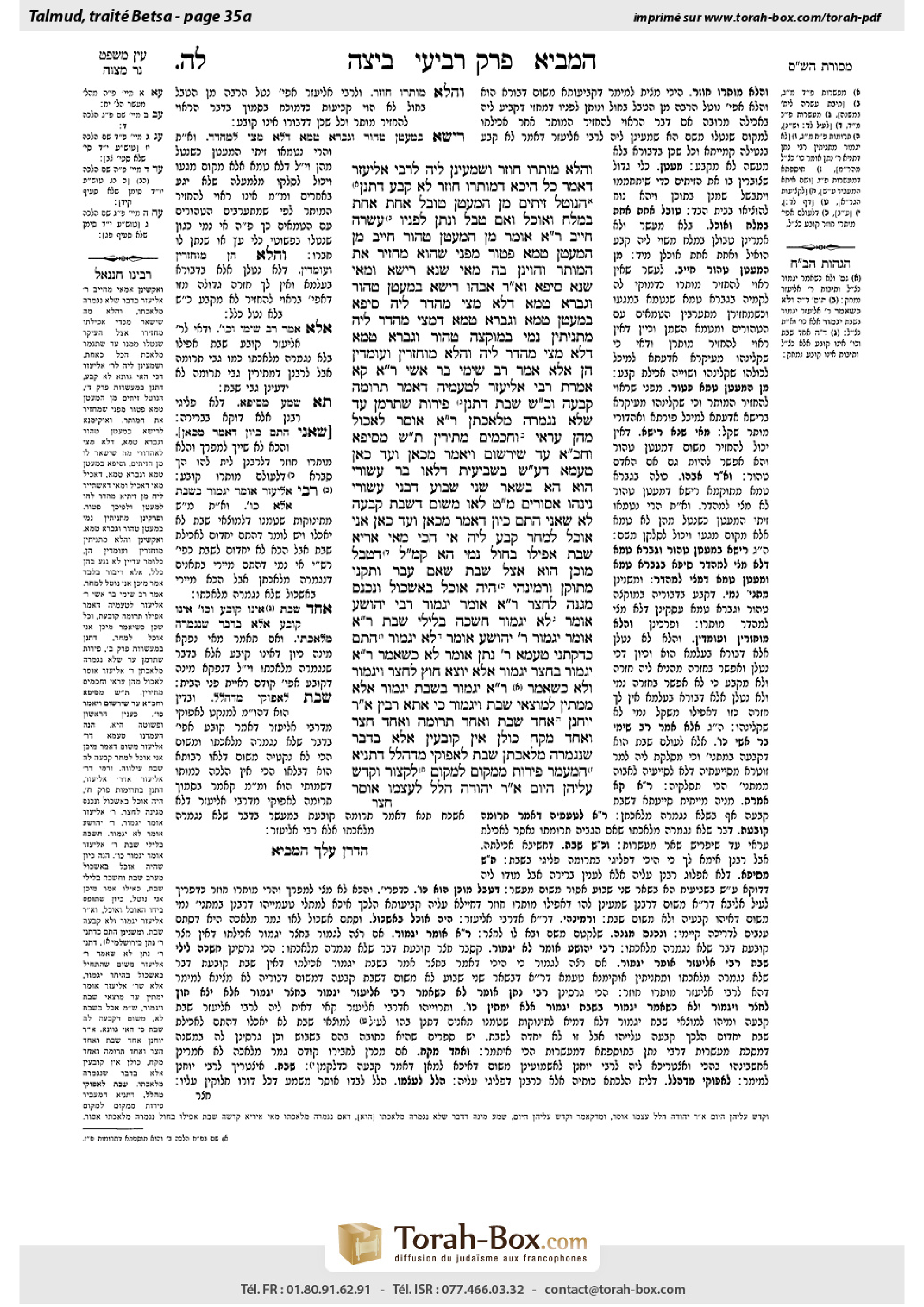
Beitzah 35a: Talmud study for Daf Yomi
Study the Talmud for Daf Yomi with scanned pages, Hebrew text, English translations from Sefaria and AI-generated French translations.
Passage selection and English or AI-generated French translation are available where the scan has annotations. Daf Study is independent of Torah-Box and Sefaria.
Browse Beitzah · ביצה · All tractatesBeitzah 35a text and translations
This page of Beitzah includes the Aramaic text, an English translation and an AI-generated French translation, alongside the scan above.
ביצה ל״ה א · Aramaic and Hebrew text
וַהֲלֹא מוֹתָרוֹ חוֹזֵר, וְשָׁמְעִינַן לֵיהּ לְרַבִּי אֱלִיעֶזֶר דְּאָמַר: כׇּל הֵיכָא דְּמוֹתָרוֹ חוֹזֵר — לָא קָבַע!
דִּתְנַן: הַנּוֹטֵל זֵיתִים מִן הַמַּעֲטָן — טוֹבֵל אַחַת אַחַת בְּמֶלַח וְאוֹכֵל. וְאִם טָבַל וְנָתַן לְפָנָיו עֲשָׂרָה — חַיָּיב. רַבִּי אֱלִיעֶזֶר אוֹמֵר: מִן הַמַּעֲטָן טָהוֹר — חַיָּיב, מִן הַמַּעֲטָן טָמֵא — פָּטוּר, מִפְּנֵי שֶׁהוּא מַחֲזִיר אֶת הַמּוֹתָר.
וְהָוֵינַן בַּהּ: מַאי שְׁנָא רֵישָׁא וּמַאי שְׁנָא סֵיפָא? וְאָמַר רַבִּי אֲבָהוּ: רֵישָׁא בְּמַעֲטָן טָהוֹר וְגַבְרָא טָמֵא, דְּלָא מָצֵי מַהְדַּר לֵיהּ.
סֵיפָא בְּמַעֲטָן טָמֵא וְגַבְרָא טָמֵא, דְּמָצֵי מַהְדַּר לֵיהּ.
מַתְנִיתִין נָמֵי בְּמוּקְצֶה טָהוֹר וְגַבְרָא טָמֵא, דְּלָא מָצֵי מַהְדַּר לֵיהּ. וַהֲלֹא מוּחְזָרִין וְעוֹמְדִין הֵן!
אֶלָּא, אָמַר רַב שִׁימִי בַּר אָשֵׁי: רַבִּי אֱלִיעֶזֶר קָא אָמְרַתְּ? רַבִּי אֱלִיעֶזֶר לְטַעְמֵיהּ, דְּאָמַר: תְּרוּמָה קָבְעָה, וְכׇל שֶׁכֵּן שַׁבָּת. דִּתְנַן: פֵּירוֹת שֶׁתְּרָמָן עַד שֶׁלֹּא נִגְמְרָה מְלַאכְתָּן, רַבִּי אֱלִיעֶזֶר אוֹסֵר לֶאֱכוֹל מֵהֶן עֲרַאי, וַחֲכָמִים מַתִּירִין.
תָּא שְׁמַע מִסֵּיפָא, וַחֲכָמִים אוֹמְרִים: עַד שֶׁיִּרְשׁוֹם וְיֹאמַר ״מִכָּאן וְעַד כָּאן״. טַעְמָא דְּעֶרֶב שַׁבָּת בַּשְּׁבִיעִית — דְּלָאו בַּר עַשּׂוֹרֵי הוּא, הָא בִּשְׁאָר שְׁנֵי שָׁבוּעַ, דִּבְנֵי עַשּׂוֹרֵי נִינְהוּ — אֲסוּרִים. מַאי טַעְמָא, לָאו מִשּׁוּם דְּשַׁבָּת קָבְעָה?
לָא, שָׁאנֵי הָתָם, כֵּיוָן דְּאָמַר: ״מִכָּאן וְעַד כָּאן אֲנִי אוֹכֵל לְמָחָר״ — קָבַע לֵיהּ. אִי הָכִי, מַאי אִרְיָא שַׁבָּת? אֲפִילּוּ בְּחוֹל נָמֵי! הָא קָא מַשְׁמַע לַן דְּטֶבֶל מוּכָן הוּא אֵצֶל שַׁבָּת, שֶׁאִם עָבַר וְתִקְּנוֹ — מְתוּקָּן.
וּרְמִינְהִי: הָיָה אוֹכֵל בָּאֶשְׁכּוֹל, וְנִכְנַס מִגִּנָּה לֶחָצֵר, רַבִּי אֱלִיעֶזֶר אוֹמֵר: יִגְמוֹר, רַבִּי יְהוֹשֻׁעַ אוֹמֵר: לֹא יִגְמוֹר.
חָשְׁכָה בְּלֵילֵי שַׁבָּת, רַבִּי אֱלִיעֶזֶר אוֹמֵר: יִגְמוֹר, רַבִּי יְהוֹשֻׁעַ אוֹמֵר: לֹא יִגְמוֹר!
הָתָם כִּדְקָתָנֵי טַעְמָא, רַבִּי נָתָן אוֹמֵר: לֹא כְּשֶׁאָמַר רַבִּי אֱלִיעֶזֶר ״יִגְמוֹר״ — בֶּחָצֵר יִגְמוֹר, אֶלָּא: יוֹצֵא חוּץ לֶחָצֵר וְיִגְמוֹר. וְלֹא כְּשֶׁאָמַר רַבִּי אֱלִיעֶזֶר ״יִגְמוֹר״ — בְּשַׁבָּת יִגְמוֹר, אֶלָּא מַמְתִּין לְמוֹצָאֵי שַׁבָּת וְיִגְמוֹר.
כִּי אֲתָא רָבִין, אָמַר רַבִּי יוֹחָנָן: אֶחָד שַׁבָּת, וְאֶחָד תְּרוּמָה, וְאֶחָד חָצֵר, וְאֶחָד מִקָּח — כּוּלָּן אֵין קוֹבְעִין, אֶלָּא בְּדָבָר שֶׁנִּגְמְרָה מְלַאכְתָּן.
שַׁבָּת — לְאַפּוֹקֵי מִדְּהִלֵּל, דְּתַנְיָא: הַמְעַמֵּר פֵּירוֹת מִמָּקוֹם לְמָקוֹם לִקְצוֹר, וְקִדֵּשׁ עֲלֵיהֶן הַיּוֹם, אָמַר רַבִּי יְהוּדָה: הִלֵּל לְעַצְמוֹ אוֹסֵר.
Beitzah 35a · English translation
The Gemara challenges: How can one say that the very decision to partake of the fruit establishes it as fixed with regard to tithes? But isn’t it true that even if one declared his intention to eat it the following day, it can nevertheless be assumed that the remaining fruit is restored to the pile? And we have heard that Rabbi Eliezer explicitly said: Anywhere that its leftovers are restored, it is not established with regard to liability for tithes at all.
This is as we learned in a mishna in tractate Ma’asrot: One who removes olives from a vat [ma’atan] where they are temporarily stored before being pressed may dip them one by one in salt and eat without tithing them first, since he is eating them one at a time. Although he is eating them with salt, it is not considered a fixed meal. And if he dipped and placed several olives before him, such as ten, they are liable in tithes. However, Rabbi Eliezer says: One who eats from a ritually pure vat is liable to separate tithes; one who eats from a ritually impure vat is exempt because he returns the surplus to the vat.
And we discussed it: What is different in the first clause of the mishna and what is different in the latter clause; why is the issue of purity relevant to this case? And Rabbi Abbahu said: The first case is referring to a ritually pure vat and a ritually impure person, who transfers his impurity to the olives he touches. He may not return the olives to the vat because he would thereby render all the remaining olives ritually impure. Therefore, from the outset he takes only the amount he wishes to eat. This is enough to consider it a fixed meal, and he must tithe them.
However, the latter clause is referring to a ritually impure vat and a person who is ritually impure, who may return the olives to the vat, as the olives it contains are already ritually impure. He is not particular to take the exact amount he wants to eat, since he knows he may return the remaining olives, and they are therefore not considered fixed for tithes. For the purposes of this discussion, it can be seen from here that Rabbi Eliezer maintains that whenever one may restore the food, it is not considered fixed until its work is complete.
The Gemara answers: The mishna also deals with the case of a ritually pure storage area, containing pure food, and a ritually impure person, who may not return them to the vat. The Gemara challenges this answer: But aren’t they already returned? This is not a case where a person takes all the fruit and replaces what remains after his meal; rather, he takes the amount he explicitly designated the day before, while the rest remains in place.
Rather, Rav Shimi bar Ashi said: The previous explanation is to be rejected, and it should be understood as follows: Rabbi Eliezer, you said? There is no difficulty according to his approach. Rabbi Eliezer conforms to his standard line of reasoning, as he said that the separation of teruma itself establishes the work of fruit as completed, so that one may not eat it even in a casual manner without first separating the other tithes. And, all the more so, Shabbat itself establishes food as fixed with regard to tithes, as we learned in a mishna: Fruits from which teruma has been separated before their work was completed, Rabbi Eliezer prohibits eating from them in a casual manner without separating the rest of the tithes, as the teruma establishes the food as fixed; but the Rabbis permit it.
The Gemara suggests a different answer to Rava’s question as to whether Shabbat establishes an obligation to tithe food whose labor is incomplete: Come and hear a resolution from the latter clause of the mishna, which states: And the Rabbis say: Even in the Sabbatical Year, when teruma and tithes are not separated from fruit, a declaration from the day before is not enough to render the food prepared for Shabbat, unless one marks the fruit he is preparing and says explicitly: From here to there. The Gemara infers from this: The reason is that the eve of Shabbat during the Sabbatical Year is not fit for tithes; but during the other years of the Sabbatical cycle, which are fit for and obligated in tithes, the fruits are prohibited. What is the reason? Is it not because Shabbat itself establishes them as fixed? If this is the view of the Rabbis, one may not reject it in favor of a minority opinion such as Rabbi Eliezer’s.
The Gemara refutes this: No, this is no proof; there it is different. Since he said: From here to there I will eat tomorrow, he has thereby established his meal, and the reason is not due to Shabbat. The Gemara asks: If so, why discuss particularly Shabbat; even on a weekday as well the same law applies? The Gemara answers: This comes to teach us, as stated above, that untithed produce is not fundamentally muktze because it is prohibited to remove the dues and tithes on Shabbat; rather, it is considered prepared with regard to Shabbat, in that if one transgressed the words of the Sages and tithed it, it is tithed.
And we raise a contradiction from a different source, in which it is taught: If one was eating from a cluster of grapes, whose work is not completed, as grapes are designated for juice extraction, and came in from a garden, where one may eat fruit in a casual manner without separating tithes, to a courtyard, Rabbi Eliezer says: He may finish eating the cluster, as the courtyard itself does not establish the fruit with regard to tithes, if their work was not completed beforehand. Rabbi Yehoshua says: He may not finish. He maintains that a courtyard does establish the fruit as fixed for tithes, even if their work has not been completed.
Similarly, if it grew dark on Friday evening, the night of Shabbat, while one was eating the cluster, and eating on Shabbat is considered a fixed meal, Rabbi Eliezer says: He may finish, as not even Shabbat establishes fruit as fixed if its work was not completed. And Rabbi Yehoshua says: He may not finish. He holds that Shabbat does indeed establish fruit as fixed for tithes even if its work has not been completed. This indicates that Rabbi Eliezer maintains that Shabbat does not establish food with regard to tithes, whereas the mishna here indicates that he agrees that the beginning of Shabbat does establish them as fixed.
The Gemara answers: There, the reason is as he taught explicitly that Rabbi Natan says: It is not that when Rabbi Eliezer said: He may finish, he meant that he may finish in the courtyard itself; but rather he meant: He may exit the courtyard and finish. And similarly, it is not that when Rabbi Eliezer said: He may finish, he meant that he may finish on Shabbat itself; but rather, he meant that he may wait until the conclusion of Shabbat and finish. If so, this source does not contradict the mishna here.
With regard to the halakhic ruling in this case, when Ravin came from Eretz Yisrael to Babylonia, he said that Rabbi Yoḥanan said: Whether with regard to Shabbat; or with regard to the separation of teruma from fruit; or with regard to a courtyard into which the fruit is brought; or with regard to a transaction; all of these cases establish a requirement for tithes only for items whose labor is completed.
The Gemara notes that each of these details teaches a novel halakha. How so? Shabbat comes to exclude the opinion of Hillel, as it is taught in a baraita: One who gathers fruits from one place to another in order to reap them, and the day sanctified upon them, i.e., Shabbat commenced, Rabbi Yehuda said: Hillel prohibits the food from the gatherer himself. In other words, Hillel alone prohibits eating the fruit in that case until its tithes have been separated, for he believes that the beginning of Shabbat itself causes the fruit to be considered completed. Rabbi Yoḥanan teaches that the halakha in this case is not in accordance with the opinion of Hillel.
Beitzah 35a · Traduction française (IA)
La Guemara soulève un défi : Comment peut-on dire que la décision de consommer le fruit le fixe en ce qui concerne les dîmes ? Mais n'est-ce pas vrai que même si l'on déclare son intention de le manger le lendemain, on peut néanmoins considérer que le fruit restant est réintégré dans le tas ? Et nous avons entendu que Rabbi Éliezer a explicitement dit : Partout où les restes sont réintégrés, le fruit n'est pas considéré comme fixé en ce qui concerne l'obligation des dîmes.
C'est ce que nous avons appris dans une mitsva du traité Ma'asrot : Celui qui retire des olives d'un tonneau [ma'atan] où elles sont stockées temporairement avant d'être pressées peut les tremper une par une dans le sel et les manger sans les dîmer d'abord, car il les mange une à une. Bien qu'il les mange avec du sel, cela ne constitue pas un repas fixe. Et si l'on trempe et place plusieurs olives devant soi, par exemple dix, elles sont soumises aux dîmes. Cependant, Rabbi Éliezer dit : Celui qui mange d'un tonneau rituellement pur est tenu de séparer les dîmes ; celui qui mange d'un tonneau rituellement impur est exempt, car il réintègre le surplus dans le tonneau.
Et nous avons discuté : Qu'est-ce qui diffère dans la première partie de la mitsva et dans la seconde partie ; pourquoi l'impureté est-elle pertinente dans ce cas ? Et Rabbi Abbahu a dit : La première situation fait référence à un tonneau rituellement pur et à une personne rituellement impure, qui transmet son impureté aux olives qu'elle touche. Il ne peut pas réintégrer les olives dans le tonneau, car cela rendrait toutes les olives restantes rituellement impures. Par conséquent, dès le départ, il ne prend que la quantité qu'il souhaite manger. Cela suffit à considérer que c'est un repas fixe, et il doit les dîmer.
Cependant, la seconde partie fait référence à un tonneau rituellement impur et à une personne rituellement impure, qui peut réintégrer les olives dans le tonneau, car les olives qu'il contient sont déjà rituellement impures. Il n'est pas exigeant de prendre la quantité exacte qu'il veut manger, car il sait qu'il peut réintégrer les olives restantes, et par conséquent, elles ne sont pas considérées comme fixées pour les dîmes. Pour l'objet de cette discussion, on peut voir ici que Rabbi Éliezer maintient que chaque fois qu'on peut réintégrer les aliments, ils ne sont pas considérés comme fixés jusqu'à ce que leur travail soit accompli.
La Guemara répond : La mitsva traite également du cas d'un lieu de stockage rituellement pur, contenant des aliments purs, et d'une personne rituellement impure, qui ne peut pas réintégrer les aliments dans le tonneau. La Guemara soulève ce défi : Mais ne sont-ils pas déjà réintégrés ? Ce n'est pas un cas où une personne prend tous les fruits et remplace ce qui reste après son repas ; plutôt, il prend la quantité qu'il a explicitement désignée la veille, tandis que le reste reste en place.
Plutôt, Rav Shimi bar Ashi a dit : L'explication précédente doit être rejetée, et il faut la comprendre ainsi : Rabbi Éliezer, vous avez dit ? Il n'y a pas de difficulté selon son approche. Rabbi Éliezer s'aligne sur sa ligne de raisonnement standard, car il a dit que la séparation de la terouma elle-même constitue la fin du travail des fruits, de sorte qu'on ne peut pas manger même de manière informelle sans d'abord séparer les autres dîmes. Et, encore plus, la Shabbat elle-même constitue les aliments comme fixés en ce qui concerne les dîmes, comme nous l'avons appris dans une mitsva : Les fruits dont la terouma a été séparée avant que leur travail ne soit accompli, Rabbi Éliezer interdit de les manger de manière informelle sans séparer les autres dîmes, car la terouma constitue les aliments comme fixés ; mais les Rabbins permettent cela.
La Guemara suggère une autre réponse à la question de Rava sur le fait que la Shabbat constitue une obligation de dîmer les aliments dont le travail n'est pas accompli : Approchez-vous et écoutez une résolution de la seconde partie de la mitsna, qui dit : Et les Rabbins disent : Même dans l'année sabbatique, où la terouma et les dîmes ne sont pas séparées des fruits, une déclaration de la veille n'est pas suffisante pour rendre les aliments préparés pour la Shabbat, à moins qu'on marque les fruits qu'on prépare et qu'on dise explicitement : De là jusqu'ici. La Guemara en déduit : La raison est que la veille de la Shabbat durant l'année sabbatique n'est pas adaptée aux dîmes ; mais durant les autres années du cycle sabbatique, qui sont adaptées et obligatoires en ce qui concerne les dîmes, les fruits sont interdits. Quelle est la raison ? N'est-ce pas parce que la Shabbat elle-même constitue les fruits comme fixés ? Si c'est le point de vue des Rabbins, on ne peut pas le rejeter en faveur d'une opinion minoritaire telle que celle de Rabbi Éliezer.
La Guemara réfute cela : Non, cela n'est pas une preuve ; là, c'est différent. Puisqu'il a dit : De là jusqu'ici je mangerai demain, il a ainsi établi son repas, et la raison n'est pas due à la Shabbat. La Guemara demande : Si c'est ainsi, pourquoi discuter spécifiquement de la Shabbat ; même un jour ordinaire, la même loi s'applique ? La Guemara répond : Cela vient enseigner, comme mentionné ci-dessus, que les produits non dîmés ne sont pas fondamentalement muktze parce qu'il est interdit de retirer les dîmes et les offrandes le jour de la Shabbat ; plutôt, ils sont considérés comme préparés en ce qui concerne la Shabbat, car si l'on a transgressé les paroles des Sages et qu'on a dîmé, cela est dîmé.
Et nous soulevons une contradiction à partir d'une source différente, dans laquelle il est enseigné : Si l'on mangeait d'un bouquet de raisins, dont le travail n'est pas accompli, car les raisins sont destinés à l'extraction du jus, et qu'on entre d'un jardin, où l'on peut manger les fruits de manière informelle sans séparer les dîmes, dans une cour, Rabbi Éliezer dit : Il peut finir de manger le bouquet, car la cour elle-même ne constitue pas les fruits en ce qui concerne les dîmes, si leur travail n'a pas été accompli auparavant. Rabbi Yéhoshua dit : Il ne peut pas finir. Il maintient que la cour constitue les fruits comme fixés en ce qui concerne les dîmes, même si leur travail n'a pas été accompli.
De même, si l'obscurité s'empare de la nuit du Sabbat, le vendredi soir, pendant que l'on mange la grappe, et que manger le Sabbat est considéré comme un repas fixe, Rabbi Eliezer dit : Il peut terminer, car même le Sabbat ne considère pas les fruits comme fixés si leur travail n'a pas été accompli. Et Rabbi Yéhoshua dit : Il ne peut pas terminer. Il maintient que le Sabbat considère effectivement les fruits comme fixés pour les dîmes même si leur travail n'a pas été accompli. Cela montre que Rabbi Eliezer considère que le Sabbat ne fixe pas les aliments en ce qui concerne les dîmes, alors que la mitsva ici indique qu'il accepte que le début du Sabbat fixe ainsi les fruits.
Le Guemara répond : Là, la raison est comme il l'a explicitement enseigné, que Rabbi Natan dit : Ce n'est pas que lorsque Rabbi Eliezer a dit : Il peut terminer, il voulait dire qu'il peut terminer dans le jardin lui-même ; mais plutôt il voulait dire qu'il peut sortir du jardin et terminer. De même, ce n'est pas que lorsque Rabbi Eliezer a dit : Il peut terminer, il voulait dire qu'il peut terminer le Sabbat lui-même ; mais plutôt, il voulait dire qu'il peut attendre jusqu'à la fin du Sabbat et terminer. Si c'est ainsi, cette source ne contredit pas la mitsva ici.
En ce qui concerne la décision halachique dans ce cas, lorsque Ravin est venu de la Terre d'Israël vers Babylone, il a dit que Rabbi Yochanan a dit : Quel que soit le cas, concernant le Sabbat ; ou la séparation de la terouma des fruits ; ou un jardin dans lequel les fruits sont apportés ; ou une transaction ; toutes ces situations exigent la séparation des dîmes uniquement pour les objets dont le travail est accompli.
Le Guemara souligne que chaque détail enseigne une halakha nouvelle. Comment cela ? Le Sabbat vient exclure l'opinion de Hillel, comme il est enseigné dans une baraïta : Celui qui transporte des fruits d'un lieu à un autre afin de les récolter, et le jour sanctifié sur eux, c'est-à-dire le Sabbat, a commencé, Rabbi Yéhuda a dit : Hillel interdit la nourriture à celui qui récolte. En d'autres termes, Hillel seul interdit de manger les fruits dans ce cas jusqu'à ce que leurs dîmes soient séparées, car il croit que le début du Sabbat lui-même cause les fruits d'être considérés comme achevés. Rabbi Yochanan enseigne que la halakha dans ce cas n'est pas selon l'opinion de Hillel.
Traduction française générée par IA à partir de l’édition anglaise de Sefaria. Vérifie toujours un passage avec le texte source.
Text from Sefaria: William Davidson Edition - Vocalized Aramaic (CC BY NC); William Davidson Edition - English (CC BY NC).