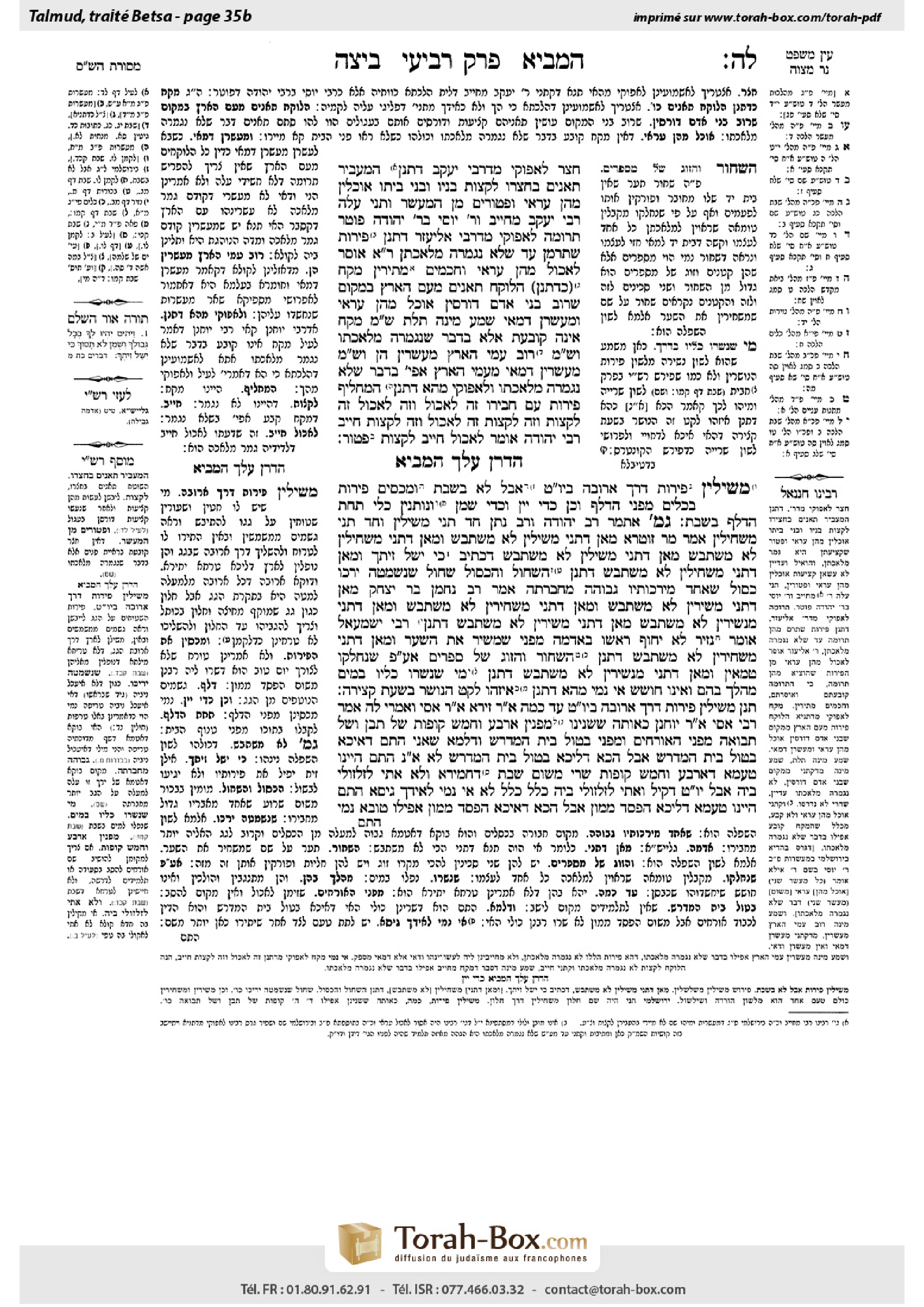
Beitzah 35b: Talmud study for Daf Yomi
Study the Talmud for Daf Yomi with scanned pages, Hebrew text, English translations from Sefaria and AI-generated French translations.
Passage selection and English or AI-generated French translation are available where the scan has annotations. Daf Study is independent of Torah-Box and Sefaria.
Browse Beitzah · ביצה · All tractatesBeitzah 35b text and translations
This page of Beitzah includes the Aramaic text, an English translation and an AI-generated French translation, alongside the scan above.
ביצה ל״ה ב · Aramaic and Hebrew text
חָצֵר — לְאַפּוֹקֵי מִדְּרַבִּי יַעֲקֹב. דִּתְנַן: הַמַּעֲבִיר תְּאֵנִים בַּחֲצֵרוֹ לְקַצּוֹת — בָּנָיו וּבְנֵי בֵּיתוֹ אוֹכְלִין מֵהֶן עֲרַאי, וּפְטוּרִים מִן הַמַּעֲשֵׂר. וְתָנֵי עֲלַהּ: רַבִּי יַעֲקֹב מְחַיֵּיב, וְרַבִּי יוֹסֵי בְּרַבִּי יְהוּדָה פּוֹטֵר.
תְּרוּמָה — לְאַפּוֹקֵי מִדְּרַבִּי אֱלִיעֶזֶר. דִּתְנַן: פֵּירוֹת שֶׁתְּרָמָן עַד שֶׁלֹּא נִגְמְרָה מְלַאכְתָּן, רַבִּי אֱלִיעֶזֶר אוֹסֵר לֶאֱכוֹל מֵהֶן עֲרַאי, וַחֲכָמִים מַתִּירִין.
מִקָּח — (כְּדִתְנַן) הַלּוֹקֵחַ תְּאֵנִים מֵעַם הָאָרֶץ, בִּמְקוֹם שֶׁרוֹב בְּנֵי אָדָם דּוֹרְסִין, אוֹכֵל מֵהֶן עֲרַאי, וּמְעַשְּׂרָן דְּמַאי.
שְׁמַע מִינַּהּ תְּלָת. שְׁמַע מִינַּהּ: מִקָּח אֵינָהּ קוֹבַעַת אֶלָּא בְּדָבָר שֶׁנִּגְמְרָה מְלַאכְתּוֹ, וּשְׁמַע מִינַּהּ: רוֹב עַמֵּי הָאָרֶץ מְעַשְּׂרִין הֵן, וּשְׁמַע מִינַּהּ: מְעַשְּׂרִין דְּמַאי מֵעַמֵּי הָאָרֶץ אֲפִילּוּ בְּדָבָר שֶׁלֹּא נִגְמְרָה מְלַאכְתּוֹ.
וּלְאַפּוֹקֵי מֵהָא דִּתְנַן: הַמַּחֲלִיף פֵּירוֹת עִם חֲבֵירוֹ, זֶה לֶאֱכוֹל וְזֶה לֶאֱכוֹל, זֶה לְקַצּוֹת וְזֶה לְקַצּוֹת, זֶה לֶאֱכוֹל וְזֶה לְקַצּוֹת — חַיָּיב. רַבִּי יְהוּדָה אוֹמֵר: לֶאֱכוֹל — חַיָּיב, לְקַצּוֹת — פָּטוּר.
הֲדַרַן עֲלָךְ הַמֵּבִיא
מַשִּׁילִין פֵּירוֹת דֶּרֶךְ אֲרוּבָּה בְּיוֹם טוֹב, אֲבָל לֹא בְּשַׁבָּת. וּמְכַסִּים פֵּירוֹת בְּכֵלִים מִפְּנֵי הַדֶּלֶף, וְכֵן כַּדֵּי יַיִן וְכַדֵּי שֶׁמֶן. וְנוֹתְנִין כְּלִי תַּחַת הַדֶּלֶף בְּשַׁבָּת.
גְּמָ׳ אִתְּמַר: רַב יְהוּדָה וְרַב נָתָן, חַד תָּנֵי ״מַשִּׁילִין״, וְחַד תָּנֵי ״מַשְׁחִילִין״.
אָמַר מָר זוּטְרָא: מַאן דְּתָנֵי ״מַשִּׁילִין״ לָא מִשְׁתַּבַּשׁ, וּמַאן דְּתָנֵי ״מַשְׁחִילִין״ לָא מִשְׁתַּבַּשׁ. מַאן דְּתָנֵי ״מַשִּׁילִין״ לָא מִשְׁתַּבַּשׁ, דִּכְתִיב: ״כִּי יִשַּׁל זֵיתֶךָ״. וּמַאן דְּתָנֵי ״מַשְׁחִילִין״ לָא מִשְׁתַּבַּשׁ, דִּתְנַן: הַשָּׁחוּל וְהַכָּסוּל. שָׁחוּל — שֶׁנִּשְׁמְטָה יְרֵכוֹ, כָּסוּל — שֶׁאֶחָד מִיַּרְכוֹתָיו גְּבוֹהָה מֵחֲבֶרְתָּהּ.
אָמַר רַב נַחְמָן בַּר יִצְחָק: מַאן דְּתָנֵי ״מַשִּׁירִין״ לָא מִשְׁתַּבַּשׁ, וּמַאן דְּתָנֵי ״מַשְׁחִירִין״ לָא מִשְׁתַּבַּשׁ, וּמַאן דְּתָנֵי ״מַנְשִׁירִין״ לָא מִשְׁתַּבַּשׁ.
מַאן דְּתָנֵי ״מַשִּׁירִין״ לָא מִשְׁתַּבַּשׁ, דִּתְנַן, רַבִּי יִשְׁמָעֵאל אוֹמֵר: נָזִיר לֹא יָחוֹף רֹאשׁוֹ בַּאֲדָמָה, מִפְּנֵי שֶׁמַּשִּׁיר אֶת הַשֵּׂעָר. וּמַאן דְּתָנֵי ״מַשְׁחִירִין״ לָא מִשְׁתַּבַּשׁ, דִּתְנַן: הַשְּׁחוֹר וְהַזּוּג שֶׁל סַפָּרִים, אַף עַל פִּי שֶׁנֶּחְלְקוּ — טְמֵאִין.
וּמַאן דְּתָנֵי ״מַנְשִׁירִין״ לָא מִשְׁתַּבַּשׁ, דִּתְנַן: מִי שֶׁנָּשְׁרוּ כֵּלָיו בַּמַּיִם — מְהַלֵּךְ בָּהֶם וְאֵינוֹ חוֹשֵׁשׁ. אִי נָמֵי מֵהָא דִּתְנַן: אֵיזֶהוּ לֶקֶט — הַנּוֹשֵׁר בִּשְׁעַת קְצִירָה.
תְּנַן: מַשִּׁילִין פֵּירוֹת דֶּרֶךְ אֲרוּבָּה בְּיוֹם טוֹב. עַד כַּמָּה? אָמַר רַבִּי זֵירָא אָמַר רַבִּי אַסִּי, וְאָמְרִי לַהּ אָמַר רַבִּי אַסִּי אָמַר רַבִּי יוֹחָנָן: כְּאוֹתָהּ שֶׁשָּׁנִינוּ: מְפַנִּין אַרְבַּע וְחָמֵשׁ קוּפּוֹת שֶׁל תֶּבֶן וְשֶׁל תְּבוּאָה מִפְּנֵי הָאוֹרְחִים, וּמִפְּנֵי בִּטּוּל בֵּית הַמִּדְרָשׁ.
וְדִלְמָא שָׁאנֵי הָתָם, דְּאִיכָּא בִּטּוּל בֵּית הַמִּדְרָשׁ, אֲבָל הָכָא דְּלֵיכָּא בִּטּוּל בֵּית הַמִּדְרָשׁ — לָא. אִי נָמֵי: הָתָם הַיְינוּ טַעְמָא, דְּאַרְבַּע וְחָמֵשׁ קוּפּוֹת שְׁרֵי מִשּׁוּם שַׁבָּת דַּחֲמִירָא וְלָא אָתֵי לְזַלְזוֹלֵי בַּיהּ, אֲבָל יוֹם טוֹב דְּקִיל וְאָתֵי לְזַלְזוֹלֵי בֵּיהּ — כְּלָל כְּלָל לָא.
אִי נָמֵי לְאִידַּךְ גִּיסָא: הָתָם הַיְינוּ טַעְמָא, דְּלֵיכָּא הֶפְסֵד מָמוֹן, אֲבָל הָכָא דְּאִיכָּא הֶפְסֵד מָמוֹן, אֲפִילּוּ טוּבָא נָמֵי.
Beitzah 35b · English translation
In addition, it was necessary for Rabbi Yoḥanan to teach the law that a courtyard does not establish fruit for tithes unless its work is completed, to exclude the opinion of Rabbi Ya’akov. As we learned in a mishna: One who was transporting figs in his courtyard to make them into dried figs, his children and the members of his household may eat from them in a casual manner, and they are exempt from tithes. And a baraita is taught in that regard: Rabbi Ya’akov obligates him, and Rabbi Yosei, son of Rabbi Yehuda, exempts him.
With regard to the law that the separation of teruma does not establish fruit as fixed for tithes, this comes to exclude the opinion of Rabbi Eliezer. As we learned in a mishna: Fruits from which teruma had been separated before their work was completed, Rabbi Eliezer prohibits eating from them in a casual manner, and the Rabbis permit it.
With regard to the statement that a transaction does not fix fruit for tithes, this is as we learned in a baraita: In the case of one who acquires figs from an am ha’aretz in a place where most people press and dry their figs in order to make them into cakes, the work of the figs is not completed before this stage, and he may therefore partake of them in a casual manner. And when their work is completed, he need only tithe them as doubtfully tithed produce, in accordance with the law with regard to all produce bought from an uneducated person.
The Gemara comments: One can learn from this baraita three halakhot: Learn from here that a transaction establishes produce as fixed only with regard to an item whose work is completed, but if its work has not been completed, even selling it does not obligate it in tithes. And learn from here that most people who are in the category of am ha’aretz separate tithes, and therefore one need only separate tithes as doubtfully tithed produce, rather than definitively untithed produce. And one can learn from here another law: One may tithe doubtfully tithed produce purchased from an am ha’aretz, even with regard to something whose work is not completed.
Rabbi Yoḥanan rules in accordance with this opinion to exclude that which we learned in a mishna: One who exchanges fruits with his friend, which is considered a commercial transaction, if their intention was for this one to eat and that one to eat, or for this one to make them into dried fruit and for that one to make them into dried fruit, this one to eat and that one to make them into dried fruit, they are both obligated in tithes. Rabbi Yehuda, however, says: The one who took the fruits in order to eat is obligated, as for him their labor is completed, but the one who intended to make them into dried fruit is exempt and may partake of the fruit in a casual manner, as for him their work has not yet been completed. Rabbi Yoḥanan rules in opposition to the first tanna. He maintains that the transaction itself does not make the fruit liable to tithes unless its work has been completed.
MISHNA: One may lower produce, which had been laid out on a roof to dry, into the house through a skylight on a Festival, in order to prevent it from becoming ruined in the rain. Although it is a strenuous activity, it is permitted do to so on a Festival in order to prevent a financial loss; however, one may not do so on Shabbat. And one may cover produce inside a building with cloths to prevent damage due to a leak in the ceiling over it, and similarly one may cover jugs of wine and jugs of oil for the same reason. And one may place a vessel beneath a leak in order to catch the water on Shabbat, to prevent it from dirtying the house.
GEMARA: The Gemara discusses the first word of the mishna from a linguistic standpoint. It was said: Rav Yehuda and Rav Natan recited differing versions of the mishna’s opening word, which is in all versions a verb meaning to lower. One of them taught mashilin, as in the text of this mishna, and the other one taught mashḥilin.
Mar Zutra said: The one who teaches mashilin is not mistaken, and the one who teaches mashḥilin is not mistaken, as support can be found for both versions. He elaborates: The one who teaches mashilin is not mistaken, as it is written: “For your olives will fall [yishal]” (Deuteronomy 28:40). Mashilin would therefore mean: To cause to fall. And he who teaches mashḥilin is not mistaken, as we learned the following cases in a mishna that lists blemishes that invalidate an animal for sacrifice: The shaḥul and the kasul. The mishna explains these terms: Shaḥul is referring to an animal whose thigh is dislocated, i.e., it has slipped out of place; kasul is referring to an animal one of whose thighs is higher than the other. This shows that the root sh-ḥ-l- is referring to something that has slipped down from its place.
Rav Naḥman bar Yitzḥak said that there are other possible variations of this word as well. One who teaches mashirin is not mistaken, and one who teaches mashḥirin is not mistaken, and one who teaches manshirin is not mistaken.
He elaborates: One who teaches mashirin is not mistaken, as we learned in a mishna: Rabbi Yishmael says: A nazirite may not wash the hair of his head with clay as a kind of shampoo, because it causes hair to fall off [mashir], and a nazirite is prohibited to remove the hairs of his head. This shows that mashir indicates causing something to fall. And one who teaches mashḥirin is also not mistaken, as we learned in a mishna: The sheḥor, a type of razor, and a barber’s scissors, even if their blades are detached, are subject to ritual impurity. The fact that a razor is called sheḥor implies that the root sh-ḥ-r indicates causing to fall down.
And one who teaches manshirin is not mistaken either, as we learned in a mishna: One whose clothes fell down [nashru] into water on Shabbat may continue to walk in them while they dry of their own accord, and he need not be concerned that people might suspect him of having washed them on Shabbat. Alternatively, another support can be found from that which we learned in the following mishna: What is gleaning [leket], which must be left for the poor as commanded in Leviticus 19:9? That which falls [nosher] during reaping. These sources show that the root n-sh-r means: To fall down, and manshirin would consequently mean: To cause to fall down.
§ The Gemara discusses the halakha in the mishna: We learned that one may lower produce through a skylight on a Festival. The Gemara asks: Up to how much produce may be lowered in this manner? At what point is it considered to be too strenuous an activity to be performed on the Festival? Rabbi Zeira said that Rav Asi said, and some say that Rav Asi said that Rabbi Yoḥanan said: It is like that which we learned in a mishna with regard to a different case: One may clear out four or five sacks of hay or grain from a room on Shabbat due to visitors, to clear a place for them to sit, or due to suspension of study in the study hall, i.e., to make room there for more people, who would not be able to study Torah otherwise. Here too, only four or five sacks’ worth of produce may be lowered from the roof.
The Gemara raises an objection to the comparison of the two cases. But perhaps there it is different, since there is the matter of preventing suspension of study in the study hall or of providing hospitality to guests, i.e., moving those items is permitted in order to facilitate a mitzva. But here, where there is no suspension of study in the study hall, i.e., no facilitation of any mitzva, they did not permit one to move such a large amount. Alternatively: There, this is the reasoning that four or five sacks are permitted: Because Shabbat is severe in people’s eyes and they will not come to belittle it; but on a Festival, which is regarded more lightly and which people might come to belittle, one may not move the items at all.
Alternatively, a claim can be made from the other perspective: There, this is the reasoning that it is permitted to carry only four or five sacks: Because there is no monetary loss involved. But here, where there is monetary loss if the produce is not moved, one may carry even a larger amount than four or five sacks.
Beitzah 35b · Traduction française (IA)
En outre, il était nécessaire que le maître Yochanan enseigne la loi selon laquelle un cour d'habitation ne constitue pas des fruits pour les dîmes à moins que son travail ne soit achevé, afin d'exclure l'opinion du maître Ya'akov. Comme nous avons appris dans une mitsna : Celui qui transportait des figues dans son cour pour les faire sécher, ses enfants et les membres de sa famille peuvent manger de ces figues de manière ordinaire, et ils sont exemptés des dîmes. Et une baraïta est enseignée à ce sujet : Le maître Ya'akov impose la dîme, et le maître Yosei, fils du maître Yehuda, l'exempte.
Concernant la loi selon laquelle la séparation de la terouma ne constitue pas les fruits comme fixés pour les dîmes, cela vise à exclure l'opinion du maître Eliezer. Comme nous avons appris dans une mitsna : Les fruits dont la terouma avait été séparée avant que leur travail ne soit achevé, le maître Eliezer interdit de manger de ces fruits de manière ordinaire, et les maîtres permettent cela.
Concernant l'affirmation selon laquelle une transaction ne constitue pas les fruits comme fixés pour les dîmes, cela correspond à ce que nous avons appris dans une baraïta : Dans le cas d'une personne qui achète des figues d'un am ha'aretz dans un lieu où la plupart des gens pressent et séchent leurs figues pour en faire des gâteaux, le travail des figues n'est pas achevé avant cette étape, et il peut donc manger de ces figues de manière ordinaire. Et lorsque leur travail est achevé, il suffit de les dîmer comme des produits dîmés douteusement, conformément à la loi concernant tous les produits achetés d'une personne non instruite.
Le Guemara commente : On peut apprendre de cette baraïta trois halakhot : Apprendre ici que la transaction constitue les produits comme fixés uniquement concernant un objet dont le travail est achevé, mais si son travail n'est pas achevé, même en le vendant, cela ne rend pas obligatoire la dîme. Et apprendre ici que la plupart des gens qui appartiennent à la catégorie des am ha'aretz séparent les dîmes, et par conséquent, il suffit de séparer les dîmes comme des produits dîmés douteusement, plutôt que définitivement non dîmés. Et on peut apprendre ici une autre loi : On peut dîmer des produits dîmés douteusement achetés d'un am ha'aretz, même concernant quelque chose dont le travail n'est pas achevé.
Le maître Yochanan rend un jugement selon cette opinion afin d'exclure ce que nous avons appris dans une mitsva : Celui qui échange des fruits avec son ami, ce qui est considéré comme une transaction commerciale, si leur intention était que l'un mange et que l'autre mange, ou que l'un les fasse sécher et que l'autre les fasse sécher, ou que l'un mange et que l'autre les fasse sécher, ils sont tous deux obligés à la dîme. Le maître Yehuda, cependant, dit : Celui qui a pris les fruits pour manger est obligé, car pour lui leur travail est achevé, mais celui qui avait l'intention de les faire sécher est exempt et peut manger les fruits de manière ordinaire, car pour lui leur travail n'est pas encore achevé. Le maître Yochanan rend un jugement contraire au premier tanna. Il maintient que la transaction elle-même ne rend pas les fruits obligatoires à la dîme à moins que leur travail soit achevé.
MICHNA: On peut descendre des produits, qui avaient été posés sur un toit pour sécher, dans la maison par une lucarne pendant un festival, afin d'éviter qu'ils ne se dégradent sous la pluie. Bien que cela soit une activité pénible, il est permis de le faire pendant un festival afin d'éviter une perte financière ; cependant, on ne peut pas le faire le sabbat. Et on peut couvrir des produits à l'intérieur d'un bâtiment avec des draps afin d'éviter les dommages dus à une fuite au plafond, et de même on peut couvrir des jarres de vin et des jarres d'huile pour la même raison. Et on peut placer un récipient sous une fuite afin de capturer l'eau le sabbat, afin d'éviter qu'elle ne salisse la maison.
GUEMARA: Le Guemara discute du premier mot de la mitsva d'un point de vue linguistique. Il a été dit : Rav Yehuda et Rav Natan ont récité des versions différentes du premier mot de la mitsva, qui est dans toutes les versions un verbe signifiant descendre. L'un d'eux a enseigné mashilin, comme dans le texte de cette mitsva, et l'autre a enseigné mashḥilin.
Mar Zutra a dit : Celui qui enseigne mashilin n'a pas tort, et celui qui enseigne mashḥilin n'a pas tort, car on peut trouver un soutien pour les deux versions. Il développe : Celui qui enseigne mashilin n'a pas tort, car il est écrit : « Pour vos olives, elles tomberont [yishal] » (Deutéronome 28:40). Mashilin signifierait donc : Causer de tomber. Et celui qui enseigne mashḥilin n'a pas tort, car nous avons appris les cas suivants dans une mitsva qui liste les défauts invalidant un animal pour le sacrifice : Le shaḥul et le kasul. La mitsva explique ces termes : Le shaḥul désigne un animal dont la cuisse est disloquée, c'est-à-dire qui a glissé de place ; le kasul désigne un animal dont l'une des cuisses est plus haute que l'autre. Cela montre que la racine sh-ḥ-l- désigne quelque chose qui a glissé de sa place.
Rav Naḥman bar Yitzḥak a dit que d'autres variations possibles de ce mot existent également. Celui qui enseigne mashirin n'a pas tort, et celui qui enseigne mashḥirin n'a pas tort, et celui qui enseigne manshirin n'a pas tort.
Il développe : Celui qui enseigne mashirin n'a pas tort, car nous avons appris dans une mitsna : Rabbi Yishmael dit : Un nazirite ne peut pas laver les cheveux de sa tête avec de la pâte comme un shampoing, car cela cause la chute des cheveux [mashir], et un nazirite est interdit de retirer les cheveux de sa tête. Cela montre que mashir indique causer quelque chose de tomber. Et celui qui enseigne mashḥirin n'a pas tort non plus, car nous avons appris dans une mitsna : Le sheḥor, un type de ciseaux, et les ciseaux d'un barbier, même si leurs lames sont détachées, sont soumis à l'impureté rituelle. Le fait que le ciseau soit appelé sheḥor implique que la racine sh-ḥ-r désigne causer de tomber.
Et celui qui enseigne les manshirin n'a pas non plus tort, comme nous l'avons appris dans une mitsna : Celui dont les vêtements tombent [nashru] dans l'eau le sabbat peut continuer à marcher en eux pendant qu'ils sèchent d'eux-mêmes, et il n'a pas à craindre que les gens puissent soupçonner qu'il les a lavés le sabbat. Une autre preuve peut être trouvée dans ce que nous avons appris dans la mitsna suivante : Qu'est-ce que le leket, qui doit être laissé aux pauvres comme commandé dans Lévitique 19,9 ? C'est ce qui tombe [nosher] lors de la moisson. Ces sources montrent que la racine n-sh-r signifie : tomber, et les manshirin signifieraient donc : faire tomber.
§ Le Guemara discute de la halakha dans la mitsna : Nous avons appris que l'on peut descendre des produits par une lucarne pendant un festival. Le Guemara demande : Jusqu'à quel point des produits peuvent-ils être descendus ainsi ? À quel moment est-ce considéré comme une activité trop pénible pour être effectuée pendant le festival ? Rabbi Zéira a dit que Rav Asi a dit, et certains disent que Rav Asi a dit que Rabbi Yochanan a dit : C'est comme ce que nous avons appris dans une mitsna concernant un cas différent : On peut vider quatre ou cinq sacs de foin ou de céréales d'une pièce le sabbat en raison de visiteurs, pour libérer un espace où ils pourront s'asseoir, ou en raison de l'intermission de l'étude dans la salle de étude, c'est-à-dire pour libérer de la place là-bas pour plus de personnes, qui ne pourraient autrement étudier la Torah. Ici aussi, seulement quatre ou cinq sacs de produits peuvent être descendus du toit.
Le Guemara soulève une objection contre la comparaison des deux cas. Mais peut-être que là, c'est différent, car il y a la question de prévenir l'intermission de l'étude dans la salle de study ou de fournir de l'hospitalité aux hôtes, c'est-à-dire que le déplacement de ces objets est permis afin de faciliter une mitsva. Mais ici, où il n'y a pas d'intermission de l'étude dans la salle de study, c'est-à-dire aucune facilitation d'une mitsva, ils n'ont pas permis de déplacer une telle quantité. Alternativement : Là, c'est le raisonnement selon lequel quatre ou cinq sacs sont permis : Parce que le sabbat est regardé comme sévère aux yeux des gens et ils ne viendront pas le mépriser ; mais pendant un festival, qui est regardé comme plus léger et dont les gens pourraient le mépriser, on ne peut pas déplacer les objets du tout.
Alternativement, une revendication peut être faite du point de vue opposé : Là, c'est le raisonnement selon lequel il est permis de transporter seulement quatre ou cinq sacs : Parce qu'il n'y a pas de perte financière impliquée. Mais ici, où il y a une perte financière si les produits ne sont pas déplacés, on peut transporter même une quantité plus grande que quatre ou cinq sacs.
Traduction française générée par IA à partir de l’édition anglaise de Sefaria. Vérifie toujours un passage avec le texte source.
Text from Sefaria: William Davidson Edition - Vocalized Aramaic (CC BY NC); William Davidson Edition - English (CC BY NC).