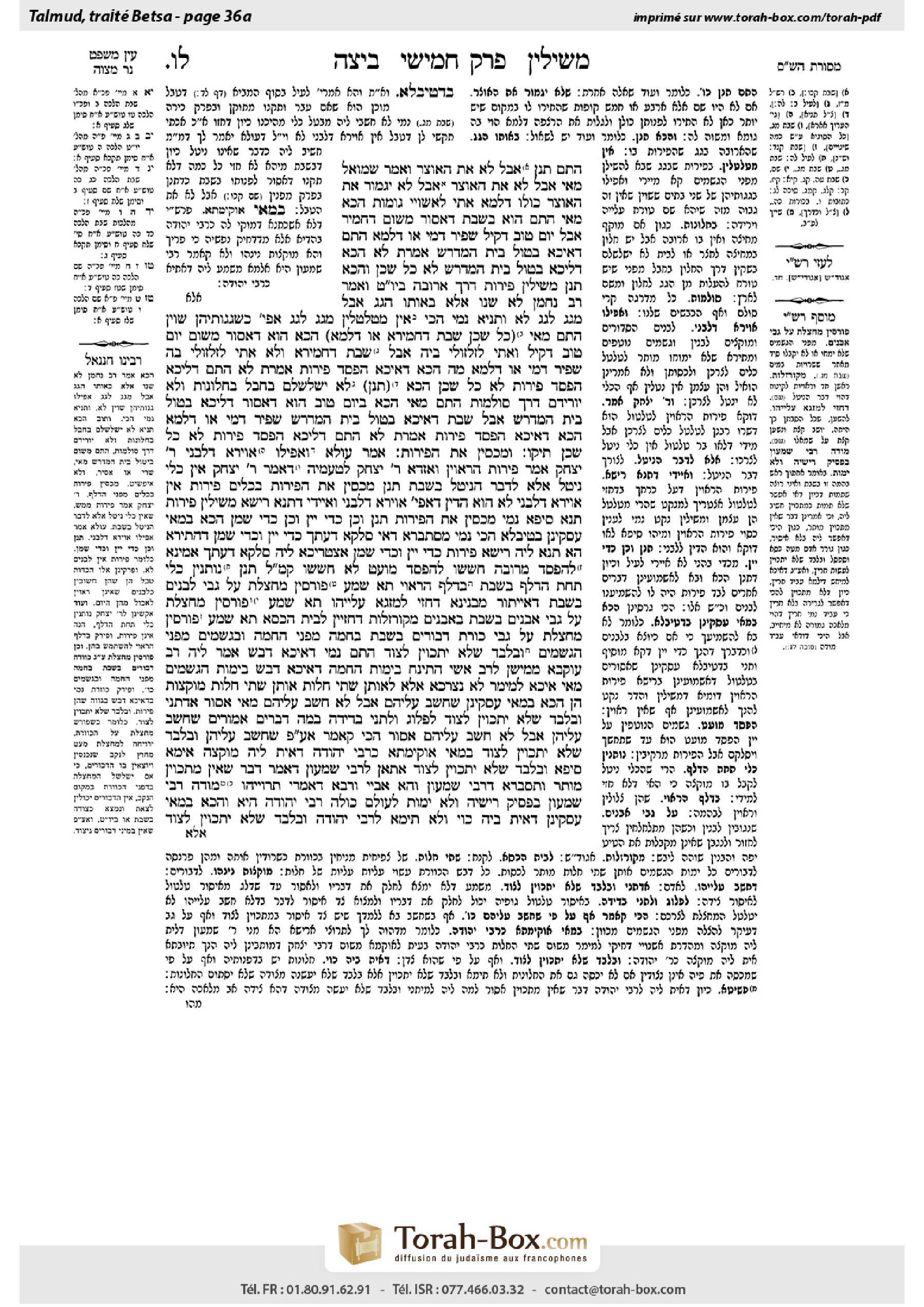
Beitzah 36a: Talmud study for Daf Yomi
Study the Talmud for Daf Yomi with scanned pages, Hebrew text, English translations from Sefaria and AI-generated French translations.
Passage selection and English or AI-generated French translation are available where the scan has annotations. Daf Study is independent of Torah-Box and Sefaria.
Browse Beitzah · ביצה · All tractatesBeitzah 36a text and translations
This page of Beitzah includes the Aramaic text, an English translation and an AI-generated French translation, alongside the scan above.
ביצה ל״ו א · Aramaic and Hebrew text
הָתָם תְּנַן ״אֲבָל לֹא אֶת הָאוֹצָר״, וְאָמַר שְׁמוּאֵל: מַאי ״אֲבָל לֹא אֶת הָאוֹצָר״ — אֲבָל לֹא יִגְמוֹר אֶת הָאוֹצָר כּוּלּוֹ, דִּלְמָא אָתֵי לְאַשְׁוֹיֵי גּוּמּוֹת. הָכָא מַאי?
הָתָם הוּא בְּשַׁבָּת דְּאָסוּר — מִשּׁוּם דַּחֲמִיר, אֲבָל יוֹם טוֹב דְּקִיל — שַׁפִּיר דָּמֵי. אוֹ דִלְמָא: הָתָם דְּאִיכָּא בִּטּוּל בֵּית הַמִּדְרָשׁ — אָמְרַתְּ לָא, הָכָא דְּלֵיכָּא בִּטּוּל בֵּית הַמִּדְרָשׁ — לֹא כׇּל שֶׁכֵּן.
וְהָכָא תְּנַן: מַשִּׁילִין פֵּירוֹת דֶּרֶךְ אֲרוּבָּה בְּיוֹם טוֹב, וְאָמַר רַב נַחְמָן: לֹא שָׁנוּ אֶלָּא בְּאוֹתוֹ הַגָּג, אֲבָל מִגַּג לְגַג — לָא. וְתַנְיָא נָמֵי הָכִי: אֵין מְטַלְטְלִין מִגַּג לְגַג אֲפִילּוּ כְּשֶׁגַּגּוֹתֵיהֶן שָׁוִין.
הָתָם מַאי? (כׇּל שֶׁכֵּן שַׁבָּת דַּחֲמִירָא, אוֹ דִלְמָא:) הָכָא הוּא דְּאָסוּר — מִשּׁוּם יוֹם טוֹב דְּקִיל, וְאָתֵי לְזַלְזוֹלֵי בֵּיהּ, אֲבָל שַׁבָּת דַּחֲמִירָא, וְלָא אָתֵי לְזַלְזוֹלֵי בַּהּ — שַׁפִּיר דָּמֵי.
אוֹ דִלְמָא: מָה הָכָא דְּאִיכָּא הֶפְסֵד פֵּירוֹת — אָמְרַתְּ לָא, הָתָם דְּלֵיכָּא הֶפְסֵד פֵּירוֹת — לֹא כׇּל שֶׁכֵּן.
הָכָא (תְּנַן): לֹא יְשַׁלְשְׁלֵם בְּחֶבֶל בְּחַלּוֹנוֹת, וְלֹא יוֹרִידֵם דֶּרֶךְ סוּלָּמוֹת, הָתָם מַאי? הָכָא בְּיוֹם טוֹב הוּא דְּאָסוּר — דְּלֵיכָּא בִּטּוּל בֵּית הַמִּדְרָשׁ, אֲבָל שַׁבָּת, דְּאִיכָּא בִּטּוּל בֵּית הַמִּדְרָשׁ — שַׁפִּיר דָּמֵי.
אוֹ דִלְמָא: הָכָא דְּאִיכָּא הֶפְסֵד פֵּירוֹת — אָמְרַתְּ לָא, הָתָם דְּלֵיכָּא הֶפְסֵד פֵּירוֹת — לֹא כׇּל שֶׁכֵּן. תֵּיקוּ.
וּמְכַסִּין אֶת הַפֵּירוֹת. אָמַר עוּלָּא: וַאֲפִילּוּ אַוֵּירָא דְלִבְנֵי. רַבִּי יִצְחָק אָמַר: פֵּירוֹת הָרְאוּיִן. וְאַזְדָּא רַבִּי יִצְחָק לְטַעְמֵיהּ. דְּאָמַר רַבִּי יִצְחָק: אֵין כְּלִי נִיטָּל אֶלָּא לְדָבָר הַנִּיטָּל בְּשַׁבָּת.
תְּנַן: מְכַסִּין אֶת הַפֵּירוֹת בְּכֵלִים. פֵּירוֹת — אִין, אַוֵּירָא דְלִבְנֵי — לָא! הוּא הַדִּין דַּאֲפִילּוּ אַוֵּירָא דְלִבְנֵי, וְאַיְּידֵי דִּתְנָא רֵישָׁא מַשִּׁילִין פֵּירוֹת — תְּנָא סֵיפָא נָמֵי מְכַסִּין אֶת הַפֵּירוֹת.
תְּנַן: וְכֵן כַּדֵּי יַיִן וְכֵן כַּדֵּי שֶׁמֶן! הָכָא בְּמַאי עָסְקִינַן, בְּטִיבְלָא.
הָכִי נָמֵי מִסְתַּבְּרָא, דְּאִי סָלְקָא דַעְתָּךְ כַּדֵּי יַיִן וְכַדֵּי שֶׁמֶן דְּהֶתֵּירָא, הָא תְּנָא לֵיהּ רֵישָׁא פֵּירוֹת?
כַּדֵּי יַיִן וְכַדֵּי שֶׁמֶן אִצְטְרִיכָא לֵיהּ, סָלְקָא דַּעְתָּךְ אָמֵינָא: לְהֶפְסֵד מְרוּבֶּה — חָשְׁשׁוּ, לְהֶפְסֵד מוּעָט — לֹא חָשְׁשׁוּ, קָא מַשְׁמַע לַן.
תְּנַן: נוֹתְנִין כְּלִי תַּחַת הַדֶּלֶף בְּשַׁבָּת. בְּדֶלֶף הָרָאוּי.
תָּא שְׁמַע: פּוֹרְסִין מַחְצֶלֶת עַל גַּבֵּי לְבֵנִים בְּשַׁבָּת! דְּאִיַּיתּוּר מִבִּנְיָנָא, דַּחֲזֵי לְמִזְגֵּא עֲלַיְיהוּ.
תָּא שְׁמַע: פּוֹרְסִין מַחְצֶלֶת עַל גַּבֵּי אֲבָנִים בְּשַׁבָּת! בַּאֲבָנִים מְקוּרְזָלוֹת, דְּחַזְיָין לְבֵית הַכִּסֵּא.
תָּא שְׁמַע: פּוֹרְסִין מַחְצֶלֶת עַל גַּבֵּי כַּוֶּרֶת דְּבוֹרִים בְּשַׁבָּת, בַּחַמָּה — מִפְּנֵי הַחַמָּה, וּבַגְּשָׁמִים — מִפְּנֵי הַגְּשָׁמִים, וּבִלְבַד שֶׁלֹּא יִתְכַּוֵּין לָצוּד! הָתָם נָמֵי, דְּאִיכָּא דְּבַשׁ.
אֲמַר לֵיהּ רַב עוּקְבָא מִמֵּישָׁן לְרַב אָשֵׁי: הָתִינַח בִּימוֹת הַחַמָּה, דְּאִיכָּא דְּבַשׁ. בִּימוֹת הַגְּשָׁמִים, מַאי אִיכָּא לְמֵימַר? לֹא נִצְרְכָא אֶלָּא לְאוֹתָן שְׁתֵּי חַלּוֹת. אוֹתָן שְׁתֵּי חַלּוֹת מוּקְצוֹת הֵן! הָכָא בְּמַאי עָסְקִינַן — שֶׁחִשֵּׁב עֲלֵיהֶם.
אֲבָל לֹא חִשֵּׁב עֲלֵיהֶם מַאי — אָסוּר? אַדְּתָנֵי וּבִלְבַד שֶׁלֹּא יִתְכַּוֵּין לָצוּד, לִפְלוֹג וְלִתְנֵי בְּדִידַהּ: בַּמֶּה דְּבָרִים אֲמוּרִים — שֶׁחִשֵּׁב עֲלֵיהֶן, אֲבָל לֹא חִשֵּׁב עֲלֵיהֶם — אָסוּר!
הָכִי קָאָמַר: אַף עַל פִּי שֶׁחִשֵּׁב עֲלֵיהֶן — וּבִלְבַד שֶׁלֹּא יִתְכַּוֵּין לָצוּד.
בְּמַאי אוֹקֵימְתָּא — כְּרַבִּי יְהוּדָה, דְּאִית לֵיהּ מוּקְצֶה? אֵימָא סֵיפָא: וּבִלְבַד שֶׁלֹּא יִתְכַּוֵּין לָצוּד — אֲתָאן לְרַבִּי שִׁמְעוֹן, דְּאָמַר: דָּבָר שֶׁאֵין מִתְכַּוֵּין מוּתָּר!
וְתִסְבְּרָא דְּרַבִּי שִׁמְעוֹן? וְהָא אַבָּיֵי וְרָבָא דְּאָמְרִי תַּרְוַיְיהוּ: מוֹדֶה רַבִּי שִׁמְעוֹן בִּפְסִיק רֵישֵׁיהּ וְלָא יְמוּת!
לְעוֹלָם כּוּלַּהּ רַבִּי יְהוּדָה הִיא, וְהָכָא בְּמַאי עָסְקִינַן — דְּאִית בֵּיהּ כַּוֵּי. וְלָא תֵּימָא לְרַבִּי יְהוּדָה, וּבִלְבַד שֶׁלֹּא יִתְכַּוֵּין לָצוּד,
Beitzah 36a · English translation
The Gemara poses another question with regard to the same issue. We learned elsewhere, at the end of the mishna cited above concerning clearing out sacks for guests and study: But one may not clear out a storeroom. And Shmuel said: What is the meaning of: But not a storeroom? It means: But one may not finish clearing out the entire storeroom while clearing out the sacks, exposing the floor of the storeroom. The reason this is prohibited is lest he come to level out depressions in the dirt floor of the storeroom, which would constitute a biblically prohibited labor. What would be the halakha here, with regard to lowering the produce from the roof on a Festival to prevent its ruin in the rain? Is it prohibited also in this case to remove all of it and thereby expose the floor of the roof?
The Gemara specifies the possible arguments: Perhaps it is there, on Shabbat, that it is prohibited, because punishment for Shabbat desecration is severe, but on a Festival, which has a lighter punishment for desecration, it is acceptable. Or perhaps it can be argued to the contrary: There, in the case of the sacks on Shabbat, even though there is suspension of study in the study hall, i.e., the clearing out facilitates a mitzva, you say that they did not permit exposing the floor. Here, in the case of lowering produce on a Festival to prevent its ruin, where there is no suspension of study in the study hall, i.e., clearing out the produce does not facilitate any mitzva, is it not all the more so prohibited?
The Gemara poses a further question. And here we learned in the mishna: One may lower produce through a skylight on a Festival, and Rav Naḥman said: They taught this halakha only with regard to the same roof, i.e., only if the skylight is in the same roof where the produce is located, but to carry the produce from one roof to another roof in order to lower it through a skylight in the second roof is not permitted. This would involve too much exertion to be permitted on the Festival. And this ruling is also taught in a baraita: One may not carry from one roof to another roof, even when the two roofs are on the same level and there is no extra effort of lifting or lowering the produce while transporting it between the roofs.
The question arises: There, in the case of moving sacks on Shabbat for guests or for study, what is the halakha? May the sacks be moved from one roof or house to another for this purpose? Perhaps all the more so they may not be moved on Shabbat, because Shabbat is more severe than a Festival? Or perhaps it can be argued to the contrary: It is here, with regard to a Festival, that it is prohibited to transfer from one roof to another, because a Festival is regarded lightly by people and they might consequently come to belittle it; but on Shabbat, which is severe in people’s eyes and so they will not come to belittle it, it is acceptable to transfer even from one house to another.
Or perhaps it may be argued: If here, in the case of clearing produce from the roof, when there is the issue of the loss of the produce, you say he may not transfer from one roof to another, then there, in the case of moving sacks on Shabbat for guests or study, when there is no issue of loss of produce, is it not all the more so prohibited?
The Gemara presents yet another dilemma: Here, with regard to bringing produce into one’s house from the roof, we learned in a baraita: If there is no skylight from the roof to the house, necessitating another method of moving the produce out of the rain, he may not lower them by means of a rope through the windows, nor may he take them down by way of ladders. There, with regard to moving sacks on Shabbat, what is the halakha? May they be moved by ropes or using a ladder? Perhaps it is only here, in the case of moving produce out of the rain on a Festival, that it is prohibited, because produce left on a roof does not entail suspension of a mitzva such as study in the study hall; but on Shabbat, when there is the possibility that leaving the sacks in their current location will lead to suspension of study in the study hall, it is acceptable to remove them even via windows and ladders.
Or perhaps it can be argued to the contrary: Here, in the case of the produce on the roof, when there is the issue of the loss of the produce, you say it is not permitted. There, in the case of clearing out sacks on Shabbat, where there is no issue of the loss of produce, should it not all the more so be prohibited to lower them via windows and ladders? No resolution was found, so the dilemma shall stand unresolved.
§ It was taught in the mishna: And one may cover produce with cloths to prevent damage due to a leak. Ulla said: And even a row of bricks that might be ruined by the rain may be covered to prevent damage. Although the halakha in the mishna mentions produce, it is not limited to that case, but extends to any item liable to be spoiled. Rabbi Yitzḥak said: It applies only to an item like produce, which is fit for use on the Festival, but not to items such as bricks, which are designated for building and are not fit for use on the Festival. The Gemara comments: And Rabbi Yitzḥak follows his line of reasoning in this regard, as Rabbi Yitzḥak said: A vessel, even if it is of the type that may be handled on Shabbat, may be handled on Shabbat only if it is going to be used for something that may itself be handled on Shabbat, but not for the sake of set-aside [muktze] objects. Since the bricks are muktze, one may not handle cloths to cover the bricks.
The Gemara attempts to find a proof for this view: We learned in the mishna: One may cover produce with cloths, which seems to imply: Produce, yes, because it may be handled on the Festival, but muktze items such as a row of bricks, no. The Gemara rejects this argument: This is no proof, as it is possible that the same is true even for a row of bricks, i.e., that they may be covered. But since the tanna taught in the first clause of the mishna: One may lower produce, and there it is referring specifically to produce, as bricks may not be handled at all and surely not lowered from the roof, he taught also in the latter clause: One may cover produce. The example of produce was chosen to parallel the first clause in the mishna, not in order to imply exclusion of bricks.
The Gemara offers a different proof. We learned in the mishna: And similarly one may cover jugs of wine and jugs of oil due to a leak in the ceiling. This choice of examples seems to indicate that one may cover only things that are fit for use on the Festival, as opposed to objects such as bricks, which are muktze. The Gemara rejects this proof: With what are we dealing here? With jugs that contain wine and oil that are untithed, which are not fit for Festival use and are therefore muktze. And the same would be true for bricks.
The Gemara goes further: So, too, it is in fact more reasonable that this is the case, as if it enters your mind that the mishna is referring to jugs of wine and jugs of oil containing permitted liquids, didn’t the tanna already teach in the first clause of this part of the mishna that it is permitted to cover produce? What new information would be added by specifying jugs as well?
The Gemara rejects this assertion. It is possible that the mishna is referring specifically to jugs containing permitted liquids. Nevertheless, it was necessary for the tanna to add the example of jugs of wine and jugs of oil, as it could enter your mind to say that the Sages were concerned over a substantial loss, such as of produce, which can be ruined by drops of rain that leak on it. But with regard to a minor loss, such as drops of rain falling into a wine jug or an oil jug, they were not concerned, and they did not permit covering them. The mishna therefore teaches us that those may be covered as well.
The Gemara raises objections against Rabbi Yitzḥak’s view: We learned in the mishna: One may place a vessel beneath a leak on Shabbat. It is permitted, then, to bring a bucket for the purpose of containing the water leaking into the house, although that water is ostensibly not fit for drinking and is therefore muktze. The Gemara rejects this objection: The case in the mishna is of leakage of water that is in fact fit to be drunk, at least by animals, and is consequently fit for Festival use.
Come and hear another objection from a baraita: One may spread a mat over bricks on Shabbat to protect against rain. The baraita explicitly permits covering bricks, which Rabbi Yitzḥak prohibited. The Gemara rejects this argument: This baraita is referring to bricks that were left over from building and are no longer designated for use in building, and which are consequently fit for use on the Festival by sitting on them.
Come and hear another objection. It was taught in a baraita: One may spread a mat over stones on Shabbat, although stones are muktze. The Gemara responds: That baraita is speaking not of ordinary stones but of rounded [mekurzalot] stones, which are fit for use in personal hygiene in the lavatory on Shabbat, and are therefore not muktze.
Come and hear an objection from a different source. One may spread a mat over a beehive on Shabbat to protect it from the elements, in the sun due to the sun, and in the rain due to the rain, provided he does not have the intent to trap the bees inside by covering the hive, as trapping is prohibited on Shabbat. A beehive and its bees are not fit for Shabbat use, yet it is permitted to handle a mat in order to cover the hive. The Gemara rejects this: There, too, the reference is to an item that is fit for Shabbat use, as it is discussing a hive when there is honey in it, which can be eaten on Shabbat. It is therefore permitted to handle the mat for the sake of the honey.
Rav Ukva from Meishan said to Rav Ashi: This explanation works out well with regard to the summer, when there is honey, but in the rainy season, when there is no honey in beehives, what can be said? The baraita explicitly mentioned the two phrases in the sun and in the rain. The Gemara answers: This halakha is necessary only for those two honeycombs left in the beehive in the winter to sustain the bees. The Gemara questions this: Are those two honeycombs not muktze, as they have clearly been left for the sake of the bees, and not to be used by humans? The Gemara replies: With what case are we dealing here? This is a case when the beekeeper had in mind before the Festival that he was going to take them from the bees and eat them himself.
The Gemara raises an objection to this interpretation. But if he did not have in mind to take them for himself, what would be the halakha? Wouldn’t it be prohibited to spread a mat over the hive? If so, when the baraita goes on to specify that sometimes it is prohibited to cover the hive, rather than teaching: As long as he does not have the intent to trap the bees, introducing a totally new factor into the discussion, let it make a distinction within the case itself by saying: In what case is this statement said, that the beehive may be covered? When he had in mind beforehand to take the honeycombs; but if he did not have in mind to take them, it is prohibited.
The Gemara responds: This is what the tanna is saying: Even if he had in mind to take the honeycombs, so that there is no problem of the hive’s being muktze, it is still permitted to cover it provided he does not have intent to trap the bees.
The Gemara raises a further objection against this interpretation of the baraita. In what manner did you establish and explain this baraita? In accordance with the opinion of Rabbi Yehuda, who, in disagreement with Rabbi Shimon, holds that the halakhot of muktze apply. But now say the latter clause of the baraita: Provided he does not have the intent to trap. This indicates that even though the bees may be trapped in the process of covering, it is permitted if this was not his intention. If so, we have come to the opinion of Rabbi Shimon, who, in disagreement with Rabbi Yehuda, said: An unintentional act is permitted even though it leads inadvertently to a prohibited result. This interpretation of the baraita is internally conflicted, half in accordance with Rabbi Yehuda and half in accordance with Rabbi Shimon.
The Gemara rejects this argument. And how can you understand that the baraita follows the view of Rabbi Shimon at all? But didn’t Abaye and Rava both say: Rabbi Shimon concedes that even an unintentional act is prohibited in a case of: Cut off its head and will it not die? In this case the person covering the hive with a mat inevitably traps the bees, even if he does not have intent to do so, and this act should be prohibited even by Rabbi Shimon.
Rather, actually all of the baraita is in accordance with Rabbi Yehuda, and with what case are we dealing here? With a beehive that has windows, i.e., small openings, besides the main opening on top, so that some of the windows remain uncovered and covering the hive does not inevitably trap the bees. And in the baraita you should not say, according to Rabbi Yehuda: Provided he does not have intent to trap the bees, which would imply that the deciding factor is the intention of the one who covers them,
Beitzah 36a · Traduction française (IA)
Le Guemara pose une autre question concernant le même sujet. Nous avons appris ailleurs, à la fin de la mitsna citée ci-dessus concernant l'évacuation des sacs pour les invités et l'étude : Mais on ne peut pas vider une cave. Et Shmuel dit : Quelle est la signification de : Mais pas une cave ? Cela signifie : Mais on ne peut pas vider entièrement la cave en vidant les sacs, exposant le plancher de la cave. La raison pour laquelle cela est interdit est pour éviter que l'on vienne niveler les dépressions du plancher en terre de la cave, ce qui constituerait un travail interdit selon la Torah. Quelle serait la halakha dans ce cas, concernant le fait de descendre les produits du toit pendant un festival pour les protéger de la pluie ? Est-ce également interdit dans ce cas de retirer tout le produit et ainsi d'exposer le plancher du toit ?
Le Guemara précise les arguments possibles : Peut-être est-ce là, le sabbat, que c'est interdit, car la sanction pour la violation du sabbat est sévère, mais le festival, qui a une sanction plus légère pour la violation, est acceptable. Ou peut-être peut-on argumenter dans le sens contraire : Là, dans le cas des sacs le sabbat, même s'il y a une suspension de l'étude dans la salle de study, c'est-à-dire que l'évacuation facilite une mitsva, vous dites qu'ils n'ont pas permis d'exposer le plancher. Ici, dans le cas de la descente des produits pendant un festival pour les protéger de la pluie, où il n'y a pas de suspension de l'étude dans la salle de study, c'est-à-dire que l'évacuation des produits ne facilite aucune mitsva, n'est-ce pas encore plus interdit ?
Le Guemara pose une autre question. Et nous avons appris dans la mitsna : On peut descendre les produits par une lucarne pendant un festival, et Rav Naḥman dit : Ils ont enseigné cette halakha uniquement concernant le même toit, c'est-à-dire uniquement si la lucarne est dans le même toit où se trouvent les produits, mais transporter les produits d'un toit à un autre toit afin de les descendre par une lucarne du second toit n'est pas permis. Cela impliquerait trop d'effort pour être permis pendant le festival. Et cette décision est également enseignée dans une baraïta : On ne peut pas transporter des produits d'un toit à un autre toit, même si les deux toits sont au même niveau et qu'il n'y a pas d'effort supplémentaire pour soulever ou descendre les produits lors du transport entre les toits.
La question se pose : Là, dans le cas de l'évacuation des sacs le sabbat pour les invités ou pour l'étude, quelle est la halakha ? Peut-on transporter les sacs d'un toit ou d'une maison à un autre pour cette raison ? Peut-être est-ce encore plus interdit le sabbat, car le sabbat est plus sévère que le festival ? Ou peut-être peut-on argumenter dans le sens contraire : C'est ici, concernant le festival, que l'interdiction de transférer d'un toit à un autre toit est applicable, car le festival est regardé avec légèreté par les gens et ils pourraient ainsi le mépriser ; mais le sabbat, qui est considéré comme sévère par les gens et qu'ils ne le mépriseront pas, est acceptable de transférer même d'une maison à une autre.
Ou peut-être peut-on argumenter : Si ici, dans le cas de l'évacuation des produits du toit, lorsqu'il y a la question de la perte des produits, vous dites qu'il n'est pas permis de transférer d'un toit à un autre toit, alors là, dans le cas de l'évacuation des sacs le sabbat pour les invités ou l'étude, lorsqu'il n'y a pas de question de perte des produits, n'est-ce pas encore plus interdit ?
Le Guemara présente une autre difficulté : Là, concernant l'apport des produits dans sa maison depuis le toit, nous avons appris dans une baraïta : Si there n'y a pas de lucarne du toit vers la maison, nécessitant une autre méthode pour transporter les produits hors de la pluie, on ne peut pas les descendre par un corde par les fenêtres, ni les descendre par des échelles. Là, concernant le transport des sacs le sabbat, quelle est la halakha ? Peut-on les transporter par des cordes ou avec des échelles ? Peut-être est-ce seulement ici, dans le cas de la descente des produits hors de la pluie pendant un festival, que c'est interdit, car les produits laissés sur un toit ne génèrent pas une suspension d'une mitsva telle que l'étude dans la salle de Torah ; mais le sabbat, lorsqu'il y a la possibilité que laisser les sacs en place entraîne une suspension de l'étude dans la salle de Torah, il est acceptable de les retirer même par les fenêtres et les échelles.
Ou peut-être peut-on argumenter dans le sens contraire : Là, dans le cas des produits sur le toit, lorsqu'il y a la question de la perte des produits, vous dites qu'il n'est pas permis. Là, dans le cas de l'évacuation des sacs le sabbat, où il n'y a pas de question de perte des produits, ne devrait-il pas être encore plus interdit de les descendre par les fenêtres et les échelles ? Aucune résolution n'a été trouvée, donc cette difficulté restera sans solution.
§ Il a été enseigné dans la mitsna : Et on peut couvrir les produits avec des tissus pour les protéger contre une fuite. Ulla dit : Et même une rangée de briques qui pourraient être ruinées par la pluie peut être couverte pour éviter la perte. Bien que la halakha dans la mitsna mentionne les produits, elle n'est pas limitée à ce cas, mais s'étend à tout objet susceptible de se gâter. Rabbi Yitzḥak dit : Elle s'applique uniquement à un objet comme les produits, qui sont adaptés à l'usage pendant le festival, mais pas aux objets tels que les briques, qui sont destinés à la construction et ne sont pas adaptés à l'usage pendant le festival. Le Guemara commente : Et Rabbi Yitzḥak suit cette ligne de raisonnement, car Rabbi Yitzḥak a dit : Un objet, même s'il est du type qui peut être manipulé le sabbat, peut être manipulé le sabbat uniquement s'il est destiné à quelque chose qui peut lui-même être manipulé le sabbat, mais pas à la raison des objets muktze. Puisque les briques sont muktze, on ne peut pas manipuler les tissus pour couvrir les briques.
La Guemara tente de trouver une preuve pour cette opinion : Nous avons appris dans la michna : On peut couvrir les produits avec des tissus, ce qui semble impliquer que les produits, oui, car ils peuvent être manipulés pendant le festival, mais les objets muktze tels qu'une rangée de briques, non. La Guemara rejette cet argument : Cela n'est pas une preuve, car il est possible que cela soit vrai même pour une rangée de briques, c'est-à-dire qu'ils puissent être couverts. Mais puisque le tanna a enseigné dans la première partie de la michna : On peut descendre les produits, et là il s'agit spécifiquement des produits, car les briques ne peuvent pas être manipulés du tout et certainement pas descendus du toit, il a aussi enseigné dans la seconde partie : On peut couvrir les produits. L'exemple des produits a été choisi pour correspondre à la première clause de la michna, pas pour impliquer l'exclusion des briques.
La Guemara propose une autre preuve. Nous avons appris dans la michna : Et de même on peut couvrir des jarres de vin et des jarres d'huile en raison d'une fuite au plafond. Ce choix d'exemples semble indiquer que l'on peut couvrir uniquement les choses adaptées à l'usage pendant le festival, contrairement aux objets tels que les briques, qui sont muktze. La Guemara rejette cette preuve : Avec quels objets sommes-nous en train de parler ? Avec des jarres contenant du vin et de l'huile non titrés, qui ne sont pas adaptés à l'usage pendant le festival et sont donc muktze. Et la même chose serait vraie pour les briques.
La Guemara va plus loin : Il est donc en effet plus raisonnable que cela soit le cas, car si cela entre dans votre esprit que la michna fait référence à des jarres de vin et des jarres d'huile contenant des liquides permis, n'avait pas le tanna déjà enseigné dans la première clause de cette partie de la michna que l'on peut couvrir les produits ? Quel nouveau élément d'information serait ajouté en spécifiant les jarres ?
La Guemara rejette cette affirmation. Il est possible que la michna fasse référence spécifiquement à des jarres contenant des liquides permis. Néanmoins, il était nécessaire que le tanna ajoute l'exemple des jarres de vin et des jarres d'huile, car il pouvait entrer dans votre esprit de dire que les Sages étaient préoccupés par une perte substantielle, telle que les produits, qui peuvent être ruinés par des gouttes de pluie qui s'écoulent dessus. Mais concernant une perte mineure, telle que des gouttes de pluie tombant dans une jarre de vin ou une jarre d'huile, ils ne s'en préoccupaient pas et ne permettaient pas de les couvrir. La michna enseigne donc que ceux-ci peuvent être couverts également.
La Guemara soulève des objections contre l'opinion de Rabbi Yitzḥak : Nous avons appris dans la michna : On peut placer un récipient sous une fuite le sabbat. Il est donc permis de ramener un seau à l'effet de contenir l'eau qui s'écoule dans la maison, même si cette eau n'est pas adaptée à la consommation et est donc muktze. La Guemara rejette cette objection : Le cas de la michna est celui d'une fuite d'eau qui est en fait adaptée à la consommation, au moins par les animaux, et est donc adaptée à l'usage pendant le festival.
Venez écouter une autre objection tirée d'une baraïta : On peut étendre un tapis sur des briques le sabbat pour se protéger de la pluie. La baraïta permet explicitement de couvrir les briques, ce que Rabbi Yitzḥak interdisait. La Guemara rejette cet argument : Cette baraïta fait référence à des briques laissées de côté lors de la construction et qui ne sont plus destinées à l'usage dans la construction, et qui sont donc adaptées à l'usage pendant le festival en étant assises dessus.
Venez écouter une autre objection. Il a été enseigné dans une baraïta : On peut étendre un tapis sur des pierres le sabbat, même si les pierres sont muktze. La Guemara répond : Cette baraïta parle non pas de pierres ordinaires, mais de pierres arrondies [mekurzalot], qui sont adaptées à l'usage dans l'hygiène personnelle dans la salle de bain le sabbat, et sont donc non muktze.
Venez écouter une objection tirée d'une autre source. On peut étendre un tapis sur une ruche le sabbat pour la protéger des éléments, en plein soleil en raison du soleil, et en pluie en raison de la pluie, à condition qu'on n'ait pas l'intention de capturer les abeilles à l'intérieur en couvrant la ruche, car la capture est interdite le sabbat. Une ruche et ses abeilles ne sont pas adaptées à l'usage le sabbat, pourtant il est permis de manipuler un tapis pour couvrir la ruche. La Guemara rejette cela : Là aussi, la référence est à un objet adapté à l'usage le sabbat, car il s'agit d'une ruche contenant du miel, qui peut être mangé le sabbat. Il est donc permis de manipuler le tapis à l'effet du miel.
Rav Ukva de Meishan a dit à Rav Ashi : Cette explication s'applique bien à l'été, lorsqu'il y a du miel, mais en saison de pluie, lorsqu'il n'y a pas de miel dans les ruches, que peut-on dire ? La baraïta mentionne explicitement les deux phrases : au soleil et en pluie. La Guemara répond : Cette halakha est nécessaire uniquement pour ces deux coups de miel laissés dans la ruche en hiver pour nourrir les abeilles. La Guemara questionne cela : Ceux deux coups de miel ne sont-ils pas muktze, car ils ont clairement été laissés à l'intention des abeilles, et non pour être utilisés par les humains ? La Guemara répond : Avec quel cas sommes-nous en train de parler ? C'est un cas où le fermier avait en tête avant le festival qu'il allait les prendre des abeilles et les manger lui-même.
La Guemara soulève une objection contre cette interprétation. Mais si l'on n'avait pas l'intention de les prendre pour soi-même, que serait la halakha ? Ne serait-il pas interdit de placer un tapis sur la ruche ? Si tel est le cas, lorsque la baraïta mentionne ensuite que parfois il est interdit de couvrir la ruche, plutôt que d'enseigner : tant que l'on n'a pas l'intention de capturer les abeilles, en introduisant un facteur totalement nouveau dans la discussion, laissez-le faire une distinction au sein du cas lui-même en disant : dans quel cas cette déclaration est-elle dite, que la ruche peut être couverte ? Lorsqu'il avait en tête d'avance de prendre les coups de miel ; mais s'il n'avait pas l'intention de les prendre, il est interdit.
La Guemara répond : C'est ce que le tanna dit : Même s'il avait l'intention de prendre les coups de miel, de sorte qu'il n'y ait pas de problème de la ruche étant muktze, il est toujours permis de la couvrir à condition qu'il n'ait pas l'intention de capturer les abeilles.
La Guemara soulève une autre objection contre cette interprétation de la baraïta. Comment avez-vous établi et expliqué cette baraïta ? Selon l'opinion de Rabbi Yéhuda, qui est en désaccord avec Rabbi Shimon, affirmant que les halakhot de muktze s'appliquent. Mais maintenant, dites la seconde partie de la baraïta : « S'il n'a pas l'intention de piéger. » Cela indique que même si les abeilles peuvent être piégées pendant le processus de couverture, cela est permis si cela n'était pas son intention. Si c'est le cas, nous sommes tombés sur l'opinion de Rabbi Shimon, qui, en désaccord avec Rabbi Yéhuda, affirmait : Une action non intentionnelle est permise même si elle conduit accidentellement à un résultat interdit. Cette interprétation de la baraïta est internelement conflictuelle, moitié en accord avec Rabbi Yéhuda et moitié en accord avec Rabbi Shimon.
La Guemara rejette cet argument. Et comment pouvez-vous comprendre que la baraïta suit l'opinion de Rabbi Shimon du tout ? Mais n'ont pas dit Abaye et Rava : Rabbi Shimon reconnaît que même une action non intentionnelle est interdite dans le cas de : « Détache sa tête et il ne mourra pas ? » Dans ce cas, couvrir le hive avec un tapis entraîne inévitablement de piéger les abeilles, même si l'on n'a pas l'intention de le faire, et cette action devrait être interdite même selon Rabbi Shimon.
En réalité, toute la baraïta est en accord avec Rabbi Yéhuda, et dans quel cas sommes-nous ici ? Dans un hive à fenêtres, c'est-à-dire des petites ouvertures, en plus de l'ouverture principale en haut, de sorte que certaines fenêtres restent découvertes et couvrir le hive ne piége pas inévitablement les abeilles. Et dans la baraïta, vous ne devriez pas dire, selon Rabbi Yéhuda : « S'il n'a pas l'intention de piéger les abeilles », ce qui impliquerait que le facteur décisif est l'intention de celui qui couvre le hive,
Traduction française générée par IA à partir de l’édition anglaise de Sefaria. Vérifie toujours un passage avec le texte source.
Text from Sefaria: William Davidson Edition - Vocalized Aramaic (CC BY NC); William Davidson Edition - English (CC BY NC).