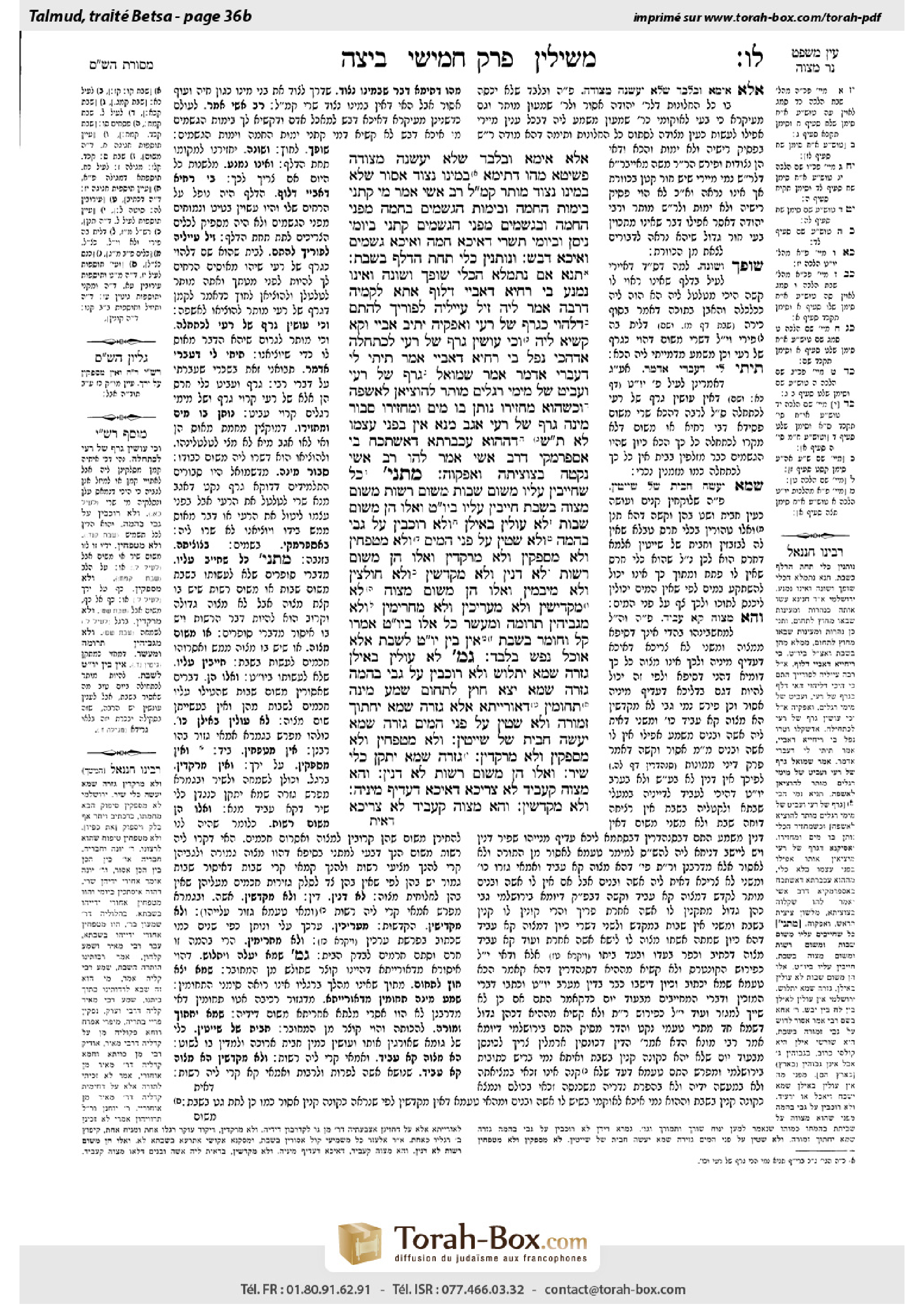
Beitzah 36b: Talmud study for Daf Yomi
Study the Talmud for Daf Yomi with scanned pages, Hebrew text, English translations from Sefaria and AI-generated French translations.
Passage selection and English or AI-generated French translation are available where the scan has annotations. Daf Study is independent of Torah-Box and Sefaria.
Browse Beitzah · ביצה · All tractatesBeitzah 36b text and translations
This page of Beitzah includes the Aramaic text, an English translation and an AI-generated French translation, alongside the scan above.
ביצה ל״ו ב · Aramaic and Hebrew text
אֶלָּא אֵימָא: וּבִלְבַד שֶׁלֹּא יַעֲשֶׂנָּה מְצוּדָה. פְּשִׁיטָא! מַהוּ דְּתֵימָא: בְּמִינוֹ נִצּוֹד — אָסוּר, שֶׁלֹּא בְּמִינוֹ נִצּוֹד — מוּתָּר, קָא מַשְׁמַע לַן.
רַב אָשֵׁי אָמַר: מִי קָתָנֵי בִּימוֹת הַחַמָּה וּבִימוֹת הַגְּשָׁמִים? בַּחַמָּה מִפְּנֵי הַחַמָּה וּבַגְּשָׁמִים מִפְּנֵי הַגְּשָׁמִים קָתָנֵי — בְּיוֹמֵי נִיסָן וּבְיוֹמֵי תִשְׁרֵי, דְּאִיכָּא חַמָּה, וְאִיכָּא גְּשָׁמִים, וְאִיכָּא דְּבַשׁ.
וְנוֹתְנִין כְּלִי תַּחַת הַדֶּלֶף בְּשַׁבָּת. תָּנָא: אִם נִתְמַלֵּא הַכְּלִי — שׁוֹפֵךְ וְשׁוֹנֶה, וְאֵינוֹ נִמְנָע.
בֵּי רִחְיָא דְּאַבָּיֵי דְּלוּף. אֲתָא לְקַמֵּיהּ דְּרַבָּה, אֲמַר לֵיהּ: זִיל עַיְּילֵיהּ לְפוּרְיָךְ לְהָתָם, דְּלֶהֱוֵי כִּגְרָף שֶׁל רְעִי, וְאַפְּקֵיהּ.
יָתֵיב אַבָּיֵי וְקָא קַשְׁיָא לֵיהּ: וְכִי עוֹשִׂין גְּרָף שֶׁל רְעִי לְכַתְּחִלָּה? אַדְּהָכִי נְפַל בֵּי רִחְיָא דְאַבָּיֵי. אָמַר: תֵּיתֵי לִי דַּעֲבַרִי אַדְּמַר.
אָמַר שְׁמוּאֵל: גְּרָף שֶׁל רְעִי וְעָבִיט שֶׁל מֵימֵי רַגְלַיִם — מוּתָּר לְהוֹצִיאָן לָאַשְׁפָּה, וּכְשֶׁהוּא מַחְזִירוֹ — נוֹתֵן בּוֹ מַיִם וּמַחְזִירוֹ.
סְבוּר מִינַּהּ: גְּרָף שֶׁל רְעִי, אַגַּב מָנָא — אִין, בִּפְנֵי עַצְמוֹ — לָא. תָּא שְׁמַע: דְּהָהוּא עַכְבַּרְתָּא דְּאִשְׁתְּכַח בֵּי אִסְפַּרְמָקֵי דְּרַב אָשֵׁי. אֲמַר לְהוּ רַב אָשֵׁי: נִקְטֻהּ בְּצוּצִיתֵהּ וְאַפְּקוּהּ.
מַתְנִי׳ כׇּל שֶׁחַיָּיבִין עָלָיו מִשּׁוּם שְׁבוּת, מִשּׁוּם רְשׁוּת, מִשּׁוּם מִצְוָה, בְּשַׁבָּת — חַיָּיבִין עָלָיו בְּיוֹם טוֹב.
וְאֵלּוּ הֵן מִשּׁוּם שְׁבוּת: לֹא עוֹלִין בָּאִילָן, וְלֹא רוֹכְבִין עַל גַּבֵּי בְּהֵמָה, וְלֹא שָׁטִין עַל פְּנֵי הַמַּיִם, וְלֹא מְטַפְּחִין וְלֹא מְסַפְּקִין וְלֹא מְרַקְּדִין.
וְאֵלּוּ הֵן מִשּׁוּם רְשׁוּת: לֹא דָּנִין, וְלֹא מְקַדְּשִׁין, וְלֹא חוֹלְצִין, וְלֹא מְיַבְּמִין.
וְאֵלּוּ הֵן מִשּׁוּם מִצְוָה: לֹא מַקְדִּישִׁין, וְלֹא מַעֲרִיכִין, וְלֹא מַחֲרִימִין, וְלֹא מַגְבִּיהִין תְּרוּמָה וּמַעֲשֵׂר.
כׇּל אֵלּוּ בְּיוֹם טוֹב אָמְרוּ, קַל וָחוֹמֶר בַּשַּׁבָּת. אֵין בֵּין יוֹם טוֹב לַשַּׁבָּת אֶלָּא אוֹכֶל נֶפֶשׁ בִּלְבָד.
גְּמָ׳ לֹא עוֹלִין בָּאִילָן — גְּזֵרָה שֶׁמָּא יִתְלוֹשׁ.
וְלֹא רוֹכְבִין עַל גַּבֵּי בְּהֵמָה — גְּזֵרָה שֶׁמָּא יֵצֵא חוּץ לַתְּחוּם. שְׁמַע מִינַּהּ תְּחוּמִין דְּאוֹרָיְיתָא! אֶלָּא: גְּזֵרָה שֶׁמָּא יַחְתּוֹךְ זְמוֹרָה.
וְלֹא שָׁטִין עַל פְּנֵי הַמַּיִם — גְּזֵרָה שֶׁמָּא יַעֲשֶׂה חָבִית שֶׁל שַׁיָּיטִין.
וְלֹא מְטַפְּחִין וְלֹא מְסַפְּקִין וְלֹא מְרַקְּדִין — גְּזֵרָה שֶׁמָּא יְתַקֵּן כְּלֵי שִׁיר.
וְאֵלּוּ הֵן מִשּׁוּם רְשׁוּת: לֹא דָּנִין. וְהָא מִצְוָה קָעָבֵיד! לָא צְרִיכָא, דְּאִיכָּא דַּעֲדִיף מִינֵּיהּ.
וְלֹא מְקַדְּשִׁין. וְהָא מִצְוָה קָעָבֵיד! לָא צְרִיכָא,
Beitzah 36b · English translation
but rather say the following: Provided he does not make it a trap as he covers it, i.e., as long as he takes care not to cover all the openings. The Gemara questions this: But it is obvious that it is prohibited to directly trap bees on Shabbat; why would the baraita mention it? The Gemara responds: It does inform us of something that is not obvious: Lest you say: An animal whose type is generally trapped and hunted by people for some purpose is prohibited to be trapped on Shabbat, whereas an animal whose type is not generally trapped, such as a bee, is permitted to be trapped even ab initio, as this is not considered to be the normal manner of hunting. The baraita therefore teaches us that one may not in fact trap bees.
Rav Ashi said a different elucidation: Is it taught in the baraita: In the summer, and: In the rainy season? No, it is taught: In the sun due to the sun and in the rain due to the rain. The baraita speaks not of the summer and the rainy season, but of the spring days of Nisan and the autumn days of Tishrei, when there is sometimes sun and there is sometimes rain, and when there is also honey in the hive. It is possible, then, that the baraita permits covering the hive during these seasons because of the honey that is in it, as initially proposed.
§ It was taught in the mishna: And one may place a vessel beneath a leak in order to catch the water on Shabbat. A Sage taught in a baraita: If the vessel became full with the leaking water, he may pour out its contents, place the vessel back under the leak, and repeat the entire process if necessary, and he need not refrain from doing so.
The Gemara relates: Abaye’s millhouse once developed a leak on Shabbat. Abaye was concerned about the potential damage to the millstones, which were made partly of clay and which would become ruined from the leaking water, and he did not have enough buckets to catch all the water without emptying and refilling them. But the water was unfit for drinking and was therefore muktze and could not be removed. Abaye came before Rabba to ask him how to proceed. Rabba said to him: Go and bring your bed into the millhouse, so that the dirty water will be considered like a container of excrement, which, despite being muktze, may be removed from one’s presence due to its repulsive nature, and then remove the water.
Abaye sat and examined the matter and posed a difficulty: And may one initiate a situation of a container of excrement, i.e., may one intentionally place any repulsive matter into a situation which will bother him and will then have to be removed, ab initio? In the meantime, as he was deliberating the issue, Abaye’s millhouse collapsed. He said: I had this coming to me for having gone against the words of my master, Rabba, by not following his ruling unquestioningly.
Shmuel said: With regard to a container of excrement and a container of urine, it is permitted to remove them on Shabbat to a garbage heap. And when he returns the container to the house he must place water in it first and then return it, for it is prohibited to carry these containers alone, as their foul odor makes them muktze due to their repulsive nature.
Some Sages at first understood from the wording of Shmuel’s statement that with regard to removing a container of excrement on account of the vessel, i.e., along with its vessel: Yes, this is permitted; but to remove the excrement by itself, without a vessel containing it: No, this is prohibited. The Gemara counters this conclusion with the following story: Come and hear that a certain dead mouse was discovered in Rav Ashi’s storeroom for spices [isparmekei]. Rav Ashi said to them: Take hold of it by its tail and remove it. This shows that repulsive matter may be removed even directly.
MISHNA: Any act for which one is liable due to a rabbinic decree made to enhance the character of Shabbat as a day of rest [shevut]; or if it is notable because it is optional, i.e., it involves an aspect of a mitzva but is not a complete mitzva; or if it is notable because it is a full-fledged mitzva, if it is prohibited on Shabbat, one is liable for it on a Festival as well.
And these are the acts prohibited by the Sages as shevut: One may not climb a tree on Shabbat, nor ride on an animal, nor swim in the water, nor clap his hands together, nor clap his hand on the thigh, nor dance.
And the following are acts that are prohibited on Shabbat and are notable because they are optional, i.e., which involve an aspect of a mitzva but are not complete mitzvot: One may not judge, nor betroth a woman, nor perform ḥalitza, which is done in lieu of levirate marriage, nor perform levirate marriage.
And the following are prohibited on Shabbat despite the fact that they are notable because of the full-fledged mitzva involved in them: One may not consecrate, nor take a valuation vow (see Leviticus 27), nor consecrate objects for use by the priests or the Temple, nor separate teruma and tithes from produce.
The Sages spoke of all these acts being prohibited even with regard to a Festival; all the more so are they prohibited on Shabbat. The general principle is: There is no difference between a Festival and Shabbat, except for work involving preparation of food alone, which is permitted on a Festival but prohibited on Shabbat.
GEMARA: The Gemara clarifies the reasons for each of these halakhot: One may not climb a tree. This is a decree that was made lest one detach branches or leaves as he climbs, thereby transgressing the prohibited labor of reaping.
Nor ride on an animal: This is a decree that was made lest one go beyond the Shabbat limit on the animal. The Gemara asks: Can one then learn from here that the prohibition against venturing beyond the Shabbat limits, which applies also to Festivals, is by Torah law? If the prohibition with regard to the Shabbat limit were rabbinic, the Sages would not have reinforced it with the additional decree against riding an animal. It is known that this is a matter of dispute; in light of this explanation of the mishna it would be a proof that Shabbat boundaries are of Torah origin. Rather, give a different reason for the prohibition: It is a decree that was made lest one cut off a branch to use as a riding switch, and thereby perform the labor of reaping, which is prohibited by Torah law.
Nor swim in the water: This is a decree that was made lest one make a swimmer’s barrel, i.e., an improvised flotation device used to teach beginners how to swim.
Nor clap one’s hands together, nor clap his hand on the thigh, nor dance: All of these are prohibited due to a decree that was made lest one fashion a musical instrument to accompany his clapping or dancing.
§ It was taught in the mishna: And the following are acts that are prohibited on Shabbat and are notable because they are optional, i.e., which involve an aspect of a mitzva but are not complete mitzvot: One may not judge. The Gemara asks: But doesn’t one perform a full-fledged mitzva by acting as a judge in a court? Why is it categorized as optional rather than as a full-fledged mitzva? The Gemara answers: No, it is necessary for the mishna to categorize it as optional, as it is speaking of a case where there is another person who is more qualified than he. Since the other person can judge even better, it is not considered an absolute mitzva for the first one to judge.
§ Nor betroth a woman: The Gemara asks: Why is this categorized as optional, indicating that it is not a full-fledged mitzva? But doesn’t one perform a full-fledged mitzva when he marries, as this enables him to fulfill the mitzva to be fruitful and multiply? The Gemara answers: No, it is necessary for the mishna to categorize it as optional,
Beitzah 36b · Traduction française (IA)
mais plutôt dire ceci : à condition qu'il ne le fasse pas devenir un piège, c'est-à-dire tant qu'il prend soin de ne pas couvrir toutes les ouvertures. La Guemara pose une question à ce propos : Mais c'est évident que c'est interdit de piéger les abeilles directement le sabbat ; pourquoi alors la baraïta en parle-t-elle ? La Guemara répond : cela nous informe d'une chose qui n'est pas évidente : afin que vous ne disiez pas : un animal dont le type est généralement piégé et chassé par les gens à des fins spécifiques est interdit de le piéger le sabbat, tandis qu'un animal dont le type n'est pas généralement piégé, comme les abeilles, est permis de le piéger dès le début, car cela n'est pas considéré comme la manière normale de chasser. La baraïta enseigne donc que l'on ne peut en effet piéger les abeilles.
Rav Ashi a dit une autre interprétation : est-ce que la baraïta enseigne : en été, et : en saison des pluies ? Non, elle enseigne : en plein soleil à cause du soleil et en pluie à cause de la pluie. La baraïta ne parle pas de l'été et de la saison des pluies, mais des jours de Nisan, printemps, et des jours de Tishrei, automne, où il y a parfois du soleil et parfois de la pluie, et où il y a aussi du miel dans la ruche. Il est donc possible que la baraïta autorise de couvrir la ruche durant ces saisons à cause du miel qu'il y a dedans, comme on l'avait initialement proposé.
§ Il fut enseigné dans la mitsva : et l'on peut placer un récipient sous une fuite afin de capturer l'eau le sabbat. Un Sage enseigna dans une baraïta : si le récipient s'est rempli de l'eau qui fuit, il peut vider son contenu, replacer le récipient sous la fuite et répéter l'ensemble si nécessaire, et il n'a pas besoin de s'en abstenir.
La Guemara rapporte : l'atelier de meunier d'Abaye a eu une fuite le sabbat. Abaye s'inquiétait du risque de dommage aux meules, qui étaient en partie en argile et qui se seraient abîmées à cause de l'eau qui fuyait, et il n'avait pas assez de seaux pour capturer toute l'eau sans les vider et les remplir à nouveau. L'eau était inutilisable à boire et était donc muktze et ne pouvait pas être retirée. Abaye s'est présenté devant Rabba pour lui demander comment agir. Rabba lui a dit : va chercher ton lit dans l'atelier de meunier, afin que l'eau sale soit considérée comme un récipient d'excréments, qui, bien qu'étant muktze, peut être retiré de la présence d'une personne à cause de sa nature répugnante, et ensuite retire l'eau.
Abaye s'est assis et a examiné la question et a posé un doute : et peut-on initier une situation de récipient d'excréments, c'est-à-dire peut-on intentionnellement placer un objet répugnant dans une situation qui le gêne et qu'il faudra ensuite retirer, dès le début ? En même temps, alors qu'il réfléchissait à cette question, l'atelier de meunier d'Abaye s'est effondré. Il a dit : j'avais cela à montrer pour avoir contredit les paroles de mon maître, Rabba, en ne suivant pas sa décision sans réserve.
Shmuel a dit : concernant un récipient d'excréments et un récipient d'urine, il est permis de les retirer le sabbat vers un tas de déchets. Et lorsqu'il rentre le récipient chez lui, il doit d'abord le remplir d'eau et ensuite le remettre, car il est interdit de transporter ces récipients seuls, à cause de leur odeur nauséabonde qui les rend muktze en raison de leur nature répugnante.
Certains Sages ont d'abord compris, à partir de la déclaration de Shmuel, que concernant le retrait d'un récipient d'excréments à cause du récipient, c'est-à-dire avec son récipient : oui, cela est permis ; mais pour retirer l'excrément lui-même, sans récipient le contenant : non, cela est interdit. La Guemara contredit cette conclusion avec l'histoire suivante : viens écouter que l'on avait découvert un rat mort dans la pièce de Rav Ashi pour les épices [isparmekei]. Rav Ashi a dit à ceux-ci : attrape-le par sa queue et retire-le. Cela montre que les choses répugnantes peuvent être retirées même directement.
MICHNA : Tout acte pour lequel l'on est tenu responsable en raison d'un décret rabbinique visant à améliorer la qualité du sabbat comme jour de repos [shevut] ; ou si c'est notable parce qu'il est optionnel, c'est-à-dire s'il implique un aspect d'une mitsva mais n'est pas une mitsva complète ; ou si c'est notable parce qu'il s'agit d'une mitsva complète, si c'est interdit le sabbat, l'on est tenu responsable de cela aussi lors d'un festival.
Et ces sont les actes interdits par les Sages comme shevut : on ne peut pas monter en arbre le sabbat, ni monter sur un animal, ni nager dans l'eau, ni claquer des mains, ni claquer la main sur la cuisse, ni danser.
Et les suivants sont des actes interdits le sabbat et sont notables parce qu'ils sont optionnels, c'est-à-dire qu'ils impliquent un aspect d'une mitsva mais ne sont pas des mitsvot complètes : on ne peut pas juger, ni épouser une femme, ni pratiquer la ḥalitza, qui est pratiquée à la place du mariage levirique, ni pratiquer le mariage levirique.
Et les suivants sont interdits le sabbat malgré le fait qu'ils sont notables à cause de la mitsva complète qu'ils impliquent : on ne peut pas sanctifier, ni prendre un vœu de valeur (voir Lévitique 27), ni sanctifier des objets pour l'usage des prêtres ou du Temple, ni séparer la terouma et les dîmes des produits.
Les Sages parlaient de tous ces actes être interdits même concernant un festival ; encore plus encore sont-ils interdits le sabbat. Le principe général est : il n'y a pas de différence entre un festival et le sabbat, sauf pour le travail impliquant la préparation des aliments seul, qui est permis lors d'un festival mais interdit le sabbat.
GUEMARA : La Guemara clarifie les raisons de chacune de ces halakhot : on ne peut pas monter en arbre. C'est un décret qui a été fait afin que l'on ne détache pas des branches ou des feuilles en montant, en transgressant ainsi le travail interdit de la récolte.
Ne pas monter sur un animal : c'est une déclaration faite afin que l'on ne dépasse pas la limite du Shabbat sur l'animal. La Guemara pose la question : peut-on alors en déduire que l'interdiction de dépasser les limites du Shabbat, qui s'applique également aux fêtes, est d'origine divine ? Si l'interdiction concernant la limite du Shabbat était rabbinique, les Sages n'auraient pas renforcé cette interdiction avec une autre déclaration contre la montée sur un animal. Il est connu que cela est une question de débat ; en lumière de cette explication de la Michna, cela serait une preuve que les limites du Shabbat sont d'origine divine. Cependant, donnez une autre raison à cette interdiction : c'est une déclaration faite afin que l'on ne coupe pas une branche pour en faire un fouet de monture, et ainsi accomplir le travail de moisson, interdit par la Loi divine.
Ne pas nager dans l'eau : c'est une déclaration faite afin que l'on ne fabrique pas un ballon de nage, c'est-à-dire un dispositif flottant improvisé utilisé pour enseigner aux débutants à nager.
Ne pas claquer des mains, ni poser la main sur la cuisse, ni danser : toutes ces actions sont interdites en raison d'une déclaration faite afin que l'on ne fabrique pas un instrument de musique pour accompagner son claquement ou sa danse.
§ Il a été enseigné dans la Michna : Et les actions suivantes sont interdites le Shabbat et sont notables car elles sont optionnelles, c'est-à-dire qu'elles comportent un aspect de la Mitsva mais ne sont pas des Mitsvot complètes : on ne peut pas être juge. La Guemara pose la question : mais ne constitue-t-il pas une Mitsva complète en agissant comme juge dans un tribunal ? Pourquoi est-il catégorisé comme optionnel plutôt que comme une Mitsva complète ? La Guemara répond : non, il est nécessaire pour la Michna de le catégoriser comme optionnel, car elle parle d'un cas où il y a une autre personne plus compétente que lui. Puisque cette autre personne peut juger encore mieux, cela n'est pas considéré comme une Mitsva absolue pour le premier de juger.
§ Ne pas épouser une femme : la Guemara pose la question : pourquoi est-ce catégorisé comme optionnel, indiquant qu'il ne s'agit pas d'une Mitsva complète ? Mais ne constitue-t-il pas une Mitsva complète lorsqu'on se marie, car cela permet de remplir la Mitsva d'être fécond et de multiplier ? La Guemara répond : non, il est nécessaire pour la Michna de le catégoriser comme optionnel,
Traduction française générée par IA à partir de l’édition anglaise de Sefaria. Vérifie toujours un passage avec le texte source.
Text from Sefaria: William Davidson Edition - Vocalized Aramaic (CC BY NC); William Davidson Edition - English (CC BY NC).