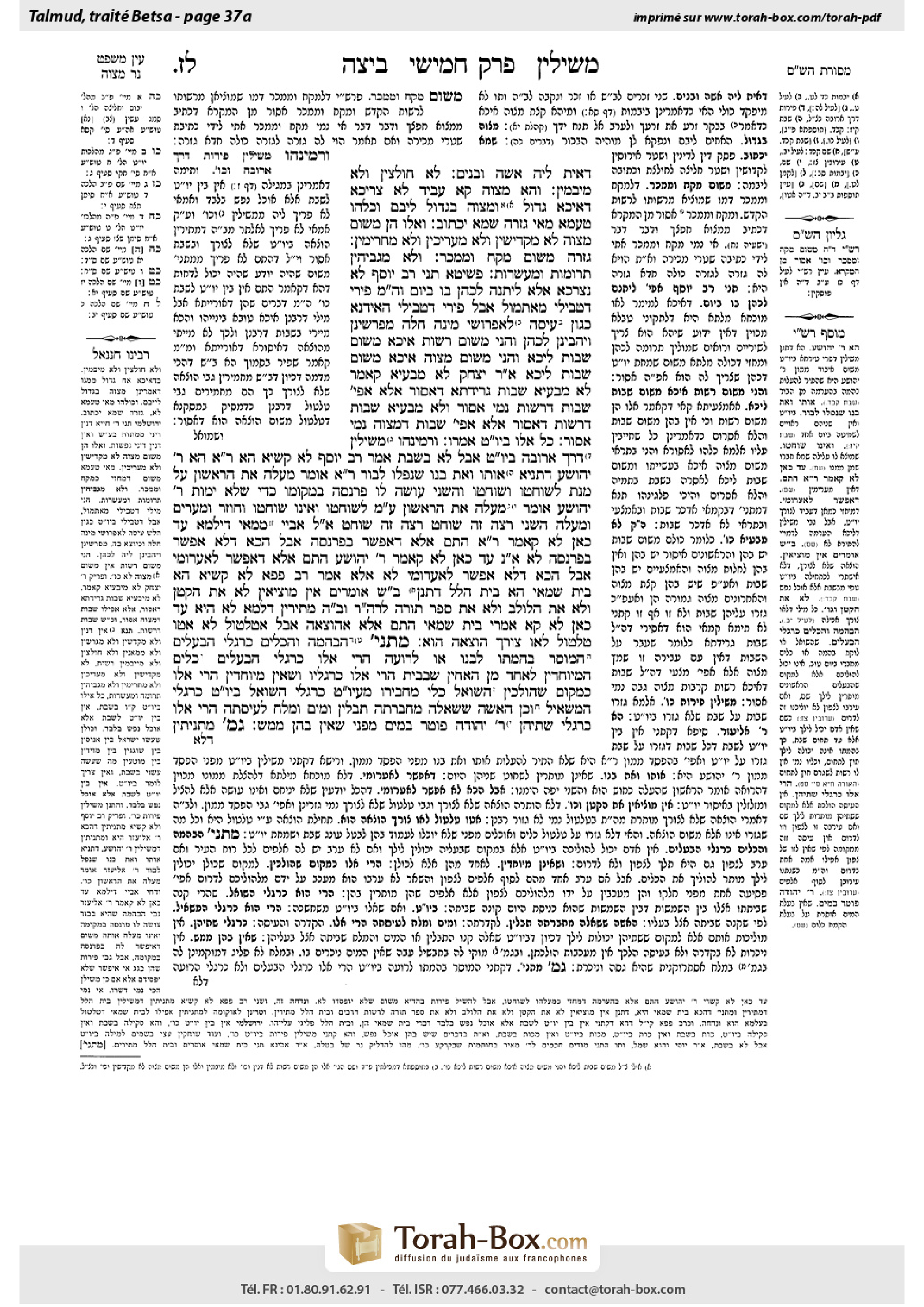
Beitzah 37a: Talmud study for Daf Yomi
Study the Talmud for Daf Yomi with scanned pages, Hebrew text, English translations from Sefaria and AI-generated French translations.
Passage selection and English or AI-generated French translation are available where the scan has annotations. Daf Study is independent of Torah-Box and Sefaria.
Browse Beitzah · ביצה · All tractatesBeitzah 37a text and translations
This page of Beitzah includes the Aramaic text, an English translation and an AI-generated French translation, alongside the scan above.
ביצה ל״ז א · Aramaic and Hebrew text
דְּאִית לֵיהּ אִשָּׁה וּבָנִים.
לֹא חוֹלְצִין וְלֹא מְיַבְּמִין. וְהָא מִצְוָה קָא עָבֵיד! לָא צְרִיכָא, דְּאִיכָּא גָּדוֹל, וּמִצְוָה בַּגָּדוֹל לְיַבֵּם.
וְכֻלְּהוּ טַעְמָא מַאי — גְּזֵרָה שֶׁמָּא יִכְתּוֹב.
וְאֵלּוּ הֵן מִשּׁוּם מִצְוָה: לֹא מַקְדִּישִׁין וְלֹא מַעֲרִיכִין וְלֹא מַחֲרִימִין — גְּזֵרָה מִשּׁוּם מִקָּח וּמִמְכָּר.
וְלֹא מַגְבִּיהִין תְּרוּמוֹת וּמַעַשְׂרוֹת. פְּשִׁיטָא! תָּנֵי רַב יוֹסֵף: לֹא נִצְרְכָא אֶלָּא לִיתְּנָהּ לְכֹהֵן בּוֹ בַּיּוֹם.
וְהָנֵי מִילֵּי פֵּירֵי דִּטְבִילִי מֵאֶתְמוֹל, אֲבָל פֵּירֵי דִּטְבִילִי הָאִידָּנָא, כְּגוֹן עִיסָּה לְאַפְרוֹשֵׁי מִינַּהּ חַלָּה — מַפְרְשִׁינַן וְיָהֲבִינַן לְכֹהֵן.
וְהָנֵי, מִשּׁוּם רְשׁוּת אִיכָּא, מִשּׁוּם שְׁבוּת לֵיכָּא? וְהָנֵי, מִשּׁוּם מִצְוָה אִיכָּא, מִשּׁוּם שְׁבוּת לֵיכָּא?
אָמַר רַבִּי יִצְחָק, לָא מִבַּעְיָא קָאָמַר: לָא מִבַּעְיָא שְׁבוּת גְּרֵידְתָּא דְּאָסוּר, אֶלָּא אֲפִילּוּ שְׁבוּת דִּרְשׁוּת נָמֵי אָסוּר. וְלָא מִבַּעְיָא שְׁבוּת דִּרְשׁוּת דְּאָסוּר, אֶלָּא אֲפִילּוּ שְׁבוּת דְּמִצְוָה נָמֵי אָסוּר.
כׇּל אֵלּוּ בְּיוֹם טוֹב אָמְרוּ, וּרְמִינְהוּ: מַשִּׁילִין דֶּרֶךְ אֲרוּבָּה בְּיוֹם טוֹב, אֲבָל לֹא בְּשַׁבָּת!
אָמַר רַב יוֹסֵף, לָא קַשְׁיָא: הָא רַבִּי אֱלִיעֶזֶר, הָא רַבִּי יְהוֹשֻׁעַ.
דְּתַנְיָא: אוֹתוֹ וְאֶת בְּנוֹ שֶׁנָּפְלוּ לְבוֹר — רַבִּי אֱלִיעֶזֶר אוֹמֵר: מַעֲלֶה אֶת הָרִאשׁוֹן עַל מְנָת לְשׁוֹחְטוֹ וְשׁוֹחֲטוֹ, וְהַשֵּׁנִי עוֹשֶׂה לוֹ פַּרְנָסָה בִּמְקוֹמוֹ כְּדֵי שֶׁלֹּא יָמוּת.
רַבִּי יְהוֹשֻׁעַ אוֹמֵר: מַעֲלֶה אֶת הָרִאשׁוֹן עַל מְנָת לְשׁוֹחְטוֹ וְאֵינוֹ שׁוֹחֲטוֹ, וְחוֹזֵר וּמַעֲרִים וּמַעֲלֶה הַשֵּׁנִי. רָצָה — זֶה שׁוֹחֵט, רָצָה — זֶה שׁוֹחֵט.
אֲמַר לֵיהּ אַבָּיֵי: מִמַּאי? דִּילְמָא עַד כָּאן לָא קָאָמַר רַבִּי אֱלִיעֶזֶר הָתָם, אֶלָּא דְּאֶפְשָׁר בְּפַרְנָסָה, אֲבָל הָכָא דְּלָא אֶפְשָׁר בְּפַרְנָסָה — לָא!
אִי נָמֵי: עַד כָּאן לָא קָאָמַר רַבִּי יְהוֹשֻׁעַ הָתָם, אֶלָּא דְּאֶפְשָׁר לְאַעֲרוֹמֵי. אֲבָל הָכָא דְּלָא אֶפְשָׁר לְאַעֲרוֹמֵי — לָא.
אֶלָּא אָמַר רַב פָּפָּא, לָא קַשְׁיָא: הָא בֵּית שַׁמַּאי, הָא בֵּית הִלֵּל.
דִּתְנַן, בֵּית שַׁמַּאי אוֹמְרִים: אֵין מוֹצִיאִין לֹא אֶת הַקָּטָן וְלֹא אֶת הַלּוּלָב וְלֹא אֶת סֵפֶר תּוֹרָה לִרְשׁוּת הָרַבִּים, וּבֵית הִלֵּל מַתִּירִין.
דִּלְמָא לָא הִיא, עַד כָּאן לָא קָא אָמְרִי בֵּית שַׁמַּאי הָתָם, אֶלָּא אַהוֹצָאָה, אֲבָל אַטִּלְטוּל — לָא. אַטּוּ טִלְטוּל לָאו צוֹרֶךְ הוֹצָאָה הוּא?
מַתְנִי׳ הַבְּהֵמָה וְהַכֵּלִים כְּרַגְלֵי הַבְּעָלִים. הַמּוֹסֵר בְּהֶמְתּוֹ לִבְנוֹ אוֹ לָרוֹעֶה — הֲרֵי אֵלּוּ כְּרַגְלֵי הַבְּעָלִים.
כֵּלִים הַמְיוּחָדִין לְאֶחָד מִן הָאַחִין שֶׁבַּבַּיִת — הֲרֵי אֵלּוּ כְּרַגְלָיו. וְשֶׁאֵין מְיוּחָדִין — הֲרֵי אֵלּוּ כִּמְקוֹם שֶׁהוֹלְכִין.
הַשּׁוֹאֵל כְּלִי מֵחֲבֵירוֹ מֵעֶרֶב יוֹם טוֹב — כְּרַגְלֵי הַשּׁוֹאֵל. בְּיוֹם טוֹב — כְּרַגְלֵי הַמַּשְׁאִיל. וְכֵן הָאִשָּׁה שֶׁשָּׁאֲלָה מֵחֲבֶרְתָּהּ תַּבְלִין וּמַיִם וָמֶלַח לְעִיסָּתָהּ — הֲרֵי אֵלּוּ כְּרַגְלֵי שְׁתֵּיהֶן. רַבִּי יְהוּדָה פּוֹטֵר בַּמַּיִם, מִפְּנֵי שֶׁאֵין בָּהֶן מַמָּשׁ.
גְּמָ׳ מַתְנִיתִין
Beitzah 37a · English translation
because it is dealing with a case in which he already has a wife and children, so that he has already fulfilled the mitzva to be fruitful and multiply, and his betrothal of another woman is only an optional act.
§ Nor perform ḥalitza, nor perform levirate marriage: The Gemara asks: But doesn’t one perform a mitzva through these acts? Why are they categorized as optional? The Gemara answers: No, it is necessary for the mishna to categorize them as optional, as it is speaking of a case when there is an older brother. Since the general principle is that the preferable way to carry out the mitzva is for the oldest brother to perform levirate marriage, the performance of levirate marriage by a younger brother is classified as optional.
The Gemara clarifies the reason for the prohibition against judging, betrothing, etc., on Shabbat and Festivals: And in all these cases, what is the reason they may not be performed? It is a decree lest one write down the proceedings of these acts in a document, such as the verdict of a judgment, the document of betrothal, a document testifying to the ḥalitza, or a marriage contract in the case of levirate marriage.
§ It was taught in the mishna: And the following are notable because of the full-fledged mitzva involved in them, yet are prohibited on Shabbat: One may not consecrate, nor take a valuation vow, nor consecrate objects for use by the priests or the Temple. The Gemara explains: All these cases are prohibited because of a decree due to their similarity to commerce. These acts, which all involve the transfer of ownership to the Temple treasury, resemble commerce, which is prohibited on a Festival.
§ It was taught in the mishna: And one may not separate terumot and tithes. The Gemara asks: Is it not obvious that this is so? In doing so one makes forbidden food usable, a form of repairing, which is a prohibited labor. Rav Yosef taught: It is necessary for the mishna to teach this only to state that it is prohibited even to separate teruma in order to give it to a priest on the same day. One could have thought that since he is separating the produce in order to give it to a priest it should be permitted like any other preparation of food; the mishna therefore states explicitly that it is prohibited.
The Gemara comments: And this applies only to produce that had the status of untithed produce, and therefore was required to be tithed, the day before the Festival. However, produce that became untithed now on the Festival itself, such as dough prepared on the Festival, which becomes untithed and requires ḥalla to be taken from it only after the dough is made: With regard to separating ḥalla from it, one may separate the ḥalla and give it to a priest even on a Festival.
The Gemara asks a question. When the mishna describes those cases as notable because they are optional, is this to say that their prohibition is not because of a rabbinic decree to enhance the character of Shabbat as a day of rest [shevut]? Likewise, with regard to those cases described as notable because they are mitzvot, is this to say that their prohibition is not because of shevut? The mishna, by referring only to the first of its three categories as shevut, implies that the acts listed in the following categories do not involve shevut. But this is not so; as the Gemara stated above, all these acts are prohibited by rabbinic decree to enhance the character of Shabbat and the Festival as days of rest.
Rabbi Yitzḥak said: They are indeed all prohibited as shevut. The mishna lists three types of shevut: Those that involve no mitzva whatsoever, those that have a mitzva aspect to them, and those that constitute a full-fledged mitzva. And the tanna is speaking and arranges his list employing the style of: There is no need, i.e., he arranges the cases in order of increasing notability. First, there is no need to state, i.e., it is most obvious, that plain shevut, which involves no mitzva at all, is prohibited, but even shevut of an optional act, i.e., an act that is a minor mitzva, is also prohibited. And there is no need to state, i.e., it is obvious, that shevut of an optional act is prohibited, but even shevut of a full-fledged mitzva is also prohibited.
§ It was taught in the mishna: The Sages spoke of all these acts being prohibited even with regard to a Festival; all the more so are they prohibited on Shabbat. There is no difference between a Festival and Shabbat except for work involving food. The Gemara raises a contradiction against this from an earlier mishna: One may lower produce from the roof into the house through a skylight to prevent it from being spoiled by the rain on a Festival, but not on Shabbat. This shows that there is another difference between a Festival and Shabbat besides food preparation: Doing a strenuous activity to prevent a loss is permitted on a Festival but prohibited on Shabbat.
Rav Yosef said: This is not difficult, as this mishna here, which does not include the halakha of lowering produce as an example of a difference between Shabbat and a Festival, is in accordance with Rabbi Eliezer, whereas that previous mishna that does cite it as a difference is in accordance with Rabbi Yehoshua.
Rav Yosef elaborates on his statement: As it is taught in a baraita: If a cow and her calf, which may not be slaughtered on the same day because of the biblical prohibition: “You shall not kill it and its offspring both in one day” (Leviticus 22:28), fell into a pit on a Festival, and their owner wishes to take them out, Rabbi Eliezer says: One may raise the first in order to slaughter it and then slaughter it, and as for the second, he provides it sustenance in its place so that it will not die in the pit. It is prohibited to undertake the strenuous task of raising an animal out of a pit except for the purpose of eating it on the Festival. Therefore, since one cannot slaughter both animals on the Festival, only one can be raised, while the other should be sustained in its place until after the Festival.
Rabbi Yehoshua, however, says: One may raise the first with the intent of slaughtering it and then change his mind and not slaughter it. Then he may go back and employ artifice by deciding that he prefers to slaughter the second one, and he raises the second. Having raised both animals, if he so desires he may slaughter this one; if he so desires he may slaughter that one. Rav Yosef understands the argument between the two Sages as follows: Rabbi Yehoshua maintains that it is permitted to perform a strenuous activity on a Festival in order to prevent a loss, and therefore he may raise both animals, lest the one left behind die in the pit. Rabbi Eliezer, on the other hand, holds that one may not perform a strenuous activity to prevent a loss, so the second animal must be left in the pit even though it may die there. It may therefore be posited that the mishna that permits lowering produce on a Festival to prevent loss is in accordance with Rabbi Yehoshua’s opinion. Rabbi Eliezer would disagree with this leniency, and the principle that there is no difference between Shabbat and a Festival other than food preparation would remain intact.
Abaye said to Rav Yosef: From where do you know that this analysis of these Sages’ opinions is correct? Perhaps Rabbi Eliezer stated his opinion that a strenuous activity to prevent monetary loss is prohibited on a Festival only thus far, there in the case of the animals in the pit, where it is possible to sustain the second animal in the pit and keep it from dying. But here, in the case of the produce on the roof, where there is no possibility of preventing the loss through providing sustenance, he would not prohibit lowering the produce to save it from loss.
Alternatively, one can propose an opposite argument: Rabbi Yehoshua stated his opinion that a strenuous activity to prevent loss is permitted only thus far, there in the case of the two animals, because it is possible to employ artifice to raise the second animal, so that an observer might assume that that he was not acting to preserve his property, but wished to eat the first animal and subsequently changed his mind. But here, in the case of the produce on the roof, where it is not possible to employ artifice, as it is clear that he is acting to salvage his produce, Rabbi Yehoshua would not be lenient. Therefore, Rav Yosef’s approach to resolving the contradiction has no support from this baraita.
Rather, Rav Pappa said: This resolution of the contradiction is to be rejected in favor of the following: This is not difficult, as this case is in accordance with Beit Shammai, whereas that case follows the approach of Beit Hillel.
As we learned in a mishna: Beit Shammai say: On a Festival one may not take out a child who cannot walk, nor a lulav, nor a Torah scroll into the public domain, as none of these are required for the preparation of food, and Beit Hillel permit it. It is certainly prohibited to carry out any item into the public domain on Shabbat, yet Beit Hillel permit it on a Festival. Therefore, it may be posited that just as Beit Hillel allow carrying out items on a Festival but not on Shabbat, so would they permit moving the produce off the roof on a Festival but not on Shabbat. According to Beit Shammai, who forbid carrying items out on a Festival and on Shabbat equally, moving the produce from the roof would also be equally prohibited, and the principle that there is no difference between Shabbat and a Festival other than food preparation would remain intact.
The Gemara at first refutes this explanation: Perhaps that is not so, as it is possible that Beit Shammai stated their opinion only thus far, there with regard to the prohibition against transferring objects from one domain to another, but not with regard to moving objects, such as produce, from place to place in the house. The Gemara rejects this claim: Is that to say that moving is not performed for the sake of taking out to the public domain? The decree against moving items unnecessarily, i.e., not for use on Shabbat or a Festival, was enacted due to a concern that one might take objects into the public domain. Rav Pappa’s explanation that it is only Beit Shammai who would prohibit lowering the produce from the roof therefore stands.
MISHNA: The status of animals and vessels on Festivals is as the feet of their owner, meaning that one’s animals and vessels are governed by his own travel limitations on Shabbat and Festivals. In the case of one who delivers his animal to his son or to a shepherd before the Festival to care for it, these are as the feet of the owner, rather than those of the son or the shepherd.
Vessels that have been inherited by several brothers and have not been divided among them but are still owned jointly, if they are designated for the use of one of the brothers in the house and the other brothers have no part in them, these are as his feet, and they are subject to his travel limitations. And as for those that are not designated for any particular brother, these are as a place where they may all go. They are limited by the travel limitations of every one of the brothers, as when one brother made a joining of Shabbat boundaries [eiruv teḥumin] and the others did not.
One who borrows a vessel from another on the eve of a Festival, it is as the feet of the borrower rather than the owner, as when the Festival began the vessel established its place of rest in possession of the borrower. However, if he borrowed it on the Festival itself, it is as the feet of the lender, since at the start of the Festival its place of rest was established in the possession of its owner. And similarly, a woman who borrowed spices from another to put in a dish, or water and salt to put in her dough, these foods, i.e., the dish and the dough, which contain ingredients belonging to both parties, are as the feet of both of them; they are limited by the travel limitations of both parties. Rabbi Yehuda exempts one from travel limitations in the case of water, because it has no substance in the mixture and therefore is not considered connected to the original owner.
GEMARA: The Gemara asserts: The mishna
Beitzah 37a · Traduction française (IA)
car il s'agit d'un cas où il a déjà une femme et des enfants, donc il a déjà accompli la mitsva de procréer et de multiplier, et son fiancement d'une autre femme n'est qu'un acte facultatif.
§ On ne pratique pas la ḥalitza, ni le mariage levirique : La Guemara demande : Mais ne sont-ce pas des actes par lesquels on accomplit une mitsva ? Pourquoi sont-ils classés comme facultatifs ? La Guemara répond : Non, il est nécessaire que la mitsna les classe comme facultatifs, car elle parle d'un cas où il y a un frère aîné. Puisque le principe général est que la voie préférée pour accomplit la mitsva est que le frère aîné pratique le mariage levirique, la pratique du mariage levirique par un frère plus jeune est classée comme facultatif.
La Guemara clarifie la raison de l'interdiction de juger, de fiancer, etc., le sabbat et les fêtes : Et dans tous ces cas, quelle est la raison qu'ils ne puissent pas être accomplis ? C'est une déclaration afin de ne pas écrire les actes dans un document, comme le verdict d'un jugement, le document de fiancement, un document témoignant de la ḥalitza, ou un contrat de mariage dans le cas du mariage levirique.
§ Il a été enseigné dans la mitsna : Et ceux-ci sont notables en raison de la mitsva complète qu'ils impliquent, toutefois ils sont interdits le sabbat : On ne peut pas consacrer, ni prendre un vœu de valeur, ni consacrer des objets pour l'usage des prêtres ou du Temple. La Guemara explique : Tous ces cas sont interdits en raison d'une déclaration due à leur similitude avec le commerce. Ces actes, qui impliquent tous la transmission de la propriété au trésor du Temple, ressemblent au commerce, qui est interdit lors d'une fête.
§ Il a été enseigné dans la mitsna : On ne peut pas séparer les terumot et les dîmes. La Guemara demande : N'est-ce pas évident ? En le faisant, on rend utilisable de la nourriture interdite, une forme de réparation, qui est un travail interdit. Rav Yosef enseigna : Il est nécessaire que la mitsna enseigne cela uniquement pour affirmer qu'il est interdit même de séparer la terouma afin de la donner à un prêtre le même jour. On pouvait penser que puisque l'on sépare les produits pour les donner à un prêtre, cela devrait être permis comme toute autre préparation de nourriture ; la mitsna affirme donc explicitement qu'il est interdit.
La Guemara commente : Et cela s'applique uniquement aux produits ayant le statut de produits non titrés, et donc nécessitant d'être titrés la veille de la fête. Cependant, les produits devenant non titrés maintenant pendant la fête elle-même, tels que la pâte préparée pendant la fête, qui devient non titrée et nécessite de prendre la ḥalla à partir d'elle seulement après que la pâte ait été faite : En ce qui concerne la séparation de la ḥalla à partir d'elle, on peut séparer la ḥalla et la donner à un prêtre même pendant la fête.
La Guemara pose une question. Lorsque la mitsna décrit ces cas comme notables en raison de leur caractère facultatif, cela signifie-t-il que leur interdiction n'est pas due à une déclaration rabbinique visant à renforcer la nature du sabbat comme jour de repos [shevut] ? De même, concernant ces cas décrits comme notables en raison de leur mitsva, cela signifie-t-il que leur interdiction n'est pas due à shevut ? La mitsna, en mentionnant uniquement le premier de ses trois catégories comme shevut, implique que les actes listés dans les catégories suivantes ne comportent pas de shevut. Mais cela n'est pas vrai ; comme la Guemara l'a dit plus haut, tous ces actes sont interdits par une déclaration rabbinique visant à renforcer la nature du sabbat et des fêtes comme jours de repos.
Rabbi Yitzḥak dit : Ils sont effectivement tous interdits comme shevut. La mitsna liste trois types de shevut : ceux qui ne comportent aucune mitsva, ceux qui comportent un aspect de mitsva, et ceux qui constituent une mitsva complète. Et le tanna parle et ordonne sa liste en utilisant le style suivant : Il n'y a pas besoin, c'est-à-dire il ordonne les cas dans l'ordre croissant de notabilité. Premièrement, il n'y a pas besoin de dire, c'est-à-dire c'est le plus évident, que le shevut simple, qui ne comporte aucune mitsva, est interdit, mais même le shevut d'un acte facultatif, c'est-à-dire un acte qui est une mitsva mineure, est également interdit. Et il n'y a pas besoin de dire, c'est-à-dire c'est évident, que le shevut d'un acte facultatif est interdit, mais même le shevut d'une mitsva complète est également interdit.
§ Il a été enseigné dans la mitsna : Les Sages parlaient de tous ces actes étant interdits même en ce qui concerne une fête ; encore plus sont-ils interdits le sabbat. Il n'y a pas de différence entre une fête et le sabbat sauf pour le travail lié à la nourriture. La Guemara soulève une contradiction contre cela à partir d'une mitsna précédente : On peut descendre les produits du toit dans la maison par une lucarne pour les préserver des pluies pendant la fête, mais pas le sabbat. Cela montre qu'il y a une autre différence entre une fête et le sabbat en dehors de la préparation de la nourriture : faire un effort pénible pour prévenir une perte est permis pendant une fête mais interdit le sabbat.
Rav Yosef dit : Ce n'est pas difficile, car cette mitsna ici, qui ne cite pas la halakha de descente des produits comme exemple de différence entre le sabbat et une fête, est en conformité avec Rabbi Eliezer, tandis que celle précédente qui cite cette halakha comme une différence est en conformité avec Rabbi Yehoshua.
Rav Yosef développe son affirmation : Comme il est enseigné dans une baraïta : Si une vache et sa petite vache, qui ne peuvent pas être sacrifiées le même jour en raison de l'interdiction biblique : « Tu ne tueras pas la bête et son petit le même jour » (Lévitique 22:28), tombent dans un puits pendant une fête, et leur propriétaire souhaite les enlever, Rabbi Eliezer dit : On peut soulever la première afin de la sacrifier et ensuite la sacrifier, et concernant la seconde, on lui fournit de la nourriture à sa place afin qu'elle ne meure pas dans le puits. Il est interdit d'entreprendre l'effort pénible de soulever un animal d'un puits sauf pour le but de le manger pendant la fête. Donc, puisque l'on ne peut sacrifier les deux animaux pendant la fête, seul l'un peut être soulevé, tandis que l'autre doit être nourri à sa place jusqu'après la fête.
Rabbi Yéhoshua, cependant, dit : On peut soulever le premier avec l'intention de le sacrifier et puis changer d'avis et ne pas le sacrifier. Puis il peut revenir et employer un artifice en décidant qu'il préfère sacrifier le second, et il souleve le second. Ayant soulevé les deux animaux, s'il le désire il peut sacrifier celui-ci ; s'il le désire il peut sacrifier celui-là. Rav Yosef comprend l'argument entre les deux Sages comme suit : Rabbi Yéhoshua maintient que l'on peut effectuer un effort pénible sur un Festival afin d'éviter une perte, et donc il peut soulever les deux animaux, de peur que celui laissé tomber meure dans le puits. Rabbi Eliezer, en revanche, considère que l'on ne peut pas effectuer un effort pénible pour éviter une perte, donc le second animal doit être laissé dans le puits même s'il peut mourir là. On peut donc émettre l'hypothèse que la mitsva qui permet de descendre des produits sur un Festival afin d'éviter une perte est en conformité avec l'opinion de Rabbi Yéhoshua. Rabbi Eliezer serait en désaccord avec cette leniencet, et le principe selon lequel il n'y a pas de différence entre le Sabbat et un Festival autre que la préparation des aliments resterait intact.
Abaye dit à Rav Yosef : D'où savez-vous que cette analyse des opinions de ces Sages est correcte ? Peut-être Rabbi Eliezer a-t-il exprimé son opinion selon laquelle un effort pénible pour éviter une perte monétaire est interdit sur un Festival uniquement jusqu'à ce point, là dans le cas des animaux dans le puits, où il est possible de maintenir le second animal dans le puits et de le préserver de la mort. Mais ici, dans le cas des produits sur le toit, où il n'y a pas de possibilité de prévenir la perte en fournissant des aliments, il ne prohiberait pas de descendre les produits pour les sauver.
Une alternative est de proposer un argument opposé : Rabbi Yéhoshua a exprimé son opinion selon laquelle un effort pénible pour éviter une perte est permis uniquement jusqu'à ce point, là dans le cas des deux animaux, car il est possible d'employer un artifice pour soulever le second animal, de sorte qu'un observateur pourrait penser qu'il ne s'agissait pas d'une action pour préserver ses biens, mais qu'il souhaitait manger le premier animal et avait changé d'avis. Mais ici, dans le cas des produits sur le toit, où il n'est pas possible d'employer un artifice, car il est clair qu'il agit pour sauver ses produits, Rabbi Yéhoshua ne serait pas leniant. Ainsi, l'approche de Rav Yosef pour résoudre la contradiction n'a pas de soutien à partir de ce baraïta.
Au contraire, Rav Pappa dit : Cette résolution de la contradiction doit être rejetée au profit de la suivante : Ce n'est pas difficile, car ce cas est en conformité avec Beit Shammai, tandis que celui-ci suit l'approche de Beit Hillel.
Comme nous avons appris dans une mitsna : Beit Shammai disent : Sur un festival, on ne peut pas sortir un enfant qui ne peut pas marcher, ni un lulav, ni un livre de Torah dans le domaine public, car aucun de ces objets n'est requis pour la préparation des aliments, et Beit Hillel permettent cela. Il est certainement interdit de transporter tout objet dans le domaine public le sabbat, mais Beit Hillel permettent cela sur un festival. On peut donc émettre l'hypothèse que tout comme Beit Hillel permettent de transporter des objets sur un festival mais pas le sabbat, ils permettraient aussi de déplacer les produits du toit sur un festival mais pas le sabbat. Selon Beit Shammai, qui interdisent de transporter des objets sur un festival et le sabbat de la même manière, déplacer les produits du toit serait également interdit, et le principe selon lequel il n'y a pas de différence entre le sabbat et un festival autre que la préparation des aliments resterait intact.
La Guemara rejette d'abord cette explication : Peut-être que ce n'est pas ainsi, car il est possible que Beit Shammai ait exprimé leur opinion uniquement jusqu'à ce point, là concernant l'interdiction de transférer des objets d'un domaine à un autre, mais pas concernant le déplacement d'objets, tels que les produits, d'un endroit à un autre dans la maison. La Guemara rejette cette affirmation : Est-ce que cela signifie que le déplacement n'est pas fait à l'intention de sortir dans le domaine public ? La déclaration contre le déplacement inutile, c'est-à-dire celui qui n'est pas utilisé le sabbat ou un festival, a été édictée en raison de la crainte qu'on puisse transporter des objets dans le domaine public. L'explication de Rav Pappa selon laquelle c'est uniquement Beit Shammai qui interdirait de descendre les produits du toit reste donc valide.
MICHNA : Le statut des animaux et des objets sur les Festivals est comme les pieds de leur propriétaire, c'est-à-dire que les animaux et les objets d'une personne sont soumis à ses propres limites de déplacement le Sabbat et les Festivals. Dans le cas d'une personne qui livre son animal à son fils ou à un berger avant le Festival pour qu'il le prenne en charge, ces animaux sont comme les pieds du propriétaire, plutôt que ceux du fils ou du berger.
Les objets qui ont été hérités par plusieurs frères et qui n'ont pas été divisés entre eux mais restent encore en propriété commune, si ces objets sont désignés pour l'usage d'un des frères dans la maison et les autres frères n'ont pas de part dans eux, ces objets sont comme ses pieds, et ils sont soumis à ses limites de déplacement. Et concernant ceux qui ne sont pas désignés pour aucun des frères, ces objets sont comme un lieu où ils peuvent tous aller. Ils sont limités par les limites de déplacement de chaque frère, comme lorsqu'un frère a fait un éruv teḥumin et les autres n'ont pas fait cela.
Celui qui emprunte un objet à un autre le soir du Festival, il est comme les pieds de l'emprunteur plutôt que du propriétaire, car lorsque le Festival a commencé, l'objet a établi son lieu de repos en possession de l'emprunteur. Cependant, s'il l'a emprunté pendant le Festival lui-même, il est comme les pieds du propriétaire, car au début du Festival, son lieu de repos avait été établi en possession de son propriétaire. De même, une femme qui emprunte des épices à un autre pour les mettre dans un plat, ou de l'eau et du sel pour les mettre dans sa pâte, ces aliments, c'est-à-dire le plat et la pâte, qui contiennent des ingrédients appartenant aux deux parties, sont comme les pieds des deux d'entre eux ; ils sont limités par les limites de déplacement des deux parties. Rabbi Yéhuda exempt de limites de déplacement dans le cas de l'eau, car elle n'a pas de substance dans le mélange et donc n'est pas considérée comme liée à l'propriétaire originel.
GUEMARA : La Guemara affirme : La mitsva
Traduction française générée par IA à partir de l’édition anglaise de Sefaria. Vérifie toujours un passage avec le texte source.
Text from Sefaria: William Davidson Edition - Vocalized Aramaic (CC BY NC); William Davidson Edition - English (CC BY NC).