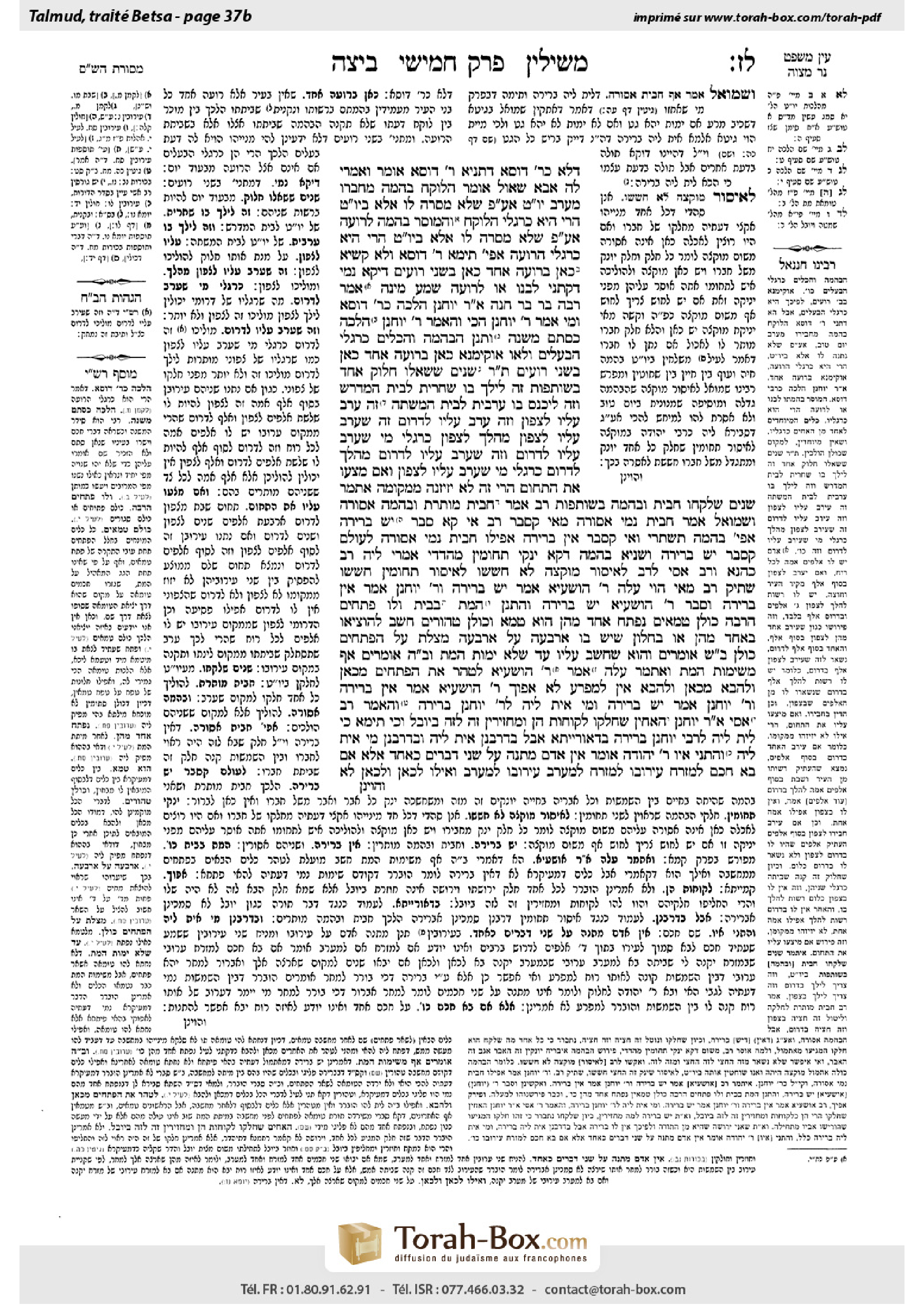
Beitzah 37b: Talmud study for Daf Yomi
Study the Talmud for Daf Yomi with scanned pages, Hebrew text, English translations from Sefaria and AI-generated French translations.
Passage selection and English or AI-generated French translation are available where the scan has annotations. Daf Study is independent of Torah-Box and Sefaria.
Browse Beitzah · ביצה · All tractatesBeitzah 37b text and translations
This page of Beitzah includes the Aramaic text, an English translation and an AI-generated French translation, alongside the scan above.
ביצה ל״ז ב · Aramaic and Hebrew text
דְּלָא כְּרַבִּי דּוֹסָא, דְּתַנְיָא: רַבִּי דּוֹסָא אוֹמֵר, וְאָמְרִי לַהּ: אַבָּא שָׁאוּל אוֹמֵר, הַלּוֹקֵחַ בְּהֵמָה מֵחֲבֵרוֹ מֵעֶרֶב יוֹם טוֹב, אַף עַל פִּי שֶׁלֹּא מְסָרָהּ לוֹ אֶלָּא בְּיוֹם טוֹב — הֲרֵי הִיא כְּרַגְלֵי הַלּוֹקֵחַ. וְהַמּוֹסֵר בְּהֵמָה לָרוֹעֶה, אַף עַל פִּי שֶׁלֹּא מְסָרָהּ לוֹ אֶלָּא בְּיוֹם טוֹב — הֲרֵי הִיא כְּרַגְלֵי הָרוֹעֶה.
אֲפִילּוּ תֵּימָא רַבִּי דּוֹסָא, וְלָא קַשְׁיָא: כָּאן בְּרוֹעֶה אֶחָד, כָּאן בִּשְׁנֵי רוֹעִים. דַּיְקָא נָמֵי דְּקָתָנֵי: לִבְנוֹ אוֹ לָרוֹעֶה, שְׁמַע מִינַּהּ.
אָמַר רַבָּה בַּר בַּר חָנָה אָמַר רַבִּי יוֹחָנָן: הֲלָכָה כְּרַבִּי דּוֹסָא. וּמִי אָמַר רַבִּי יוֹחָנָן הָכִי? וְהָאָמַר רַבִּי יוֹחָנָן: הֲלָכָה כִּסְתַם מִשְׁנָה, וּתְנַן: הַבְּהֵמָה וְהַכֵּלִים כְּרַגְלֵי הַבְּעָלִים!
וְלָאו אוֹקֵימְנָא — כָּאן בְּרוֹעֶה אֶחָד, כָּאן בִּשְׁנֵי רוֹעִים!
תָּנוּ רַבָּנַן: שְׁנַיִם שֶׁשָּׁאֲלוּ חָלוּק אֶחָד בְּשׁוּתָּפוּת, זֶה לֵילֵךְ בּוֹ שַׁחֲרִית לְבֵית הַמִּדְרָשׁ, וְזֶה לִיכָּנֵס בּוֹ עַרְבִית לְבֵית הַמִּשְׁתֶּה. זֶה עֵרַב עָלָיו לַצָּפוֹן, וְזֶה עֵרַב עָלָיו לַדָּרוֹם. זֶה שֶׁעֵרַב עָלָיו לַצָּפוֹן — מְהַלֵּךְ לַצָּפוֹן כְּרַגְלֵי מִי שֶׁעֵרַב עָלָיו לַדָּרוֹם.
וָזֶה שֶׁעֵרַב עָלָיו לַדָּרוֹם — מְהַלֵּךְ לַדָּרוֹם כְּרַגְלֵי מִי שֶׁעֵרַב עָלָיו לַצָּפוֹן.
וְאִם מִצְּעוּ אֶת הַתְּחוּם — הֲרֵי זֶה לֹא יְזִיזֶנָּה מִמְּקוֹמָהּ.
אִתְּמַר: שְׁנַיִם שֶׁלָּקְחוּ חָבִית וּבְהֵמָה בְּשׁוּתָּפוּת, רַב אָמַר: חָבִית מוּתֶּרֶת וּבְהֵמָה אֲסוּרָה. וּשְׁמוּאֵל אָמַר: חָבִית נָמֵי אֲסוּרָה.
מַאי קָסָבַר רַב? אִי קָא סָבַר יֵשׁ בְּרֵירָה — אֲפִילּוּ בְּהֵמָה תִּשְׁתְּרֵי! וְאִי קָסָבַר אֵין בְּרֵירָה — אֲפִילּוּ חָבִית נָמֵי אֲסוּרָה!
לְעוֹלָם קָסָבַר יֵשׁ בְּרֵירָה, וְשַׁנְיָא בְּהֵמָה — דְּקָא יָנְקִי תְּחוּמִין מֵהֲדָדֵי. אָמְרִי לֵיהּ רַב כָּהֲנָא וְרַב אַסִּי לְרַב: לְאִיסּוּר מוּקְצֶה לֹא חָשְׁשׁוּ, לְאִיסּוּר תְּחוּמִין חָשְׁשׁוּ?! שָׁתֵיק רַב.
מַאי הָוֵי עֲלַהּ? רַבִּי הוֹשַׁעְיָא אָמַר: יֵשׁ בְּרֵירָה. וְרַבִּי יוֹחָנָן אָמַר: אֵין בְּרֵירָה.
וְסָבַר רַבִּי הוֹשַׁעְיָא יֵשׁ בְּרֵירָה? וְהָתְנַן: הַמֵּת בְּבַיִת, וְלוֹ פְּתָחִים הַרְבֵּה — כּוּלָּן טְמֵאִים. נִפְתַּח אֶחָד מֵהֶן — הוּא טָמֵא, וְכוּלָּן טְהוֹרִים. חִשֵּׁב לְהוֹצִיאוֹ בְּאֶחָד מֵהֶן, אוֹ בַּחַלּוֹן שֶׁיֵּשׁ בּוֹ אַרְבָּעָה עַל אַרְבָּעָה — מַצֶּלֶת עַל הַפְּתָחִים כּוּלָּן.
בֵּית שַׁמַּאי אוֹמְרִים: וְהוּא שֶׁחִשֵּׁב עָלָיו עַד שֶׁלֹּא יָמוּת הַמֵּת. וּבֵית הִלֵּל אוֹמְרִים: אַף מִשֶּׁיָּמוּת הַמֵּת.
וְאִתְּמַר עֲלַהּ, אָמַר רַבִּי הוֹשַׁעְיָא: לְטַהֵר אֶת הַפְּתָחִים מִכָּאן וּלְהַבָּא. מִכָּאן וּלְהַבָּא — אִין, לְמַפְרֵעַ — לָא.
אֵפוֹךְ, רַבִּי הוֹשַׁעְיָא אָמַר: אֵין בְּרֵירָה, וְרַבִּי יוֹחָנָן אָמַר: יֵשׁ בְּרֵירָה.
וּמִי אִית לֵיהּ לְרַבִּי יוֹחָנָן בְּרֵירָה? וְהָאָמַר רַב אַסִּי אָמַר רַבִּי יוֹחָנָן: הָאַחִין שֶׁחָלְקוּ — לָקוֹחוֹת הֵן, וּמַחְזִירִין זֶה לָזֶה בַּיּוֹבֵל.
וְכִי תֵּימָא: כִּי לֵית לֵיהּ לְרַבִּי יוֹחָנָן בְּרֵירָה — בִּדְאוֹרָיְיתָא, אֲבָל בִּדְרַבָּנַן — אִית לֵיהּ,
וּבִדְרַבָּנַן מִי אִית לֵיהּ? וְהָתָנֵי אַיּוֹ —
רַבִּי יְהוּדָה אוֹמֵר: אֵין אָדָם מַתְנֶה עַל שְׁנֵי דְּבָרִים כְּאֶחָד, אֶלָּא: אִם בָּא חָכָם לַמִּזְרָח — עֵירוּבוֹ לַמִּזְרָח, לַמַּעֲרָב — עֵירוּבוֹ לַמַּעֲרָב, וְאִילּוּ לְכָאן וּלְכָאן — לָא.
Beitzah 37b · English translation
is not in accordance with the opinion of Rabbi Dosa. As it is taught in a baraita: Rabbi Dosa says, and some say Abba Shaul says: One who purchases an animal from another on the eve of a Festival, even if he did not deliver it to him until the Festival itself, it is as the feet of the purchaser. And one who delivers his animal to a shepherd, even if he did not deliver it to him until the Festival itself, it is as the feet of the shepherd. The mishna, on the other hand, teaches that an animal delivered to a shepherd remains as the feet of the owner, therefore apparently contradicting Rabbi Dosa.
The Gemara rejects the assertion that this is a contradiction. You can even say that the mishna is in accordance with Rabbi Dosa, and it is not difficult. Here, in the baraita, it is referring to a town that has only one shepherd. In that case the owner knows with certainty beforehand that he will be delivering his animal to this shepherd over the course of the Festival, and therefore the animal’s place of rest is established as being identical to that of the shepherd. There, however, the mishna is referring to a town where there are two shepherds. Since the issue of which of them will receive this animal is undetermined when the Festival begins, the animal remains as the feet of its owner. The Gemara strengthens this assertion that the mishna is dealing with a case where there are two shepherds: The language of the mishna is also precise in accordance with this interpretation, as it teaches: To his son or to a shepherd, suggesting that initially he did not know to whom he would give the animal. The Gemara concludes: Indeed, learn from this that this is so.
Rabba bar bar Ḥana said that Rabbi Yoḥanan said: The halakha is in accordance with the opinion of Rabbi Dosa, that animals given to a shepherd are as the feet of the shepherd. The Gemara asks: And did Rabbi Yoḥanan actually say this? But didn’t Rabbi Yoḥanan say a general principle that the halakha always follows an unattributed statement in a mishna? And we learned in the mishna: Animals and vessels are as the feet of the owner. One who delivers his animal to his son or to a shepherd, it is as the feet of the owner.
The Gemara answers: And did we not establish that the baraita of Rabbi Dosa is dealing with a different case than the mishna, that here in the baraita it is dealing with a town with one shepherd, whereas there in the mishna it is dealing with a town with two shepherds? There is consequently no contradiction between establishing the halakha both in accordance with Rabbi Dosa and in accordance with the mishna.
§ The Sages taught: In the case of two people who borrowed one robe in partnership from a third party, this person in order to go to the study hall with it in the morning and that person in order to enter a wedding feast with it in the evening, and this one made a joining of Shabbat boundaries [eiruv teḥumin] for himself to the north in order to reach his destination, and that one made an eiruv for himself to the south in order to reach his destination, the one who made an eiruv for himself to the north may walk with the robe only to the north as far as it is permitted for the feet of the one who made an eiruv for himself to the south, i.e., he may go north only as far as the other borrower may go.
And similarly, the one who made an eiruv for himself to the south may walk with the robe to the south only as far as is permitted for the feet of the one who made an eiruv for himself to the north, as the robe is as the feet of both borrowers and may go only as far as both of them may walk. If each of them placed his eiruv at a distance of one thousand cubits from their house, to the north and south respectively, they may each walk, without the robe, three thousand cubits from their regular dwelling-place, one partner toward the north and the other partner toward the south. The three thousand cubits are comprised of the thousand cubits from the house to the eiruv plus another two thousand, the standard Shabbat limit, from the location of the eiruv. The one whose eiruv is in the north may not wear the robe farther than one thousand cubits north of his house, as he would then be going beyond the farthest extent of the other’s Shabbat limit, and vice versa for the one whose eiruv is in the south.
And if they made their respective limits end in the center, i.e., if one placed his eiruv two thousand cubits from the house to the south, so that the house is his farthest limit to the north, and the other placed his eiruv two thousand cubits to the north of the house, the house being his farthest limit to the south, then each of them may not move the robe from its place at all.
The Gemara records a dispute between amora’im. It was said: In the case of two people who purchased a barrel of wine or an animal in partnership before a Festival, in order to divide the contents of the barrel or the meat of the animal between them on the Festival itself, what is the halakha if the two people have different Shabbat limits? Rav said: The barrel is permitted to each of them, and each may take his portion on the Festival and transfer it within his respective Shabbat limit, which is also applicable to Festivals; but the animal is prohibited, and each portion of it may be transferred only within the limits that are shared by both purchasers. And Shmuel said: The barrel is also prohibited to be transferred beyond the limits shared by both people.
The Gemara questions the opinion of Rav, who distinguished between the case of the barrel and that of the animal. What does Rav hold? If he holds that there is retroactive designation, so that after the division of the barrel it becomes clarified retroactively which portion belonged to which partner, and the Festival place of rest for each portion is established at the start of the Festival in accordance with the person who will later become its owner, then even the animal should be permitted. And if he holds that there is no retroactive designation, so that at the start of the Festival both portions of the animal belong jointly to both of them and may therefore be transferred only within the limits shared by both people, then even the barrel should be prohibited.
The Gemara answers: Actually, the explanation for Rav is that he holds there is retroactive designation, and the reason Rav was stringent in the case of the animal is that an animal is different, as the limits absorb from each other. A live animal cannot be divided into two parts for ownership; each part of its body depends on and is nourished by the other. Consequently, even if the designation of the respective portions takes place retroactively, each portion continues to draw from the other part, so that at the time of division the two portions are once again mixed together. Rav Kahana and Rav Asi said to Rav: If that is your rationale, this indicates that the Sages were not concerned about the prohibition of muktze, as it is not assumed that each of them removed the portion of his partner from his mind, thereby prohibiting it from his own use, and yet they were concerned about the prohibition of Shabbat limits. Isn’t this illogical? Rav was silent and offered no response.
The Gemara asks: What conclusion was reached about this issue? Rabbi Hoshaya said: In general, there is retroactive designation, and they can therefore each transport their portions of both the barrel and the animal to their respective places. And Rabbi Yoḥanan said: There is no retroactive designation, and therefore they may not move their portions of either the barrel or the animal except within the limits shared by both of them.
The Gemara asks: And does Rabbi Hoshaya really hold there is retroactive designation? But didn’t we learn in a mishna: If there is a corpse in a house that has many entrances, all the entrances are ritually impure, i.e., everything situated in the space of the entrance becomes impure, even in the part that lies beyond a closed door, separating it from the corpse. Since any of the entrances might be used to remove the corpse, and none are designated for that purpose, all are rendered impure. However, if one of them was subsequently opened, then the space of that particular entrance is impure, while all the others are pure, as it is assumed that that the corpse will be removed by way of the open door. Even if none of the entrances was actually open, if one merely intended to remove the corpse through a particular one of the entrances or through a window that is at least four by four handbreadths in size, this intention of his saves all the other entrances from impurity.
The details of this last halakha are disputed by tanna’im. Beit Shammai say: And this applies only if he had this intention before the dead person died, so that at the time of death it was known which entrance would be used. And Beit Hillel say: It applies even if he had this intention only after the dead person died.
And it is stated with regard to this mishna: Rabbi Hoshaya said: When Beit Hillel said that the other entrances are pure even if one thought of removing the corpse via a particular entrance only after the person died, they meant only to purify the entrances from that point and onward; from the moment of his intention there is no more impurity in the other entrances. From this the Gemara infers: From here and onward: Yes, the other entrances are saved from impurity, but retroactively: No. Whatever was in the doorways before this intent was formulated has already contracted ritual impurity and this cannot be reversed retroactively by one’s subsequent thoughts. This indicates that the principle of retroactive designation is not accepted by Rabbi Hoshaya.
The Gemara resolves this contradiction in the following manner: Reverse the presentation of their opinions given above, and say: Rabbi Hoshaya said: There is no retroactive designation, and Rabbi Yoḥanan said: There is retroactive designation.
The Gemara questions this resolution: And does Rabbi Yoḥanan really accept the principle of retroactive designation? But didn’t Rav Asi say that Rabbi Yoḥanan said: Brothers who divided property received as an inheritance are considered purchasers from each other, and as purchasers of land they must return the portions to each other in the Jubilee year, at which point they may redistribute the property? This demonstrates that Rabbi Yoḥanan does not hold that it is retroactively established that each brother’s portion was designated for him directly upon their father’s death, but rather it is considered that all the land was joint property until the brothers traded or bought their respective portions from each other.
And if you should say: When does Rabbi Yoḥanan not accept the principle of retroactive designation? Only in regard to matters that are Torah law, but he does hold of retroactive designation in regard to matters of rabbinic law, such as the halakhot of Shabbat limits; this would account for the discrepancy.
But does he accept retroactive designation in matters of rabbinic law? Didn’t the Sage Ayo teach otherwise in regard to the halakhot of joining of Shabbat boundaries [eiruv teḥumin]? As it was taught in a mishna: One who has heard that a rabbi will be coming to a place near his town to deliver a lesson on Shabbat, but is unsure where the lecture will take place, may place two eiruvin on Shabbat eve in two different directions, while stipulating that only the eiruv on the side where the rabbi will teach will take effect. Furthermore, if he hears that two rabbis will be coming to two different locations, he may place two eiruvin and stipulate that he will decide on Shabbat which rabbi he prefers, and consequently which of the two eiruvin will take effect.
Ayo taught in a baraita that Rabbi Yehuda disagreed with this halakha and said: A person may not make a stipulation with regard to two contradictory things at once, and therefore if two Sages will be arriving, his condition is of no effect. Rather, it is true that in the first case, where he knows that a rabbi is coming but does not know from which direction, he may place two eiruvin and stipulate that if the rabbi comes from the east his eiruv in the east will take effect, and if the rabbi comes from the west, his eiruv in the west will take effect. However, in the second case, when two rabbis come to the two locations, one of them arriving here and the other arriving there, and one wants to place two eiruvin and decide on Shabbat which of the two lectures he will attend, this he may not do; that would require the identity of the functional eiruv to be determined retroactively, and one’s place of rest must be determined when Shabbat begins.
Beitzah 37b · Traduction française (IA)
Ce n'est pas conforme à l'opinion du Rabbi Dosa. Comme il est enseigné dans une baraïta : Le Rabbi Dosa dit, et certains disent que c'est Abba Shaul qui dit : Celui qui achète un animal d'un autre le soir de la fête, même s'il ne lui a pas livré l'animal jusqu'à la fête elle-même, il est comme les pieds de l'acheteur. Et celui qui livre son animal à un berger, même s'il ne lui a pas livré l'animal jusqu'à la fête elle-même, il est comme les pieds du berger. La mitsna, en revanche, enseigne que l'animal livré à un berger reste comme les pieds du propriétaire, ce qui semble contredire le Rabbi Dosa.
La Guemara rejette l'affirmation que cela constitue une contradiction. On peut même dire que la mitsna est conforme à l'opinion du Rabbi Dosa, et ce n'est pas difficile. Ici, dans la baraïta, il s'agit d'une ville qui n'a qu'un seul berger. Dans ce cas, le propriétaire sait d'avance avec certitude qu'il livrera son animal à ce berger durant la fête, et donc le lieu de repos de l'animal est établi comme celui du berger. Là, en revanche, la mitsna s'occupe d'une ville où il y a deux bergers. Puisque la question de savoir à quel berger cet animal sera livré reste indéterminée au début de la fête, l'animal reste comme les pieds de son propriétaire. La Guemara renforce cette affirmation selon laquelle la mitsna traite d'un cas où il y a deux bergers : le langage de la mitsna est également précis selon cette interprétation, car il enseigne : À son fils ou à un berger, suggérant qu'initialement il ne savait pas à qui il allait donner l'animal. La Guemara conclut : En effet, apprends-en que c'est ainsi.
Rabba bar bar Ḥana a dit que Rabbi Yoḥanan a dit : La halakha suit l'opinion du Rabbi Dosa, que les animaux donnés à un berger sont comme les pieds du berger. La Guemara pose la question : Et le Rabbi Yoḥanan a-t-il vraiment dit cela ? Mais n'a-t-il pas dit un principe général selon lequel la halakha suit toujours une déclaration non attribuée dans une mitsna ? Et nous avons appris dans la mitsna : Les animaux et les objets sont comme les pieds du propriétaire. Celui qui livre son animal à son fils ou à un berger, il est comme les pieds du propriétaire.
La Guemara répond : Et n'avons-nous pas établi que la baraïta du Rabbi Dosa traite d'un cas différent de la mitsna, que ici dans la baraïta il s'agit d'une ville avec un seul berger, tandis que là dans la mitsna il s'agit d'une ville avec deux bergers ? Il n'y a donc pas de contradiction entre établir la halakha selon le Rabbi Dosa et selon la mitsna.
§ Les Sages ont enseigné : Dans le cas de deux personnes qui ont emprunté ensemble un manteau d'un tiers, cette personne pour aller à la maison de étude le matin et celle-ci pour entrer dans un mariage le soir, et celle-ci a fait un eiruv teḥumin vers le nord pour atteindre sa destination, et celle-là a fait un eiruv vers le sud pour atteindre sa destination, celle qui a fait un eiruv vers le nord peut marcher avec le manteau uniquement vers le nord jusqu'à la distance autorisée pour les pieds de celui qui a fait un eiruv vers le sud, c'est-à-dire qu'elle peut aller vers le nord uniquement jusqu'à la distance que peut parcourir l'autre emprunteur.
Et de même, celui qui a fait un eiruv pour lui-même vers le sud peut marcher avec le manteau vers le sud uniquement jusqu'à la distance autorisée pour les pieds de celui qui a fait un eiruv pour lui-même vers le nord, car le manteau est comme les pieds des deux emprunteurs et peut aller uniquement jusqu'à la distance que peuvent parcourir les deux. Si chacun d'eux a placé son eiruv à une distance de mille coudées de leur maison, vers le nord et le sud respectivement, ils peuvent chacun marcher, sans le manteau, trois mille coudées depuis leur demeure habituelle, un partenaire vers le nord et l'autre vers le sud. Les trois mille coudées comprennent les mille coudées de la maison à l'eiruv plus les deux mille coudées, la limite sabbatique standard, depuis l'emplacement de l'eiruv. Celui dont l'eiruv est au nord ne peut pas porter le manteau plus loin qu'une mille coudées au nord de sa maison, car il irait au-delà de la limite sabbatique la plus éloignée de l'autre, et inversement pour celui dont l'eiruv est au sud.
Et si leurs limites se rejoignent au centre, c'est-à-dire si l'un a placé son eiruv à deux mille coudées au sud de sa maison, de sorte que la maison est sa limite la plus éloignée au nord, et l'autre a placé son eiruv à deux mille coudées au nord de la maison, la maison étant sa limite la plus éloignée au sud, alors aucun d'eux ne peut déplacer le manteau de son lieu.
La Guemara rapporte un débat entre des amoraïm. On a dit : Dans le cas de deux personnes qui ont acheté une barrique de vin ou un animal en partage avant une fête, afin de diviser le contenu de la barrique ou la viande de l'animal entre eux pendant la fête elle-même, quelle est la halakha si les deux personnes ont des limites sabbatiques différentes ? Rav a dit : La barrique est permise à chacun d'eux, et chacun peut prendre sa part pendant la fête et la transporter dans ses limites sabbatiques respectives, ce qui s'applique également aux fêtes ; mais l'animal est interdit, et chaque portion de lui peut être transportée uniquement dans les limites partagées par les deux acheteurs. Et Shmuel a dit : La barrique est également interdite à être transportée au-delà des limites partagées par les deux personnes.
La Guemara questionne l'opinion de Rav, qui distingue entre le cas de la barrique et celui de l'animal. Qu'est-ce que Rav pense ? Si Rav considère qu'il y a une désignation rétroactive, de sorte que, après la division de la barrique, il est clarifié rétroactivement à quel partenaire appartient chaque portion, et la place de repos sabbatique de chaque portion est établie au début de la fête selon la personne qui deviendra ultérieurement son propriétaire, alors même l'animal devrait être permis. Et si Rav considère qu'il n'y a pas de désignation rétroactive, de sorte que, au début de la fête, les deux portions de l'animal appartiennent conjointement aux deux et peuvent donc être transportées uniquement dans les limites partagées par les deux personnes, alors même la barrique devrait être interdite.
Le Guemara répond : En réalité, l'explication de Rava est qu'il considère qu'il y a une désignation rétroactive, et la raison pour laquelle Rava était strict sur le cas de l'animal est que l'animal est différent, car les limites s'absorbent mutuellement. Un animal vivant ne peut être divisé en deux parties pour l'ownership ; chaque partie du corps dépend de l'autre et est nourrie par l'autre. Ainsi, même si la désignation des portions respectives a lieu rétroactivement, chaque portion continue à s'approvisionner de l'autre partie, de sorte que lors de la division, les deux portions sont à nouveau mélangées. Rava Kahana et Rava Asi dirent à Rava : Si c'est votre raisonnement, cela indique que les Sages ne s'inquiétaient pas de la prohibition de muktze, car il n'est pas supposé que chacun ait retiré la portion de son partenaire de son esprit, interdisant ainsi son propre usage, et pourtant ils s'inquiétaient de la prohibition des limites du Shabbat. Ce n'est pas logique, n'est-ce pas ? Rava resta silencieux et ne donna pas de réponse.
Le Guemara demande : Quelle conclusion a-t-on tirée de cette question ? Rabbi Hoshaya dit : En général, il y a une désignation rétroactive, et ils peuvent donc transporter chacun leurs portions des tonneaux et de l'animal vers leurs lieux respectifs. Et Rabbi Yoḥanan dit : Il n'y a pas de désignation rétroactive, et par conséquent ils ne peuvent pas déplacer leurs portions du tonneau ou de l'animal, sauf dans les limites partagées par les deux.
Le Guemara demande : Et Rabbi Hoshaya considère-t-il vraiment qu'il y a une désignation rétroactive ? Mais n'avons-nous pas appris dans une mitsva : S'il y a un cadavre dans une maison qui a plusieurs entrées, toutes les entrées sont impures, c'est-à-dire que tout ce qui est dans l'espace de l'entrée devient impur, même dans la partie qui se trouve au-delà d'une porte fermée, le séparant du cadavre. Puisque n'importe quelle entrée pourrait être utilisée pour retirer le cadavre, et aucune n'est désignée à cet effet, toutes deviennent impures. Cependant, si l'une d'entre elles est ensuite ouverte, l'espace de cette entrée devient impur, tandis que toutes les autres restent pures, car on suppose que le cadavre sera retiré par cette porte. Même si aucune des entrées n'a été effectivement ouverte, si l'un d'entre eux avait l'intention de retirer le cadavre par une entrée particulière ou par une fenêtre d'au moins quatre tefachim de large, cette intention sauve toutes les autres entrées de l'impureté.
Les détails de cette dernière halakha sont discutés par les tannaïm. Beit Shammai disent : Et cela s'applique uniquement si l'intention avait été formulée avant la mort de la personne, de sorte que lors de la mort, on savait quelle entrée serait utilisée. Et Beit Hillel disent : Cela s'applique même si l'intention avait été formulée après la mort de la personne.
Et il est dit concernant cette mitsna : Rabbi Hoshaya dit : Lorsque Beit Hillel a dit que les autres entrées sont pures même si l'intention de retirer le cadavre par une entrée particulière avait été formulée après la mort de la personne, ils voulaient simplement purifier les entrées à partir de ce moment ; à partir du moment de l'intention, il n'y a plus d'impureté dans les autres entrées. De cela, le Guemara infère : À partir de ce moment et après : Oui, les autres entrées sont sauvées de l'impureté, mais rétroactivement : Non. Ce qui était dans les portes avant cette intention a déjà contracté l'impureté rituelle et cela ne peut pas être réversible par la suite par ses pensées. Cela indique que le principe de désignation rétroactive n'est pas accepté par Rabbi Hoshaya.
Le Guemara résout ce paradoxe de la manière suivante : Inversez la présentation de leurs opinions données ci-dessus, et dites : Rabbi Hoshaya dit : Il n'y a pas de désignation rétroactive, et Rabbi Yoḥanan dit : Il y a une désignation rétroactive.
Le Guemara questionne cette résolution : Et Rabbi Yoḥanan accepte-t-il vraiment le principe de désignation rétroactive ? Mais n'avons-nous pas appris que Rav Asi a dit que Rabbi Yoḥanan a dit : Les frères qui ont divisé la propriété reçue en héritage sont considérés comme des acheteurs les uns des autres, et comme acheteurs de terres, ils doivent rendre leurs portions les unes aux autres à la Jubélique, à ce moment-là ils peuvent redistribuer la propriété ? Cela démontre que Rabbi Yoḥanan ne considère pas que chaque portion de frère ait été désignée directement à son profit au moment de la mort de leur père, mais plutôt qu'il s'agissait de propriété commune jusqu'à ce que les frères aient échangé ou acheté leurs portions respectives.
Et si l'on dit : Quand Rabbi Yoḥanan ne considère-t-il pas la désignation rétroactive ? Seulement en ce qui concerne les lois de la Torah, mais il considère que la désignation rétroactive s'applique en ce qui concerne les lois rabbiniques, comme les halakhot des limites du Shabbat ; cela expliquerait la différence.
Mais accepte-t-il la désignation rétroactive en ce qui concerne les lois rabbiniques ? N'a-t-il pas été enseigné par le Sage Ayo autrement concernant les halakhot de la jointure des limites du Shabbat [eiruv teḥumin] ? Comme il a été appris dans une mitsna : Celui qui a entendu qu'un rabbin viendra dans un lieu près de sa ville pour donner une leçon le Shabbat, mais est incertain de l'endroit où la leçon aura lieu, peut placer deux eiruvin le soir du Shabbat dans deux directions différentes, tout en stipulant que seul l'eiruv du côté où le rabbin donnera la leçon sera valide. De plus, si l'on entend que deux rabbins viendront dans deux lieux différents, il peut placer deux eiruvin et stipuler qu'il décidera le Shabbat quel rabbin il préfère, et par conséquent quel eiruv sera valide.
Ayo a-t-il appris dans une baraïta que Rabbi Yéhuda contestait cette halakha et a dit : une personne ne peut pas stipuler à la fois sur deux choses contradictoires, et par conséquent, si deux Sages viennent, sa condition n’a aucun effet. En revanche, il est vrai que dans le premier cas, où il sait qu’un rabbin arrive mais ne sait pas de quelle direction, il peut placer deux eiruvin et stipuler que si le rabbin arrive de l’est, son eiruv de l’est sera valide, et si le rabbin arrive de l’ouest, son eiruv de l’ouest sera valide. Cependant, dans le second cas, lorsque deux rabbins arrivent aux deux lieux, l’un ici et l’autre là-bas, et qu’un veut placer deux eiruvin et décider le sabbat de quelle des deux lectures il assistera, il ne doit pas le faire ; cela exigerait de déterminer à posteriori l’identité de l’eiruv fonctionnel, et le lieu de repos doit être déterminé au début du sabbat.
Traduction française générée par IA à partir de l’édition anglaise de Sefaria. Vérifie toujours un passage avec le texte source.
Text from Sefaria: William Davidson Edition - Vocalized Aramaic (CC BY NC); William Davidson Edition - English (CC BY NC).