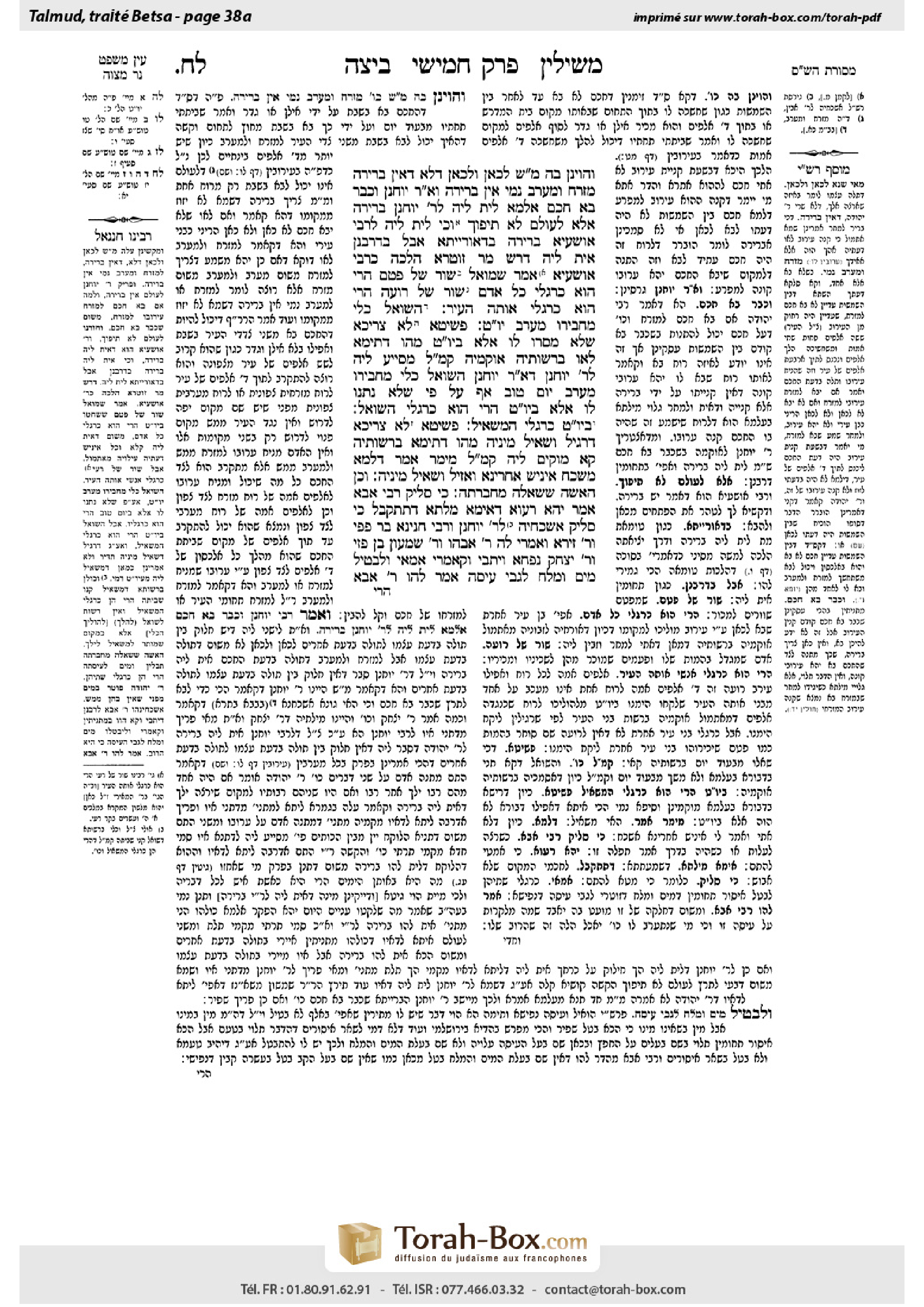
Beitzah 38a: Talmud study for Daf Yomi
Study the Talmud for Daf Yomi with scanned pages, Hebrew text, English translations from Sefaria and AI-generated French translations.
Passage selection and English or AI-generated French translation are available where the scan has annotations. Daf Study is independent of Torah-Box and Sefaria.
Browse Beitzah · ביצה · All tractatesBeitzah 38a text and translations
This page of Beitzah includes the Aramaic text, an English translation and an AI-generated French translation, alongside the scan above.
ביצה ל״ח א · Aramaic and Hebrew text
וְהָוֵינַן בַּהּ: מַאי שְׁנָא לְכָאן וּלְכָאן דְּלָא — דְּאֵין בְּרֵירָה, מִזְרָח וּמַעֲרָב נָמֵי אֵין בְּרֵירָה!
וְאָמַר רַבִּי יוֹחָנָן: וּכְבָר בָּא חָכָם. אַלְמָא: לֵית לֵיהּ לְרַבִּי יוֹחָנָן בְּרֵירָה!
אֶלָּא: לְעוֹלָם לָא תֵּיפוֹךְ, וְכִי לֵית לֵיהּ לְרַבִּי אוֹשַׁעְיָא בְּרֵירָה — בִּדְאוֹרָיְיתָא, אֲבָל בִּדְרַבָּנַן — אִית לֵיהּ.
דָּרֵשׁ מָר זוּטְרָא: הֲלָכָה כְּרַבִּי אוֹשַׁעְיָא.
אָמַר שְׁמוּאֵל: שׁוֹר שֶׁל פַּטָּם — הֲרֵי הוּא כְּרַגְלֵי כׇּל אָדָם. שׁוֹר שֶׁל רוֹעֶה — הֲרֵי הוּא כְּרַגְלֵי אוֹתָהּ הָעִיר.
הַשּׁוֹאֵל כְּלִי מֵחֲבֵירוֹ מֵעֶרֶב יוֹם טוֹב. פְּשִׁיטָא! לָא צְרִיכָא, שֶׁלֹּא מְסָרוֹ לוֹ אֶלָּא בְּיוֹם טוֹב. מַהוּ דְּתֵימָא: לָאו בִּרְשׁוּתֵיהּ אוֹקְמֵיהּ, קָא מַשְׁמַע לַן.
מְסַיַּיע לֵיהּ לְרַבִּי יוֹחָנָן, דְּאָמַר רַבִּי יוֹחָנָן: הַשּׁוֹאֵל כְּלִי מֵחֲבֵירוֹ מֵעֶרֶב יוֹם טוֹב, אַף עַל פִּי שֶׁלֹּא נְתָנוֹ לוֹ אֶלָּא בְּיוֹם טוֹב — הֲרֵי הוּא כְּרַגְלֵי הַשּׁוֹאֵל.
בְּיוֹם טוֹב — כְּרַגְלֵי הַמַּשְׁאִיל. פְּשִׁיטָא! לָא צְרִיכָא, דִּרְגִיל וְשָׁאֵיל מִינֵּיהּ, מַהוּ דְּתֵימָא: בִּרְשׁוּתֵיהּ קָא מוֹקֵים לֵיהּ, קָא מַשְׁמַע לַן, מֵימָר אָמַר: דִּלְמָא מַשְׁכַּח אִינִישׁ אַחֲרִינָא וְאָזֵיל וְשָׁאֵיל מִינֵּיהּ.
וְכֵן הָאִשָּׁה שֶׁשָּׁאֲלָה מֵחֲבֶרְתָּהּ. כִּי סְלֵיק רַבִּי אַבָּא אָמַר: יְהֵא רַעֲוָא דְּאֵימָא מִלְּתָא דְּתִתְקַבַּל. כִּי סְלֵיק, אַשְׁכְּחֵיהּ לְרַבִּי יוֹחָנָן וְרַבִּי חֲנִינָא בַּר פַּפִּי וְרַבִּי זֵירָא, וְאָמְרִי לַהּ רַבִּי אֲבָהוּ וְרַבִּי שִׁמְעוֹן בֶּן פַּזִּי וְרַבִּי יִצְחָק נַפָּחָא, וְיָתְבִי וְקָאָמְרִי: אַמַּאי? וְלִבְטִיל מַיִם וָמֶלַח לְגַבֵּי עִיסָּה! אֲמַר לְהוּ רַבִּי אַבָּא:
Beitzah 38a · English translation
And we discussed the following difficulty with regard to this teaching of Ayo: What is different about the case where two rabbis are coming to the two locations, one here and the other there, and one places two eiruvin, planning to decide on Shabbat which lecture he will attend? Why did Rabbi Yehuda state that this may not be done? It is because he held that there is no retroactive designation. But if so, in the first case as well, where only one rabbi comes, but the location of his lecture was not known before Shabbat, and one placed eiruvin in the east and the west, we should say that neither is effective because the rabbi’s location will not be known until Shabbat, and there is no retroactive designation.
And Rabbi Yoḥanan said in explanation: This first case is referring to a situation in which the rabbi had already arrived before the eiruv was placed, but the one placing the eiruv does not know the rabbi’s location. Therefore, it had already been determined which of the two eiruvin would be effective, although it was not yet known to him when Shabbat began. Apparently, then, Rabbi Yoḥanan does not accept the principle of retroactive designation even in matters of rabbinic law, as he states that if the rabbi were to arrive after the eiruv was placed, it would not be effective retroactively.
Rather, the Gemara rejects this approach and states: Actually, do not reverse the views of Rabbi Yoḥanan and Rabbi Hoshaya; it is indeed Rabbi Hoshaya, also known as Rabbi Oshaya, who accepts retroactive designation, and Rabbi Yoḥanan who rejects it. As for Rabbi Oshaya’s statement with regard to the entrances to a house that contains a corpse, the following answer may be offered: And when does Rabbi Oshaya not hold of the principle of retroactive designation? With regard to matters of Torah law, such as the ritual impurity of the dead. But with regard to matters of rabbinic law, such as Shabbat limits and the placement of eiruvin, he does accept this principle.
Mar Zutra taught in a public lesson: The halakha is in accordance with the opinion of Rabbi Oshaya with regard to retroactive designation.
Shmuel said: An ox of a fattener, one whose occupation is to fatten oxen in order to sell them for their meat, is as the feet of all people. It is as the feet of the one who acquires the animal on the Festival, even if the buyer is from another city, as the fattener’s intention when the Festival begins is that the ox belong to whoever buys it. But an ox of a shepherd, who raises oxen for himself but occasionally sells them to his neighbors or acquaintances, is as the feet of the people of that city, as his intention when the Festival begins is that he might sell the animal to someone in town, but not to someone from out of town.
§ The mishna states: In the case of one who borrows a vessel from another on the eve of a Festival, it is as the feet of the borrower. The Gemara asks: It is obvious that this is the case, as the place of rest of the vessel has already been established in the possession of the borrower. The Gemara answers: No, it is necessary to state this halakha in a case where one did not deliver the vessel to him until the Festival itself. Lest you say: Since the lender did not establish it in the borrower’s possession before the Festival began, it should remain as the feet of the lender, the mishna therefore teaches us that it is not so, but it is as the feet of the borrower.
The Gemara comments: Interpreted in this manner, the mishna supports a statement of Rabbi Yoḥanan, as Rabbi Yoḥanan said: One who borrows a vessel from another on the eve of a Festival, even if he did not give it to him until the Festival itself, it is as the feet of the borrower.
§ It is taught in the mishna: If one borrowed on the Festival itself, it is as the feet of the lender. The Gemara again wonders: This is obvious. The Gemara answers: No, it is necessary to state this halakha in a case where this borrower is accustomed to borrowing such items from this lender. Lest you say that since it is a regular occurrence for this loan to take place, the lender establishes it in his possession ahead of time, and it should therefore be considered as though the object’s place of rest is established as the feet of the borrower, the mishna therefore teaches us that it is not so, as the lender certainly says to himself: Perhaps he will find someone else this time, and he will go and borrow from him. Consequently, the lender does not transfer possession of the object to the borrower until the latter takes it, and it may be carried only where the lender may go.
§ It is taught in the mishna: And similarly, a woman who borrowed spices from another to put in a dish, or water and salt to put in her dough, these are as the feet of both of them. The Gemara relates: When Rabbi Abba ascended from Babylonia to Eretz Yisrael, he said: May it be God’s will that I say a statement of halakha that will be accepted by my listeners in Eretz Yisrael, so that I will not be put to shame. When he ascended, he found Rabbi Yoḥanan, Rabbi Ḥanina bar Pappi, and Rabbi Zeira, and some say he found Rabbi Abbahu, Rabbi Shimon ben Pazi, and Rabbi Yitzḥak Nappaḥa, and they were sitting and saying in a discussion of the mishna: Why is this the halakha with regard to dough? But let the water and salt be considered nullified in the dough, and the status of the dough should follow its flour rather than its minor ingredients, such as water and salt. Rabbi Abba said to them:
Beitzah 38a · Traduction française (IA)
Et nous avons discuté de la difficulté suivante concernant cette enseignement d'Ayo : Qu'est-ce qui diffère dans le cas où deux rabbins viennent aux deux lieux, l'un ici et l'autre là, et l'un place deux eiruvin, prévoyant de décider le sabbat sur laquelle conférence il assistera ? Pourquoi Rabbi Yehuda a-t-il dit que cela ne doit pas être fait ? C'est parce qu'il considérait qu'il n'y a pas de désignation rétroactive. Mais si c'est ainsi, dans le premier cas également, où seul un rabbin vient, mais la localisation de sa conférence n'était pas connue avant le sabbat, et l'on place des eiruvin à l'est et à l'ouest, nous devrions dire que ni l'un ni l'autre ne sont efficaces, car la localisation du rabbin ne sera pas connue jusqu'au sabbat, et il n'y a pas de désignation rétroactive.
Et Rabbi Yoḥanan a dit en explication : Ce premier cas fait référence à une situation où le rabbin était déjà arrivé avant que l'eiruv ne soit placé, mais celui qui place l'eiruv ne connaît pas la localisation du rabbin. Ainsi, il avait déjà été déterminé quel des deux eiruvin serait efficace, même si cela n'était pas encore connu lorsqu'il a commencé le sabbat. Apparemment, alors, Rabbi Yoḥanan ne reconnaît pas le principe de désignation rétroactive même dans les affaires de lois rabbiniques, car il affirme que si le rabbin arrivait après que l'eiruv ait été placé, cela ne serait pas efficace rétroactivement.
Au contraire, la Guemara rejette cette approche et affirme : En réalité, ne reversez pas les opinions de Rabbi Yoḥanan et de Rabbi Hoshaya ; c'est bien Rabbi Hoshaya, également connu sous le nom de Rabbi Oshaya, qui accepte la désignation rétroactive, et Rabbi Yoḥanan qui la rejette. En ce qui concerne l'affirmation de Rabbi Oshaya concernant les entrées d'une maison contenant un cadavre, la suivante réponse peut être offerte : Et quand Rabbi Oshaya ne tient pas compte du principe de désignation rétroactive ? En ce qui concerne les affaires de halakha, telles que l'impureté rituelle du mort. Mais en ce qui concerne les affaires de lois rabbiniques, telles que les limites du sabbat et la mise en place des eiruvin, il accepte ce principe.
Mar Zutra enseigna dans une leçon publique : La halakha suit l'opinion de Rabbi Oshaya concernant la désignation rétroactive.
Shmuel dit : Un bœuf d'un éleveur, celui dont l'occupation est d'élever des bœufs pour les vendre pour leur viande, est comme les pieds de tous les gens. Il est comme les pieds de celui qui acquiert l'animal pendant la fête, même si l'acheteur est d'une autre ville, car l'intention de l'éleveur lorsqu'il commence la fête est que le bœuf appartienne à celui qui l'achète. Mais un bœuf d'un berger, qui élève des bœufs pour lui-même mais parfois les vend à ses voisins ou connaissances, est comme les pieds des habitants de cette ville, car son intention lorsqu'il commence la fête est qu'il puisse vendre l'animal à quelqu'un de la ville, mais pas à quelqu'un d'ailleurs.
§ La mitsna stipule : Dans le cas où l'on emprunte un récipient à un autre le soir de la fête, il est comme les pieds de l'emprunteur. La Guemara demande : Cela est évident, car la place de repos du récipient a déjà été établie dans la possession de l'emprunteur. La Guemara répond : Non, il est nécessaire d'énoncer cette halakha dans un cas où l'on n'a pas livré le récipient à l'emprunteur jusqu'à la fête elle-même. De peur que l'on dise : Puisque le prêteur n'a pas établi cela dans la possession de l'emprunteur avant le début de la fête, il devrait rester comme les pieds du prêteur, la mitsna nous apprend donc que ce n'est pas ainsi, mais il est comme les pieds de l'emprunteur.
La Guemara commente : Interprété ainsi, la mitsna soutient une affirmation de Rabbi Yoḥanan, car Rabbi Yoḥanan a dit : Celui qui emprunte un récipient à un autre le soir de la fête, même s'il ne lui a pas donné jusqu'à la fête elle-même, il est comme les pieds de l'emprunteur.
§ Il est enseigné dans la mitsna : Si l'on emprunte pendant la fête elle-même, il est comme les pieds du prêteur. La Guemara se demande à nouveau : Cela est évident. La Guemara répond : Non, il est nécessaire d'énoncer cette halakha dans un cas où cet emprunteur est habitué à emprunter de tels objets à ce prêteur. De peur que l'on dise que puisque c'est une occurrence régulière pour ce prêt, le prêteur l'établit d'avance dans sa possession, et il devrait donc être considéré comme si la place de repos de l'objet est établie comme les pieds de l'emprunteur, la mitsna nous apprend donc que ce n'est pas ainsi, car le prêteur se dit certainement : Peut-être qu'il trouvera quelqu'un d'autre cette fois-ci, et il ira emprunter à quelqu'un d'autre. Ainsi, le prêteur ne transfère pas la possession de l'objet à l'emprunteur jusqu'à ce que l'objet soit pris, et il peut être transporté uniquement là où le prêteur peut aller.
§ Il est enseigné dans la mitsna : Et de même, une femme qui emprunte des épices à un autre pour les mettre dans un plat, ou de l'eau et du sel pour mettre dans sa pâte, ces objets sont comme les pieds des deux. La Guemara rapporte : Lorsque Rabbi Abba est monté de Babylone en Terre d'Israël, il a dit : Que Dieu le permette de dire une déclaration de halakha qui soit acceptée par ses auditeurs en Terre d'Israël, afin que je ne sois pas humilié. Lorsqu'il est monté, il a trouvé Rabbi Yoḥanan, Rabbi Ḥanina bar Pappi et Rabbi Zeira, et certains disent qu'il a trouvé Rabbi Abbahu, Rabbi Shimon ben Pazi et Rabbi Yitzḥak Nappaḥa, et ils étaient assis en discussion sur la mitsna : Pourquoi cette halakha concerne la pâte ? Mais que l'eau et le sel soient considérés comme annulés dans la pâte, et que le statut de la pâte suive sa farine plutôt que ses ingrédients mineurs, tels que l'eau et le sel. Rabbi Abba a dit à eux :
Traduction française générée par IA à partir de l’édition anglaise de Sefaria. Vérifie toujours un passage avec le texte source.
Text from Sefaria: William Davidson Edition - Vocalized Aramaic (CC BY NC); William Davidson Edition - English (CC BY NC).