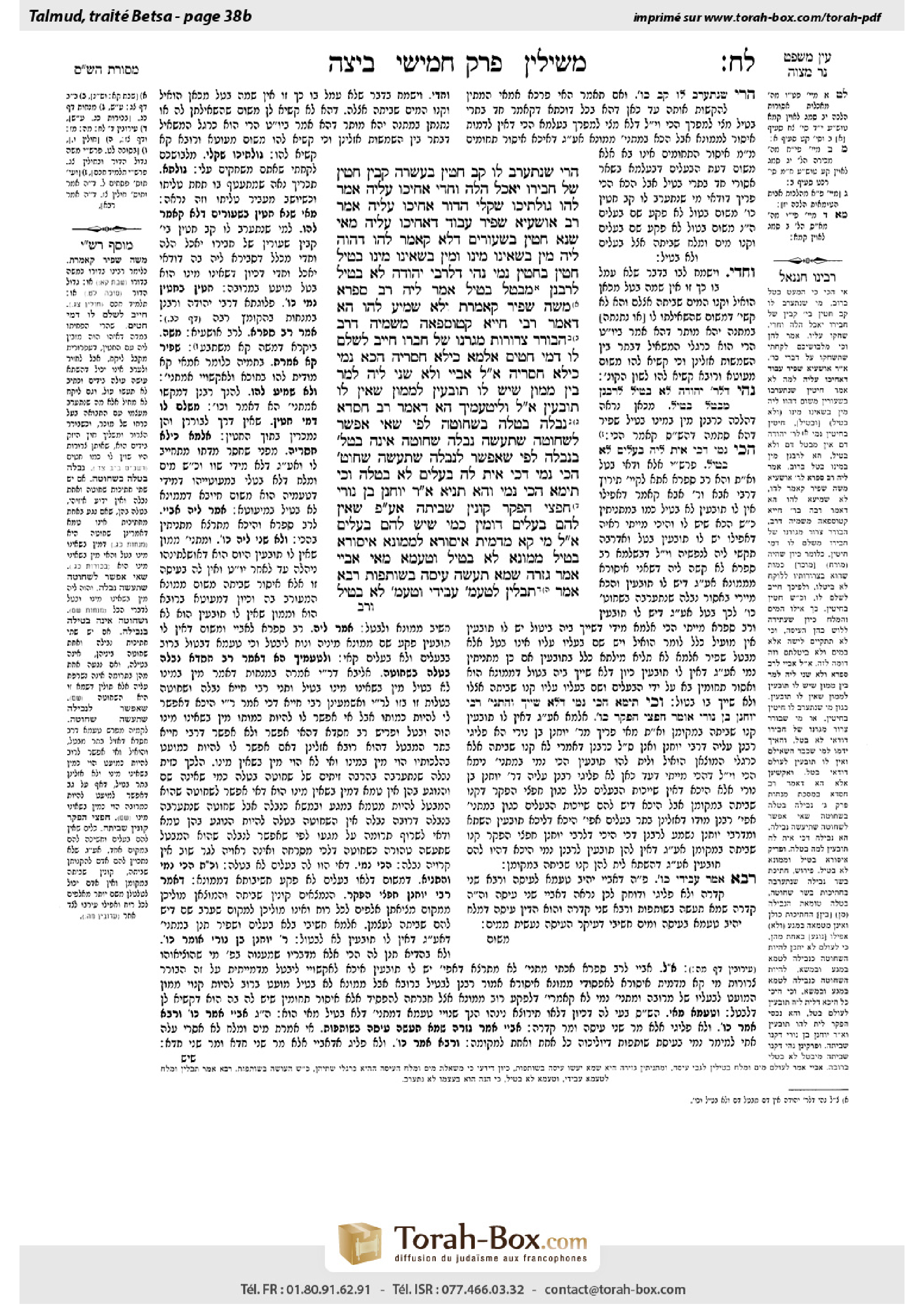
Beitzah 38b: Talmud study for Daf Yomi
Study the Talmud for Daf Yomi with scanned pages, Hebrew text, English translations from Sefaria and AI-generated French translations.
Passage selection and English or AI-generated French translation are available where the scan has annotations. Daf Study is independent of Torah-Box and Sefaria.
Browse Beitzah · ביצה · All tractatesBeitzah 38b text and translations
This page of Beitzah includes the Aramaic text, an English translation and an AI-generated French translation, alongside the scan above.
ביצה ל״ח ב · Aramaic and Hebrew text
הֲרֵי שֶׁנִּתְעָרֵב לוֹ קַב חִטִּין בַּעֲשָׂרָה קַבִּין חִטִּין שֶׁל חֲבֵירוֹ, יֹאכַל הַלָּה וְחָדֵי?! אַחִיכוּ עֲלֵיהּ. אֲמַר לְהוּ: גּוּלְּתַיְכוּ שְׁקַלִי? הֲדוּר אַחִיכוּ עֲלֵיהּ.
אָמַר רַב אוֹשַׁעְיָא: שַׁפִּיר עֲבוּד דְּאַחִיכוּ עֲלֵיהּ. מַאי שְׁנָא חִטִּין בִּשְׂעוֹרִים דְּלָא קָאָמַר לְהוּ — דְּהָוֵה לֵיהּ מִין בְּשֶׁאֵינוֹ מִינוֹ, וּמִין בְּשֶׁאֵינוֹ מִינוֹ — בָּטֵיל. חִטִּין בְּחִטִּין נָמֵי, נְהִי דִּלְרַבִּי יְהוּדָה לֹא בָּטֵיל, לְרַבָּנַן מִבְטָל בָּטֵיל.
אֲמַר לֵיהּ רַב סָפְרָא: מֹשֶׁה! שַׁפִּיר קָאָמְרַתְּ?! וְלָא שְׁמִיעַ לְהוּ הָא דְּאָמַר רַבִּי חִיָּיא קְטוֹסְפָאָה מִשְּׁמֵיהּ דְּרַב: הַבּוֹרֵר צְרוֹרוֹת מִגׇּרְנוֹ שֶׁל חֲבֵרוֹ — חַיָּיב לְשַׁלֵּם לוֹ דְּמֵי חִטִּים.
אַלְמָא: כַּיְלָא חַסְּרֵיהּ. הָכָא נָמֵי — כַּיְלָא חַסְּרֵיהּ.
אֲמַר לֵיהּ אַבָּיֵי: וְלָא שָׁנֵי לֵיהּ לְמָר בֵּין מָמוֹן שֶׁיֵּשׁ לוֹ תּוֹבְעִין לְמָמוֹן שֶׁאֵין לוֹ תּוֹבְעִין?
אֲמַר לֵיהּ: וְלִיטַעְמָיךְ, הָא דְּאָמַר רַב חִסְדָּא: נְבֵלָה בְּטֵלָה בִּשְׁחוּטָה, לְפִי שֶׁאִי אֶפְשָׁר לַשְּׁחוּטָה שֶׁתֵּעָשֶׂה נְבֵלָה.
שְׁחוּטָה אֵינָהּ בְּטֵלָה בִּנְבֵלָה, לְפִי שֶׁאֶפְשָׁר לַנְּבֵלָה שֶׁתֵּעָשֶׂה שְׁחוּטָה.
הָכִי נָמֵי דְּכִי אִית לַהּ בְּעָלִים — לָא בָּטְלָה? וְכִי תֵּימָא הָכִי נָמֵי — וְהָא תַּנְיָא, אָמַר רַבִּי יוֹחָנָן בֶּן נוּרִי: חֶפְצֵי הֶפְקֵר קוֹנִין שְׁבִיתָה. אַף עַל פִּי שֶׁאֵין לָהֶם בְּעָלִים — דּוֹמִין כְּמִי שֶׁיֵּשׁ לָהֶם בְּעָלִים.
אֲמַר לֵיהּ: מִי קָא מְדַמֵּית אִיסּוּרָא לְמָמוֹנָא? אִיסּוּרָא — בָּטֵיל, מָמוֹנָא — לֹא בָּטֵיל.
וְטַעְמָא מַאי?
אַבָּיֵי אָמַר: גְּזֵרָה שֶׁמָּא תַּעֲשֶׂה עִיסָּה בְּשׁוּתָּפוּת.
רָבָא אָמַר: תַּבְלִין לְטַעְמָא עֲבִידִי, וְטַעְמָא לָא בָּטֵיל.
Beitzah 38b · English translation
If one’s single kav of wheat became mingled with ten kav of another’s wheat, shall the latter eat all eleven kav and rejoice? One does not allow his property to become nullified into someone else’s property. The same applies to water and salt in dough. The Sages laughed at him. He said to them: Did I take your cloaks from you that you are putting me to shame? They again laughed at him.
Rabbi Oshaya said: They did well to laugh at him. They were correct that the two cases are dissimilar, as they reasoned as follows: What is different about a case of wheat belonging to one person that became mingled with barley of another, that Rabbi Abba did not say this case to them as an example? He specifically chose an example of wheat mingling with other wheat and not that case of barley because that is one type mingled with something that is not its same type. The principle is: A type of food mixed with a large amount of food not of its own type becomes nullified, and this principle applies even when the two foods belong to two different people. If so, the same may be said when wheat of one individual is mixed with wheat of another as well. Although, according to Rabbi Yehuda, an item mingled with another item of the same type is not nullified, according to the Rabbis it is certainly nullified.
Rav Safra said to Rabbi Oshaya: Moses! This is a term of reverence for the leader of the generation. Have you in fact spoken well in defending those who scoffed at Rabbi Abba? But, did those Sages who scoffed not hear of this teaching that Rabbi Ḥiyya of Ketosfa’a said in the name of Rav: One who removes pebbles from another’s wheat granary is obligated to reimburse him for the loss he has caused and pay him the value of wheat according to the weight of those stones. The latter could have sold those pebbles along with his wheat, as there is always some refuse mixed in with the wheat that is weighed and sold along with it. Therefore, the removal of the pebbles has caused the owner of the granary a monetary loss.
Apparently, he must compensate him because he has reduced his measure of wheat. Despite the fact that the pebbles themselves are worthless, we do not say that the pebbles were nullified in the wheat and that consequently there is no loss involved in their removal. Here, too, in the case of one who borrows water and salt, which are not worthless, all the more so may we say that one has reduced his measure, and he must compensate the lender; it cannot be said that they are nullified in the dough and that they are no longer taken into account regarding the Shabbat limit.
Abaye objected to the comparison to the case with the pebbles in the wheat, and said to Rav Safra: And does the master not differentiate between money that has claimants, such as in the case of the pebbles removed from the granary in which the owner seeks compensation and therefore there is no nullification, and money that does not have claimants, as in the case of water and salt, where the owner lent them to the borrower and does not demand them back for now? In the latter case it is possible for these ingredients to be considered nullified.
Rav Safra said to him: And according to your reasoning, that one must distinguish between money that has claimants and money that does not, how would you account for this teaching: Rav Ḥisda said: According to Rabbi Yehuda, who maintains that an item can be nullified only when mixed with an item of a different type but not of the same type, flesh of an unslaughtered animal carcass can be nullified in a larger quantity of meat of a slaughtered animal. Although carcass meat generally imparts impurity, if someone touches the mixture of the two meats he does not become ritually impure, as the carcass meat is considered a different type from the slaughtered animal, and is therefore nullified. This is because meat from a slaughtered animal cannot attain the status of carcass, and it is therefore viewed as a different type.
The Gemara continues to cite Rav Ḥisda’s statement: However, if meat of a slaughtered animal became mingled with a larger quantity of pieces of animal carcass, the meat of the slaughtered animal is not nullified by the carcass, as it is possible for a carcass to attain the status of a slaughtered animal. This means that it can lose its ability to transmit ritual impurity, as if a carcass becomes spoiled to the extent that it is no longer edible, it loses its impure status. The fact that the carcass meat has the potential ability to attain the status of slaughtered meat renders the two meats as the same type, and according to Rabbi Yehuda the smaller amount of slaughtered meat would not be nullified in the larger amount of carcass meat. The entirety of the mixture would not be considered carcass meat, but would retain its status of intermingled carcass and slaughtered meat.
Here, too, will you say that if the carcass has owners other than the owner of the slaughtered meat, it is not nullified in the slaughtered meat? And if you say: Yes, it is indeed so, but isn’t it taught: Rabbi Yoḥanan ben Nuri said: Ownerless objects acquire residence for Shabbat in their location, and anyone who finds them on Shabbat may move them two thousand cubits in all directions but not beyond that, as although they have no owner, it is as though they have an owner? This shows that even property that has no claimants, like the salt and water in this mishna, has its own independent Shabbat limits, which do not become nullified when mixed with items that have a different Shabbat limit.
Abaye said to Rav Safra: Are you comparing a halakha involving prohibitions, i.e., ritual law, to monetary law? An object subject to a prohibition, such as a prohibited food, can be nullified, whereas one’s money cannot be nullified.
Therefore, the initial question remains: Why isn’t the small amount of salt and water in the dough, which is subject to the ritual restriction of Shabbat limits, nullified in the rest of the dough, in the manner of nullification of all other ritual prohibitions? And what is the reason that the water and salt are not nullified in the dough?
Abaye said: It is a decree that the Sages made, lest a woman make dough in partnership with her neighbors. Indeed, in the case of the mishna, the small amount she received from her neighbor should be nullified in the dough. However, on another occasion, several friends or neighbors might decide to pool ingredients and prepare bread in partnership, in which case the bread is certainly bound by the Shabbat limits of all the parties combined. In order to prevent confusion between making dough in partnership and making it with borrowed ingredients, the Sages made a decree that the dough in both cases be subject to the same limitations.
Rava said a different reason: Spices are made in order to add taste to food, and taste is not nullified, even if the amount of actual substance is minute. Nullification indicates that a small amount of food may be considered insignificant and therefore null and void, but if an ingredient is added with the specific intent that its taste be noticed, there can be no nullification.
Beitzah 38b · Traduction française (IA)
Si un kav de blé d'une personne s'est mélangé avec dix kav de blé d'une autre, peut-il manger les onze kav et se réjouir ? On ne permet pas que sa propriété devienne nulle dans la propriété d'une autre. Cela s'applique également à l'eau et au sel dans la pâte. Les Sages se sont moqués de lui. Il a dit à ceux-ci : Avez-vous pris mes manteaux pour m'humilier ainsi ? Ils se sont à nouveau moqués de lui.
Rabbi Oshaya a dit : Ils ont bien fait de se moquer de lui. Ils avaient raison de dire que les deux cas sont différents, car ils ont raisonné ainsi : Qu'est-ce qui diffère dans le cas où le blé d'une personne s'est mélangé avec du froment d'une autre, que Rabbi Abba n'a pas présenté comme exemple ? Il a spécifiquement choisi un exemple de blé mélangé avec un autre blé et non ce cas de froment mélangé avec une autre matière, car c'est une matière de type différent. Le principe est : une matière de type mélangée avec une grande quantité de matière d'un type différent devient nulle, et ce principe s'applique même lorsque les deux matières appartiennent à deux personnes différentes. Si c'est ainsi, on peut dire de même dans le cas où le blé d'une personne s'est mélangé avec le blé d'une autre. Cependant, selon Rabbi Yehuda, une matière mélangée avec une autre de même type n'est pas nulle, tandis que selon les Rabbins, elle est certainement nulle.
Rav Safra a dit à Rabbi Oshaya : Moïse ! C'est un terme de respect pour le chef de la génération. Avez-vous vraiment bien parlé en défendant ceux qui se moquaient de Rabbi Abba ? Mais, n'ont pas entendu les Sages qui se moquaient de Rabbi Abba cette enseignement que Rabbi Ḥiyya de Ketosfa’a a dit en nom de Rav : Celui qui retire des cailloux d'un grenier de blé d'une autre personne est tenu de lui réparer le préjudice qu'il a causé et de lui payer la valeur du blé selon le poids de ces cailloux. L'autre pouvait vendre ces cailloux avec son blé, car il y a toujours quelque chose de rebuté mélangé avec le blé qui est pesé et vendu avec. Ainsi, le retrait des cailloux a causé à l'propriétaire du grenier un préjudice monétaire.
Apparemment, il doit le compenser car il a réduit sa mesure de blé. Malgré le fait que les cailloux eux-mêmes sont inutiles, on ne dit pas qu'ils ont été nuls dans le blé et que par conséquent il n'y a pas de perte en leur retrait. Ici aussi, dans le cas où l'on emprunte de l'eau et du sel, qui ne sont pas inutiles, on peut encore plus dire que l'on a réduit sa mesure, et il doit compenser le prêteur ; on ne peut pas dire qu'ils sont nuls dans la pâte et qu'ils ne sont plus pris en compte concernant la limite du Shabbat.
Abaye a objecté à la comparaison avec le cas des cailloux dans le blé et a dit à Rav Safra : Et le maître ne distingue-t-il pas entre de l'argent ayant des propriétaires, comme dans le cas des cailloux retirés du grenier, où l'propriétaire demande une compensation et donc il n'y a pas de nullification, et de l'argent n'ayant pas de propriétaires, comme dans le cas de l'eau et du sel, où l'propriétaire les a prêtés à l'emprunteur et ne les demande pas à présent ? Dans ce dernier cas, il est possible que ces ingrédients soient considérés comme nuls.
Rav Safra dit à lui : Et selon votre raisonnement, que l'on doit distinguer entre de l'argent ayant des propriétaires et de l'argent n'ayant pas de propriétaires, comment expliquez-vous cette enseignement : Rav Ḥisda a dit : Selon Rabbi Yehuda, qui affirme qu'un objet peut être nul uniquement lorsqu'il est mélangé avec un objet d'un type différent et non d'un même type, la viande d'un cadavre non sacrifié peut être nulle dans une grande quantité de viande d'un animal sacrifié. Bien que la viande de cadavre transmette l'impureté, si quelqu'un touche le mélange des deux viandes, il ne devient pas impur, car la viande de cadavre est considérée comme un type différent de la viande sacrifiée, et est donc nulle. C'est parce que la viande sacrifiée ne peut pas atteindre le statut de cadavre, et est donc vue comme un type différent.
La Guemara continue à citer l'enseignement de Rav Ḥisda : Cependant, si la viande d'un animal sacrifié s'est mélangée avec une grande quantité de morceaux de cadavre, la viande sacrifiée n'est pas nulle dans le cadavre, car il est possible que le cadavre atteigne le statut d'un animal sacrifié. Cela signifie qu'il peut perdre son statut d'impureté, car si un cadavre devient pourri à tel point qu'il n'est plus comestible, il perd son statut d'impur. Le fait que la viande de cadavre ait le potentiel d'atteindre le statut de viande sacrifiée rend les deux viandes du même type, et selon Rabbi Yehuda, la quantité plus petite de viande sacrifiée ne serait pas nulle dans la quantité plus grande de cadavre. L'ensemble du mélange ne serait pas considéré comme de la viande de cadavre, mais conserverait son statut de viande mélangée de cadavre et de viande sacrifiée.
Ici aussi, direz-vous que si le cadavre appartient à d'autres que l'owner de la viande sacrifiée, il n'est pas nul dans la viande sacrifiée ? Et si vous dites : Oui, il est effectivement ainsi, n'est-ce pas enseigné : Rabbi Yoḥanan ben Nuri a dit : Les objets sans propriétaire acquièrent un lieu pour le Shabbat à leur emplacement, et celui qui les trouve le Shabbat peut les déplacer jusqu'à deux mille coudées dans toutes les directions mais pas au-delà, car bien qu'ils n'aient pas de propriétaire, ils sont comme s'ils en avaient un ? Cela montre que même les objets sans propriétaire, comme le sel et l'eau dans ce mitsna, ont leurs propres limites du Shabbat indépendantes, qui ne deviennent pas nulles lorsqu'ils sont mélangés avec des objets ayant une limite différente du Shabbat.
Abaye a dit à Rav Safra : Comparez-vous-vous une loi concernant des prohibitions, c'est-à-dire la loi rituelle, à une loi monétaire ? Un objet soumis à une prohibition, comme un aliment interdit, peut être nul, tandis que l'argent d'une personne ne peut pas être nul.
Ainsi, la question initiale reste : pourquoi la petite quantité de sel et d'eau dans la pâte, soumise à la restriction rituelle des limites du Shabbat, n'est-elle pas nulle dans le reste de la pâte, comme la nullification de toutes les autres prohibitions rituelles ? Et quelle est la raison pour laquelle le sel et l'eau ne sont pas nuls dans la pâte ?
Abaye a dit : C'est une déclaration des Sages, afin que la femme ne pétrisse la pâte en partage avec ses voisins. En effet, dans le cas de la Michna, la quantité petite qu'elle a reçue de son voisin devrait être annulée dans la pâte. Cependant, lors d'une autre occasion, plusieurs amis ou voisins pourraient décider de réunir des ingrédients et de préparer du pain en partage, dans ce cas le pain est certainement soumis aux limites de la Shabbat de tous les parties combinés. Afin d'éviter la confusion entre la préparation de la pâte en partage et celle avec des ingrédients empruntés, les Sages ont fait une déclaration selon laquelle la pâte dans les deux cas est soumise aux mêmes limites.
Rava a dit une autre raison : Les épices sont préparées afin d'ajouter du goût aux aliments, et le goût n'est pas annulé, même si la quantité réelle d'ingrédient est minime. L'annulation signifie qu'une petite quantité d'aliment peut être considérée comme insignifiante et donc nulle et non avenue, mais si un ingrédient est ajouté avec l'intention spécifique que son goût soit remarqué, il ne peut pas être annulé.
Traduction française générée par IA à partir de l’édition anglaise de Sefaria. Vérifie toujours un passage avec le texte source.
Text from Sefaria: William Davidson Edition - Vocalized Aramaic (CC BY NC); William Davidson Edition - English (CC BY NC).