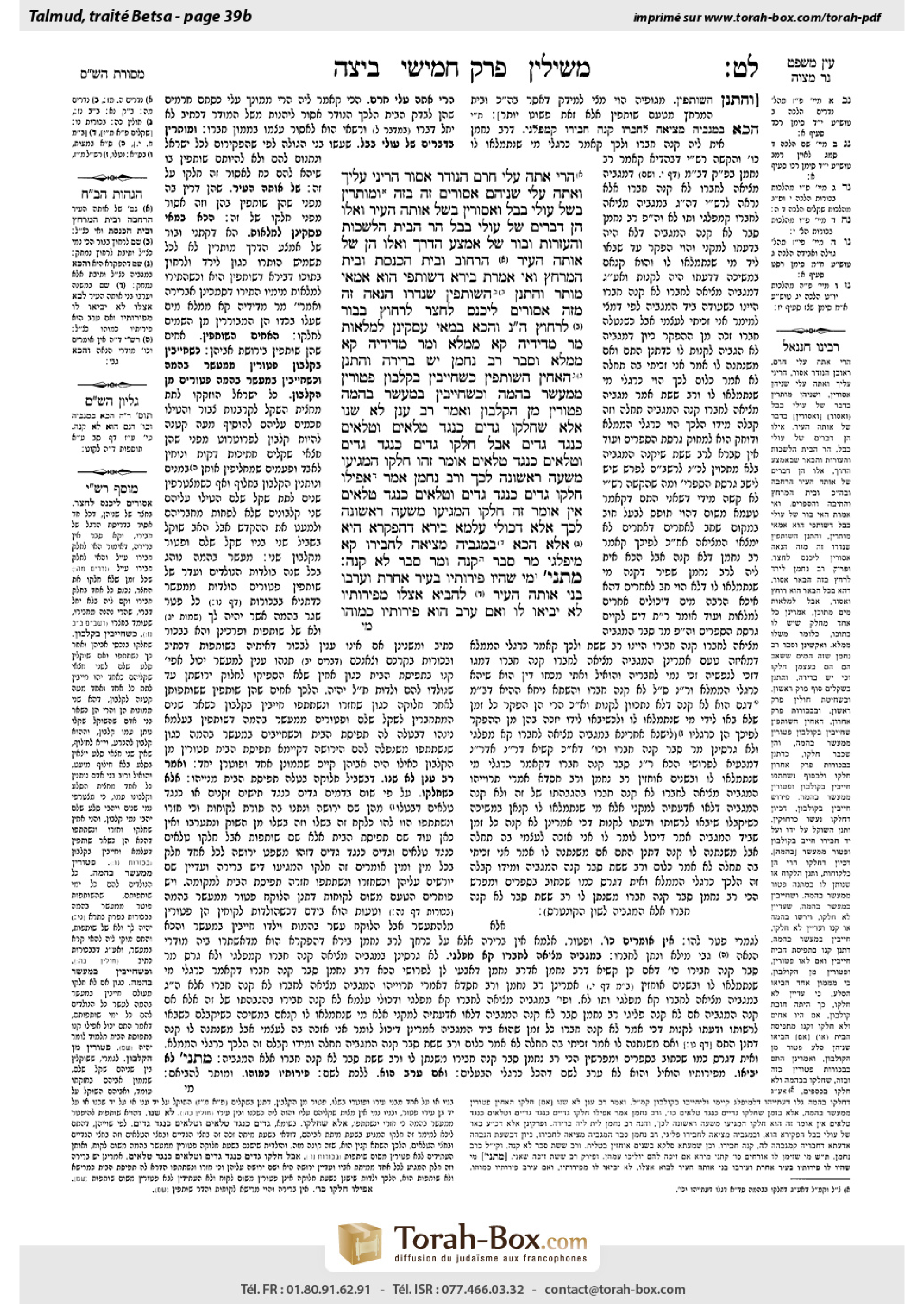
Beitzah 39b: Talmud study for Daf Yomi
Study the Talmud for Daf Yomi with scanned pages, Hebrew text, English translations from Sefaria and AI-generated French translations.
Passage selection and English or AI-generated French translation are available where the scan has annotations. Daf Study is independent of Torah-Box and Sefaria.
Browse Beitzah · ביצה · All tractatesBeitzah 39b text and translations
This page of Beitzah includes the Aramaic text, an English translation and an AI-generated French translation, alongside the scan above.
ביצה ל״ט ב · Aramaic and Hebrew text
הֲרֵי אַתָּה עָלַי חֵרֶם — הַנּוֹדֵר אָסוּר. הֲרֵינִי עָלֶיךָ וְאַתָּה עָלַי — שְׁנֵיהֶם אֲסוּרִים זֶה בָּזֶה, וּמוּתָּרִין בְּשֶׁל עוֹלֵי בָבֶל, וַאֲסוּרִין בְּשֶׁל אוֹתָהּ הָעִיר.
וְאֵלּוּ הֵן דְּבָרִים שֶׁל עוֹלֵי בָבֶל: הַר הַבַּיִת, הַלְּשָׁכוֹת וְהָעֲזָרוֹת, וּבוֹר שֶׁל אֶמְצַע הַדֶּרֶךְ. וְאֵלּוּ הֵן שֶׁל אוֹתָהּ הָעִיר: הָרְחוֹב, וּבֵית הַכְּנֶסֶת, וּבֵית הַמֶּרְחָץ.
וְאִי אָמְרַתְּ בֵּירָא דְשׁוּתָּפֵי הוּא, אַמַּאי מוּתָּר? וְהָתְנַן: הַשּׁוּתָּפִין שֶׁנָּדְרוּ הֲנָאָה זֶה מִזֶּה — אֲסוּרִים לִיכָּנֵס לֶחָצֵר לִרְחוֹץ בַּבּוֹר!
לִרְחוֹץ הָכִי נָמֵי, וְהָכָא בְּמַאי עָסְקִינַן — לְמַלּאוֹת, מָר מִדִּידֵיהּ קָא מְמַלֵּא וּמַר מִדִּידֵיהּ קָא מְמַלֵּא.
וְסָבַר רַב נַחְמָן יֵשׁ בְּרֵירָה? וְהָתְנַן: הָאַחִין הַשּׁוּתָּפִין, כְּשֶׁחַיָּיבִין בַּקָּלְבּוֹן — פְּטוּרִין מִמַּעְשַׂר בְּהֵמָה.
וּכְשֶׁחַיָּיבִין בְּמַעְשַׂר בְּהֵמָה — פְּטוּרִין מִן הַקָּלְבּוֹן.
וְאָמַר רַב עָנָן: לֹא שָׁנוּ אֶלָּא שֶׁחָלְקוּ גְּדָיִם כְּנֶגֶד טְלָאִים וּטְלָאִים כְּנֶגֶד גְּדָיִם.
אֲבָל חָלְקוּ גְּדָיִם כְּנֶגֶד גְּדָיִם וּטְלָאִים כְּנֶגֶד טְלָאִים, אוֹמֵר: זֶהוּ חֶלְקוֹ הַמַּגִּיעוֹ מִשָּׁעָה רִאשׁוֹנָה לְכָךְ.
וְרַב נַחְמָן אָמַר: אֲפִילּוּ חָלְקוּ גְּדָיִם כְּנֶגֶד גְּדָיִם וּטְלָאִים כְּנֶגֶד טְלָאִים — אֵין אוֹמֵר: זֶה חֶלְקוֹ הַמַּגִּיעוֹ מִשָּׁעָה רִאשׁוֹנָה לְכָךְ.
אֶלָּא דְּכוּלֵּי עָלְמָא בֵּירָא דְהֶפְקֵרָא הִיא, אֶלָּא הָכָא בְּמַגְבִּיהַּ מְצִיאָה לַחֲבֵירוֹ קָא מִיפַּלְגִי. מָר סָבַר: קָנָה, וּמָר סָבַר: לָא קָנָה.
מַתְנִי׳ מִי שֶׁהָיוּ פֵּירוֹתָיו בְּעִיר אַחֶרֶת וְעֵרְבוּ בְּנֵי אוֹתָהּ הָעִיר לְהָבִיא אֶצְלוֹ מִפֵּירוֹתָיו — לֹא יָבִיאוּ לוֹ. וְאִם עֵרַב הוּא — פֵּירוֹתָיו כָּמוֹהוּ.
Beitzah 39b · English translation
If he said to him: You are hereby prohibited to me by force of ḥerem, the one making the vow is himself prohibited to derive benefit from the addressee or from his property. If he said to him: I am hereby prohibited to you and you to me by force of ḥerem, they are both prohibited to benefit from one another. And they are permitted to benefit from anything belonging to those who come up from Babylonia, i.e., public property that is not owned by any person or group, but they are prohibited to benefit from property that is jointly owned by the inhabitants of that city, as both parties have a share in such items.
That mishna provides examples: And the following are items of those coming up from Babylonia, i.e., publicly owned items: The Temple Mount, the chambers, and the courtyards on the Temple Mount, and a cistern situated in the middle of the road. And these are items jointly owned by the inhabitants of that city: The street, and the synagogue, and the bathhouse.
Rava, having cited the mishna in full, concludes his challenge to the opinion of Rav Naḥman: And if you say that a cistern of those who come up from Babylonia, a public cistern, is owned jointly by partners, i.e., by all Jews, why should it be permitted for the one who made the vow and the addressee to use it? But didn’t we learn in a mishna (Nedarim 45b): Two partners who took a vow not to derive benefit from one another are prohibited to enter a joint courtyard in which they both have a share to wash themselves in a cistern. According to you, the same should apply to a cistern in which the two of them have a share, such as the cisterns of those who come up from Babylonia.
Rav Naḥman answered: Indeed that is the case. So too, they are prohibited to wash themselves in a cistern because when bathing one uses of all the water of the cistern, part of which belongs to the forbidden partner. But when the baraita says that a cistern of those who come up from Babylonia is permitted to both parties, with what are we dealing here? The baraita is referring only to filling water from the cistern. This is permitted because it is considered that this one fills from his portion, and that one fills from his portion. The water that each of them draws is considered retroactively designated exclusively for him, so that the partner has no share in it at all.
The Gemara asks: And does Rav Naḥman hold that there is retroactive designation? But didn’t we learn in a mishna (Shekalim 1:7): If brothers divided up inherited property among themselves and subsequently joined their property again and became partners, they are obligated to add a kalbon, a small coin, to the obligatory half-shekel yearly Temple donation. The kalbon covered both the cost to the Temple of exchanging half-shekels into larger coins and the depreciation of the donated coin. Although a whole shekel given by two partners does not need to be changed into a larger coin, the Sages imposed the same kalbon fee on the partners as on everyone else. However, these partners are exempt from the animal tithe, in accordance with the standard halakha that people who own animals in partnership are exempt from the animal tithe.
The quote from the mishna continues: And in a situation in which the brothers are liable for the animal tithe, as when they have not yet divided up their inheritance, and all the deceased’s estate is therefore still considered a single unit and not a partnership, they are exempt from the kalbon, in accordance with the halakha that a father who contributes a single shekel for his two dependent sons does not need to add the kalbon.
And Rav Anan said: The Sages taught that the inherited property is no longer considered a single unit after the brothers divided it and then rejoined in a partnership only when they divided kids against lambs or lambs against kids, i.e., if one brother took kids and the other took a corresponding value of lambs. This kind of division is considered a commercial transaction, with one brother purchasing goats and paying for them with lambs and vice versa. Therefore, when they join their animals again as partners, it is considered an entirely new partnership.
However, if they divided kids against kids and lambs against lambs, meaning that each brother took an equal portion of each of the items they inherited, one can say of each brother’s portion: This is his portion destined to reach him from the first moment, from the time of the death of the deceased. If the brothers form their partnership again, the inheritance becomes a single unit again, and they are therefore obligated in the animal tithe and exempt from the kalbon.
But Rav Naḥman said: Even if they divided kids against kids and lambs against lambs, one does not say that this is his portion destined to reach him from the first moment. This is because Rav Naḥman does not accept the principle of retroactive designation. Consequently, the resolution proposed previously for the issue of filling water from the cistern of those who come up from Babylonia is invalid.
The Gemara retracts its previous explanation of the disagreement between Rava and Rav Naḥman: Rather, everyone agrees that a cistern of those who come up from Babylonia, i.e., a public cistern, is an ownerless cistern, but here they disagree over a different issue: One who picks up a found article intending to acquire it on behalf of his friend. One Sage, Rav Naḥman, holds that if one picks up a found object on behalf of his friend, his friend acquires it through this act as though he had picked it up himself. The water of the ownerless cistern is like a found object. Therefore, if one draws water on behalf of another, the latter acquires it, and consequently the water is as his feet. And one Sage, Rav Sheshet, holds that when one picks up a found object for another, the latter does not acquire it. Rather, it belongs to the one who actually picked it up, and consequently the water is as the feet of the one who draws it.
MISHNA: With regard to one who had produce in a different city beyond the Shabbat limit, and the residents of that city where the produce was located joined the Shabbat boundaries, enabling them to reach the owner’s home on the Festival, and they wish to bring him some of his produce, they may not bring it to him. His produce is as his feet; since it is outside of his Shabbat limit, it may not be taken from its place. However, if the owner placed an eiruv to enable travel to that city, the legal status of his produce is like his status with regard to the Shabbat limit. People from that city who also placed an eiruv may bring the produce to him, since he himself may walk to the produce and take it.
Beitzah 39b · Traduction française (IA)
Si l'on dit à lui : Tu es désormais interdit à moi par force de ḥerem, celui qui fait le vœu est lui-même interdit à tirer profit de l'interlocuteur ou de ses biens. Si l'on dit à lui : Je suis désormais interdit à toi et toi à moi par force de ḥerem, ils sont tous deux interdits à tirer profit l'un de l'autre. Et ils sont autorisés à tirer profit de tout ce qui appartient à ceux qui viennent de Babylone, c'est-à-dire des biens publics non possédés par personne ou groupe, mais ils sont interdits à tirer profit des biens communs aux habitants de cette ville, car les deux parties y ont une part.
Cette mitsva donne des exemples : Et voici les biens de ceux qui viennent de Babylone, c'est-à-dire des biens publics : Le mont du Temple, les chambres et les courtyards du mont du Temple, et un cisternes situé au milieu de la route. Et voici les biens communs aux habitants de cette ville : La rue, la synagogue et la maison de bain.
Rava, ayant cité la mitsva en entier, conclut son défi à l'opinion de Rav Naḥman : Et si tu dis qu'un cisternes de ceux qui viennent de Babylone, un cisternes public, est possédé en commun par des partenaires, c'est-à-dire par tous les Juifs, pourquoi est-il autorisé pour celui qui a fait le vœu et l'interlocuteur à l'utiliser ? Mais n'avons-nous pas appris dans une mitsva (Nedarim 45b) : Deux partenaires qui ont fait un vœu de ne pas tirer profit l'un de l'autre sont interdits à entrer dans un courtil commun où ils ont tous deux une part pour se laver dans un cisternes. Selon toi, cela devrait s'appliquer de même à un cisternes où les deux ont une part, comme les cisternes de ceux qui viennent de Babylone.
Rav Naḥman répondit : C'est exact. De même, ils sont interdits de se laver dans un cisternes car lors de la baignade, on utilise toute l'eau du cisternes, partie de laquelle appartient au partenaire interdit. Mais lorsque la baraïta dit qu'un cisternes de ceux qui viennent de Babylone est autorisé aux deux parties, avec quels biens sommes-nous en présence ? La baraïta fait référence uniquement au remplissage de l'eau du cisternes. Cela est autorisé car on considère que celui-ci remplit de sa part et celui-là remplit de sa part. L'eau que chacun tire est considérée comme désignée rétrospectivement exclusivement pour lui, de sorte que le partenaire n'a aucune part en elle.
Le Guemara pose la question : Et Rav Naḥman considère-t-il qu'il y a une désignation rétrospective ? Mais n'avons-nous pas appris dans une mitsva (Shekalim 1:7) : Si des frères ont divisé entre eux les biens hérités, puis ont réunis leurs biens et sont devenus partenaires, ils sont obligés d'ajouter un kalbon, une petite monnaie, à la contribution annuelle obligatoire de moitié de shekel pour le Temple. Le kalbon couvrait le coût pour le Temple de l'échange de moitiés de shekels en pièces plus grandes ainsi que la dépréciation de la monnaie offerte. Bien qu'un shekel entier donné par deux partenaires n'ait pas besoin d'être échangé en une pièce plus grande, les Sages ont imposé le même kalbon aux partenaires que à tous les autres. Cependant, ces partenaires sont exemptés de l'offrande d'animaux, conformément à la halakha standard selon laquelle les personnes qui possèdent des animaux en partenariat sont exemptés de l'offrande d'animaux.
La citation de la mitsva continue : Et dans un cas où les frères sont responsables de l'offrande d'animaux, comme lorsqu'ils n'ont pas encore divisé leur héritage, et que tous les biens du défunt sont donc encore considérés comme une seule unité et non un partenariat, ils sont exemptés du kalbon, conformément à la halakha selon laquelle un père qui contribue un shekel pour ses deux enfants dépendants n'a pas besoin d'ajouter le kalbon.
Et Rav Anan dit : Les Sages ont enseigné que les biens hérités ne sont plus considérés comme un seul unité après que les frères les aient divisés et ensuite reconstitués en partenariat uniquement lorsqu'ils ont divisé des agneaux contre des brebis ou des brebis contre des agneaux, c'est-à-dire si un frère a pris des agneaux et l'autre a pris une valeur correspondante de brebis. Ce genre de division est considéré comme une transaction commerciale, avec un frère achetant des brebis et payant avec des agneaux et vice versa. Par conséquent, lorsqu'ils reconstituent à nouveau leurs animaux en partenariat, cela est considéré comme un partenariat entièrement nouveau.
Cependant, si ils ont divisé des agneaux contre des agneaux et des brebis contre des brebis, c'est-à-dire que chaque frère a pris une part égale de chaque des biens hérités, on peut dire de chaque part de chaque frère : C'est sa part destinée à lui depuis le début, depuis le moment de la mort du défunt. Si les frères forment à nouveau leur partenariat, l'héritage devient à nouveau un seul unité, et ils sont donc obligés de l'offrande d'animaux et exemptés du kalbon.
Mais Rav Naḥman dit : Même s'ils ont divisé des agneaux contre des agneaux et des brebis contre des brebis, on ne dit pas que c'est sa part destinée à lui depuis le début. Cela est dû au fait que Rav Naḥman ne reconnaît pas le principe de désignation rétrospective. Par conséquent, la résolution proposée précédemment concernant le remplissage d'eau dans le cisternes de ceux qui viennent de Babylone est invalide.
Le Guemara retire son explication précédente du désaccord entre Rava et Rav Naḥman : Plutôt, tout le monde convient qu'un cisternes de ceux qui viennent de Babylone, c'est-à-dire un cisternes public, est un cisternes sans propriétaire, mais ici ils divergent sur un autre point : celui qui ramasse un objet trouvé en vue d'acquérir pour son ami. Un Sage, Rav Naḥman, considère que si l'on ramasse un objet trouvé en vue d'acquérir pour son ami, l'ami acquiert cet objet par cet acte comme s'il l'avait lui-même ramassé. L'eau du cisternes sans propriétaire est comme un objet trouvé. Par conséquent, si l'on tire de l'eau en vue d'un autre, l'autre acquiert l'eau, et l'eau est comme ses pieds. Un autre Sage, Rav Sheshet, considère que lorsqu'on ramasse un objet trouvé pour un autre, l'autre ne l'acquiert pas. Plutôt, il appartient à celui qui l'a effectivement ramassé, et par conséquent l'eau est comme les pieds de celui qui la tire.
MICHNA : Concernant celui qui avait des produits dans une ville différente au-delà des limites du Shabbat, et les habitants de cette ville où se trouvaient les produits ont adopté les limites du Shabbat, ce qui leur permettait d'atteindre la maison du propriétaire pendant la fête, et ils souhaitaient lui apporter certains de ses produits, ils ne pouvaient pas lui apporter ces produits. Ses produits sont comme ses pieds ; puisqu'ils sont en dehors de ses limites du Shabbat, ils ne peuvent pas être enlevés de leur lieu. Cependant, si le propriétaire avait mis en place un eiruv pour permettre le déplacement vers cette ville, le statut légal de ses produits est comme son statut concernant les limites du Shabbat. Les personnes de cette ville qui avaient également mis en place un eiruv pouvaient apporter les produits à lui, puisque lui-même pouvait marcher vers les produits et les prendre.
Traduction française générée par IA à partir de l’édition anglaise de Sefaria. Vérifie toujours un passage avec le texte source.
Text from Sefaria: William Davidson Edition - Vocalized Aramaic (CC BY NC); William Davidson Edition - English (CC BY NC).