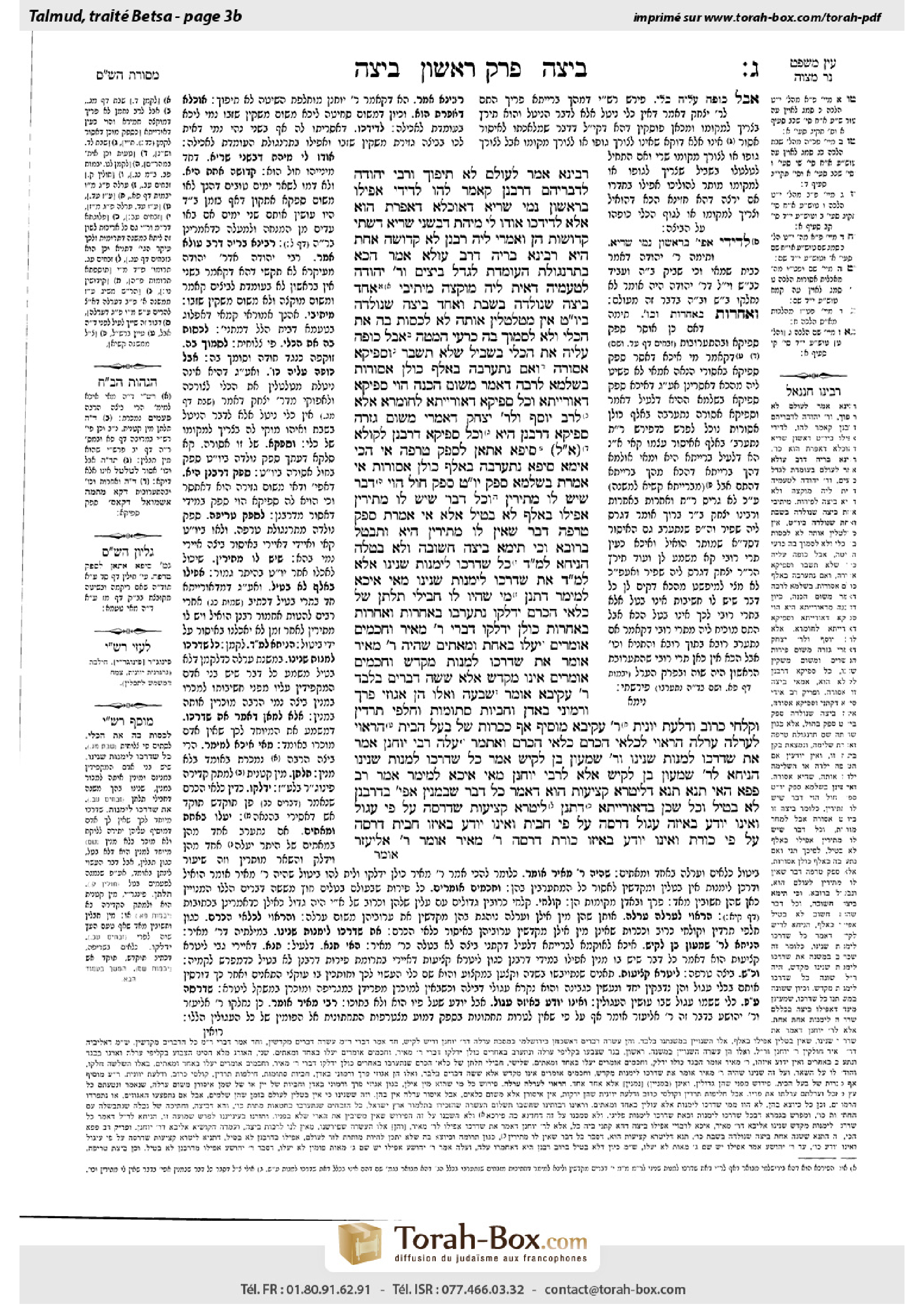
Beitzah 3b: Talmud study for Daf Yomi
Study the Talmud for Daf Yomi with scanned pages, Hebrew text, English translations from Sefaria and AI-generated French translations.
Passage selection and English or AI-generated French translation are available where the scan has annotations. Daf Study is independent of Torah-Box and Sefaria.
Browse Beitzah · ביצה · All tractatesBeitzah 3b text and translations
This page of Beitzah includes the Aramaic text, an English translation and an AI-generated French translation, alongside the scan above.
ביצה ג׳ ב · Aramaic and Hebrew text
רָבִינָא אָמַר: לְעוֹלָם לָא תֵּיפוֹךְ, וְרַבִּי יְהוּדָה לְדִבְרֵיהֶם דְּרַבָּנַן קָאָמַר לְהוּ:
לְדִידִי אֲפִילּוּ בָּרִאשׁוֹן נָמֵי שַׁרְיָא, דְּאוּכְלָא דְאִפְּרַת הוּא. אֶלָּא לְדִידְכוּ — אוֹדוֹ לִי מִיהַת דְּבַשֵּׁנִי שַׁרְיָא, דִּשְׁתֵּי קְדוּשּׁוֹת הֵן. וְאָמְרִי לֵיהּ רַבָּנַן: לָא, קְדוּשָּׁה אַחַת הִיא.
רָבִינָא בְּרֵיהּ דְּרַב עוּלָּא אָמַר: הָכָא בְּתַרְנְגוֹלֶת הָעוֹמֶדֶת לְגַדֵּל בֵּיצִים, וְרַבִּי יְהוּדָה לְטַעְמֵיהּ, דְּאִית לֵיהּ מוּקְצֶה.
מֵיתִיבִי: אֶחָד בֵּיצָה שֶׁנּוֹלְדָה בְּשַׁבָּת וְאֶחָד בֵּיצָה שֶׁנּוֹלְדָה בְּיוֹם טוֹב — אֵין מְטַלְטְלִין אוֹתָהּ, לֹא לְכַסּוֹת בָּהּ אֶת הַכְּלִי, וְלֹא לִסְמוֹךְ בָּהּ כַּרְעֵי הַמִּטָּה.
אֲבָל כּוֹפֶה עָלֶיהָ אֶת הַכְּלִי בִּשְׁבִיל שֶׁלֹּא תִּשָּׁבֵר. וּסְפֵיקָא אֲסוּרָה, וְאִם נִתְעָרְבָה בְּאֶלֶף — כּוּלָּן אֲסוּרוֹת.
בִּשְׁלָמָא לְרַבָּה, דְּאָמַר מִשּׁוּם הֲכָנָה, הָוֵי סְפֵיקָא דְאוֹרָיְיתָא — וְכׇל סְפֵיקָא דְאוֹרָיְיתָא לְחוּמְרָא.
אֶלָּא לְרַב יוֹסֵף וּלְרַבִּי יִצְחָק, דְּאָמְרִי מִשּׁוּם גְּזֵרָה, סְפֵיקָא דְרַבָּנַן הִיא — וְכׇל סְפֵיקָא דְרַבָּנַן לְקוּלָּא!
(אֲמַר לֵיהּ:) סֵיפָא אֲתָאן לִסְפֵק טְרֵפָה.
אִי הָכִי, אֵימָא סֵיפָא: נִתְעָרְבָה בְּאֶלֶף — כּוּלָּן אֲסוּרוֹת. אִי אָמְרַתְּ בִּשְׁלָמָא סָפֵק יוֹם טוֹב סָפֵק חוֹל, הָוֵי דָּבָר שֶׁיֵּשׁ לוֹ מַתִּירִין, וְכׇל דָּבָר שֶׁיֵּשׁ לוֹ מַתִּירִין — אֲפִילּוּ בְּאֶלֶף לֹא בָּטֵיל.
אֶלָּא אִי אָמְרַתְּ סְפֵק טְרֵפָה, דָּבָר שֶׁאֵין לוֹ מַתִּירִין הִיא, וְתִבְטַל בְּרוּבָּא!
וְכִי תֵּימָא בֵּיצָה חֲשׁוּבָה וְלֹא בָּטְלָה, הָנִיחָא לְמַאן דְּאָמַר: כׇּל שֶׁדַּרְכּוֹ לִימָּנוֹת שָׁנִינוּ.
אֶלָּא לְמַאן דְּאָמַר: אֶת שֶׁדַּרְכּוֹ לִימָּנוֹת שָׁנִינוּ, מַאי אִיכָּא לְמֵימַר!
דִּתְנַן: מִי שֶׁהָיוּ לוֹ חֲבִילֵי תִּלְתָּן שֶׁל כִּלְאֵי הַכֶּרֶם — יִדְלְקוּ. נִתְעָרְבוּ בַּאֲחֵרוֹת, וַאֲחֵרוֹת בַּאֲחֵרוֹת — כּוּלָּן יִדָּלְקוּ, דִּבְרֵי רַבִּי מֵאִיר. וַחֲכָמִים אוֹמְרִים: יַעֲלוּ בְּאַחַת וּמָאתַיִם.
שֶׁהָיָה רַבִּי מֵאִיר אוֹמֵר: אֶת שֶׁדַּרְכּוֹ לִמָּנוֹת — מְקַדֵּשׁ; וַחֲכָמִים אוֹמְרִים: אֵינוֹ מְקַדֵּשׁ אֶלָּא שִׁשָּׁה דְּבָרִים בִּלְבַד; רַבִּי עֲקִיבָא אוֹמֵר: שִׁבְעָה. וְאֵלּוּ הֵן: אֱגוֹזֵי פֶּרֶךְ, וְרִמּוֹנֵי בָּאדָן, וְחָבִיּוֹת סְתוּמוֹת, וְחִלְפֵי תְרָדִין, וְקִלְחֵי כְרוּב, וְדַלַּעַת יְוָנִית. רַבִּי עֲקִיבָא מוֹסִיף אַף כִּכָּרוֹת שֶׁל בַּעַל הַבַּיִת.
הָרָאוּי לְעׇרְלָה — עׇרְלָה. הָרָאוּי לְכִלְאֵי הַכֶּרֶם — כִּלְאֵי הַכֶּרֶם. וְאִתְּמַר עֲלַהּ, רַבִּי יוֹחָנָן אָמַר: אֶת שֶׁדַּרְכּוֹ לִמָּנוֹת שָׁנִינוּ. וְרַבִּי שִׁמְעוֹן בֶּן לָקִישׁ אָמַר: כׇּל שֶׁדַּרְכּוֹ לִמָּנוֹת שָׁנִינוּ.
הָנִיחָא לְרַבִּי שִׁמְעוֹן בֶּן לָקִישׁ, אֶלָּא לְרַבִּי יוֹחָנָן — מַאי אִיכָּא לְמֵימַר?
אָמַר רַב פָּפָּא: הַאי תַּנָּא — תַּנָּא דְּלִיטְרָא קְצִיעוֹת הוּא, דְּאָמַר: כׇּל דָּבָר שֶׁבְּמִנְיָן, אֲפִילּוּ בִּדְרַבָּנַן לֹא בָּטֵיל, וְכׇל שֶׁכֵּן בִּדְאוֹרָיְיתָא.
דִּתְנַן: לִיטְרָא קְצִיעוֹת שֶׁדְּרָסָהּ עַל פִּי עִגּוּל, וְאֵינוֹ יוֹדֵעַ בְּאֵיזֶה עִגּוּל דְּרָסָהּ, עַל פִּי חָבִית, וְאֵינוֹ יוֹדֵעַ בְּאֵיזוֹ חָבִית דְּרָסָהּ, עַל פִּי כַּוֶּרֶת, וְאֵינוֹ יוֹדֵעַ בְּאֵיזוֹ כַּוֶּרֶת דְּרָסָהּ. רַבִּי מֵאִיר אוֹמֵר, רַבִּי אֱלִיעֶזֶר
Beitzah 3b · English translation
With regard to the contradiction presented by Rabbi Yoḥanan, which led him to suggest that the opinions should be reversed, Ravina said that this is not the only possible resolution: Actually, do not reverse the opinions. Rather, in the case of the two Festival days, one could claim that Rabbi Yehuda spoke to them in accordance with the statement of the Rabbis, rather than presenting his own opinion.
If so, Rabbi Yehuda’s statement should be understood as follows: In my opinion, even on the first Festival day, the egg is also permitted, as it is food that was separated. However, according to your opinion, which is that you prohibit liquid that comes from food, at least agree with me that it is permitted on the second day, as they are two sanctities. The first and second days of Rosh HaShana are not one unit, but two separate entities. Therefore, it is possible that the first day is sacred, while the second is a weekday. Consequently, an item prohibited on the first day might be permitted on the second. And the Rabbis said to him: No, the two days are one sanctity, i.e., they are viewed as a single continuous unit. The uncertainty applies equally to both of them.
Ravina, son of Rav Ulla, said: There is an alternative resolution to the contradiction raised by Rabbi Yoḥanan. Here, in the case of the egg laid on a Festival, Rabbi Yehuda prohibited eating the egg since it is not from a chicken designated for food, whose legal status is that of food. Rather, the case refers to a chicken designated for laying eggs, and Rabbi Yehuda conforms to his standard line of reasoning, as he holds that there is a prohibition of muktze. Since the egg is produced by something muktze, it is certainly muktze itself, which means that the halakha of food that was separated is inapplicable to this case.
§ The Gemara raises an objection from a baraita, which clarifies the issue differently: Both an egg that was laid on Shabbat and an egg that was laid on a Festival are considered to be muktze, and therefore in both cases, one may not move the egg, neither for the sake of food nor for any other purpose: Not to cover a vessel with it, nor to support the legs of a bed with it.
However, if one wishes, he may cover the egg with a vessel, without handling the egg itself, so that it does not break from being accidentally trodden upon. Although it is prohibited to move the egg itself, it is nevertheless permitted to move a vessel for its sake. And even if there is uncertainty with regard to whether this egg was laid on a Festival, it is prohibited to move it. And, furthermore, if it became intermingled with a thousand permitted eggs, they are all prohibited.
The Gemara notes: Granted, according to the opinion of Rabba, who said that an egg is prohibited due to the lack of preparation, this case involves an uncertainty with regard to the legal status of an item prohibited by Torah law; and in any case of an uncertainty with regard to the legal status of an item prohibited by Torah law, the ruling is stringent. Therefore, the egg is prohibited even if there is uncertainty whether it was laid on a Festival.
However, according to the opinions of Rav Yosef and Rabbi Yitzḥak, who say that an egg is prohibited due to a decree, this case involves an uncertainty with regard to the legal status of an item prohibited by rabbinic law, and in any case of an uncertainty with regard to the legal status of an item prohibited by rabbinic law, the ruling is lenient.
The Gemara answers: In the latter clause of the baraita, we have arrived at a different case. The case does not involve the prohibition of an egg laid on a Festival; the case involves an egg laid by a chicken with regard to which there is uncertainty whether it is an animal with a condition that will cause it to die within twelve months [tereifa], which is prohibited by Torah law. The uncertainty with regard to the legal status of the chicken is relevant to the egg.
The Gemara raises a difficulty with this response: If so, say the latter clause of that same baraita: If it became intermingled with a thousand other eggs, they are all prohibited. Granted, if you say that there is uncertainty whether the egg was laid on a Festival and uncertainty whether it was laid on a weekday, then it is an object whose prohibition is temporary, as the egg will be permitted on the following day, and the principle is: Any object whose prohibition is temporary is not nullified, even by a thousand permitted items. Since its prohibition will lapse on its own, there is no need to make use of the option of nullification.
However, if you say that the egg referred to in the baraita is an uncertain tereifa, it is an object whose prohibition is not temporary, as there is no way to permit the prohibition of tereifa, and it should therefore be nullified by a simple majority.
The Gemara adds: And if you say that an egg is significant and is not nullified, as nullification applies only to items that have no intrinsic significance, while a significant object cannot be nullified, that works out well according to the one who said that we learned: Any item whose manner is also to be counted, i.e., that is sometimes sold by unit, rather than by weight or volume, is considered significant. An egg falls into that category, as it is sometimes sold by unit.
However, according to the one who said that we learned: That item whose manner is exclusively to be counted, i.e., that is always sold by unit, is considered significant, what can be said? Although eggs are often sold by unit, they are also often sold by weight or volume.
The Gemara cites the mishna where the dispute cited above appears. As we learned (Orla 3:6–7): With regard to one who had bundles of clover, a type of legume, that were diverse kinds of food crops that grew in a vineyard, from which it is prohibited to derive benefit, those bundles must be burned. If the bundles were intermingled with others, and those others were intermingled with others, they must all be burned. This is the statement of Rabbi Meir. And the Rabbis say: They may be nullified by one part in two hundred similar parts. When the prohibited portion is less than one-half of one percent of the permitted portion, the prohibition is nullified.
The mishna continues: Rabbi Meir says that they must all be burned, as Rabbi Meir would say: That whose manner is exclusively to be counted, is considered significant and cannot be nullified. Therefore, it renders the entire mixture forbidden, and it must be burned. And the Rabbis say: Only six items are sufficiently significant to render the entire mixture forbidden. Rabbi Akiva says: There are seven. And they are: High-quality nuts from Perekh, and pomegranates from Badan, and sealed barrels of wine, and branches of spinach, and cabbage stalks, and Greek pumpkin. Rabbi Akiva adds: Even loaves of a homeowner.
Different prohibitions apply to these seven items. That which is fit to be forbidden due to orla, fruit that grows during the first three years after a tree is planted, is forbidden due to orla. That which is fit to be forbidden due to diverse kinds of food crops that grew in a vineyard is forbidden due to diverse kinds in a vineyard (Avoda Zara 74a). And it was stated about the wording of this mishna that there is an amoraic dispute. Rabbi Yoḥanan said that we learned: Only that whose manner is exclusively to be counted is significant and cannot be nullified, and it is therefore prohibited by Rabbi Meir. And Rabbi Shimon ben Lakish said that we learned: Any item whose manner is also to be counted, is significant and cannot be nullified.
Returning to the matter of the egg, the Gemara reprises its question: This works out well according to the opinion of Rabbi Shimon ben Lakish, but according to Rabbi Yoḥanan, what can be said? Since an egg is not sold exclusively by unit, it is not significant. Therefore, the egg of a tereifa should be nullified by a simple majority.
Rav Pappa said: According to Rabbi Yoḥanan, this tanna, who said that an egg cannot be nullified, is the tanna of the halakha concerning a litra of dried figs, who, based on his statement, said: Any item that is counted, even if it is prohibited by rabbinic law, cannot be nullified, and all the more so items prohibited by Torah law, e.g., the egg of a tereifa.
As we learned in a mishna: With regard to a litra of dried figs, whose stems were removed, and were dried and pressed in different vessels and shaped into circles, the obligation to tithe fruits is by rabbinic law. If one forgot to tithe the figs, and later remembered that he placed the figs into a barrel, and during the process of producing a circle he pressed the figs onto the mouth of one of the circular vessels in which the circles are formed, and does not know into which circular vessel he pressed it; or, if he recalls that he pressed it on the mouth of a barrel, but does not know in which barrel he pressed it, or if he recalls that he pressed it on the mouth of a straw receptacle, but does not know in which receptacle he pressed it, Rabbi Meir says that in all these cases there is a dispute between the tanna’im of the previous generation: Rabbi Eliezer
Beitzah 3b · Traduction française (IA)
Concernant la contradiction soulevée par Rabbi Yoḥanan, qui l'a conduit à suggérer que les opinions devraient être inversées, Ravina a dit que cela n'est pas la seule solution possible : En réalité, ne reversez pas les opinions. Plutôt, dans le cas des deux jours de fête, on pourrait affirmer que Rabbi Yehuda a parlé en conformité avec la déclaration des Rabbins, plutôt que de présenter son propre avis.
Si c'est ainsi, la déclaration de Rabbi Yehuda devrait être interprétée comme suit : Selon mon avis, même le premier jour de fête, l'œuf est également permis, car il s'agit d'aliment séparé. Cependant, selon votre avis, qui est que vous interdisez les liquides issus d'aliments, au moins convenez-vous avec moi que cela est permis le deuxième jour, car ils sont deux sanctuaires. Les premiers et seconds jours de Rosh HaShana ne sont pas une unité, mais deux entités distinctes. Ainsi, il est possible que le premier jour soit sacré, tandis que le second soit un jour ordinaire. Par conséquent, un objet interdit le premier jour pourrait être permis le deuxième. Et les Rabbins lui dirent : Non, les deux jours sont une seule sanctité, c'est-à-dire qu'ils sont vus comme une unité continue. L'incertitude s'applique également aux deux.
Ravina, fils de Rav Ulla, dit : Il existe une autre solution à la contradiction soulevée par Rabbi Yoḥanan. Ici, dans le cas d'un œuf pondu pendant un festival, Rabbi Yehuda interdit de manger l'œuf car il ne provient pas d'une poule destinée à l'alimentation, dont le statut légal est celui d'aliment. Plutôt, le cas concerne une poule destinée à pondre des œufs, et Rabbi Yehuda suit sa ligne de raisonnement habituelle, car il considère qu'il y a une interdiction de muktze. Puisque l'œuf est produit par quelque chose de muktze, il est certainement muktze lui-même, ce qui signifie que la halakha de l'aliment séparé ne s'applique pas à ce cas.
§ Le Guemara soulève une objection tirée d'une baraïta, qui clarifie la question différemment : Tant un œuf pondu le sabbat qu'un œuf pondu pendant un festival sont considérés comme muktze, et par conséquent, dans les deux cas, on ne peut pas déplacer l'œuf, ni pour l'usage d'aliment ni pour tout autre but : ne pas le couvrir d'un récipient, ni le placer sous les pieds d'un lit.
Cependant, si l'on le souhaite, on peut couvrir l'œuf avec un récipient sans manipuler l'œuf lui-même, afin qu'il ne se brise pas accidentellement. Bien que l'œuf lui-même soit interdit de mouvement, il est permis de déplacer un récipient à son intention. Et même si l'on est incertain quant à ce que l'œuf ait été pondu pendant un festival, il est interdit de le déplacer. De plus, si l'œuf s'est mêlé à mille œufs permis, ils sont tous interdits.
Le Guemara note : Cela est vrai selon l'opinion de Rabba, qui a dit que l'œuf est interdit en raison de l'absence de préparation, ce cas implique une incertitude concernant le statut légal d'un objet interdit par la Loi divine ; et dans tout cas d'incertitude concernant le statut légal d'un objet interdit par la Loi divine, la décision est stricte. Par conséquent, l'œuf est interdit même en cas d'incertitude quant à ce qu'il ait été pondu pendant un festival.
Cependant, selon les opinions de Rav Yosef et de Rabbi Yitzḥak, qui affirment que l'œuf est interdit en raison d'un décret, ce cas implique une incertitude concernant le statut légal d'un objet interdit par la loi rabbinique ; et dans tout cas d'incertitude concernant le statut légal d'un objet interdit par la loi rabbinique, la décision est clémente.
Le Guemara répond : Dans la dernière partie de la baraïta, nous avons atteint un cas différent. Le cas ne concerne pas l'interdiction d'un œuf pondu pendant un festival ; le cas concerne un œuf pondu par une poule dont on est incertain quant à son état, qui provoquera sa mort dans les douze mois, interdit par la Torah écrite. L'incertitude concernant le statut légal de la poule est pertinente pour l'œuf.
Le Guemara soulève une difficulté avec cette réponse : Si c'est ainsi, disent la dernière partie de cette même baraïta : Si l'œuf s'est mêlé à mille autres œufs, ils sont tous interdits. Cela est vrai, si vous dites qu'il y a une incertitude quant à ce que l'œuf ait été pondu pendant un festival et une incertitude quant à ce qu'il ait été pondu un jour ordinaire, alors c'est un objet dont l'interdiction est temporaire, car l'œuf sera permis le jour suivant, et le principe est : Tout objet dont l'interdiction est temporaire n'est pas annulé, même par mille objets permis. Puisque son interdiction expire d'elle-même, il n'est pas nécessaire d'utiliser l'option d'annulation.
Cependant, si vous dites que l'œuf mentionné dans la baraïta est un tereifa incertain, c'est un objet dont l'interdiction n'est pas temporaire, car il n'y a aucun moyen de permettre l'interdiction de tereifa, et il devrait donc être annulé par la majorité simple.
Le Guemara ajoute : Et si vous dites que l'œuf est important et n'est pas annulé, car l'annulation s'applique uniquement aux objets sans importance intrinsèque, tandis qu'un objet important ne peut pas être annulé, cela s'applique bien à celui qui a dit que nous avons appris : Tout objet dont la manière est aussi à compter, c'est-à-dire qui est parfois vendu par unité plutôt que par poids ou volume, est considéré comme important. L'œuf entre dans cette catégorie, car il est parfois vendu par unité.
Cependant, selon celui qui a dit que nous avons appris : Cet objet dont la manière est exclusivement à compter, c'est-à-dire qui est toujours vendu par unité, est considéré comme important, que peut-on dire ? Bien que les œufs soient souvent vendus par unité, ils sont aussi souvent vendus par poids ou volume.
La Guemara cite la Michna où l'opposition mentionnée ci-dessus apparaît. Comme nous l'avons appris (Orla 3:6–7) : Concernant celui qui possédait des bouquets de trèfle, un type de légumineuse, qui étaient des cultures diverses de légumes poussant dans un cépage, d'où il est interdit d'extraire un bénéfice, ces bouquets doivent être brûlés. Si les bouquets étaient mélangés avec d'autres, et que ceux-ci étaient eux-mêmes mélangés avec d'autres, ils doivent tous être brûlés. C'est la déclaration du Rabbi Meir. Et les Sages disent : Ils peuvent être annulés par une part sur deux cents parties semblables. Lorsque la portion interdite est inférieure à un demi-pour centième de la portion permise, l'interdiction est annulée.
La Michna continue : Le Rabbi Meir dit qu'ils doivent tous être brûlés, comme le Rabbi Meir dirait : Celui dont la manière est exclusivement à être compté est considéré comme important et ne peut être annulé. Par conséquent, cela rend le mélange entier interdit, et il doit être brûlé. Et les Sages disent : Seulement six choses sont suffisamment importantes pour rendre le mélange entier interdit. Le Rabbi Akiva dit : Il y en a sept. Et elles sont : Les noix de haute qualité de Perekh, et les pamplemousses de Badan, et les barriques de vin scellées, et les branches d'épinards, et les tiges de chou, et le potiron grec. Le Rabbi Akiva ajoute : Même les pains d'un propriétaire.
Des prohibitions différentes s'appliquent à ces sept choses. Ce qui est dû à l'interdiction d'orla, c'est-à-dire les fruits qui poussent durant les trois premières années après que l'arbre est planté, est interdit à cause d'orla. Ce qui est dû à l'interdiction des cultures diverses de légumes poussant dans un cépage est interdit à cause des cultures diverses dans un cépage (Avoda Zara 74a). Et il a été dit concernant la formulation de cette Michna qu'il y a un débat entre les amoraïm. Le Rabbi Yoḥanan dit que nous avons appris : Seulement celui dont la manière est exclusivement à être compté est important et ne peut être annulé, et il est donc interdit selon le Rabbi Meir. Et le Rabbi Shimon ben Lakish dit que nous avons appris : Tout objet dont la manière est aussi à être compté est important et ne peut être annulé.
En revenant à la question concernant l'œuf, la Guemara répète sa question : Cela fonctionne bien selon l'opinion du Rabbi Shimon ben Lakish, mais selon le Rabbi Yoḥanan, que peut-on dire ? Puisque l'œuf n'est pas vendu exclusivement par unité, il n'est pas important. Par conséquent, l'œuf d'un animal mort est annulé par une majorité simple.
Le Rabbi Pappa dit : Selon le Rabbi Yoḥanan, ce tanna, qui dit que l'œuf ne peut être annulé, est le tanna de la halakha concernant un litra de figues sèches, qui, basé sur sa déclaration, a dit : Tout objet qui est compté, même s'il est interdit par la loi rabbinique, ne peut être annulé, et encore plus fort les objets interdits par la loi divine, par exemple, l'œuf d'un animal mort.
Comme nous l'avons appris dans une Michna : Concernant un litra de figues sèches, dont les tiges avaient été retirées, et qui étaient sèches et pressées dans différents récipients et formées en cercles, l'obligation de dîmer les fruits est selon la loi rabbinique. Si l'on oublie de dîmer les figues, et plus tard se souvient qu'il a mis les figues dans une barrique, et durant le processus de fabrication d'un cercle il a pressé les figues sur la bouche d'un des récipients circulaires dans lesquels les cercles sont formés, et ne sait pas dans quel récipient circulaire il a pressé, ou si l'on se souvient qu'il a pressé sur la bouche d'une barrique, mais ne sait pas dans quelle barrique il a pressé, ou si l'on se souvient qu'il a pressé sur la bouche d'un récipient en paille, mais ne sait pas dans quel récipient en paille il a pressé, le Rabbi Meir dit que dans tous ces cas il y a un débat entre les tannaïm de la génération précédente : le Rabbi Eliezer
Traduction française générée par IA à partir de l’édition anglaise de Sefaria. Vérifie toujours un passage avec le texte source.
Text from Sefaria: William Davidson Edition - Vocalized Aramaic (CC BY NC); William Davidson Edition - English (CC BY NC).