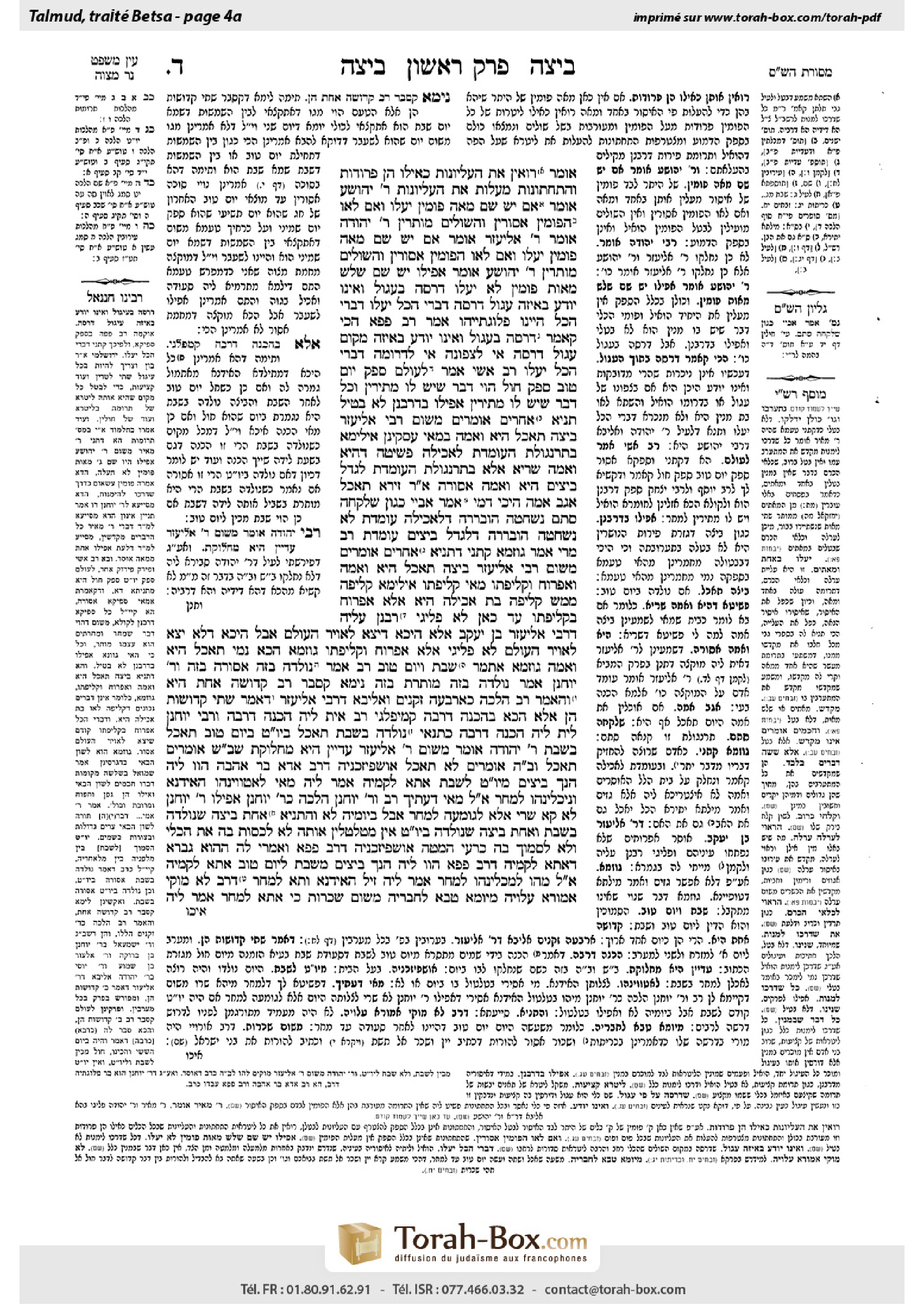
Beitzah 4a: Talmud study for Daf Yomi
Study the Talmud for Daf Yomi with scanned pages, Hebrew text, English translations from Sefaria and AI-generated French translations.
Passage selection and English or AI-generated French translation are available where the scan has annotations. Daf Study is independent of Torah-Box and Sefaria.
Browse Beitzah · ביצה · All tractatesBeitzah 4a text and translations
This page of Beitzah includes the Aramaic text, an English translation and an AI-generated French translation, alongside the scan above.
ביצה ד׳ א · Aramaic and Hebrew text
אוֹמֵר: רוֹאִין אֶת הָעֶלְיוֹנוֹת כָּאֵלּוּ הֵן פְּרוּדוֹת, וְהַתַּחְתּוֹנוֹת מַעֲלוֹת אֶת הָעֶלְיוֹנוֹת.
רַבִּי יְהוֹשֻׁעַ אוֹמֵר: אִם יֵשׁ שָׁם מֵאָה פּוּמִּין — יַעֲלוּ, וְאִם לָאו — הַפּוּמִּין אֲסוּרִין, וְהַשּׁוּלַיִם מוּתָּרִין.
רַבִּי יְהוּדָה אוֹמֵר, רַבִּי אֱלִיעֶזֶר אוֹמֵר: אִם יֵשׁ שָׁם מֵאָה פּוּמִּין — יַעֲלוּ, וְאִם לָאו — הַפּוּמִּין אֲסוּרִין, וְהַשּׁוּלַיִם מוּתָּרִין. רַבִּי יְהוֹשֻׁעַ אוֹמֵר: אֲפִילּוּ יֵשׁ שָׁם שְׁלֹשׁ מֵאוֹת פּוּמִּין — לֹא יַעֲלוּ.
דְּרָסָהּ בְּעִגּוּל וְאֵינוֹ יוֹדֵעַ בְּאֵיזֶה עִגּוּל דְּרָסָהּ — דִּבְרֵי הַכֹּל יַעֲלוּ. דִּבְרֵי הַכֹּל?! הַיְינוּ פְּלוּגְתַּיְיהוּ!
אָמַר רַב פָּפָּא, הָכִי קָאָמַר: דְּרָסָהּ בְּעִגּוּל, וְאֵינוֹ יוֹדֵעַ בְּאֵיזֶה מְקוֹם עִגּוּל דְּרָסָהּ, אִי לִצְפוֹנָהּ אִי לִדְרוֹמָהּ — דִּבְרֵי הַכֹּל יַעֲלוּ.
רַב אָשֵׁי אָמַר: לְעוֹלָם סָפֵק יוֹם טוֹב סָפֵק חוֹל הָוֵי דָּבָר שֶׁיֵּשׁ לוֹ מַתִּירִין, וְכׇל דָּבָר שֶׁיֵּשׁ לוֹ מַתִּירִין — אֲפִילּוּ בִּדְרַבָּנַן לֹא בָּטֵיל.
תַּנְיָא, אֲחֵרִים אוֹמְרִים מִשּׁוּם רַבִּי אֱלִיעֶזֶר: בֵּיצָה — תֵּאָכֵל הִיא וְאִמָּהּ. בְּמַאי עָסְקִינַן? אִילֵימָא בְּתַרְנְגוֹלֶת הָעוֹמֶדֶת לַאֲכִילָה — פְּשִׁיטָה דְּהִיא וְאִמָּהּ שַׁרְיָא! אֶלָּא בְּתַרְנְגוֹלֶת הָעוֹמֶדֶת לְגַדֵּל בֵּיצִים — הִיא וְאִמָּהּ אֲסוּרָה! אָמַר רַבִּי זֵירָא: תֵּאָכֵל אַגַּב אִמָּהּ.
הֵיכִי דָּמֵי? אָמַר אַבָּיֵי: כְּגוֹן שֶׁלְּקָחָהּ סְתָם, נִשְׁחֲטָה — הוּבְרְרָה דְּלַאֲכִילָה עוֹמֶדֶת. לֹא נִשְׁחֲטָה — הוּבְרְרָה דִּלְגַדֵּל בֵּיצִים עוֹמֶדֶת.
רַב מָרִי אָמַר: גּוּזְמָא קָתָנֵי. דְּתַנְיָא, אֲחֵרִים אוֹמְרִים מִשּׁוּם רַבִּי אֱלִיעֶזֶר: בֵּיצָה תֵּאָכֵל הִיא וְאִמָּהּ, וְאֶפְרוֹחַ וּקְלִיפָּתוֹ.
מַאי קְלִיפָּתוֹ? אִילֵּימָא קְלִיפָּה מַמָּשׁ, קְלִיפָּה בַּת אֲכִילָה הִיא? אֶלָּא אֶפְרוֹחַ בִּקְלִיפָּתוֹ. עַד כָּאן לָא פְּלִיגִי רַבָּנַן עֲלֵיהּ דְּרַבִּי אֱלִיעֶזֶר בֶּן יַעֲקֹב, אֶלָּא הֵיכָא דְּיָצָא לַאֲוִיר הָעוֹלָם. אֲבָל הֵיכָא דְּלֹא יָצָא לַאֲוִיר הָעוֹלָם — לָא פְּלִיגִי.
אֶלָּא ״אֶפְרוֹחַ וּקְלִיפָּתוֹ״ — גּוּזְמָא, הָכָא נָמֵי ״תֵּאָכֵל הִיא וְאִמָּהּ״ — גּוּזְמָא.
אִתְּמַר, שַׁבָּת וְיוֹם טוֹב, רַב אָמַר: נוֹלְדָה בָּזֶה — אֲסוּרָה בָּזֶה, וְרַבִּי יוֹחָנָן אָמַר: נוֹלְדָה בָּזֶה — מוּתֶּרֶת בָּזֶה. נֵימָא קָסָבַר רַב: קְדוּשָּׁה אַחַת הִיא?
וְהָאָמַר רַב: הֲלָכָה כְּאַרְבָּעָה זְקֵנִים וְאַלִּיבָּא דְּרַבִּי אֱלִיעֶזֶר, דְּאָמַר: שְׁתֵּי קְדוּשּׁוֹת הֵן.
אֶלָּא, הָכָא בַּהֲכָנָה דְרַבָּהּ קָמִיפַּלְגִי: רַב אִית לֵיהּ הֲכָנָה דְרַבָּה, וְרַבִּי יוֹחָנָן לֵית לֵיהּ הֲכָנָה דְרַבָּה.
כְּתַנָּאֵי: נוֹלְדָה בְּשַׁבָּת — תֵּאָכֵל בְּיוֹם טוֹב, בְּיוֹם טוֹב — תֵּאָכֵל בְּשַׁבָּת. רַבִּי יְהוּדָה אוֹמֵר מִשּׁוּם רַבִּי אֱלִיעֶזֶר: עֲדַיִין הִיא מַחֲלוֹקֶת, שֶׁבֵּית שַׁמַּאי אוֹמְרִים: תֵּאָכֵל, וּבֵית הִלֵּל אוֹמְרִים: לֹא תֵּאָכֵל.
אוּשְׁפִּיזְכָּנֵיהּ דְּרַב אַדָּא בַּר אַהֲבָה הֲווֹ לֵיהּ הָנָךְ בֵּיצִים מִיּוֹם טוֹב לְשַׁבָּת. אֲתָא לְקַמֵּיהּ, אֲמַר לֵיהּ: מַאי לְאַטְווֹיִנְהוּ הָאִידָּנָא וְנֵיכְלִינְהוּ לִמְחַר?
אֲמַר לֵיהּ: מַאי דַּעְתָּיךְ, רַב וְרַבִּי יוֹחָנָן — הֲלָכָה כְּרַבִּי יוֹחָנָן. אֲפִילּוּ רַבִּי יוֹחָנָן לָא קָא שָׁרֵי אֶלָּא לְגוֹמְעָהּ לְמָחָר, אֲבָל בְּיוֹמֵיהּ לָא.
וְהָתַנְיָא: אַחַת בֵּיצָה שֶׁנּוֹלְדָה בְּשַׁבָּת וְאַחַת בֵּיצָה שֶׁנּוֹלְדָה בְּיוֹם טוֹב — אֵין מְטַלְטְלִין אוֹתָהּ, לֹא לְכַסּוֹת בָּהּ אֶת הַכְּלִי, וְלֹא לִסְמוֹךְ בָּהּ כַּרְעֵי הַמִּטָּה.
אוּשְׁפִּיזְכָּנֵיהּ דְּרַב פָּפָּא, וְאָמְרִי לַהּ, הָהוּא גַּבְרָא דַּאֲתָא לְקַמֵּיהּ דְּרַב פָּפָּא. הֲווֹ לֵיהּ הָנָךְ בֵּיצִים מִשַּׁבָּת לְיוֹם טוֹב. אֲתָא לְקַמֵּיהּ, אֲמַר לֵיהּ: מַהוּ לְמֵכְלִינְהוּ לִמְחַר? אֲמַר לֵיהּ: זִיל הָאִידָּנָא וּתָא לִמְחַר, דְּרַב לָא מוֹקֵי אָמוֹרָא עִלָּוֵיהּ מִיּוֹמָא טָבָא לְחַבְרֵיהּ מִשּׁוּם שִׁכְרוּת.
כִּי אֲתָא לִמְחַר, אֲמַר לֵיהּ:
Beitzah 4a · English translation
says: One considers the upper circles of dried figs as though they are separate pieces, rather than one unit. And the lower ones, which were there beforehand and have certainly been tithed, nullify the upper ones, as there are enough circles of figs in the entire barrel to nullify the upper litra.
In contrast, Rabbi Yehoshua says: If there are one hundred mouths of different barrels or circular vessels there, the prohibited litra of untithed figs on the mouth of one of the vessels is nullified by a ratio of one part of prohibited figs to one hundred parts of similar, permitted figs. And if not, all of the circles of figs at the mouths of the barrels or circular vessels are prohibited, as one of them clearly contains a prohibited litra that has not been nullified. And the figs on the insides of the vessels are permitted, as the prohibited figs certainly did not reach there. This is Rabbi Meir’s version of the dispute.
Rabbi Yehuda says a different version of the dispute. Rabbi Eliezer says: If there are one hundred mouths of vessels with permitted figs present there, in addition to the prohibited one, it is nullified by the one hundred permitted mouths. And if not, the figs at the mouths are prohibited and those at the bottom are permitted. Rabbi Yehoshua says: Even if there are three hundred mouths present there, they are not nullified, as this litra cannot be nullified in any manner. Rav Pappa was referring to this opinion when he said that there is a tanna, meaning Rabbi Yehoshua in Rabbi Yehuda’s version, who maintains that even an item occasionally sold by unit, e.g., a circle of dried figs, can never be nullified.
The same mishna further states: If one pressed the litra of figs into a circular vessel but he does not know into which circular vessel he pressed it, everyone agrees that the prohibited fig cakes are nullified. The Gemara expresses surprise at this statement: Everyone agrees? This is the very matter of their dispute, whether or not the litra is nullified.
Rav Pappa said: This is what the tanna said, i.e., he meant the following: One pressed it onto a circular vessel but does not know onto which place, which side of the circular vessel he pressed it, whether on its north or on its south side. In this case, as the prohibited litra is not located in a specific place and it cannot be distinguished from the others, it certainly cannot be considered an object of significance, and everyone agrees that it is nullified.
The Gemara explained why the egg mentioned in the baraita, an egg laid by a chicken that is a tereifa, cannot be nullified even if it is mingled with a thousand permitted eggs. However, Rav Ashi said: Actually, the baraita can be explained as referring to a case where there is uncertainty whether it is a Festival or a weekday. While it is true that according to most opinions this is a rabbinic prohibition, and the halakha is generally lenient with regard to uncertainties involving rabbinic law, it is an object whose prohibition is temporary. And with regard to any object whose prohibition is temporary, even if it involves a rabbinic prohibition, it cannot be nullified.
§ It is taught in a baraita: Aḥerim say in the name of Rabbi Eliezer: With regard to an egg laid on a Festival, it and its mother may be eaten. The Gemara asks: With what case are we dealing? If we say that this is dealing with a chicken designated for food, it is obvious that it and its mother are permitted. Rather, say that this is dealing with a chicken designated for laying eggs, but in that case it and its mother are both prohibited. Rabbi Zeira said that the baraita should be understood as follows: The egg may be eaten on account of its mother; if the chicken is eaten on the Festival, the egg may also be eaten.
The Gemara asks: What are the circumstances? In which case is it necessary to apply this ruling? Abaye said: It is referring to a case where one bought this chicken without specifying whether he intended to eat it or use it for its eggs. In that case, if the chicken was slaughtered on a Festival, it has been retroactively clarified that it was intended for food, and the eggs it lays are, therefore, permitted. If it was not slaughtered, it has been retroactively clarified that it was intended for laying eggs, and the eggs it lays are prohibited.
Rav Mari said that the phrase: It and its mother may be eaten, should not be taken literally. Rather, the tanna is teaching an exaggeration [guzma], for extra emphasis, as it is taught in another baraita: Aḥerim say in the name of Rabbi Eliezer: An egg may be eaten, it and its mother, and a chick and its shell.
The Gemara clarifies: What is the meaning of this addition: Its shell? If we say it is referring to an actual shell, is a shell edible? Rather, the baraita must be referring to the consumption of a chick that is still in its shell. This explanation is problematic, as the Rabbis disagree with Rabbi Eliezer ben Ya’akov only in permitting the eating of a chick immediately after it hatches, when it has already entered the world. However, when it has not yet entered the world, i.e., if the chick is still in its shell, they do not disagree. Even the Rabbis accept that this chick has the status of a creeping animal and may not be eaten.
Rather, evidently the expression: A chick and its shell, should not be understood literally, as it is an exaggeration. Here, too, the phrase: It and its mother may be eaten, is an exaggeration. It does not mean literally that the chick and its mother may be eaten, but is merely a statement of emphasis that the egg is undoubtedly permitted.
§ It was stated that amora’im disputed the following issue (Eiruvin 38b): If Shabbat and a Festival occur on consecutive days, Rav said: An egg laid on this one is prohibited on that one, and Rabbi Yoḥanan said: An egg laid on this one is permitted on that one. The Gemara asks: Let us say that Rav holds that when Shabbat and a Festival occur on consecutive days, it is considered one continuous sanctity, i.e., a single, indivisible day.
But didn’t Rav say: The halakha is in accordance with the opinion of four elders, who ruled in accordance with the opinion of Rabbi Eliezer, who said: When a Shabbat and a Festival occur consecutively, they are two sanctities rather than one long day; therefore, a joining of Shabbat boundaries need not be placed on a weekday, but may be placed on the first of the holy days to allow going beyond the Shabbat boundary on the second. Evidently, this issue cannot be the basis of their dispute.
Rather, here they disagree with regard to Rabba’s preparation, i.e., an item that was prepared on its own from one day to the other, whose use Rabba prohibits. Rav holds that items prepared by means of Rabba’s preparation are prohibited, whereas Rabbi Yoḥanan does not hold that items prepared by means of Rabba’s preparation are prohibited.
The Gemara comments: This dispute is like a dispute between tanna’im: An egg laid on Shabbat may be eaten on a Festival; if it was laid on a Festival, it may be eaten on Shabbat. Rabbi Yehuda says in the name of Rabbi Eliezer: This opinion is not unanimous; rather, it is still a matter of dispute, as Beit Shammai say it may be eaten, and Beit Hillel say it may not be eaten, just as they disagreed about whether an egg is permitted on the day on which it was laid.
The Gemara relates: Rav Adda bar Ahava’s host [ushpizikhnei] had these eggs that were laid on a Festival that occurred on a Friday, and the host was unsure whether eggs laid on the Festival were permitted from the Festival for use on Shabbat. He came before his guest, Rav Adda, and said to him: What is the halakha with regard to roasting these eggs now, on the Festival, although eating them today is prohibited due to nolad, and let us eat them tomorrow, as they will be no longer be prohibited due to nolad?
Rav Adda said to him: What is your opinion that led you to pose this question? You evidently assume that in the dispute between Rav and Rabbi Yoḥanan, the halakha is in accordance with the opinion of Rabbi Yoḥanan, and therefore an egg laid on one day will be permitted on the following day. However, even Rabbi Yoḥanan permitted one to swallow it only raw, on the next day, when it is no longer prohibited; but on the same day that it was laid, he did not permit one even to move it, and certainly not to roast it.
And it is taught likewise in a baraita: With regard to both an egg that was laid on Shabbat and an egg that was laid on a Festival, one may not move it, neither to cover a vessel with it nor to support the legs of a bed with it.
The Gemara relates a similar incident: Rav Pappa’s host, and some say it was a certain man who came before Rav Pappa, had these eggs that were laid on a Shabbat that occurred before a Festival. He came before him and said to him: What is the halakha with regard to whether it is permitted to eat these eggs tomorrow, on the Festival? Rav Pappa said to him: Go away from me now, and come back tomorrow. He said this because Rav would not place a disseminator before him to explain his lectures, from one Festival day until the end of the other, the second Festival day, due to drunkenness. Since it was customary in those times to drink a great deal of wine during Festival meals, Rav was concerned that his mind would not be sufficiently clear to issue a public ruling.
When that man came back on the following day, Rav Pappa said to him:
Beitzah 4a · Traduction française (IA)
dit : On considère les cercles supérieurs des figues sèches comme des pièces distinctes, plutôt qu'un seul objet. Les cercles inférieurs, qui étaient déjà là et qui ont certainement été tithés, annulent les cercles supérieurs, car il y a suffisamment de cercles de figues dans le tonneau pour annuler le litra supérieur.
En revanche, Rabbi Yéhoshua dit : Si l'on a cent bouches de tonneaux ou de récipients circulaires différents, le litra interdit de figues non tithées sur la bouche d'un de ces récipients est annulé par un rapport de 1 partie de figues interdites à 100 parties de figues permises similaires. Et si ce n'est pas le cas, tous les cercles de figues aux bouches des tonneaux ou des récipients circulaires sont interdits, car l'un d'entre eux contient clairement un litra interdit non annulé. Les figues à l'intérieur des récipients sont permises, car les figues interdites n'ont certainement pas atteint là. C'est la version de Rabbi Méir de la dispute.
Rabbi Yéhuda dit une autre version de la dispute. Rabbi Éléazer dit : Si l'on a cent bouches de récipients avec des figues permises présentes, en plus du litra interdit, il est annulé par les cent bouches permises. Et si ce n'est pas le cas, les figues aux bouches sont interdites et celles en bas sont permises. Rabbi Yéhoshua dit : Même s'il y a trois cents bouches présentes, elles ne sont pas annulées, car ce litra ne peut être annulé de toute façon. Rav Pappa faisait référence à cette opinion lorsqu'il a dit qu'il y a un tanna, c'est-à-dire Rabbi Yéhoshua dans la version de Rabbi Yéhuda, qui maintient que même un objet occasionnellement vendu par unité, par exemple un cercle de figues sèches, ne peut jamais être annulé.
La même mitsva précise également : Si l'on a pressé le litra de figues dans un récipient circulaire mais qu'on ne sait pas dans quel récipient circulaire on l'a pressé, tout le monde convient que les gâteaux de figues interdits sont annulés. La Guemara exprime une surprise à propos de cette déclaration : Tout le monde convient ? C'est précisément la matière de leur débat, savoir si le litra est annulé ou non.
Rav Pappa dit : C'est ce que le tanna a dit, c'est-à-dire qu'il voulait dire ceci : On l'a pressé sur un récipient circulaire mais on ne sait pas sur quelle partie, quel côté du récipient circulaire on l'a pressé, que ce soit au nord ou au sud. Dans ce cas, comme le litra interdit n'est pas situé dans un lieu spécifique et ne peut être distingué des autres, il ne peut certainement pas être considéré comme un objet important, et tout le monde convient qu'il est annulé.
La Guemara explique pourquoi l'œuf mentionné dans la baraïta, un œuf laid par une poule téréfah, ne peut pas être annulé même s'il est mélangé à mille œufs permis. Cependant, Rav Ashi dit : En réalité, la baraïta peut être interprétée comme faisant référence à un cas où il y a une incertitude sur le fait qu'il s'agit d'un festival ou d'un jour ordinaire. Bien que selon la plupart des opinions cela soit une interdiction rabbinique, et que la halakha soit généralement leniente concernant les incertitudes liées à la loi rabbinique, il s'agit d'un objet dont l'interdiction est temporaire. Et concernant tout objet dont l'interdiction est temporaire, même s'il s'agit d'une interdiction rabbinique, il ne peut pas être annulé.
§ Il est enseigné dans une baraïta : Aḥerim disent en nom de Rabbi Éléazer : Concernant un œuf laid sur un festival, il et sa mère peuvent être mangés. La Guemara pose la question : De quel cas s'agit-il ? Si on dit que cela concerne une poule destinée à la nourriture, il est évident qu'elle et sa mère sont permises. Plutôt, disons que cela concerne une poule destinée à pondre des œufs, mais dans ce cas, elle et sa mère sont toutes deux interdites. Rabbi Zéira dit que la baraïta doit être interprétée ainsi : L'œuf peut être mangé en raison de sa mère ; si la poule est mangée sur le festival, l'œuf peut également être mangé.
La Guemara pose la question : Quelles sont les circonstances ? Dans quel cas est-il nécessaire d'appliquer cette décision ? Abaye dit : Il s'agit d'un cas où l'on a acheté cette poule sans spécifier s'il avait l'intention de la manger ou de l'utiliser pour ses œufs. Dans ce cas, si la poule a été sacrifiée sur un festival, cela a été clarifié en arrière que l'intention était de la manger, et les œufs qu'elle pond sont donc permis. Si elle n'a pas été sacrifiée, cela a été clarifié en arrière que l'intention était de pondre des œufs, et les œufs qu'elle pond sont interdits.
Rav Mari dit que la phrase : Il et sa mère peuvent être mangés, ne doit pas être prise littéralement. Plutôt, le tanna enseigne une exagération [guzma], pour souligner, comme il est enseigné dans une autre baraïta : Aḥerim disent en nom de Rabbi Éléazer : Un œuf peut être mangé, il et sa mère, et un poussin et sa coquille.
La Guemara clarifie : Quelle est la signification de cette addition : Sa coquille ? Si on dit qu'il s'agit d'une coquille réelle, est-ce que la coquille est comestible ? Plutôt, la baraïta doit faire référence à la consommation d'un poussin qui est encore dans sa coquille. Cette explication est problématique, car les Rabbins ne s'opposent pas à Rabbi Éléazer ben Ya'akov que dans le cas de la permission de manger un poussin immédiatement après qu'il ait éclos, lorsqu'il a déjà entré dans le monde. Cependant, lorsqu'il n'a pas encore entré dans le monde, c'est-à-dire si le poussin est encore dans sa coquille, ils ne s'opposent pas. Même les Rabbins acceptent que ce poussin a le statut d'un animal rampant et ne peut pas être mangé.
Plutôt, évidemment, l'expression : Un poussin et sa coquille, ne doit pas être comprise littéralement, car c'est une exagération. Ici aussi, la phrase : Il et sa mère peuvent être mangés, est une exagération. Elle ne signifie pas littéralement que le poussin et sa mère peuvent être mangés, mais est simplement une déclaration d'accentuation selon laquelle l'œuf est certainement permis.
§ Il a été dit que des amora’im disputaient la question suivante (Eiruvin 38b) : Si le Sabbat et un festival se succèdent, Rav dit : Un œuf laid sur celui-ci est interdit sur celui-là, et Rabbi Yoḥanan dit : Un œuf laid sur celui-ci est permis sur celui-là. La Guemara pose la question : Disons que Rav considère que lorsque le Sabbat et un festival se succèdent, cela est considéré comme une sanctité continue, c'est-à-dire un seul jour indivisible.
Mais n’a-t-il pas dit Rav : la halakha suit l’opinion des quatre anciens, qui ont rendu leur décision selon l’opinion de Rabbi Eliezer, qui affirmait : lorsqu’un sabbat et un festival se suivent, ils constituent deux sanctuaires plutôt qu’un seul jour de repos ; par conséquent, il n’est pas nécessaire de joindre les limites du sabbat à un jour de semaine, mais on peut le faire sur le premier jour de la fête afin de permettre de sortir de la limite du sabbat le jour suivant. Il est évident que cette question ne peut être le fondement de leur débat.
Au contraire, ici ils s’opposent concernant la préparation de Rabba, c’est-à-dire un objet préparé d’un jour à l’autre, dont l’utilisation est interdite selon Rabba. Rav considère que les objets préparés par la méthode de la préparation de Rabba sont interdits, tandis que Rabbi Yoḥanan ne considère pas que ces objets soient interdits.
Le Guemara commente : ce débat est comme un débat entre des tannaïm : un œuf pondu le sabbat peut être mangé lors d’un festival ; s’il a été pondu lors d’un festival, il peut être mangé le sabbat. Rabbi Yehuda cite en nom de Rabbi Eliezer : cette opinion n’est pas unanime ; elle reste un point de débat, car Beit Shammai disent qu’il peut être mangé, et Beit Hillel disent qu’il ne peut pas être mangé, tout comme ils s’opposaient sur la question de savoir si un œuf est permis le jour où il a été pondu.
Le Guemara rapporte : le hôte de Rav Adda bar Ahava avait ces œufs qui avaient été pondus lors d’un festival qui avait eu lieu un vendredi, et le hôte ne savait pas si les œufs pondus lors du festival étaient permis à partir du festival pour être utilisés le sabbat. Il est venu devant son hôte, Rav Adda, et lui a dit : quelle est la halakha concernant la cuisson de ces œufs maintenant, lors du festival, bien que leur consommation aujourd’hui soit interdite en raison de nolad, et pouvons-nous les manger demain, car ils ne seront plus interdits en raison de nolad ?
Rav Adda lui a répondu : quelle est votre opinion qui vous a conduit à poser cette question ? Vous semblez supposer que dans le débat entre Rav et Rabbi Yoḥanan, la halakha suit l’opinion de Rabbi Yoḥanan, et par conséquent un œuf pondu un jour est permis le jour suivant. Cependant, même Rabbi Yoḥanan permettait de le déglutir seulement cru, le jour suivant, lorsqu’il n’est plus interdit ; mais le même jour où il a été pondu, il ne permettait même pas de le déplacer, et certainement pas de le cuire.
Et cela est enseigné de la même manière dans une baraïta : concernant un œuf qui a été pondu le sabbat et un œuf qui a été pondu lors d’un festival, on ne doit pas le déplacer, ni pour couvrir un récipient avec, ni pour soutenir les pieds d’un lit.
Le Guemara rapporte un incident similaire : le hôte de Rav Pappa, et on dit aussi qu’il s’agissait d’un certain homme qui s’est présenté devant Rav Pappa, avait ces œufs qui avaient été pondus lors d’un sabbat qui s’était suivi d’un festival. Il est venu devant lui et lui a dit : quelle est la halakha concernant la permission de manger ces œufs demain, lors du festival ? Rav Pappa lui a répondu : allez-vous en maintenant et revenez demain. Il a dit cela parce que Rav ne voulait pas placer un expéditeur devant lui pour expliquer ses enseignements, du premier jour du festival jusqu’à la fin du second jour de festival, en raison de l’ivresse. En effet, il était coutumier à cette époque de boire beaucoup de vin lors des repas de festival, et Rav avait peur que son esprit ne soit pas suffisamment clair pour rendre un jugement public.
Lorsque cet homme est revenu le lendemain, Rav Pappa lui a dit :
Traduction française générée par IA à partir de l’édition anglaise de Sefaria. Vérifie toujours un passage avec le texte source.
Text from Sefaria: William Davidson Edition - Vocalized Aramaic (CC BY NC); William Davidson Edition - English (CC BY NC).