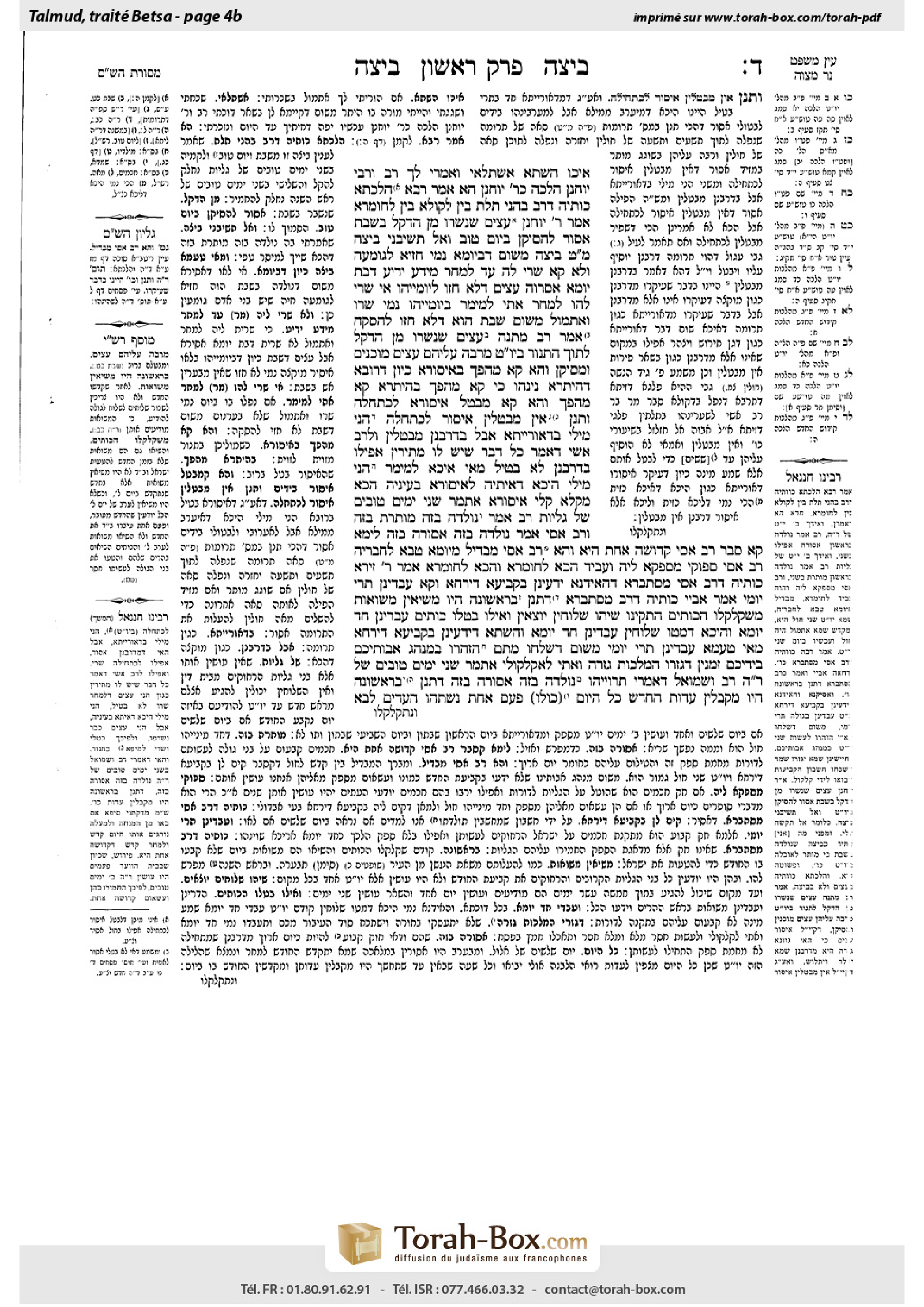
Beitzah 4b: Talmud study for Daf Yomi
Study the Talmud for Daf Yomi with scanned pages, Hebrew text, English translations from Sefaria and AI-generated French translations.
Passage selection and English or AI-generated French translation are available where the scan has annotations. Daf Study is independent of Torah-Box and Sefaria.
Browse Beitzah · ביצה · All tractatesBeitzah 4b text and translations
This page of Beitzah includes the Aramaic text, an English translation and an AI-generated French translation, alongside the scan above.
ביצה ד׳ ב · Aramaic and Hebrew text
אֵיכוּ הַשְׁתָּא, אִשְׁתְּלַאי וַאֲמַרִי לְךָ: רַב וְרַבִּי יוֹחָנָן — הֲלָכָה כְּרַבִּי יוֹחָנָן. הָא אָמַר רָבָא: הִלְכְתָא כְּוָתֵיהּ דְּרַב בְּהָנֵי תְּלָת, בֵּין לְקוּלָּא בֵּין לְחוּמְרָא.
אָמַר רַבִּי יוֹחָנָן: עֵצִים שֶׁנָּשְׁרוּ מִן הַדֶּקֶל בְּשַׁבָּת — אָסוּר לְהַסִּיקָן בְּיוֹם טוֹב. וְאַל תְּשִׁיבֵנִי בֵּיצָה, מַאי טַעְמָא? בֵּיצָה מִשּׁוּם דִּבְיוֹמָא נָמֵי חַזְיָא לְגוֹמְעָהּ וְלָא קָא שָׁרֵי לַהּ עַד לִמְחַר — מִידָּע יְדִיעַ דְּבַת יוֹמָא אַסְרוּהָ. עֵצִים דְּלָא חָזוּ לְיוֹמַיְיהוּ, אִי שָׁרֵי לְהוּ לִמְחַר — אָתֵי לְמֵימַר: בְּיוֹמַיְיהוּ נָמֵי שְׁרוּ, וְאֶתְמוֹל מִשּׁוּם שַׁבָּת הוּא דְּלָא חָזוּ לְהַסָּקָה.
אָמַר רַב מַתְנָה: עֵצִים שֶׁנָּשְׁרוּ מִן הַדֶּקֶל לְתוֹךְ הַתַּנּוּר בְּיוֹם טוֹב — מַרְבֶּה עֲלֵיהֶם עֵצִים מוּכָנִים, וּמַסִּיקָן: וְהָא קָא מְהַפֵּךְ בְּאִיסּוּרָא! כֵּיוָן דְּרוּבָּא דְּהֶיתֵּרָא נִינְהוּ, כִּי קָא מְהַפֵּךְ — בְּהֶיתֵּרָא קָא מְהַפֵּךְ.
וְהָא קָא מְבַטֵּל אִיסּוּרָא לְכַתְּחִלָּה, וּתְנַן: אֵין מְבַטְּלִין אָסוּר לְכַתְּחִלָּה! הָנֵי מִילֵּי בִּדְאוֹרָיְיתָא, אֲבָל בִּדְרַבָּנַן מְבַטְּלִין.
וּלְרַב אָשֵׁי דְּאָמַר: כׇּל דָּבָר שֶׁיֵּשׁ לוֹ מַתִּירִין אֲפִילּוּ בִּדְרַבָּנַן לֹא בָּטֵיל, מַאי אִיכָּא לְמֵימַר? הָנֵי מִילֵּי הֵיכָא דְּאִיתֵיהּ לְאִיסּוּרָא בְּעֵינֵיהּ, הָכָא — מִקְלָא קָלִי אִיסּוּרָא.
אִתְּמַר: שְׁנֵי יָמִים טוֹבִים שֶׁל גָּלִיּוֹת, רַב אָמַר: נוֹלְדָה בָּזֶה — מוּתֶּרֶת בָּזֶה, וְרַב אַסִּי אָמַר: נוֹלְדָה בָּזֶה — אֲסוּרָה בָּזֶה.
לֵימָא קָא סָבַר רַב אַסִּי קְדוּשָּׁה אַחַת הִיא? וְהָא רַב אַסִּי מַבְדֵּיל מִיּוֹמָא טָבָא לְחַבְרֵיהּ!
רַב אַסִּי סַפּוֹקֵי מְסַפְּקָא לֵיהּ, וְעָבֵיד הָכָא לְחוּמְרָא וְהָכָא לְחוּמְרָא.
אָמַר רַבִּי זֵירָא: כְּוָתֵיהּ דְּרַב אַסִּי מִסְתַּבְּרָא, דְּהָאִידָּנָא יָדְעִינַן בִּקְבִיעָא דְיַרְחָא, וְקָא עָבְדִינַן תְּרֵי יוֹמֵי.
אָמַר אַבָּיֵי: כְּוָתֵיהּ דְּרַב מִסְתַּבְּרָא, דִּתְנַן: בָּרִאשׁוֹנָה, הָיוּ מַשִּׂיאִין מַשּׂוּאוֹת. מִשֶּׁקִּלְקְלוּ הַכּוּתִים, הִתְקִינוּ שֶׁיְּהוּ שְׁלוּחִין יוֹצְאִין.
וְאִילּוּ בָּטְלוּ כּוּתִים — עָבְדִינַן חַד יוֹמָא, וְהֵיכָא דְּמָטוּ שְׁלוּחִין — עָבְדִינַן חַד יוֹמָא.
וְהַשְׁתָּא דְּיָדְעִינַן בִּקְבִיעָא דְיַרְחָא, מַאי טַעְמָא עָבְדִינַן תְּרֵי יוֹמֵי? מִשּׁוּם דִּשְׁלַחוּ מִתָּם: הִזָּהֲרוּ בְּמִנְהַג אֲבוֹתֵיכֶם בִּידֵיכֶם, זִמְנִין דְּגָזְרוּ הַמַּלְכוּת גְּזֵרָה וְאָתֵי לְאִקַּלְקוּלֵי.
אִתְּמַר, שְׁנֵי יָמִים טוֹבִים שֶׁל רֹאשׁ הַשָּׁנָה. רַב וּשְׁמוּאֵל דְּאָמְרִי תַּרְוַיְיהוּ: נוֹלְדָה בָּזֶה — אֲסוּרָה בָּזֶה, דִּתְנַן: בָּרִאשׁוֹנָה הָיוּ מְקַבְּלִין עֵדוּת הַחֹדֶשׁ כׇּל הַיּוֹם (כּוּלּוֹ). פַּעַם אַחַת נִשְׁתַּהוּ הָעֵדִים לָבֹא,
Beitzah 4b · English translation
Had I issued a ruling for you then, I would have forgotten the correct response, and I would have said to you, based on the accepted principle that in the case of a dispute between Rav and Rabbi Yoḥanan, the halakha is in accordance with the opinion of Rabbi Yoḥanan, that the eggs are permitted. However, Rava said: The halakha is in accordance with the opinion of Rav with regard to these three issues, in connection to the sanctity of Festivals and Shabbat, whether his ruling is lenient, or whether it is stringent. This is one of those three cases in which the halakha is in accordance with the opinion of Rav.
§ Rabbi Yoḥanan said: With regard to branches that fell from a palm tree on Shabbat, it is prohibited to kindle them on a Festival that occurs the next day. And do not reply to me by asking why I permit an egg to be eaten on the following day. What is the reason for the distinction between the two cases? In the case of an egg, because on the day of Shabbat itself it is also fit to be swallowed raw and nevertheless it is permitted to be eaten only the following day, one knows that an egg is prohibited on the day it was laid. In contrast, with regard to branches, which are not fit for kindling on the day of Shabbat, as kindling a fire is prohibited, if you permit them to kindle the wood on the Festival that occurs on the following day they will mistakenly come to say that on the day that they fell off the tree they are also permitted. And as for the reason the branches were not kindled yesterday when they fell from the tree, it was due only to Shabbat, as they were not fit for kindling then.
Rav Mattana said: With regard to branches that fell from a palm tree directly into an oven on a Festival, one may add to those branches wood prepared from the previous day, which may be used for kindling, and kindle them all together. The Gemara asks: But doesn’t he turn over and move the prohibited wood in the course of the cooking process? The Gemara answers: Since most of the wood is permitted, when he turns it over, he turns over permitted wood, as the prohibited part is nullified by the majority.
The Gemara challenges this: But doesn’t he thereby nullify a prohibited item ab initio, by adding permitted wood to the pieces of wood that fell into the oven, which are prohibited? And we learned in a mishna (see Terumot 5:9): One may not nullify a prohibited item ab initio. The Gemara answers: That principle applies only to items prohibited by Torah law; but with regard to items prohibited by rabbinic law, as in this case involving the prohibition of muktze, one may nullify the prohibition ab initio.
The Gemara asks: And according to the opinion of Rav Ashi, who said: Any object whose prohibition is temporary, even if the prohibition applies by rabbinic law, it cannot be nullified, what is there to say? Doesn’t Rav Ashi agree that it is permitted to kindle the wood after the Festival? The Gemara answers: That principle applies only where the prohibited item remains intact; here, however, the prohibited item is burned, as the wood is turned over when it has already become charcoal. Therefore, one does not perform any action with prohibited items.
§ It was stated that there is a dispute between amora’im with regard to the halakha for the two Festival days observed in the Diaspora. Rav said: An egg that was laid on this day is permitted on that one, and Rav Asi said: An egg that was laid on this day is prohibited on that one.
The Gemara asks: Let us say that Rav Asi holds that the two days are one sanctity. But didn’t Rav Asi himself recite havdala, the prayer of distinction at the end of a holy day, from one Festival day of the Diaspora to the other? This shows that, in his opinion, the first day is the true Festival, while the second day is considered a weekday. In earlier generations, they observed the second day of the Diaspora because they were unaware when the court sanctified the New Moon to mark the beginning of the month. Today, that determination is accomplished by means of calculations known to all, and the second day is observed as the custom of our fathers, not due to any uncertainty.
The Gemara answers: Rav Asi was uncertain whether the Sages’ ordinance that the second day is to be observed as a Festival was a fixed ordinance that applies even when the calculations determining the New Moon are known to all; or whether the ordinance was based strictly on the uncertainty stemming from their lack of awareness. Today, when everyone is aware of the beginning of the month, the second day is a weekday. And therefore he acted stringently here, and prohibited eating an egg on the second day that had been laid on the first day. And he also acted stringently here, and recited havdala between the two days.
Rabbi Zeira said: It is reasonable to say in accordance with the opinion of Rav Asi that the Sages considered the two days as one and it is not a practice instituted due to uncertainty, as today we know the determination of the first day of the new month based on a fixed calendar and the precise dates of the Festivals are known by all, and nevertheless we observe the two Festival days of the Diaspora.
Abaye said: On the contrary, It is reasonable to say in accordance with the opinion of Rav that the second day is observed as a Festival due to uncertainty, as we learned in a mishna (Rosh HaShana 22b): Initially, after the court sanctified the new month, they would light torches on the mountain tops, from one peak to another, to signal that the New Moon had been sanctified. After the Samaritans [Kutim] disrupted this method by lighting torches at the wrong times, the Sages instituted that messengers should depart to inform the people of the start of the month. Since the messengers could not reach all Diaspora communities before the beginning of the Festival, the Sages instituted that an additional Festival day should be observed there, due to the resultant uncertainty with regard to which day was the actual Festival day.
Abaye continues his argument: And this indicates that if the Samaritans had desisted from their interference, the Sages would have restored the earlier custom and we would observe only one day. And, similarly, in a place where the messengers arrived from Jerusalem on time, we observe only one Festival day.
The Gemara asks: And now that we know the determination of the first day of the new month, what is the reason that we observe two Festival days in the Diaspora? Because they sent a warning from there, from Eretz Yisrael: Although now there is a fixed calendar and there is no uncertainty, be careful to observe the custom of your fathers that you received, because at times the monarchy will issue decrees of persecution restricting Torah study and the fixed calendar may be forgotten. And the people will come to have their proper observance of the Festivals be disrupted again. However, the fundamental halakha is that the observance of two Festival days is based on uncertainty.
§ It was further stated that the amora’im discussed a similar problem, with regard to the two Festival days of Rosh HaShana. Rav and Shmuel both said: An egg laid on this day is prohibited on that one, as the two days of Rosh HaShana have a special status. As we learned in a mishna (Rosh HaShana 30b): Initially, the court would accept testimony of witnesses who saw the new moon to establish the first day of the new month. This system would also be used for the first of Tishrei, which is Rosh HaShana, and the court would accept this testimony on the entire thirtieth day of the month of Elul. Once, the witnesses tarried and managed to arrive only when the hour was late,
Beitzah 4b · Traduction française (IA)
Si j'avais alors rendu un jugement pour vous, j'aurais oublié la réponse correcte, et j'aurais dit à vous, selon le principe accepté que, en cas de désaccord entre Rav et Rabbi Yoḥanan, la halakha suit l'opinion de Rabbi Yoḥanan, que les œufs sont permis. Cependant, Rava a dit : La halakha suit l'opinion de Rav concernant ces trois questions, en lien avec la sanctité des Fêtes et du Shabbat, que son jugement est leniant ou strict. C'est l'une de ces trois cas dans lesquels la halakha suit l'opinion de Rav.
§ Rabbi Yoḥanan a dit : Concernant les branches tombées d'un palmier le Shabbat, il est interdit de les allumer lors d'une Fête du lendemain. Et ne me répondez pas en demandant pourquoi je permets de manger un œuf le lendemain. Quelle est la raison de la distinction entre ces deux cas ? Concernant l'œuf, puisque le jour même du Shabbat il est également adapté à être mangé cru et qu'il est permis de le manger seulement le lendemain, on sait que l'œuf est interdit le jour où il a été pondu. À l'inverse, concernant les branches, qui ne sont pas adaptées à l'allumage le jour du Shabbat, car allumer un feu est interdit, si vous permettez d'allumer le bois lors de la Fête du lendemain, ils pourraient penser que les branches sont également permises le jour où elles sont tombées. Et quant à la raison pour laquelle les branches n'ont pas été allumées hier lorsqu'elles sont tombées du arbre, c'était uniquement en raison du Shabbat, car elles n'étaient pas adaptées à l'allumage à ce moment-là.
Rav Mattana a dit : Concernant les branches tombées d'un palmier directement dans un four lors d'une Fête, on peut ajouter à ces branches du bois préparé la veille, qui peut être utilisé pour l'allumage, et les allumer ensemble. La Guemara pose la question : Mais ne tourne-t-il pas et ne déplace-t-il pas le bois interdit pendant le processus de cuisson ? La Guemara répond : Puisque la majorité du bois est permis, lorsqu'il le tourne, il tourne du bois permis, car la partie interdite est annulée par la majorité.
La Guemara conteste cela : Mais ne nullifie-t-il pas ainsi un objet interdit dès le début, en ajoutant du bois permis aux morceaux de bois tombés dans le four, qui sont interdits ? Et nous avons appris dans une mishna (Terumot 5:9) : On ne peut pas annuler un objet interdit dès le début. La Guemara répond : Ce principe s'applique uniquement aux objets interdits par la Loi divine ; mais concernant les objets interdits par la loi rabbinique, comme dans ce cas concernant l'interdiction de muktze, on peut annuler l'interdiction dès le début.
La Guemara pose la question : Et selon l'opinion de Rav Ashi, qui a dit : Tout objet dont l'interdiction est temporaire, même si l'interdiction s'applique par la loi rabbinique, il ne peut pas être annulé, que dire alors ? Ne convient-il pas à Rav Ashi que l'allumage du bois soit permis après la Fête ? La Guemara répond : Ce principe s'applique uniquement lorsque l'objet interdit reste intact ; ici, cependant, l'objet interdit est brûlé, car le bois est retourné lorsqu'il est déjà devenu charbon. Par conséquent, on ne fait aucune action avec des objets interdits.
§ Il a été dit qu'il existe un désaccord entre les amoraïm concernant la halakha pour les deux jours de Fête observés en Diaspora. Rav a dit : Un œuf pondu ce jour-là est permis le jour suivant, et Rav Asi a dit : Un œuf pondu ce jour-là est interdit le jour suivant.
La Guemara pose la question : Supposons que Rav Asi tienne que les deux jours sont un seul sanctuaire. Mais n'a-t-il pas lui-même récité havdala, la prière de distinction à la fin d'un jour saint, du premier jour de Fête en Diaspora au second ? Cela montre qu'en son opinion, le premier jour est la Fête véritable, tandis que le second jour est considéré comme un jour ordinaire. Dans les générations précédentes, ils observaient le second jour de Fête en Diaspora car ils ignoraient quand le tribunal sanctifiait le Nouveau-Mois pour marquer le début du mois. Aujourd'hui, cette détermination est accomplie par des calculs connus de tous, et le second jour est observé comme la coutume de nos pères, pas en raison d'une incertitude.
La Guemara répond : Rav Asi était incertain quant à l'ordonnance des Sages que le second jour soit observé comme une Fête, s'il s'agissait d'une ordonnance fixe applicable même lorsque les calculs déterminant le Nouveau-Mois sont connus de tous ; ou s'il s'agissait d'une ordonnance basée uniquement sur l'incertitude provenant de leur manque de connaissance. Aujourd'hui, lorsque tout le monde connaît le début du mois, le second jour est un jour ordinaire. Et par conséquent, il a agi avec stricteur ici, et a interdit de manger un œuf le second jour qui avait été pondu le premier jour. Et il a également agi avec stricteur ici, et a récité havdala entre les deux jours.
Rabbi Zeira a dit : Il est raisonnable de suivre l'opinion de Rav Asi que les Sages considéraient les deux jours comme un seul et que ce n'est pas une coutume instituée en raison d'une incertitude, car aujourd'hui nous savons déterminer le premier jour du nouveau mois grâce à un calendrier fixe et les dates des Fêtes sont connues de tous, et pourtant nous observons les deux jours de Fête en Diaspora.
Abaye a dit : Au contraire, il est raisonnable de suivre l'opinion de Rav que le second jour est observé comme une Fête en raison d'une incertitude, car nous avons appris dans une mishna (Rosh HaShana 22b) : Initialement, après que le tribunal ait sanctifié le nouveau mois, ils allumaient des torches sur les sommets, d'un pic à l'autre, pour signaler que le Nouveau-Mois avait été sanctifié. Après que les Samaritains [Kutim] aient perturbé cette méthode en allumant des torches à des moments inappropriés, les Sages ont institué que des messagers devaient partir pour informer le peuple du début du mois. Puisque les messagers ne pouvaient pas atteindre toutes les communautés en Diaspora avant le début de la Fête, les Sages ont institué qu'un jour supplémentaire de Fête devait être observé là, en raison de l'incertitude résultante concernant quel jour était le jour de Fête véritable.
Abaye continue son argument : Et cela montre que si les Samaritains avaient cessé d'interférer, les Sages auraient restauré la coutume antérieure et nous aurions observé seulement un jour. De même, dans un lieu où les messagers sont arrivés à temps à Jérusalem, nous observons seulement un jour de fête.
La Guemara demande : Et maintenant que nous savons la détermination du premier jour du nouveau mois, quelle est la raison pour laquelle nous observons deux jours de fête en Diaspora ? Parce qu'ils ont envoyé un avertissement d'ici, d'Eretz Yisrael : Bien que maintenant il y ait un calendrier fixe et qu'il n'y ait plus d'incertitude, soyez vigilants pour observer la coutume de vos pères que vous avez reçue, car parfois le monarque émet des décrets de persécution limitant l'étude de la Torah et le calendrier fixe pourrait être oublié. Et le peuple pourrait revenir à avoir son observation des fêtes perturbée à nouveau. Cependant, la halakha fondamentale est que l'observation de deux jours de fête est basée sur l'incertitude.
§ Il a été dit en outre que les amoraïm discutaient d'un problème similaire concernant les deux jours de fête de Rosh HaShana. Rav et Shmuel ont tous les deux dit : Un œuf pondu ce jour-là est interdit ce jour-là, car les deux jours de Rosh HaShana ont un statut spécial. Comme nous avons appris dans une mitsna (Rosh HaShana 30b) : Initialement, le tribunal acceptait le témoignage des témoins qui avaient vu la nouvelle lune pour établir le premier jour du nouveau mois. Ce système aurait aussi été utilisé pour le premier de Tishrei, qui est Rosh HaShana, et le tribunal acceptait ce témoignage tout au long du trentième jour du mois d'Elul. Une fois, les témoins ont tardé et sont parvenus seulement lorsque l'heure était tardive,
Traduction française générée par IA à partir de l’édition anglaise de Sefaria. Vérifie toujours un passage avec le texte source.
Text from Sefaria: William Davidson Edition - Vocalized Aramaic (CC BY NC); William Davidson Edition - English (CC BY NC).