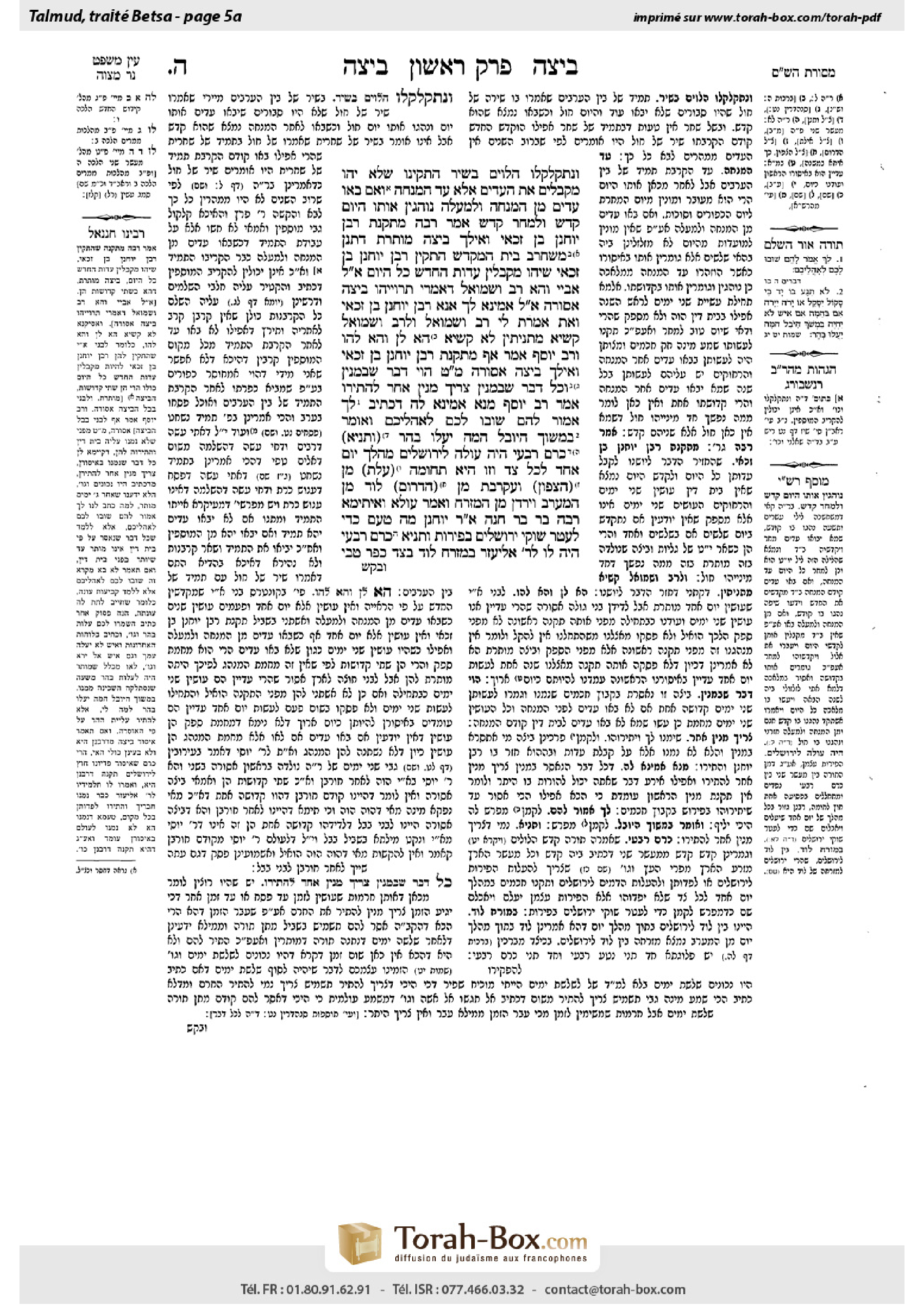
Beitzah 5a: Talmud study for Daf Yomi
Study the Talmud for Daf Yomi with scanned pages, Hebrew text, English translations from Sefaria and AI-generated French translations.
Passage selection and English or AI-generated French translation are available where the scan has annotations. Daf Study is independent of Torah-Box and Sefaria.
Browse Beitzah · ביצה · All tractatesBeitzah 5a text and translations
This page of Beitzah includes the Aramaic text, an English translation and an AI-generated French translation, alongside the scan above.
ביצה ה׳ א · Aramaic and Hebrew text
וְנִתְקַלְקְלוּ הַלְוִיִּם בַּשִּׁיר. הִתְקִינוּ שֶׁלֹּא יְהוּ מְקַבְּלִים אֶת הָעֵדִים אֶלָּא עַד הַמִּנְחָה.
וְאִם בָּאוּ עֵדִים מִן הַמִּנְחָה וּלְמַעְלָה, נוֹהֲגִין אוֹתוֹ הַיּוֹם קֹדֶשׁ, וּלְמָחָר קֹדֶשׁ.
אָמַר רַבָּה: מִתַּקָּנַת רַבָּן יוֹחָנָן בֶּן זַכַּאי וְאֵילָךְ, בֵּיצָה — מוּתֶּרֶת. דִּתְנַן: מִשֶּׁחָרַב בֵּית הַמִּקְדָּשׁ, הִתְקִין רַבָּן יוֹחָנָן בֶּן זַכַּאי שֶׁיְּהוּ מְקַבְּלִין עֵדוּת הַחֹדֶשׁ כׇּל הַיּוֹם.
אֲמַר לֵיהּ אַבָּיֵי, וְהָא רַב וּשְׁמוּאֵל דְּאָמְרִי תַּרְוַיְיהוּ: בֵּיצָה אֲסוּרָה! אֲמַר לֵיהּ: אָמֵינָא לָךְ אֲנָא רַבָּן יוֹחָנָן בֶּן זַכַּאי, וְאַתְּ אָמְרַתְּ לִי רַב וּשְׁמוּאֵל?!
וּלְרַב וּשְׁמוּאֵל קַשְׁיָא מַתְנִיתִין! לָא קַשְׁיָא: הָא לַן, וְהָא לְהוּ.
וְרַב יוֹסֵף אָמַר: אַף מִתַּקָּנַת רַבָּן יוֹחָנָן בֶּן זַכַּאי וְאֵילָךְ — בֵּיצָה אֲסוּרָה. מַאי טַעְמָא: הָוֵי דָּבָר שֶׁבְּמִנְיָן, וְכׇל דָּבָר שֶׁבְּמִנְיָן — צָרִיךְ מִנְיָן אַחֵר לְהַתִּירוֹ.
אָמַר רַב יוֹסֵף: מְנָא אָמֵינָא לַהּ, דִּכְתִיב: ״לֵךְ אֱמוֹר לָהֶם שׁוּבוּ לָכֶם לְאׇהֳלֵיכֶם״, וְאוֹמֵר: ״בִּמְשֹׁךְ הַיֹּבֵל הֵמָּה יַעֲלוּ בָהָר״.
(וְתַנְיָא:) כֶּרֶם רְבָעִי הָיָה עוֹלֶה לִירוּשָׁלַיִם מַהֲלַךְ יוֹם אֶחָד לְכׇל צַד. וְזוֹ הִיא תְּחוּמָהּ: (עֵלַת) מִן (הַצָּפוֹן), וְעַקְרַבַּת מִן (הַדָּרוֹם), לוֹד מִן הַמַּעֲרָב, וְיַרְדֵּן מִן הַמִּזְרָח.
וְאָמַר עוּלָּא, וְאִיתֵּימָא רַבָּה בַּר בַּר חָנָה אָמַר רַבִּי יוֹחָנָן: מָה טַעַם — כְּדֵי לְעַטֵּר שׁוּקֵי יְרוּשָׁלַיִם בְּפֵירוֹת.
וְתַנְיָא: כֶּרֶם רְבָעִי הָיָה לוֹ לְרַבִּי אֱלִיעֶזֶר בְּמִזְרַח לוֹד בְּצַד כְּפַר טָבִי,
Beitzah 5a · English translation
and the Levites erred in the song. They were unsure whether to sing the weekday song or that of Rosh HaShana during the sacrifice of the afternoon daily offering, as it was unclear whether or not witnesses would arrive that day. From that point on, the court instituted that they would accept witnesses who came to testify that that day was Rosh HaShana only up to minḥa time, i.e., when the daily afternoon offering was sacrificed. If witnesses had not arrived by then, they would declare Elul a thirty-day month and calculate the dates of the Festivals accordingly.
And if witnesses came from minḥa time onward, although the calculations for the dates of the Festivals began only from the following day, the people would nevertheless observe that day on which the witnesses arrived as sacred, and they would also observe the following day as sacred. On the second day, they observed Rosh HaShana in full, both by sacrificing its offerings as well as calculating the upcoming Festivals from that date. It is evident that the observance of two days of Rosh HaShana did not stem from uncertainty in the Diaspora as to when the Festival began. Rather, the Sages instituted that the two days of Rosh HaShana are one unit due to the inherent difficulty in determining the date of a Festival that is celebrated on the first of the month.
Rabba said: From the time of the ordinance of Rabban Yoḥanan ben Zakkai onward, an egg laid on one day of Rosh HaShana is permitted on the other. As we learned in a mishna (Rosh HaShana 30b): After the Temple was destroyed, Rabban Yoḥanan ben Zakkai instituted that the court should once again accept testimony to determine the start of the month all day. Since the concern about errors was no longer relevant, they reverted to the original custom. As the court was aware of the exact date based on the testimony of the witnesses, those in proximity to the court kept only one day of Rosh HaShana. Those who lived far from the court observed two days merely due to uncertainty, and as one of those days was certainly a weekday, an egg laid on the first day was permitted on the second.
Abaye said to him: But didn’t Rav and Shmuel both say that an egg is prohibited? Rabba said to him: Your question is out of place; I say to you a statement in the name of the distinguished tanna Rabban Yoḥanan ben Zakkai, and you say to me a ruling of the amora’im Rav and Shmuel?
The Gemara asks: And according to the opinion of Rav and Shmuel, isn’t it true that the mishna is difficult, as it indicates that the special status of Rosh HaShana has been revoked? The Gemara answers that this is not difficult: This ruling is for us, those who live outside of Eretz Yisrael, who have kept the ancient custom of observing two Festival days, and therefore Rosh HaShana is still considered one long day and constitute a single sanctity. Conversely, that ruling of the mishna is for them, the inhabitants of Eretz Yisrael. Since Rabban Yoḥanan ben Zakkai instituted that the court should once again accept testimony all day concerning the new moon, then even if circumstances dictate that Rosh HaShana would be observed for two days, each day is considered an independent sanctity.
And Rav Yosef said: Even from the time of the ordinance of Rabban Yoḥanan ben Zakkai onward, an egg remains prohibited. The Gemara explains: What is the reason for the opinion of Rav Yosef? It is that the decree prohibiting an egg laid on the first day of Rosh HaShana on the second day of Rosh HaShana is a matter that was established by a vote of the Sanhedrin, after that occasion on which the witnesses failed to arrive on time, and any matter that was established by a vote requires another vote to permit it. A new vote must be taken to render the prohibited item permitted, as the prohibition does not lapse even if the reason for the decree no longer applies.
Rav Yosef said: From where do I say my opinion? As it is written, after the Jews received the Torah: “Go, say to them: Return to your tents” (Deuteronomy 5:26), where “your tents” is referring to your wives. And it says, before the revelation at Sinai: “When the ram’s horn sounds long, they may come up to the mount” (Exodus 19:13). And it is stated: “Be ready for the third day, do not come near a woman” (Exodus 19:15). In other words, although the original prohibition served a particular purpose, in this case the giving of the Torah, it was nevertheless necessary to explicitly render the prohibition permitted.
And this idea was likewise taught in a baraita: The fruit of a fourth-year grapevine have the status of second-tithe fruits, and therefore their owner would ascend to Jerusalem and eat them there. If he was unable to do so, due to the distance involved or the weight of the load, he could redeem the fruits with money where he was, and later redeem that money for other fruits in Jerusalem. However, the Sages decreed that fruit from the environs of Jerusalem should not be redeemed, but that the owners should bring the fruit itself to Jerusalem. The environs of Jerusalem for this purpose were defined as a day’s walk in each direction. And this is its boundary: Eilat to the north; Akrabat to the south; Lod to the west; and the Jordan to the east.
And Ulla said, and some say Rabba bar bar Ḥana said that Rabbi Yoḥanan said: For what reason did the Sages institute this ordinance, that someone who lived near Jerusalem must bring his fruit there? In order to adorn the markets of Jerusalem with fruit, as this decree ensured that there was always an abundance of fruit in Jerusalem for people to eat.
And it was further taught in a baraita: Rabbi Eliezer ben Hyrcanus, a student of Rabban Yoḥanan ben Zakkai, had a fourth-year grapevine located between Lod and Jerusalem, to the east of Lod alongside the village of Tavi. The grapevine was within the environs of Jerusalem for the purpose of this halakha. Rabbi Eliezer could not bring the fruit to the Temple, as it had been destroyed,
Beitzah 5a · Traduction française (IA)
et les Lévites se sont trompés dans la prière. Ils étaient incertains de savoir s'ils devaient chanter la prière du jour ordinaire ou celle de Rosh HaShana lors de la sacrifice de l'offrande du soir quotidienne, car il était indéterminé si des témoins arriveraient ce jour-là. À partir de ce moment, la cour a institué qu'ils accepteraient les témoins qui viendraient témoigner que ce jour était Rosh HaShana uniquement jusqu'au moment de la prière du milieu du jour, c'est-à-dire lorsqu'on sacrifiait l'offrande du soir quotidienne. Si les témoins n'étaient pas arrivés à ce moment-là, ils déclaraient Elul comme un mois de trente jours et calculaient les dates des Fêtes en conséquence.
Et si des témoins arrivaient à partir du moment de la prière du milieu du jour, bien que les calculs des dates des Fêtes commencèrent seulement le lendemain, le peuple observait néanmoins le jour où les témoins étaient arrivés comme sacré, et ils observaient également le lendemain comme sacré. Le deuxième jour, ils observaient Rosh HaShana en entier, tant par le sacrifice de ses offrandes que par le calcul des Fêtes futures à partir de cette date. Il est évident que l'observation de deux jours de Rosh HaShana ne provenait pas d'une incertitude dans la Diaspora quant à la date de début de la Fête. Plutôt, les Sages ont institué que les deux jours de Rosh HaShana forment une unité en raison de la difficulté inhérente à déterminer la date d'une Fête célébrée le premier du mois.
Rabba dit : Depuis l'établissement de l'ordre de Rabban Yoḥanan ben Zakkai, un œuf pondu un jour de Rosh HaShana est permis le lendemain. Comme nous l'avons appris dans une mitsna (Rosh HaShana 30b) : Après la destruction du Temple, Rabban Yoḥanan ben Zakkai a institué que la cour devait à nouveau accepter les témoins pour déterminer le début du mois toute la journée. Puisque l'inquiétude concernant les erreurs n'était plus pertinente, ils ont rétabli la coutume originale. Puisque la cour savait la date exacte grâce aux témoins, ceux qui étaient proches de la cour observaient seulement un jour de Rosh HaShana. Ceux qui vivaient loin de la cour observaient deux jours uniquement en raison d'une incertitude, et comme l'un de ces jours était certainement un jour de semaine, un œuf pondu le premier jour était permis le second.
Abaye dit à lui : Mais n'ont pas dit Rav et Shmuel que l'œuf est interdit ? Rabba dit à lui : Votre question est inopportune ; je vous dis une déclaration en nom du tanna distingué Rabban Yoḥanan ben Zakkai, et vous me dites une décision des amoraïm Rav et Shmuel ?
La Guemara pose la question : Et selon l'opinion de Rav et Shmuel, n'est-ce pas vrai que la mitsna est difficile, car elle indique que le statut spécial de Rosh HaShana a été révoqué ? La Guemara répond que cela n'est pas difficile : Cette décision est pour nous, ceux qui vivons en dehors d'Eretz Yisrael, qui avons conservé la coutume ancienne d'observer deux jours de Fête, et donc Rosh HaShana est encore considéré comme un jour long et constitue une sanctité unique. À l'inverse, cette décision de la mitsna est pour eux, les habitants d'Eretz Yisrael. Puisque Rabban Yoḥanan ben Zakkai a institué que la cour devait à nouveau accepter les témoins toute la journée concernant la nouvelle lune, alors même que les circonstances indiquent que Rosh HaShana serait observé pendant deux jours, chaque jour est considéré comme une sanctité indépendante.
Et Rav Yosef dit : Même depuis l'établissement de l'ordre de Rabban Yoḥanan ben Zakkai, l'œuf reste interdit. La Guemara explique : Quelle est la raison de l'opinion de Rav Yosef ? C'est que le décret interdisant un œuf pondu le premier jour de Rosh HaShana sur le second jour de Rosh HaShana est une décision prise par un vote du Sanhédrin, après l'occasion où les témoins n'avaient pas arrivé à temps, et toute décision prise par un vote nécessite un autre vote pour la permettre. Un nouveau vote doit être tenu pour rendre l'objet interdit permis, car l'interdiction ne s'efface même si la raison du décret n'est plus pertinente.
Rav Yosef dit : D'où dis-je mon opinion ? Comme il est écrit, après que les Juifs ont reçu la Torah : « Allez, dites-leur : Retournez vers vos tentes » (Deutéronome 5:26), où « vos tentes » fait référence à vos épouses. Et il est dit, avant la révélation au Sinaï : « Quand le cor de la bête sonne longtemps, ils peuvent monter au mont » (Exode 19:13). Et il est dit : « Soyez prêts pour le troisième jour, ne vous approchez pas d'une femme » (Exode 19:15). En d'autres termes, bien que l'interdiction originale ait un but particulier, dans ce cas la donnée de la Torah, il a été nécessaire de rendre explicitement l'interdiction permise.
Et cette idée a également été enseignée dans une baraïta : Les fruits d'une vigne de quatrième année ont le statut des fruits de la dîme secondaire, et donc leur propriétaire montait à Jérusalem pour les manger là-bas. S'il ne pouvait pas le faire, en raison de la distance ou du poids du chargement, il pouvait racheter les fruits avec de l'argent là où il était, et plus tard racheter cet argent pour d'autres fruits à Jérusalem. Cependant, les Sages ont décrété que les fruits des environs de Jérusalem ne devaient pas être rachetés, mais que les propriétaires devaient apporter les fruits eux-mêmes à Jérusalem. Les environs de Jérusalem, pour cette raison, étaient définis comme une marche d'un jour dans chaque direction. Et c'est sa limite : Eilat au nord ; Akrabat au sud ; Lod à l'ouest ; et le Jourdain à l'est.
Et Ulla a dit, et certains disent que Rabba bar bar Ḥana a dit que Rabbi Yoḥanan a dit : Pour quelle raison les Sages ont institué cet ordonnance, que quelqu'un vivant près de Jérusalem doit apporter ses fruits là-bas ? Pour embellir les marchés de Jérusalem avec des fruits, car ce décret garantissait qu'il y avait toujours une abondance de fruits à Jérusalem pour que les gens puissent en manger.
Et cela a également été enseigné dans une baraïta : Rabbi Eliezer ben Hyrcanus, un disciple de Rabban Yoḥanan ben Zakkai, avait une vigne de quatrième année située entre Lod et Jérusalem, à l'est de Lod près du village de Tavi. La vigne était dans les environs de Jérusalem pour l'effet de cette halakha. Rabbi Eliezer ne pouvait pas apporter les fruits au Temple, car celui-ci avait été détruit,
Traduction française générée par IA à partir de l’édition anglaise de Sefaria. Vérifie toujours un passage avec le texte source.
Text from Sefaria: William Davidson Edition - Vocalized Aramaic (CC BY NC); William Davidson Edition - English (CC BY NC).